
Fuelling & performance nutrition for fencing
An evidence-based guide to fuelling the fencer's body. Fencing is a strange athletic shape: explosive lunges and footwork packed into short, intense bouts, but strung across a tournament day that can run many hours, with long stretches of waiting in between. That makes it less a story about draining glycogen and more one about steady all-day energy, hydration under the kit, and holding your focus. This covers daily carbohydrate, the pre-competition meal, how to graze between bouts, hydration and the heat trap of protective clothing, the honest truth about carbohydrate and concentration, and recovery across multi-day events.
Here's the short answer to "how should a fencer fuel?": treat it as an all-day energy problem rather than a glycogen-loading one: eat enough carbohydrate day to day, arrive well-fed and hydrated, then keep blood sugar and energy steady with small, familiar carbohydrate snacks and regular fluids between bouts, while managing the heat that builds under your kit and recovering well between competition days. Everything below is the detail behind that sentence: the numbers, where they come from, and why fencing deliberately isn't fuelled like an endurance sport.
Pair this with the fencing strength and conditioning guide for the training side: explosive lunge strength, reactive agility and the prehab that manages fencing's left–right asymmetry.
On this page
- What fencing actually demands
- Daily carbohydrate: the steady base
- Before competition: the pre-day meal and breakfast
- Across the day: grazing between bouts
- Hydration under the kit
- Focus, reaction and blood sugar: honestly
- Recovery and multi-day events
- Eating enough overall
- Common questions
- Takeaways
- References
A framing note before the numbers. Sports nutrition is well studied, but people differ enormously: body size, how hard and long you fence, fitness, the weather, gut tolerance, sex and health status all shift what's right on the day. So this is written as can, tends to and around, never as a guarantee, and every specific figure is a population-level guide drawn from published consensus rather than a personal prescription. It's general education rather than medical or dietary advice, and it isn't a personalised plan.
What fencing actually demands
Physiologically, fencing is a high-intensity intermittent sport. The actions themselves (the explosive lunge, the fleche, the rapid change of direction) draw on fast, largely anaerobic (alactic) energy for the short bursts, while the recovery between actions and bouts is fuelled aerobically. A review of fencing physiology covering all three weapons describes competition days lasting on the order of nine to eleven hours, made up of poule fights (a maximum of three minutes, or first to five hits) and direct-elimination bouts (first to fifteen hits, or up to three three-minute periods).[1] In direct-elimination fights, that same review reports fencers working at roughly 75–100% of maximum heart rate and around 75% of maximal oxygen uptake.[1] In elite épée fencers, roughly 80–90% of the energy across a simulated match came from the aerobic (oxidative) system, with the phosphagen system covering the explosive actions.[2]
Two features drive the fuelling strategy. First, no single bout lasts long enough to empty your glycogen: even a full direct-elimination bout is minutes of intermittent work, nowhere near an hour of continuous effort. Across an international tournament, bouts account for only about 18% of total competition time, with an effective fighting time of roughly 17 to 48 minutes.[3] So the total carbohydrate cost of fencing is moderate, and there's no endurance-style "wall" to fear inside a fight. Second, and less obvious, is the day: hours on your feet, long waits between bouts, and the constant low-grade drain of concentration and travel. The challenge isn't running out mid-bout. It's arriving at your fifth or eighth fight of the day still sharp, fed, hydrated and not flat.
Daily carbohydrate: the steady base
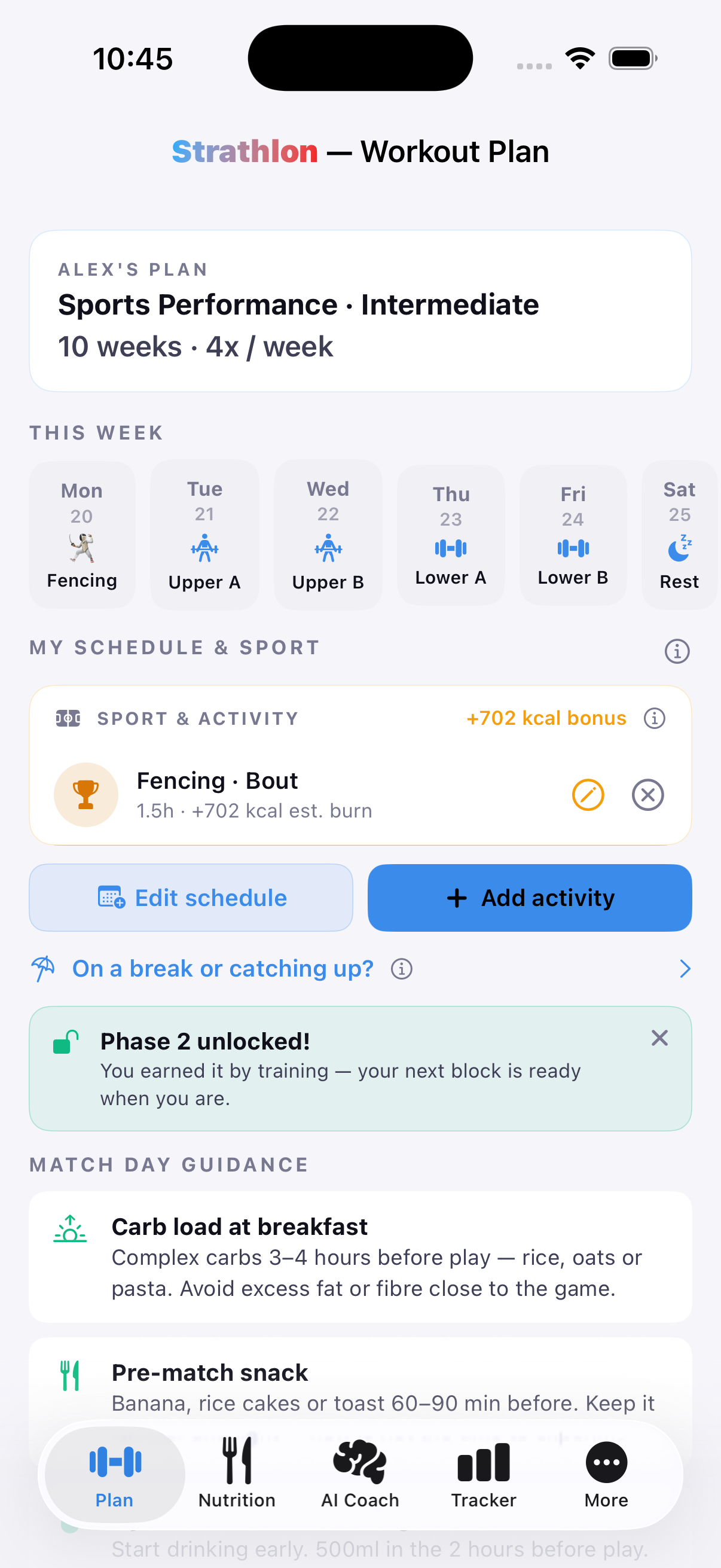
Good competition-day energy starts with your everyday eating, matched to how much you train. The joint position on nutrition and athletic performance from the Academy of Nutrition and Dietetics (United States), Dietitians of Canada (Canada) and the American College of Sports Medicine (ACSM, United States) sets daily carbohydrate targets scaled to training load: around 3–5 g of carbohydrate per kilogram of body weight per day for light, low-intensity or largely skill-based activity, and roughly 5–7 g/kg/day for a moderate programme of about an hour of exercise a day.[4] Because most fencers' training sits in the light-to-moderate band (footwork, drills, lessons, sparring and conditioning rather than hours of continuous cardio), those middle numbers are usually the right home base, nudged up on heavier training or competition days and down on rest days.
The practical point is that these dials should move with your week. A day with a hard conditioning session or a long competition warrants more carbohydrate than an easy technical day. You don't need the towering intakes an endurance athlete does (inflating your carbs to marathon levels just adds food you won't use), but chronically under-eating carbohydrate while training and competing hard is a reliable way to feel flat, recover poorly and lose sharpness late in the day.
Before competition: the pre-day meal and breakfast
Because fencing's demand is spread across a day rather than concentrated in one effort, the goal beforehand is simply to arrive with the tank comfortably full. Loading it to bursting adds nothing. In the day or two before, eat normally but make sure carbohydrate is well represented across your meals, and hydrate steadily. A formal carbohydrate load isn't necessary for an intermittent sport. A couple of solid, carb-inclusive days is plenty.
Competition breakfast is where it counts most. Eat a carbohydrate-based meal you know sits well (porridge, toast, cereal, a bagel, fruit), giving yourself enough time to digest before the first bout, and keep it lower in fat and fibre so it clears your stomach rather than lingering. The same position stand advises that choices high in fat, protein or fibre may need to be avoided to reduce the risk of gut trouble during the event.[4] For pre-event fuelling before exercise lasting over an hour it describes roughly 1–4 g of carbohydrate per kilogram of body weight, eaten around one to four hours beforehand[4], the larger amounts earlier when you have time, the smaller amounts closer to the start. The golden rule is to try nothing new: the food, the coffee, the timing should all be things you've already rehearsed at training or a lower-stakes event.
Across the day: grazing between bouts
This is where fencing fuelling really differs from endurance fuelling. You are not trying to hit a fixed grams-per-hour target during a continuous effort. You're trying to keep energy and blood sugar steady across a long, stop-start day. For endurance exercise of one to two-and-a-half hours (including "stop and start" sports), the same position stand suggests around 30–60 g of carbohydrate per hour. For brief exercise under 45 minutes it says carbohydrate is simply not needed, and for sustained high-intensity efforts of 45–75 minutes only small amounts, even a mouth rinse, are called for.[4] A fencing bout falls firmly in that "little or none needed mid-effort" zone, so the fuelling happens in the gaps between bouts.
In practice that means grazing: small, easily digested carbohydrate snacks and regular fluids between bouts, so you never swing between ravenous and over-full. A rough menu of what tends to work well:
| Situation | What tends to work | Why |
|---|---|---|
| Long wait between bouts | Banana, cereal/granola bar, a few crackers or pretzels, dried fruit | Small carbohydrate top-ups keep blood sugar and energy steady without a heavy stomach. |
| Hot or very long day | Carbohydrate-electrolyte sports drink, sipped | Covers fuel, fluid and sodium at once when you're sweating more. |
| Just before a bout | A few sips of fluid and little or no solid food | Avoids a full stomach during explosive footwork. The bout is too short to need fuelling. |
| A real gap (an hour or more) | A light sandwich, wrap or rice-based snack | A slightly bigger, familiar carbohydrate meal when there's time to digest before the next fight. |
Two principles hold it together. Familiar and easy to digest beats optimal-on-paper every time. Competition day is not for experiments. And little and often beats one big meal that leaves you bloated when you're called to the piste. Keep your snacks and drink in your kit bag so topping up is effortless between bouts rather than a scramble.
Hydration under the kit
Hydration is quietly one of fencing's biggest fuelling levers, precisely because it's easy to underrate. The movement can look modest between bursts, but fencers compete in full-body protective clothing (jacket, plastron, mask and breeches), and that clothing limits all the heat-loss mechanisms available to a fencer.[5] In a simulated épée competition of seven poule and seven direct-elimination fights, gastrointestinal temperature averaged 38.7°C after direct-elimination fights (against 38.1°C after poule fights), with the temperature inside the mask climbing about 1.1°C across the direct-elimination rounds: a hot micro-climate held against the skin.[5] In other words, you can sweat considerably more than the sport's stop-start rhythm suggests, and dehydration creeps up over hours rather than announcing itself.
There's no universal millilitres-per-hour number, because sweat rates vary enormously between people and with heat, humidity and how hard you fence. The long-standing guidance from the American College of Sports Medicine (ACSM, United States) position stand on exercise and fluid replacement is to drink during exercise so as to prevent excessive dehydration (defined as more than about 2% of body weight lost as water) rather than to a rigid schedule.[6] Fluid deficits beyond that 2% can compromise cognitive function and aerobic performance, particularly in hot weather, and dehydration raises the perception of effort.[4] The most reliable way to learn your own need is to weigh yourself before and after a hard session or competition[6]: in the absence of other things shifting body mass, a kilogram lost represents roughly a litre of sweat.[4]
Practically: keep water or a drink in your kit and sip steadily between bouts rather than waiting until you're thirsty. On hot or long days, a drink carrying some sodium (electrolytes) helps you hold onto ingested fluid[4] and can double as a light carbohydrate source. Drinks containing electrolytes and carbohydrate can offer benefits over water alone in some circumstances.[6] And don't overcorrect the other way: drinking in excess of your sweat and urine losses is the primary cause of hyponatraemia, where blood sodium falls below 135 mmol/L.[4]
Focus, reaction and blood sugar: honestly
Fencing is often called physical chess, and the mental side (reading distance, timing, holding your nerve on the final hit) is where a long day quietly erodes you. It's tempting to reach for the story that carbohydrate "sharpens your reactions." Here's the honest version. The brain depends on glucose as its main source of energy[7], and letting hydration drop is a documented drag on thinking: fluid deficits beyond about 2% of body weight can compromise cognitive function, especially in the heat.[4] So avoiding a slump is real and worth doing.
But the evidence stops short of "carbs make you quicker." A 2023 systematic review and meta-analysis of ten randomised trials in athletes found that carbohydrate drinks taken before or during exercise were not significantly effective at reducing the post-exercise decline in executive function, whether measured by accuracy, reaction time or test score.[8] The fair reading is that carbohydrate mostly works by removing a handicap: keeping you fuelled, hydrated and steady so fatigue doesn't dull your fencing, rather than adding an edge you can drink your way to. So fuel and hydrate to stay level across the day. Don't expect a snack to buy you a faster hand.
Recovery and multi-day events
After the last bout, two jobs matter: refill what you used and rehydrate. For a single competition day with nothing tomorrow, there's no need to rush. A normal balanced meal and steady drinking over the evening restores you comfortably. The urgency ramps up only for multi-day events and consecutive competition days, where you fence again in the morning.
When the turnaround is short, start recovery promptly with a snack or meal combining carbohydrate and some protein within roughly the first hour, then keep rehydrating to replace your sweat losses. For speedy refuelling (less than eight hours between two fuel-demanding sessions), the joint position stand describes carbohydrate intakes of around 1.0–1.2 g per kilogram of body weight per hour, starting in early recovery and continuing for the first four to six hours, plus early intake of high-quality protein at roughly 0.25–0.3 g per kilogram to provide amino acids for muscle repair.[4] Across the whole day, the same stand puts dietary protein needs at around 1.2–2.0 g per kilogram of body weight per day, spread over meals.[4] Our eating-for-results guide covers the broader nutrition picture in depth.
Eating enough overall
One honest caution. Some fencers, chasing leanness or squeezed by long travel days and nerves, end up eating too little overall to support their training and competition. Sustained under-eating (low energy availability, where too little energy is left after exercise to run the body's basic functions) is grouped by the International Olympic Committee (IOC, international) under Relative Energy Deficiency in Sport (REDs). Its 2023 consensus statement defines REDs as a syndrome of impaired physiological and/or psychological functioning experienced by female and male athletes, with detrimental outcomes that include decreases in energy metabolism, reproductive function, musculoskeletal health, immunity, glycogen synthesis and cardiovascular and haematological health, which together can lead to impaired well-being, increased injury risk and decreased sports performance.[9] Warning signs include recurrent illness or stress fractures, stalled progress despite hard work, poor sleep and (in women) missing periods. If they appear, the answer is usually to eat more rather than train harder, and to seek help from a sports physician or dietitian. Fuelling isn't only a competition-day concern: turning up under-fed day after day is the slow route to injury and burnout.
Common questions
How should a fencer fuel for a competition day?
Treat it as an all-day energy problem. Glycogen-loading isn't the concern here. Arrive well-fed and well-hydrated after a familiar carbohydrate-based breakfast, then graze across the day: small, easily digested carbohydrate snacks and regular sips of fluid between bouts to keep blood sugar and energy steady through hours of waiting and short, explosive fights. Any single bout is too short to need fuelling mid-fight, so the skill is topping up in the gaps and managing the heat that builds under your kit. Practise the plan at training or lower-stakes events first. Competition day is not the time for new foods.
Do fencers need to carb-load like marathon runners?
No. Carbohydrate loading is aimed at preparation for events lasting more than about 90 minutes of sustained or intermittent exercise, where muscles genuinely drain their glycogen.[4] Fencing packs a modest amount of actual fighting (an effective fight time of roughly 17 to 48 minutes) into a nine-to-eleven-hour day,[3] so total glycogen demand is moderate and a deliberate load isn't needed. What matters far more is simply eating enough carbohydrate in the day or two beforehand as part of normal meals, and turning up with a full breakfast rather than under-fuelled.
What should I eat and drink between bouts?
Favour small amounts of familiar, easy-to-digest carbohydrate you've tested before (a banana, a cereal or granola bar, a few crackers or pretzels, some dried fruit), plus steady fluids rather than one big meal that sits heavily before you fence. The aim is to keep blood sugar stable and avoid both a hungry slump and an over-full stomach. On a hot day or a long one, a carbohydrate-electrolyte sports drink can cover fuel and fluid at once. Keep water or drink in your kit bag and sip regularly rather than waiting until you feel thirsty.
How much should I drink during a fencing competition?
There is no single number, because sweat rates vary hugely between people and conditions, and fencing's full-body protective kit traps heat, so you can sweat more than the modest movement suggests.[5] The long-standing sports-medicine guidance is to drink enough to keep body-mass loss under about 2% across the day, rather than to a fixed schedule.[6] The most reliable way to find your own need is to weigh yourself before and after a hard session[6]: each kilogram lost is roughly a litre of sweat.[4] Sip steadily between bouts. Don't wait for thirst, and don't over-drink either.
Will eating carbohydrate make my reactions sharper?
Not directly: it's more about avoiding a decline than adding an edge. The brain depends on glucose as its main source of energy,[7] and letting hydration drop across a long day is a documented drag on thinking: fluid deficits beyond about 2% of body weight can compromise cognitive function, especially in the heat.[4] But being honest about the evidence: a 2023 systematic review and meta-analysis of ten randomised trials in athletes found that carbohydrate drinks taken before or during exercise were not significantly effective at reducing the post-exercise decline in executive function, whether measured by accuracy, reaction time or test score.[8] So carbohydrate is best understood as removing a handicap: keeping you fuelled, hydrated and steady so fatigue doesn't dull your fencing, rather than a reaction-time booster you can drink your way to.
How should I recover between competition days?
After the last bout, start recovery with a snack or meal combining carbohydrate and some protein within roughly the first hour, then rehydrate to replace what you sweated out. This matters most across multi-day events, where you fence again tomorrow. If the turnaround is short, the joint position stand on nutrition and athletic performance describes carbohydrate intakes of around 1.0 to 1.2 g per kilogram of body weight per hour in the first four to six hours, plus roughly 0.25 to 0.3 g per kilogram of high-quality protein.[4] With a full day or more between events, you simply don't need to rush. Normal balanced meals refill your stores comfortably.
Takeaways
- The bout isn't the challenge. The day is. Fencing is explosive and intermittent, and bouts make up only about 18% of a tournament day (an effective fight time of roughly 17 to 48 minutes[3]), so the real challenge is steady energy, hydration and focus across nine to eleven hours.[1]
- Build a steady base. Match everyday carbohydrate to training: roughly 3–5 g/kg on lighter, skill-based days, around 5–7 g/kg for a moderate programme of about an hour a day[4], and move the dial with your week. No endurance-style loading needed.
- Arrive full. Not stuffed. Eat a familiar carbohydrate breakfast (about 1–4 g/kg, one to four hours before), lower in fat and fibre[4]. Try nothing new on competition day.
- Graze between bouts. Small, easy-to-digest carbohydrate snacks and regular sips of fluid in the gaps. Efforts under 45 minutes need no carbohydrate at all mid-effort.[4]
- Respect the kit. Protective clothing limits every heat-loss route, and core temperature averaged 38.7°C after direct-elimination fights[5], so hydration matters more than the movement suggests: aim to keep body-mass loss under about 2%[6] and learn your sweat rate.
- Fuel to stay level. Sharpening isn't the job. Carbohydrate helps you avoid a focus-sapping slump, but a meta-analysis of ten trials found carbohydrate drinks did not significantly blunt the post-exercise drop in executive function or reaction time[8]. Treat it as removing a handicap.
- Recover for tomorrow. Rush carbohydrate-plus-protein (~1.0–1.2 g/kg/h carbs, ~0.25–0.3 g/kg protein) only when you fence again soon. Otherwise normal meals suffice. Aim ~1.2–2.0 g/kg/day protein overall.[4]
- Eat enough, always. Chronic under-fuelling (low energy availability, REDs) harms metabolism, reproductive function, musculoskeletal health, immunity and performance, in men and women alike.[9] When in doubt, eat more.
If you remember one thing, make it this: the fencers who fuel well aren't the ones with the cleverest supplements. They're the ones who show up fed and hydrated, top up sensibly through the day, and eat enough overall to keep training. Strathlon's job is to keep that base honest by adjusting your targets around the sessions you actually log, so the everyday fuelling that underpins every competition is one less thing to guess at.
References
Sources for the specific figures on this page. Where a number reflects established consensus rather than a single trial, the citation is to the relevant expert body’s position stand, with the country or region that body belongs to named: guidance is written by national and regional organisations, and no one country’s advice is universal. The fencing-specific measurements here come from British-led research (Middlesex, Hertfordshire and Coventry universities in the United Kingdom), an Italian review and a South Korean laboratory study; the general fuelling and hydration numbers come from a joint United States and Canadian position stand and a United States position stand; and the under-fuelling material comes from the International Olympic Committee. No source cited here is produced or funded by a food or drink company.
- Oates LW, Price MJ, Bottoms LM. Physiological demands of fencing: a narrative review. Journal of Elite Sport Performance. 2023;3. doi:10.54080/JPBK7315: Narrative review covering épée, foil and sabre, by researchers at Middlesex University, Coventry University and the University of Hertfordshire (United Kingdom). Source of the 9–11-hour competition day, the poule and direct-elimination formats, and the 75–100% of maximum heart rate and ~75% of maximal oxygen uptake figures for direct-elimination fights. https://uhra.herts.ac.uk/id/eprint/10363/2/73815-physiological-demands-of-fencing-a-narrative-review.pdf
- Yang WH, Park JH, Shin YC, Kim J. Physiological profiling and energy system contributions during simulated epée matches in elite fencers. International Journal of Sports Physiology and Performance. 2022;17(6):943–950: Ten elite male épée fencers in simulated matches; oxidative (aerobic) contribution of 80–90%, exceeding both the phosphagen and glycolytic systems. https://pubmed.ncbi.nlm.nih.gov/35290960/
- Roi GS, Bianchedi D. The science of fencing: implications for performance and injury prevention. Sports Medicine. 2008;38(6):465–481: Review by Italian sports-medicine researchers. Source of the statement that an international tournament may last between 9 and 11 hours, that bouts represent only 18% of total competition time, and that effective fight time is between 17 and 48 minutes. https://pubmed.ncbi.nlm.nih.gov/18489194/
- Thomas DT, Erdman KA, Burke LM. Position of the Academy of Nutrition and Dietetics, Dietitians of Canada, and the American College of Sports Medicine: nutrition and athletic performance. Journal of the Academy of Nutrition and Dietetics. 2016;116(3):501–528. (Published jointly in Medicine & Science in Sports & Exercise. 2016;48(3):543–568.) Joint position stand of the Academy of Nutrition and Dietetics (United States), Dietitians of Canada (Canada) and the American College of Sports Medicine (ACSM, United States). Source of the 3–5 g/kg/day light and 5–7 g/kg/day moderate carbohydrate targets, the 1–4 g/kg pre-event meal eaten 1–4 hours before, the advice to avoid high-fat/protein/fibre choices pre-event, the 30–60 g/h during-exercise range for 1–2.5-hour efforts including “stop and start” sports, the “not needed” verdict below 45 minutes and small-amounts/mouth-rinse advice for 45–75 minutes, the carbohydrate-loading indication for events over 90 minutes of sustained or intermittent exercise, the 1.0–1.2 g/kg/h speedy-refuelling rate and 0.25–0.3 g/kg recovery protein, the 1.2–2.0 g/kg/day protein range, the >2% body-weight fluid deficit and perceived-effort statements, the 1 kg body mass ≈ 1 L sweat conversion, the role of dietary sodium in retaining ingested fluid, and the over-drinking cause of hyponatraemia. https://pubmed.ncbi.nlm.nih.gov/26920240/
- Oates LW, Price MJ, Bottoms LM. Thermoregulatory demands of épée fencing during competition. Temperature. 2024;11(4):373–386: Seven well-trained fencers in a simulated competition of seven poule and seven direct-elimination fights. Gastrointestinal temperature 38.7 ± 0.3°C after direct-elimination fights versus 38.1 ± 0.4°C after poule fights, mask temperature rising ~1.1°C across the direct-elimination rounds, and the statement that fencing’s protective clothing limits all heat-loss mechanisms available to the fencer. https://pubmed.ncbi.nlm.nih.gov/39583904/
- Sawka MN, Burke LM, Eichner ER, Maughan RJ, Montain SJ, Stachenfeld NS. American College of Sports Medicine position stand: exercise and fluid replacement. Medicine & Science in Sports & Exercise. 2007;39(2):377–390: Position stand of the American College of Sports Medicine (ACSM, United States). Source of the goal of preventing excessive dehydration (>2% body weight loss from water deficit), the recommendation to estimate individual sweat rates by weighing before and after exercise, and the note that beverages with electrolytes and carbohydrate can benefit over water alone in some circumstances. https://pubmed.ncbi.nlm.nih.gov/17277604/
- Mergenthaler P, Lindauer U, Dienel GA, Meisel A. Sugar for the brain: the role of glucose in physiological and pathological brain function. Trends in Neurosciences. 2013;36(10):587–597: Review stating that the mammalian brain depends upon glucose as its main source of energy. https://pubmed.ncbi.nlm.nih.gov/23968694/
- Yang J, Han Q, Liu Q, Li T, Shao Y, Sui X, Wang Q. Effects of carbohydrate drinks ingestion on executive function in athletes: a systematic review and meta-analysis. Frontiers in Psychology. 2023;14:1183460: Ten randomised controlled trials in athletes (including fencers). Carbohydrate intake before or during exercise was not significantly effective at reducing the post-exercise decline in executive function, measured as accuracy, reaction time or score. https://pmc.ncbi.nlm.nih.gov/articles/PMC10448191/
- Mountjoy M, Ackerman KE, Bailey DM, Burke LM, Constantini N, Hackney AC, et al. 2023 International Olympic Committee’s (IOC) consensus statement on Relative Energy Deficiency in Sport (REDs). British Journal of Sports Medicine. 2023;57(17):1073–1097: Consensus statement of the International Olympic Committee (IOC, international). Defines REDs as a syndrome of impaired physiological and/or psychological functioning in female and male athletes, with outcomes including decreased energy metabolism, reproductive function, musculoskeletal health, immunity, glycogen synthesis and cardiovascular and haematological health, leading to impaired well-being, increased injury risk and decreased sports performance. https://pubmed.ncbi.nlm.nih.gov/37752011/
This is general educational information rather than medical, dietary or coaching advice. The sports-nutrition figures here are drawn from established consensus and are framed as population-level guides; individual needs vary widely with body size, workload, conditions, gut tolerance and health, and are best personalised with a qualified professional. Anyone with a health condition, a history of disordered eating, or who is pregnant or postpartum, or who suspects under-fuelling, stress fractures, menstrual disruption or RED-S, should consult a sports physician or registered dietitian before making changes. See our Terms for more.
← All guides · Fencing strength & conditioning · Eating for results · Understanding your stats · Home