
Fuelling & performance nutrition for futsal
An evidence-based guide to fuelling the futsal player's body. Futsal is one of the most intensity-dense sports there is: five-a-side, indoors, on a hard court, with rolling substitutions and near-continuous fast play. That combination burns through your fastest fuel (muscle glycogen) quickly, even though a match is short in actual playing time. This covers why futsal is so glycogen-hungry, your daily carbohydrate base, the pre-match meal, what to do on the bench and during play, hydration on a hot indoor court, recovery between matches on a tournament day, and the quietly common problem of under-fuelling. Practical, honest, and grounded in established sports-nutrition consensus.
Here's the short answer to "how should a futsal player fuel?": show up with full glycogen from a genuinely carbohydrate-rich week and a familiar pre-match meal, stay hydrated using the frequent breaks that rolling substitutions give you, and on tournament days make refuelling and rehydrating between matches your main job: you do not need marathon-style carb loading. Keeping the tank full and eating enough overall is what actually counts. Everything below is the detail behind that sentence: the numbers, where they come from, and how to make them work for your body rather than someone else's.
Pair this with the futsal strength and conditioning guide for the training side: explosive power, change-of-direction work and the prehab that lowers futsal's ankle, knee and hamstring injury risk.
On this page
A framing note before the numbers. Sports nutrition is well studied, but people differ enormously: body size, playing role and minutes, fitness, how warm the hall is, gut tolerance, sex and health status all shift what's right on the day. So this is written as can, tends to and around, never as a guarantee, and every specific figure is a population-level guide drawn from published consensus rather than a personal prescription. It's also worth being honest up front that futsal has less sport-specific nutrition research than, say, marathon running, so several numbers here are drawn from the wider football and team-sport literature and applied with judgement. This is general education rather than medical or dietary advice, and it isn't a personalised plan.
Why futsal drains glycogen fast
Your body runs on a blend of two main fuels: fat and carbohydrate. Fat is almost limitless even in a lean player, but it burns slowly. Carbohydrate (stored as glycogen in muscle and liver, plus glucose in the blood) burns fast, and it's the fuel that powers sprinting, accelerating, decelerating and changing direction at speed. The catch is that carbohydrate stores are small, and futsal spends them at an unusual rate.
Look at what a futsal match actually asks of the body. A game is two 20-minute halves of stopped-clock time (the clock pauses whenever the ball is out of play) with a half-time break of up to 15 minutes and unlimited rolling substitutions, so the real time on court is short but nearly every second of it is intense. Match-analysis research on elite and sub-elite players finds average heart rates around 90% of maximum (roughly 174 beats per minute), with players spending about 83% of the match above 85% of maximum heart rate and close to half of playing time above 80% of VO2max. Blood lactate sits around 4–5 mmol/L, a marker of heavy anaerobic work. Players cover somewhere in the region of 3–4.5 km in a match despite the small court, including on the order of 26 sprints (roughly one every 90 seconds) plus dozens of hard accelerations and decelerations. In other words, futsal is a string of repeated, near-maximal efforts with very little true rest.
That intensity is exactly what taxes glycogen. In the closest well-studied cousin (outdoor football) a classic study measured muscle glycogen falling from around 96 mmol/kg before a match to about 32 at half-time and 9 afterwards, i.e. largely emptied, with the most depleted players covering less ground and sprinting less in the second half. Futsal is shorter in playing minutes, but its intensity is higher and more relentless, so the same lesson applies: the fuel that limits you is glycogen, and the whole fuelling strategy below exists to make sure you start with plenty and don't run dry when it matters: late in a match, or in the later matches of a tournament.
Daily carbohydrate: the base
Match-day fuelling only works if you show up with the tank reasonably full, and that comes from your everyday carbohydrate intake, matched to your training. The joint position on nutrition and athletic performance from the Academy of Nutrition and Dietetics, Dietitians of Canada and the American College of Sports Medicine sets out daily carbohydrate targets scaled to training load: around 5–7 g of carbohydrate per kilogram of body weight per day for a general or moderate program (about an hour a day), roughly 6–10 g/kg/day for the moderate-to-high loads of a serious player training and playing most days, and up to 8–12 g/kg/day on the very heaviest days. Futsal-specific commentary lands in the same territory, citing roughly 5–8 g/kg/day (from the International Society of Sports Nutrition) up to about 6–10 g/kg/day for the demands of the sport.
Here's the honest, futsal-specific catch: players frequently don't hit these numbers. A study of professional futsal players measured average carbohydrate intake at about 4.1 g/kg/day, below the recommended range, with roughly 45% of players eating under 4 g/kg/day, while protein intake was, if anything, slightly high. The pattern is common across the game: plenty of meat and protein, but rarely enough carbohydrate to refill glycogen between demanding sessions. If you take one thing from this guide, let it be that for most futsal players the biggest available gain is simply eating more carbohydrate (rice, potatoes, pasta, bread, oats, fruit) especially around your hardest days.
Before the match: the pre-match meal
Before a match, a carbohydrate-focused top-up helps ensure liver and muscle glycogen are high at kick-off. Position stands describe a pre-exercise meal or snack of roughly 1–4 g of carbohydrate per kilogram of body weight, eaten around one to four hours beforehand: the larger amounts earlier when you have time to digest, the smaller amounts closer to the start. For a 75 kg player, that's very roughly a substantial carbohydrate meal (say, rice or pasta with a lean protein) three hours out, perhaps topped up with a banana or a slice of toast closer to the whistle.
Hitting the number is easy. Keeping it down while you sprint and turn is the trick. Favour familiar, lower-fibre and lower-fat carbohydrate you've rehearsed (porridge, toast, a banana, a bagel, rice) because fibre and fat slow digestion and can sit heavily during the stop-start sprints and sudden changes of direction that define futsal. The golden rule of match day is to try nothing new: the meal, the coffee, the timing should all be things your gut has already met before a hard training session.
During the match and on the bench
For a single, well-fuelled match you usually don't need to eat during play: your existing glycogen plus the pre-match meal cover a 40-minute-of-play game. What matters more in the moment is fluid, and futsal hands you a natural way to take it on: rolling substitutions mean you rotate off frequently, so the habit to build is simply to sip water or a sports drink every time you come off, rather than gulping a lot at half-time.
Carbohydrate during play still has a role in two situations. In the later stages of a hard match, or across a long tournament day, a carbohydrate-electrolyte drink can help maintain blood glucose and (just as importantly for a decision-heavy sport) concentration. The wider position-stand guidance for efforts of roughly one to two-and-a-half hours is about 30–60 g of carbohydrate per hour, which for futsal you'd meet at the lower, drink-based end rather than by forcing down gels. There's also good evidence that even a carbohydrate mouth rinse (swilling a sugary drink and spitting it out) can improve short, high-intensity performance when you've little in the tank, which is a handy trick late in a tight game.
Hydration on an indoor court
It's easy to assume that "indoor" means "cool", but futsal halls are often warm, humid and poorly ventilated, and the work rate is ferocious, so sweat losses can be higher than players expect. Significant dehydration (losing more than roughly 2% of body mass as sweat) is associated with rising perceived effort, higher heart rate and falling performance, and in a sport built on repeated sprints and sharp decisions that shows up fast. The long-standing sports-medicine guidance is to drink enough to keep body-mass loss under about 2% over the session, rather than to a rigid schedule.
There's no universal millilitres-per-hour number, because sweat rates vary enormously between people and with the heat of the hall. The most reliable way to find your own is to weigh yourself before and after a representative match or training session: each kilogram lost is roughly a litre of sweat, which tells you how much you're under-replacing. Use the frequent bench time that rolling substitutions give you to drink little and often, rather than trying to catch up all at once.
Replacing some sodium (electrolytes) alongside fluid helps you hold onto what you drink and can reduce cramping in salty sweaters: conveniently, the same sports drinks that carry a little carbohydrate usually carry sodium too. This matters most after a match when another game is coming: team-sport recovery guidance describes replacing about 150% of the fluid lost (so roughly 1.5 litres for every kilogram of body mass dropped) over the following few hours, with sodium in it, to be properly rehydrated before you play again.
Recovery and the tournament-day problem
Recovery is where futsal fuelling gets genuinely distinctive, because the sport is so often played as multiple matches in a single day or across a weekend tournament. How urgently you need to refuel depends entirely on when you next play.
- Fast turnaround (another match in a few hours, or later the same day). Here speed matters. Team-sport recovery research describes taking in carbohydrate at around 1.0–1.2 g per kilogram of body weight per hour in the first few hours after a match to refill glycogen as quickly as possible, and starting soon: the muscle's glycogen-storing enzymes are most active right after you stop, and delaying carbohydrate by a couple of hours has been shown to leave glycogen stores markedly lower later on. Pair it with some protein (on the order of 0.3 g/kg per feed, roughly 20–40 g) to support repair, and rehydrate with sodium-containing fluid as above. Think easy-to-eat carbohydrate you'll actually manage courtside: a banana, a cereal bar, a sandwich, a carbohydrate-electrolyte drink, a rice or pasta box between games.
- Normal turnaround (a day or more until the next match). There's no need to rush. Simply hitting your usual daily carbohydrate and protein targets across normal meals refills stores comfortably before you need them. The "eat within 30 minutes or lose your gains" urgency is real only when the next match is genuinely close.
- References
Over the whole day, futsal players are generally well served by around 1.5–2.0 g of protein per kilogram of body weight (the repeated sprinting, decelerating and cutting does real muscle work) spread across meals rather than piled into one, alongside the carbohydrate that so many players under-eat. The eating-for-results guide covers the broader nutrition picture in depth.
Eating enough: low energy availability
The most serious nutrition mistake in futsal isn't a poor drink choice: it's chronically eating too little to support the training and matches. The sport is intensity-dense and often layered on top of other football, gym work and busy lives, so it's easy to slip into low energy availability: not leaving enough energy, after exercise is paid for, to run the body's basic functions.
Sports scientists quantify this as energy availability: roughly, energy eaten minus energy burned in exercise, expressed per kilogram of fat-free (lean) mass. Research associates falling below about 30 kcal per kg of fat-free mass per day with a cascade of problems, while something nearer 45 kcal/kg FFM/day is considered healthy for an active body. This is not a hypothetical for futsal: the same study that found players under-eating carbohydrate also measured average energy availability around 25.7 kcal/kg FFM/day: under the healthy mark and near the low-availability threshold. Sustained low energy availability is the root of what the International Olympic Committee calls Relative Energy Deficiency in Sport (RED-S): a syndrome affecting both men and women that can impair bone health, hormones, immunity, metabolism, mood and (the irony every player should note) performance itself.
The warning signs are worth knowing: nagging or recurrent stress fractures and bony injuries, frequent illness, stalled or declining performance despite hard training, poor sleep, low mood, and (in women) missing or irregular periods. None of these are things to push through. If they appear, the answer is usually to eat more rather than train harder, and to seek help from a sports physician or dietitian. For a sport where so many players already run their carbohydrate too low, "eat enough" is not a soft message: it's the foundation everything else sits on.
Common questions
How should a futsal player fuel for a match?
Futsal is a very high-intensity, glycogen-hungry sport played in short bursts, so the priority is turning up with your muscle glycogen stores well filled. That means enough carbohydrate across the day-to-day week: sports-nutrition position stands describe roughly 5–7 g of carbohydrate per kilogram of body weight per day for a moderate program, rising to about 6–10 g/kg on heavier training days, plus a familiar, carbohydrate-focused meal of around 1–4 g/kg eaten one to four hours before you play. Because a single match is short in actual playing time (two 20-minute stopped-clock halves), you do not need marathon-style carb loading. You need to start full, stay hydrated, and eat enough overall. Across a tournament day with several matches, topping up carbohydrate and fluid between games becomes the main job.
Do I need to carb-load before futsal?
For a single match, no. Full carbohydrate loading (eating around 10–12 g per kilogram of body weight per day for a day or two beforehand) is aimed at continuous endurance events lasting longer than about 90 minutes, and a futsal match is far shorter than that in actual playing time. A normal-to-high carbohydrate day or two before you play is enough to fill your glycogen stores. The exception worth planning for is a tournament: when you have multiple matches in a day or across a weekend, keeping daily carbohydrate high (around 6–10 g/kg/day) helps you refill between games and hold your intensity into the later matches.
Should I eat or drink anything during a futsal match?
For a single, well-fuelled match you usually don't need to eat during play: your existing glycogen and pre-match meal cover the effort. What helps is fluid: sip water or a sports drink whenever you rotate off, because rolling substitutions give you frequent short breaks. In the later stages of a hard match, or across a tournament day, a carbohydrate-electrolyte drink providing modest carbohydrate (position stands describe around 30–60 g per hour for efforts of roughly one to two-and-a-half hours) can help maintain blood glucose and concentration. Even a carbohydrate mouth rinse has been shown to help short, high-intensity efforts. Practise anything you plan to use in training first.
How do I recover between matches on a tournament day?
When the next match is only hours away, recovery becomes urgent and carbohydrate is the priority. Team-sport recovery research describes taking in carbohydrate at around 1.0–1.2 g per kilogram of body weight per hour in the first few hours after a game to refill glycogen quickly, ideally starting soon after you finish: delaying carbohydrate for a couple of hours has been shown to leave glycogen stores meaningfully lower. Add some protein (roughly 0.3 g/kg, or on the order of 20–40 g) to support repair, and rehydrate by replacing more fluid than you lost, with sodium in it. If you have a full day or more before the next match, you don't need to rush: normal meals hitting your daily carbohydrate and protein targets will refill you comfortably.
How much should I drink playing indoor futsal?
There is no single number, because sweat rates vary widely between people and with how warm and humid the hall is, and indoor courts are often poorly ventilated, so losses can be higher than players expect. The long-standing sports-medicine guidance is to drink enough to keep body-mass loss under about 2% over the session, rather than to a fixed schedule, and to use the frequent breaks from rolling substitutions to sip. The most reliable way to find your own number is to weigh yourself before and after a match: each kilogram lost is roughly a litre of sweat. Rehydrate afterwards with more fluid than you lost (around 150% of the deficit) and include sodium, especially before another match the same day.
Can eating too little carbohydrate hurt my futsal?
Yes, and it is common. Surveys of futsal players have found average carbohydrate intakes of around 4 g per kilogram of body weight per day: below the roughly 5–8 g/kg or more that governing-body and society guidance suggests for the sport, with many players eating even less. Because futsal is so intensity-heavy, low glycogen tends to show up as fading legs, slower sprints and poorer decisions late in matches. Chronically under-eating carbohydrate and energy overall also raises the risk of low energy availability, which can harm bone, hormones, immunity and performance. For most futsal players, the single biggest fuelling win is simply eating more carbohydrate. No fancier gel replaces that.
Takeaways
- Futsal is glycogen-hungry. The clock is short but the intensity is extreme (around 90% of max heart rate for most of the match) so carbohydrate is the fuel that limits you.
- Build the base daily. Match everyday carbohydrate to load: roughly 5–7 g/kg on moderate days, up to 6–10 g/kg on hard ones, and know that most players eat too little (often near 4 g/kg).
- Top up before you play. A familiar, carb-focused meal of about 1–4 g/kg, one to four hours before. Nothing new on match day.
- Skip the marathon carb-load. A single match doesn't need 10–12 g/kg loading. Save "keep carbs high for a day or more" for tournaments.
- On court, hydrate first. Sip whenever you rotate off. Add modest carbohydrate (drinks, or even a mouth rinse) late in hard matches and across tournament days.
- Respect the indoor heat. Halls are often warm. Aim to keep body-mass loss under ~2%, weigh yourself to learn your sweat rate, and don't over-drink.
- Recover fast when matches stack up. Within hours of the next game, chase ~1.0–1.2 g/kg/h of carbohydrate plus ~0.3 g/kg protein and sodium-containing fluid. With a full day, normal meals suffice.
- Eat enough, always. Chronic under-fuelling (low energy availability, RED-S) harms bone, hormones, health and performance. When in doubt, eat more, starting with carbohydrate.
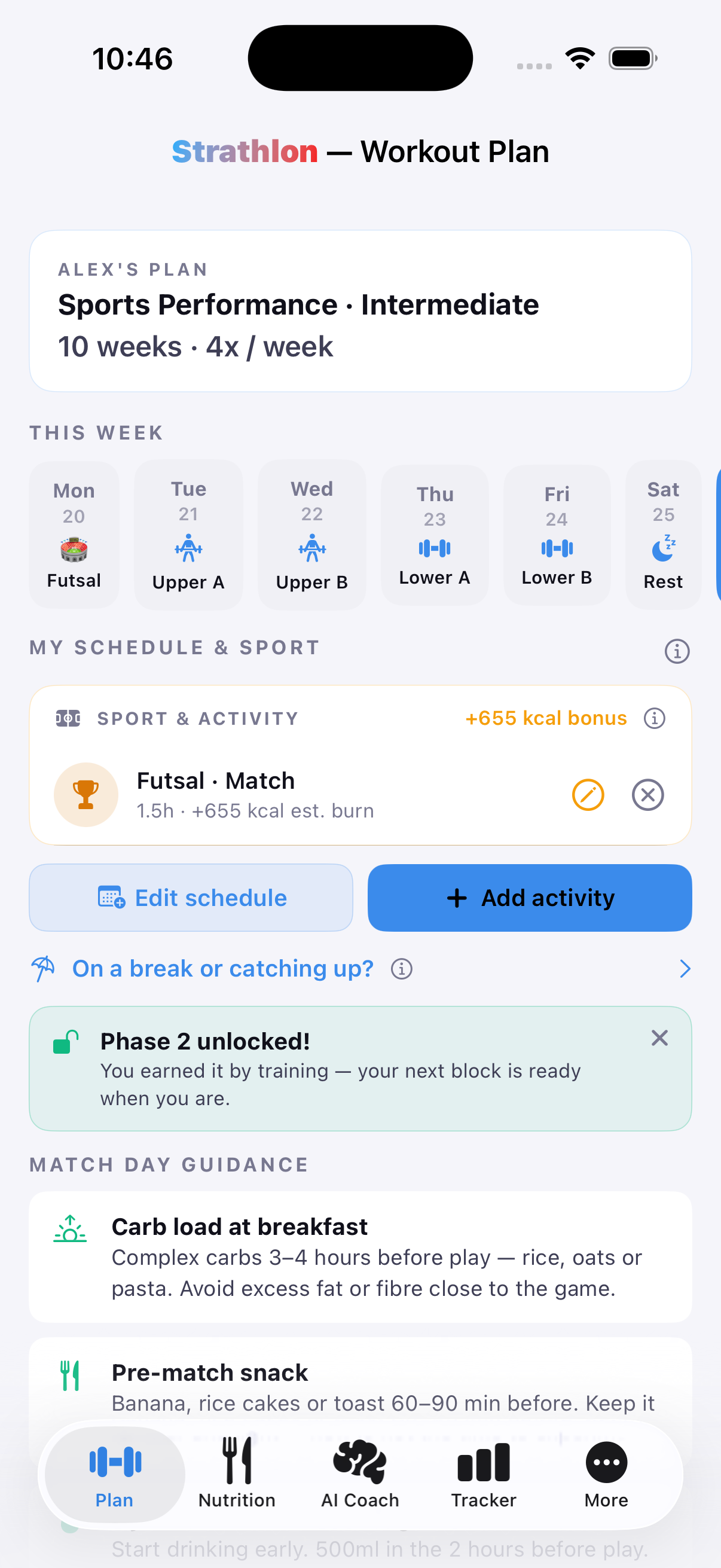
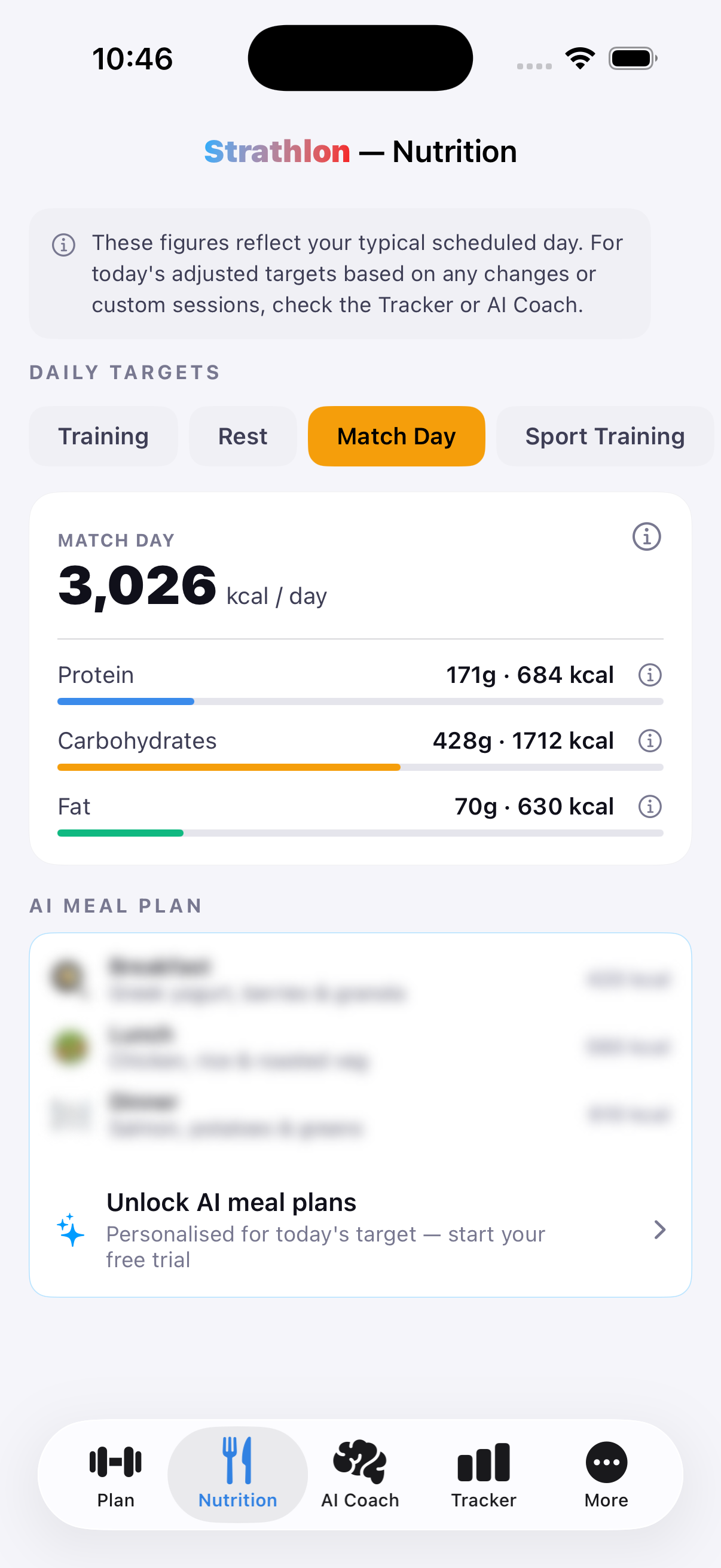
If you remember one thing, make it this: futsal players rarely lose to a lack of gels: they lose to turning up with the tank half-empty. Eat carbohydrate like the high-intensity athlete you are, hydrate using the breaks the game already gives you, and refuel hard between matches on tournament days. Strathlon's job is to keep that base honest by adjusting your targets around the sessions you actually log, so the everyday fuelling that underpins every match is one less thing to guess at.
References
Numbered sources for the specific figures, effect sizes and named studies above. Where a claim reflects agreed guidance rather than a single trial, the citation is to the position stand or consensus statement of the body concerned, with the country or international remit named. Futsal's nutrition literature is thin, so the demands below are futsal-specific and the fuelling prescriptions come from the indoor and intermittent team-sport evidence, which is said where it applies.
- Spyrou K, Freitas TT, Marín-Cascales E, Alcaraz PE. Physical and Physiological Match-Play Demands and Player Characteristics in Futsal: A Systematic Review. Frontiers in Psychology. 2020;11:569897. Spyrou and colleagues' systematic review of physical and physiological match-play demands in futsal: the source for the energy cost this guide fuels for. PubMed 33240157 · PMC7677190 full text
- Ribeiro JN, Ferraz A, Gonçalves B, Serrano C, Coutinho D, Ballester R, et al. Training exercises, match demands, and variability in elite futsal. Frontiers in Sports and Active Living. 2025;7:1553046. Study of training exercises, match demands and variability in elite futsal, the second source for the same. PubMed 40212887 · PMC11983534 full text
- González-Fernández FT, Ceylan HI, Silva RM, Clemente FM, Bezerra P, Chen YS. Relationships between physical fitness and match running demands during a futsal congested-weeks training camp. Biology of Sport. 2024;41(4):11–30. Study relating fitness to match running demands across a congested futsal week, the basis for the between-match refuelling advice. PubMed 39416517 · PMC11475011 full text
- Castillo M, Lozano-Casanova M, Sospedra I, Norte A, Gutiérrez-Hervás A, Martínez-Sanz JM. Energy and Macronutrients Intake in Indoor Sport Team Athletes: Systematic Review. Nutrients. 2022;14(22). Systematic review of energy and macronutrient intake in indoor team-sport athletes: the closest published fuelling benchmark for this sport. PubMed 36432438 · PMC9696016 full text
- Williams C, Rollo I. Carbohydrate Nutrition and Team Sport Performance. Sports Medicine. 2015;45 Suppl 1(Suppl 1):S13–22. Review of carbohydrate nutrition and team-sport performance, the source for the carbohydrate case in a stop-start sport. PubMed 26553494 · PMC4672015 full text
- Baker LB, Rollo I, Stein KW, Jeukendrup AE. Acute Effects of Carbohydrate Supplementation on Intermittent Sports Performance. Nutrients. 2015;7(7):5733–63. Review of the acute effects of carbohydrate supplementation on intermittent sports performance, the specific evidence for in-match fuelling. PubMed 26184303 · PMC4517026 full text
- Nuccio RP, Barnes KA, Carter JM, Baker LB. Fluid Balance in Team Sport Athletes and the Effect of Hypohydration on Cognitive, Technical, and Physical Performance. Sports Medicine. 2017;47(10):1951–1982. Review of fluid balance in team-sport athletes and the effect of hypohydration on cognitive, technical and physical performance, the hydration case. PubMed 28508338 · PMC5603646 full text
- Ahmadi M, Hoorang N, Imanian B, Hemmatinafar M, Rezaei R, Nemati J, et al. Boosting Recovery: Omega-3 and Whey Protein Enhance Strength and Ease Muscle Soreness in Female Futsal Players. Nutrients. 2024;16(24). Randomised trial of omega-3 and whey protein on strength and soreness in female futsal players, cited in the recovery section. PubMed 39770885 · PMC11678206 full text
- Thomas DT, Erdman KA, Burke LM. Position of the Academy of Nutrition and Dietetics, Dietitians of Canada, and the American College of Sports Medicine: Nutrition and Athletic Performance. Journal of the Academy of Nutrition and Dietetics. 2016;116(3):501–528. Joint position of the Academy of Nutrition and Dietetics, Dietitians of Canada and the American College of Sports Medicine: the umbrella source for the daily energy, carbohydrate and protein ranges used throughout. PubMed 26920240
- Burke LM, Hawley JA, Wong SH, Jeukendrup AE. Carbohydrates for training and competition. Journal of Sports Sciences. 2011;29 Suppl 1:S17–27. Burke and colleagues on carbohydrate for training and competition, the source for the g/kg/day carbohydrate targets matched to training load. PubMed 21660838
- Jeukendrup A. A step towards personalized sports nutrition: carbohydrate intake during exercise. Sports Medicine. 2014;44 Suppl 1(Suppl 1):S25–33. Jeukendrup on personalising carbohydrate intake during exercise: the source for the g/h feeding rates and the duration at which they start to matter. PubMed 24791914 · PMC4008807 full text
- Jäger R, Kerksick CM, Campbell BI, Cribb PJ, Wells SD, Skwiat TM, et al. International Society of Sports Nutrition Position Stand: protein and exercise. Journal of the International Society of Sports Nutrition. 2017;14:20. International Society of Sports Nutrition (ISSN, United States) position stand on protein and exercise, the source for the daily protein range and per-meal distribution. PubMed 28642676 · PMC5477153 full text
- Schoenfeld BJ, Aragon AA. How much protein can the body use in a single meal for muscle-building? Implications for daily protein distribution. Journal of the International Society of Sports Nutrition. 2018;15:10. Schoenfeld and Aragon on how much protein the body can use in a single meal, the basis for the per-feed figure quoted. PubMed 29497353 · PMC5828430 full text
- Burke LM, van Loon LJC, Hawley JA. Postexercise muscle glycogen resynthesis in humans. Journal of Applied Physiology. 2017;122(5):1055–1067. Review of post-exercise muscle glycogen resynthesis, the source for the refuelling rates and for when a fast refuel is actually needed. PubMed 27789774
- Sawka MN, Burke LM, Eichner ER, Maughan RJ, Montain SJ, Stachenfeld NS. American College of Sports Medicine position stand. Exercise and fluid replacement. Medicine and Science in Sports and Exercise. 2007;39(2):377–90. ACSM position stand on exercise and fluid replacement: the source for the under-2% body-mass-loss guideline and the sweat-rate method. PubMed 17277604
- Barnes KA, Anderson ML, Stofan JR, Dalrymple KJ, Reimel AJ, Roberts TJ, et al. Normative data for sweating rate, sweat sodium concentration, and sweat sodium loss in athletes: An update and analysis by sport. Journal of Sports Sciences. 2019;37(20):2356–2366. Normative data for sweating rate and sweat sodium concentration in athletes, the source for how widely fluid and sodium losses vary between individuals. PubMed 31230518
- Hew-Butler T, Rosner MH, Fowkes-Godek S, Dugas JP, Hoffman MD, Lewis DP, et al. Statement of the Third International Exercise-Associated Hyponatremia Consensus Development Conference, Carlsbad, California, 2015. Clinical Journal of Sport Medicine : Official Journal of the Canadian Academy of Sport Medicine. 2015;25(4):303–20. Third International Exercise-Associated Hyponatremia Consensus statement, the basis for the warning against drinking well beyond sweat losses. PubMed 26102445
- Guest NS, VanDusseldorp TA, Nelson MT, Grgic J, Schoenfeld BJ, Jenkins NDM, et al. International society of sports nutrition position stand: caffeine and exercise performance. Journal of the International Society of Sports Nutrition. 2021;18(1):1. ISSN position stand on caffeine and exercise performance, the source for the caffeine dose and timing guidance. PubMed 33388079 · PMC7777221 full text
- Kreider RB, Kalman DS, Antonio J, Ziegenfuss TN, Wildman R, Collins R, et al. International Society of Sports Nutrition position stand: safety and efficacy of creatine supplementation in exercise, sport, and medicine. Journal of the International Society of Sports Nutrition. 2017;14:18. ISSN position stand on the safety and efficacy of creatine supplementation, cited where creatine is relevant to the sport's demands. PubMed 28615996 · PMC5469049 full text
- Maughan RJ, Burke LM, Dvorak J, Larson-Meyer DE, Peeling P, Phillips SM, et al. IOC consensus statement: dietary supplements and the high-performance athlete. British Journal of Sports Medicine. 2018;52(7):439–455. IOC consensus statement on dietary supplements and the high-performance athlete: the framing for treating supplements as optional extras. PubMed 29540367 · PMC5867441 full text
- Mountjoy M, Ackerman KE, Bailey DM, Burke LM, Constantini N, Hackney AC, et al. 2023 International Olympic Committee's (IOC) consensus statement on Relative Energy Deficiency in Sport (REDs). British Journal of Sports Medicine. 2023;57(17):1073–1097. The 2023 IOC consensus statement on Relative Energy Deficiency in Sport, the source for the consequences of under-fuelling a training load. PubMed 37752011
- Aragon AA, Schoenfeld BJ. Nutrient timing revisited: is there a post-exercise anabolic window?. Journal of the International Society of Sports Nutrition. 2013;10(1):5. Aragon and Schoenfeld on the post-exercise anabolic window, the source for timing mattering far less than daily totals. PubMed 23360586 · PMC3577439 full text
- British Dietetic Association (BDA, United Kingdom). Sport and exercise nutrition: Food Fact Sheet. British Dietetic Association (BDA, United Kingdom) Food Fact Sheet on sport and exercise nutrition, the practical UK dietetic framing. BDA Food Fact Sheet
This is general educational information rather than medical, dietary or coaching advice. The sports-nutrition figures here are drawn from established consensus and team-sport research and are framed as population-level guides: individual needs vary widely with body size, minutes played, conditions, gut tolerance and health, and are best personalised with a qualified professional. Anyone with a health condition, a history of disordered eating, or who is pregnant or postpartum, or who suspects under-fuelling, stress fractures, menstrual disruption or RED-S, should consult a sports physician or registered dietitian before making changes. See our Terms for more.
← All guides · Futsal strength & conditioning · Eating for results · Understanding your stats · Home