
Fuelling & performance nutrition for MMA
An evidence-based, safety-first guide to fuelling the mixed martial artist. MMA is two problems at once: it demands explosive power for striking and grappling, and it is a weight-class sport, so most of the nutrition conversation ends up being about making weight without wrecking performance or health. This covers fuelling multi-discipline camp, protecting muscle through a cut, losing weight the slow and sensible way, the fight-week manipulations, the 24–36 hour weigh-in window and how to rehydrate and refuel inside it, and the genuinely serious risks of rapid weight cutting and chronic under-fuelling. Practical, honest, and grounded in established sports-nutrition consensus.
Here's the short answer to "how should an MMA athlete fuel?": fuel camp properly (enough daily carbohydrate for striking and grappling and high protein to protect muscle) make weight gradually rather than through a brutal last-minute cut, keep any acute water loss small and supervised, then use the 24–36 hour weigh-in window to rehydrate and refuel, and route the actual weight cut through a qualified professional. Everything below is the detail behind that sentence: the numbers, where they come from, and why the cautious version is also the higher-performing one.
On this page
- Why MMA asks two things of your fuel
- Fuelling camp: the everyday base
- Making weight the safe way: the gradual descent
- Fight week: glycogen, fibre, sodium and water
- The acute water cut: the risky part
- The weigh-in window: rehydrate and refuel
- The real risks: dehydration, kidneys and RED-S
- Common questions
- Takeaways
Two framing notes before the numbers. First, this is one of the few sports where nutrition can genuinely be dangerous if done badly (weight cutting has a real history of harm) so this guide is deliberately cautious, and the single most important line in it is that decisions about cutting weight belong with a sports physician or performance dietitian. A forum thread or a training partner isn't the right source. Second, people differ enormously: body size, style, camp length, how much you have to lose, sex and health status all shift what's right. So this is written as can, tends to and around, never as a guarantee, and every figure is a population-level guide drawn from published consensus rather than a personal prescription. It's general education rather than medical, dietary or coaching advice.
Pair this with the MMA strength & conditioning guide : weight-cutting and fuelling are only half a fighter's physical preparation. The lifts, conditioning and prehab that build camp are the other half.
Why MMA asks two things of your fuel
A fight is a patchwork of energy systems. Explosive shots (a punch, a takedown entry, a scramble) are powered by the near-instant ATP-PCr (phosphagen) system. Sustained high-output flurries and grappling exchanges lean heavily on the glycolytic system, which burns carbohydrate and produces the lactate that floods the muscles and makes your arms feel like lead in round three. As rounds lengthen past about four minutes, the aerobic system's contribution can rise above 70%, yet those anaerobic bursts keep firing on top of it. Wrestling research has recorded blood lactate climbing to around 20 mmol/L across a single five-minute match (roughly double what a hard treadmill test produces) which tells you how glycolytically demanding grappling really is.
The practical upshot: MMA is a carbohydrate-hungry, power-hungry sport. Striking and grappling both draw on glycogen, and both depend on the strength and power you protect by holding onto muscle. That matters enormously once weight cutting enters the picture, because the sport's central tension is that the same fuel you need to perform (carbohydrate, water and lean tissue) is exactly what fighters strip away to make a lighter class. The whole art of fuelling MMA is resolving that tension without paying for it in the cage.
Fuelling camp: the everyday base
A fight camp is typically an eight-to-ten-week block of intense, multi-discipline training, usually run while gradually dropping body mass. That combination (high work, falling calories) is where most fighters get their fuelling wrong, either by under-eating so hard they lose muscle and sharpness, or by cutting the wrong macronutrient. The International Society of Sports Nutrition's 2025 position stand on nutrition and weight-cut strategies for MMA and combat sports gives clear floors for camp.
- Carbohydrate: don't let it collapse. Even in a deficit, carbohydrate should generally not drop below about 3–4 g per kilogram of body weight per day, because it fuels the striking and grappling volume of camp. This is a floor rather than a target. On the hardest training days you'll want more.
- Protein: protect it above all. Aim for roughly 1.2–2.0 g/kg/day through camp to defend lean muscle during the energy deficit and aid recovery between the day's sessions. If anything, lean athletes dieting hard should sit toward the top of that band or beyond (more on this below).
- Fat: the adjustable lever. Fat is usually the macronutrient trimmed to create the calorie shortfall, but it shouldn't fall below roughly 0.5–1.0 g/kg/day, because fat supports hormones and the absorption of fat-soluble vitamins.
- References
The logic is simple and worth internalising: keep carbohydrate high enough to train, keep protein high to hold muscle, and take the calorie deficit mostly out of fat. That ordering is what lets a fighter descend in weight over weeks while still hitting pads and rolling at a high level.
Making weight the safe way: the gradual descent
The single biggest lever on a safe cut isn't a fight-week trick: it's starting close enough to your division: that you never need a desperate one. Combat-sports guidance suggests keeping your everyday "walk-around" weight to roughly 12–15% above your competitive class, so a steady descent through camp handles most of the gap. Sit much further above that and the maths forces either a longer, harder deficit or a brutal water cut: both of which cost performance and raise risk.
The descent itself should be slow. Guidance points to losing about 0.5–1 kg (roughly 0.5–1% of body mass) per week, a rate that a controlled trial in elite athletes found preserved strength and power (at around 0.7% per week) far better than crash dieting. Over an eight-week camp, that gentle rate is exactly what makes the 12–15% starting buffer workable. Sports nutritionists build this backwards: take the total mass to lose, divide across the weeks of camp, and monitor body composition so the loss comes off fat rather than muscle.
This is also where protein earns its keep. Beyond the 1.2–2.0 g/kg camp range, the wider sports-nutrition literature (including the ISSN position stand on diets and body composition) suggests that lean athletes in a hard calorie deficit may benefit from more still, up to around 2.3–3.1 g per kilogram of fat-free mass, to maximise muscle retention. In a weight-class sport, muscle you keep is power you keep at a lower number on the scale.
Fight week: glycogen, fibre, sodium and water
Once camp has done its job, the final few percent is shed through reversible manipulations: temporary changes that lower the number on the scale without stripping fat or muscle, and that are largely undone after weigh-in. The position stand describes three main levers, used carefully and ideally under supervision:
- Depleting water-bound glycogen. Every gram of stored glycogen holds several grams of water with it. Reducing carbohydrate and training the stores down during fight week can shed roughly 1–2% of body mass in that bound water.
- Emptying the gut with a low-fibre intake. Cutting fibre to under about 10 g a day for around four days reduces the undigested food and water sitting in the digestive tract: a real, if unglamorous, chunk of scale weight.
- Sodium and water manipulation. Lowering sodium (a reduced-sodium intake during fight week) alongside a period of higher water intake can prime the body to shed fluid as urine. This is a supervised technique. It isn't a casual one.
Done well, these get a fighter to within a whisker of the limit through changes that are temporary and recoverable: which is the entire point. They are meaningfully safer than relying on a large sweat-out, precisely because most of the weight comes back with the next few meals and drinks rather than requiring dangerous dehydration.
The acute water cut: the risky part
The final lever, and the one to treat with the most respect, is acute dehydration: sweating out water in the last 24 hours through saunas, hot-water immersion or sweat suits. It works, but it is where the genuine danger lives, and the guidance is emphatic that it should be kept small and supervised: optimally on the order of 2–4% of body mass within the 24 hours before weigh-in, a world away from the double-digit horror stories the sport is infamous for.
To put realistic magnitudes on the whole descent, one analysis of UFC fighters found them roughly 6.7% above their class 72 hours out, tapering to about 4.4% over 24 hours out, a much smaller, more feasible amount of acute water to shed at the end. The table below sums up the "suitable" loss milestones described in the position stand.
| Time before weigh-in | Suitable total loss (of body mass) | Mostly from |
|---|---|---|
| 72 hours | ~6.7% | Diet, glycogen/water, gut contents |
| 48 hours | ~5.7% | Continued fibre/sodium/water manipulation |
| 24 hours | ~4.4% | Final acute water loss (~2–4%), supervised |
Two things make the small-cut approach both safer and smarter. First, dehydration of more than about 2% of body mass is already associated with falling strength, power and skill (the very qualities a fighter needs) so a big cut you haven't fully reversed can leave you competing impaired. Second, the more water you strip, the more you have to put back in a fixed window, and full reversal isn't guaranteed. A smaller cut is easier to undo before the first bell.
The weigh-in window: rehydrate and refuel
This is the part unique to MMA, and it's where the cut is won or lost. Professional MMA, boxing and kickboxing typically weigh in 24 to 36 hours before the fighter enters the cage: a genuinely useful window (unlike wrestling or Brazilian jiu-jitsu, where same-day weigh-ins can leave only an hour or two, forcing a much smaller cut). The job in those hours is to reverse the dehydration and refill the glycogen you deliberately ran down. Guidance describes a layered protocol:
- Fluid first, with sodium. Replace roughly 125–150% of the fluid lost as sweat: more than you lost, because some is passed as urine before it's absorbed. Use an oral rehydration solution (fluid with added sodium, unlike plain water) at around 1–1.5 litres per hour immediately after weighing in. The sodium is what helps you hold the fluid rather than urinate it straight back out.
- Then carbohydrate, to refill glycogen. After rehydration is underway, refuel carbohydrate. If a big glycogen-depletion cut was used, intakes of around 8–12 g per kilogram of body weight across the window may be appropriate; for a more modest cut, roughly 4–7 g/kg. Keep fast-digesting carbohydrate to about 60 g an hour so the gut copes, and limit fibre to avoid bloating and distress before the fight.
- Aim to regain the mass. Rehydration-and-refuel protocols generally target recovering at least 10% of body mass before competing, to blunt the performance decline that unreversed rapid weight loss otherwise causes.
The honest caveat is that this recovery is never perfect, and the bigger the cut the less complete it tends to be, which is the whole reason the earlier sections push so hard on making weight gradually and keeping the acute cut small. A well-planned fighter treats the window as a top-up. It isn't a rescue.
The real risks: dehydration, kidneys and RED-S
It's worth being blunt about why this guide is so cautious. Rapid weight loss and severe dehydration aren't just uncomfortable. They carry documented harm. Combat athletes commonly lose around 5% of body mass in the days before weigh-in (and sometimes far more, in the 2–10% range), and the sports-medicine literature includes a published case in which extreme weight making caused relative energy deficiency, dehydration and acute kidney injury in a male MMA fighter. Sports physicians have formally described alarming weight-cutting behaviour in MMA as "a cause for concern and a call for action." The long-term effects of repeated hard cuts, the position stand is candid, are simply not yet known. None of this is a reason for fear-mongering: it's a reason to involve a professional and keep cuts conservative.
The slower-burning risk is chronic under-fuelling. Push the deficit too deep or the camp too short and you slide into low energy availability: not leaving enough energy, after training is paid for, to run the body's basic functions. Research on longer, harder descents has recorded testosterone dropping below clinical reference ranges and resting metabolic rate falling when fighters lost around 13–15% of body mass over a camp, which is why 12–15% above your class is treated as an upper limit rather than a goal. Sustained low energy availability is the root of what the International Olympic Committee calls Relative Energy Deficiency in Sport (RED-S): a syndrome affecting both men and women that can impair bone health, hormones, immunity, mood and (the irony) performance itself. Sports scientists associate falling below about 30 kcal per kilogram of fat-free mass per day with these problems, versus something nearer 45 kcal/kg for a healthy exercising body. Weight-class combat athletes are flagged as a higher-risk group precisely because "making weight" and long deficits are baked into the sport.
Common questions
How should an MMA fighter fuel day to day during camp?
Through fight camp the priority is fuelling hard multi-discipline training while lowering body mass gradually. Combat-sports nutrition guidance suggests keeping carbohydrate at roughly 3–4 g per kilogram of body weight a day or above to support striking and grappling work, protein around 1.2–2.0 g/kg to protect lean muscle during the energy deficit, and using fat as the lever to create the calorie shortfall, kept above the roughly 0.5–1.0 g/kg/day floor the position stand sets. The aim is to arrive at fight week lean and strong rather than depleted.
How much weight can you safely cut for MMA?
There is no universally safe cut, which is why the decision belongs with a professional. Combat-sports guidance suggests keeping walk-around weight to about 12–15% above your division, so the gradual descent through camp does the heavy lifting, then losing weight at roughly 0.5–1% of body mass (about 0.5–1 kg) per week. Any last-minute acute water loss in the final 24 hours is best kept small: on the order of 2–4% of body mass, under supervision. Larger, faster cuts raise the risk sharply and offer no real advantage.
How do you rehydrate after an MMA weigh-in?
MMA, boxing and kickboxing usually weigh in 24–36 hours before the first bell, which gives a realistic window to recover. Guidance is to replace roughly 125–150% of the fluid lost as sweat, using an oral rehydration solution with sodium (not plain water) at around 1–1.5 litres an hour, then to refuel carbohydrate (up to about 8–12 g per kilogram if a big glycogen-depletion cut was used, or around 4–7 g/kg for a modest one) with fast carbs kept to roughly 60 g an hour and fibre limited to avoid gut trouble. Protocols typically aim to regain at least 10% of body mass before competing.
How much protein should I eat when cutting weight for a fight?
Protein is the macronutrient you protect while cutting, because it defends muscle in a calorie deficit. Combat-sports guidance advises around 1.2–2.0 g per kilogram of body weight a day through camp, and the wider sports-nutrition literature suggests lean athletes dieting hard may benefit from more still (up to roughly 2.3–3.1 g per kilogram of fat-free mass) to maximise muscle retention. Spread it across the day's meals rather than piling it into one, and keep it high even as calories fall.
Is rapid weight cutting for MMA dangerous?
It can be. Rapid weight loss and severe dehydration are associated with impaired strength, power and skill, and in documented cases extreme weight making has caused acute kidney injury and relative energy deficiency in fighters. Dehydration of more than about 2% of body mass already degrades performance, and sports physicians have publicly called alarming weight-cutting behaviour in MMA a cause for concern. The long-term effects of repeated hard cuts are still unknown. This is exactly the part of the sport to run past a qualified professional, never a message-board protocol.
What is RED-S and are MMA fighters at risk?
RED-S (relative energy deficiency in sport) is the syndrome that follows sustained low energy availability, when you don't leave enough energy, after training, to run the body's basic functions. Research associates falling below about 30 kcal per kilogram of fat-free mass a day with disrupted hormones, bone and performance, versus nearer 45 kcal/kg for a healthy exercising body. Weight-class combat athletes are considered a higher-risk group because repeated making weight and long deficits are built into the sport, and both men and women are affected. Cutting too much, too fast, over too short a camp is a fast route to it.
Takeaways
- MMA is carbohydrate- and power-hungry. Striking and grappling run on glycogen and lactate-tolerant power, so fuelling and muscle both directly drive performance.
- Fuel camp, don't starve it. Keep carbohydrate at roughly 3–4 g/kg/day or more, protein around 1.2–2.0 g/kg to protect muscle, and take the deficit mostly from fat, kept above the ~0.5–1.0 g/kg/day floor.
- Make weight gradually. Walk around about 12–15% above your class and descend at roughly 0.5–1% of body mass (0.5–1 kg) per week. That's what preserves strength and power.
- Protect protein hardest. Lean athletes cutting hard may benefit from up to ~2.3–3.1 g/kg of fat-free mass to hold muscle at a lower weight.
- Fight week is reversible manipulation. Glycogen/water depletion (~1–2%), low fibre (<10 g/day for ~4 days) and sodium/water manipulation get you close without stripping fat or muscle.
- Keep the acute cut small. Aim for only ~2–4% of body mass of water loss in the final 24 hours, supervised. More than ~2% dehydration already hurts performance.
- Use the 24–36h window well. Replace ~125–150% of sweat losses with a sodium-containing solution (~1–1.5 L/h), refuel carbohydrate (~4–12 g/kg depending on the cut, fast carbs ≤~60 g/h), and aim to regain ≥10% of body mass.
- Respect the risks. Extreme cuts have caused kidney injury and RED-S. The long-term toll of repeated cutting is unknown. Eat enough, cut conservatively, and involve a professional.
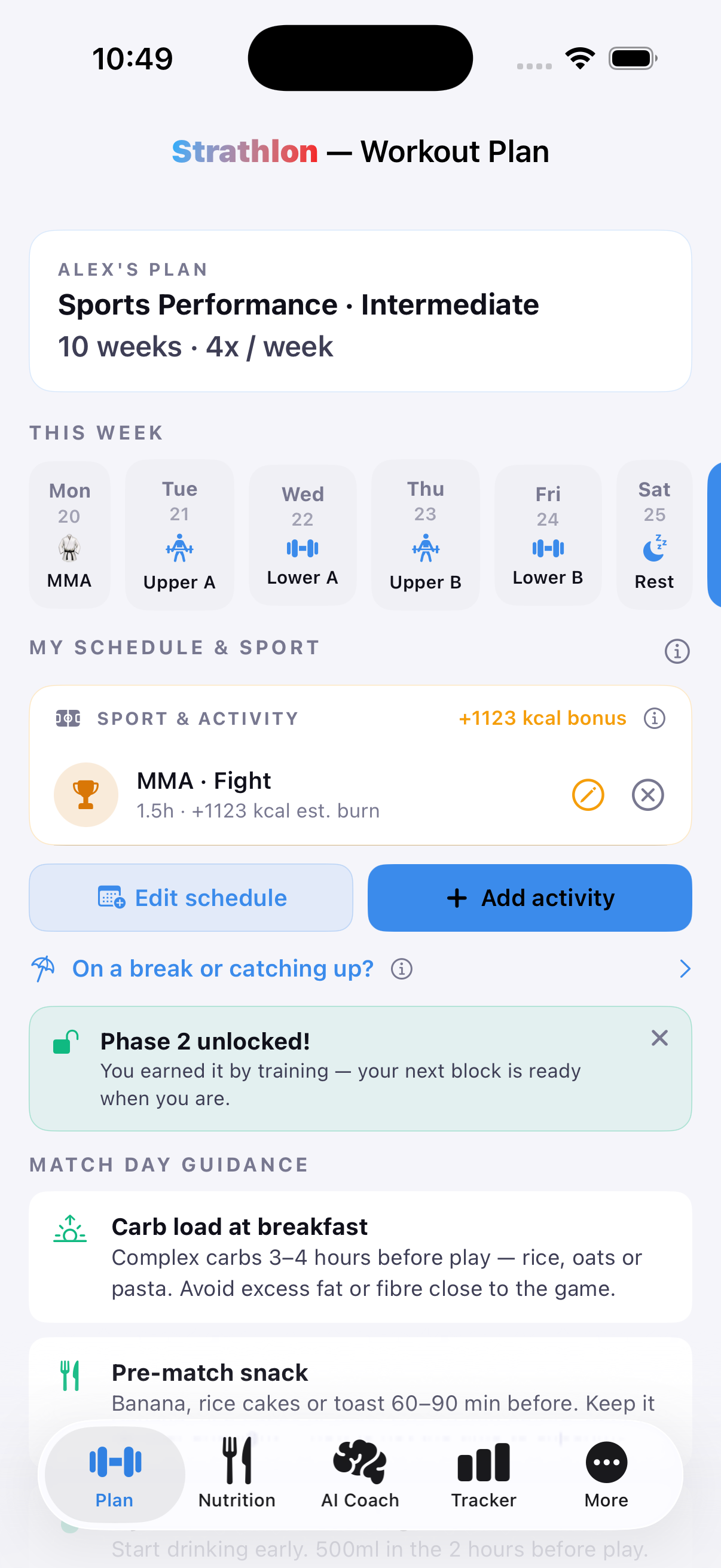
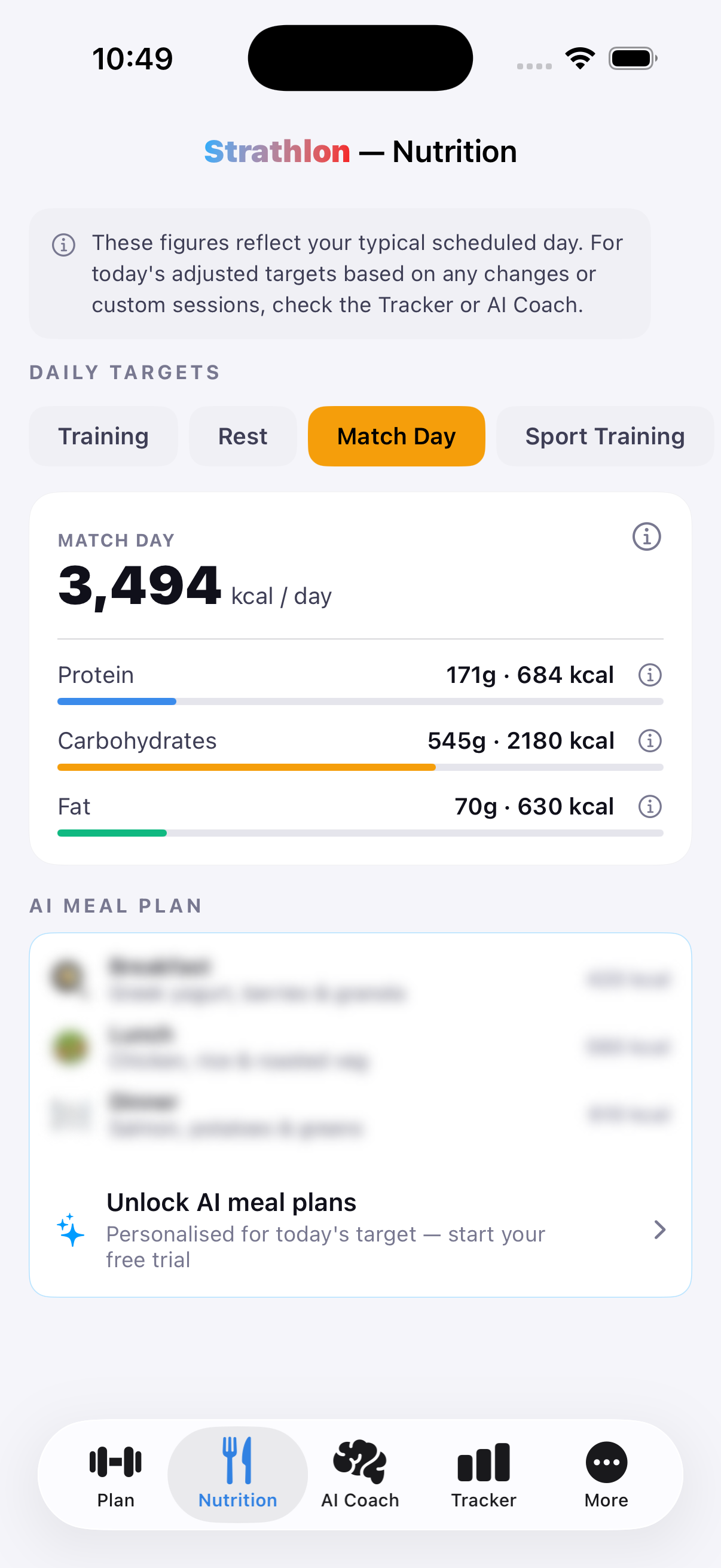
If you remember one thing, make it this: the fighters who make weight best aren't the ones who suffer most in the sauna: they're the ones who start near their class, descend slowly with protein high, keep the final cut small, and rehydrate carefully in the window. Strathlon's job is to keep that everyday base honest by adjusting your targets around the sessions you actually log, so the fuelling that underpins a whole camp is one less thing to guess at, while the cut itself stays where it belongs, with your medical and performance team. For the striking side of the story, see the companion boxing fuelling guide.
References
Numbered sources for the specific figures, effect sizes and named studies above. Where a claim reflects agreed guidance rather than a single trial, the citation is to the position stand or consensus statement of the body concerned, with the country or international remit named. MMA now has its own ISSN position stand on weight-cutting, which is the anchor for this guide; the rest is combat-sport and general sports-nutrition evidence.
- Ricci AA, Evans C, Stull C, Peacock CA, French DN, Stout JR, et al. International society of sports nutrition position stand: nutrition and weight cut strategies for mixed martial arts and other combat sports. Journal of the International Society of Sports Nutrition. 2025;22(1):2467909. International Society of Sports Nutrition position stand on nutrition and weight-cut strategies for mixed martial arts athletes: the anchor source for this guide. PubMed 40059405 · PMC11894756 full text
- Kirk C, Clark DR, Langan-Evans C, Morton JP. The physical demands of mixed martial arts: A narrative review using the ARMSS model to provide a hierarchy of evidence. Journal of Sports Sciences. 2020;38(24):2819–2841. Narrative review of the physical demands of MMA using the ARMSS evidence hierarchy, the demand this guide fuels for. PubMed 32783581
- Reale R, Slater G, Burke LM. Acute-Weight-Loss Strategies for Combat Sports and Applications to Olympic Success. International Journal of Sports Physiology and Performance. 2017;12(2):142–151. Review of acute weight-loss strategies in combat sports and their application to Olympic success, the source for the cutting cautions. PubMed 27347784
- Matthews JJ, Stanhope EN, Godwin MS, Holmes MEJ, Artioli GG. The Magnitude of Rapid Weight Loss and Rapid Weight Gain in Combat Sport Athletes Preparing for Competition: A Systematic Review. International Journal of Sport Nutrition and Exercise Metabolism. 2019;29(4):441–452. Systematic review of the magnitude of rapid weight loss and regain in combat-sport athletes preparing for competition. PubMed 30299200
- Kasper AM, Crighton B, Langan-Evans C, Riley P, Sharma A, Close GL, et al. Case Study: Extreme Weight Making Causes Relative Energy Deficiency, Dehydration, and Acute Kidney Injury in a Male Mixed Martial Arts Athlete. International Journal of Sport Nutrition and Exercise Metabolism. 2019;29(3):331–338. Case study of extreme weight-making causing relative energy deficiency, dehydration and acute kidney injury in a male MMA athlete: the clearest single illustration of the risk. PubMed 29989458
- Lakicevic N, Paoli A, Roklicer R, Trivic T, Korovljev D, Ostojic SM, et al. Effects of Rapid Weight Loss on Kidney Function in Combat Sport Athletes. Medicina. 2021;57(6). Study of the effects of rapid weight loss on kidney function in combat-sport athletes, the wider evidence for the same. PubMed 34072641 · PMC8229569 full text
- Murugappan KR, Reale R, Baribeau V, O'Gara BP, Mueller A, Sarge T. Rapid weight gain following weight cutting in male professional boxers. The Physician and Sportsmedicine. 2022;50(6):494–500. Study of rapid weight gain following weight cutting in professional boxers, cited for the rehydration and refeed window. PubMed 34310264
- Reale R, Slater G, Cox GR, Dunican IC, Burke LM. The Effect of Water Loading on Acute Weight Loss Following Fluid Restriction in Combat Sports Athletes. International Journal of Sport Nutrition and Exercise Metabolism. 2018;28(6):565–573. Randomised trial of water loading for acute weight loss following fluid restriction in combat-sport athletes, cited where a cut is unavoidable. PubMed 29182412
- Burke LM, Slater GJ, Matthews JJ, Langan-Evans C, Horswill CA. ACSM Expert Consensus Statement on Weight Loss in Weight-Category Sports. Current Sports Medicine Reports. 2021;20(4):199–217. ACSM expert consensus statement on weight loss in weight-category sports, the governing guidance. PubMed 33790193
- Hammer E, Sanfilippo JL, Johnson G, Hetzel S. Association of in-competition injury risk and the degree of rapid weight cutting prior to competition in division I collegiate wrestlers. British Journal of Sports Medicine. 2023;57(3):160–165. Study associating in-competition injury risk with the degree of rapid weight cutting, the injury cost of an aggressive cut. PubMed 36261252
- Thomas DT, Erdman KA, Burke LM. Position of the Academy of Nutrition and Dietetics, Dietitians of Canada, and the American College of Sports Medicine: Nutrition and Athletic Performance. Journal of the Academy of Nutrition and Dietetics. 2016;116(3):501–528. Joint position of the Academy of Nutrition and Dietetics, Dietitians of Canada and the American College of Sports Medicine: the umbrella source for the daily energy, carbohydrate and protein ranges used throughout. PubMed 26920240
- Burke LM, Hawley JA, Wong SH, Jeukendrup AE. Carbohydrates for training and competition. Journal of Sports Sciences. 2011;29 Suppl 1:S17–27. Burke and colleagues on carbohydrate for training and competition, the source for the g/kg/day carbohydrate targets matched to training load. PubMed 21660838
- Jeukendrup A. A step towards personalized sports nutrition: carbohydrate intake during exercise. Sports Medicine. 2014;44 Suppl 1(Suppl 1):S25–33. Jeukendrup on personalising carbohydrate intake during exercise: the source for the g/h feeding rates and the duration at which they start to matter. PubMed 24791914 · PMC4008807 full text
- Jäger R, Kerksick CM, Campbell BI, Cribb PJ, Wells SD, Skwiat TM, et al. International Society of Sports Nutrition Position Stand: protein and exercise. Journal of the International Society of Sports Nutrition. 2017;14:20. International Society of Sports Nutrition (ISSN, United States) position stand on protein and exercise, the source for the daily protein range and per-meal distribution. PubMed 28642676 · PMC5477153 full text
- Schoenfeld BJ, Aragon AA. How much protein can the body use in a single meal for muscle-building? Implications for daily protein distribution. Journal of the International Society of Sports Nutrition. 2018;15:10. Schoenfeld and Aragon on how much protein the body can use in a single meal, the basis for the per-feed figure quoted. PubMed 29497353 · PMC5828430 full text
- Burke LM, van Loon LJC, Hawley JA. Postexercise muscle glycogen resynthesis in humans. Journal of Applied Physiology. 2017;122(5):1055–1067. Review of post-exercise muscle glycogen resynthesis, the source for the refuelling rates and for when a fast refuel is actually needed. PubMed 27789774
- Sawka MN, Burke LM, Eichner ER, Maughan RJ, Montain SJ, Stachenfeld NS. American College of Sports Medicine position stand. Exercise and fluid replacement. Medicine and Science in Sports and Exercise. 2007;39(2):377–90. ACSM position stand on exercise and fluid replacement: the source for the under-2% body-mass-loss guideline and the sweat-rate method. PubMed 17277604
- Barnes KA, Anderson ML, Stofan JR, Dalrymple KJ, Reimel AJ, Roberts TJ, et al. Normative data for sweating rate, sweat sodium concentration, and sweat sodium loss in athletes: An update and analysis by sport. Journal of Sports Sciences. 2019;37(20):2356–2366. Normative data for sweating rate and sweat sodium concentration in athletes, the source for how widely fluid and sodium losses vary between individuals. PubMed 31230518
- Hew-Butler T, Rosner MH, Fowkes-Godek S, Dugas JP, Hoffman MD, Lewis DP, et al. Statement of the Third International Exercise-Associated Hyponatremia Consensus Development Conference, Carlsbad, California, 2015. Clinical Journal of Sport Medicine : Official Journal of the Canadian Academy of Sport Medicine. 2015;25(4):303–20. Third International Exercise-Associated Hyponatremia Consensus statement, the basis for the warning against drinking well beyond sweat losses. PubMed 26102445
- Guest NS, VanDusseldorp TA, Nelson MT, Grgic J, Schoenfeld BJ, Jenkins NDM, et al. International society of sports nutrition position stand: caffeine and exercise performance. Journal of the International Society of Sports Nutrition. 2021;18(1):1. ISSN position stand on caffeine and exercise performance, the source for the caffeine dose and timing guidance. PubMed 33388079 · PMC7777221 full text
- Kreider RB, Kalman DS, Antonio J, Ziegenfuss TN, Wildman R, Collins R, et al. International Society of Sports Nutrition position stand: safety and efficacy of creatine supplementation in exercise, sport, and medicine. Journal of the International Society of Sports Nutrition. 2017;14:18. ISSN position stand on the safety and efficacy of creatine supplementation, cited where creatine is relevant to the sport's demands. PubMed 28615996 · PMC5469049 full text
- Maughan RJ, Burke LM, Dvorak J, Larson-Meyer DE, Peeling P, Phillips SM, et al. IOC consensus statement: dietary supplements and the high-performance athlete. British Journal of Sports Medicine. 2018;52(7):439–455. IOC consensus statement on dietary supplements and the high-performance athlete: the framing for treating supplements as optional extras. PubMed 29540367 · PMC5867441 full text
- Mountjoy M, Ackerman KE, Bailey DM, Burke LM, Constantini N, Hackney AC, et al. 2023 International Olympic Committee's (IOC) consensus statement on Relative Energy Deficiency in Sport (REDs). British Journal of Sports Medicine. 2023;57(17):1073–1097. The 2023 IOC consensus statement on Relative Energy Deficiency in Sport, the source for the consequences of under-fuelling a training load. PubMed 37752011
- Aragon AA, Schoenfeld BJ. Nutrient timing revisited: is there a post-exercise anabolic window?. Journal of the International Society of Sports Nutrition. 2013;10(1):5. Aragon and Schoenfeld on the post-exercise anabolic window, the source for timing mattering far less than daily totals. PubMed 23360586 · PMC3577439 full text
- British Dietetic Association (BDA, United Kingdom). Sport and exercise nutrition: Food Fact Sheet. British Dietetic Association (BDA, United Kingdom) Food Fact Sheet on sport and exercise nutrition, the practical UK dietetic framing. BDA Food Fact Sheet
This is general educational information rather than medical, dietary or coaching advice. Weight cutting carries real health risks and must be planned and supervised by a qualified sports physician and performance dietitian rather than undertaken alone. The sports-nutrition figures here are drawn from established consensus (including the International Society of Sports Nutrition's position stand on nutrition and weight-cut strategies for MMA and combat sports) and are framed as population-level guides: individual needs vary widely with body size, style, camp length, conditions and health. Anyone with a health condition, a history of disordered eating, or who is pregnant or postpartum, or who suspects under-fuelling, kidney problems, hormonal or menstrual disruption or RED-S, should consult a sports physician or registered dietitian before making changes. See our Terms for more.
← All guides · MMA strength & conditioning · Fuelling for boxing · Eating for results · Understanding your stats · Home