
Fuelling & performance nutrition for triathlon
An evidence-based guide to fuelling for triathlon, the endurance sport that is really three fuelling problems stitched together. You swim (where you can't eat), you ride (where you can), and you run (where your stomach least wants to). This covers daily carbohydrate, race-week carb loading, the pre-race meal, how to fuel across swim-bike-run, why the bike is your main eating window, carbohydrate per hour, hydration by your own sweat rate, training your gut with brick sessions, recovery, and the quietly serious risk of chronic under-fuelling. Practical, honest, and grounded in established sports-nutrition consensus.
Here's the short answer to "how should a triathlete fuel?": build the base with enough daily carbohydrate, top up your glycogen in the days and hours before the race, then do most of your in-race eating and drinking on the bike (roughly 30–60 g of carbohydrate per hour, rising toward 90 g for long-course, plus fluid to your sweat rate), so you reach the run with fuel in the tank and a settled stomach, and recover and eat enough overall to avoid running an energy deficit. Everything below is the detail behind that sentence: the numbers, where they come from, and how to make them work for your body across three disciplines.
Pair this with the triathlon strength and conditioning guide: the heavy lifting and durability work that builds economy across three disciplines only pays off if you're fuelled to train and race on it.
On this page
- Why triathlon is three fuelling problems in one
- Daily carbohydrate: the base
- Carbohydrate per hour in the race
- Fuelling across swim, bike and run
- Race week: carb loading and the pre-race meal
- Hydration, sweat and heat
- Training your gut and brick sessions
- Recovery: carbohydrate and protein
- Under-fuelling and RED-S
- Common questions
- Takeaways
A framing note before the numbers. Sports nutrition is well studied, but people differ enormously: body size, pace, fitness, the weather, gut tolerance, sex and health status all shift what's right on the day. So this is written as can, tends to and around, never as a guarantee, and every specific figure is a population-level guide drawn from published consensus rather than a personal prescription. It's general education rather than medical or dietary advice, and it isn't a personalised race plan.
Why triathlon is three fuelling problems in one
Like all endurance sport, triathlon runs on a blend of two fuels: fat, which is almost limitless even in a lean athlete but burns slowly, and carbohydrate (stored as glycogen in muscle and liver, plus glucose in the blood), which burns fast and lets you hold any real pace. The catch is that carbohydrate stores are small, enough for very roughly 90–120 minutes of hard effort before they run low. The faster you go, the more you lean on carbohydrate rather than fat, which is why fuelling decides so many races: when the tank empties, pace collapses (the classic "bonk"). The muscles aren't damaged. They've simply run out of their fast fuel.
What makes triathlon distinctive is that this single fuel problem plays out across three very different stages, each with its own rules:
- The swim. You can't eat or drink, and it's usually the shortest leg. You fuel for it beforehand.
- The bike. Steady, supported, comparatively smooth: this is where eating and drinking are genuinely easy, and where almost all of your in-race fuelling should happen.
- The run. The pounding of running makes the stomach far less tolerant of food, so this is the leg where gut trouble strikes and where you rely most on what you banked earlier.
- References
Hold those three windows in mind, because the entire strategy below is about getting fuel in when your body will accept it (mostly on the bike), so you arrive at the run with glycogen still in reserve and a stomach that isn't in revolt.
Daily carbohydrate: the base
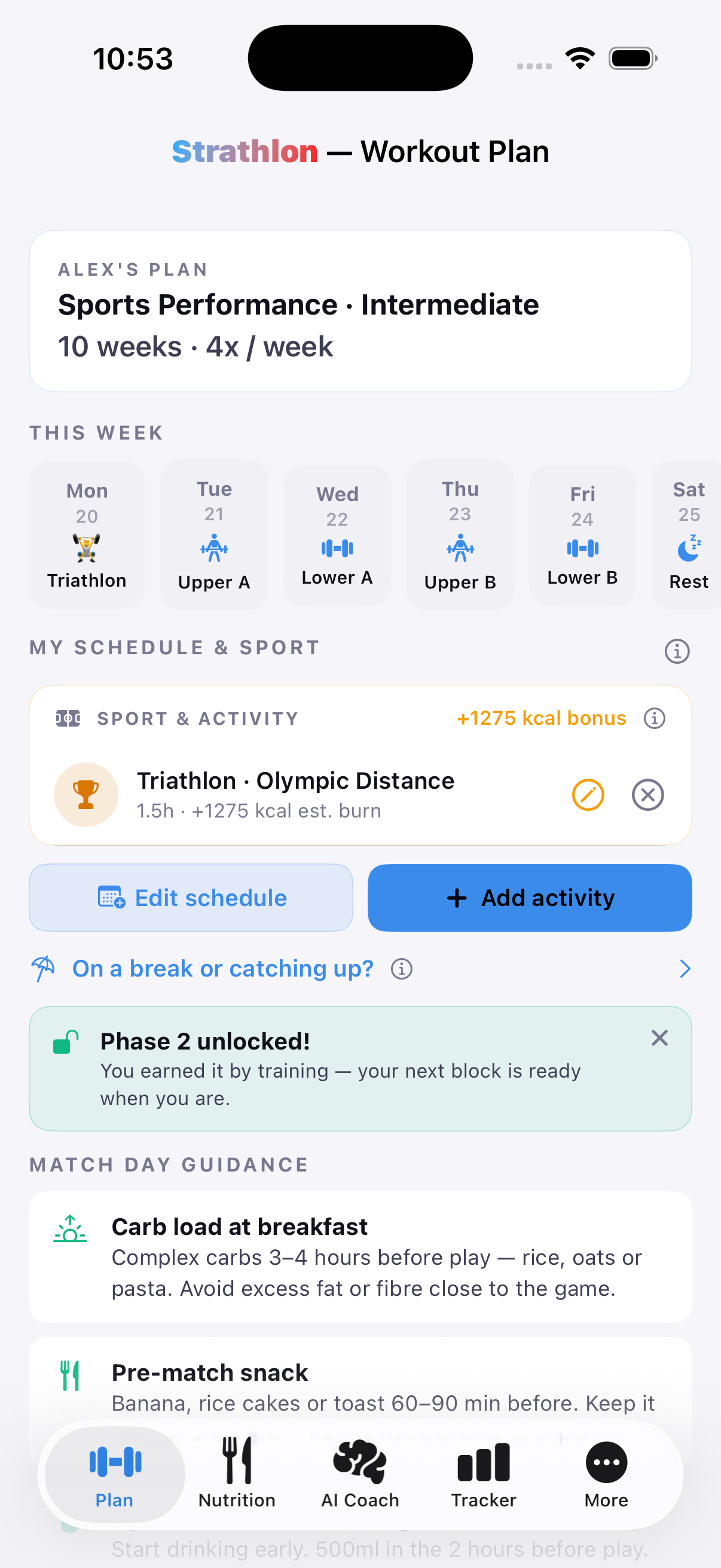
Race-day fuelling only works if you show up with the tank reasonably full, and that comes from your everyday carbohydrate intake, matched to your training. Triathletes train a lot (often two or three sessions a day across the disciplines), so the base matters more here than in most sports. The joint position on nutrition and athletic performance from the Academy of Nutrition and Dietetics, Dietitians of Canada and the American College of Sports Medicine sets out daily carbohydrate targets scaled to training load: around 5–7 g of carbohydrate per kilogram of body weight per day for a light or moderate program, roughly 6–10 g/kg/day for the moderate-to-high volumes of serious training of one to three hours a day, and up to 8–12 g/kg/day for very high volumes and heavy multi-session days. The International Society of Sports Nutrition frames the same idea as a broad 5–12 g/kg/day band, with the top reserved for those training many hours a week at intensity.
The practical point is that these dials should move with your week. A long-ride or brick day warrants more carbohydrate than an easy swim or a rest day. Chronically eating at the low end while training three sports is one of the most common ways triathletes end up flat, under-recovered and stuck: the base is too empty for the quality fuelling on top to matter.
Carbohydrate per hour in the race
Once a race pushes past roughly an hour, taking in carbohydrate during the effort helps maintain blood glucose and spares your limited glycogen, delaying fatigue. How much depends mostly on how long you'll be out there, and, in triathlon, on the fact that you can only realistically get it in on the bike. The joint position stand and wider consensus give a duration-scaled ladder:
| Race duration | Carbohydrate per hour | Type of carbohydrate | Rough triathlon equivalent |
|---|---|---|---|
| Under ~60 min | Little or none | N/A | Short sprint: existing glycogen covers it. |
| ~1–2.5 hours | ~30–60 g | Single source fine | Sprint / Olympic distance. |
| >~2.5–3 hours | Up to ~90 g | Multiple transportable | Middle distance (70.3) and beyond. |
| Very long (full distance) | ~60–90 g, sustained | Multiple transportable | Full-distance / Ironman: held for many hours. |
The jump from 60 to 90 g per hour hides an important piece of physiology. The gut can only move a single type of carbohydrate (like glucose or maltodextrin) across the intestinal wall at a rate that tops out near 60 g per hour: pour in more and it sits in your stomach, which is how you get the sloshing and gut distress. But glucose and fructose use different transporters, so combining them, typically in roughly a 2:1 glucose-to-fructose ratio (about 60 g of glucose plus 30 g of fructose), lets the body absorb and oxidise carbohydrate faster, up to around 90 g per hour. Sports-science reviews report combined glucose–fructose oxidation as much as roughly 50–65% higher than glucose alone. That's why modern high-carb gels, drinks and chews advertise a "2:1" blend: it isn't marketing, it's the transporter maths that lets a long-course triathlete fuel aggressively without their gut shutting down.
Two honest caveats. First, you may have read about professionals pushing 120 g/h or more. Those are the top of a range that a handful of elite athletes have trained toward over years, and they are not a target for age-group racers: most people do very well in the 60–90 g/h band. Second, these are ceilings you build up to over time: start at the lower end, and only raise them after training your gut to cope (below).
Fuelling across swim, bike and run
This is the part that's genuinely unique to triathlon: when you fuel matters as much as how much.
The swim. There's nothing to do here but arrive well-fuelled. You can't eat or drink mid-swim, and the swim itself draws down some glycogen, so the pre-race meal and any final top-up (a gel a few minutes before the gun, if you've practised it) are what carry you through. Think of the swim as spending fuel you already banked.
The bike: your main eating window. The moment you're settled onto the bike, the real fuelling begins, because this is the only leg where your stomach and your hands are both free. The coaching shorthand is "fuel the bike to save the run": take in the bulk of your race carbohydrate and fluid here, aiming for your per-hour target within the first 15–20 minutes and holding it steadily rather than gulping it all at once. Practically, that means starting to eat and drink early, spreading intake across the leg, and pairing your carbohydrate with fluid. What you get in on the bike is what fuels the run that follows.
The run: protect the stomach. Running's up-and-down jolting is hard on a full gut, and gastrointestinal distress is most common at run pace, so this is where solid food often becomes intolerable. A widely used tactic is to take your last solid food a good while before the bike ends (roughly the final 30–45 minutes of the ride), so it's digested before you start running, then switch to easily absorbed liquids and gels on the run, at a lower volume than on the bike. This is a top-up. The heavy lifting already happened on the bike.
Race week: carb loading and the pre-race meal
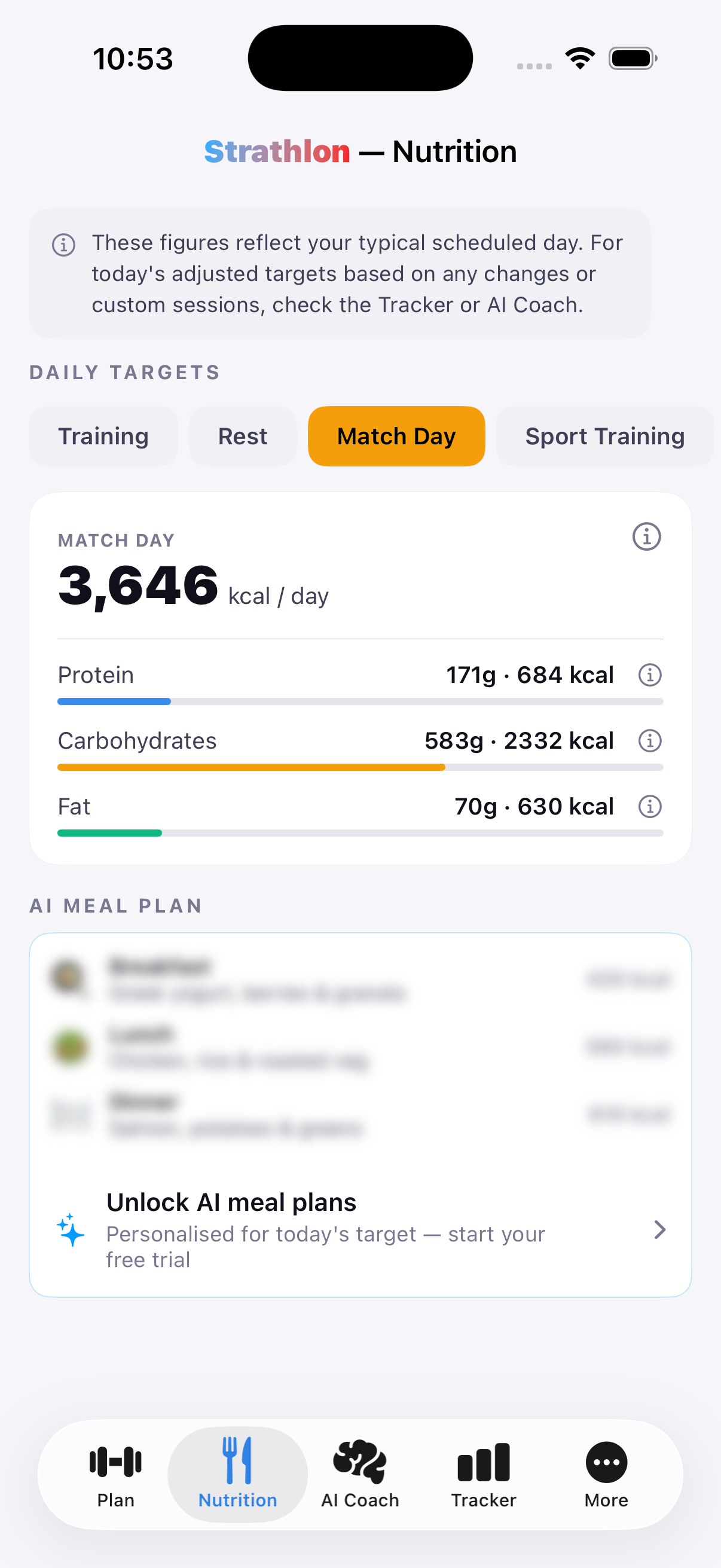
For long-course races that last well beyond about 90 minutes (middle and full distance), starting with maximally full glycogen stores can meaningfully delay fatigue. This is carbohydrate loading, and the modern version is far gentler than the brutal depletion protocols of the past. Contemporary guidance describes eating a high carbohydrate intake of around 8–12 g of carbohydrate per kilogram of body weight per day for the day or two before the race, while simultaneously tapering training so you store what you eat rather than burning it off. There's no need to deplete yourself first. Simply loading up while resting the legs brings stores close to their ceiling. Expect the scale to rise a kilo or two: each gram of glycogen is stored with roughly three grams of water, so that gain is fuel and hydration that helps you on the day, rather than added body fat. For short races such as a sprint or Olympic distance, a full load isn't needed. A normal high-carbohydrate day or two is plenty.
The pre-race meal. Because the swim and early bike come before you can eat much, the meal a few hours before the start matters. Position stands describe a carbohydrate-focused meal of roughly 1–4 g of carbohydrate per kilogram of body weight, eaten around one to four hours beforehand: the larger amounts earlier when you have time to digest, the smaller amounts closer to the gun. Favour familiar, lower-fibre, lower-fat carbohydrate you've rehearsed in training (porridge, toast, a banana, a bagel) because fibre and fat slow digestion and can sit heavily through a nervous, wetsuit-tight swim start. The golden rule of race morning is to try nothing new.
Hydration, sweat and heat
Triathlons are often long and frequently hot, and you sweat across all three legs (including the swim, where you can't feel it). Significant dehydration (losing more than roughly 2% of body mass as sweat) is associated with rising effort, higher heart rate and, in the heat, falling performance. The long-standing guidance from the American College of Sports Medicine is to drink enough to keep body-mass loss under about 2% over a long effort, rather than to a rigid schedule.
There's no universal millilitre-per-hour number, because sweat rates vary enormously between people and with heat, humidity and pace. As an illustration, example intakes fall in a broad band of roughly 0.4–0.8 litres per hour, most of which (like your food) is easiest to take on the bike. The most reliable way to find your number is to weigh yourself before and after a long training session in representative conditions: each kilogram lost is roughly a litre of sweat, which tells you how much you're under-replacing and how much to aim for next time. USA Triathlon and sports-medicine bodies both recommend this simple sweat test over any generic target.
For long or hot races, replacing some sodium (electrolytes) alongside fluid helps you hold on to what you drink and can reduce cramping in salty sweaters: figures around 300–600 mg of sodium per hour are commonly cited, with heavy or salty sweaters needing more. Conveniently, the same sports drinks that deliver carbohydrate usually carry sodium too, so fuelling and hydrating overlap on the bike.
Training your gut and brick sessions
Here's the piece most age-group triathletes skip. Taking in 60–90 g of carbohydrate an hour while racing is a skill the gut has to learn. It isn't a switch you flip on race day. The intestine can be trained: regularly practising carbohydrate feeding during long sessions appears to up-regulate the transporters that ferry glucose and fructose across the gut wall, speed up gastric emptying and dampen the sensation of fullness, so the same gels that make you queasy today are tolerated comfortably a few weeks from now.
For triathlon there's a second, sport-specific rehearsal that matters just as much: the brick session: a bike immediately followed by a run. Bricks are where you practise the exact handover that wrecks races: eating and drinking your race amounts on the bike, easing the volume down toward the end, then running on that fuel to see how your stomach copes with the jolting. Rehearse your precise plan (the same gels or drink, the same grams per hour, the same timing, the same easing-off before the run) on your long rides and bricks, working up toward your target intake. The payoff is twofold: your gut copes, and you arrive at the start line already certain your fuelling plan works. Nothing about race-day fuelling should be a first attempt.
Recovery: carbohydrate and protein
After a hard or long session, two jobs matter: refill glycogen and repair muscle. How urgently you chase the first depends entirely on when you next train hard, and triathletes, with their frequent back-to-back sessions, hit the fast-turnaround case more than most.
- Fast turnaround (another hard session within a day, or a second session the same day). Here speed matters. Research on rapid recovery describes taking in carbohydrate at around 1.0–1.2 g per kilogram of body weight per hour during the first few hours after exercise to refill glycogen as quickly as possible: the muscle is most receptive soon after you stop. Adding some protein (roughly 0.25–0.3 g/kg per feed) supports repair and appears to help glycogen refilling most when carbohydrate intake is on the low side.
- Normal turnaround (a full day or more until the next hard session). There's no need to rush. Simply hitting your usual daily carbohydrate and protein targets across normal meals refills stores comfortably before you need them.
Over the whole day, endurance athletes are generally advised to eat around 1.2–2.0 g of protein per kilogram of body weight, more than a sedentary person, because training damages muscle and protein supports repair and adaptation, spread across meals rather than piled into one. The eating-for-results guide covers the broader nutrition picture in depth.
Under-fuelling and RED-S
The most serious nutrition mistake in triathlon isn't a bad gel choice: it's chronically eating too little to support the training. Three disciplines burn a large amount of energy, and combined with the sport's culture around leanness, triathletes are among the athletes who most often slip into low energy availability: not leaving enough energy, after training is paid for, to run the body's basic functions.
Sports scientists quantify this as energy availability: roughly, energy eaten minus energy burned in exercise, expressed per kilogram of fat-free (lean) mass. Research associates falling below about 30 kcal per kg of fat-free mass per day with a cascade of problems, while something nearer 45 kcal/kg FFM/day is considered healthy for an exercising body. Sustained low energy availability is the root cause of what the International Olympic Committee calls Relative Energy Deficiency in Sport (RED-S): a syndrome, affecting both men and women, that can impair bone health, hormones and menstrual function, immunity, metabolism, mood and (the irony every triathlete should note) performance itself. The IOC's 2023 consensus update specifically highlights the role of low carbohydrate availability, alongside total energy, as part of the picture.
The warning signs are worth knowing: nagging or recurrent stress fractures, frequent illness, stalled or declining performance despite hard training, poor sleep, low mood, and (in women) missing periods. None of these are things to push through. If they appear, the answer is usually to eat more rather than train harder, and to seek help from a sports physician or dietitian. Fuelling isn't only about race day: under-fuelling day after day is the fast route to injury and burnout.
Common questions
How many carbohydrates per hour should I take during a triathlon?
It depends mostly on how long you'll be racing. For a short race under about an hour you need little or nothing. For efforts of roughly one to two-and-a-half hours (an Olympic-distance race or a fast middle-distance) around 30–60 g of carbohydrate per hour maintains blood glucose. For long-course racing beyond about two-and-a-half to three hours, such as a middle- or full-distance triathlon, you can aim for up to around 90 g per hour. To absorb more than about 60 g per hour you need multiple transportable carbohydrates (glucose plus fructose in roughly a 2:1 ratio) because a single sugar tends to max out near 60 g per hour. Take most of it on the bike, start at the lower end and practise the amount in training first.
Why is the bike leg the most important part of triathlon fuelling?
Because it is the only leg where eating and drinking are genuinely easy. You can't eat during the swim, and the pounding of running makes the stomach far less tolerant of food. The bike is steady, supported and comparatively smooth, so it's your main window to take on carbohydrate and fluid, and what you bank on the bike is what fuels the run that follows. The coaching shorthand is fuel the bike to save the run: front-load your carbohydrate and fluid on the bike, then taper the volume down as you approach the run so your stomach isn't overloaded when it becomes least forgiving.
Should I carbohydrate-load before a triathlon?
For long-course races lasting well over about 90 minutes (middle and full distance), starting with topped-up muscle glycogen can meaningfully delay fatigue. Contemporary guidance describes eating a high carbohydrate intake of around 8–12 g per kilogram of body weight per day for the day or two before, while tapering training so you store what you eat rather than burning it off. For short races such as a sprint or Olympic distance, a full load isn't necessary: a normal high-carbohydrate day or two is enough. Expect the scale to rise a kilo or two, because glycogen is stored with water. That extra weight is fuel and hydration rather than fat.
How do I avoid stomach problems on the run?
Gut trouble on the run is one of the most common reasons triathlons fall apart, and it's largely preventable. Do most of your eating and drinking on the bike and ease the volume down in the last part of the ride, favouring easily digested liquids and gels rather than solid food as you approach the run. Avoid overshooting what your gut can absorb: undigested carbohydrate sloshing in the stomach is a leading cause of nausea and cramping. Above all, train your gut: rehearse your exact race fuelling on long rides and brick sessions so the amounts you'll take are ones your stomach has already handled, never a race-day first attempt.
How much should I drink during a triathlon?
There's no single number, because sweat rates vary widely between people and with heat, humidity and pace. The long-standing sports-medicine guidance is to drink enough to keep body-mass loss under about 2% over a long effort rather than to a fixed schedule. Example intakes fall in a broad band of roughly 0.4–0.8 litres per hour, mostly taken on the bike. The most reliable approach is to learn your own sweat rate by weighing yourself before and after training in similar conditions. In the heat, replacing some sodium alongside fluid helps: often cited around 300–600 mg per hour, more for heavy or salty sweaters. Drinking far more than you lose is not safer and can cause dangerous hyponatraemia.
Can a lean triathlete under-fuel without realising it?
Yes, and it's one of the sport's most serious and under-recognised risks. Training three disciplines burns a large amount of energy, and combined with a culture around leanness it's easy to slip into low energy availability: not leaving enough energy, after training is paid for, to run the body's basic functions. Sustained low energy availability is the root of what the International Olympic Committee calls Relative Energy Deficiency in Sport (RED-S), which can impair bone health, hormones, immunity, mood and performance itself in both men and women. Warning signs include recurrent stress fractures, frequent illness, stalled performance, poor sleep and, in women, missing periods. The answer is usually to eat more rather than train harder, and to seek help from a sports physician or dietitian.
Takeaways
- Triathlon is three fuelling problems in one. You fuel for the swim, fuel on the bike, and protect the stomach on the run.
- Build the base daily. Match everyday carbohydrate to training: roughly 5–7 g/kg on lighter days, up to 8–12 g/kg/day on the heaviest, and move the dial with your week.
- Fuel by duration in the race. Little under an hour; ~30–60 g of carbs per hour for sprint/Olympic; up to ~90 g/h for long-course, using a glucose–fructose (about 2:1) blend to absorb it.
- The bike is your eating window. Fuel the bike to save the run: bank most of your carbohydrate and fluid on the bike, then ease off before the run.
- Carb-load only for long-course. Around 8–12 g/kg/day for the day or two before while tapering. The water weight is fuel rather than fat. Short races don't need it.
- Top up before the start. A familiar, carb-focused meal of about 1–4 g/kg, eaten one to four hours before. Nothing new on race morning.
- Hydrate to your own sweat rate. Aim to keep body-mass loss under ~2%. Example intakes are ~0.4–0.8 L/h, mostly on the bike: weigh yourself to learn your number, add sodium in the heat, and don't over-drink.
- Train your gut and practise bricks. Rehearse race fuelling on long rides and bike-to-run bricks so your gut tolerates 60–90 g/h. Never debut a plan on race day.
- Recover with carbs (and some protein). Rush refuelling (~1.0–1.2 g/kg/h) only when the next hard session is soon. Aim ~1.2–2.0 g/kg/day of protein overall.
- Eat enough, always. Chronic under-fuelling (low energy availability, RED-S) harms bone, hormones, health and performance. When in doubt, eat more.
If you remember one thing, make it this: the triathletes who fuel well aren't the ones with the fanciest gels: they're the ones who arrive with a full tank, do the bulk of their eating and drinking on the bike, protect the stomach for the run, and eat enough overall to keep training. Strathlon's job is to keep that base honest by adjusting your targets around the sessions you actually log, so the everyday fuelling that underpins every race is one less thing to guess at.
References
Numbered sources for the specific figures, effect sizes and named studies above. Where a claim reflects agreed guidance rather than a single trial, the citation is to the position stand or consensus statement of the body concerned, with the country or international remit named. Triathlon has dedicated endurance-nutrition reviews and a race-fuelling literature of its own; the in-race figures below come from those rather than from single-discipline research.
- Miguel-Ortega Á, Rodríguez-Rodrigo MA, Mielgo-Ayuso J, Calleja-González J. Triathlon: Ergo Nutrition for Training, Competing, and Recovering. Nutrients. 2025;17(11). The dedicated triathlon nutrition review covering training, competing and recovering: the anchor source for this guide. PubMed 40507114 · PMC12157197 full text
- Jeukendrup AE. Nutrition for endurance sports: marathon, triathlon, and road cycling. Journal of Sports Sciences. 2011;29 Suppl 1:S91–9. Review of nutrition for endurance sports across marathon, triathlon and road cycling, the general framework. PubMed 21916794
- Bentley DJ, Cox GR, Green D, Laursen PB. Maximising performance in triathlon: applied physiological and nutritional aspects of elite and non-elite competitions. Journal of Science and Medicine in Sport. 2008;11(4):407–16. Review of maximising performance in triathlon across elite and non-elite competition, the source for how fuelling changes with race distance. PubMed 17869183
- Jeukendrup AE, Jentjens RL, Moseley L. Nutritional considerations in triathlon. Sports Medicine. 2005;35(2):163–81. Review of nutritional considerations in triathlon, the longer-standing source for the same. PubMed 15707379
- Vitale K, Getzin A. Nutrition and Supplement Update for the Endurance Athlete: Review and Recommendations. Nutrients. 2019;11(6). Nutrition and supplement review and recommendations for the endurance athlete, the supplement half of this guide. PubMed 31181616 · PMC6628334 full text
- Witard OC, Hearris M, Morgan PT. Protein Nutrition for Endurance Athletes: A Metabolic Focus on Promoting Recovery and Training Adaptation. Sports Medicine. 2025;55(6):1361–1376. Review of protein nutrition for endurance athletes with a focus on recovery and training adaptation. PubMed 40117058 · PMC12152099 full text
- Podlogar T, Bokal Š, Cirnski S, Wallis GA. Increased exogenous but unaltered endogenous carbohydrate oxidation with combined fructose-maltodextrin ingested at 120 g h(-1) versus 90 g h(-1) at different ratios. European Journal of Applied Physiology. 2022;122(11):2393–2401. Study of combined fructose-maltodextrin ingestion raising exogenous carbohydrate oxidation: the mechanism behind the higher in-race feeding rates. PubMed 35951130 · PMC9560939 full text
- Wilson PB. A Narrative Review of the High-Carbohydrate Fueling Revolution (≥ 100 g/h) in the Professional Peloton. Sports Medicine. 2026;56(2):295–313. Review of the high-carbohydrate fuelling shift in professional endurance sport, the source for the upper figures quoted. PubMed 41343040 · PMC12982284 full text
- Papadopoulou SK, Xyla EE, Methenitis S, Feidantsis KG, Kotsis Y, Pagkalos IG, et al. Nutrition strategies before and during ultra-endurance event: A significant gap between science and practice. Scandinavian Journal of Medicine & Science in Sports. 2018;28(3):881–892. Study of nutrition strategies before and during ultra-endurance events and the gap between science and practice, cited for long-course racing. PubMed 29117450
- Gallant TL, Ong LF, Wong L, Sparks M, Wilson E, Puglisi JL, et al. Low Energy Availability and Relative Energy Deficiency in Sport: A Systematic Review and Meta-analysis. Sports Medicine. 2025;55(2):325–339. Systematic review and meta-analysis of low energy availability and RED-S, the under-fuelling risk in a three-discipline training load. PubMed 39485653
- Thomas DT, Erdman KA, Burke LM. Position of the Academy of Nutrition and Dietetics, Dietitians of Canada, and the American College of Sports Medicine: Nutrition and Athletic Performance. Journal of the Academy of Nutrition and Dietetics. 2016;116(3):501–528. Joint position of the Academy of Nutrition and Dietetics, Dietitians of Canada and the American College of Sports Medicine: the umbrella source for the daily energy, carbohydrate and protein ranges used throughout. PubMed 26920240
- Burke LM, Hawley JA, Wong SH, Jeukendrup AE. Carbohydrates for training and competition. Journal of Sports Sciences. 2011;29 Suppl 1:S17–27. Burke and colleagues on carbohydrate for training and competition, the source for the g/kg/day carbohydrate targets matched to training load. PubMed 21660838
- Jeukendrup A. A step towards personalized sports nutrition: carbohydrate intake during exercise. Sports Medicine. 2014;44 Suppl 1(Suppl 1):S25–33. Jeukendrup on personalising carbohydrate intake during exercise: the source for the g/h feeding rates and the duration at which they start to matter. PubMed 24791914 · PMC4008807 full text
- Jäger R, Kerksick CM, Campbell BI, Cribb PJ, Wells SD, Skwiat TM, et al. International Society of Sports Nutrition Position Stand: protein and exercise. Journal of the International Society of Sports Nutrition. 2017;14:20. International Society of Sports Nutrition (ISSN, United States) position stand on protein and exercise, the source for the daily protein range and per-meal distribution. PubMed 28642676 · PMC5477153 full text
- Schoenfeld BJ, Aragon AA. How much protein can the body use in a single meal for muscle-building? Implications for daily protein distribution. Journal of the International Society of Sports Nutrition. 2018;15:10. Schoenfeld and Aragon on how much protein the body can use in a single meal, the basis for the per-feed figure quoted. PubMed 29497353 · PMC5828430 full text
- Burke LM, van Loon LJC, Hawley JA. Postexercise muscle glycogen resynthesis in humans. Journal of Applied Physiology. 2017;122(5):1055–1067. Review of post-exercise muscle glycogen resynthesis, the source for the refuelling rates and for when a fast refuel is actually needed. PubMed 27789774
- Sawka MN, Burke LM, Eichner ER, Maughan RJ, Montain SJ, Stachenfeld NS. American College of Sports Medicine position stand. Exercise and fluid replacement. Medicine and Science in Sports and Exercise. 2007;39(2):377–90. ACSM position stand on exercise and fluid replacement: the source for the under-2% body-mass-loss guideline and the sweat-rate method. PubMed 17277604
- Barnes KA, Anderson ML, Stofan JR, Dalrymple KJ, Reimel AJ, Roberts TJ, et al. Normative data for sweating rate, sweat sodium concentration, and sweat sodium loss in athletes: An update and analysis by sport. Journal of Sports Sciences. 2019;37(20):2356–2366. Normative data for sweating rate and sweat sodium concentration in athletes, the source for how widely fluid and sodium losses vary between individuals. PubMed 31230518
- Hew-Butler T, Rosner MH, Fowkes-Godek S, Dugas JP, Hoffman MD, Lewis DP, et al. Statement of the Third International Exercise-Associated Hyponatremia Consensus Development Conference, Carlsbad, California, 2015. Clinical Journal of Sport Medicine : Official Journal of the Canadian Academy of Sport Medicine. 2015;25(4):303–20. Third International Exercise-Associated Hyponatremia Consensus statement, the basis for the warning against drinking well beyond sweat losses. PubMed 26102445
- Guest NS, VanDusseldorp TA, Nelson MT, Grgic J, Schoenfeld BJ, Jenkins NDM, et al. International society of sports nutrition position stand: caffeine and exercise performance. Journal of the International Society of Sports Nutrition. 2021;18(1):1. ISSN position stand on caffeine and exercise performance, the source for the caffeine dose and timing guidance. PubMed 33388079 · PMC7777221 full text
- Kreider RB, Kalman DS, Antonio J, Ziegenfuss TN, Wildman R, Collins R, et al. International Society of Sports Nutrition position stand: safety and efficacy of creatine supplementation in exercise, sport, and medicine. Journal of the International Society of Sports Nutrition. 2017;14:18. ISSN position stand on the safety and efficacy of creatine supplementation, cited where creatine is relevant to the sport's demands. PubMed 28615996 · PMC5469049 full text
- Maughan RJ, Burke LM, Dvorak J, Larson-Meyer DE, Peeling P, Phillips SM, et al. IOC consensus statement: dietary supplements and the high-performance athlete. British Journal of Sports Medicine. 2018;52(7):439–455. IOC consensus statement on dietary supplements and the high-performance athlete: the framing for treating supplements as optional extras. PubMed 29540367 · PMC5867441 full text
- Mountjoy M, Ackerman KE, Bailey DM, Burke LM, Constantini N, Hackney AC, et al. 2023 International Olympic Committee's (IOC) consensus statement on Relative Energy Deficiency in Sport (REDs). British Journal of Sports Medicine. 2023;57(17):1073–1097. The 2023 IOC consensus statement on Relative Energy Deficiency in Sport, the source for the consequences of under-fuelling a training load. PubMed 37752011
- Aragon AA, Schoenfeld BJ. Nutrient timing revisited: is there a post-exercise anabolic window?. Journal of the International Society of Sports Nutrition. 2013;10(1):5. Aragon and Schoenfeld on the post-exercise anabolic window, the source for timing mattering far less than daily totals. PubMed 23360586 · PMC3577439 full text
- British Dietetic Association (BDA, United Kingdom). Sport and exercise nutrition: Food Fact Sheet. British Dietetic Association (BDA, United Kingdom) Food Fact Sheet on sport and exercise nutrition, the practical UK dietetic framing. BDA Food Fact Sheet
This is general educational information rather than medical, dietary or coaching advice. The sports-nutrition figures here are drawn from established consensus and are framed as population-level guides: individual needs vary widely with body size, pace, conditions, gut tolerance and health, and are best personalised with a qualified professional. Anyone with a health condition, a history of disordered eating, or who is pregnant or postpartum, or who suspects under-fuelling, stress fractures, menstrual disruption or RED-S, should consult a sports physician or registered dietitian before making changes. See our Terms for more.
← All guides · Triathlon strength and conditioning · Eating for results · Understanding your stats · Home