
Fuelling & performance nutrition for volleyball
An evidence-based guide to fuelling the volleyball player's body. Volleyball is an intermittent power sport (short, explosive rallies built on repeated maximal jumps, with real rest between points) so its fuelling story is different from a marathon. This covers why the continuous fuel demand of a single match is modest, how daily carbohydrate and the pre-match meal set you up, what to do during long matches and across a tournament day, the big hydration contrast between indoor and beach, and the protein that supports jump power and recovery. Practical, honest, and grounded in established sports-nutrition consensus.
Here's the short answer to "how should a volleyball player fuel?": start each match with your glycogen topped up, keep energy and fluid steady through the stop-start play (hydration is the number-one lever, especially in beach heat), take in some carbohydrate (around 30–60 g per hour) only when a match runs long or games stack back to back, and recover between matches with carbohydrate plus some protein. A single match asks for modest fuel. A full day of matches is where fuelling and recovery really earn their keep. Everything below is the detail behind that sentence.
Pair this with the volleyball strength and conditioning guide: fuelling keeps the engine running through long matches and tournament days, but it's the gym work that builds the engine in the first place.
On this page
- Why volleyball is an intermittent power sport
- Daily carbohydrate and energy: the base
- Before the match: topping up
- During long matches: carbs and the mouth rinse
- Hydration: indoor vs beach
- Fuelling and recovery across a tournament day
- Protein for power and jump recovery
- Eating enough: low energy availability
- Common questions
- Takeaways
A framing note before the numbers. Sports nutrition is well studied, but people differ enormously : body size, position, playing level, the weather, gut tolerance, sex and health status all shift what's right on the day. So this is written as can, tends to and around, never as a guarantee, and every specific figure is a population-level guide drawn from published consensus rather than a personal prescription. It's general education rather than medical or dietary advice, and it isn't a personalised plan.
Why volleyball is an intermittent power sport
Volleyball lives at the explosive end of the spectrum. Points are short and sharp: indoor rallies average roughly 6 seconds of play followed by around 10–15 seconds of rest, a work-to-rest ratio of about 1:2 to 1:2.5, and the defining efforts are maximal: spikes, blocks and jump serves, repeated dozens of times a match. Elite beach rallies run a little longer, around 9–10 seconds, at a work-to-rest ratio nearer 1:2.4. Either way, the pattern is burst, recover, burst, a world away from the continuous grind of running or cycling.
That pattern shapes the fuel mix. Those brief maximal jumps are powered mainly by the muscle's immediate stores, phosphocreatine and stored carbohydrate (glycogen), which the rest between rallies helps top back up. Because the total continuous work in a single match is modest, the glycogen you burn straight through one match is real but not enormous, and you rarely empty the tank the way a marathoner does. What changes that picture is volume: long five-set matches, several matches in a day, and hot conditions. Over a tournament day, repeated draws on glycogen add up, and fluid losses accumulate, which is exactly where fuelling starts to matter.
Daily carbohydrate and energy: the base
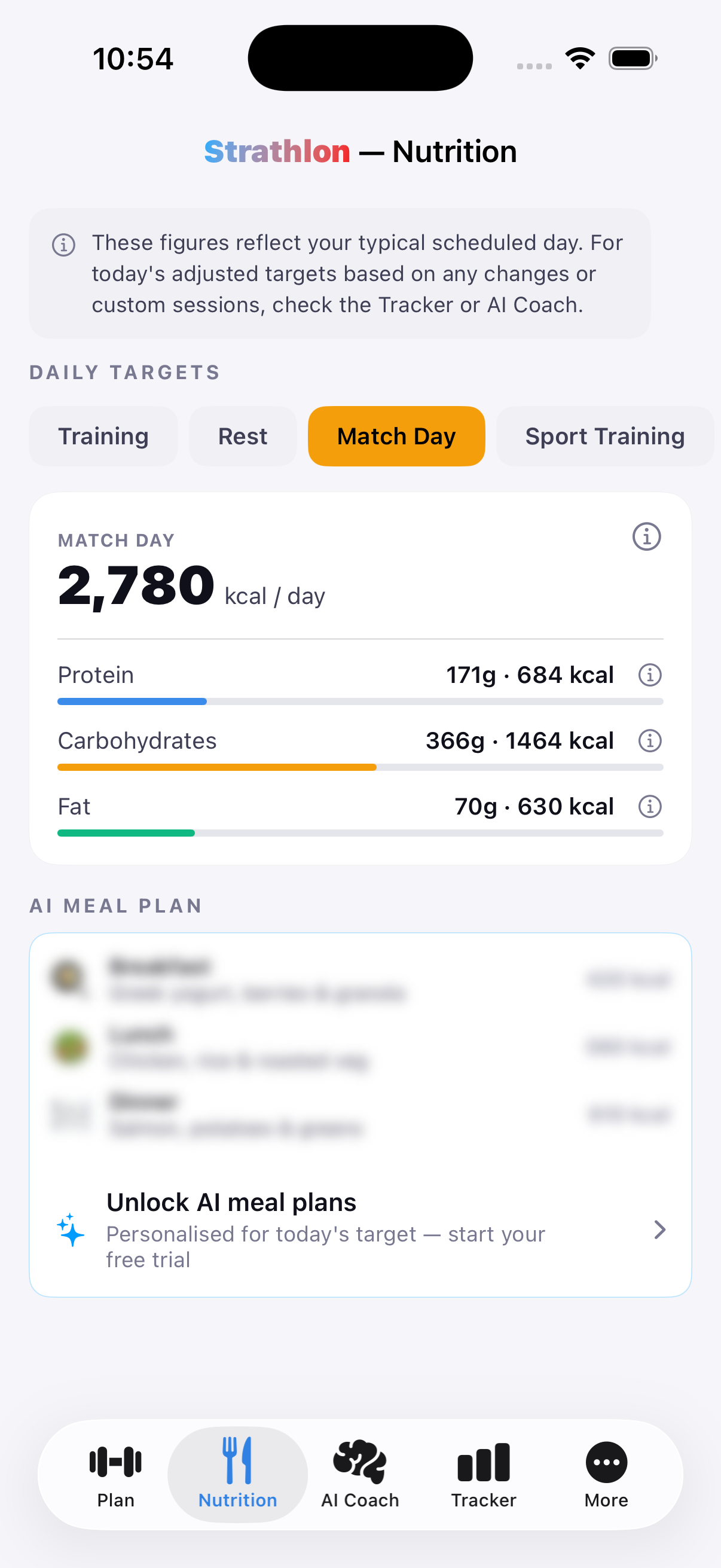
Whatever happens on match day works better if you show up with the tank reasonably full, and that comes from your everyday carbohydrate, matched to your training. The joint position on nutrition and athletic performance from the Academy of Nutrition and Dietetics, Dietitians of Canada and the American College of Sports Medicine scales daily carbohydrate to load: roughly 3–5 g of carbohydrate per kilogram of body weight per day for light activity, around 5–7 g/kg/day for a moderate program of about an hour a day, and 6–10 g/kg/day for the higher volumes of one to three hours daily. The International Society of Sports Nutrition frames it as a broad 5–12 g/kg/day band, with the top reserved for very high training loads.
For most volleyball players, honestly, the middle of that range is the home: think roughly 5–7 g/kg on typical training days, edging higher during heavy weeks or a multi-match tournament block, and easing back on lighter days. This is deliberately not an endurance prescription: chasing 10–12 g/kg because a running guide says so would just be extra food you don't burn. The base you need is enough to refill glycogen between sessions and support the gym work behind your jump, no more, no less. The dial should move with your week rather than sit at one number.
Before the match: topping up
Before a match or a tough training session, a carbohydrate-focused top-up helps make sure liver and muscle glycogen are high at first whistle and your blood sugar is steady for concentration. Position stands describe a pre-exercise meal or snack of roughly 1–4 g of carbohydrate per kilogram of body weight, eaten around one to four hours beforehand: the larger amounts earlier when you have time to digest, the smaller amounts closer to warm-up.
The art is in tolerance as much as grams. Favour familiar, lower-fibre, lower-fat carbohydrate you've rehearsed (porridge, toast, rice, a banana, a bagel) because fibre and fat slow digestion and can sit heavily when you're jumping and diving. Volleyball's constant landings and quick changes of direction are unforgiving on a full or unsettled stomach, so lean toward eating a little earlier rather than later, and keep anything close to start time small. The golden rule holds: on tournament morning, try nothing new.
During long matches: carbs and the mouth rinse
For a single, ordinary-length match, your existing glycogen covers most of the work and you don't need to fuel like an endurance athlete. Where in-play carbohydrate starts to help is the long stuff: drawn-out five-set matches, back-to-back games, and full tournament days. Sports-nutrition guidance for intermittent and team sports suggests taking in around 30–60 g of carbohydrate per hour once activity runs beyond about an hour, typically through a carbohydrate-electrolyte drink that hydrates at the same time. That's a lower, gentler target than the 60–90 g per hour a marathoner might chase, and it reflects volleyball's stop-start nature.
There's a lighter-touch trick worth knowing for tight, short efforts: the carbohydrate mouth rinse. Swilling a carbohydrate drink around the mouth and spitting it out has been shown to give a small performance benefit (on the order of 2–3%) in high-intensity efforts shorter than about an hour, with the effect showing up especially in the late stages of hard, intermittent work. The proposed mechanism is neural: receptors in the mouth signal the brain's reward and motor areas, lifting drive without anything being digested. It won't replace being well fed, though for the closing points of a tense set it's a real, low-cost edge, and it sidesteps any stomach upset from drinking more.
Hydration: indoor vs beach
Hydration is the single biggest fuelling lever in volleyball, and it's where indoor and beach part ways sharply. Losing more than roughly 2% of body mass as sweat is associated with rising perceived effort, higher heart rate and, in the heat, falling performance and skill. The long-standing guidance from the American College of Sports Medicine is to drink enough to keep body-mass loss under about that 2% over a session, rather than to a rigid schedule.
Indoors, play is in a climate-controlled hall, so sweat rates are usually moderate and the main job is simply to drink regularly through timeouts and side-outs rather than gulping only at the end. Beach volleyball adds three heat loads at once: direct sun, radiant heat bouncing off the sand, and often longer rallies in open, hot conditions, so sweat losses run considerably higher. In one study of players during an official beach tournament, athletes lost roughly 1.4 litres of sweat per match while voluntarily drinking only about 0.7 litres (replacing around half) for a mean body-mass change near −0.8%. That happened to stay under the 2% line, but it shows how a deficit can build match after match across a scorching day if you rely on thirst alone.
Two practical habits cover both settings. First, for anything beyond about an hour, and especially in heat, replace some sodium (electrolytes) alongside fluid: the same carbohydrate-electrolyte drinks used for fuelling carry it, so hydrating and fuelling overlap. Second, learn your own number: weigh yourself before and after a representative match: each kilogram lost is roughly a litre of sweat, so you know how much you tend to under-replace and can drink to that number instead of guessing.
Fuelling and recovery across a tournament day
A tournament (several matches spread across a long day) is the scenario volleyball fuelling is really built for, because no single meal can cover repeated matches, and the gaps between games are where you win or lose the later ones. Treat those gaps as active recovery windows: top up carbohydrate and fluid, and add some protein.
When the next match is soon, speed matters. Research on rapid glycogen recovery describes taking in carbohydrate at around 1.0–1.2 g per kilogram of body weight per hour in the first few hours after a hard effort to refill stores quickly: the muscle is most receptive soon after you stop. If there's a longer gap, there's less urgency and normal meals do the job. The practical layer is tolerance: between matches, reach for familiar, easy-to-digest options you can stomach courtside (a banana, a sandwich, a rice or oat snack, a carbohydrate-electrolyte drink) not something heavy and greasy that leaves you sluggish for the next serve. And keep sipping electrolyte drinks through the whole day, so hydration is a steady trickle rather than a panic at the end.
Protein for power and jump recovery
Volleyball is, at heart, a jumping sport, and every spike, block and jump serve is a small bout of high-force muscle work. Protein is what supports the repair and adaptation behind that: the raw material that lets you keep jumping hard across a season without breaking down, instead of a performance drink that makes you jump higher on the day.
Sports-nutrition position stands put a daily target of roughly 1.4–2.0 g of protein per kilogram of body weight for active people, with strength and power athletes sitting toward the middle of that band (about 1.6–1.7 g/kg/day). Just as important is distribution: spreading protein across the day in feeds of roughly 0.25–0.3 g per kilogram (very roughly 20–40 g) each every few hours supports muscle protein synthesis better than loading it all into dinner. Pairing protein with carbohydrate in your post-match recovery covers both jobs at once: refilling glycogen and repairing the muscle you just worked. The eating-for-results guide covers the broader nutrition picture in depth.
Eating enough: low energy availability
One honest caution to close on. Because volleyball rewards a lean, springy physique and jump training is demanding, some players (like athletes in many sports) slip into eating too little to support the work. Sports scientists call this low energy availability: not leaving enough energy, after training is paid for, to run the body's basic functions.
Sustained low energy availability is the root of what the International Olympic Committee calls Relative Energy Deficiency in Sport (RED-S): a syndrome affecting both men and women that can impair bone health, hormones and menstrual function, immunity, mood and, ironically, performance and power output themselves. For a jumping sport, the bone-health angle deserves respect: chronic under-fuelling raises the risk of stress injuries in the very legs your game depends on. Warning signs, recurrent stress fractures, frequent illness, stalled performance despite hard training, poor sleep, low mood, or (in women) missing periods, are reasons to eat more and seek help from a sports physician or dietitian. Pushing through is the wrong response.
Common questions
How should a volleyball player fuel for a match?
Start with your glycogen topped up and stay hydrated. A single match's continuous fuel demand is modest because volleyball is stop-start, but you still play best on a full tank and with good concentration late in the game. In practice: eat a familiar, carbohydrate-focused meal of roughly 1–4 g of carbohydrate per kilogram of body weight around one to four hours before; sip fluid during side-outs and timeouts rather than waiting for the end; and if a match runs long or you have several back to back, take in some carbohydrate: position stands suggest around 30–60 g per hour for intermittent sport lasting over an hour. Refuel between matches and after with carbohydrate plus some protein.
Is beach volleyball different from indoor for fuelling and hydration?
The fuel is broadly the same, but hydration is a much bigger deal on the beach. Beach volleyball adds direct sun, heat radiating off the sand and often longer rallies, so sweat losses run higher than in a climate-controlled indoor hall. In one study of players during an official beach tournament, athletes lost roughly 1.4 litres of sweat per match while drinking only about 0.7 litres (replacing around half) for a mean body-mass change near 0.8%. That stayed under the roughly 2% loss where performance tends to fall, but it shows how a deficit can build across a hot tournament day. Indoors, sweat losses are usually lower, but you should still drink to a plan. The reliable method for both is to weigh yourself before and after play to learn your own sweat rate.
How do I fuel across a full day of matches at a tournament?
A tournament day is where volleyball fuelling really matters, because repeated matches slowly draw down glycogen and fluid that one meal can't cover. Come in well fed and hydrated, then treat the gaps between matches as recovery windows: take in carbohydrate and fluid, and add some protein. When the next match is soon, research on rapid recovery describes carbohydrate intakes around 1.0–1.2 g per kilogram of body weight per hour in the first hours to refill glycogen quickly. Favour familiar, easy-to-digest foods you tolerate courtside, keep sipping electrolyte drinks through the day, and don't skip eating just because you're nervous or busy between games.
How much protein do I need for jump power and recovery?
Volleyball is a power sport built on repeated maximal jumps, so protein supports the muscle repair and adaptation behind that. Sports-nutrition position stands put a daily target of roughly 1.4–2.0 g of protein per kilogram of body weight for active and strength or power athletes, spread across the day rather than piled into one meal: about 0.25–0.3 g per kilogram, or roughly 20–40 g, per feed every few hours works well. Protein won't make you jump higher on its own. It supports the recovery that lets you keep jumping hard across a season of training and matches.
Do I need sports drinks and gels for volleyball?
Usually not the way a marathoner does. For a single, ordinary-length match your existing glycogen covers most of the work, so gels are rarely necessary. Where carbohydrate during play helps is long matches, back-to-back games and full tournament days, and even then real food plus a drink between matches often does the job. An electrolyte or carbohydrate-electrolyte drink is genuinely useful for hydration, especially on the beach or in the heat, because it replaces both fluid and the sodium lost in sweat. Interestingly, even swilling and spitting a carbohydrate drink (a mouth rinse) has been shown to give a small performance lift in short, high-intensity efforts, which can help late in a tight match.
Takeaways
- Volleyball is intermittent power rather than endurance. Short explosive rallies (~6 s play, ~10–15 s rest indoors) mean one match's continuous fuel demand is modest: don't fuel it like a marathon.
- Build a sensible base. Match daily carbohydrate to training (roughly 5–7 g/kg on typical days, higher only in heavy or tournament weeks) rather than chasing endurance-sized numbers you won't burn.
- Top up before you play. A familiar, carb-focused meal of about 1–4 g/kg, one to four hours before. Keep it lighter and lower-fat the closer to warm-up you eat.
- Fuel in-play only when it's long. Around 30–60 g of carbs per hour for long or back-to-back matches. A carbohydrate mouth rinse can give a ~2–3% lift in the closing points of a hard set.
- Hydration is the big lever, and beach is harder. Keep body-mass loss under ~2%. Beach players in one tournament study lost ~1.4 L of sweat a match but drank only ~0.7 L, so sip through every changeover and replace sodium in the heat.
- Learn your own sweat rate. Weigh yourself before and after a match. Each kilogram lost is about a litre of sweat.
- Recover between matches. When the next game is soon, ~1.0–1.2 g/kg/h of carbohydrate refills glycogen fast. Add protein and keep it easy to digest.
- Protein supports the jump. Aim ~1.4–2.0 g/kg/day (power athletes ~1.6–1.7), spread in ~20–40 g feeds. It's about recovery rather than an instant hops boost.
- Eat enough, always. Chronic under-fuelling (low energy availability, RED-S) harms bone, hormones, health and power, and risks stress injuries in the legs you jump on.
- References
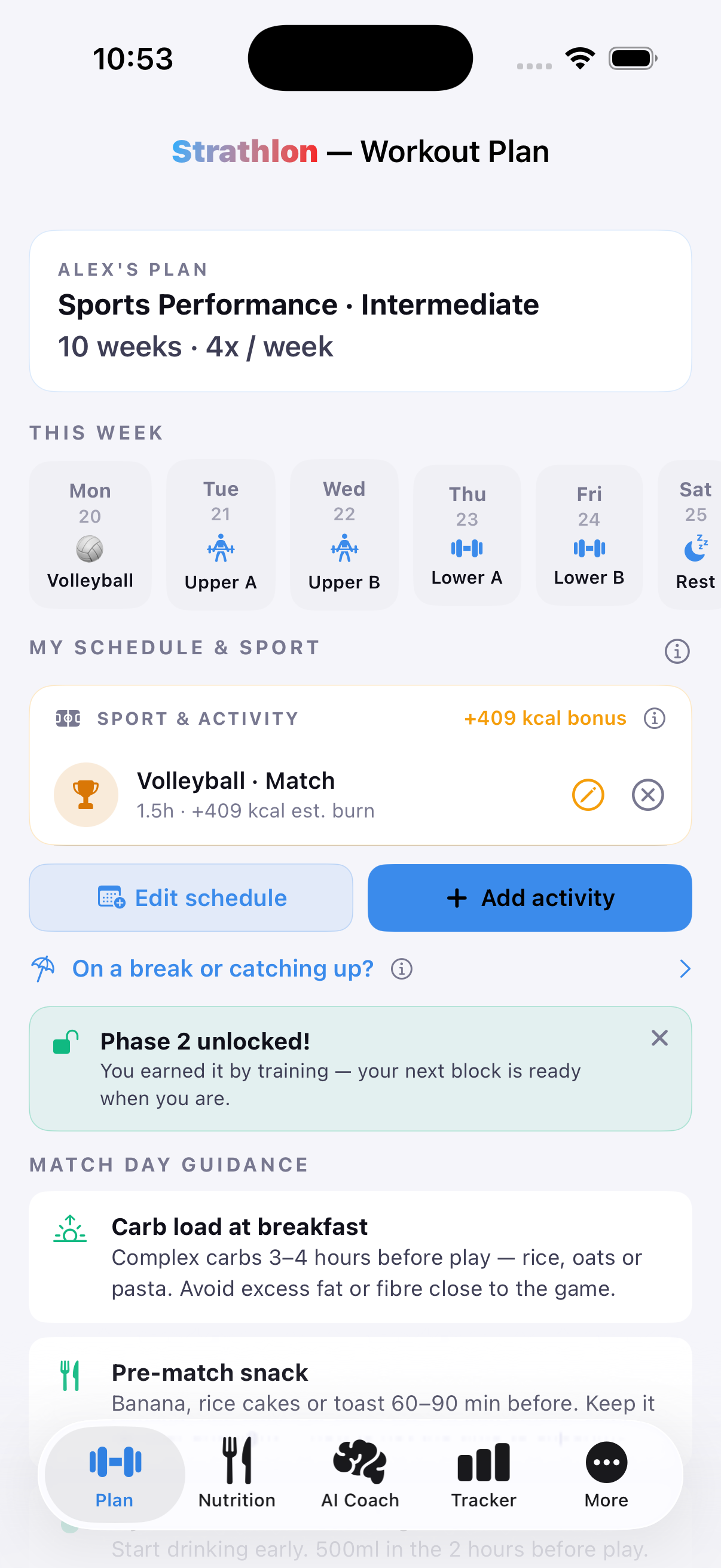
If you remember one thing, make it this: volleyball isn't won by fuelling like an endurance athlete: it's won by arriving with a full tank, staying hydrated through every changeover, and recovering well between matches across a long day. Strathlon's job is to keep that base honest by adjusting your targets around the sessions you actually log, so the everyday fuelling underneath your jump is one less thing to guess at.
References
Numbered sources for the specific figures, effect sizes and named studies above. Where a claim reflects agreed guidance rather than a single trial, the citation is to the position stand or consensus statement of the body concerned, with the country or international remit named. Volleyball has a real dietary-intake literature, most of it showing players under-eating relative to their training load, and the figures below are cited to it.
- Rebelo A, Stojanović E, Martinho DV, Pérez-López A, López-Samanes Á, Scanlan AT. What are the demands of volleyball match-play? A systematic review of the external and internal loads encountered according to playing position, number of sets, and player sex. Journal of Sports Sciences. 2026;44(6):769–796. Systematic review of the external and internal loads of volleyball match play: the source for the energy cost this guide fuels for. PubMed 41460726
- Sesbreno E, Dziedzic CE, Sygo J, Blondin DP, Haman F, Leclerc S, et al. Elite Male Volleyball Players Are at Risk of Insufficient Energy and Carbohydrate Intake. Nutrients. 2021;13(5). Study finding elite male volleyball players are at risk of insufficient energy and carbohydrate intake: the direct source for this guide's central warning. PubMed 33923156 · PMC8146803 full text
- Woodruff SJ, Meloche RD. Energy availability of female varsity volleyball players. International Journal of Sport Nutrition and Exercise Metabolism. 2013;23(1):24–30. Study of energy availability in female varsity volleyball players, the female half of the same picture. PubMed 22899818
- Mielgo-Ayuso J, Zourdos MC, Calleja-González J, Urdampilleta A, Ostojic SM. Dietary intake habits and controlled training on body composition and strength in elite female volleyball players during the season. Applied Physiology, Nutrition, and Metabolism = Physiologie Appliquee, Nutrition et Metabolisme. 2015;40(8):827–34. Study of dietary intake habits and controlled training on body composition and strength in elite female volleyball players. PubMed 26224330
- Castillo M, Lozano-Casanova M, Sospedra I, Norte A, Gutiérrez-Hervás A, Martínez-Sanz JM. Energy and Macronutrients Intake in Indoor Sport Team Athletes: Systematic Review. Nutrients. 2022;14(22). Systematic review of energy and macronutrient intake in indoor team-sport athletes, the wider benchmark. PubMed 36432438 · PMC9696016 full text
- Muniz-Santos R, Bachini F, Bassini A, Alexandre PCB, Jurisica I, Chandran V, et al. The Influence of Competition Day Loads on the Metabolic and Immune Response of Olympic Female Beach Volleyball Athletes: A Sportomics Analysis. Nutrients. 2025;17(11). Study of competition-day loads and the metabolic and immune response of Olympic female beach volleyball athletes, cited for the beach game. PubMed 40507193 · PMC12157736 full text
- Williams C, Rollo I. Carbohydrate Nutrition and Team Sport Performance. Sports Medicine. 2015;45 Suppl 1(Suppl 1):S13–22. Review of carbohydrate nutrition and team-sport performance, the source for the carbohydrate case. PubMed 26553494 · PMC4672015 full text
- Baker LB, Rollo I, Stein KW, Jeukendrup AE. Acute Effects of Carbohydrate Supplementation on Intermittent Sports Performance. Nutrients. 2015;7(7):5733–63. Review of the acute effects of carbohydrate supplementation on intermittent sports performance, the in-match evidence. PubMed 26184303 · PMC4517026 full text
- Nuccio RP, Barnes KA, Carter JM, Baker LB. Fluid Balance in Team Sport Athletes and the Effect of Hypohydration on Cognitive, Technical, and Physical Performance. Sports Medicine. 2017;47(10):1951–1982. Review of fluid balance in team-sport athletes and the effect of hypohydration on cognitive, technical and physical performance. PubMed 28508338 · PMC5603646 full text
- Thomas DT, Erdman KA, Burke LM. Position of the Academy of Nutrition and Dietetics, Dietitians of Canada, and the American College of Sports Medicine: Nutrition and Athletic Performance. Journal of the Academy of Nutrition and Dietetics. 2016;116(3):501–528. Joint position of the Academy of Nutrition and Dietetics, Dietitians of Canada and the American College of Sports Medicine: the umbrella source for the daily energy, carbohydrate and protein ranges used throughout. PubMed 26920240
- Burke LM, Hawley JA, Wong SH, Jeukendrup AE. Carbohydrates for training and competition. Journal of Sports Sciences. 2011;29 Suppl 1:S17–27. Burke and colleagues on carbohydrate for training and competition, the source for the g/kg/day carbohydrate targets matched to training load. PubMed 21660838
- Jeukendrup A. A step towards personalized sports nutrition: carbohydrate intake during exercise. Sports Medicine. 2014;44 Suppl 1(Suppl 1):S25–33. Jeukendrup on personalising carbohydrate intake during exercise: the source for the g/h feeding rates and the duration at which they start to matter. PubMed 24791914 · PMC4008807 full text
- Jäger R, Kerksick CM, Campbell BI, Cribb PJ, Wells SD, Skwiat TM, et al. International Society of Sports Nutrition Position Stand: protein and exercise. Journal of the International Society of Sports Nutrition. 2017;14:20. International Society of Sports Nutrition (ISSN, United States) position stand on protein and exercise, the source for the daily protein range and per-meal distribution. PubMed 28642676 · PMC5477153 full text
- Schoenfeld BJ, Aragon AA. How much protein can the body use in a single meal for muscle-building? Implications for daily protein distribution. Journal of the International Society of Sports Nutrition. 2018;15:10. Schoenfeld and Aragon on how much protein the body can use in a single meal, the basis for the per-feed figure quoted. PubMed 29497353 · PMC5828430 full text
- Burke LM, van Loon LJC, Hawley JA. Postexercise muscle glycogen resynthesis in humans. Journal of Applied Physiology. 2017;122(5):1055–1067. Review of post-exercise muscle glycogen resynthesis, the source for the refuelling rates and for when a fast refuel is actually needed. PubMed 27789774
- Sawka MN, Burke LM, Eichner ER, Maughan RJ, Montain SJ, Stachenfeld NS. American College of Sports Medicine position stand. Exercise and fluid replacement. Medicine and Science in Sports and Exercise. 2007;39(2):377–90. ACSM position stand on exercise and fluid replacement: the source for the under-2% body-mass-loss guideline and the sweat-rate method. PubMed 17277604
- Barnes KA, Anderson ML, Stofan JR, Dalrymple KJ, Reimel AJ, Roberts TJ, et al. Normative data for sweating rate, sweat sodium concentration, and sweat sodium loss in athletes: An update and analysis by sport. Journal of Sports Sciences. 2019;37(20):2356–2366. Normative data for sweating rate and sweat sodium concentration in athletes, the source for how widely fluid and sodium losses vary between individuals. PubMed 31230518
- Hew-Butler T, Rosner MH, Fowkes-Godek S, Dugas JP, Hoffman MD, Lewis DP, et al. Statement of the Third International Exercise-Associated Hyponatremia Consensus Development Conference, Carlsbad, California, 2015. Clinical Journal of Sport Medicine : Official Journal of the Canadian Academy of Sport Medicine. 2015;25(4):303–20. Third International Exercise-Associated Hyponatremia Consensus statement, the basis for the warning against drinking well beyond sweat losses. PubMed 26102445
- Guest NS, VanDusseldorp TA, Nelson MT, Grgic J, Schoenfeld BJ, Jenkins NDM, et al. International society of sports nutrition position stand: caffeine and exercise performance. Journal of the International Society of Sports Nutrition. 2021;18(1):1. ISSN position stand on caffeine and exercise performance, the source for the caffeine dose and timing guidance. PubMed 33388079 · PMC7777221 full text
- Kreider RB, Kalman DS, Antonio J, Ziegenfuss TN, Wildman R, Collins R, et al. International Society of Sports Nutrition position stand: safety and efficacy of creatine supplementation in exercise, sport, and medicine. Journal of the International Society of Sports Nutrition. 2017;14:18. ISSN position stand on the safety and efficacy of creatine supplementation, cited where creatine is relevant to the sport's demands. PubMed 28615996 · PMC5469049 full text
- Maughan RJ, Burke LM, Dvorak J, Larson-Meyer DE, Peeling P, Phillips SM, et al. IOC consensus statement: dietary supplements and the high-performance athlete. British Journal of Sports Medicine. 2018;52(7):439–455. IOC consensus statement on dietary supplements and the high-performance athlete: the framing for treating supplements as optional extras. PubMed 29540367 · PMC5867441 full text
- Mountjoy M, Ackerman KE, Bailey DM, Burke LM, Constantini N, Hackney AC, et al. 2023 International Olympic Committee's (IOC) consensus statement on Relative Energy Deficiency in Sport (REDs). British Journal of Sports Medicine. 2023;57(17):1073–1097. The 2023 IOC consensus statement on Relative Energy Deficiency in Sport, the source for the consequences of under-fuelling a training load. PubMed 37752011
- Aragon AA, Schoenfeld BJ. Nutrient timing revisited: is there a post-exercise anabolic window?. Journal of the International Society of Sports Nutrition. 2013;10(1):5. Aragon and Schoenfeld on the post-exercise anabolic window, the source for timing mattering far less than daily totals. PubMed 23360586 · PMC3577439 full text
- British Dietetic Association (BDA, United Kingdom). Sport and exercise nutrition: Food Fact Sheet. British Dietetic Association (BDA, United Kingdom) Food Fact Sheet on sport and exercise nutrition, the practical UK dietetic framing. BDA Food Fact Sheet
This is general educational information rather than medical, dietary or coaching advice. The sports-nutrition figures here are drawn from established consensus and are framed as population-level guides: individual needs vary widely with body size, position, conditions, gut tolerance and health, and are best personalised with a qualified professional. Anyone with a health condition, a history of disordered eating, or who is pregnant or postpartum, or who suspects under-fuelling, stress fractures, menstrual disruption or RED-S, should consult a sports physician or registered dietitian before making changes. See our Terms for more.
← All guides · Volleyball strength and conditioning · Eating for results · Understanding your stats · Home