
How much protein do you actually need?
An evidence-based guide to the one nutrition number most people get wrong in both directions: protein. This covers the daily target for active people and anyone building or keeping muscle, the higher intakes that protect lean mass when you're dieting hard, how much to eat per meal and how to spread it, why the daily total matters more than precise timing, the quality difference between plant and animal sources, and the honest myths: you don't need shakes, and more isn't unlimited-better. Practical, and grounded in published sports-nutrition consensus.
Here's the short answer: most active people who want to build or keep muscle do well on roughly 1.4–2.0 g of protein per kg of body weight per day (up to about 2.2 g/kg for hard resistance training) spread across the day in meals of roughly 20–40 g each. The total you eat over the day matters far more than the exact timing, and once you're hitting that target, more protein doesn't buy more muscle. Everything below is the detail behind that sentence: the numbers, where they come from, and how to make them work for you.
On this page
- Survival vs. thriving: why the RDA is a floor
- The daily number for active people
- A worked daily target
- When you're dieting hard: protecting muscle
- Per-meal dosing and spreading it out
- Timing: total daily protein beats the "window"
- Quality and sources: plant, animal and leucine
- Do you need protein shakes?
- Is more always better?
- Common questions
- Takeaways
A framing note before the numbers. Protein needs are well studied, but people differ: body size, training, age, sex, how lean you are and your goals all shift what's right for you. So this is written as can, tends to and around, never as a guarantee, and every specific figure is a population-level guide drawn from published consensus rather than a personal prescription. It's general education rather than medical or dietary advice, and it isn't a personalised plan.
Survival vs. thriving: why the RDA is a floor
The number most people half-remember, the Recommended Dietary Allowance (RDA) of about 0.8 g of protein per kg of body weight per day, is real, but it answers a different question than the one you're asking. The RDA was set to estimate the minimum intake needed to stop the average sedentary adult from slowly losing body protein: a floor to prevent deficiency rather than a target to build or keep muscle on. It has been essentially unchanged for decades and was never meant to describe what an active body thrives on.
Once you train, and especially once you lift, the picture changes. Exercise damages and remodels muscle, raises protein turnover, and (with enough total food) lets you add lean tissue. All of that draws on dietary protein, so the amount that keeps a sofa-bound person out of deficiency is well short of the amount that lets a training person adapt. That's why every sports-nutrition body sets its recommendations above the RDA rather than at it.
The daily number for active people
Two of the most authoritative consensus documents converge on a similar band. The joint position on nutrition and athletic performance from the Academy of Nutrition and Dietetics, Dietitians of Canada and the American College of Sports Medicine recommends daily protein of roughly 1.2–2.0 g per kg of body weight to support training adaptation, repair and remodelling. The International Society of Sports Nutrition (ISSN) position stand on protein and exercise puts the range for building and maintaining muscle at 1.4–2.0 g/kg/day for most exercising people, and adds a useful nuance: endurance athletes sit toward the lower end, those doing intermittent or mixed sports in the middle, and strength or power athletes toward the upper end.
Where within that range should a dedicated lifter aim? A large 2018 systematic review and meta-analysis (49 studies, over 1,800 participants) found that adding protein reliably increased muscle and strength gains from resistance training, but that the benefit to lean mass largely plateaued once total intake reached about 1.6 g/kg/day, with the upper edge of the statistical confidence interval near 2.2 g/kg/day. That is exactly where the popular practical target of around 1.6–2.2 g/kg/day for hard resistance training comes from: about 1.6 g/kg is where most of the muscle-building payoff has already been captured, and 2.2 g/kg is a sensible ceiling that covers individual variation without overshooting into pointless excess. That same review noted the effect shrank with age (older adults may need to sit higher in the range) and was stronger in people who were already resistance-trained.
A worked daily target
Grams per kilogram is abstract until you put a body weight to it. Here's the same guidance turned into real daily totals for a few example weights, using the common active-person band. Read it as a range to land inside, rather than a single figure to hit exactly.
| Body weight | General active / endurance-leaning (~1.4 g/kg) | Building / keeping muscle (~1.8 g/kg) | Hard resistance training (~2.2 g/kg) |
|---|---|---|---|
| 60 kg | ~84 g | ~108 g | ~132 g |
| 70 kg | ~98 g | ~126 g | ~154 g |
| 80 kg | ~112 g | ~144 g | ~176 g |
| 90 kg | ~126 g | ~162 g | ~198 g |
A couple of honest caveats so you use this well. The figures are illustrative arithmetic from the consensus ranges above rather than a prescription: your own number depends on your sport, your goal, your age and how much lean mass you carry. And if you're carrying a lot of excess body fat, calculating protein off a target or reference body weight (rather than total scale weight) tends to give a more sensible number, since fat mass isn't the tissue driving your protein needs.
When you're dieting hard: protecting muscle
Protein needs go up rather than down when you're in a calorie deficit trying to lose fat. Two things happen when energy is scarce: your body is more inclined to break down muscle for fuel, and higher protein helps blunt that while keeping you fuller. So the harder and leaner you diet, the more protein helps protect the muscle you already have.
The ISSN position stand reflects this directly: it notes that higher intakes of roughly 2.3–3.1 g/kg/day may be needed to preserve lean body mass in resistance-trained people during hypocaloric (calorie-restricted) periods. The underlying research is usually framed per kilogram of fat-free (lean) mass, and the practical rule of thumb that falls out of it is intuitive: the leaner you already are and the more aggressive the deficit, the higher within that range you should push protein. A relatively lean physique athlete crash-cutting for a deadline is the case for the top of the range. Someone with plenty of fat to lose on a gentle deficit needs far less.
Per-meal dosing and spreading it out
The daily total is the headline, but how you split it up matters at the margins. After a protein-containing meal, muscle protein synthesis rises and then settles, and it's maximised by a fairly modest dose rather than an enormous one. The ISSN suggests about 0.25 g of high-quality protein per kg of body weight, or an absolute dose of roughly 20–40 g, per serving, with servings every three to four hours across the day. Reviewers who looked specifically at daily distribution put a slightly more generous practical ceiling of about 0.4 g/kg per meal, eaten across at least four meals, as a reliable way to reach a muscle-building daily total.
Put together, that gives a simple pattern: aim for something like 0.25–0.4 g/kg (roughly 20–40 g) of protein per meal, three to five times a day. This is the practical case for not saving all your protein for one big dinner: three or four moderate protein feeds tend to stimulate more total muscle-building signal across the day than a single large one, even for the same total grams. Older adults in particular seem to benefit from making sure each meal clears a decent protein dose, because ageing muscle is a little less responsive to small amounts.
Timing: total daily protein beats the "window"
Few fitness ideas are as sticky as the anabolic window: the belief that you must slam protein within minutes of finishing a workout or forfeit your gains. The evidence has walked this back a long way. The ISSN position stand concludes that total protein and calorie intake is the most important consideration for adapting to resistance training, and that the effect of eating protein immediately before or after training, over and above hitting your daily total, is minimal in non-athletic populations.
That doesn't make timing worthless: it makes it a second-order concern. Having some protein in the hours around training is sensible, and spreading protein evenly across the day (rather than skewing it all to one meal) has a modest edge. But the window is measured in hours rather than minutes, and it sits on top of the thing that actually decides the outcome: did you hit your daily protein target? Get the total right first. Worry about distribution second. Stop worrying about the stopwatch almost entirely.
Quality and sources: plant, animal and leucine
Not all protein is equally good at building muscle, and the difference comes down mostly to two things: amino acid profile (especially the amount of leucine, the amino acid that acts as the main on-switch for muscle protein synthesis) and digestibility. Animal proteins (whey, milk, eggs, meat and fish) tend to be complete, highly digestible and leucine-rich, which is why the ISSN highlights leucine-containing doses of roughly 700–3000 mg (about 1–3 g of leucine) per meal as part of what maximises the response, an amount animal foods reach easily.
Single plant proteins tend to fall a little short: they're often lower in leucine, sometimes missing or low in one or more essential amino acids, and can be less digestible. In head-to-head studies, animal sources such as milk protein have edged out single plant sources like soy for lean-mass gains. But, and this matters, the gap is closable. Eating a bit more total plant protein, combining sources so their amino acids complement each other (classically legumes with grains), and making sure each meal carries enough leucine largely evens things out. A well-planned plant-based or mixed diet with enough total protein builds and keeps muscle perfectly well. You just have to be a little more deliberate about quantity and variety.
Do you need protein shakes?
No. This is worth stating plainly because the supplement industry works hard to blur it. The ISSN is explicit that it is possible to meet your protein needs from whole foods, and that supplementation is simply a practical, convenient way to get there. A protein shake is nothing more than a portable, cheap, fast, easily measured source of high-quality protein. It has no special muscle-building property that chicken, fish, eggs, dairy, tofu, beans or lentils lack.
Where powders genuinely earn their place is convenience: hitting a high daily target when you're busy or travelling, getting protein in when your appetite is low, or topping up around training without cooking. If those describe you, a shake is a useful tool. If you can comfortably reach your daily number with food you enjoy, you can skip powder entirely and lose nothing. Think of it as a shortcut, never a requirement.
Is more always better?
Given all this, why not just eat as much protein as possible? Because the benefit has a ceiling. As the meta-analysis showed, muscle-building gains from extra protein largely level off once you're around 1.6 g/kg/day, and the practical top end for hard training sits near 2.2 g/kg. Push past what your goal needs and you don't add more muscle: you're just eating protein your body oxidises for energy like any other calorie.
There's also an opportunity cost. Every extra gram of protein is a gram of carbohydrate or fat you didn't eat, and for an active person, carbohydrate is often the fuel that actually powers hard training. Crowding your plate with excess protein can quietly leave you under-fuelled for performance. On safety, the reassuring news is that for healthy people the intakes used in training (up to around 2 g/kg/day, and higher for short dieting phases) are well tolerated in the research, with no established harm to healthy kidneys or bones. The clear exception is anyone with existing kidney disease or another relevant medical condition, who should get individual advice before eating high protein. For everyone else the message is simply: hit your target, and there's no prize for wildly exceeding it.
Common questions
How much protein do I actually need per day?
It depends on what you're asking your body to do. The baseline Recommended Dietary Allowance to prevent deficiency is about 0.8 g of protein per kg of body weight per day, but that is a floor for sedentary people rather than an optimum. For active people and anyone building or keeping muscle, sports-nutrition position stands put the useful range at roughly 1.2–2.0 g/kg/day (Academy of Nutrition and Dietetics, Dietitians of Canada and the American College of Sports Medicine) or 1.4–2.0 g/kg/day (International Society of Sports Nutrition), with endurance athletes toward the lower end and strength or power athletes toward the upper end. A widely cited meta-analysis found muscle-building gains from extra protein largely plateau once total intake reaches about 1.6 g/kg/day, with the upper confidence limit near 2.2 g/kg/day, which is where the practical target of about 1.6–2.2 g/kg/day for hard resistance training comes from.
Does protein timing matter, or just the daily total?
For most people the daily total matters far more than the exact timing. The International Society of Sports Nutrition concludes that total protein and calorie intake is the most important consideration for adapting to resistance training, and that the effect of eating protein immediately before or after training is minimal in non-athletic populations. There is a modest benefit to spreading protein across the day rather than piling it into one meal (roughly a dose every three to four hours) but the old idea of a narrow anabolic window you must hit within minutes of training is overstated. Hit your daily number first, and distribute it sensibly second.
How much protein can I use in one meal?
Muscle protein synthesis after a meal is maximised by a fairly modest dose. The International Society of Sports Nutrition suggests about 0.25 g of high-quality protein per kg of body weight, or an absolute dose of roughly 20–40 g, per meal. Reviewers who looked specifically at daily distribution suggest a slightly more generous ceiling of about 0.4 g/kg per meal, eaten across at least four meals, to comfortably reach a muscle-building daily total. Protein beyond the amount that maximises synthesis in one sitting isn't wasted. It is still used for other functions and oxidised for energy, but the extra doesn't add more to the muscle-building signal from that meal, which is the practical reason to spread protein out rather than saving it all for dinner.
Is plant protein as good as animal protein for building muscle?
Gram for gram, many single plant proteins are slightly less effective than animal proteins for building muscle, because they tend to be lower in the amino acid leucine (the main trigger for muscle protein synthesis) and less complete or less digestible. Position-stand evidence generally ranks animal proteins such as whey, milk and eggs above single plant sources like soy for lean-mass gains. But this is a gap you can close: eating a bit more total plant protein, combining sources so the amino acids complement each other (for example legumes with grains), and making sure each meal carries enough leucine largely levels the playing field. A well-planned plant-based diet with enough total protein can absolutely build and keep muscle.
Do you need protein shakes to hit your target?
No. Protein powder is a convenience rather than a requirement. The International Society of Sports Nutrition is explicit that it is possible to meet your protein needs from whole foods, and that supplementation is simply a practical way to do it. A shake is just a portable, cheap, fast source of protein (useful when you're busy, travelling, or short of appetite) but it holds no special muscle-building magic over chicken, fish, eggs, dairy, tofu, beans or lentils. If you can hit your daily number with food you enjoy, you need no powder at all.
Can you eat too much protein?
For healthy people, protein intakes in the ranges used for training (up to around 2 g/kg/day, and higher for short periods when dieting) are well tolerated and not associated with harm to healthy kidneys or bones in the research. But more is not unlimited-better: once you're meeting your muscle-building target, extra protein doesn't add more muscle, and every gram of protein you eat displaces a gram of carbohydrate or fat you might have used for training fuel or satiety. Very high intakes are simply unnecessary for most goals. The exception is people with existing kidney disease or another medical condition, who should get individual advice before pushing protein high.
Takeaways
- The RDA (0.8 g/kg) is a floor rather than a target. It prevents deficiency in sedentary people, and active bodies and muscle-builders need meaningfully more.
- Aim for roughly 1.4–2.0 g/kg/day if you're active: the lower end for endurance, the upper end for strength and power, per the ISSN and the ACSM/AND/DC joint position (1.2–2.0 g/kg).
- About 1.6–2.2 g/kg/day suits hard resistance training. Gains from extra protein largely plateau near 1.6 g/kg, with ~2.2 g/kg a sensible ceiling.
- Dieting hard? Go higher. Roughly 2.3–3.1 g/kg/day (framed per kg of lean mass) helps protect muscle in lean, resistance-trained people during an aggressive deficit.
- Spread it out. About 0.25–0.4 g/kg (~20–40 g) per meal, three to five times a day, tends to beat one big protein hit for the same total.
- Total daily protein beats timing. The anabolic window spans hours rather than minutes: hit your daily number first, distribute second, forget the stopwatch.
- Mind quality, but plants work. Animal proteins are leucine-rich and complete. Single plant sources lag slightly, a gap closed by more total protein, combining sources and enough leucine per meal.
- You don't need shakes. Powder is convenience rather than magic: whole foods do the same job.
- More isn't unlimited-better. Past your target, extra protein adds no muscle and crowds out training fuel. In healthy people, the training ranges are well tolerated.
- References
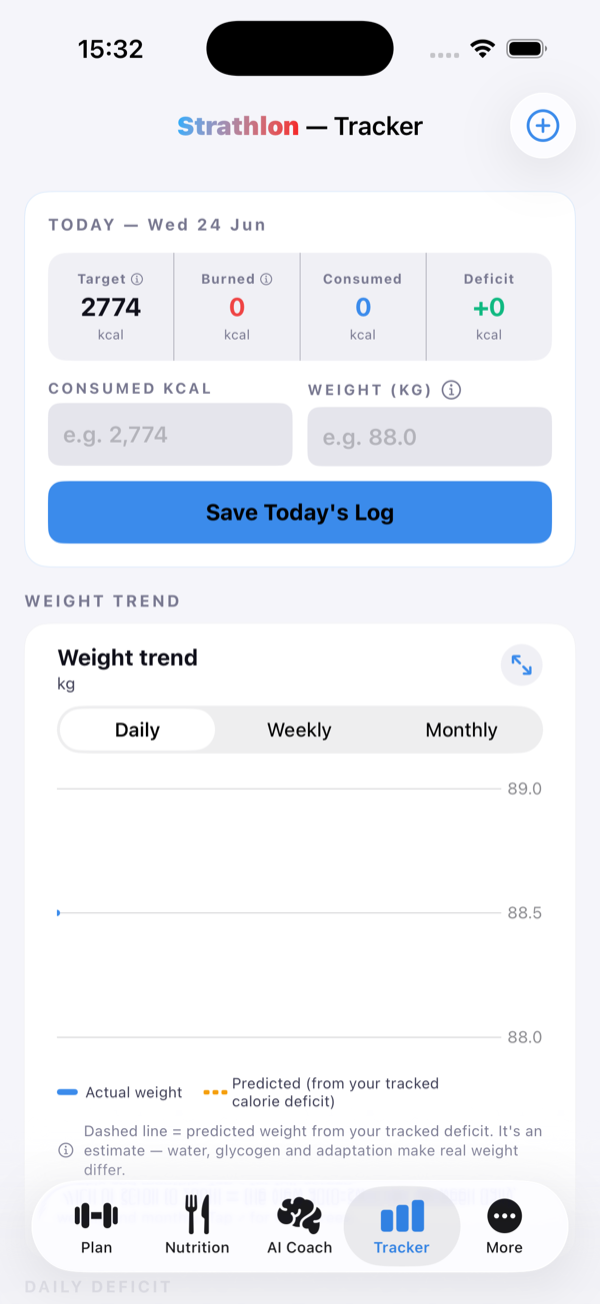
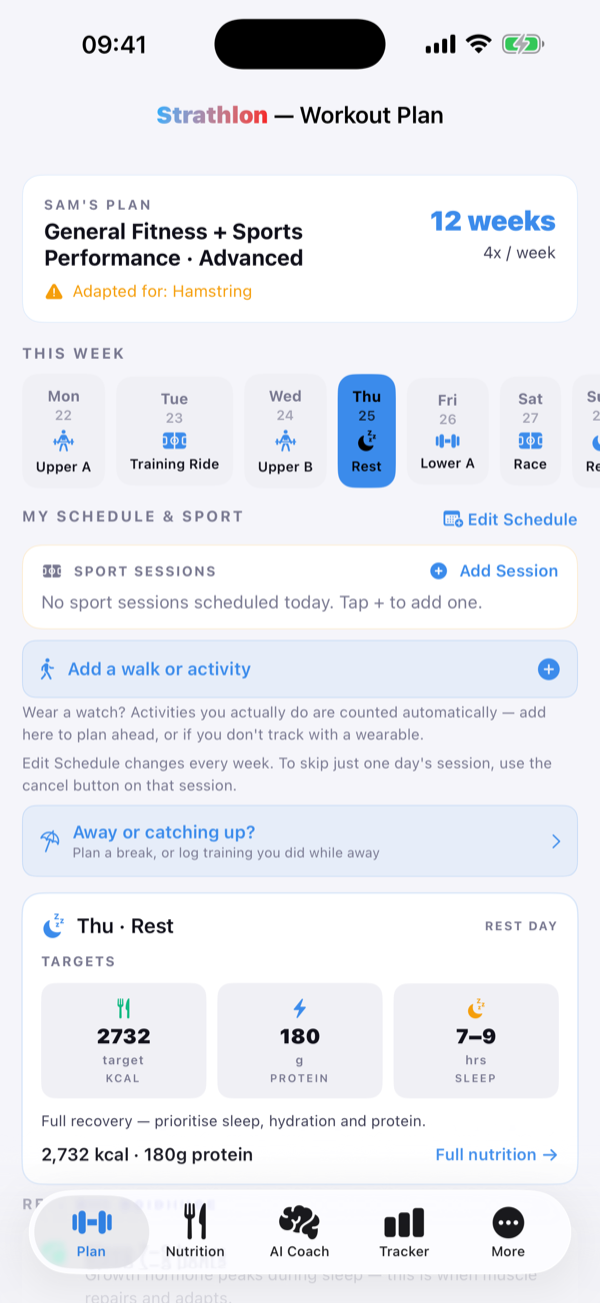
If you remember one thing, make it the daily total: pick a target in the band that fits your training (around 1.6–2.2 g/kg if you're chasing muscle), split it into a few moderate protein meals, and stop sweating the rest. Strathlon's job is to keep that daily number visible and honest, adjusting your targets around the training you actually log, so the part that decides the outcome is the part you can see at a glance.
References
Numbered sources for the specific figures and ranges above. Where a point reflects agreed guidance rather than a single trial, the citation is to the position stand or consensus statement of the body concerned, with the country or international remit named. Protein is the best-served topic in sports nutrition; almost every figure here comes from a meta-analysis or a position stand rather than a single trial.
- Jäger R, Kerksick CM, Campbell BI, Cribb PJ, Wells SD, Skwiat TM, et al. International Society of Sports Nutrition Position Stand: protein and exercise. Journal of the International Society of Sports Nutrition. 2017;14:20. ISSN position stand on protein and exercise: the primary source for the 1.4 to 2.0 g/kg/day range and for the per-meal distribution advice. PubMed 28642676 · PMC5477153 full text
- Thomas DT, Erdman KA, Burke LM. Position of the Academy of Nutrition and Dietetics, Dietitians of Canada, and the American College of Sports Medicine: Nutrition and Athletic Performance. Journal of the Academy of Nutrition and Dietetics. 2016;116(3):501–528. Joint position of the Academy of Nutrition and Dietetics, Dietitians of Canada and the ACSM, the source for the 1.2 to 2.0 g/kg athlete range quoted alongside the ISSN figure. PubMed 26920240
- Morton RW, Murphy KT, McKellar SR, Schoenfeld BJ, Henselmans M, Helms E, et al. A systematic review, meta-analysis and meta-regression of the effect of protein supplementation on resistance training-induced gains in muscle mass and strength in healthy adults. British Journal of Sports Medicine. 2018;52(6):376–384. Morton and colleagues' meta-analysis and meta-regression: the source for gains largely plateauing near 1.6 g/kg/day with a sensible ceiling above it. PubMed 28698222 · PMC5867436 full text
- Schoenfeld BJ, Aragon AA. How much protein can the body use in a single meal for muscle-building? Implications for daily protein distribution. Journal of the International Society of Sports Nutrition. 2018;15:10. Schoenfeld and Aragon on the usable protein dose in a single meal, the basis for the 0.25 to 0.40 g/kg (about 20 to 40 g) per-feed figure. PubMed 29497353 · PMC5828430 full text
- Mamerow MM, Mettler JA, English KL, Casperson SL, Arentson-Lantz E, Sheffield-Moore M, et al. Dietary protein distribution positively influences 24-h muscle protein synthesis in healthy adults. The Journal of Nutrition. 2014;144(6):876–80. Mamerow and colleagues on even protein distribution and 24-hour muscle protein synthesis, supporting three to five feeds over one large hit. PubMed 24477298 · PMC4018950 full text
- Mazzulla M, Abou Sawan S, Williamson E, Hannaian SJ, Volterman KA, West DWD, et al. Protein Intake to Maximize Whole-Body Anabolism during Postexercise Recovery in Resistance-Trained Men with High Habitual Intakes is Severalfold Greater than the Current Recommended Dietary Allowance. The Journal of Nutrition. 2020;150(3):505–511. Protein needed to maximise whole-body anabolism after exercise in trained men already eating a lot of protein: the study behind the upper end of the per-meal range. PubMed 31618421
- Helms ER, Zinn C, Rowlands DS, Brown SR. A systematic review of dietary protein during caloric restriction in resistance trained lean athletes: a case for higher intakes. International Journal of Sport Nutrition and Exercise Metabolism. 2014;24(2):127–38. Helms and colleagues' systematic review of protein during caloric restriction in lean resistance-trained athletes, the source for the 2.3 to 3.1 g/kg lean-mass figure while dieting hard. PubMed 24092765
- Longland TM, Oikawa SY, Mitchell CJ, Devries MC, Phillips SM. Higher compared with lower dietary protein during an energy deficit combined with intense exercise promotes greater lean mass gain and fat mass loss: a randomized trial. The American Journal of Clinical Nutrition. 2016;103(3):738–46. Longland and colleagues' trial of higher versus lower protein in a deficit with intense exercise, the direct evidence for protein protecting lean mass while cutting. PubMed 26817506
- Kanaan MF, Nait-Yahia S, Doucet É. The effects of high protein intakes during energy restriction on body composition, energy metabolism and physical performance in recreational athletes. European Journal of Clinical Nutrition. 2025;79(6):544–552. A randomised trial of high protein intakes during energy restriction on body composition and performance, added as a recent check on the same claim. PubMed 40011662
- Drummen M, Tischmann L, Gatta-Cherifi B, Fogelholm M, Raben A, Adam TC, et al. High Compared with Moderate Protein Intake Reduces Adaptive Thermogenesis and Induces a Negative Energy Balance during Long-term Weight-Loss Maintenance in Participants with Prediabetes in the Postobese State: A PREVIEW Study. The Journal of Nutrition. 2020;150(3):458–463. Trial showing higher protein reduced adaptive thermogenesis during weight loss, supporting the metabolic argument for holding protein high in a deficit. PubMed 31754687 · PMC7056617 full text
- Aragon AA, Schoenfeld BJ. Nutrient timing revisited: is there a post-exercise anabolic window?. Journal of the International Society of Sports Nutrition. 2013;10(1):5. Aragon and Schoenfeld on the anabolic window, the source for total daily protein outranking timing. PubMed 23360586 · PMC3577439 full text
- Zare R, Devrim-Lanpir A, Guazzotti S, Ali Redha A, Prokopidis K, Spadaccini D, et al. Effect of Soy Protein Supplementation on Muscle Adaptations, Metabolic and Antioxidant Status, Hormonal Response, and Exercise Performance of Active Individuals and Athletes: A Systematic Review of Randomised Controlled Trials. Sports Medicine. 2023;53(12):2417–2446. Systematic review of soy protein and muscle adaptations, the evidence behind plant sources lagging slightly and the gap being closable. PubMed 37603200 · PMC10687132 full text
- Helms ER, Aragon AA, Fitschen PJ. Evidence-based recommendations for natural bodybuilding contest preparation: nutrition and supplementation. Journal of the International Society of Sports Nutrition. 2014;11:20. Evidence-based recommendations for natural bodybuilding contest preparation, cited for the practical upper ranges and for powder being convenience rather than necessity. PubMed 24864135 · PMC4033492 full text
- British Dietetic Association (BDA, United Kingdom). Sport and exercise nutrition: Food Fact Sheet. BDA Food Fact Sheet on sport and exercise nutrition: the UK dietetic view that whole foods cover most people's needs. BDA Food Fact Sheet
- National Health Service (NHS, United Kingdom). Physical activity guidelines for adults aged 19 to 64. NHS physical activity guidance, the population baseline the 'active' qualifier in this guide is measured against. NHS physical activity guidelines
This is general educational information rather than medical, dietary or coaching advice. The protein figures here are drawn from established sports-nutrition consensus and are framed as population-level guides: individual needs vary widely with body size, training, age, sex and health, and are best personalised with a qualified professional. Anyone with a health condition (particularly kidney disease), a history of disordered eating, or who is pregnant or postpartum, should consult a physician or registered dietitian before making significant changes to protein intake. See our Terms for more.
← All guides · How muscle actually grows · Eating to build muscle · Eating for results · Pre- & post-workout nutrition · Home