
American football strength & conditioning
An evidence-based guide to training for the gridiron. American football is, more than almost any team sport, a game of brief, violent efforts: a few seconds of maximal sprinting, blocking and tackling, then a rest, then again, for dozens of plays. This covers the max strength and explosive power that drive those efforts, how strength transfers to speed and change of direction, the short-burst conditioning the game actually asks for, and the prehab that protects the knees, hamstrings, shoulders and heads football most often hurts. Practical, honest, and grounded in strength-and-conditioning research.
Here's the whole thing in one sentence: American football is won by maximal strength, explosive power and short-sprint acceleration (produced in roughly five-second bursts and repeated all game), so the training that matters most is heavy lifting, explosive power work and short conditioning, wrapped in the prehab that protects knees, hamstrings, shoulders and heads. Everything below is the detail behind that sentence: which lifts build those qualities, why they transfer, how to condition without undoing your strength, and how to hold it all together across a season.
On this page
A framing note before the detail. Strength-and-conditioning science is well studied, but people and positions differ enormously: a nose tackle and a cornerback are almost different athletes, and age, training age, body size and health status all shift what's right for an individual. So this is written as can, tends to and is associated with, never as a guarantee, and every specific number is a population-level guide drawn from published research rather than a personal prescription. It's general education rather than medical or individual coaching advice, and it isn't a substitute for a qualified S&C coach.
The demands of American football
Football looks like an endurance sport from the stands (games run for hours), but physiologically it is the opposite. It is a collision-and-sprint sport made of very short maximal efforts. Two match-analysis studies describe it, and they measured different populations in different ways, so they are worth keeping apart. Rhea and colleagues (2006) observed 30 games across three levels: the average play lasted 5.6 seconds in high school and about half a second less in college and in the NFL, and the work-to-recovery ratio was 1:5.5 at high-school level, 1:6.1 in college and 1:6.2 in the NFL: recovery between plays being longest in the NFL and shortest in high school.[1] Iosia and Bishop (2008) instead timed the rest directly, in televised NCAA Division IA college games: plays averaged 5.23 seconds, and the rest between them averaged 36.1 seconds with extended stoppages excluded, rising to 46.9 seconds once time-outs and injury attention were counted in.[2] The two figures are not interchangeable: one is a ratio derived across three levels of the game, the other a directly measured rest interval in college football alone. In plain terms, though, the picture agrees: you sprint or collide flat-out for around five seconds, then recover for something like half a minute, over and over.
That structure tells you which energy system runs the show. Efforts that short and that intense are powered predominantly by the phosphagen (ATP-PC) system (the stored ATP and phosphocreatine that can be split fastest) rather than by the glycolytic and aerobic pathways that come to the fore over longer efforts. The honest caveat is that energy is drawn from all the pathways in almost any activity, and the old picture of them switching on one after another, with the aerobic system barely contributing to short work, is a misconception.[3] A decent aerobic base still matters, but its job here is mainly to help you recover between plays and between practice reps. It does not power the plays themselves: the ability to repeat sprints depends heavily on how fast phosphocreatine is restored between efforts, which is an oxidative process.[4] This is why conditioning modelled on distance running tends to miss: football's engine is short, powerful and repeatable rather than long and steady.
Biomechanically, the game is about producing and absorbing large forces quickly: accelerating out of a low stance, driving through a block, exploding into or breaking a tackle, planting and cutting to change direction. The exact blend is position-dependent. Linemen live in short-range, high-force collisions and benefit from maximal strength, muscle mass and power off the line. Skill positions (receivers, backs, defensive backs) live on sprint speed, acceleration and sharp change of direction. Almost every position, though, sits on a shared base of strength and short-sprint power.
The injury profile follows from all that force and contact. In an analysis of official NFL injury reports across two regular seasons between 2012 and 2014, the knee was the most frequently injured site (17.8% of injuries), followed by the ankle (12.4%), the hamstring (8.7%), the shoulder (8.4%) and the head (7.0%), and roughly six in ten injuries (61.9%) were to the lower extremity.[5] Those sites, knee (including the ACL), hamstring, shoulder and head, are exactly where the training below tries to build resilience.
Key strength work, and why it matters
The base of football training is old-fashioned maximal strength: the ability to produce a lot of force. Force is what accelerates a body, drives a block and anchors against one, and it is the quality every other explosive trait is built on: you cannot express power you don't have the strength to produce. A large review of the topic concludes that greater muscular strength can enhance the ability to perform general sport skills such as jumping, sprinting and change of direction, and that it decreases the risk of injury when performing those skills.[6] The best tools are the big compound patterns loaded heavily: the squat and hinge (deadlift, trap-bar, hip thrust) for the hips and legs that drive sprinting and collisions, and horizontal and vertical press and pull for the upper body that blocks, sheds and tackles.
This isn't strength for its own sake: it transfers. A meta-analysis by Seitz and colleagues (2014) found that increases in lower-body (back-squat) strength transfer positively to sprint performance, reporting a very large correlation (r = −0.77) between how much athletes improved their squat and how much faster they got.[7] Getting stronger, in other words, tends to make you faster. That's worth remembering the next time someone claims lifting will "slow you down."
Strength opens the door. Power walks through it. Power is force applied quickly, and football is played in a window too short to reach maximal force, so how fast you can express force (your rate of force development) often matters more than your absolute one-rep max. Two families of exercise build it. The first is weightlifting derivatives (power cleans, hang cleans, pulls and jump shrugs), which Suchomel and colleagues (2017) argue can be sequenced through the training year to develop strength, rate of force development and power output, programmed by where each variation sits on the force–velocity curve.[8] The second is plyometrics and jumps/throws (bounds, hurdle hops, broad jumps, medicine-ball throws), which train the reactive, elastic quality behind a fast first step. The best evidence here is in youth rather than adults: a meta-analysis of plyometric-jump training in healthy participants under 18 found small-to-moderate improvements (effect sizes 0.35–0.80) in maximal dynamic strength, linear sprint speed, horizontal jump, reactive strength index and sport-specific performance. The gains seemed to be similar before and after peak height velocity.[9] Be careful what you take from it, though: change-of-direction speed and countermovement-jump height were not significantly improved, and the certainty of the evidence was rated low to very low throughout.[9]
Because the game is played on one leg as often as two (every cut, plant and sprint step is a single-leg action), unilateral work earns its place: split squats, lunges, step-ups and lateral variations build the single-leg strength and control that underpin change of direction (a quality that tracks with lower-body strength[6]) and help even out left-right imbalances. And because football is a contact sport played through the neck, direct neck training (multi-planar isometric, concentric and eccentric work) is worth including for head control, with the honest caveat covered in the injury section below.
How you load these lifts depends on the quality you're chasing. The position stand on resistance-training progression from the American College of Sports Medicine (ACSM, United States) describes broadly the following bands for trained lifters (bear in mind this is one country's professional body, and that guidance elsewhere is expressed in slightly different terms):[10]
| Quality | Load | Reps | What it's for |
|---|---|---|---|
| Maximal strength | Heavy | ~1–6RM | Raw force: the base under everything else. Long rests (3–5 min). |
| Power | Two strands | Heavy + fast | Heavy strength work plus light, fast lifts: 0–60% of 1RM for lower-body and 30–60% for upper-body power moves, done explosively. |
| Hypertrophy (size) | Moderate | ~6–12RM | Muscle mass: protective and useful for collision positions. Shorter rests (1–2 min). |
Those are population-level starting bands rather than rules. The important idea is that a football athlete usually needs all three across a year (mass and maximal strength built first, then converted into power and speed) rather than living in any one rep range. And the sport-specific explosive work only pays off when it sits on top of that complementary base: heavy compound strength underneath, short conditioning around it, so the jumps and accessory movements have something to express.
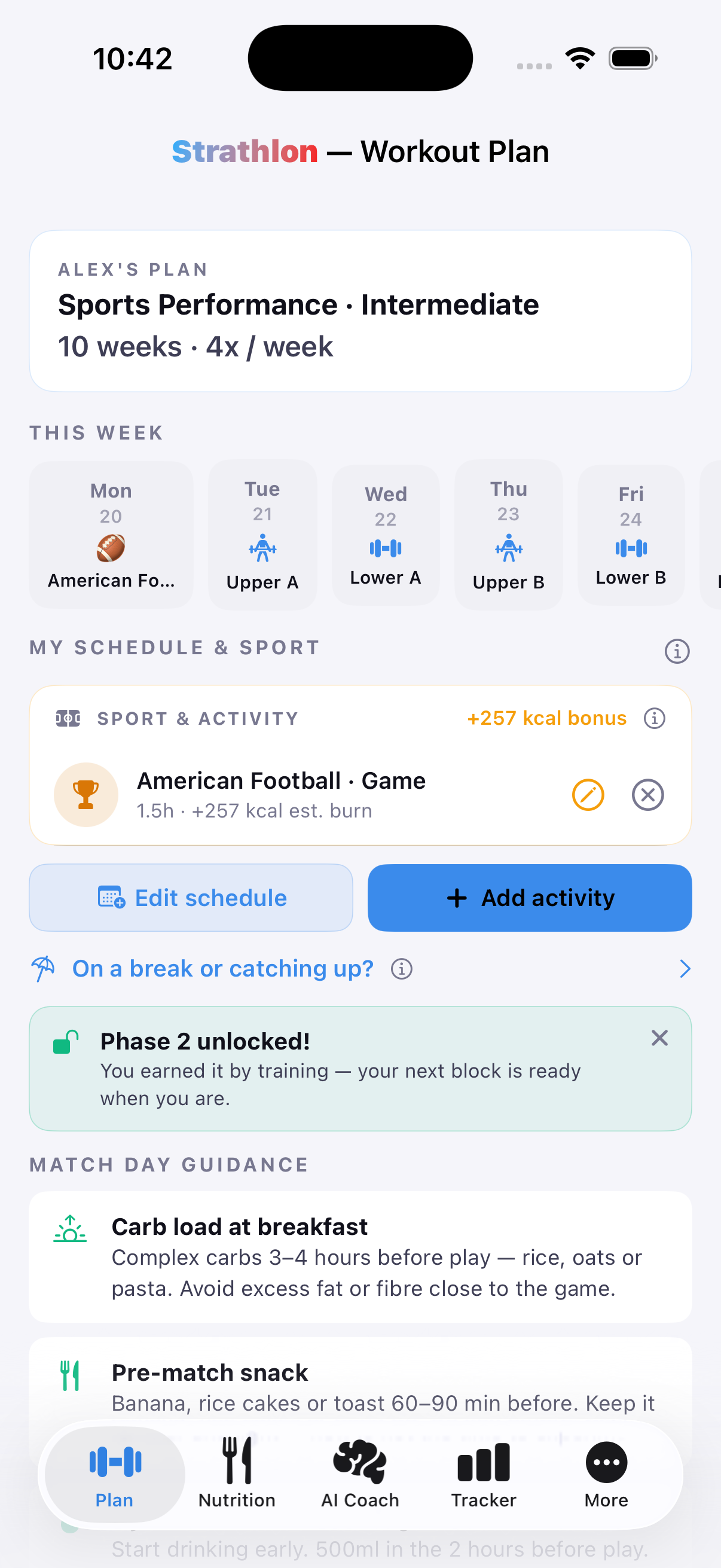
That pairing is the whole point of the week, and it is worth saying why both halves matter. The base lifts (the squat, hinge, press and pull) are what actually raise your force ceiling. They are not generic filler to be dropped in favour of football-looking drills. On top of that base sit the sport-specific pieces: an accessory block aimed at football's particular demands, including box jumps, bounds and sled pushes that train you to express force fast, which is the quality a collision sport actually cashes in. Neither half works alone. Jumps and sled work have nothing to express without the strength underneath them. A big squat that is never trained to move quickly arrives too late to matter on the field.
Conditioning for American football
Conditioning should look like the game. Since plays are short maximal efforts separated by incomplete rest, the most specific conditioning is repeat-sprint work: short sprints (roughly 10–40 yards) performed with work-to-rest ratios that echo the sport's own: think brief efforts with rest periods several times longer, then gradually squeezing the rest as fitness improves. A review of how to train repeated-sprint ability lands on two complementary jobs: work that makes a single sprint faster (sprint training plus strength and power work), and work that improves your ability to recover between sprints.[11] The second is what fades late in a game or a long practice.
An aerobic base still deserves a place, but a supporting one. The same review suggests the most useful form of it is high-intensity interval work at roughly 80–90% of maximal oxygen uptake: hard, structured intervals rather than high-volume distance running that has little to do with the sport.[11] A little goes a long way. The base is there to serve the sprints, and it isn't meant to replace them.
Here is where strength and conditioning can fight each other. Research on concurrent training shows that large volumes of endurance work performed alongside strength training can blunt gains in strength and, especially, power: the so-called interference effect. A meta-analysis of 21 studies found the size of that interference depends on the endurance work you choose: power improved less under concurrent training than under strength training alone (effect sizes of 0.55 against 0.91), the relationship grew more negative as endurance frequency and duration rose, and running, but not cycling, produced significant decrements in both strength and muscle size.[12] The practical answer for football is to keep conditioning short, intense and specific: sprints and intervals that match the game rather than long slow miles, so you build the right engine without eroding the strength and power that matter more. Where you can, separate hard sprinting from heavy lifting enough that neither is done deep in the other's fatigue.
Staying injury-resilient
Training can't make a contact sport safe, but it can meaningfully shift the odds on some of football's most common non-contact and overuse injuries. Four sites are worth targeting directly.
Hamstrings. The hamstring was the third most commonly injured site in that NFL data,[5] and the best-studied countermeasure is the Nordic hamstring exercise, an eccentric-strength movement. A meta-analysis by Al Attar and colleagues (2017), conducted in soccer players, found that injury-prevention programmes including the Nordic exercise were associated with roughly a halving of hamstring-injury rates (a 51% reduction, injury rate ratio 0.49) compared with no prevention programme.[13] Treat that as an association rather than a guaranteed number: a later reappraisal that re-ran the analysis with stricter methods concluded the protective effect is inconclusive and largely rests on trials at high risk of bias.[14] The exercise is still cheap to add and hard to argue against. Just don't expect the headline figure.
Knees (ACL). The ACL is football's signature season-ender, most often torn in non-contact cutting and landing. Pooling eight previous meta-analyses, Webster and Hewett (2018) found ACL injury-prevention programmes (which combine strength, balance, plyometrics and landing/cutting technique) roughly halved the risk of all ACL injuries (odds ratio 0.5), and cut non-contact ACL injuries by two-thirds in female athletes. They were explicit that six of the eight underlying reviews included only women, and that there was insufficient data to draw a conclusion for male athletes.[15] That gap has since narrowed: a review of cluster randomised trials found programmes containing plyometric exercises reduced ACL injury rates by about 60%, with the effect present in male participants too.[16] What protects the knee is teaching the body to land and cut with control (soft, aligned knees rather than collapsing inward), done consistently.
Shoulders. Shoulder injuries in football are largely contact-driven. Among 336 elite college players screened at the NFL Combine, half had a history of shoulder injury, and the commonest problems were acromioclavicular separation (41% of injuries), anterior instability (20%) and rotator-cuff injury (12%). Injury type varied by position, with linemen showing more rotator-cuff and posterior-instability problems.[17] Those are harder to prevent than a hamstring strain. Strength training can't stop a bad landing, but building balanced pressing and pulling strength plus dedicated rotator-cuff and scapular work supports the joint and may help with the lesser overuse problems.
Head and neck. This is the one to be most honest about. In laboratory testing of 46 contact-sport athletes, greater isometric neck strength (and consciously bracing the neck before impact) was independently associated with a smaller head response to impulsive loading, measured as lower peak linear and angular velocity of the head.[18] In the field, a study of 6,704 high-school athletes by Collins and colleagues (2014) found smaller neck circumference and weaker neck strength were associated with concussion, with each additional pound of neck strength associated with about a 5% lower odds of concussion, though that study covered soccer, basketball and lacrosse rather than American football.[19] That's a reason to train the neck: multi-planar isometric and eccentric work is low-risk and sensible. But the reviews are sober. A systematic review of neck-strengthening protocols in adult collision sport found only three eligible studies: two in rugby union, one in American football, all in male players. Two of the three improved isometric neck strength, but none reported any effect on cervical-spine injuries, and the authors concluded there is currently a lack of evidence that neck strengthening reduces impact-injury risk.[20] A 2023 meta-analysis of eight studies and 7,625 participants rated the evidence linking greater neck strength to lower concussion risk as very low certainty, with a small, non-significant pooled effect.[21] Neck training is worth doing. It is not a substitute for good technique, rules enforcement and proper equipment, and it does not make contact safe.
Programming it around your season
Football has a clear calendar, and the training should change shape across it.
In the off-season, when there's no game to recover for, you build: this is the time for the highest training frequency and the heaviest lifting, developing maximal strength and, for those who need it, muscle mass: the raw materials everything else is made from. A systematic review of elite rugby union, rugby league and American football players found two to four resistance sessions per muscle group per week developed strength and power, with the biggest weekly gains at around three sessions (about 1.8% a week, versus 0.9% at two).[22] As the season approaches, a pre-season block shifts the emphasis toward converting that strength into power and speed, with more explosive lifting, jumping and sprinting and less pure grinding.
Then comes the part most players get wrong: the in-season. The instinct is to stop lifting because games and practice are exhausting, but that's how hard-won strength quietly drains away. The reassuring news is that maintaining strength takes far less than building it. In a small trial of 14 professional soccer players who had trained twice weekly through a 10-week preparatory period, one quality strength session per week maintained both leg strength and 40 m sprint speed across the first 12 weeks of the season, whereas the seven who dropped to one session every two weeks lost both.[23] It is one small study in a different sport, so treat the principle rather than the number as the finding. A review of the minimal effective dose reaches the same place from a different angle: in younger adults, strength and muscle size can be held for up to 32 weeks on as little as one session a week and one set per exercise, provided the load stays heavy, since it is intensity, rather than volume or frequency, that matters. That review is also candid that athlete-specific data is too thin for firm recommendations.[24] Stop altogether and strength holds for around three weeks before decay sets in.[22] Practically, that means keeping one to two short, heavy sessions a week (a few hard sets on the main patterns, kept well short of exhaustion), so you preserve your off-season gains without piling fatigue onto an already demanding schedule.
Fitting it around practice is a fatigue-management puzzle more than a programming one: lift on lighter practice days where you can, keep in-season sessions brief and high-quality, and let recovery (sleep, food and easy days) protect the work you do on the field. In-season, the field comes first. The weights room exists to keep you strong enough to play well in it.
Where Strathlon fits
Common questions
What physical qualities matter most for American football?
It is a collision-and-sprint sport built on short, maximal efforts. Rhea and colleagues (2006) observed 30 games and found the average play lasted 5.6 seconds in high school and about half a second less in college and the NFL, with work-to-recovery ratios of 1:5.5 at high-school level, 1:6.1 in college and 1:6.2 in the NFL.[1] Separately, Iosia and Bishop (2008) timed televised NCAA Division IA college games: plays averaged 5.23 seconds and the rest between them averaged 36.1 seconds, or 46.9 seconds once time-outs and injury attention were included: a directly measured rest interval in one population, which is not the same thing as the ratios above.[2] Efforts that brief and that intense are powered predominantly by the phosphagen (ATP-PC) system, although all three energy pathways contribute to almost any effort.[3] The qualities that transfer best are maximal strength, explosive power and acceleration, plus the ability to change direction and repeat those efforts without fading. Which quality leads depends on your position, but almost every position is built on a base of strength and short-sprint power rather than endurance.
Will lifting heavy weights make me slower or too bulky for football?
The evidence points the other way. A meta-analysis by Seitz and colleagues (2014) found that gains in lower-body (squat) strength transfer positively to sprint performance, with a very large correlation between getting stronger and getting faster.[7] Heavier, more forceful legs generally sprint and hit harder. Substantial "bulk" from strength training is slow and deliberate to build and is usually an asset in a collision sport. If a position needs you to stay lean, that is managed mainly through nutrition and conditioning, rather than by avoiding the weights room.
Do I need to do Olympic lifts like power cleans?
They help but are not compulsory. Weightlifting derivatives (power cleans, hang cleans, pulls and jump shrugs) can be sequenced across the training year to develop strength, rate of force development and power, which underpin acceleration and blocking (Suchomel et al., 2017).[8] But they are technical and coach-dependent. If you cannot learn them safely, you can develop much of the same explosive quality with heavy squats and hinges plus jumps, throws and short sprints. The principle (move a meaningful load fast) matters more than the specific lift.
Can strength training actually reduce my injury risk?
It can reduce the risk of some of football's common injuries, though not eliminate them. Programmes that include the Nordic hamstring exercise were associated with roughly a halving of hamstring-injury rates (a 51% reduction) in a meta-analysis of soccer players by Al Attar and colleagues (2017),[13] though a later methodological reappraisal by Impellizzeri and colleagues (2021) concluded that the evidence remains inconclusive.[14] Multi-component neuromuscular training is associated with about a 50% reduction in all ACL injuries across pooled meta-analyses,[15] and programmes that include plyometric exercises cut ACL injury rates by about 60% in a review of cluster randomised trials, with the effect holding in male participants.[16] Collision and contact injuries are harder to prevent, but building strength and resilient tissue tilts the odds in your favour.
Does neck training prevent concussions?
The honest answer is "maybe, and it is worth doing, but the evidence is not settled." In laboratory testing, greater isometric neck strength was independently associated with a smaller head response to impulsive loading: lower peak linear and angular velocity of the head (Eckner et al., 2014).[18] A study of 6,704 high-school athletes found each additional pound of neck strength was associated with about a 5% lower odds of concussion (Collins et al., 2014),[19] though that study covered soccer, basketball and lacrosse rather than American football. Systematic reviews are more sober: a review of adult collision sport found just three eligible studies, none of which reported any effect on cervical-spine injuries, and concluded there is a lack of evidence that neck strengthening reduces impact-injury risk,[20] and a 2023 meta-analysis rated the strength-to-concussion link as very low certainty and non-significant when pooled.[21] Neck work is sensible and low-risk, but it is not a helmet, and it does not make contact safe.
How do I keep my strength through a long season?
You do not need to keep training the way you did in the off-season. In a small trial of 14 professional soccer players, one quality strength session per week maintained the leg strength and 40 m sprint speed built in the preparatory period across the first 12 weeks of the season, whereas dropping to one session every two weeks reduced both.[23] That is a single small study in another sport. A review of the minimal effective dose reaches the same place: in younger adults strength can be held for months on as little as one session a week and one set per exercise, provided the load stays heavy, although that review is explicit that athlete-specific data is thin.[24] The practical approach is to lift heavy but briefly (a small number of hard sets on the main patterns, one to two times a week), so you hold onto the off-season's gains without adding fatigue that hurts your play.
Takeaways
- Football is a short-burst power sport. Plays last about 5 seconds, at work-to-recovery ratios of 1:5.5 (high school) to 1:6.2 (NFL).[1] In televised college games the measured rest between plays averaged 36.1 seconds, or 46.9 seconds counting time-outs and injury attention.[2] Either way it is powered mainly by the phosphagen system, so train strength, power and short sprints rather than distance.
- Build maximal strength first. Heavy squats, hinges, presses and pulls are the base. Lower-body strength gains transfer positively to sprint speed (Seitz et al., 2014).[7]
- Turn strength into power. Weightlifting derivatives (Suchomel et al., 2017),[8] jumps, throws and short sprints build the rate of force development the game is actually played in.
- Add unilateral and neck work. Single-leg strength supports change of direction. Neck work is sensible for head control, with honest limits on the concussion evidence.[20][21]
- Condition short and specific. Use repeat-sprint and interval work that echoes the game,[11] and keep endurance volume modest (and prefer lower-impact modes to high-volume running) to limit the interference effect on strength and power.[12]
- Prehab the common injuries. Nordic hamstring work is associated with ~50% fewer hamstring injuries (Al Attar et al., 2017), though a stricter reappraisal calls that inconclusive.[13][14] ACL prevention programmes roughly halve ACL injuries overall, and about 60% fewer when they include plyometrics.[15][16]
- Maintain in-season on little. One quality strength session a week held leg strength and 40 m sprint speed across the first 12 weeks of a season in a small trial of 14 professional soccer players.[23] One to two short heavy sessions should keep your gains without wrecking recovery.
- Periodise across the year. Build in the off-season, convert to power in pre-season, maintain in-season, and let the field come first once games start.
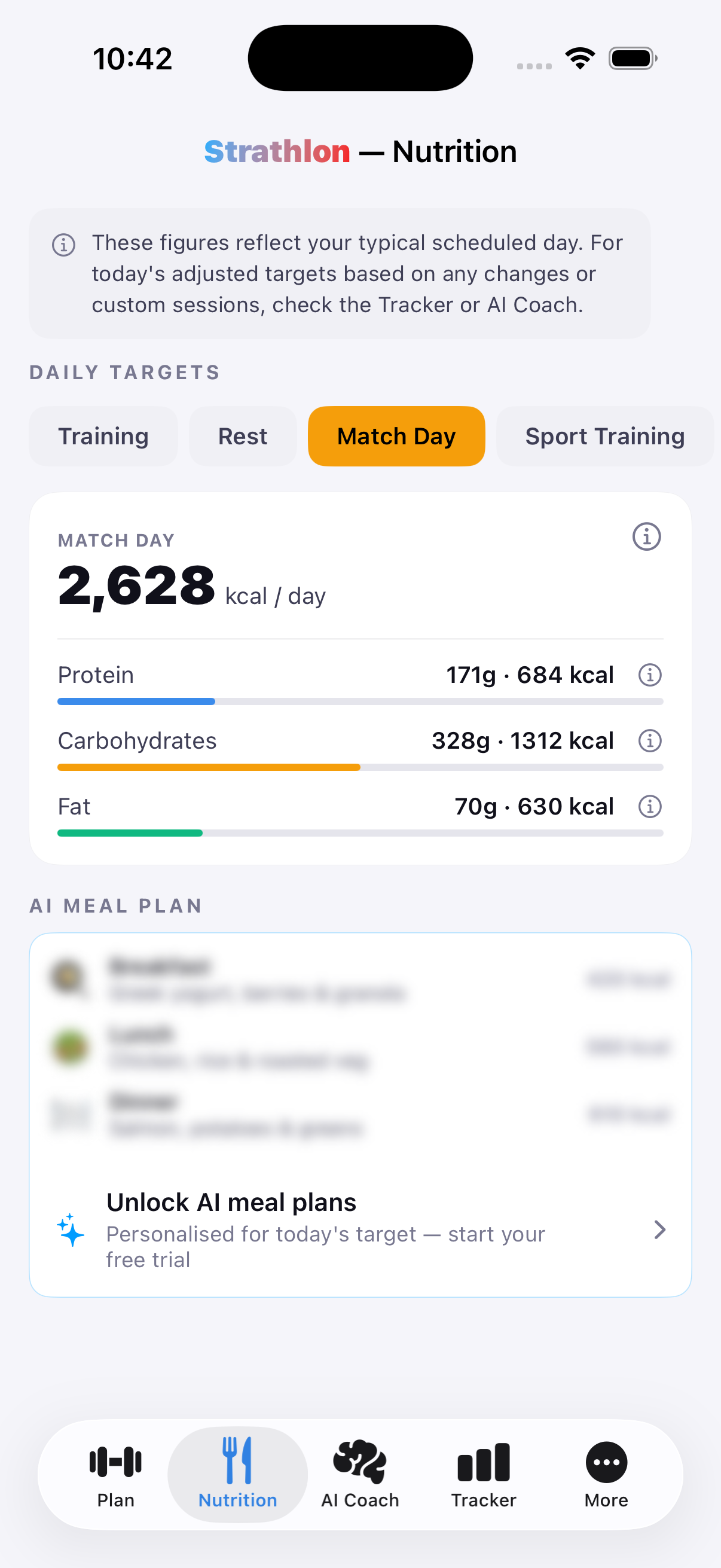
If you remember one thing, make it this: football rewards the athlete who is strong, explosive and able to repeat it, and who protects the knees, hamstrings, shoulders and head that the game most often hurts. Build strength, express it as power and short-sprint speed, condition the way the sport is actually played, and keep the prehab honest. Strathlon's role is to tune that plan toward your sport (with Sports Performance as one of your goals) and remember your lifts, so the base under all the position-specific work stays on track.
References
Every figure quoted above traces to one of the sources below. Where a point reflects established guidance rather than a single study, the citation is to a named governing body's position stand or consensus statement, with the country or international scope it speaks for: guidance differs between countries, and no one nation's recommendations are universal.
- Rhea MR, Hunter RL, Hunter TJ. Competition modeling of American football: observational data and implications for high school, collegiate, and professional player conditioning. Journal of Strength and Conditioning Research. 2006;20(1):58–61. PMID: 16503692
- Iosia MF, Bishop PA. Analysis of exercise-to-rest ratios during division IA televised football competition. Journal of Strength and Conditioning Research. 2008;22(2):332–340. PMID: 18550945
- Gastin PB. Energy system interaction and relative contribution during maximal exercise. Sports Medicine. 2001;31(10):725–741. PMID: 11547894
- Girard O, Mendez-Villanueva A, Bishop D. Repeated-sprint ability — part I: factors contributing to fatigue. Sports Medicine. 2011;41(8):673–694. PMID: 21780851
- Lawrence DW, Hutchison MG, Comper P. Descriptive epidemiology of musculoskeletal injuries and concussions in the National Football League, 2012–2014. Orthopaedic Journal of Sports Medicine. 2015;3(5):2325967115583653. PMC4622347
- Suchomel TJ, Nimphius S, Stone MH. The importance of muscular strength in athletic performance. Sports Medicine. 2016;46(10):1419–1449. PMID: 26838985
- Seitz LB, Reyes A, Tran TT, Sáez de Villarreal E, Haff GG. Increases in lower-body strength transfer positively to sprint performance: a systematic review with meta-analysis. Sports Medicine. 2014;44(12):1693–1702. PMID: 25059334
- Suchomel TJ, Comfort P, Lake JP. Enhancing the force–velocity profile of athletes using weightlifting derivatives. Review in the journal of the National Strength and Conditioning Association (NSCA, United States). Strength and Conditioning Journal. 2017;39(1):10–20. doi:10.1519/SSC.0000000000000275
- Ramirez-Campillo R, Sortwell A, Moran J, Afonso J, Clemente FM, Lloyd RS, Oliver JL, Pedley J, Granacher U. Plyometric-jump training effects on physical fitness and sport-specific performance according to maturity: a systematic review with meta-analysis. Sports Medicine – Open. 2023;9(1):23. PMID: 37036542
- American College of Sports Medicine (ACSM, United States). ACSM position stand: progression models in resistance training for healthy adults. Medicine & Science in Sports & Exercise. 2009;41(3):687–708. PMID: 19204579
- Bishop D, Girard O, Mendez-Villanueva A. Repeated-sprint ability — part II: recommendations for training. Sports Medicine. 2011;41(9):741–756. PMID: 21846163
- Wilson JM, Marin PJ, Rhea MR, Wilson SM, Loenneke JP, Anderson JC. Concurrent training: a meta-analysis examining interference of aerobic and resistance exercises. Journal of Strength and Conditioning Research. 2012;26(8):2293–2307. PMID: 22002517
- Al Attar WSA, Soomro N, Sinclair PJ, Pappas E, Sanders RH. Effect of injury prevention programs that include the Nordic hamstring exercise on hamstring injury rates in soccer players: a systematic review and meta-analysis. Sports Medicine. 2017;47(5):907–916. PMID: 27752982
- Impellizzeri FM, McCall A, van Smeden M. Why methods matter in a meta-analysis: a reappraisal showed inconclusive injury preventive effect of Nordic hamstring exercise. Journal of Clinical Epidemiology. 2021;140:111–124. PMID: 34520846
- Webster KE, Hewett TE. Meta-analysis of meta-analyses of anterior cruciate ligament injury reduction training programs. Journal of Orthopaedic Research. 2018;36(10):2696–2708. PMID: 29737024
- Al Attar WSA, Bakhsh JM, Khaledi EH, Ghulam H, Sanders RH. Injury prevention programs that include plyometric exercises reduce the incidence of anterior cruciate ligament injury: a systematic review of cluster randomised trials. Journal of Physiotherapy. 2022;68(4):255–261. PMID: 36244964
- Kaplan LD, Flanigan DC, Norwig J, Jost P, Bradley J. Prevalence and variance of shoulder injuries in elite collegiate football players. The American Journal of Sports Medicine. 2005;33(8):1142–1146. PMID: 16002483
- Eckner JT, Oh YK, Joshi MS, Richardson JK, Ashton-Miller JA. Effect of neck muscle strength and anticipatory cervical muscle activation on the kinematic response of the head to impulsive loads. The American Journal of Sports Medicine. 2014;42(3):566–576. PMID: 24488820
- Collins CL, Fletcher EN, Fields SK, Kluchurosky L, Rohrkemper MK, Comstock RD, Cantu RC. Neck strength: a protective factor reducing risk for concussion in high school sports. The Journal of Primary Prevention. 2014;35(5):309–319. PMID: 24930131
- Daly E, Pearce AJ, Ryan L. A systematic review of strength and conditioning protocols for improving neck strength and reducing concussion incidence and impact injury risk in collision sports; is there evidence? Journal of Functional Morphology and Kinesiology. 2021;6(1):8. PMC7838928
- Garrett JM, Mastrorocco M, Peek K, van den Hoek DJ, McGuckian TB. The relationship between neck strength and sports-related concussion in team sports: a systematic review with meta-analysis. Journal of Orthopaedic & Sports Physical Therapy. 2023;53(10):585–593. PMID: 37428807
- McMaster DT, Gill N, Cronin J, McGuigan M. The development, retention and decay rates of strength and power in elite rugby union, rugby league and American football: a systematic review. Sports Medicine. 2013;43(5):367–384. PMID: 23529287
- Rønnestad BR, Nymark BS, Raastad T. Effects of in-season strength maintenance training frequency in professional soccer players. Journal of Strength and Conditioning Research. 2011;25(10):2653–2660. PMID: 21873897
- Spiering BA, Mujika I, Sharp MA, Foulis SA. Maintaining physical performance: the minimal dose of exercise needed to preserve endurance and strength over time. Narrative review in the journal of the National Strength and Conditioning Association (NSCA, United States). Journal of Strength and Conditioning Research. 2021;35(5):1449–1458. PMID: 33629972
Pair this with the American football fuelling guide: strength and power are built in the kitchen as much as the weights room, and the fuelling guide covers eating for size, recovery and game-day energy.
This is general educational information rather than medical or individual coaching advice. The strength-and-conditioning figures here are drawn from published research and are framed as population-level guides and associations: individual needs vary widely with position, training age, body size and health, and injury-reduction findings describe averaged risk across groups rather than a promise for any one person. Anyone with pain, an injury, a suspected concussion, or a health condition, and anyone starting or changing a training programme, should consult a qualified strength coach, physician or sports-medicine clinician. See our Terms for more.
← All guides · American football fuelling · How muscle actually grows · Recovery & rest · Eating for results · Understanding your stats · Home