
Archery strength & conditioning
An evidence-based guide to training the body behind the bow. Archery looks static, but a full draw asks a lot of the drawing shoulder, upper back and trunk, held steady, at a mechanical disadvantage, over hundreds of arrows. This covers what the sport actually demands, the strength and endurance work that builds a steadier hold, why steadiness comes from stability and control rather than heavy conditioning, the shoulder, elbow and low-back injuries worth prehabbing against, and how to fit it all around your season. Practical, honest, and grounded in sports-science and strength-and-conditioning evidence.
Here's archery training in one sentence: the qualities that matter most are postural and scapular endurance, rotator-cuff and upper-back stability, and trunk control: the ability to hold the bow rock-steady and repeat it without fading. Raw power matters far less. Everything below is the detail behind that: which muscles do the work, the movements that build them, the injuries to guard against, and how little in-season training it takes to keep the strength you've built.
On this page
A framing note before the detail. Strength-and-conditioning science is well studied, but people differ enormously: training age, sex, injury history, technique and how many arrows you shoot all shift what's right for you. Archery-specific research is also thinner than for big Olympic endurance sports, so where the direct evidence runs out, this leans on well-established general principles and says so. It's written as can, tends to and is associated with, never as a guarantee. It's general education rather than individual coaching or medical advice, and it isn't a personalised programme.
The demands of archery
Archery is a stability-and-endurance sport wearing the costume of a still one. There is almost no whole-body movement, and yet each shot loads the body hard in a very particular way: you draw the string back (for an Olympic recurve, an average of around 48–50 lb for men and about 33 lb for women) and then hold that load nearly motionless while you aim, at the point where the shoulder is at its greatest mechanical disadvantage, before a clean release. Do that in a single qualification round of 72 arrows and you have pulled, cumulatively, roughly one and a half tonnes. A serious recurve archer may shoot around 300 arrows in a day's training. The demand isn't power. It's the ability to produce a precise, sub-maximal, largely isometric hold, and to repeat it hundreds of times without the quality decaying.
Mechanically, the draw is dominated by the back, with the arm playing a supporting role. Drawing the string requires scapular retraction and shoulder-blade control driven by the rhomboids and the mid and lower trapezius, with the latissimus contributing, while the rotator cuff (the infraspinatus and its neighbours) and the posterior shoulder stabilise the joint through the hold and release. Meanwhile the bow-side shoulder has to stay quiet and packed against the push of the bow, and the trunk holds the whole posture stacked and still. In an EMG and force-plate study of elite archers, the shots that scored highest were marked by less postural sway and a slower, smaller shift of the body's centre of pressure during aiming, more economical muscle recruitment, and greater activation of the drawing-side deep trunk muscle (multifidus) supporting the spine (Jacquot et al., 2025). In plain terms: the best shots come from being steadier, and steadiness is a product of stability and control far more than brute force.
Because the mechanical power output is low but the postural load is repeated for hours, the "energy system" story is unusual. No single shot troubles your heart or lungs. The limiting factor is local muscular endurance and fine neuromuscular control of the drawing and postural muscles, plus the concentration to keep them precise late in a long day. A modest aerobic base matters mostly in the background, for recovery between ends and across a competition day, rather than as a performance engine in itself.
That loading pattern also explains where archers get hurt. Surveys consistently put the shoulder first: in one epidemiological survey of archers, roughly 57% reported an injury, with the drawing shoulder (about 28%) and the neck and back (about 20%) the most common sites ("Where do archers hurt?", Physiotherapy Theory and Practice, 2024), and a cross-sectional study of elite adolescent archers found shoulder pain in around half (about 49%) of participants (2024). The elbow (medial and lateral epicondylitis, sometimes called "archer's elbow") and the low back round out the picture, the lumbar spine typically appearing as the second most common region of complaint. Those three, shoulder, elbow and low back, are the injury map your training should be built to defend.
Key strength work, and why it matters
If the sport is repeated, precise, sub-maximal holds, then strength training has two honest jobs. The first is to raise your ceiling so that the draw is a smaller fraction of what you can do: a hold at 40% of your capacity trembles far less than one at 80%. The second is to build the local muscular endurance that keeps that hold clean on the 250th arrow as well as the 25th. Neither job needs you to chase a one-rep max. Both are served by a sensible base of strength with a strong bias toward the muscles that stabilise the shot.
The movements that transfer best mirror the archery shot rather than fight it: pulling, external rotation, scapular control and anti-movement trunk work:
| Movement pattern | Example exercises | Why it transfers to archery |
|---|---|---|
| Horizontal pull | Seated row, single-arm dumbbell row, inverted row, face pull | Trains the rhomboids and mid/lower trapezius that drive scapular retraction (the engine of the draw) and builds the upper-back endurance to repeat it. |
| Vertical pull | Lat pulldown, assisted pull-up | Develops the latissimus and shoulder depressors that help control the draw and hold the shoulder down and packed. |
| Rotator-cuff / scapular | Side-lying and band external rotation, prone Y/T raises, serratus punches | Builds the rotator-cuff and scapular-control endurance that keeps the drawing shoulder stable through hold and release: the highest-value prehab for archery. |
| Anti-movement core | Plank, side plank, Pallof / anti-rotation press, suitcase carry | Teaches the trunk to resist twisting and leaning, keeping the posture stacked and still: the low-sway quality that separates high-scoring shots. |
| Full-body base | Goblet or back squat, hip hinge / deadlift, overhead and horizontal press | Raises your overall strength ceiling and keeps the body balanced, so the draw feels submaximal and pushing/pulling stay in proportion. |
| Grip & forearm | Farmer's carry, wrist/finger work, dead hangs | Supports a relaxed, consistent bow-hand and drawing-hand and the forearm endurance behind a repeatable release. |
The loading should follow the demand. Standard strength-and-conditioning guidance places exercises on a continuum: heavier loads and lower reps favour maximal strength, moderate loads and reps favour muscle size, and lighter loads with higher reps favour local muscular endurance (ACSM position stand; Ratamess et al., 2009). For archery, most of the sport-specific work (the cuff, scapular and postural exercises) sits toward the endurance end: lighter, controlled, higher-rep sets that build a hold that lasts. A smaller amount of heavier compound work provides the ceiling underneath it. You don't need to test one-rep maxes to get either. What matters is consistent direction. Heroics aren't the goal.
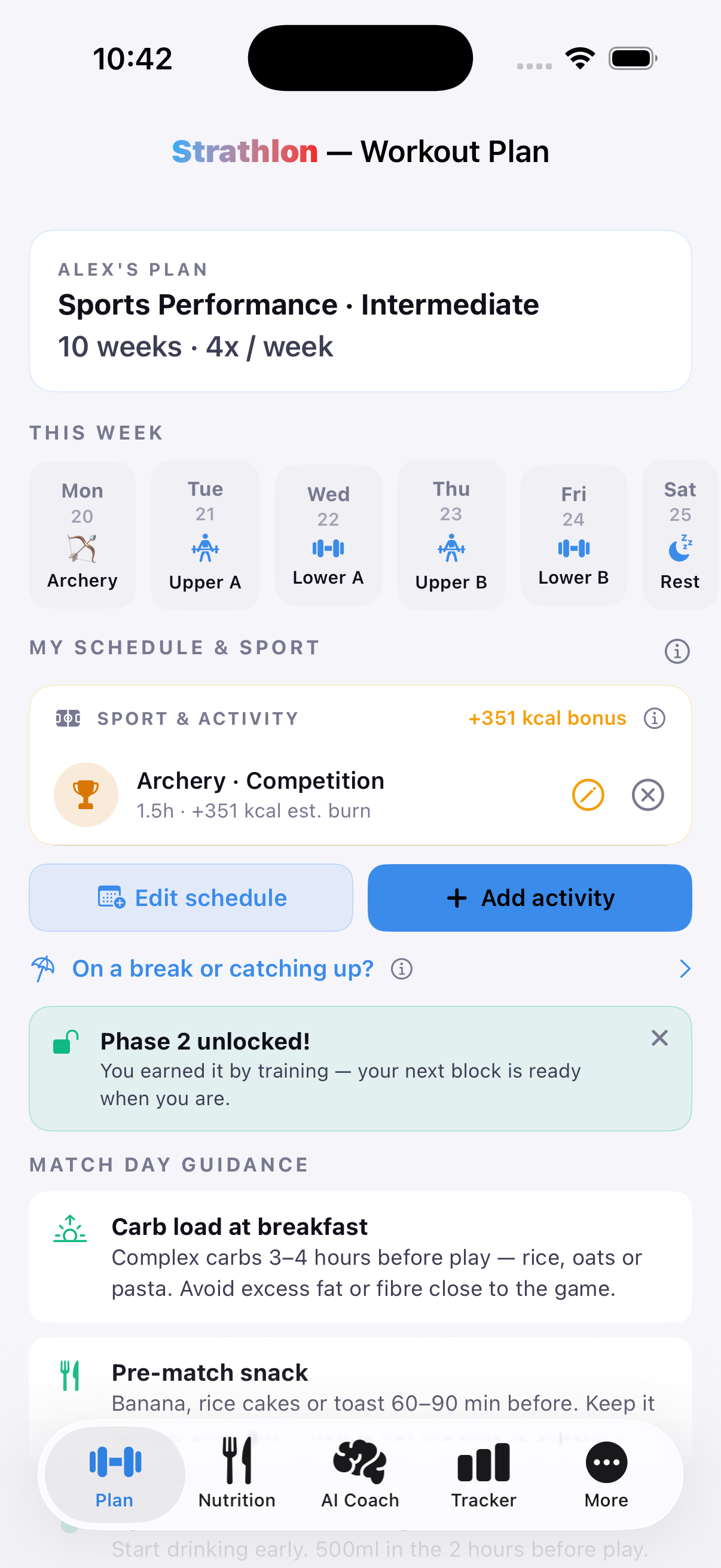
That layering is the whole philosophy, and it is worth spelling out why both halves matter. The base work (the horizontal and vertical pulls, the full-body compound lifts, the anti-movement core) is what raises your ceiling, so that holding at full draw uses a smaller share of what you have. On top of it sits the sport-specific block: rotator-cuff and scapular control for a shoulder that has to stay quiet under load, and extra pulling and anti-rotation work for a steady draw. Neither half works alone. Cuff work on a weak base leaves you steady but short of endurance. A strong base without the small stabilising work leaves the shoulder exposed to exactly the overuse this sport produces.
That's the whole idea of the pairing. The sport-specific block (the pulling, cuff, scapular and anti-rotation work) is what makes the plan archery's rather than generic, because it targets exactly the muscles that stabilise the shot and get injured. But it only works sitting on a complementary base of full-body strength and light conditioning: the squat, hinge and press that raise your ceiling and keep you balanced, and the easy aerobic work that helps you recover. Skip the base and the accessory work has no foundation to stand on. Skip the accessory block and you have a generic gym plan that ignores what archery actually asks of the shoulder and trunk. The plan needs both.
Conditioning for archery
Conditioning is where archery differs most from the running or cycling model, and where it's easy to overdo the wrong thing. Archery is not limited by your cardiovascular engine, so it needs no repeat-sprint work and no high-volume endurance training. What it does benefit from is a modest aerobic base (a couple of easy-to-moderate sessions a week) for three quiet reasons: it aids recovery between ends and across the hours of a competition day, it supports general health and body composition, and better general fitness tends to steady the heart rate and breathing, both of which subtly disturb aiming when they run high. This is background support rather than a performance driver, and it should always be light enough that it never leaves you too tired to hold a clean shot.
The far more sport-specific form of "conditioning" for archery is muscular endurance: the ability of the drawing, scapular and postural muscles to keep producing a precise hold late into a long session. That's trained partly through the higher-rep accessory work above and partly through shooting volume itself, built up gradually. Think of it as two conditioning targets: a light general-fitness base from easy cardio, and a specific local-endurance base from higher-rep strength work and sensible arrow counts.
How do strength and conditioning fit together without interfering? For archery the risk is low, because the aerobic dose is small and the strength work is largely sub-maximal: the classic interference effect (where lots of endurance training blunts strength gains) barely applies at these volumes. The practical rule is simply fatigue management: keep your hardest gym work and your most important shooting on different days or well separated, so neither shows up to the other already drained.
Staying injury-resilient
Archery's injury map is short and predictable, shoulder, elbow, low back, which makes it very trainable. The most important single fact is a general one: across sports, a well-known meta-analysis found that strength-training programmes were associated with sports injuries dropping to roughly a third of the expected rate, and overuse injuries almost halved (Lauersen et al., 2014), with a later analysis showing the protective effect is dose-dependent: more (sensible) strength training, more protection (Lauersen et al., 2018). Strength training isn't just for performance. It's among the best-evidenced injury-prevention tools there is, and archery's overuse profile is exactly what it defends against.
- Shoulder (the priority). The drawing shoulder is the most commonly injured area, so rotator-cuff and scapular work is the highest-value prehab in the whole plan. The evidence-based staples for overhead-type shoulders are external-rotation exercises, rows and prone raises that build the mid and lower trapezius, and serratus and scapular-control drills, done with lighter loads and higher reps to build the endurance and balanced control that keep the joint stable through the draw and release. Restoring balanced scapular control is a recognised cornerstone of shoulder-injury prevention in overhead athletes.
- Elbow. Medial and lateral epicondylitis are overuse tendon problems from repeated loading. The defence is forearm and grip conditioning plus, above all, sensible volume progression: the tendons are usually overwhelmed by too many arrows too soon. A lack of strength alone is rarely the cause. Ramp arrow counts gradually and address a relaxed, non-gripping bow hand with your coach.
- Low back. The static, slightly extended, repeated posture loads the lumbar spine. Trunk-stability training (the anti-rotation and anti-extension work above) is supported by evidence for non-specific low-back pain, and loaded standing trunk work tends to prepare the spine better than low-load floor drills alone. A balanced hinge and squat base rounds it out.
- References
Two cross-cutting principles matter as much as any exercise. First, load management: the biggest driver of overuse injury is doing too much too soon, so build arrow counts and gym loads gradually and back off when something flares. Second, don't shoot through new or worsening pain: treat it as a signal to reduce load and see a qualified clinician. Pushing through isn't toughness.
Programming it around your season
The reassuring headline for a busy archer is that strength is cheap to keep once you've built it. A systematic review and meta-analysis of resistance-training frequency found that, when the total amount of work is matched, frequency makes little clear difference to strength gains, and that strength can be maintained in-season on relatively little, as low as around one session per week over a span of weeks (Cuthbert et al., 2021). That means the gym should never crowd out the range.
- Off-season / base phase. This is when you build. Run two to three strength sessions a week: the full-body base to raise your ceiling, plus generous cuff, scapular and trunk endurance work. Progress it gradually the same way any strength plan progresses, a little more over time, while shooting volume is lower, so you have recovery to spend on getting stronger.
- In-season / competition phase. Shift to maintenance: roughly one to two shorter sessions a week is enough to hold on to what you built, per the evidence above. Keep the sport-specific cuff and scapular work, that's prehab you don't want to drop, and trim the heavy compound volume. Slot sessions on days that don't sit right before important shooting, so you arrive at the range fresh.
- Fitting it around fatigue. Archery practice is itself a large postural-endurance load, so treat gym work and high-volume shooting as competing for the same recovery. Separate your hardest efforts, watch for the drawing shoulder feeling worn, and take a lighter week when accumulated fatigue starts to show. Maintaining strength while staying fresh beats chasing gym numbers into a stale shot.

Common questions
What strength work matters most for archery?
Archery rewards muscular endurance and stability far more than raw power. The priorities are the muscles that hold the bow steady at full draw: the mid and lower trapezius, rhomboids and rotator cuff of the drawing shoulder, the postural muscles of the upper back, a stable bow-side shoulder, and the trunk. Horizontal pulls such as rows, external-rotation and scapular-control work, and anti-movement core exercises like planks and anti-rotation holds cover most of it. A modest base of full-body strength gives you headroom, so that holding a draw weight of roughly 33 to 50 lb for hundreds of arrows feels submaximal. Steadiness itself comes from control and endurance, much more than from lifting the heaviest possible weight.
Will lifting weights make me too bulky or shaky to shoot well?
This is a common worry and it is largely unfounded. Building noticeable muscle is slow and deliberate, and sensible strength training tends to make a submaximal hold feel easier and steadier, because the lighter your draw feels relative to your strength, the less your muscles tremble under it. What can disrupt a shot is training so hard right before shooting that you turn up fatigued, so the fix is timing. Keep heavy sessions away from important practice or competition, rather than avoiding the gym altogether. Across sports, strength training is associated with fewer injuries, which is the opposite of a handicap.
How do I stop my shoulder hurting from archery?
The shoulder, and especially the drawing shoulder, is the most commonly injured area in archers, so some prehab is worth the time. The evidence-based staples for overhead-type shoulders are rotator-cuff and scapular work: external-rotation exercises, rows and prone raises that train the mid and lower trapezius, and serratus and scapular-control drills, generally done with lighter loads and higher reps to build endurance. Managing volume matters just as much: ramp arrow counts up gradually, and treat new or worsening pain as a reason to reduce load and see a qualified clinician rather than shoot through it.
Do I need cardio for archery?
Archery is not an aerobic sport in the way running or cycling is: no single shot is limited by your heart or lungs. But a modest aerobic base still helps, because it supports recovery between ends and across long competition days, and general fitness underpins health and concentration. There is no need for heavy repeat-sprint or high-volume endurance conditioning. A couple of easy-to-moderate sessions a week is plenty, and it should never leave you too fatigued to hold a steady shot.
How often should I do strength work during competition season?
Less than you might think. A systematic review and meta-analysis of resistance-training frequency found that, when the total amount of work is matched, frequency makes little clear difference to strength gains, and strength can be maintained in-season on relatively little, as low as around one session per week over several weeks. In practice, one to two focused sessions a week is usually enough to hold on to your off-season strength through a competition block, fitted on days that do not clash with important shooting.
Should I lift heavy or light for archery?
Both have a role, but the balance leans toward endurance. Lighter loads and higher repetitions build the local muscular endurance that lets you hold a steady shot deep into a session, and they suit the rotator-cuff and scapular work that keeps the shoulder healthy. A smaller amount of heavier, lower-rep strength work builds the maximal strength that gives you headroom, so your draw weight is a smaller fraction of what you can do. You do not need to grind maximal singles. Think of heavier work as the foundation and endurance work as the sport-specific layer on top.
Takeaways
- Archery is a stability-and-endurance sport. The demand is a precise, sub-maximal, largely isometric hold, repeated hundreds of times: steadiness owes far more to stability and control than to heavy conditioning.
- Train the back, the cuff and the trunk. Rows and pulls for scapular retraction, rotator-cuff and scapular-control work for a stable shoulder, and anti-rotation core work for a still, stacked posture.
- Bias toward endurance, with a strength base under it. Lighter, higher-rep work builds the hold that lasts. A smaller amount of heavier compound work raises your ceiling so the draw feels light.
- Keep cardio modest. A little easy aerobic work aids recovery and steadies heart rate and breathing. No repeat-sprint or high-volume endurance is needed.
- Prehab the shoulder, elbow and low back. Cuff and scapular work for the shoulder, forearm/grip work and gradual volume for the elbow, trunk stability for the low back: strength training is associated with roughly a two-thirds drop in injuries across sports.
- Strength is cheap to keep. Build with two to three sessions a week off-season. Maintain in-season on as little as one to two, per the frequency evidence, and never let the gym crowd out the range.
- Manage load and respect pain. Most archery injuries are overuse from too much too soon. Ramp volume gradually and don't shoot through new or worsening pain.
If you take one thing away, make it this: the archer's gym isn't about lifting the most. It's about owning a steady hold and a resilient shoulder. Build a modest strength base, load the back, cuff and trunk with endurance-flavoured work, keep it up on a light in-season dose, and manage your volume. That's the training that quietly holds up on the last arrow of a long day.
Pair this with the archery fuelling guide for the nutrition and hydration side (including the caffeine cautions that matter for a steady-hand sport).
References
Numbered sources for the specific figures, effect sizes and named studies above. Where a claim reflects agreed guidance rather than a single trial, the citation is to the position stand or consensus statement of the body concerned, with the country or international remit named. Archery has a small research literature, so the sport-specific sources below are few and the prehab and programming guidance is drawn from the general strength and shoulder evidence, which is said where it applies.
- Lin JJ, Hung CJ, Yang CC, Chen HY, Chou FC, Lu TW. Activation and tremor of the shoulder muscles to the demands of an archery task. Journal of Sports Sciences. 2010;28(4):415–21. Study of shoulder muscle activation and tremor during an archery task: the direct source for the demand being a precise, sub-maximal, largely isometric hold rather than a strength effort. PubMed 20432134
- Fan CH, Liao CN, Hsu WH. Associations of Scoring Accuracy with Postural Stability and Strength Measures in Archers on a Standard Archery Site. Sports. 2025;13(9). Study associating archers' scoring accuracy with postural stability and strength measures, the evidence that steadiness and a strength base both contribute to the score. PubMed 41003616 · PMC12473916 full text
- Soylu S, Arslan E, Kilit B, Soylu Y. The Effects of Mental Fatigue on Psychophysiological Responses, Mood States, and Archery Shooting Performance Under a Simulated Archery Competition: A Randomized Cross-Over Study. Brain Sciences. 2026;16(5). Study of mental fatigue on psychophysiological responses and archery shooting performance, supporting the point that the sport's endurance demand is as much central as muscular. PubMed 42192772 · PMC13204432 full text
- Cools AM, Johansson FR, Borms D, Maenhout A. Prevention of shoulder injuries in overhead athletes: a science-based approach. Brazilian Journal of Physical Therapy. 2015;19(5):331–9. Cools and colleagues on preventing shoulder injuries in overhead athletes: the source for the rotator-cuff and scapular-control prehab prescribed here. PubMed 26537804 · PMC4647145 full text
- Cools AM, Struyf F, De Mey K, Maenhout A, Castelein B, Cagnie B. Rehabilitation of scapular dyskinesis: from the office worker to the elite overhead athlete. British Journal of Sports Medicine. 2014;48(8):692–7. Cools and colleagues on rehabilitation of scapular dyskinesis, the basis for the scapular-retraction and control work in the back and cuff section. PubMed 23687006
- Hoppe MW, Brochhagen J, Tischer T, Beitzel K, Seil R, Grim C. Risk factors and prevention strategies for shoulder injuries in overhead sports: an updated systematic review. Journal of Experimental Orthopaedics. 2022;9(1):78. Updated systematic review of risk factors and prevention strategies for shoulder injuries in overhead sports, supporting the claim that most archery shoulder problems are overuse from too much too soon. PubMed 35971013 · PMC9378805 full text
- Suchomel TJ, Nimphius S, Stone MH. The Importance of Muscular Strength in Athletic Performance. Sports Medicine. 2016;46(10):1419–49. Suchomel and colleagues on the importance of muscular strength in athletic performance: the source for greater maximal strength being associated with faster sprinting, jumping and change of direction, and with lower injury risk. PubMed 26838985
- Seitz LB, Reyes A, Tran TT, Saez de Villarreal E, Haff GG. Increases in lower-body strength transfer positively to sprint performance: a systematic review with meta-analysis. Sports Medicine. 2014;44(12):1693–702. Seitz and colleagues' systematic review with meta-analysis showing increases in lower-body strength transfer positively to sprint performance, the evidence behind the 'strength is the base' argument. PubMed 25059334
- Lauersen JB, Andersen TE, Andersen LB. Strength training as superior, dose-dependent and safe prevention of acute and overuse sports injuries: a systematic review, qualitative analysis and meta-analysis. British Journal of Sports Medicine. 2018;52(24):1557–1563. Lauersen and colleagues' meta-analysis finding strength training a superior, dose-dependent and safe prevention of acute and overuse sports injuries: the direct source for treating strength work as prehab. PubMed 30131332
- Lauersen JB, Bertelsen DM, Andersen LB. The effectiveness of exercise interventions to prevent sports injuries: a systematic review and meta-analysis of randomised controlled trials. British Journal of Sports Medicine. 2014;48(11):871–7. Lauersen and colleagues' earlier meta-analysis of exercise interventions to prevent sports injuries, the broader evidence base the prevention advice sits on. PubMed 24100287
- . American College of Sports Medicine position stand. Progression models in resistance training for healthy adults. Medicine and Science in Sports and Exercise. 2009;41(3):687–708. American College of Sports Medicine (ACSM, United States) position stand on progression models in resistance training: the source for the heavy-load and explosive-load percentage ranges quoted. PubMed 19204579
- Cuthbert M, Haff GG, Arent SM, Ripley N, McMahon JJ, Evans M, et al. Effects of Variations in Resistance Training Frequency on Strength Development in Well-Trained Populations and Implications for In-Season Athlete Training: A Systematic Review and Meta-analysis. Sports Medicine. 2021;51(9):1967–1982. Cuthbert and colleagues' systematic review of resistance-training frequency in well-trained populations, the source for the sessions-per-week guidance. PubMed 33886099 · PMC8363540 full text
- Spiering BA, Mujika I, Sharp MA, Foulis SA. Maintaining Physical Performance: The Minimal Dose of Exercise Needed to Preserve Endurance and Strength Over Time. Journal of Strength and Conditioning Research. 2021;35(5):1449–1458. Spiering and colleagues on the minimal dose of exercise needed to preserve endurance and strength: the source for maintaining in-season on as little as one to two sessions a week. PubMed 33629972
- Rønnestad BR, Nymark BS, Raastad T. Effects of in-season strength maintenance training frequency in professional soccer players. Journal of Strength and Conditioning Research. 2011;25(10):2653–60. Ronnestad and colleagues' trial of in-season strength maintenance frequency in professional footballers, the specific in-season maintenance result quoted. PubMed 21873897
- Nuzzo JL, Pinto MD, Kirk BJC, Nosaka K. Resistance Exercise Minimal Dose Strategies for Increasing Muscle Strength in the General Population: an Overview. Sports Medicine. 2024;54(5):1139–1162. Nuzzo and colleagues on minimal-dose resistance exercise strategies for increasing strength, supporting the claim that a small, well-chosen dose does most of the work. PubMed 38509414 · PMC11127831 full text
- Wilson JM, Marin PJ, Rhea MR, Wilson SM, Loenneke JP, Anderson JC. Concurrent training: a meta-analysis examining interference of aerobic and resistance exercises. Journal of Strength and Conditioning Research. 2012;26(8):2293–307. Wilson and colleagues' meta-analysis of concurrent training and the interference effect: the source for separating heavy lifting from hard conditioning. PubMed 22002517
- Schumann M, Feuerbacher JF, Sünkeler M, Freitag N, Rønnestad BR, Doma K, et al. Compatibility of Concurrent Aerobic and Strength Training for Skeletal Muscle Size and Function: An Updated Systematic Review and Meta-Analysis. Sports Medicine. 2022;52(3):601–612. An updated systematic review of the compatibility of concurrent aerobic and strength training, the more recent evidence that interference is smaller than once believed. PubMed 34757594 · PMC8891239 full text
- Ramirez-Campillo R, Sortwell A, Moran J, Afonso J, Clemente FM, Lloyd RS, et al. Plyometric-Jump Training Effects on Physical Fitness and Sport-Specific Performance According to Maturity: A Systematic Review with Meta-analysis. Sports Medicine - Open. 2023;9(1):23. Ramirez-Campillo and colleagues on plyometric-jump training effects on physical fitness and sport-specific performance, the source for the plyometric guidance. PubMed 37036542 · PMC10086091 full text
- Impellizzeri FM, Woodcock S, Coutts AJ, Fanchini M, McCall A, Vigotsky AD. What Role Do Chronic Workloads Play in the Acute to Chronic Workload Ratio? Time to Dismiss ACWR and Its Underlying Theory. Sports Medicine. 2021;51(3):581–592. Impellizzeri and colleagues on the pitfalls of the acute:chronic workload ratio: cited because it is the reason this guide talks about ramping load gradually rather than quoting a workload number. PubMed 33332011
- Baz-Valle E, Balsalobre-Fernández C, Alix-Fages C, Santos-Concejero J. A Systematic Review of The Effects of Different Resistance Training Volumes on Muscle Hypertrophy. Journal of Human Kinetics. 2022;81:199–210. Systematic review of resistance-training volume and hypertrophy, the general dose-response evidence behind the set and session recommendations. PubMed 35291645 · PMC8884877 full text
This is general educational information rather than medical or coaching advice. The strength-and-conditioning principles here are well established in broad terms, but archery-specific research is limited, individual variation is large, and every figure or range is a population-level guide rather than a personal prescription, framed as tendencies and associations rather than certainties. Anyone with shoulder, elbow or back pain, an injury, a health condition, or who is pregnant or postpartum, should consult a qualified strength-and-conditioning coach or clinician before starting or changing an exercise programme. See our Terms for more.
← All guides · Archery fuelling guide · How muscle actually grows · Recovery & rest · Eating for results · Understanding your stats · Home