
Boxing strength & conditioning: building punch power, power endurance and durability
An evidence-based guide to the gym half of boxing. A punch looks like an arm movement but is really a whole-body one, driven from the floor up, so the strength and conditioning that matters is the kind that makes you produce force fast, repeat it round after round, and stay in one piece while doing it. This covers punch power and rate of force development, rotational and posterior-chain work, power endurance, the resilience of your neck, hands and shoulders, and how to fit it all around sparring and your season. Weight-making is a big topic in boxing, but it belongs to nutrition: the boxing fuelling guide handles that so this one can stay on the S&C.
In one sentence: the qualities that most separate a hard, durable boxer are explosive power and rate of force development (how fast you turn strength into a punch through the whole kinetic chain), plus the power endurance to keep producing it, resting on a base of maximal strength and a body built to absorb impact. Everything below is the detail behind that: which lifts develop those qualities and why they transfer, how to condition the sport's energy systems without the two kinds of training fighting each other, and how to protect the hands, shoulders and head that take the punishment.
On this page
A framing note before the detail. Strength and conditioning is well studied, but boxers differ hugely: style, weight class, experience, age, injury history and how much sparring you already carry all change what's right for you. So this is written as can, tends to and is associated with, never as a guarantee, and every specific figure is a population-level finding from published research. None of it is a personal prescription. It's general education rather than medical or individual coaching advice, and it is not a substitute for a qualified strength coach or clinician.
The demands of boxing
Start with what a punch actually is. It is not an arm throwing a fist: it is a kinetic chain: force generated against the floor by the legs, routed through hip and trunk rotation, and delivered out through the shoulder and arm to the knuckles. Biomechanical analysis makes the point bluntly: most of a punch's force comes from the legs and trunk, with the arm contributing comparatively little, and the cross (the rear-hand straight that leans hardest on rear-leg drive and trunk rotation) generates the highest forces of the common punches (Stewart et al., 2025).[1] The same study showed that when the lower body is fatigued, punch force falls across the board (around 4% on average, and more in the weaker punches), which tells you the legs aren't just for footwork: they are part of the punch.[1]
That is also why the gym transfers at all. In elite amateur boxers, strength and power qualities are strongly associated with punch impact, with correlations across the measures tested (jump height, jump-squat and bench-press power, maximum isometric force and rate of force development) ranging from roughly 0.67 to 0.85, and the authors point to lower-limb muscle power as one of those strong associations (Loturco et al., 2016).[2] Read that as: a boxer who can produce a lot of force quickly, including through the legs and hips, tends to hit harder. Power, along with strength and the chain that transmits it, is the through-line of everything in the strength section below.
The sport's energy demands shape the conditioning. Boxing is intermittent (short, explosive flurries inside continuous rounds), but the physiology underneath is surprisingly aerobic. In highly trained amateurs contesting three-minute rounds, heart rate sits above roughly 93% of maximum in the early rounds and above 97% by the last, blood lactate after the bout reaches around 12–18 mmol/L, and the estimated energy split is about 73% aerobic, 19% from the phosphocreatine (alactic) system and 8% glycolytic (Bruzas et al., 2023).[3] In other words, a big aerobic engine is what lets you keep throwing hard and recover between exchanges and rounds, while the anaerobic systems fuel the individual bursts. Both matter.
Finally, the injury map, because it drives the durability work. In amateur boxing the pattern splits by setting: in competition the head and neck are the most commonly injured region (a median of about 72% of injuries), while in training it is the upper limb (a median of about 49%) (Alevras et al., 2022).[4] Within that upper limb the hands and wrists take the brunt: over eight years of the Great Britain Olympic squad the commonest diagnoses were carpometacarpal instability, "boxer's knuckle" (an injury to the extensor hood over the knuckle), thumb ligament sprains and wrist sprains, and hand and wrist injuries occurred at a far higher rate in competition than in training (Loosemore et al., 2017).[5] Concussion is a steady share of what boxing produces: pooled across amateur and professional studies it made up around 12% of all reported injuries by type, with professional boxing carrying substantially higher injury rates than amateur (Mao et al., 2023).[6] A boxer's S&C plan has to respect all three: build the hands and wrists that deliver force, the shoulders that throw hundreds of punches a session, and a neck and body that absorb what comes back.
Key strength work, and why it matters
The gym's job in boxing is not to make you a powerlifter. It is to raise the force you can produce and, above all, the speed at which you can produce it (what coaches call rate of force development (RFD)), because a punch is over in a fraction of a second, far too quickly to express your slow, grinding maximum. Think of it as a two-storey build: maximal strength lays the foundation, and power/RFD work turns that foundation into something that arrives fast. Here are the movement patterns that matter and why each transfers.
- Heavy compound lifts: the force base. Squats, hinges (deadlift and its variants), presses and pulls build maximal strength, and maximal strength is the reservoir that power draws from: you cannot produce force quickly that you cannot produce at all. Standard strength-and-conditioning guidance develops maximal strength with heavy loads for low reps (broadly in the region of 85% or more of your one-rep max, for a handful of reps, with full rest).[7] This is the least boxing-specific-looking work and among the most important, because it lifts the ceiling that all the explosive work then expresses.
- Explosive and ballistic work: rate of force development. Jump squats, explosive (triple-extension) pulls and Olympic-lift derivatives, and plyometrics train the body to switch force on fast. These use lighter loads moved with maximal intent, for low reps with full recovery, so every rep is fast rather than fatigued.[7] The boxing evidence here is about speed rather than force: in national-level boxers running an eight-week plyometric programme, the punch measure taken was maximum punching velocity, and the boxers who could move a heavy bench press fastest were the ones with the fastest rear-hand punch (Söyler et al., 2025).[8] That is the quality this work is aimed at: force arriving fast, in an action that is over in a fraction of a second.
- Rotational power and medicine-ball throws: the transfer path. A punch is a rotational event, and rotational throws (side-to-side and shot-put-style med-ball throws into a wall) rehearse the exact hip-to-trunk-to-arm sequencing a punch uses, at high speed and without the joint stress of catching a heavy weight. Trunk-rotation strength is closely related to how forcefully an athlete can hurl a medicine ball rotationally (correlations around 0.68–0.79), which is why these throws are both a training tool and a rough test of rotational power (Rodríguez-Perea et al., 2024).[9]
- Posterior chain: the engine behind the cross. Deadlifts, hip hinges, hip thrusts and Nordic-style hamstring work build the hip extension and rear-leg drive that power the rear-hand punch and stabilise you through rotation. This is also protective work, since a strong posterior chain underpins both power and durability.
- Neck and grip/forearm: the resilience end. Direct neck work (covered below) aims to help the head resist acceleration, and grip and forearm work supports a firm, aligned wrist at impact. Both sit alongside the power lifts rather than replacing them.
A note on combining the two storeys. Because boxers need both heavy strength and explosive speed, many programmes pair them deliberately, for example complex or contrast training, where a heavy lift is followed by an explosive movement in the same session to exploit the brief potentiation a heavy set leaves behind. A trial in elite amateur boxers found this style of training improved both strength and punch performance over several weeks (Liu et al., 2024).[10] You don't have to be fancy about it. The principle is simply that strength and power are trained together rather than in isolation.
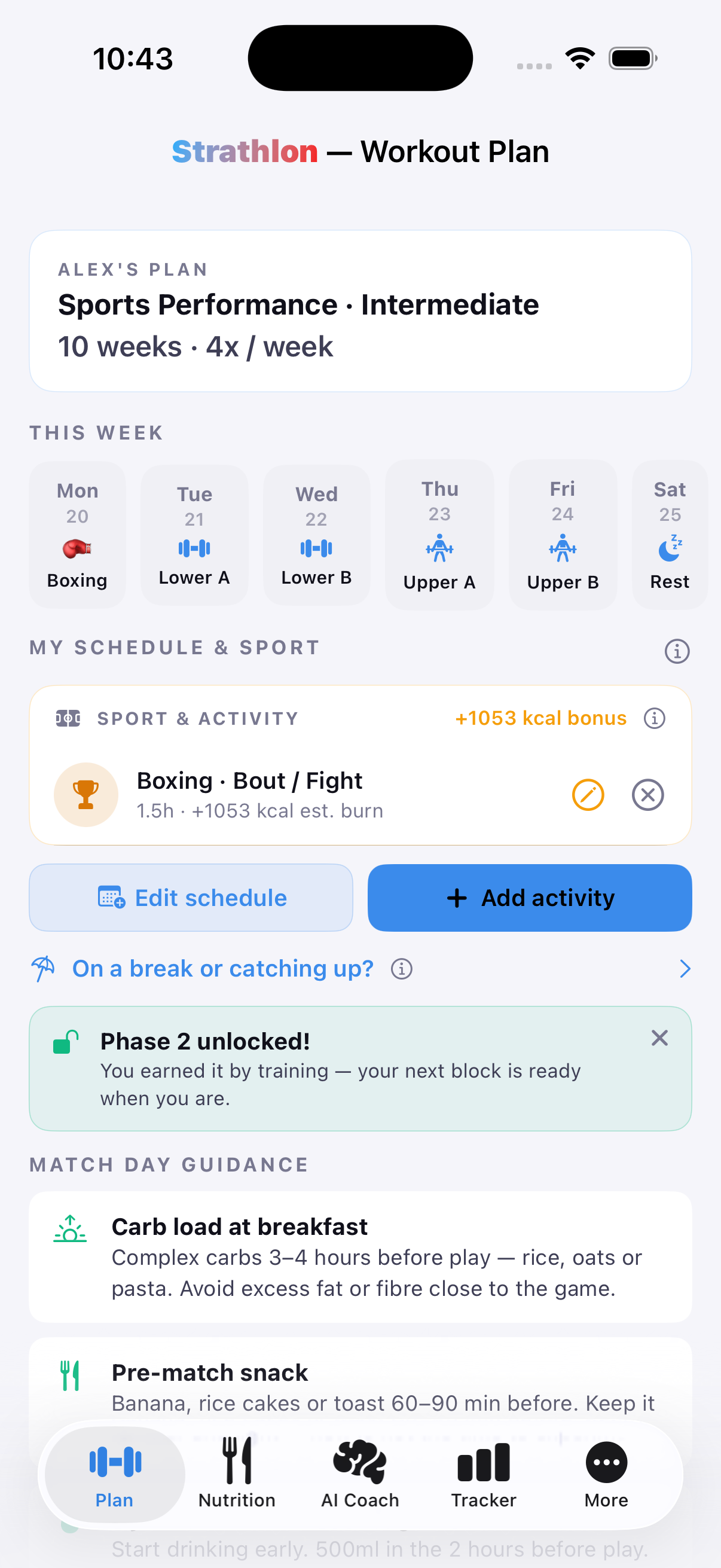
This is the whole philosophy of this article in one plan, and it is worth being explicit about why it is built that way. The sport-specific moves (the landmine rotations, kettlebell swings, medicine-ball slams and sled drags) are what make the plan look like boxing rather than generic gym work, and they train the RFD and force-transfer that punch power depends on. But they only pay off when they sit on the complementary base: the heavy compound strength that gives you force to express, and the conditioning that lets you repeat it. Skip the base and the explosive work has little to draw on. Skip the sport-specific work and you get stronger in ways that don't fully find the fist. The pairing is the point.
Conditioning for boxing
Conditioning has to match the physiology from the demands section: an aerobic engine that keeps you recovering and working, plus the anaerobic power to fuel bursts. In practice that means two distinct jobs, trained in two distinct ways.
- Build the aerobic base. Because roughly three-quarters of a bout's energy is aerobic (Bruzas et al., 2023),[3] a well-developed aerobic capacity is what lets you throw hard combinations and recover between them, round after round. Steady and moderate continuous work (the traditional "roadwork"), plus longer intervals, develop this base most efficiently when done at their own, relatively low intensity. Turning every run into a race doesn't help.
- Train power endurance with round-shaped intervals. The sport-specific quality is the ability to repeat high-intensity efforts with brief recovery, so the most transferable conditioning mirrors the bout: hard intervals in the region of a round's length (or shorter, sharper repeats within it) with controlled rest. This is where bag work, pad rounds and interval circuits do double duty: they condition the anaerobic and repeat-power systems in the exact rhythm competition demands.
The tricky part is fitting conditioning alongside strength without the two undermining each other: the so-called interference effect, where a large volume of endurance training can blunt strength and power adaptations if they're piled on top of each other.[11] The practical mitigations are well established: keep genuinely hard endurance and hard strength sessions separated (by several hours, or on different days), don't chase a hard run right before or after your explosive lifting, and remember that for a boxer the strength work is usually the smaller time commitment supporting the sport, so it's protected rather than sacrificed. Since boxers already get enormous conditioning volume from sparring, bag and pad work, the gym rarely needs to add much more, which conveniently reduces the interference problem in the first place.
Staying injury-resilient
Boxing asks the body to deliver force through the hands and absorb it with the head and trunk, so the durability work targets exactly those sites. None of this eliminates risk (this is a combat sport), but resilient tissue and good movement reduce the odds and the severity of the common problems.
- Hands and wrists. These take a large share of boxing's injuries, from carpometacarpal instability to "boxer's knuckle", thumb ligament sprains and wrist sprains (Loosemore et al., 2017).[5] Most prevention is technical and protective (correct fist and wrist alignment at impact, well-applied hand wraps and appropriate gloves), but building grip and forearm strength supports a firm, stable wrist so force transmits through a rigid lever rather than a collapsing joint. Respect hand pain. Boxer's knuckle in particular tends to nag and worsen if trained through.
- Shoulders. Throwing hundreds of punches a session is a lot of repetitive loading through the shoulder, and the upper limb as a whole is the region most commonly injured in training (Alevras et al., 2022).[4] Rotator-cuff and scapular-stability work (external rotations, scapular retraction and control drills, plus posterior-shoulder and upper-back strength) helps the shoulder tolerate that volume and decelerate each punch, which is where a lot of the wear happens.
- Neck and head. Here the honesty matters most. Observational research has found greater neck strength associated with lower concussion risk: in one large study of high-school athletes, each roughly 0.45 kg (one pound) of extra neck strength was linked to about a 5% reduction in concussion odds (Collins et al., 2014).[12] But when researchers reviewed the intervention trials (does training the neck actually reduce concussions?), they found the evidence limited and inconclusive (Daly et al., 2021).[13] So train the neck: it is low-risk, plausibly helpful for absorbing impact, and cheap. Just don't treat it as a proven shield. Boxing's head-injury risk (acute concussion and the cumulative toll of repeated impacts) is real and is managed chiefly through skill and defence, controlled sparring, protective equipment, honest return-to-training after any head knock, and medical oversight. A neck exercise doesn't manage that risk on its own.[14]
- General strength as prehab. Beyond the specific sites, being strong through the posterior chain, trunk and legs supports the joints and positions boxing loads hardest. Strength training broadly is one of the better-evidenced ways to reduce sports injuries in general, so the same work that builds punch power doubles as durability.[15]
Programming it around your season
Strength and power don't get trained the same way all year, because your goal changes with the calendar. The broad shape is build in the off-season, maintain in-season.
- Off-season / build phase. With no fight imminent and lighter sparring, this is when you do the bulk of the heavy strength and the concentrated power work, commonly two to three focused gym sessions a week alongside boxing practice, progressively loaded over a block of weeks. This is where you push the ceiling on maximal strength and rate of force development.
- In-season / fight camp. As sparring, pad and bag volume climb, the gym's job flips from building to maintaining: protecting the strength and power you built without adding fatigue that steals from your boxing. The encouraging evidence: reduced training frequency, as little as one to two quality sessions a week, can maintain strength for weeks to months provided the intensity (load) stays reasonably high (Spiering et al., 2021).[16] And once weekly volume is accounted for, how many days you spread it across matters little for strength (Grgic et al., 2018).[17] So in camp you can drop to a lean, heavy-ish maintenance dose and keep almost everything you earned.
- Fit it around fatigue. The scheduling principle throughout is to keep your hardest efforts from colliding: put heavier or explosive lifting on lighter boxing days or several hours apart from hard sparring, and pull back the gym volume in the sharpest weeks before a fight. When accumulated fatigue climbs, a lighter week clears it so the next block progresses, the same logic that governs recovery in any well-run programme, covered in the recovery and rest guide.

Common questions
Does lifting weights make you a slower or muscle-bound boxer?
No, done sensibly, the opposite tends to be true. A punch is limited by how fast you can produce force, and force starts with strength. In elite amateur boxers, strength and power qualities are strongly associated with punch impact, with correlations of roughly 0.67 to 0.85 across measures like bench-press strength, jump height and loaded jump-squat power (Loturco et al., 2016).[2] Getting stronger and more explosive, without chasing size for its own sake, generally makes punches harder rather than slower. Much early strength gain also comes from your nervous system rather than added muscle, so you can get meaningfully stronger without necessarily getting much bigger.
What is the best exercise to punch harder?
There isn't a single one, because a punch is a whole-body action driven from the ground up. Biomechanical work shows the legs and trunk generate most of a punch's force rather than the arm, and the cross (which relies on rear-leg drive and trunk rotation) produces the highest forces (Stewart et al., 2025).[1] The most transferable work therefore combines heavy compound lifts (squat, hinge, press, pull) for the force base, explosive and ballistic movements such as jump squats and explosive pulls for rate of force development, and rotational medicine-ball throws that rehearse the hip-to-trunk-to-fist force transfer. No gym lift replaces technical punching practice. Strength work raises the ceiling that skill then expresses.
How many days a week should a boxer strength train?
It depends on your calendar. Off-season or in a build phase, two to three focused sessions a week is a common, workable amount alongside boxing practice. In-season, the goal shifts from building to maintaining, and here the evidence is reassuring: reduced frequencies (as little as one to two quality sessions a week) can maintain strength for weeks to months as long as the intensity (load) is kept reasonably high (Spiering et al., 2021),[16] and once weekly volume is accounted for, training frequency itself makes little difference to strength gains (Grgic et al., 2018).[17] The practical rule is to keep the heavy work away from your hardest sparring days.
Should boxers train their neck to prevent concussion?
Neck strengthening is reasonable and low-risk, but be honest about what it can and can't do. Observational research has found greater neck strength associated with lower concussion odds: in one large study of high-school athletes, each roughly 0.45 kg (one pound) of additional neck strength was linked to about a 5% reduction in concussion odds (Collins et al., 2014).[12] However, a systematic review found the intervention evidence that neck strengthening actually reduces concussions to be limited and inconclusive (Daly et al., 2021).[13] Treat neck work as sensible insurance that may help you absorb impacts. It isn't a proven shield, and it does not remove boxing's inherent head-injury risk, which is managed mainly through skill, defensive habits, sensible sparring, protective equipment and medical oversight.
Won't strength training make me gain weight and move up a class?
Not automatically. Substantial muscle gain is slow and requires a calorie surplus and high training volume aimed at size. Strength and power training can be programmed for the nervous system instead (heavier loads, lower reps, longer rest), which improves how forcefully and quickly you contract without adding much mass. That's why lifters can get markedly stronger while staying in the same weight class. If you're managing weight, the lever to pull is your nutrition rather than avoiding the gym. The boxing fuelling guide covers making weight without wrecking performance.
How do I fit strength work around sparring and roadwork without overtraining?
Prioritise and separate. Boxing skill and sparring come first. Strength and conditioning support them. Where possible, put heavy or explosive lifting on lighter boxing days, or several hours apart from a hard session, so neither is done in the shadow of the other's fatigue. Because boxing is aerobically demanding but highly intermittent, most conditioning is best done as intervals that echo the round structure, with your steady aerobic base built separately. Keep truly hard strength, hard sparring and hard conditioning from all landing on the same day, and use lighter maintenance weeks when fatigue climbs.
Takeaways
- A punch is a whole-body movement. Force comes from the ground up through the legs and trunk more than the arm. The cross, driven by the rear leg, hits hardest (Stewart et al., 2025).[1]
- Train power and rate of force development, on a base of maximal strength. Strength and power qualities are strongly associated with punch impact (r ≈ 0.67–0.85; Loturco et al., 2016).[2] Heavy lifts build the force. Explosive and rotational work makes it arrive fast.
- Use the transfer movements. Jump squats and explosive pulls for RFD, rotational medicine-ball throws for the hip-to-fist force path, posterior-chain work for the rear-leg drive.
- Condition both engines. Boxing is aerobic-dominant but intermittent (about 73% aerobic, Bruzas et al., 2023)[3]: build the aerobic base separately and train power endurance with round-shaped intervals.
- Manage interference. Separate hard strength and hard endurance, and protect the smaller gym dose rather than piling it onto heavy sparring days.
- Protect the hands, shoulders and neck. Grip/forearm strength and technique for the wrists, rotator-cuff and scapular work for the shoulders, and neck work as sensible (if unproven) insurance: head-injury risk is managed by skill, sparring control, equipment and medical oversight rather than the gym.
- Build off-season, maintain in-season. One to two quality sessions a week can maintain strength for weeks to months when the load stays high (Spiering et al., 2021; Grgic et al., 2018).[16][17]
- Weight-making is a nutrition problem. Don't skip the gym to make weight. See the boxing fuelling guide.
If you remember one thing, make it this: your punch is only as fast as your legs, hips and trunk can deliver force, and only as durable as the round after it. Build the base, train the transfer, condition both engines, protect the joints that take the load, and let skill do the rest. Strathlon's role is to tune that gym plan toward boxing (with Sports Performance as one of your goals) and keep it honest as your lifts trend up, so the strength half of your training is one less thing to guess at.
References
Every figure quoted above traces to one of the sources below. Where a point reflects established guidance rather than a single study, the citation is to a named governing body's position stand or consensus statement, with the country or international scope it speaks for: guidance differs between countries, and no one nation's recommendations are universal.
- Stewart C, Cornett R, Baker JS, Gu Y, Dutheil F, Ugbolue UC. The role of lower limb kinetics in boxing punches and the impact of fatigue on biomechanical performance. Bioengineering. 2025;12(12):1355. PMC12729554
- Loturco I, Nakamura FY, Artioli GG, Kobal R, Kitamura K, Cal Abad CC, Cruz IF, Romano F, Pereira LA, Franchini E. Strength and power qualities are highly associated with punching impact in elite amateur boxers. Journal of Strength and Conditioning Research. 2016;30(1):109–116. PMID: 26110348
- Bruzas V, Venckunas T, Kamandulis S, Snieckus A, Mockus P, Stasiulis A. Metabolic and physiological demands of 3×3-min-round boxing fights in highly trained amateur boxers. The Journal of Sports Medicine and Physical Fitness. 2023;63(5):623–629. PMID: 35415997
- Alevras AJ, Fuller JT, Mitchell R, Lystad RP. Epidemiology of injuries in amateur boxing: a systematic review and meta-analysis. Journal of Science and Medicine in Sport. 2022;25(12):995–1001. PMID: 36195527
- Loosemore M, Lightfoot J, Gatt I, Hayton M, Beardsley C. Hand and wrist injuries in elite boxing: a longitudinal prospective study (2005–2012) of the Great Britain Olympic boxing squad. Hand (New York, N.Y.). 2017;12(2):181–187. PMC5349401
- Mao Y, Zhao D, Li J, Fu W. Incidence rates and pathology types of boxing-specific injuries: a systematic review and meta-analysis of epidemiology studies in the 21st century. Orthopaedic Journal of Sports Medicine. 2023;11(3):23259671221127669. PMC10071201
- American College of Sports Medicine (ACSM, United States). ACSM position stand: progression models in resistance training for healthy adults. Medicine & Science in Sports & Exercise. 2009;41(3):687–708. PMID: 19204579
- Söyler M, Gürkan AC, Kayantaş İ, Aydın S, Karataş B, Eraslan M, Şahin M, Küçük H, Badau A, Badau D. Investigation of the effects of different plyometric training protocols on punching force and muscle performance in male boxers. Applied Sciences. 2025;15(12):6532. doi:10.3390/app15126532
- Rodriguez-Perea A, Morenas-Aguilar MD, Martinez-Garcia D, Chirosa-Rios LJ, Garcia-Buendia G. Influence of trunk rotator strength on rotational medicine ball throwing performance. The Journal of Sports Medicine and Physical Fitness. 2024;64(1):30–36. PMID: 37721721
- Liu Y, Huang Z, Zhou Z, Zhang L, Guo Y, Chen C. Effects of variable resistance training within complex training on strength and punch performance in elite amateur boxers. Frontiers in Physiology. 2024;15:1472258. doi:10.3389/fphys.2024.1472258
- Wilson JM, Marin PJ, Rhea MR, Wilson SM, Loenneke JP, Anderson JC. Concurrent training: a meta-analysis examining interference of aerobic and resistance exercises. Journal of Strength and Conditioning Research. 2012;26(8):2293–2307. PMID: 22002517
- Collins CL, Fletcher EN, Fields SK, Kluchurosky L, Rohrkemper MK, Comstock RD, Cantu RC. Neck strength: a protective factor reducing risk for concussion in high school sports. The Journal of Primary Prevention. 2014;35(5):309–319. PMID: 24930131
- Daly E, Pearce AJ, Ryan L. A systematic review of strength and conditioning protocols for improving neck strength and reducing concussion incidence and impact injury risk in collision sports; is there evidence? Journal of Functional Morphology and Kinesiology. 2021;6(1):8. PMC7838928
- Patricios JS, Schneider KJ, Dvorak J, et al., for the Concussion in Sport Group (international). Consensus statement on concussion in sport: the 6th International Conference on Concussion in Sport — Amsterdam, October 2022. British Journal of Sports Medicine. 2023;57(11):695–711. PMID: 37316210
- Lauersen JB, Bertelsen DM, Andersen LB. The effectiveness of exercise interventions to prevent sports injuries: a systematic review and meta-analysis of randomised controlled trials. British Journal of Sports Medicine. 2014;48(11):871–877. PMID: 24100287
- Spiering BA, Mujika I, Sharp MA, Foulis SA. Maintaining physical performance: the minimal dose of exercise needed to preserve endurance and strength over time. Narrative review in the journal of the National Strength and Conditioning Association (NSCA, United States). Journal of Strength and Conditioning Research. 2021;35(5):1449–1458. PMID: 33629972
- Grgic J, Schoenfeld BJ, Davies TB, Lazinica B, Krieger JW, Pedisic Z. Effect of resistance training frequency on gains in muscular strength: a systematic review and meta-analysis. Sports Medicine. 2018;48(5):1207–1220. PMID: 29470825
This is general educational information rather than medical or individual coaching advice. The strength-and-conditioning findings here are drawn from published research and framed as population-level tendencies and associations; individual responses vary widely with experience, weight class, age, style and injury history, and are best personalised with a qualified strength coach. Nothing here reduces the inherent head-injury and other risks of boxing. Anyone with pain, an injury, a concussion or head knock, a health condition, or who is pregnant or postpartum, should consult a qualified clinician before starting or changing a training programme. See our Terms for more.
Pair this with the boxing fuelling guide · ← All guides · Eating for results · How muscle actually grows · Recovery & rest · Understanding your stats · Home