
Strength & conditioning for cycling
An evidence-based guide to training off the bike so you go better on it. Cycling looks like a pure aerobic sport, and the engine matters most, but the riders who add well-chosen strength work tend to pedal more economically, sprint harder and hold a good position longer, without getting heavy. This covers the qualities cycling actually demands, the lifts that transfer to the pedals, how strength and conditioning fit together without one blunting the other, the knee and back problems that dog cyclists, and how to programme it all across a season. Practical, honest, and grounded in sports-science research.
Here's the short version: cycling rewards lower-body maximal strength and leg power (for economy, hills and the sprint), sitting on top of a durable, stable trunk and posterior chain that holds an aero position and transfers force to the pedals for hours, all in service of the aerobic fitness your on-bike training builds. Everything below is the detail behind that sentence.
On this page
A framing note before the detail. Strength and conditioning is well studied, but cyclists differ enormously: discipline (road, track, time-trial, mountain bike), training age, body size, sex, and health all shift what's right for a given rider. And the strength-training-for-cyclists literature, while genuinely encouraging, is mostly built on small studies rated at low certainty, so the numbers below are guides rather than guarantees. This is written as can, tends to and is associated with, never as a promise. It is general education rather than medical advice or an individual programme.
The demands of cycling
Cycling is, first and last, an aerobic sport. Whether you ride a flat time trial or a mountainous road race, most of the work is sustained sub-maximal effort powered by your aerobic system, and the biggest single lever on performance is the aerobic engine you build with on-bike training. No amount of squatting substitutes for that. What strength work does is sharpen the parts of the sport that the engine alone doesn't fully address: the hard efforts (the sprint for the line, the surge over a short climb, the repeated accelerations of a race) and the economy with which you produce sub-maximal power for hours.
Mechanically, the pedal stroke is a repeated, one-leg-at-a-time push driven mainly by the big muscles of the hip and thigh: the quadriceps extending the knee, the glutes and hamstrings driving the hip, and the calves transferring force through the ankle. It is a closed, cyclical movement with almost no impact (which is exactly why cyclists can accumulate enormous training hours) but that same repetitive, seated, forward-flexed posture is the root of the sport's characteristic problems.
The two most common overuse injuries in cyclists are anterior (front-of-)knee pain and low-back pain. In a study of professional road cyclists, well over half reported low-back pain in the preceding year and around a third reported anterior knee pain. Knee problems were the most likely to cost training time, while back pain caused the most functional trouble and the most visits for medical attention. Neither comes from a collision: they come from thousands of near-identical pedal strokes in a fixed position, which is what makes bike fit, and the supporting strength work below, matter so much. The trunk is a quieter demand than the legs but a real one: it has to hold a stable, often forward-flexed platform for the legs to push against for hours, and it fatigues.
Key strength work, and why it matters
The headline is well supported: for competitive and trained cyclists, heavy lower-body strength training added to normal riding improves cycling economy, efficiency and short-effort power. In one frequently cited controlled study, competitive road cyclists who added half-squats at 4 sets of 4 repetitions (a heavy, near-maximal 4RM load), three times a week for eight weeks, improved their leg strength by about 14%, their rate of force development by about 17%, their cycling economy by roughly 5%, and their time to exhaustion at maximal aerobic power by about 17%, with no change in body weight or VO2max. A 2025 systematic review with meta-analysis of endurance cyclists reached the same broad verdict: heavy strength training produced a small improvement in cycling efficiency, a moderate improvement in anaerobic power, and a moderate improvement in cycling performance (time trial and time to exhaustion), while leaving VO2max essentially unchanged: a pattern that says strength training makes the engine you already have work better, rather than building a bigger one.
Here is why the specific lifts transfer:
- Heavy squats and leg press (maximal strength). Low reps at a heavy load (across the studies, typically around 67–95% of 1RM, roughly 3–5 sets) develop maximal force and, crucially, rate of force development: how quickly you can produce force. Producing the same pedal force at a lower percentage of your maximum is a plausible mechanism for improved economy, and the extra force ceiling is what you draw on when you stamp on the pedals. These are the best-evidenced lifts for cyclists.
- Single-leg work (split squats, single-leg press, step-ups). Pedalling is fundamentally a one-leg-at-a-time action, and the strength research on cyclists includes single-leg press and single-leg hip movements precisely for that reason. Unilateral work lets each leg do its own work, which helps address the left–right differences that bilateral lifting can hide, and trains the hip and trunk stabilisers that keep each stroke aligned.
- A posterior-chain hinge (Romanian deadlift, hip thrust). The downstroke is driven heavily by the glutes and hamstrings. Training the hip hinge builds the muscles that push the pedal down and back, and balances the quad-dominant nature of cycling.
- Trunk / core strength and endurance (planks, side planks, dead bugs, bird-dogs, back extensions). The value here is less about a six-pack and more about anti-movement endurance: a trunk that resists collapsing into excess flexion holds your aero position and gives the legs a stable base to push against. This ties directly to the injury section below, because back-extensor endurance is one of the things cyclists with back pain tend to lack.
- References
Two honest qualifiers. First, the benefits are clearest for power and economy. The effect on long time-trial performance is more variable and less certain (see the conditioning and FAQ sections). Second, you do not need a bodybuilder's volume: the studies that worked used a handful of heavy exercises, a couple of times a week. More is not the point. Heavy, progressed, and consistent is.
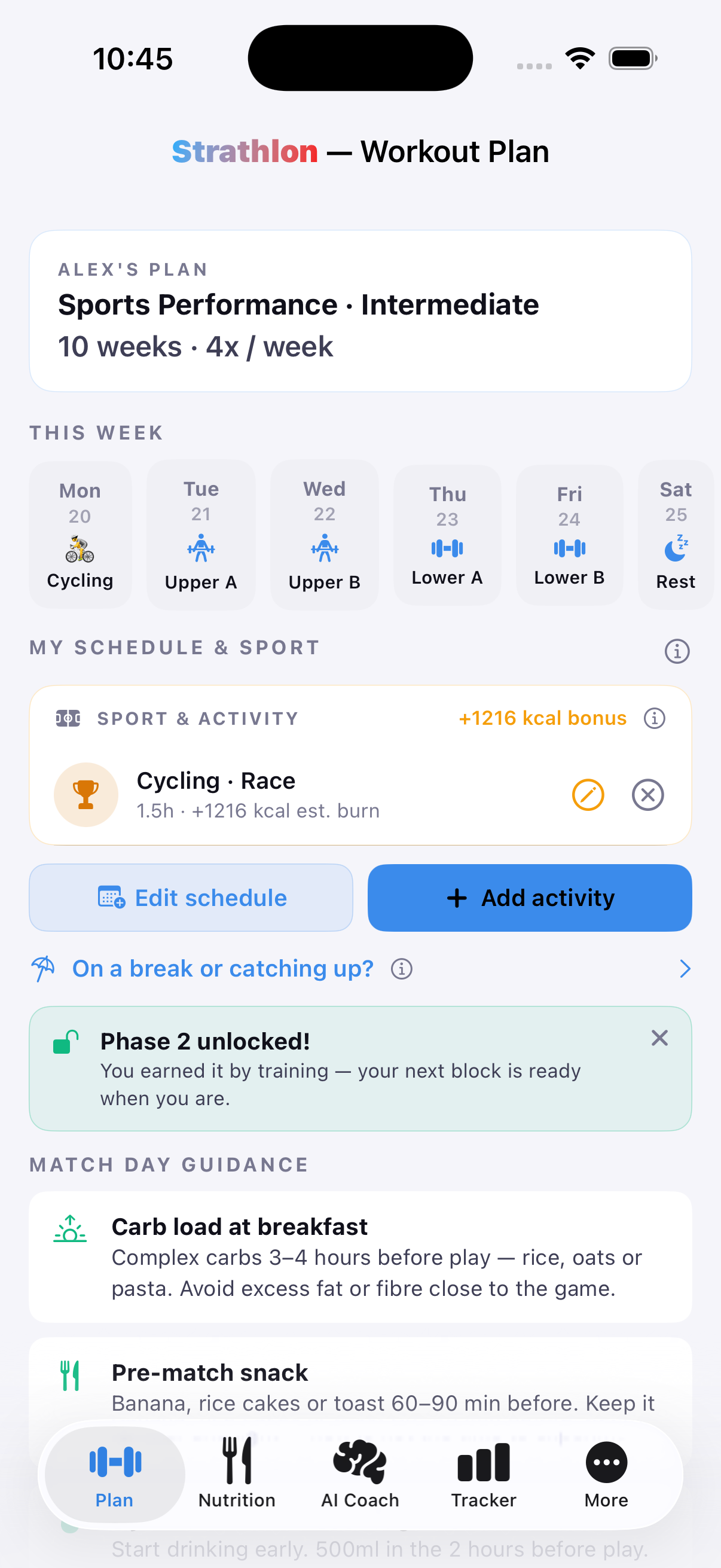
That pairing is worth dwelling on, because it captures the two halves that make a cyclist's gym plan work. The base (the heavy squat, hinge and press that build maximal strength and force) is what the economy and power research is actually built on, and it should never be crowded out. The sport-specific layer (the single-leg accessory work that Strathlon adds for cycling when Sports Performance is one of your goals, and the core finisher at the end of your gym sessions) is what tilts a general strength plan toward the pedals: the unilateral strength that matches the one-leg pedal stroke, and the anti-flexion endurance that keeps your position honest late in a ride. Neither half works alone. Base strength without the cycling-specific accessories is a decent general lifter. Accessories without the heavy base is fiddly detail with no foundation under it. The point of a good cyclist's plan is to have both, in that order of priority.
Conditioning for cycling
Strength work is the supplement. The bike work is the main course, and the two have to coexist without blunting each other. The aerobic side of cycling is trained the way endurance is trained everywhere: a large base of easy, sustainable aerobic volume to build the engine, plus targeted intervals (threshold efforts, VO2-max repeats, and short repeat-sprint work) to sharpen the top end. Strength training complements this by improving the economy and anaerobic power the intervals develop. It does not replace them, and it doesn't raise VO2max, which is why the ride stays central.
The catch when you combine them is the interference effect: doing endurance and strength close together can partly mute the adaptations to each, because the two send somewhat competing signals to the muscle. The practical fixes are well described:
- Separate the two when you can. Leaving several hours between a hard ride and a strength session (around six is a commonly cited target, and at least three) reduces the acute interference, so each session is done fresher and adapts better.
- Pair strength with easy riding rather than hard. If a lift and a ride land on the same day, put the heavy legs session next to your easy aerobic ride, and keep your hard interval days for quality bike work.
- Do the priority first. When sessions must be back-to-back, lead with whichever quality you're prioritising. Within a single session the order matters only a little, but doing strength before endurance tends to slightly favour lower-body strength gains.
- Respect fatigue. Heavy lifting on badly pre-fatigued legs is lower quality and higher risk. In a heavy race or training week, the strength work is what gets trimmed first.
The reassuring part is that the interference is a matter of degree. It isn't a wall. Done sensibly (spaced out, with strength as the junior partner to the bike) concurrent training is a well-established, effective way to get both qualities, and it is exactly what the successful cycling strength studies did: they added the lifting on top of normal endurance training.
Staying injury-resilient
Because cycling is low-impact, its injuries are overwhelmingly overuse rather than trauma (crashes aside). The two big ones (from the professional-cyclist data above) are anterior knee (patellofemoral) pain and low-back pain, with the knee most likely to cost you riding time and the back the most likely to send you looking for help. Reported risk factors are telling: bike fit, grinding a low cadence under high load, ramping training load too fast, prolonged lumbar flexion, and weak abdominal and lumbar muscles. The first line of defence is always a proper bike fit and a sensible training-load progression. Strength work is a genuine but secondary layer on top of that.
Where the evidence is strongest:
- Anterior knee / patellofemoral pain. This is the classic cyclist's knee. For patellofemoral pain generally, the research is clear that adding hip strengthening to knee strengthening beats knee work alone for reducing pain and improving function: hip-abductor and external-rotator strength appears to reduce the inward collapse of the knee that loads the joint. In practice that means the single-leg and hip work in the strength section pulls double duty: it builds pedalling strength and supports the knee.
- Low-back pain. Cyclists with back pain tend to show reduced back-extensor endurance, core activation imbalances, and more lumbar flexion on the bike. The prehab that follows is trunk and hip endurance work (planks and side planks, dead bugs, bird-dogs, glute bridges and back extensions) to build a trunk that can hold a neutral-ish spine late in a ride rather than folding into flexion. Strengthening the core is associated with less back pain in cyclists, though as ever it works alongside fit rather than instead of it.
- Posterior-chain balance. Cycling is quad-dominant and never takes the hamstrings through a big range under load. Posterior-chain work (hinges, and for some riders eccentric hamstring exercises such as the Nordic curl) keeps that balance. The Nordic curl's evidence deserves an honest look: its impressive injury-prevention record (meta-analysis associates Nordic-based programmes with roughly halving hamstring-strain injury rates) comes from sprinting and cutting sports like football, where hamstring strains are common. Cycling is not a big hamstring-strain sport, so treat the Nordic as a reasonable general posterior-chain and balance exercise for cyclists. It isn't a headline injury-preventer with a cycling-specific number attached.
Programming it around your season
Strength for cycling is periodised around the racing calendar, because the bike always comes first when it counts. The broad shape most riders and coaches use:
- Off-season / base (build phase). This is when you build strength, because on-bike intensity is lower and there's room to lift hard. A common, evidence-aligned dose is around two lower-body strength sessions a week (matching the roughly twice-weekly frequency used in the studies that improved cycling performance) progressing the heavy compound lifts over blocks of several weeks. This is where the economy and force gains are actually made.
- In-season (maintenance phase). Once racing or hard riding ramps up, the goal switches from building to holding what you built, at minimal cost to your legs. The maintenance evidence is genuinely liberating here: strength can be preserved for many weeks (studies show up to around 32 weeks) on as little as one session a week, and even low set-counts, provided you keep the load heavy. The variable you must not drop is intensity. It's fine to cut the volume and frequency, but keep lifting something close to heavy. Practically, that's one (or a light two) short heavy session per week, slotted next to easy rides.
- Around the hardest weeks. In peak race weeks or a heavy training block, strength is the first thing to trim or drop for a few days: the bike is the priority, and a maintained lift will keep for a short lull. Reintroduce it as the load eases.
The through-line is that strength for cyclists is a build-then-maintain story, fitted into the gaps the bike leaves. You earn the strength in the quiet months and spend very little to keep it when it matters, which is precisely why the once-a-week, keep-it-heavy maintenance finding is so useful.
Where Strathlon fits
Common questions
Does lifting weights make me slower or bulkier on the bike?
For most cyclists, no. In endurance-trained riders, heavy strength training done alongside normal riding tends to improve strength and power mainly through the nervous system (bigger, faster force) rather than by adding much muscle bulk. In one controlled study of competitive cyclists, eight weeks of heavy half-squats raised leg strength by about 14% and improved cycling economy and time to exhaustion with no change in body weight or VO2max. Meta-analysis agrees that heavy strength training improves cycling efficiency and anaerobic power without harming aerobic capacity. The riders who get heavy and slow are usually those chasing size with bodybuilding-style, high-volume training. The low-volume, heavy, leg-focused work described here is a different tool.
How often should I strength train as a cyclist?
Roughly two sessions a week is the common working dose in the research. In studies that improved cycling performance, riders lifted on average around twice a week (a range of one to three) across blocks of about 5 to 25 weeks. A sensible pattern is two focused lower-body sessions per week in the off-season to build, then dropping to one (or a light two) in-season to hold what you built. The evidence on maintenance is encouraging: strength can be preserved for many weeks on as little as one session a week, provided you keep the loads heavy rather than just going through the motions.
What are the best strength exercises for a cyclist?
The lifts with the most direct evidence for cyclists are heavy, low-rep, lower-body movements: squats (including half-squats and leg press) and single-leg variations such as split squats and single-leg press, which mirror the one-leg-at-a-time nature of pedalling. A posterior-chain hinge (Romanian deadlift or hip thrust) builds the glutes and hamstrings that drive the pedal down and back. On top of that, trunk work that resists movement (planks, side planks, dead bugs, bird-dogs and back-extensor endurance work) supports a stable, sustainable position on the bike. Calf and hip work rounds it out. You do not need many exercises. A handful done heavy and progressed over time does most of the job.
Will strength work help my endurance, or just my sprint?
Both, but the effects differ in size. The clearest and most consistent benefits of heavy strength training in cyclists are to sprint and short-effort power and to cycling economy and efficiency: you use slightly less energy at a given sub-maximal pace. Benefits to longer time-trial performance appear more variable and less certain: some studies show gains, others show no clear group difference over a 40-minute all-out effort. The honest summary is that strength training reliably helps your power and economy, plausibly helps sustained performance, and does not appear to raise your VO2max: that is what your on-bike aerobic training is for.
I get knee or lower-back pain when I ride: can strength training help?
It can be part of the answer, alongside a proper bike fit. Anterior knee (patellofemoral) pain and low-back pain are the two most common overuse complaints in cyclists. For patellofemoral pain, adding hip strengthening to knee strengthening is more effective than knee work alone for reducing pain and improving function. For the low back, cyclists with pain tend to show weaker back-extensor endurance and more lumbar flexion, and training trunk and hip strength and endurance is associated with less back pain on the bike. Strength work is not a substitute for a bike fit or clinical care: if pain is persistent or sharp, see a physiotherapist or sports clinician.
Should I lift before or after riding?
If you can separate them, do. Research on concurrent training suggests leaving several hours (around six is often cited, and at least three) between a hard ride and a strength session reduces the acute interference between the two, so each gets a better-quality effort. If they must share a session, do the higher-priority one first: lead with strength on a day when the ride is easy, and lead with the ride when the quality bike session is the priority. Within a single session the order matters only a little, but strength-before-endurance tends to slightly favour lower-body strength gains.
Takeaways
- The engine comes first. Cycling is an aerobic sport. Strength work supplements your on-bike training, it never replaces it, and it doesn't raise VO2max.
- Heavy legs, done right, transfer. Heavy lower-body strength training improves cycling economy, efficiency and short-effort power in trained cyclists, with little or no change in body weight.
- Lift heavy and low-volume. A handful of near-maximal compound lifts (squat/leg press, a hinge, single-leg work), roughly twice a week, is the dose the research used, well short of bodybuilding volume.
- Pedalling is one-legged. Single-leg work matches the pedal stroke and helps even out left–right differences. A hip hinge balances the quad-dominant bike.
- Train the trunk for endurance. Anti-movement core and back-extensor work holds your aero position and gives the legs a stable base, and supports the low back.
- Protect the knee and back. These are cycling's two big overuse injuries. Hip-plus-knee strengthening helps patellofemoral pain, and trunk/hip endurance supports the low back, on top of a good bike fit.
- Space strength and hard rides. Leave several hours between them where you can, pair lifting with easy rides, and do the priority quality first to limit interference.
- Build off-season, maintain in-season. Two sessions a week to build. Then as little as one heavy session a week can maintain strength for months: keep the load, cut the volume.
If you take one thing away, make it the shape of the year: earn your strength in the quiet months with a few heavy leg sessions a week, then spend almost nothing to keep it (one heavy session a week) once the riding gets serious. Strathlon's role is to give you a starting plan, tuned for cycling once Sports Performance is one of your goals, and to show your lifts trending up, so the strength half of your cycling stays honest without becoming a second job.
Pair this with the cycling fuelling guide: how to fuel the rides that all this strength work sits on top of.
References
Numbered sources for the specific figures, effect sizes and named studies above. Where a claim reflects agreed guidance rather than a single trial, the citation is to the position stand or consensus statement of the body concerned, with the country or international remit named. The strength-for-cyclists question has been tested directly in trained cyclists, so the economy and short-effort-power claims below are cited to cycling trials rather than to general endurance research.
- Beattie K, Kenny IC, Lyons M, Carson BP. The effect of strength training on performance in endurance athletes. Sports Medicine. 2014;44(6):845–65. Meta-analysis of the effect of strength training on performance in endurance athletes: the source for heavy lower-body work improving economy and short-effort power without raising VO2max. PubMed 24532151
- Bini R, Hume PA, Croft JL. Effects of bicycle saddle height on knee injury risk and cycling performance. Sports Medicine. 2011;41(6):463–76. Study of bicycle saddle height on knee injury risk and cycling performance, the basis for the knee-overuse discussion. PubMed 21615188
- Menard M, Domalain M, Decatoire A, Lacouture P. Influence of saddle setback on knee joint forces in cycling. Sports Biomechanics. 2020;19(2):245–257. Study of saddle setback and knee joint forces, the second half of the same fit-and-load argument. PubMed 29920153
- Olmedillas H, González-Agüero A, Moreno LA, Casajus JA, Vicente-Rodríguez G. Cycling and bone health: a systematic review. BMC Medicine. 2012;10:168. Systematic review of cycling and bone health: the source for the caution that cycling alone does little for bone and that lifting matters for more than power. PubMed 23256921 · PMC3554602 full text
- Simonovich IT, Rinot N, Keren Y. ROAD CYCLING, DECREASED BONE DENSITY AND PROXIMAL FEMORAL FRACTURES. Harefuah. 2022;161(6):361–366. Review of road cycling, decreased bone density and proximal femoral fractures, the clinical end of the same point. PubMed 35734792
- Keay N, Francis G, Hind K. Low energy availability assessed by a sport-specific questionnaire and clinical interview indicative of bone health, endocrine profile and cycling performance in competitive male cyclists. BMJ Open Sport & Exercise Medicine. 2018;4(1):e000424. Study of low energy availability and bone health in cyclists, cited for the fuelling caution attached to a high-volume aerobic sport. PubMed 30364549 · PMC6196965 full text
- Wilson JM, Marin PJ, Rhea MR, Wilson SM, Loenneke JP, Anderson JC. Concurrent training: a meta-analysis examining interference of aerobic and resistance exercises. Journal of Strength and Conditioning Research. 2012;26(8):2293–307. Wilson and colleagues' concurrent-training meta-analysis, cited here for spacing strength work from hard rides. PubMed 22002517
- Suchomel TJ, Nimphius S, Stone MH. The Importance of Muscular Strength in Athletic Performance. Sports Medicine. 2016;46(10):1419–49. Suchomel and colleagues on the importance of muscular strength in athletic performance: the source for greater maximal strength being associated with faster sprinting, jumping and change of direction, and with lower injury risk. PubMed 26838985
- Seitz LB, Reyes A, Tran TT, Saez de Villarreal E, Haff GG. Increases in lower-body strength transfer positively to sprint performance: a systematic review with meta-analysis. Sports Medicine. 2014;44(12):1693–702. Seitz and colleagues' systematic review with meta-analysis showing increases in lower-body strength transfer positively to sprint performance, the evidence behind the 'strength is the base' argument. PubMed 25059334
- Lauersen JB, Andersen TE, Andersen LB. Strength training as superior, dose-dependent and safe prevention of acute and overuse sports injuries: a systematic review, qualitative analysis and meta-analysis. British Journal of Sports Medicine. 2018;52(24):1557–1563. Lauersen and colleagues' meta-analysis finding strength training a superior, dose-dependent and safe prevention of acute and overuse sports injuries: the direct source for treating strength work as prehab. PubMed 30131332
- Lauersen JB, Bertelsen DM, Andersen LB. The effectiveness of exercise interventions to prevent sports injuries: a systematic review and meta-analysis of randomised controlled trials. British Journal of Sports Medicine. 2014;48(11):871–7. Lauersen and colleagues' earlier meta-analysis of exercise interventions to prevent sports injuries, the broader evidence base the prevention advice sits on. PubMed 24100287
- . American College of Sports Medicine position stand. Progression models in resistance training for healthy adults. Medicine and Science in Sports and Exercise. 2009;41(3):687–708. American College of Sports Medicine (ACSM, United States) position stand on progression models in resistance training: the source for the heavy-load and explosive-load percentage ranges quoted. PubMed 19204579
- Cuthbert M, Haff GG, Arent SM, Ripley N, McMahon JJ, Evans M, et al. Effects of Variations in Resistance Training Frequency on Strength Development in Well-Trained Populations and Implications for In-Season Athlete Training: A Systematic Review and Meta-analysis. Sports Medicine. 2021;51(9):1967–1982. Cuthbert and colleagues' systematic review of resistance-training frequency in well-trained populations, the source for the sessions-per-week guidance. PubMed 33886099 · PMC8363540 full text
- Spiering BA, Mujika I, Sharp MA, Foulis SA. Maintaining Physical Performance: The Minimal Dose of Exercise Needed to Preserve Endurance and Strength Over Time. Journal of Strength and Conditioning Research. 2021;35(5):1449–1458. Spiering and colleagues on the minimal dose of exercise needed to preserve endurance and strength: the source for maintaining in-season on as little as one to two sessions a week. PubMed 33629972
- Rønnestad BR, Nymark BS, Raastad T. Effects of in-season strength maintenance training frequency in professional soccer players. Journal of Strength and Conditioning Research. 2011;25(10):2653–60. Ronnestad and colleagues' trial of in-season strength maintenance frequency in professional footballers, the specific in-season maintenance result quoted. PubMed 21873897
- Nuzzo JL, Pinto MD, Kirk BJC, Nosaka K. Resistance Exercise Minimal Dose Strategies for Increasing Muscle Strength in the General Population: an Overview. Sports Medicine. 2024;54(5):1139–1162. Nuzzo and colleagues on minimal-dose resistance exercise strategies for increasing strength, supporting the claim that a small, well-chosen dose does most of the work. PubMed 38509414 · PMC11127831 full text
- Wilson JM, Marin PJ, Rhea MR, Wilson SM, Loenneke JP, Anderson JC. Concurrent training: a meta-analysis examining interference of aerobic and resistance exercises. Journal of Strength and Conditioning Research. 2012;26(8):2293–307. Wilson and colleagues' meta-analysis of concurrent training and the interference effect: the source for separating heavy lifting from hard conditioning. PubMed 22002517
- Schumann M, Feuerbacher JF, Sünkeler M, Freitag N, Rønnestad BR, Doma K, et al. Compatibility of Concurrent Aerobic and Strength Training for Skeletal Muscle Size and Function: An Updated Systematic Review and Meta-Analysis. Sports Medicine. 2022;52(3):601–612. An updated systematic review of the compatibility of concurrent aerobic and strength training, the more recent evidence that interference is smaller than once believed. PubMed 34757594 · PMC8891239 full text
- Ramirez-Campillo R, Sortwell A, Moran J, Afonso J, Clemente FM, Lloyd RS, et al. Plyometric-Jump Training Effects on Physical Fitness and Sport-Specific Performance According to Maturity: A Systematic Review with Meta-analysis. Sports Medicine - Open. 2023;9(1):23. Ramirez-Campillo and colleagues on plyometric-jump training effects on physical fitness and sport-specific performance, the source for the plyometric guidance. PubMed 37036542 · PMC10086091 full text
- Impellizzeri FM, Woodcock S, Coutts AJ, Fanchini M, McCall A, Vigotsky AD. What Role Do Chronic Workloads Play in the Acute to Chronic Workload Ratio? Time to Dismiss ACWR and Its Underlying Theory. Sports Medicine. 2021;51(3):581–592. Impellizzeri and colleagues on the pitfalls of the acute:chronic workload ratio: cited because it is the reason this guide talks about ramping load gradually rather than quoting a workload number. PubMed 33332011
- Baz-Valle E, Balsalobre-Fernández C, Alix-Fages C, Santos-Concejero J. A Systematic Review of The Effects of Different Resistance Training Volumes on Muscle Hypertrophy. Journal of Human Kinetics. 2022;81:199–210. Systematic review of resistance-training volume and hypertrophy, the general dose-response evidence behind the set and session recommendations. PubMed 35291645 · PMC8884877 full text
This is general educational information rather than medical or coaching advice. The strength-and-conditioning figures here are drawn from published sports-science research (much of it small studies rated at low certainty) and are framed as population-level guides rather than personal prescriptions; individual needs vary widely with discipline, training age, body size, sex and health. Anyone with pain, an injury, a health condition, or who is pregnant or postpartum, should consult a qualified strength coach, physiotherapist or clinician before starting or changing a training programme, and should treat persistent knee or back pain as a reason to seek a bike fit and professional assessment rather than to train through. See our Terms for more.
← All guides · Cycling fuelling · How muscle actually grows · Recovery & rest · Eating for results · Home