
Gym class strength & conditioning
An evidence-based guide to the strength and conditioning that makes you better, and more injury-resilient, in group fitness classes. Classes are mixed, full-body and deliberately fatiguing, which is exactly why a little structured strength work underneath them pays off. This covers the physical demands, the lifts and patterns that transfer, how to condition without the two halves of your training fighting each other, prehab for the shoulder, low back and knee, and how to fit it all around a busy class schedule. Practical, honest, and grounded in established strength-and-conditioning science.
Here's the whole thing in one sentence: the qualities that matter most across group classes are balanced full-body strength, movement quality (control through range, especially as you tire), and a mix of aerobic and anaerobic conditioning. Classes deliver plenty of the conditioning on their own. What most class-goers are missing is the progressive, trackable strength base that makes the movements feel easier, keeps your technique together late in a session, and lowers your injury risk. Everything below is the detail behind that sentence.
On this page
A framing note before the detail. Strength-and-conditioning science is well studied, but people differ enormously: training age, sex, injury history, sleep, stress and health status all shift what's right for any individual. So this is written as can, tends to and is associated with, never as a guarantee, and every specific number is a population-level guide drawn from published research rather than a personal prescription. It's general education rather than medical or individual coaching advice, and it isn't a personalised programme. "Gym class" here means the broad family of group formats (circuit, bootcamp, functional, HIIT-style and strength classes), so the guidance is deliberately general rather than tuned to one studio's format.
The demands of gym class
Group classes are, by design, mixed-modal and full-body. A single session might blend resistance moves, bodyweight strength, plyometric jumps and sustained cardio, often stitched together as a circuit with short rests. That means no single energy system dominates: you dip into the fast anaerobic pathways for the explosive bursts and the heavy intervals, and lean on your aerobic base to keep going and to recover between efforts. A good class-goer needs to be a generalist: able to produce force, repeat it, and hold form while breathing hard.
That last point is where classes get their character, and their risk. Reps are often high, the tempo is brisk, coaching cues are shared across a room rather than individual, and the hardest work frequently lands when you're already fatigued. Under fatigue, technique drifts: the back rounds on the twentieth kettlebell swing, the knees cave on a jumping lunge, the shoulders shrug and hitch on an overhead press. Repeated often enough, that drift is how the typical class injuries accumulate.
And the pattern is consistent. Across studies of high-intensity functional and CrossFit-style group training, the shoulder, the low back and the knee are reliably the most commonly reported injury sites, with overall injury rates in the region of two to five per 1,000 training hours, broadly comparable to many recreational sports rather than alarmingly high. Most of these are technique-and-overuse problems rather than freak accidents, which is genuinely good news: the same things that make you better in class (getting stronger, moving well, and loading sensibly) are also what make those three joints more durable.
Key strength work, and why it matters
The goal for a class-goer isn't to specialise. It's to be well-rounded and progressively stronger. There is, as one influential review put it, effectively no substitute for greater muscular strength for general athletic skills: across the literature, stronger athletes tend to jump higher, sprint faster and change direction better, and greater strength is associated with lower injury risk (Suchomel, Nimphius and Stone, 2016). Build strength across the fundamental movement patterns and it transfers to almost everything a class asks of you.
A complete week covers these patterns:
- Squat (goblet, front or back squat): the base for lower-body force and for the squatting, lunging and jumping that fill classes. Loading it builds the quads, glutes and trunk that keep your knees tracking well when you fatigue.
- Hinge (Romanian deadlift, deadlift, hip thrust): trains the posterior chain (hamstrings, glutes, spinal erectors) that protects the low back and produces the hip power behind swings, jumps and sprints. For many class-goers this is the most under-trained and most protective pattern.
- Push: a horizontal press (bench or push-up) and a vertical press (overhead press) so the shoulder is balanced rather than front-loaded.
- Pull: a horizontal row and a vertical pull (lat pulldown or chin-up). Pulling volume balances all the pressing in classes and is central to a healthy shoulder.
- Single-leg (split squat, step-up, lunge): one leg at a time exposes and fixes side-to-side gaps, and builds the knee and hip control that underpins change-of-direction and landing.
- Carry and core: loaded carries (farmer's walks) and anti-movement core work (planks, Pallof presses) build a trunk that holds position rather than one that just crunches.
- References
How to load it. General resistance-training guidance, for example the American College of Sports Medicine's position stand on progression models (Ratamess and colleagues, 2009), maps loads to goals roughly like this. For pure maximal strength, heavier loads for low reps (advanced lifters work up toward ~80–100% of your one-rep max for around 1–6 reps); for a blend of strength and muscle, moderate loads of about 67–85% of 1RM for roughly 6–12 reps; and for power, lighter loads moved fast and explosively. Most people chasing all-round class fitness do well living mostly in the middle band: a few hard sets (commonly around 2–4 working sets per exercise) of 6–12 reps on the main patterns, with the odd heavier or more explosive block for variety. Whatever the rep range, the engine is progressive overload: gradually doing a little more over time, which is only possible if you actually track your lifts.
That trackability is the honest advantage structured lifting has over classes. In a class you rarely know exactly what you lifted last week, so it's hard to be sure you're doing more. A few barbell or dumbbell sessions where the weights are written down turn "am I getting stronger?" from a guess into a fact, and that steady climb is what carries over into everything else you do in the room.
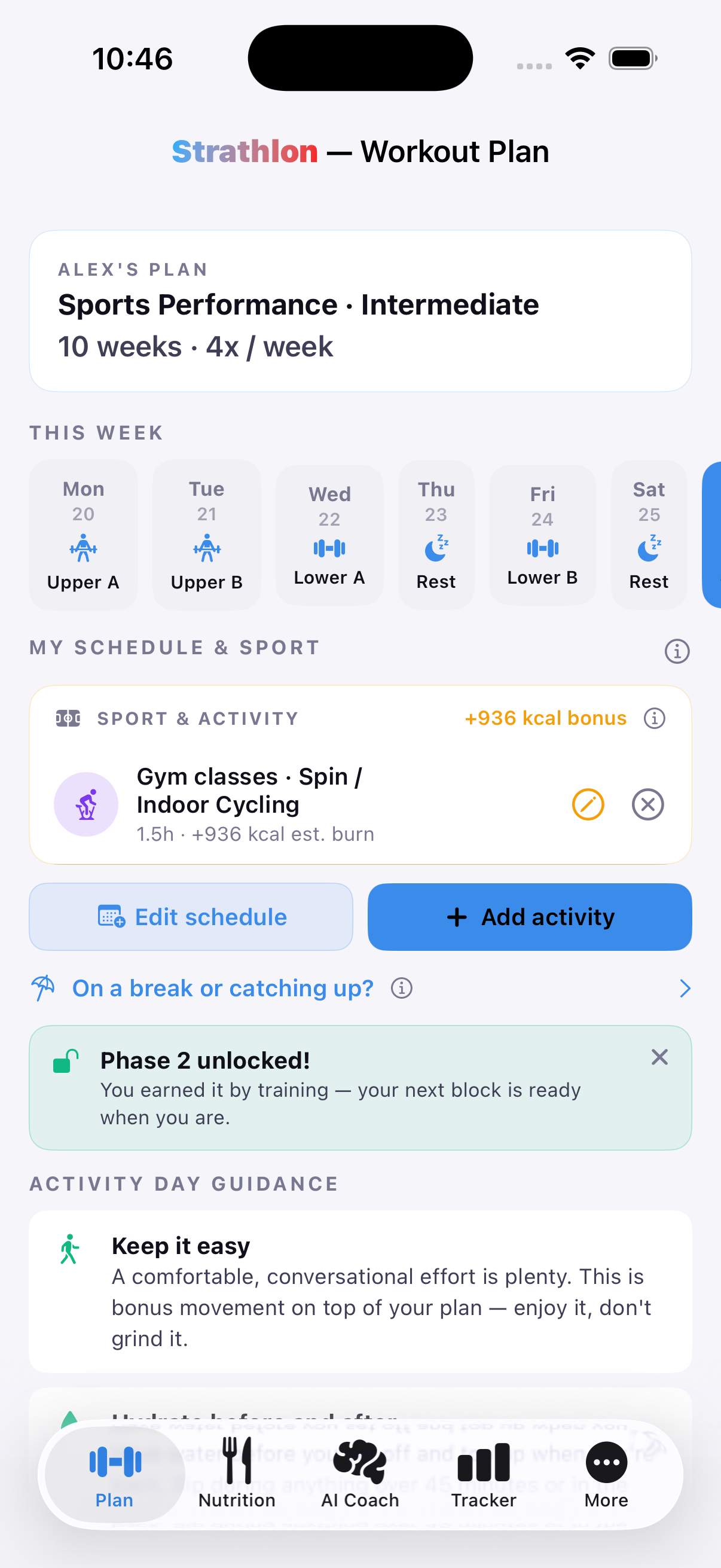
It is worth being clear about how a class fits alongside the rest of your training, because both halves matter. A class is the sport-specific piece in your week: it supplies intensity, variety and the reason to turn up, and Strathlon schedules it into your week and raises that day's calorie target for it. What it usually cannot supply on its own is a progressive strength base: loads that climb week to week in a small number of patterns. Neither half works alone. Classes without a base leave you fit but never much stronger, and the same class gets harder rather than easier. A strength base with no classes leaves the conditioning and the consistency that a fixed time in the diary provides.
That's the shape of a sensible class-goer's week: base strength lifts doing the heavy lifting of getting you stronger, plus a core finisher at the end of your gym sessions and, from Phase 2 of your workout plan, a HIIT finisher too. The base builds the raw capability. The core finisher steadies the trunk every class leans on. The HIIT finisher keeps a foot in the conditioning world. None of the three is optional if you want to both perform and stay healthy.
Conditioning for gym class
Here's the reassuring part: classes are conditioning. Between the circuits, the intervals and the sustained cardio blocks, a couple of classes a week already trains both your aerobic base and your ability to repeat hard efforts. For most class-goers the job isn't to add lots more conditioning. It's to make sure the strength base underneath is keeping pace, and to arrange the two so they don't blunt each other.
A simple, evidence-friendly way to think about it: keep an aerobic base (the easy, conversational end, much of which classes and daily activity supply), add intervals when you want to raise your ceiling (short, hard efforts with recovery, which classes often already contain), and let your lifting supply the force and power that pure cardio never will. Plyometric and repeat-effort work (the jumps, hops and short sprints) sharpen reactive strength and change-of-direction, and they layer naturally on top of a strength base rather than replacing it.
The one real subtlety is the interference effect. Doing a lot of endurance work in the same programme as strength work can slightly blunt strength, power and muscle gains, and a meta-analysis found this shows up more with running than with cycling, and grows with the frequency and duration of the endurance training (Wilson and colleagues, 2012). For a class-goer this rarely matters much, but two habits keep it small: where you can, separate your heaviest lifting from your hardest conditioning (different days, or several hours apart), and if a session must combine both, lift first when strength or power is the priority, so it isn't done on legs already emptied by a class.
Staying injury-resilient
Start with the single most useful fact: strength training itself is strongly protective. A well-known meta-analysis found that strength-training programmes were associated with roughly a two-thirds reduction in sports injuries (cutting both acute and overuse injuries) with a dose-response pattern, meaning more (well-recovered) strength work tended to mean more protection (Lauersen, Andersen and Andersen, 2018). Before any joint-specific drill, the base strength work above is already your best injury insurance. Now the three joints classes tend to trouble:
- Shoulder. Classes are pressing-heavy and often overhead. Balance them with plenty of pulling, and add targeted rotator-cuff and scapular work (external rotations, face pulls, scapular control drills). A systematic review of overhead-sport shoulder injury found moderate evidence that shoulder rotational strength, scapular control and dedicated prevention programmes are linked to shoulder-injury risk, meaning these are trainable qualities.
- Low back. The back tends to complain when the hinge is weak or when technique breaks down under fatigue. A progressively loaded hinge (Romanian deadlift, hip thrust) plus anti-movement core work (planks, Pallof presses, carries) builds a trunk that resists rounding and twisting. The bigger lever, though, is load management: progressing weight and reps gradually rather than in big jumps, and not chasing rep counts once form goes.
- Knee. Jumping, landing and cutting load the knee, and the classic risk is the knee caving inward on landing. Neuromuscular training (the mix of strength, landing technique, balance and plyometrics used in ACL-prevention programmes) is well evidenced here: a meta-analysis of meta-analyses found such programmes roughly halved all ACL injuries and cut non-contact ACL injuries in female athletes by around two-thirds (Webster and Hewett, 2018). Single-leg strength, controlled landings ("land soft, knees out") and a little jump training go a long way.
One more high-value, low-cost habit if your classes involve a lot of running, sprinting or kicking: Nordic hamstring curls. Injury-prevention programmes that include the Nordic curl are associated with roughly halving the rate of hamstring injuries in meta-analysis (risk ratio about 0.49, per van Dyk, Behan and Whiteley, 2019), one of the larger, more reliable prehab effects in the literature, though it's fair to note some later reappraisals urge caution about treating the exact figure as universal. Start with a very small dose and build up slowly, because Nordics are humbling and can leave you very sore at first.
Programming it around your season
Even recreational training has a rhythm, and thinking in build vs maintain keeps you progressing without burning out.
When classes are lighter or on pause (a quieter month, an off-season, a deliberate block), treat it as your build phase. Lift two to three times a week, push progressive overload on the main patterns, and let strength climb while the competing fatigue is low. General guidance is to train each major pattern roughly two to three times weekly for development (Ratamess and colleagues, 2009), and this is when adding weight to the bar should be the priority.
When classes are frequent and hard (your busy, in-season stretch), switch to maintain. Here's the liberating bit: research on training frequency shows that once you account for total volume and load, how many times a week you train has little independent effect on strength (Cuthbert and colleagues, 2021). In plain terms, maintenance is far cheaper than building: as little as one to two focused sessions a week, kept reasonably heavy, can hold much of the strength you built, even while classes dominate your calendar. The mistake to avoid is dropping strength work entirely during a busy block. A small, hard dose keeps the base intact so you don't start from scratch when things calm down.
Whichever phase you're in, respect fatigue. Stack your heaviest lifting away from your hardest classes, keep an easy day genuinely easy, and take a lighter week when several sessions in a row feel sluggish. Progress is the trend over months rather than a personal best every session, and the recovery-and-rest side of that story is covered in depth in the recovery & rest guide.
Common questions
What strength work should I prioritise for gym classes?
Balanced, full-body work built around the fundamental movement patterns: a squat and a hinge (like a Romanian deadlift) for lower-body and posterior-chain force, a horizontal and a vertical push and pull for balanced shoulders, some single-leg work for knee control, and loaded carries plus anti-rotation core for a trunk that holds position under fatigue. Greater overall strength is associated with better jumping, sprinting and change-of-direction and with lower injury risk (Suchomel and colleagues, 2016), and it is the base that makes everything a class throws at you feel easier. You don't need to specialise. You need to be well-rounded and progressively stronger over time.
Will lifting heavy make me slow or bulky for classes?
No. Building noticeable size is slow and deliberate and takes months to years of consistent training and eating to support it. It does not happen by accident. Heavy strength work done for low reps mainly trains your nervous system to produce force, which tends to make you more powerful and more resilient. Across the sport-science literature, stronger athletes generally jump higher, sprint faster and change direction better (Suchomel and colleagues, 2016). The people who feel heavy and sluggish in classes are far more often under-recovered or under-strong than "too muscular".
How many days a week should I lift alongside my classes?
For most people two, sometimes three, focused strength sessions a week is plenty to build strength, in line with general resistance-training guidance of training each major pattern roughly two to three times weekly (ACSM progression-models position stand, Ratamess and colleagues, 2009). Because it is total volume and load, rather than how many times you show up, that mostly drives strength gains (Cuthbert and colleagues, 2021), you can hold much of that strength through a busy stretch on as little as one to two quality sessions a week. Slot lifting on lower-intensity class days or with a few hours' gap, so neither session guts the other.
Are group classes enough on their own, or do I need separate strength work?
Classes build real fitness and can include genuine strength work, but most group formats are built around variety and sustained effort, with little of the progressive, trackable loading that reliably builds maximal strength. Adding a small amount of structured, heavier lifting (where you know the weights and can nudge them up over weeks) complements classes rather than competing with them, and strength training is associated with a large reduction in acute and overuse injuries in its own right (Lauersen and colleagues, 2018). Think of classes as your conditioning and skill work, with a couple of focused strength sessions as the foundation underneath.
My shoulders, knees or lower back ache after classes: what can help?
These are the three most commonly reported injury sites in high-intensity group training, and much of it is technique-and-overuse rather than accident. The evidence-based levers are: build strength and control in the surrounding tissues (rotator-cuff and scapular work for the shoulder; hip, hamstring and quad strength plus single-leg control for the knee; a progressively loaded hinge and anti-movement core for the low back), progress load gradually rather than in big jumps, and keep technique honest as fatigue sets in late in a class. Persistent or sharp pain is a reason to see a physiotherapist or qualified coach instead of pushing through.
Can I keep my strength during a busy, class-heavy block?
Yes, and it takes less than people fear. Because total volume and load matter more than session count (Cuthbert and colleagues, 2021), a reduced schedule of around one to two quality sessions a week that keeps the intensity up (a few hard sets of your main lifts) can preserve much of the strength you built when you had more time. Maintenance is far cheaper than building, so through a heavy class block the goal shifts from adding weight every week to simply holding the loads you already own until you have room to build again.
Takeaways
- Be a generalist. Classes reward balanced full-body strength, good movement quality under fatigue, and mixed aerobic-anaerobic conditioning more than specialisation.
- Cover the patterns. Squat, hinge, horizontal and vertical push and pull, single-leg, plus carries and core. Greater strength transfers broadly to jumping, sprinting and change-of-direction (Suchomel and colleagues, 2016).
- Load with progressive overload. Live mostly in ~6–12 reps at moderate loads with a few hard sets, and track it so you know you're doing more over time.
- Let classes be your conditioning. Keep an aerobic base and intervals, and separate your heaviest lifting from your hardest conditioning to limit the interference effect (Wilson and colleagues, 2012).
- Strength is protective. Strength training is associated with roughly a two-thirds cut in acute and overuse injuries (Lauersen and colleagues, 2018).
- Prehab the big three. Rotator-cuff and scapular work for shoulders; hinge and core plus gradual loading for the low back; single-leg strength and landing/neuromuscular work for the knee (ACL programmes roughly halve ACL injuries: Webster and Hewett, 2018). Add Nordic curls if you run or sprint (van Dyk and colleagues, 2019).
- Build vs maintain. Push strength when classes are light. In a busy block, one to two hard sessions a week can hold most of it. Frequency matters less than volume and load (Cuthbert and colleagues, 2021).
- Respect fatigue. Recovery is where adaptation happens. More hard classes on top of fatigue is not more fitness.
If you take one thing away, make it this: classes give you the conditioning, but a small, consistent dose of progressive strength work is the quiet foundation that makes you better in every class and keeps your shoulders, back and knees in the game. Strathlon's job is to get that foundation right and fit it around your classes: a starting point you can build on.
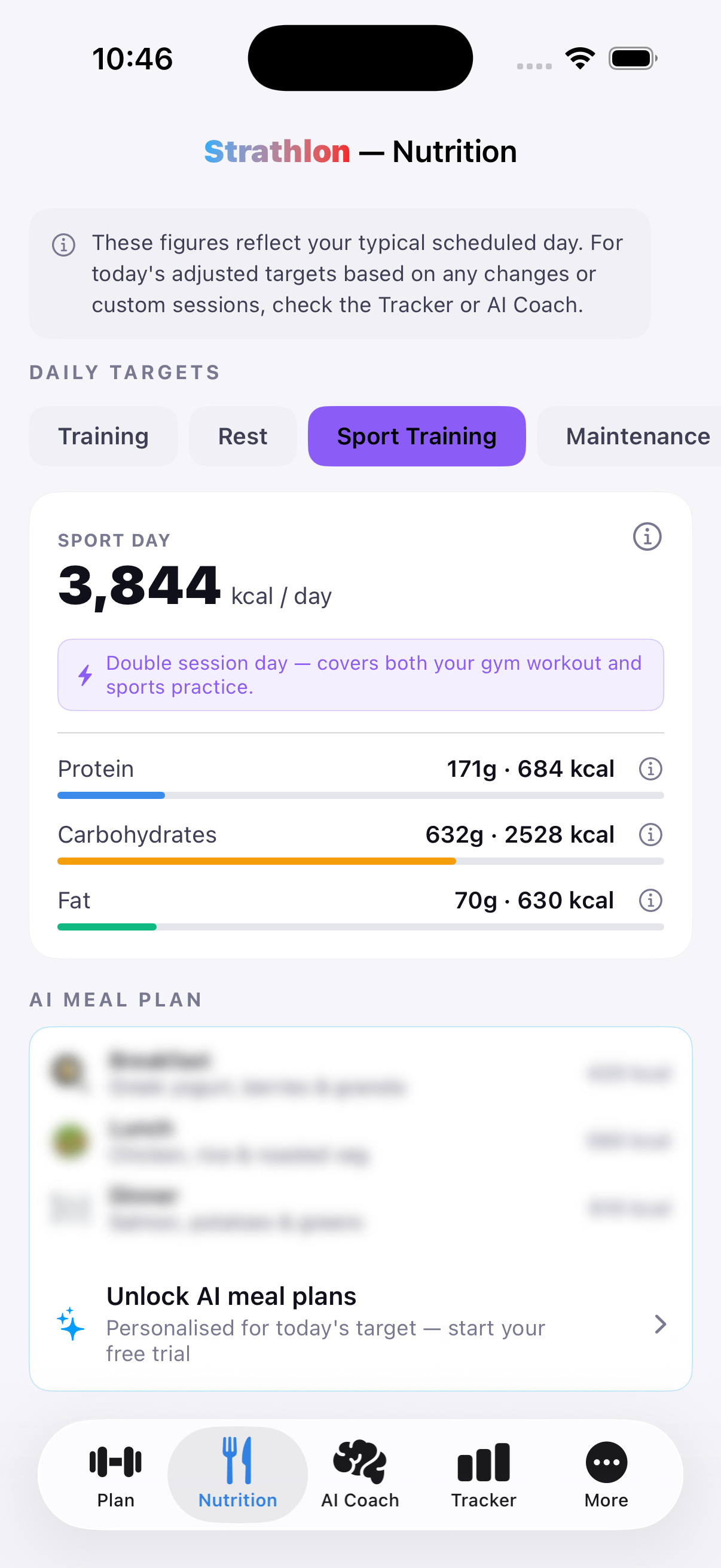
Pair this with the gym class fuelling guide to match your eating to the work, and see how muscle actually grows, recovery & rest and eating for results for the pieces that sit alongside it.
References
Numbered sources for the specific figures, effect sizes and named studies above. Where a claim reflects agreed guidance rather than a single trial, the citation is to the position stand or consensus statement of the body concerned, with the country or international remit named. A gym class is a format rather than a sport, so there is no class-specific performance literature. Everything below is general strength, conditioning and injury-prevention evidence, applied to what a class actually asks of you.
- Gottschall JS, Hastings B. A comparison of physiological intensity and psychological perceptions during three different group exercise formats. Frontiers in Sports and Active Living. 2023;5:1138605. Comparison of physiological intensity and psychological perceptions across three group-exercise formats: the source for how widely the demand varies between classes. PubMed 37065806 · PMC10102604 full text
- Herrmann SD, Willis EA, Ainsworth BE, Barreira TV, Hastert M, Kracht CL, et al. 2024 Adult Compendium of Physical Activities: A third update of the energy costs of human activities. Journal of Sport and Health Science. 2024;13(1):6–12. The 2024 Adult Compendium of Physical Activities, the source for the energy costs used to estimate what a class of a given intensity actually burns. PubMed 38242596 · PMC10818145 full text
- Villarroel López P, Juárez Santos-García D. High Intensity Functional Training in Hybrid Competitions: A Scoping Review of Performance Models and Physiological Adaptations. Journal of Functional Morphology and Kinesiology. 2025;10(4). Scoping review of high-intensity functional training performance models and physiological adaptations, the closest evidence to a mixed-format class. PubMed 41133555 · PMC12550923 full text
- Ángel Rodríguez M, García-Calleja P, Terrados N, Crespo I, Del Valle M, Olmedillas H. Injury in CrossFit®: A Systematic Review of Epidemiology and Risk Factors. The Physician and Sportsmedicine. 2022;50(1):3–10. Systematic review of injury epidemiology in high-intensity group training, the basis for scaling when form fails. PubMed 33322981
- Yu W, Feng D, Zhong Y, Luo X, Xu Q, Yu J. Examining the Influence of Warm-Up Static and Dynamic Stretching, as well as Post-Activation Potentiation Effects, on the Acute Enhancement of Gymnastic Performance: A Systematic Review with Meta-Analysis. Journal of Sports Science & Medicine. 2024;23(1):156–176. Meta-analysis of static and dynamic stretching and post-activation potentiation in warm-ups, the source for the warm-up guidance. PubMed 38455430 · PMC10915619 full text
- National Health Service (NHS, United Kingdom). Physical activity guidelines for adults aged 19 to 64. NHS physical activity guidance for adults, the weekly volume a regular class habit is measured against. NHS physical activity guidelines
- Suchomel TJ, Nimphius S, Stone MH. The Importance of Muscular Strength in Athletic Performance. Sports Medicine. 2016;46(10):1419–49. Suchomel and colleagues on the importance of muscular strength in athletic performance: the source for greater maximal strength being associated with faster sprinting, jumping and change of direction, and with lower injury risk. PubMed 26838985
- Seitz LB, Reyes A, Tran TT, Saez de Villarreal E, Haff GG. Increases in lower-body strength transfer positively to sprint performance: a systematic review with meta-analysis. Sports Medicine. 2014;44(12):1693–702. Seitz and colleagues' systematic review with meta-analysis showing increases in lower-body strength transfer positively to sprint performance, the evidence behind the 'strength is the base' argument. PubMed 25059334
- Lauersen JB, Andersen TE, Andersen LB. Strength training as superior, dose-dependent and safe prevention of acute and overuse sports injuries: a systematic review, qualitative analysis and meta-analysis. British Journal of Sports Medicine. 2018;52(24):1557–1563. Lauersen and colleagues' meta-analysis finding strength training a superior, dose-dependent and safe prevention of acute and overuse sports injuries: the direct source for treating strength work as prehab. PubMed 30131332
- Lauersen JB, Bertelsen DM, Andersen LB. The effectiveness of exercise interventions to prevent sports injuries: a systematic review and meta-analysis of randomised controlled trials. British Journal of Sports Medicine. 2014;48(11):871–7. Lauersen and colleagues' earlier meta-analysis of exercise interventions to prevent sports injuries, the broader evidence base the prevention advice sits on. PubMed 24100287
- . American College of Sports Medicine position stand. Progression models in resistance training for healthy adults. Medicine and Science in Sports and Exercise. 2009;41(3):687–708. American College of Sports Medicine (ACSM, United States) position stand on progression models in resistance training: the source for the heavy-load and explosive-load percentage ranges quoted. PubMed 19204579
- Cuthbert M, Haff GG, Arent SM, Ripley N, McMahon JJ, Evans M, et al. Effects of Variations in Resistance Training Frequency on Strength Development in Well-Trained Populations and Implications for In-Season Athlete Training: A Systematic Review and Meta-analysis. Sports Medicine. 2021;51(9):1967–1982. Cuthbert and colleagues' systematic review of resistance-training frequency in well-trained populations, the source for the sessions-per-week guidance. PubMed 33886099 · PMC8363540 full text
- Spiering BA, Mujika I, Sharp MA, Foulis SA. Maintaining Physical Performance: The Minimal Dose of Exercise Needed to Preserve Endurance and Strength Over Time. Journal of Strength and Conditioning Research. 2021;35(5):1449–1458. Spiering and colleagues on the minimal dose of exercise needed to preserve endurance and strength: the source for maintaining in-season on as little as one to two sessions a week. PubMed 33629972
- Rønnestad BR, Nymark BS, Raastad T. Effects of in-season strength maintenance training frequency in professional soccer players. Journal of Strength and Conditioning Research. 2011;25(10):2653–60. Ronnestad and colleagues' trial of in-season strength maintenance frequency in professional footballers, the specific in-season maintenance result quoted. PubMed 21873897
- Nuzzo JL, Pinto MD, Kirk BJC, Nosaka K. Resistance Exercise Minimal Dose Strategies for Increasing Muscle Strength in the General Population: an Overview. Sports Medicine. 2024;54(5):1139–1162. Nuzzo and colleagues on minimal-dose resistance exercise strategies for increasing strength, supporting the claim that a small, well-chosen dose does most of the work. PubMed 38509414 · PMC11127831 full text
- Wilson JM, Marin PJ, Rhea MR, Wilson SM, Loenneke JP, Anderson JC. Concurrent training: a meta-analysis examining interference of aerobic and resistance exercises. Journal of Strength and Conditioning Research. 2012;26(8):2293–307. Wilson and colleagues' meta-analysis of concurrent training and the interference effect: the source for separating heavy lifting from hard conditioning. PubMed 22002517
- Schumann M, Feuerbacher JF, Sünkeler M, Freitag N, Rønnestad BR, Doma K, et al. Compatibility of Concurrent Aerobic and Strength Training for Skeletal Muscle Size and Function: An Updated Systematic Review and Meta-Analysis. Sports Medicine. 2022;52(3):601–612. An updated systematic review of the compatibility of concurrent aerobic and strength training, the more recent evidence that interference is smaller than once believed. PubMed 34757594 · PMC8891239 full text
- Ramirez-Campillo R, Sortwell A, Moran J, Afonso J, Clemente FM, Lloyd RS, et al. Plyometric-Jump Training Effects on Physical Fitness and Sport-Specific Performance According to Maturity: A Systematic Review with Meta-analysis. Sports Medicine - Open. 2023;9(1):23. Ramirez-Campillo and colleagues on plyometric-jump training effects on physical fitness and sport-specific performance, the source for the plyometric guidance. PubMed 37036542 · PMC10086091 full text
- Impellizzeri FM, Woodcock S, Coutts AJ, Fanchini M, McCall A, Vigotsky AD. What Role Do Chronic Workloads Play in the Acute to Chronic Workload Ratio? Time to Dismiss ACWR and Its Underlying Theory. Sports Medicine. 2021;51(3):581–592. Impellizzeri and colleagues on the pitfalls of the acute:chronic workload ratio, cited because it is the reason this guide talks about ramping load gradually rather than quoting a workload number. PubMed 33332011
- Baz-Valle E, Balsalobre-Fernández C, Alix-Fages C, Santos-Concejero J. A Systematic Review of The Effects of Different Resistance Training Volumes on Muscle Hypertrophy. Journal of Human Kinetics. 2022;81:199–210. Systematic review of resistance-training volume and hypertrophy, the general dose-response evidence behind the set and session recommendations. PubMed 35291645 · PMC8884877 full text
This is general educational information rather than medical or individual coaching advice. The strength-and-conditioning figures here are drawn from published research and are framed as population-level guides; individual needs vary widely with training age, sex, injury history and health, and are best personalised with a qualified strength coach or clinician. Anyone with pain, an injury, a health condition, or who is pregnant or postpartum, should consult a suitably qualified professional before starting or changing an exercise programme. Progress load gradually and stop if a movement is sharply painful. See our Terms for more.
← All guides · Gym class fuelling · How muscle grows · Eating for results · Understanding your stats · Home