
Handball strength & conditioning
An evidence-based guide to training the body handball asks for. Handball is a collision sport of jumps, sprints, hard cuts and repeated overhead throws, which means it lives or dies on lower-body power, change-of-direction, and a shoulder and knee that can take the load. This covers the strength work that transfers, how to condition the sport's energy systems, the prehab that lowers its most common injuries, and how to fit it all around a season. Practical, honest, and grounded in sports-science evidence.
The short version: the qualities that matter most in handball are lower-body power (for jumping, sprinting and cutting), rotational and overhead throwing power, and a durable, well-conditioned shoulder and knee. Build heavy full-range strength as the base, add plyometric and throwing-power work to express it fast, and protect the shoulder, knee and ankle with proven prehab. Everything below is the detail behind that sentence, and where each number comes from.
On this page
A framing note before the detail. Strength and conditioning is well studied, but people differ enormously: playing position, age, sex, training history, injury history and recovery all shift what's right for you. So this is written as can, tends to and is associated with, never as a guarantee, and every specific figure is a population-level finding from published research rather than a personal prescription. It's general education rather than medical or individual coaching advice.
The demands of handball
Handball is an intermittent, high-intensity team sport: long stretches of moderate movement punctuated by short, maximal bursts: a sprint into a fast break, a jump throw, a hard block, a change of direction to shake a defender. A systematic review of match demands (García-Sánchez et al., 2023) found elite players cover on average around 3,664 m per match, but the distance matters less than what's inside it: players perform more than 1,000 accelerations and decelerations in a game, with heart rates sitting in a band of roughly 70–90% of maximum and blood-lactate readings commonly around 3.6–4.8 mmol/L and occasionally higher. In other words, handball leans on a solid aerobic base to recover between efforts, but the moments that decide games are anaerobic and explosive.
The biomechanics centre on three things: jumping and landing (the jump throw and defensive blocks), rapid change of direction and deceleration (cutting past and defending against opponents), and the overhead throw: a fast, repeated whip of the trunk and shoulder that generates ball speed through a kinetic chain running from the ground up. Demands also differ by position: the same review found backs throw the most (around 9.9 throws per match), which loads the shoulder heavily, while wings do more sprinting and fast breaks, and pivots absorb the most contact.
Those demands map directly onto the sport's most common injury sites. Broadly, the knee (including the ACL) and ankle dominate acute, traumatic injuries from cutting and landing, while the shoulder and lower back lead the overuse injuries from repeated throwing. Women carry a notably higher ACL risk than men. Good training, then, does two jobs at once: it builds the power the sport rewards, and it hardens the exact tissues the sport tends to break.
Key strength work, and why it matters
Strength is the foundation everything else is built on: a stronger athlete has more force available to turn into sprint speed, jump height and ball velocity. The goal isn't to become a powerlifter: it's to build enough strength that the fast, sport-specific work has something to draw on. Here are the patterns that transfer, and why.
- Heavy lower-body strength: squats and hinges. The squat (or a variation) and the hip hinge (deadlift, Romanian deadlift, trap-bar) build the force your legs put into the floor. This is the engine behind jumping and sprinting. Meta-analyses across team-sport athletes show heavy strength training transfers to faster linear sprints and higher jumps, the raw materials of a fast break and a jump throw. Train these through a full range and progress the load gradually over weeks.
- Plyometrics: jumps, bounds and hops. Handball is played off the floor and off quick ground contacts, which is reactive strength: the ability to absorb and return force fast. Plyometric training has strong evidence for improving jump height and sprint speed (with large effect sizes in meta-analyses), and it doubles as landing practice. Single-leg hops and bounds also rehearse the exact deceleration-and-cut pattern that both scores goals and, done badly, injures knees.
- Rotational and overhead throwing power. Ball speed is generated by rotating the trunk and transferring energy up the chain to the arm. Medicine-ball throws (rotational slams, chest passes, overhead throws) and cable/band rotational work train exactly this transfer at speed. In a meta-analysis of 30 studies and 727 handball players (Hadjisavvas et al., 2024), resistance training produced large improvements in throwing velocity (across standing, running and jumping throws) with the strongest, most consistent evidence for traditional barbell compound lifts. The honest read: build strength with the barbell, then add throwing-power drills to express it. Evidence for medicine-ball and band methods alone is weaker, so treat them as useful complements rather than the whole plan.
- Unilateral (single-leg) work for change-of-direction. Cutting, defending and landing happen on one leg. Split squats, lunges, step-ups and single-leg RDLs build strength and control in the position the sport actually loads, and help even out left-to-right imbalances that a two-legged squat can hide.
- Trunk and shoulder: the throw's transmission and its brake. A stiff, strong trunk transmits leg power to the arm. A well-conditioned shoulder (especially the external rotators and scapular muscles) both adds to the throw and survives its repetition. This overlaps directly with the shoulder prehab below, which is a case of the same work serving performance and durability at once.
- References
This is what it looks like as a plan rather than a list: a goal-driven base of squats and hinges, plus a handball accessory block layered on top: what Strathlon builds when you set handball as your sport and choose Sports Performance as one of your goals, with the session itself sitting in the week alongside your gym days.
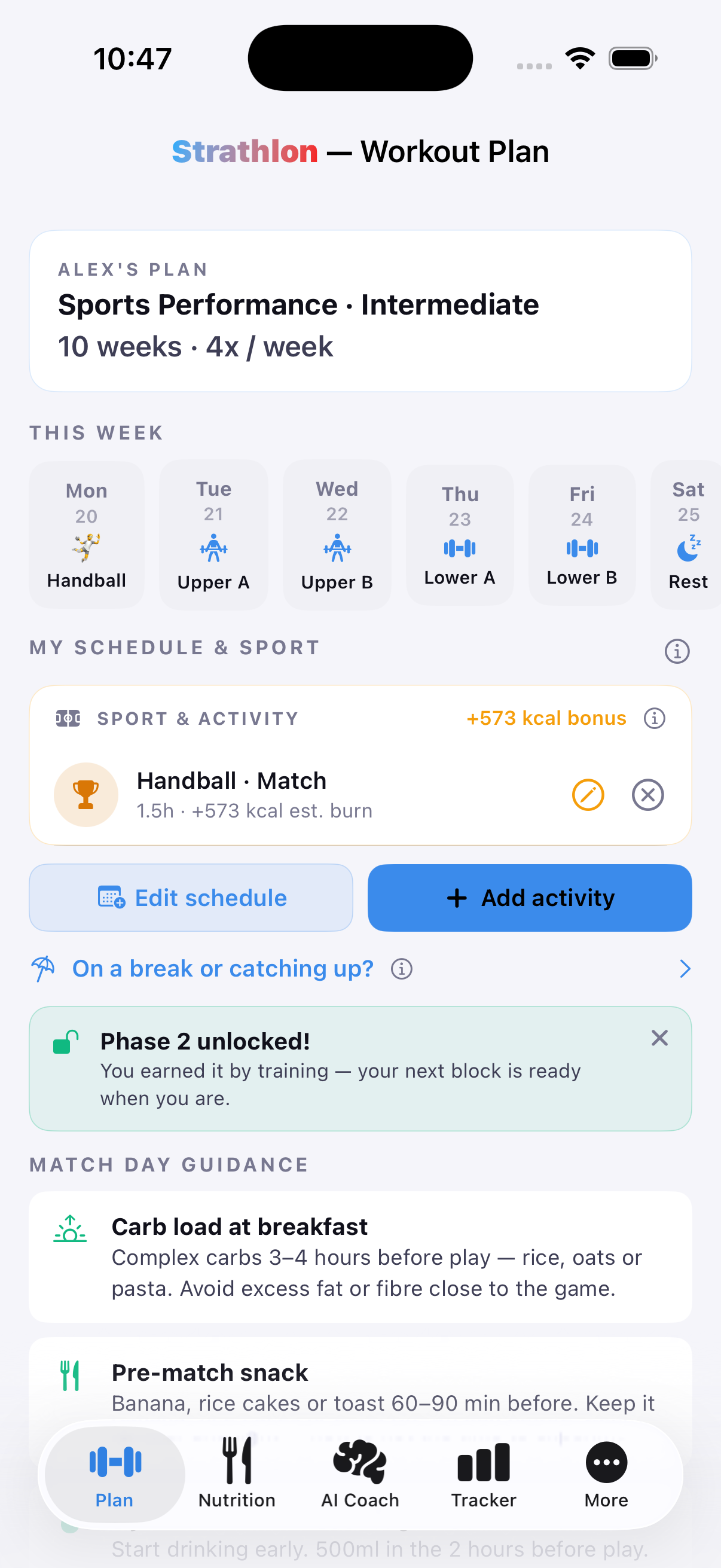
Why show both halves? Because a handball athlete needs both. The base lifts give you the force. The accessory block (single-leg and lateral strength, jumps and bounds, hamstring and adductor work) turns that force into handball-relevant speed and protects the knees, hamstrings and groin doing the work. Skip the base and you have nothing to express. Skip the sport-specific block and your general strength never quite becomes a quicker first step or a sharper cut.
Conditioning for handball
Handball's conditioning demand is repeat-sprint ability: producing near-maximal efforts over and over, with brief incomplete recovery, for two halves. That rests on two systems working together. A strong aerobic base is what lets you recover between bursts and hold your quality into the last ten minutes. The anaerobic, high-intensity efforts are what win individual plays. Both need training, but the sport itself is intermittent, so your conditioning should be too.
- Repeat-sprint and interval work. Short maximal sprints (roughly 10–40 m) with change of direction, on incomplete recovery, train the exact quality the sport demands and echo its cutting patterns. Shorter, sharper intervals develop the anaerobic side. Slightly longer intervals build the aerobic engine that supports repeated efforts.
- Aerobic base. Enough steady aerobic fitness underpins recovery between sprints and between matches. Much of this is developed by playing and by the interval work above, so most handball players don't need long, slow distance running on top: it can eat into the legs' freshness for power work.
- Let the sport do some of the conditioning. Full-court practice and match play are themselves high-intensity intermittent conditioning. Adding large volumes of extra running on top can push total load too high and blunt your power. Count practice as training. It isn't free.
Fitting strength and conditioning together without interference is mostly about ordering and spacing. As a rule of thumb, keep quality power and strength work when you're fresh, and don't bury a heavy leg day right before a match or a hard conditioning session. When strength and endurance work must share a day, separating them by several hours, or prioritising whichever quality matters most that week, reduces the classic concurrent-training trade-off. In practice the bigger risk for most handball players isn't interference between gym and running: it's simply too much total load once you add court time, which is why the in-season plan below is deliberately lean.
Staying injury-resilient
Handball has some of the best injury-prevention evidence of any team sport, much of it generated in Scandinavian handball itself. Three areas are worth building into every week: the knee and ankle (cutting and landing), the shoulder (throwing), and the hamstrings (sprinting). The common thread is that a few minutes of the right work, done consistently, moves the odds.
Knee (ACL) and ankle: neuromuscular training. The landmark handball study here is a cluster-randomised trial of 1,837 adolescent players (Olsen et al., 2005), in which a structured warm-up that trained running, cutting and landing technique alongside balance and strength roughly halved acute knee and ankle injuries. That finding sits inside a much larger body of evidence: meta-analyses of neuromuscular prevention programmes in female athletes are associated with a large reduction in ACL injuries: broadly around a halving of overall ACL risk, and even larger reductions for non-contact ACL injuries, the kind that happen on a landing or a cut with no one touching you. The active ingredients are landing and cutting technique (land soft, knees tracking over toes, avoid the knee collapsing inward), plyometrics, balance and lower-body strength. Compliance is the catch: these programmes work when they're done routinely, so make them your warm-up rather than an afterthought.
Shoulder: external-rotator and scapular strength. The overhead throw is repetitive and heavy, and the shoulder is the leading site of overuse injury in throwers. In a cluster-randomised trial of 660 elite handball players (Andersson et al., 2017), the Oslo Sports Trauma Research Center shoulder programme (building external-rotation and scapular strength, internal-rotation range and thoracic mobility, done as a warm-up three times a week) lowered the season prevalence of shoulder problems from about 23% to 17%, roughly a quarter fewer. Be honest about the evidence: a later handball trial of a stretching-and-band programme did not reduce overuse shoulder injuries, so this isn't a guarantee. But the components are low-risk, they overlap with performance, and managing throwing volume (not spiking your throws suddenly) is part of the same picture.
Hamstrings: Nordic curls, with honest expectations. Sprinting exposes the hamstrings, and the most-studied preventive exercise is the Nordic hamstring curl, an eccentric exercise done in pairs. A meta-analysis of 8,459 athletes (van Dyk et al., 2019) found that prevention programmes including the Nordic exercise were associated with roughly halving the rate of hamstring injuries. State it as an association rather than a promise: a subsequent methodological reappraisal argued the certainty is lower than that headline suggests. Still, it's a cheap, low-risk exercise with a plausible mechanism, and a sensible inclusion for a sprinting sport.
Programming it around your season
The season decides how much strength and conditioning you do and when. The principle is simple: build in the off-season, maintain in-season.
- Off-season and pre-season: build. With no matches to protect, this is when you develop the base: heavier strength work (squats, hinges, presses, pulls), a proper block of plyometrics and throwing power, and the conditioning that raises your repeat-sprint ceiling. Two to three quality gym sessions a week, alongside rebuilding court fitness, is a realistic frame. This is where new strength and power are genuinely won.
- In-season: maintain. Once matches and heavy practice arrive, the goal shifts from gaining to keeping. The encouraging evidence here is that maintenance is cheap: research on in-season team-sport athletes (for example Rønnestad et al., 2011) indicates that as little as one well-run strength session per week can preserve the strength and power built earlier, as long as the load stays reasonably heavy. Most handball players do well on one to two short, focused sessions a week, kept away from match days, plus their prehab warm-up. Keep the intensity respectable but the volume and fatigue low: you're topping up a tank rather than refilling it.
- Fit it around fatigue, and the calendar second. Practice and matches are training load too. Schedule gym work when you're freshest (often early in the week, well before the next match), and be willing to pull back a session in a congested fixture week. A missed maintenance session in a heavy week costs far less than turning up to a match with tired legs.
Common questions
What strength work matters most for handball?
Handball rewards three qualities: lower-body power for jumping and sprinting, change-of-direction ability for cutting and defending, and throwing power from a well-conditioned trunk and shoulder. The base is heavy, full-range lower-body strength (squats and hinges) because a stronger athlete has more force to turn into speed and jump height. On top of that sit plyometrics (jumps and bounds) for reactive strength, and rotational and medicine-ball throwing work plus single-leg exercises for cutting. In a meta-analysis of 30 studies and 727 handball players (Hadjisavvas et al., 2024), resistance training produced large improvements in throwing velocity, with the strongest and most consistent evidence for traditional barbell compound lifts. Strength is the foundation the sport-specific work is built on.
Does lifting weights make me slower or too bulky for handball?
No: this is one of the most persistent myths in court sports. The evidence points the other way: meta-analyses show that strength and plyometric training transfer to faster sprints, higher jumps and better change-of-direction speed, and that in handball specifically, resistance training raises throwing velocity. Getting stronger improves your ability to produce force quickly, which is what fast, explosive movement is made of. Substantial muscle bulk is slow and deliberate to build and needs a large calorie surplus. It does not happen by accident from a couple of well-run gym sessions a week. The realistic outcome of sensible strength training is a more powerful, more resilient handball player rather than a slower one.
How do I protect my shoulder as a thrower?
Overhead throwing is repetitive and high-load, and the shoulder is the most common site of overuse injury in handball backs. The best-supported approach is a structured shoulder programme built into your warm-up. In a cluster-randomised trial of 660 elite handball players (Andersson et al., 2017), the Oslo Sports Trauma Research Center shoulder programme (which builds external-rotation and scapular strength, internal-rotation range and thoracic mobility, done three times a week) lowered the prevalence of shoulder problems from about 23% to 17% over a season, roughly a quarter fewer. Not every trial has found a benefit, so treat it as promising rather than guaranteed, but the ingredients (external-rotator and scapular strength, mobility and managing throwing volume) are low-risk and worth doing.
How can I reduce my ACL and knee injury risk in handball?
Handball involves a lot of cutting, landing and rapid deceleration, and the knee (including the ACL) is one of its most serious injury sites, with women at higher risk than men. The strongest evidence is for neuromuscular training programmes that combine balance, strength, plyometric and landing-technique work. In a cluster-randomised trial of 1,837 adolescent handball players (Olsen et al., 2005), a structured warm-up of this kind roughly halved acute knee and ankle injuries. Broader meta-analyses of neuromuscular prevention programmes in female athletes are associated with a large reduction in ACL injuries: around a halving of overall risk and even larger reductions for non-contact ACL injuries. Compliance matters: the programmes work best when done consistently, so build them into your regular warm-up rather than doing them occasionally.
How many strength sessions a week do I need during the season?
Fewer than you might fear. The bulk of your strength and power should be built in the off-season and pre-season. In-season the job is mostly to maintain it around a heavy schedule of practice and matches. Research on in-season maintenance in team-sport athletes (for example Rønnestad et al., 2011) indicates that as little as one well-run strength session per week can preserve the strength and power gains built earlier, provided the load stays reasonably heavy. Most handball players do well on one to two short, focused gym sessions a week in-season, placed away from matches, plus their prehab warm-up. The aim is to keep the quality high and the fatigue low rather than chase new personal bests mid-season.
Will heavy lifting actually make me throw harder?
It tends to help, though throwing is a whole-body skill and the weight room is only part of it. In a meta-analysis of resistance training in handball players (Hadjisavvas et al., 2024), training produced large improvements in throwing velocity across standing, running and jumping throws, with the strongest evidence for barbell compound lifts. A harder throw comes from force generated in the legs and trunk and transmitted through the shoulder and arm, so lower-body and trunk strength matter as much as the arm. Add rotational and medicine-ball power work to express that strength quickly, keep throwing technique sharp on court, and use the gym to raise the ceiling your throwing skill draws on.
Takeaways
- Train the three qualities that matter. Lower-body power, rotational/overhead throwing power, and a durable shoulder and knee are what handball rewards most.
- Build the base with heavy, full-range strength. Squats and hinges give you the force that becomes sprint speed and jump height. Barbell compound lifts have the strongest evidence for raising throwing velocity (Hadjisavvas et al., 2024).
- Add plyometrics and throwing power. Jumps, bounds and medicine-ball throws turn raw strength into fast, handball-specific movement, and double as landing practice.
- Use single-leg work for cutting. Split squats, lunges and single-leg RDLs train the one-legged positions the sport actually loads.
- Condition for repeat-sprint. Short maximal sprints with change of direction, on incomplete recovery, over a solid aerobic base. Count practice as load. It isn't free.
- Do the prehab, consistently. A neuromuscular warm-up roughly halved acute knee and ankle injuries in handball (Olsen et al., 2005); a shoulder programme cut shoulder problems from ~23% to ~17% (Andersson et al., 2017); Nordic curls are associated with about halving hamstring injuries (van Dyk et al., 2019).
- Build off-season, maintain in-season. As little as one heavy session a week can preserve strength through a season (Rønnestad et al., 2011). One to two focused sessions plus prehab suits most players in-season.
- Ignore the "bulky and slow" myth. Sensible strength training makes handball players faster and more resilient. It doesn't make them slower.
If you take one thing away: the strongest, most durable handball players aren't the ones grinding endless court sprints: they're the ones who build real lower-body and throwing power in the gym, protect the shoulder and knee with proven prehab, and then hold it all together in-season with a lean weekly dose. Strathlon's job is to give you a handball-aware plan and keep the base honest, so the sport-specific work has something solid to sit on.
Pair this with the handball fuelling guide: training builds the engine. Fuelling is what powers it through practice and matches.
References
Numbered sources for the specific figures, effect sizes and named studies above. Where a claim reflects agreed guidance rather than a single trial, the citation is to the position stand or consensus statement of the body concerned, with the country or international remit named. Handball has strong trial evidence on shoulder-injury prevention specifically, so that section below is cited to randomised handball trials rather than to general overhead-athlete guidance.
- García-Sánchez C, Navarro RM, Karcher C, de la Rubia A. Physical Demands during Official Competitions in Elite Handball: A Systematic Review. International Journal of Environmental Research and Public Health. 2023;20(4). Systematic review of the physical demands of official elite handball competition: the source for the jump, sprint and contact demands described. PubMed 36834047 · PMC9965087 full text
- Carton-Llorente A, Lozano D, Gilart Iglesias V, Jorquera DM, Manchado C. Worst-case scenario analysis of physical demands in elite men handball players by playing position through big data analytics. Biology of Sport. 2023;40(4):1219–1227. Worst-case-scenario analysis of physical demands in elite men's handball by playing position, the basis for the repeat-effort conditioning. PubMed 37867747 · PMC10588589 full text
- Saal C, Baumgart C, Wegener F, Ackermann N, Sölter F, Hoppe MW. Physical match demands of four LIQUI-MOLY Handball-Bundesliga teams from 2019-2022: effects of season, team, match outcome, playing position, and halftime. Frontiers in Sports and Active Living. 2023;5:1183881. Study of physical match demands across four Handball-Bundesliga teams, the second source for the same profile. PubMed 37293438 · PMC10246450 full text
- Andersson SH, Bahr R, Clarsen B, Myklebust G. Preventing overuse shoulder injuries among throwing athletes: a cluster-randomised controlled trial in 660 elite handball players. British Journal of Sports Medicine. 2017;51(14):1073–1080. Andersson and colleagues' cluster-randomised controlled trial preventing overuse shoulder injuries among throwing athletes in elite handball: the direct evidence behind the shoulder programme prescribed. PubMed 27313171
- Clarsen B, Bahr R, Andersson SH, Munk R, Myklebust G. Reduced glenohumeral rotation, external rotation weakness and scapular dyskinesis are risk factors for shoulder injuries among elite male handball players: a prospective cohort study. British Journal of Sports Medicine. 2014;48(17):1327–33. Study finding reduced glenohumeral rotation, external-rotation weakness and scapular dyskinesis are risk factors for shoulder injury in handball, the mechanism that programme targets. PubMed 24948083
- Andersson SH, Bahr R, Clarsen B, Myklebust G. Risk factors for overuse shoulder injuries in a mixed-sex cohort of 329 elite handball players: previous findings could not be confirmed. British Journal of Sports Medicine. 2018;52(18):1191–1198. Study of risk factors for overuse shoulder injuries in a mixed-sex cohort of elite handball players, the epidemiology behind it. PubMed 28784621
- Naderi A, Shaabani F, Keikha M, Degens H. Is an Exercise-Based Injury-Prevention Program Effective in Team Handball Players? A Systematic Review and Meta-Analysis. Journal of Athletic Training. 2024;59(8):845–856. Systematic review and meta-analysis asking whether exercise-based injury-prevention programmes work in team handball, the summary of that evidence. PubMed 37681675 · PMC11340671 full text
- Asker M, Hägglund M, Waldén M, Källberg H, Skillgate E. The Effect of Shoulder and Knee Exercise Programmes on the Risk of Shoulder and Knee Injuries in Adolescent Elite Handball Players: A Three-Armed Cluster Randomised Controlled Trial. Sports Medicine - Open. 2022;8(1):91. Study of shoulder and knee exercise programmes and injury risk in adolescent elite handball players, the knee half of the same prevention argument. PubMed 35834139 · PMC9283550 full text
- Bayrak A, Enli M. Epidemiological analysis of injuries in elite handball: insights from the 2023-2024 Turkish super league season. BMC Sports Science, Medicine & Rehabilitation. 2025;17(1):203. Epidemiological analysis of injuries in elite handball, cited for the current injury distribution. PubMed 40665408 · PMC12261712 full text
- Petushek EJ, Sugimoto D, Stoolmiller M, Smith G, Myer GD. Evidence-Based Best-Practice Guidelines for Preventing Anterior Cruciate Ligament Injuries in Young Female Athletes: A Systematic Review and Meta-analysis. The American Journal of Sports Medicine. 2019;47(7):1744–1753. Petushek and colleagues' meta-analysis of ACL injury prevention, the source for the neuromuscular knee-programme effect quoted. PubMed 30001501 · PMC6592422 full text
- Suchomel TJ, Nimphius S, Stone MH. The Importance of Muscular Strength in Athletic Performance. Sports Medicine. 2016;46(10):1419–49. Suchomel and colleagues on the importance of muscular strength in athletic performance: the source for greater maximal strength being associated with faster sprinting, jumping and change of direction, and with lower injury risk. PubMed 26838985
- Seitz LB, Reyes A, Tran TT, Saez de Villarreal E, Haff GG. Increases in lower-body strength transfer positively to sprint performance: a systematic review with meta-analysis. Sports Medicine. 2014;44(12):1693–702. Seitz and colleagues' systematic review with meta-analysis showing increases in lower-body strength transfer positively to sprint performance, the evidence behind the 'strength is the base' argument. PubMed 25059334
- Lauersen JB, Andersen TE, Andersen LB. Strength training as superior, dose-dependent and safe prevention of acute and overuse sports injuries: a systematic review, qualitative analysis and meta-analysis. British Journal of Sports Medicine. 2018;52(24):1557–1563. Lauersen and colleagues' meta-analysis finding strength training a superior, dose-dependent and safe prevention of acute and overuse sports injuries: the direct source for treating strength work as prehab. PubMed 30131332
- Lauersen JB, Bertelsen DM, Andersen LB. The effectiveness of exercise interventions to prevent sports injuries: a systematic review and meta-analysis of randomised controlled trials. British Journal of Sports Medicine. 2014;48(11):871–7. Lauersen and colleagues' earlier meta-analysis of exercise interventions to prevent sports injuries, the broader evidence base the prevention advice sits on. PubMed 24100287
- . American College of Sports Medicine position stand. Progression models in resistance training for healthy adults. Medicine and Science in Sports and Exercise. 2009;41(3):687–708. American College of Sports Medicine (ACSM, United States) position stand on progression models in resistance training: the source for the heavy-load and explosive-load percentage ranges quoted. PubMed 19204579
- Cuthbert M, Haff GG, Arent SM, Ripley N, McMahon JJ, Evans M, et al. Effects of Variations in Resistance Training Frequency on Strength Development in Well-Trained Populations and Implications for In-Season Athlete Training: A Systematic Review and Meta-analysis. Sports Medicine. 2021;51(9):1967–1982. Cuthbert and colleagues' systematic review of resistance-training frequency in well-trained populations, the source for the sessions-per-week guidance. PubMed 33886099 · PMC8363540 full text
- Spiering BA, Mujika I, Sharp MA, Foulis SA. Maintaining Physical Performance: The Minimal Dose of Exercise Needed to Preserve Endurance and Strength Over Time. Journal of Strength and Conditioning Research. 2021;35(5):1449–1458. Spiering and colleagues on the minimal dose of exercise needed to preserve endurance and strength: the source for maintaining in-season on as little as one to two sessions a week. PubMed 33629972
- Rønnestad BR, Nymark BS, Raastad T. Effects of in-season strength maintenance training frequency in professional soccer players. Journal of Strength and Conditioning Research. 2011;25(10):2653–60. Ronnestad and colleagues' trial of in-season strength maintenance frequency in professional footballers, the specific in-season maintenance result quoted. PubMed 21873897
- Nuzzo JL, Pinto MD, Kirk BJC, Nosaka K. Resistance Exercise Minimal Dose Strategies for Increasing Muscle Strength in the General Population: an Overview. Sports Medicine. 2024;54(5):1139–1162. Nuzzo and colleagues on minimal-dose resistance exercise strategies for increasing strength, supporting the claim that a small, well-chosen dose does most of the work. PubMed 38509414 · PMC11127831 full text
- Wilson JM, Marin PJ, Rhea MR, Wilson SM, Loenneke JP, Anderson JC. Concurrent training: a meta-analysis examining interference of aerobic and resistance exercises. Journal of Strength and Conditioning Research. 2012;26(8):2293–307. Wilson and colleagues' meta-analysis of concurrent training and the interference effect: the source for separating heavy lifting from hard conditioning. PubMed 22002517
- Schumann M, Feuerbacher JF, Sünkeler M, Freitag N, Rønnestad BR, Doma K, et al. Compatibility of Concurrent Aerobic and Strength Training for Skeletal Muscle Size and Function: An Updated Systematic Review and Meta-Analysis. Sports Medicine. 2022;52(3):601–612. An updated systematic review of the compatibility of concurrent aerobic and strength training, the more recent evidence that interference is smaller than once believed. PubMed 34757594 · PMC8891239 full text
- Ramirez-Campillo R, Sortwell A, Moran J, Afonso J, Clemente FM, Lloyd RS, et al. Plyometric-Jump Training Effects on Physical Fitness and Sport-Specific Performance According to Maturity: A Systematic Review with Meta-analysis. Sports Medicine - Open. 2023;9(1):23. Ramirez-Campillo and colleagues on plyometric-jump training effects on physical fitness and sport-specific performance, the source for the plyometric guidance. PubMed 37036542 · PMC10086091 full text
- Impellizzeri FM, Woodcock S, Coutts AJ, Fanchini M, McCall A, Vigotsky AD. What Role Do Chronic Workloads Play in the Acute to Chronic Workload Ratio? Time to Dismiss ACWR and Its Underlying Theory. Sports Medicine. 2021;51(3):581–592. Impellizzeri and colleagues on the pitfalls of the acute:chronic workload ratio: cited because it is the reason this guide talks about ramping load gradually rather than quoting a workload number. PubMed 33332011
- Baz-Valle E, Balsalobre-Fernández C, Alix-Fages C, Santos-Concejero J. A Systematic Review of The Effects of Different Resistance Training Volumes on Muscle Hypertrophy. Journal of Human Kinetics. 2022;81:199–210. Systematic review of resistance-training volume and hypertrophy, the general dose-response evidence behind the set and session recommendations. PubMed 35291645 · PMC8884877 full text
This is general educational information rather than medical or individual coaching advice. The strength-and-conditioning figures here are drawn from published research and are framed as population-level findings and associations: individual needs vary widely with position, age, sex, training history and injury history, and are best personalised with a qualified strength-and-conditioning coach. Anyone with pain, a current or past injury, a health condition, or who is pregnant or postpartum, should consult a qualified clinician or coach before starting or changing a training programme. See our Terms for more.
← All guides · Handball fuelling · Training for baseball (overhead throwing) · Training for tennis (rotational power) · How muscle actually grows · Eating for results · Home