
Strength & conditioning for netball
An evidence-based guide to training the netball body. Netball looks like a passing game, but physically it is a sport of hard stops, jumps, single-leg landings and sharp changes of direction on a small court, which is exactly why it carries a real risk to the knee and ankle. This covers the physical demands, the strength and power work that actually transfers, how to condition the repeat-effort engine, the prehab that lowers injury risk, and how to fit it all around a season. Practical, honest, and grounded in published sports-science research.
Here's the short version: the qualities that matter most in netball are single-leg strength and the control to land and decelerate safely, reactive lower-body power for jumping and changing direction, and the repeat-effort conditioning to do it all again 60 seconds later, with ankle and knee robustness woven through everything, because that is where netball hurts people. The rest of this page is the detail: what the sport demands, which lifts and drills build those qualities, and how to train them without wrecking yourself.
On this page
A framing note before the detail. Sports science is well studied but people differ enormously: age, training history, position, sex and health status all shift what's right for a given player. So this is written as can, tends to and is associated with, never as a guarantee, and every specific figure is a population-level finding from published research rather than a personal prescription. It's general education rather than medical or individual coaching advice.
The demands of netball
Netball is an intermittent, high-intensity team sport: short bursts of sprinting, jumping, cutting and hard stopping, stitched together with walking, jogging and standing. A match is four 15-minute quarters on a relatively small court (roughly 30.5 m by 15.25 m), and the footwork rule (you can't move the landing foot once you've caught the ball) forces players to stop dead and land under control constantly. Because of court zoning and positional roles, total distance covered varies widely by position: tracking studies put mid-court roles such as Centre at the top (broadly around 4,000–5,500 m or more in a match) and the shooting-circle roles much lower (closer to ~2,000–4,300 m), but all positions share the same repeated pattern of accelerate, decelerate, jump, land and change direction. The needs analysis by Thomas and colleagues (2017) describes the sport as predominantly anaerobic, layered on an aerobic base that fuels recovery between efforts.
That movement profile explains the injury picture. The braking and single-leg landing that the footwork rule demands loads the knee and ankle heavily and repeatedly. Across the research the ankle is consistently the most commonly injured site in netball, followed by the knee: a systematic review of netball injuries (Sports Medicine – Open, 2021) reported the ankle accounting for roughly 26–84% of injuries and the knee 8–29%, and a three-season professional cohort found the ankle (about 21%), knee (about 16%) and foot the most frequently reported medical-attention injuries. Most are acute: rolled ankles and knee injuries from landing and cutting rather than gradual overuse. Injuries also happen far more in matches than in training, so what you do to prepare the body to play matters most.
The injury that ends seasons is the anterior cruciate ligament (ACL) tear. It's relatively rare but hugely costly, and it has a signature mechanism in netball. In a systematic video analysis of 21 ACL injuries in elite netball, Belcher, Whatman and Brughelli (2024) found 17 of 21 (about 81%) occurred during jump-landing and only two from cutting, with a common scenario (around half the cases) of a player decelerating hard after jumping to receive a high pass, then landing with the knee extended and the foot planted, often off balance and with the head turned away. An earlier video study by Stuelcken and colleagues (2016) likewise found landings dominated, frequently with apparent knee valgus (inward) collapse. In plain terms: the danger isn't the jump, it's the uncontrolled landing and stop. That single insight drives most of what follows.
Key strength work, and why it matters
Strength is the foundation the fast stuff is built on. A stronger muscle can absorb landing forces, brake harder, and produce more power, and getting stronger transfers: systematic reviews and meta-analyses consistently find that improving lower-body strength is associated with faster sprinting, higher jumping and better change-of-direction in athletes. The point of lifting for netball isn't to look strong in the gym. It's to arrive on court able to stop, jump and cut with more in reserve. Here are the patterns that earn their place, and why.
- A bilateral base: squat and hinge. Back or front squats build the knee-and-hip extension strength behind every jump and hard stop. A hip hinge (Romanian or trap-bar deadlift) builds the posterior chain (glutes and hamstrings) that decelerates you and protects the knee. General resistance-training guidelines build maximal strength with heavier loads for low reps (broadly at or above about 85% of your one-rep max, in the region of 1–6 reps, for several sets), and power with lighter, faster, ballistic work. Netball wants both. Start with the base: it's what everything else stands on.
- Single-leg strength: the netball priority. Netball is played and landed on one leg far more than two, so unilateral strength is arguably the highest-value gym work in the sport. Bulgarian split squats, step-ups, single-leg Romanian deadlifts and lunges build strength in the exact position you land and cut in, expose and fix left–right imbalances a barbell can hide, and train the hip and knee control that keeps the knee tracking over the foot instead of collapsing inward. The netball needs analysis (Thomas and colleagues, 2017) emphasises exactly this lower-limb, single-leg control because of how the sport stops and lands.
- Reactive power: jumps, hops and landings. Plyometrics train the muscles and tendons to store and return energy quickly, which is what a jump for the ball and a sharp cut both rely on. Meta-analyses in athletes, including female athletes specifically, show plyometric training improves jump height, sprint speed and change-of-direction. Just as important for netball, landing is a skill you train: teaching a soft, bent-knee, two-then-one-foot landing under control is both a power exercise and injury prevention. Progress from two-foot to single-leg, and from planned to reactive, as control improves.
- Deceleration and change-of-direction. Because ACL and ankle injuries cluster around braking and cutting, learning to decelerate (to absorb speed over several steps with a stable knee and hip rather than one stiff, extended leg) is trainable and protective. Eccentric-biased strength (controlled lowering), single-leg landings and progressive cutting drills all build the capacity to stop safely at speed.
- Trunk and upper body. A strong, stable trunk lets you hold position under a contest and land balanced rather than leaning back. The off-balance landing was a repeated theme in the ACL video studies. Some pressing and pulling rounds out a durable, contact-ready athlete.
- References
Notice the theme: base strength makes the reactive, single-leg and deceleration work safer and more productive, and the sport-specific drills turn that strength into on-court speed and control. You need both halves: the heavy base and the fast, sport-shaped work on top. For the underlying mechanics of getting stronger and building muscle (progressive overload, effort and recovery) the progressive-overload guide goes deep.
Conditioning for netball
Netball's engine is repeat-effort: the ability to produce a hard sprint, jump or cut, recover briefly, and do it again, for four quarters. That's mostly an anaerobic demand on top of an aerobic base, and both matter. The aerobic base is what refuels you between efforts and stops your quality falling off late in a game. The anaerobic, repeat-sprint capacity is what lets each effort be sharp. So conditioning for netball leans on short, high-intensity intervals and repeat-sprint work: efforts of a few seconds to a minute with incomplete recovery, ideally shaped to include the accelerations, decelerations and changes of direction the sport actually uses, sitting on a foundation of general aerobic fitness.
Court-based, change-of-direction conditioning has a bonus: it rehearses the exact stop-start pattern that loads the knee and ankle, so done with good mechanics it doubles as movement practice. The trap to avoid is only ever running in straight lines, because netball almost never does.
How do strength and conditioning fit together without one blunting the other? Two honest principles. First, separate the hardest efforts where you can: a maximal strength or power session and a brutal conditioning session on the same day, back to back, tends to compromise at least one of them (the classic "interference" concern is mostly about heavy concurrent fatigue). If you must combine, put the quality you care about most first, while you're fresh. Second, let the season set the balance: when match and court demands are high, conditioning is largely covered by playing and practising, so gym time protects strength and power rather than adding more running fatigue.
Staying injury-resilient
This is the section that keeps you on court, and netball's injury profile points to clear, evidence-based priorities: the ankle, the knee (including the ACL), and the landing and cutting mechanics behind both.
- Balance and proprioceptive training for the ankle. The ankle is netball's most-injured site, and balance training is the best-evidenced defence. A systematic review and meta-analysis by de Vasconcelos and colleagues (2018) found proprioceptive/balance training was associated with roughly a 38% reduction in ankle-sprain incidence (risk ratio about 0.62). Balance work tends to be especially worthwhile for players who have sprained an ankle before: the strongest predictor of a sprain is having had one. Wobble-board, single-leg-balance and hop-and-stick drills are cheap, quick and worth doing year-round.
- A multi-component neuromuscular warm-up for the knee. Because netball ACL injuries are overwhelmingly non-contact landing events, the intervention with the strongest evidence is a structured neuromuscular programme (landing and deceleration technique, single-leg control, balance, and plyometrics) done as a warm-up a few times a week. Meta-analyses of these programmes in female team athletes report meaningful reductions in ACL-injury risk, on the order of roughly halving it, alongside lower overall knee-injury rates. A randomised trial in young female netballers specifically found neuromuscular training improved landing biomechanics: lower peak landing forces and less inward knee movement. The size of the benefit, honestly, hinges on doing it consistently: compliance is the difference between a programme that works and one that doesn't. Netball Australia's KNEE Program is a sport-specific, ready-made example.
- Posterior-chain and eccentric strength. Strong, capable hamstrings help the knee absorb and brake. The best-known example is the Nordic hamstring exercise: including it in injury-prevention programmes is associated with roughly halving hamstring-injury rates in a meta-analysis of over 8,000 athletes by van Dyk, Behan and Whiteley (2019) (injury risk ratio about 0.49). Two honest caveats: hamstring strains are a smaller share of netball's injuries than ankle and knee, so this is supporting rather than headline prehab. Some later reappraisals also urge caution on the exact magnitude. Eccentric single-leg and calf work similarly build braking capacity for the knee and ankle.
Two more universal protectors: manage load (sudden spikes in training or match volume raise injury risk, so build up gradually) and never skip the warm-up before matches, where injury rates are highest. Prehab isn't a separate project. It's a few minutes of the right movement, done often.
Programming it around your season
The same training looks different depending on the time of year. The useful mental model is build in the off-season, maintain in-season.
- Off-season / pre-season: build. This is when you can afford two to three strength sessions a week, push maximal strength, and add power and plyometrics on a base of general conditioning. It's the window to raise your ceiling: the stronger and more powerful you get now, the more you have to maintain later.
- In-season: maintain and stay sharp. Once matches and court practice fill the week, the gym's job changes from building to protecting what you built. The encouraging evidence: you need surprisingly little to hold on. In professional soccer players, one strength session per week maintained strength and sprint performance across the first 12 weeks of the season, whereas training only once every two weeks let both decline (Rønnestad, Nymark and Raastad, 2011). For netball, one to two short, heavy, low-fatigue sessions a week (a few hard sets on a squat or hinge, a single-leg lift, some fast jumps) is usually enough to keep strength and power up without adding fatigue that dulls you for matches.
- Fit S&C around court fatigue rather than on top of it. Put heavy or powerful gym work on days that don't sit right before a match or a hard court session, and keep the highest-quality work while you're freshest. When in doubt in-season, do less in the gym and protect the on-court performance: the goal is to play well rather than to log a big week of lifting.
One constant across every phase: keep the neuromuscular and balance warm-up in year-round. It's the cheapest, highest-return habit in the whole plan.

Common questions
What strength work matters most for netball?
Netball is a landing, decelerating and cutting sport played mostly on one leg, so the highest-value work is single-leg strength (split squats, step-ups, single-leg Romanian deadlifts), a strong bilateral base (squat and hinge patterns), and reactive, explosive power (jumps, hops and landings trained deliberately). General resistance-training guidelines build maximal strength with heavier loads for low reps, while power and reactive qualities need lighter, faster and plyometric work. Meta-analyses show that getting stronger tends to transfer to faster sprints, higher jumps and better change-of-direction. The needs analysis for netball (Thomas and colleagues, 2017) emphasises lower-limb strength and control precisely because the sport demands rapid stopping and single-leg landing.
Does lifting weights make netballers slow or bulky?
No: this is one of the most persistent myths in women's sport. Building substantial muscle is slow and deliberate and does not happen by accident. Getting stronger is strongly associated with improved sprinting, jumping and change-of-direction in athletes, which is the opposite of slow. Heavy strength work is mostly a nervous-system adaptation, especially early on, so you can get markedly stronger and more powerful with only modest changes in size. For netball, appropriate strength training tends to make you faster and more injury-resilient rather than heavier.
How can I reduce my risk of an ACL injury in netball?
ACL injuries in netball are overwhelmingly non-contact and happen on landing. In a video analysis of 21 ACL injuries in elite netball (Belcher and colleagues, 2024), 17 of 21 (about 81%) occurred during jump-landing and only two from cutting, with a common pattern of decelerating hard after jumping for a high pass and landing with the knee extended and the foot planted. The evidence-based answer is a multi-component neuromuscular warm-up: landing and deceleration technique, single-leg control, balance and plyometrics, done a few times a week. Meta-analyses of these programmes in female team athletes report meaningful reductions in ACL-injury risk, on the order of roughly halving it, though the benefit depends heavily on doing the programme consistently. Netball Australia's KNEE Program is a sport-specific example.
How do I keep my strength up during the netball season?
You need less than most people think to maintain what you built. In professional soccer players, one strength session per week maintained strength and sprint performance across the first 12 weeks of the season, whereas training only once every two weeks let both slip (Rønnestad and colleagues, 2011). Practically, one to two short, heavy, low-fatigue sessions a week (a handful of hard sets on a squat or hinge, a single-leg lift and some fast jumps) is usually enough to hold strength and power in-season while you keep matches and court skills fresh. In-season is for maintaining and staying sharp rather than chasing new personal bests.
What are the most common netball injuries, and how do I prevent them?
Across the research the ankle is consistently the most-injured site in netball, followed by the knee. A systematic review reported the ankle accounting for roughly 26–84% of injuries and the knee 8–29%, and a three-season professional cohort found the ankle (about 21%), knee (about 16%) and foot the most common medical-attention injuries. Most are acute, from landing and cutting. The best-evidenced prevention is balance and proprioceptive training, which is associated with around a 38% reduction in ankle-sprain incidence (de Vasconcelos and colleagues, 2018), combined with a neuromuscular warm-up for the knee and single-leg strength. Match injury rates are far higher than training, so warming up properly before you play matters most.
How many days a week of strength and conditioning does netball need?
It depends on the phase. In the off-season or pre-season, two to three strength sessions a week lets you build a base and add power. In-season, one to two shorter maintenance sessions a week can hold strength and power (Rønnestad and colleagues, 2011), fitted on days that don't clash with hard court sessions or matches. Either way, a short neuromuscular and balance warm-up before most sessions and matches is the highest-value habit for staying available. The right number is the most you can recover from while training and playing netball well.
Takeaways
- Netball is a landing-and-cutting sport. Hard stops, jumps and single-leg landings on a small court are what load the knee and ankle, and that's where most injuries happen.
- Prioritise single-leg strength. Split squats, step-ups and single-leg RDLs build strength in the exact position you land and cut in: arguably the highest-value gym work for netball.
- Build a base, then make it fast. Squat and hinge for force. Add plyometrics, deliberate landings and change-of-direction work to turn strength into on-court power. Getting stronger tends to transfer to faster sprints and higher jumps.
- Condition the repeat-effort engine. Short, high-intensity, change-of-direction intervals on an aerobic base. Keep the hardest gym and conditioning efforts apart, and put the priority quality first.
- Guard the ankle with balance work. Proprioceptive training is associated with about a 38% drop in ankle sprains, most of all if you've sprained before.
- Guard the knee with a neuromuscular warm-up. Landing, deceleration, balance and plyometric programmes are associated with roughly halving ACL-injury risk in female athletes, but only if you actually do them consistently.
- Maintain in-season on little. One to two short, heavy sessions a week can hold strength and power through a season, so you don't need to keep chasing personal bests while you're competing.
- Warm up before matches, always. Injury rates are far higher in games than training, so the pre-match neuromuscular warm-up is the cheapest protection you have.
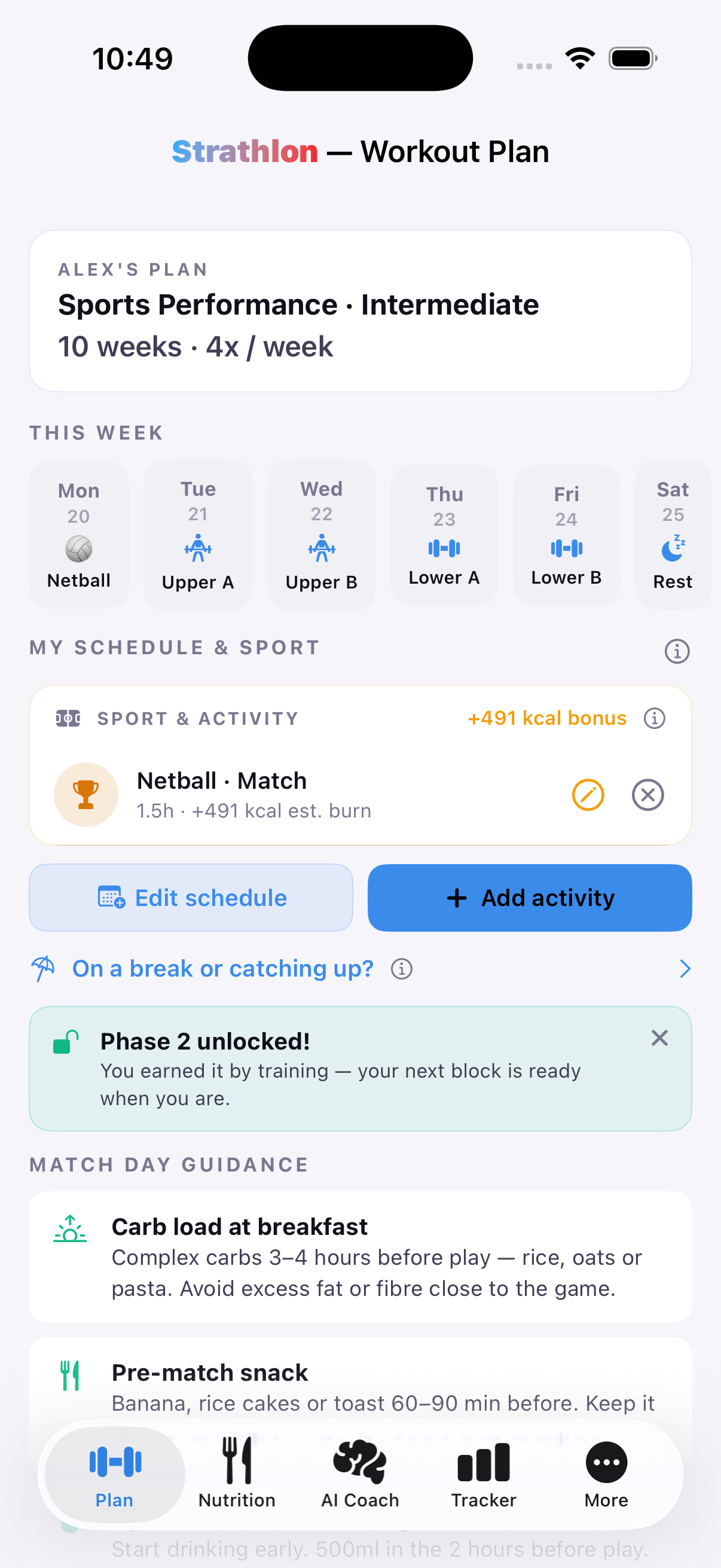
If you remember one thing, make it this: netball injuries happen when you land and stop out of control, so the training that protects you (single-leg strength, deliberate landings, balance and a neuromuscular warm-up) is the same training that makes you faster and springier on court. Strathlon's job is to keep that base honest with a plan tuned for netball once Sports Performance is one of your goals, so the strength and progression underneath your game are one less thing to guess at. Pair this with the netball fuelling guide to get the nutrition side right too.
References
Numbered sources for the specific figures, effect sizes and named studies above. Where a claim reflects agreed guidance rather than a single trial, the citation is to the position stand or consensus statement of the body concerned, with the country or international remit named. Netball is well described for match demands and injury but has almost no published training-intervention research, so the strength and plyometric prescriptions below come from general evidence and from the closely comparable court sports.
- Brooks ER, Benson AC, Fox AS, Bruce LM. Physical movement demands of elite-level netball match-play as measured by an indoor positioning system. Journal of Sports Sciences. 2020;38(13):1488–1495. Study of the physical movement demands of elite netball match play measured by an indoor positioning system: the source for the sport's stop-start, jump-and-land profile. PubMed 32268834
- King DA, Cummins C, Hume PA, Clark TN. Physical Demands of Amateur Domestic and Representative Netball in One Season in New Zealand Assessed Using Heart Rate and Movement Analysis. Journal of Strength and Conditioning Research. 2020;34(7):2062–2070. Study of the physical demands of amateur domestic and representative netball across a season, cited so the demands are not described from the elite game alone. PubMed 29781938
- Tissera KM, Naughton GA, Gabbett TJ, Krause LM, Moresi MP, Benson AC. Sex Differences in Physical Fitness Characteristics and Match-Play Demands in Adolescent Netball: Should Male and Female Adolescents Co-compete in Netball?. Journal of Strength and Conditioning Research. 2019;33(3):846–856. Study of sex differences in fitness characteristics and match demands in adolescent netball, cited in the programming section. PubMed 30399115
- Wik EH, Sewry N, Derman W, Schwellnus M, Eken M. Ankle, knee and concussion concerns: Unveiling injury patterns in highly trained South African netball players. Physical Therapy in Sport : Official Journal of the Association of Chartered Physiotherapists in Sports Medicine. 2024;70:1–6. Study of ankle, knee and concussion injury patterns in highly trained South African netball players: the source for the injury sites the prehab targets. PubMed 39153283
- Schiftan GS, Ross LA, Hahne AJ. The effectiveness of proprioceptive training in preventing ankle sprains in sporting populations: a systematic review and meta-analysis. Journal of Science and Medicine in Sport. 2015;18(3):238–44. Schiftan and colleagues' meta-analysis of proprioceptive training and ankle sprains, the source for the ankle-prehab effect quoted. PubMed 24831756
- Petushek EJ, Sugimoto D, Stoolmiller M, Smith G, Myer GD. Evidence-Based Best-Practice Guidelines for Preventing Anterior Cruciate Ligament Injuries in Young Female Athletes: A Systematic Review and Meta-analysis. The American Journal of Sports Medicine. 2019;47(7):1744–1753. Petushek and colleagues' meta-analysis of ACL injury prevention in young female athletes, the source for neuromuscular programmes roughly halving ACL risk. PubMed 30001501 · PMC6592422 full text
- Emery CA, Owoeye OBA, Räisänen AM, Befus K, Hubkarao T, Palacios-Derflingher L, et al. The "SHRed Injuries Basketball" Neuromuscular Training Warm-up Program Reduces Ankle and Knee Injury Rates by 36% in Youth Basketball. The Journal of Orthopaedic and Sports Physical Therapy. 2022;52(1):40–48. The SHRed Injuries neuromuscular warm-up trial in basketball, read across to netball's very similar landing and cutting demands. PubMed 34972488
- Ramirez-Campillo R, García-Hermoso A, Moran J, Chaabene H, Negra Y, Scanlan AT. The effects of plyometric jump training on physical fitness attributes in basketball players: A meta-analysis. Journal of Sport and Health Science. 2022;11(6):656–670. Meta-analysis of plyometric jump training in basketball players, applied to netball for the same reason and said to be a read-across. PubMed 33359798 · PMC9729929 full text
- Spencer K, Paget N, Kilding A, McErlain-Naylor SA. Physical, physiological, and technical demands of national netball umpires at different competition levels. Journal of Sports Sciences. 2020;38(14):1660–1665. Study of the physical and physiological demands on national netball umpires, cited for the range of demands the sport places on court. PubMed 32299309
- Suchomel TJ, Nimphius S, Stone MH. The Importance of Muscular Strength in Athletic Performance. Sports Medicine. 2016;46(10):1419–49. Suchomel and colleagues on the importance of muscular strength in athletic performance: the source for greater maximal strength being associated with faster sprinting, jumping and change of direction, and with lower injury risk. PubMed 26838985
- Seitz LB, Reyes A, Tran TT, Saez de Villarreal E, Haff GG. Increases in lower-body strength transfer positively to sprint performance: a systematic review with meta-analysis. Sports Medicine. 2014;44(12):1693–702. Seitz and colleagues' systematic review with meta-analysis showing increases in lower-body strength transfer positively to sprint performance, the evidence behind the 'strength is the base' argument. PubMed 25059334
- Lauersen JB, Andersen TE, Andersen LB. Strength training as superior, dose-dependent and safe prevention of acute and overuse sports injuries: a systematic review, qualitative analysis and meta-analysis. British Journal of Sports Medicine. 2018;52(24):1557–1563. Lauersen and colleagues' meta-analysis finding strength training a superior, dose-dependent and safe prevention of acute and overuse sports injuries: the direct source for treating strength work as prehab. PubMed 30131332
- Lauersen JB, Bertelsen DM, Andersen LB. The effectiveness of exercise interventions to prevent sports injuries: a systematic review and meta-analysis of randomised controlled trials. British Journal of Sports Medicine. 2014;48(11):871–7. Lauersen and colleagues' earlier meta-analysis of exercise interventions to prevent sports injuries, the broader evidence base the prevention advice sits on. PubMed 24100287
- . American College of Sports Medicine position stand. Progression models in resistance training for healthy adults. Medicine and Science in Sports and Exercise. 2009;41(3):687–708. American College of Sports Medicine (ACSM, United States) position stand on progression models in resistance training: the source for the heavy-load and explosive-load percentage ranges quoted. PubMed 19204579
- Cuthbert M, Haff GG, Arent SM, Ripley N, McMahon JJ, Evans M, et al. Effects of Variations in Resistance Training Frequency on Strength Development in Well-Trained Populations and Implications for In-Season Athlete Training: A Systematic Review and Meta-analysis. Sports Medicine. 2021;51(9):1967–1982. Cuthbert and colleagues' systematic review of resistance-training frequency in well-trained populations, the source for the sessions-per-week guidance. PubMed 33886099 · PMC8363540 full text
- Spiering BA, Mujika I, Sharp MA, Foulis SA. Maintaining Physical Performance: The Minimal Dose of Exercise Needed to Preserve Endurance and Strength Over Time. Journal of Strength and Conditioning Research. 2021;35(5):1449–1458. Spiering and colleagues on the minimal dose of exercise needed to preserve endurance and strength: the source for maintaining in-season on as little as one to two sessions a week. PubMed 33629972
- Rønnestad BR, Nymark BS, Raastad T. Effects of in-season strength maintenance training frequency in professional soccer players. Journal of Strength and Conditioning Research. 2011;25(10):2653–60. Ronnestad and colleagues' trial of in-season strength maintenance frequency in professional footballers, the specific in-season maintenance result quoted. PubMed 21873897
- Nuzzo JL, Pinto MD, Kirk BJC, Nosaka K. Resistance Exercise Minimal Dose Strategies for Increasing Muscle Strength in the General Population: an Overview. Sports Medicine. 2024;54(5):1139–1162. Nuzzo and colleagues on minimal-dose resistance exercise strategies for increasing strength, supporting the claim that a small, well-chosen dose does most of the work. PubMed 38509414 · PMC11127831 full text
- Wilson JM, Marin PJ, Rhea MR, Wilson SM, Loenneke JP, Anderson JC. Concurrent training: a meta-analysis examining interference of aerobic and resistance exercises. Journal of Strength and Conditioning Research. 2012;26(8):2293–307. Wilson and colleagues' meta-analysis of concurrent training and the interference effect: the source for separating heavy lifting from hard conditioning. PubMed 22002517
- Schumann M, Feuerbacher JF, Sünkeler M, Freitag N, Rønnestad BR, Doma K, et al. Compatibility of Concurrent Aerobic and Strength Training for Skeletal Muscle Size and Function: An Updated Systematic Review and Meta-Analysis. Sports Medicine. 2022;52(3):601–612. An updated systematic review of the compatibility of concurrent aerobic and strength training, the more recent evidence that interference is smaller than once believed. PubMed 34757594 · PMC8891239 full text
- Ramirez-Campillo R, Sortwell A, Moran J, Afonso J, Clemente FM, Lloyd RS, et al. Plyometric-Jump Training Effects on Physical Fitness and Sport-Specific Performance According to Maturity: A Systematic Review with Meta-analysis. Sports Medicine - Open. 2023;9(1):23. Ramirez-Campillo and colleagues on plyometric-jump training effects on physical fitness and sport-specific performance, the source for the plyometric guidance. PubMed 37036542 · PMC10086091 full text
- Impellizzeri FM, Woodcock S, Coutts AJ, Fanchini M, McCall A, Vigotsky AD. What Role Do Chronic Workloads Play in the Acute to Chronic Workload Ratio? Time to Dismiss ACWR and Its Underlying Theory. Sports Medicine. 2021;51(3):581–592. Impellizzeri and colleagues on the pitfalls of the acute:chronic workload ratio, cited because it is the reason this guide talks about ramping load gradually rather than quoting a workload number. PubMed 33332011
- Baz-Valle E, Balsalobre-Fernández C, Alix-Fages C, Santos-Concejero J. A Systematic Review of The Effects of Different Resistance Training Volumes on Muscle Hypertrophy. Journal of Human Kinetics. 2022;81:199–210. Systematic review of resistance-training volume and hypertrophy, the general dose-response evidence behind the set and session recommendations. PubMed 35291645 · PMC8884877 full text
This is general educational information rather than medical or coaching advice. The sports-science figures here are drawn from published research and are framed as population-level findings and associations; individual needs vary widely with age, position, training history and health, and are best personalised with a qualified strength & conditioning coach. Injury-prevention effects depend heavily on doing programmes consistently and correctly, and no programme removes risk entirely. Anyone with pain, a current or past injury (especially knee or ankle), a health condition, or who is pregnant or postpartum should consult a qualified S&C coach or clinician before starting or changing a training programme. See our Terms for more.
← All guides · Netball fuelling guide · How muscle grows · Eating for results · Understanding your stats · Home