
Strength & conditioning for padel
An evidence-based guide to the gym half of padel. Padel is easy to pick up and quietly demanding on the body: a stop-start game of short sprints, sharp changes of direction, and repeated rotational and overhead striking in a small, walled court. This covers what padel actually asks of your body, the strength qualities that transfer to the court, how to condition alongside them, the prehab that keeps padel's most common injuries (elbow, shoulder, knee and ankle) at bay, and how to fit it all around your matches across a season. Practical, honest, and grounded in sports-science consensus.
Here's the whole thing in one sentence: the physical qualities that most set padel players apart are explosive rotational power for the racquet, multidirectional lower-body strength that lets you brake, cut and change direction, and a durable overhead shoulder and elbow (underpinned by single-leg strength and reactive agility), and built in roughly two brief, focused sessions a week. Everything below is the detail behind that sentence: what padel demands of your body, which exercises transfer and why, and how to fit them around your court time without the two cancelling each other out.
On this page
A framing note before the detail. Exercise science is well studied, but padel players differ enormously: training age, playing level, body type, injury history, sex, age and health status all shift what's right for any one person. So this is written as can, tends to and is associated with, never as a guarantee, and every specific figure is drawn from published research and framed as a population-level guide rather than a personal prescription. It's general education rather than medical or individualised coaching advice, and it isn't a substitute for a qualified strength coach or clinician.
The demands of padel
Padel is a doubles racquet sport played on an enclosed, roughly 10 × 20 m court with walls that keep the ball in play. Mechanically it is an intermittent, multidirectional game: systematic reviews of padel match play describe rallies that typically last on the order of 10–15 seconds with a handful of strokes, separated by short recoveries, so a match is a long series of brief, sharp efforts rather than one continuous grind. Across a match, players tend to cover on the order of 3–4 km and perform hundreds of accelerations, decelerations and changes of direction, most of them over very short distances inside a confined space.
Energy-system-wise, that intermittent profile makes padel predominantly aerobic with repeated high-intensity bursts. Reviews report only a modest contribution from anaerobic glycolysis and mean match heart rates commonly in the region of 130–160 beats per minute (rising with playing standard), with a large share of match time (roughly half or more) spent in recovery between points. The upshot for training: padel is not an endurance sport in the running or cycling sense. The aerobic base matters mainly as a recovery engine that lets you repeat sharp efforts and back up match after match on a tournament day. The moments that win points are short, powerful and reactive.
That power-and-agility profile also explains where padel hurts people. Reviews of padel injury data report an overall injured proportion of players spanning a wide 40–95% across studies, with an incidence around 3 injuries per 1000 hours of play in training and higher again in matches, and a predominance of tendon (roughly 44–49% of injuries) and muscle (roughly 27–34%) problems. The pattern by body region is distinctive:
- Elbow: the signature padel injury. The elbow is consistently the most commonly injured region in the upper limb, usually as tendinopathy of the wrist-extensor tendons (lateral epicondylalgia, "tennis" or "padel" elbow), driven by repeated gripping and striking.
- Shoulder: the overhead cost. Close behind the elbow, the shoulder takes a repetitive overhead load from the smash and the "bandeja" and "vibora" overheads, with tendinous rotator-cuff problems common.
- Knee and ankle: the cutting cost. In the lower limb, the knee and ankle are the most affected joints, most often ligament sprains from the repeated fixed-foot braking, cutting and landing the confined court forces on you.
- Muscle strains. Calf, hamstring, adductor and other muscle strains round out the picture, arising from the repeated accelerations and stretches of quick court movement.
- References
Almost every item on that list is, at root, a capacity problem: a tissue or joint asked to absorb more force, more often, than it is currently prepared for. That's precisely the gap strength and conditioning is built to close: raise the capacity of the elbow, shoulder, knee and ankle, and improve the control that spreads load sensibly, and the same qualities that keep you on court also make you quicker and more powerful on it.
Key strength work, and why it matters
The guiding idea for a padel player in the gym is that you are training for power, agility and durability (the ability to produce force quickly, in every direction, and to tolerate repeated striking and cutting) rather than for size or endurance. A good padel strength session is really two layers: a small base of heavy compound lifts that builds the raw force everything else draws on, and a sport-specific layer of rotational, lateral, single-leg and shoulder work that targets padel's exact movements and injury sites. Here are the patterns that do the work, and why each transfers.
| Movement pattern | Example exercises | Typical emphasis | Why it transfers to padel |
|---|---|---|---|
| Heavy squat / hinge (base) | Back or front squat, trap-bar deadlift, Romanian deadlift | Heavy, low reps | Builds the maximal force every push-off, brake and jump on court draws from. |
| Rotational power | Rotational medicine-ball throws, cable chops & lifts | Explosive, low reps | Trains the hip-to-shoulder sequence that drives racquet-head speed on drives and the smash. |
| Lateral / multidirectional | Lateral lunge, skater squat, Copenhagen adduction, hip-abductor work | Controlled / heavy | Builds frontal-plane strength to push off, cover the court and stabilise cuts. |
| Deceleration / change-of-direction | Eccentric split squat, controlled lateral bounds, low reactive drills | Eccentric / reactive | Trains braking: the biggest force in a cut, and where knees and ankles are most vulnerable. |
| Single-leg strength | Bulgarian split squat, step-up, single-leg RDL | Controlled | Court movement is single-legged, building hip/knee control and evening out side-to-side. |
| Shoulder, scapular & forearm | External rotation, scapular/cuff work, wrist-extensor eccentrics, grip | Moderate reps | Builds the cuff and scapular strength the overhead smash needs, and loads the elbow's tendons. |
| Plyometrics (reactive) | Pogo hops, lateral bounds, low box jumps | Fast, explosive | Trains the stretch–shortening cycle behind first-step quickness and reactive agility. |
Three of those rows carry the most padel-specific value. Rotational power is the thread running through every forceful stroke: a padel drive or smash is a sequence that starts at the ground, passes through the hips and trunk, and finishes at the racquet, so training the trunk to transfer force explosively, with rotational medicine-ball throws and cable chops, targets the exact quality that produces racquet-head speed. The transfer here is best described as a mechanism rather than a precise number: med-ball and cable rotational power train the same hip-to-shoulder sequencing the stroke uses, and rotational-throw power tends to track striking and serving velocity in racquet and throwing sports.
Multidirectional and single-leg strength is what padel's footwork actually runs on. Unlike running, almost nothing on a padel court happens facing straight ahead: you shuffle, cross, brace against a wall and cut off one leg. Building strength in the frontal plane (lateral lunges, hip-abductor and Copenhagen adductor work) and on a single leg (split squats, step-ups) gives you the sideways force and the joint control that quick court movement demands, and, crucially, the strength to decelerate. Braking is the hidden half of agility: the ability to absorb force and stop is what lets you change direction fast and is the moment your knee and ankle are most exposed, which is why eccentric and reactive work earns its place. Broadly, meta-analyses of resistance and resisted-movement training show meaningful improvements in change-of-direction speed, and plyometric training reliably improves jump and sprint performance: the ingredients of a quicker first step.
Underneath all of it sits the heavy base. Loads at or above roughly 80% of your one-rep maximum for low reps build maximal strength mostly through neural adaptations (recruiting more muscle, faster and more coordinated), with relatively little added mass, so you get more powerful without necessarily getting heavier. That base matters because power is strength expressed quickly: the stronger the squat and hinge underneath, the more there is for the rotational and plyometric work to convert into on-court speed. Neither layer alone is enough. The base without the padel-specific accessories leaves your rotation, lateral strength and shoulder under-trained. The sport-specific work without a strong base has little force to build on.
That two-layer structure is the whole philosophy, and it is worth saying why both layers matter. The base (the compound lower-body and upper-body strength) is what raises your ceiling, so a long match costs a smaller share of it. On top sits the sport-specific layer: an accessory block of single-leg work for a game played off one leg, rotational medicine-ball throws and cable rotations for the swing, and shoulder care and grip work for the racquet arm. Neither layer works alone. Rotational and lateral drills on a weak base are movement without force. A strong base that never trains the frontal plane leaves you strong going forwards and exposed going sideways.
Conditioning for padel
Padel's conditioning demand is repeat-effort rather than endurance. Because points are short and recoveries frequent, the fitness that matters is the ability to produce a sharp effort, recover quickly, and do it again: hundreds of times a match, and across several matches on a tournament day. Two energy qualities support that, and they layer on top of each other:
- An aerobic base: the recovery engine. A reasonable level of aerobic fitness is what clears the by-products of each burst and refills energy between points, games and matches. You don't need a distance runner's engine, but a base of easy-to-moderate aerobic work (or simply plenty of court time) shortens your recovery between efforts and is what lets you still move well in a third set or a fourth match.
- Repeat-sprint and reactive agility: the sharp end. The efforts that win points are short accelerations, stops and direction changes. Training these deliberately (short repeat-sprint efforts with full-ish recoveries, and reactive agility drills where you respond to a cue rather than run a memorised pattern) sharpens the exact quality padel rewards, at a higher quality than a social game usually reaches.
The reassuring news is that a lot of this conditioning is already in the padel: match play is itself intermittent high-intensity training. What court time under-trains is the steady aerobic base and the well-rested, high-quality agility and repeat-sprint work, so a little targeted conditioning goes a long way, and it should complement your matches rather than pile more of the same fatigue on top.
That raises the usual worry about mixing strength and conditioning: the interference effect, the idea that doing both blunts each. It's real but manageable, and the size of the problem is smaller for a power-and-agility athlete adding some conditioning than for an endurance athlete adding lots of lifting. Two rules of thumb do most of the work:
- Do power and reactive work fresh. Rotational power, plyometrics and reactive agility depend on quality. Accumulated fatigue works against them: a few crisp efforts when you're fresh beat many sloppy ones when you're wrecked. Put these early in a session, or on their own day, ahead of any long conditioning grind.
- Keep hard days hard and easy days easy. Cluster your heavy lifting and hardest court sessions rather than smearing moderate fatigue across every day, so your easy and rest days stay genuinely restful.
For the everyday recovery that lets strength, conditioning and padel coexist (sleep, easy days, deloads and the signs of doing too much), the recovery-and-rest guide goes deep, and it applies just as much to a padel player as to a lifter.
Staying injury-resilient
Padel's injuries cluster in four places (elbow, shoulder, knee and ankle), and strength and conditioning reduces risk in two ways: it raises tissue capacity (stronger tendons, muscles and stabilisers tolerate more), and it improves the control and mechanics that spread load sensibly. Start from the broad finding: a widely cited meta-analysis of exercise interventions (Lauersen and colleagues, 2014) found that strength-training programmes reduced overall sports-injury rates to roughly a third, and cut overuse injuries by almost half: a large, consistent effect that outperformed stretching and, in that analysis, proprioception alone. Here's how that translates to padel's specific problem sites, with the magnitudes stated honestly.
- Elbow (padel/tennis elbow): load the wrist extensors. Because the signature padel injury is tendinopathy of the wrist-extensor tendons, the best-supported approach is progressive eccentric loading of those extensors rather than rest. Systematic reviews (for example Cullinane and colleagues, 2014) support eccentric wrist-extensor exercise as part of managing lateral elbow tendinopathy. Add grip work, check racquet grip size and technique, and (importantly) manage volume: much elbow trouble in padel is simply too much striking, too soon.
- Shoulder: rotator-cuff and scapular strength. The repetitive overhead smash loads the shoulder, and reduced rotation, external-rotator weakness and poor scapular control are known risk factors in overhead athletes. Strengthening the rotator cuff (especially external rotators) and the scapular muscles targets those factors. Be honest about the evidence, though: a large cluster-randomised trial in handball players (Andersson and colleagues, 2017) found a shoulder programme reduced the prevalence of shoulder problems, while a later handball trial found no benefit, so treat cuff and scapular work as sensible, well-founded prehab rather than a guaranteed shield.
- Ankle: balance and proprioceptive training. Ankle sprains are among padel's most common lower-limb injuries. Here the evidence is encouraging: balance and proprioceptive training is associated with roughly a third fewer ankle sprains (a risk ratio near 0.65 in a 2015 systematic review and meta-analysis, Schiftan and colleagues), with a larger protective effect in players who have already sprained an ankle. Simple single-leg balance and hop-and-stick drills, progressed over time, are the practical tools.
- Knee: single-leg strength and controlled deceleration. Knee ligament sprains come from fixed-foot braking, cutting and landing. Building single-leg strength and training deceleration and landing mechanics (the neuromuscular ingredients shared by established lower-limb injury-prevention programmes) helps the knee absorb and redirect force under exactly those conditions. Strong, well-controlled posterior-chain work (including eccentric hamstring exercises such as the Nordic curl) supports this too: pooled data associate Nordic-based programmes with roughly halving hamstring-injury rates (a risk ratio near 0.49 in a 2019 meta-analysis of over 8,000 athletes, van Dyk and colleagues), although a later methodological reappraisal argued the true effect is less certain because several underlying trials were at high risk of bias.
A unifying point: much of this prehab is the same work that makes you a better padel player. The single-leg and lateral strength that guards the knee and ankle also powers your court movement. The rotator-cuff and scapular work that protects the shoulder also stabilises a faster, more repeatable smash. Injury-resilience and performance are largely the same project, and none of it replaces seeing a clinician for a painful joint or tendon.
Programming it around your season
Strength work should ebb and flow with how much you're playing and competing. It shouldn't run flat all year. The broad shape most coaches use maps onto two phases:
- Off-season / quieter block: build. When competition is far off and you're playing a little less, this is the time to develop. Aim for around two focused strength sessions a week, leaning on the heavy compound base to raise maximal strength, with rotational power, lateral/single-leg work and plyometrics layered on. This is when the biggest gains in power and durability are made, because you can absorb the extra fatigue without compromising matches.
- In-season / competitive block: maintain. When you're playing and competing heavily, the job flips from building strength to keeping it. The encouraging evidence: in trained athletes, one quality strength session per week can maintain strength and sprint performance across an in-season block (Ronnestad and colleagues, 2011), whereas dropping to once every two weeks let strength and sprint speed slip. Most players settle on one to two short sessions in-season. The classic mistake is thinking "maintenance" means going light and high-rep: that removes the very stimulus that holds the adaptation. Keep it brief and heavy (or explosive), just less of it.
Two more practical notes. First, in the last few days before an important tournament, taper the lifting: pull back heavy strength and hard plyometrics so you arrive fresh. A little light, sharp movement to stay primed is plenty. Second, fatigue is finite. In a heavy playing week, dial down the strength work and protect your key matches instead. Slotting one or two quality sessions into the week (rather than chasing more) is how strength, conditioning and padel reinforce each other instead of competing.
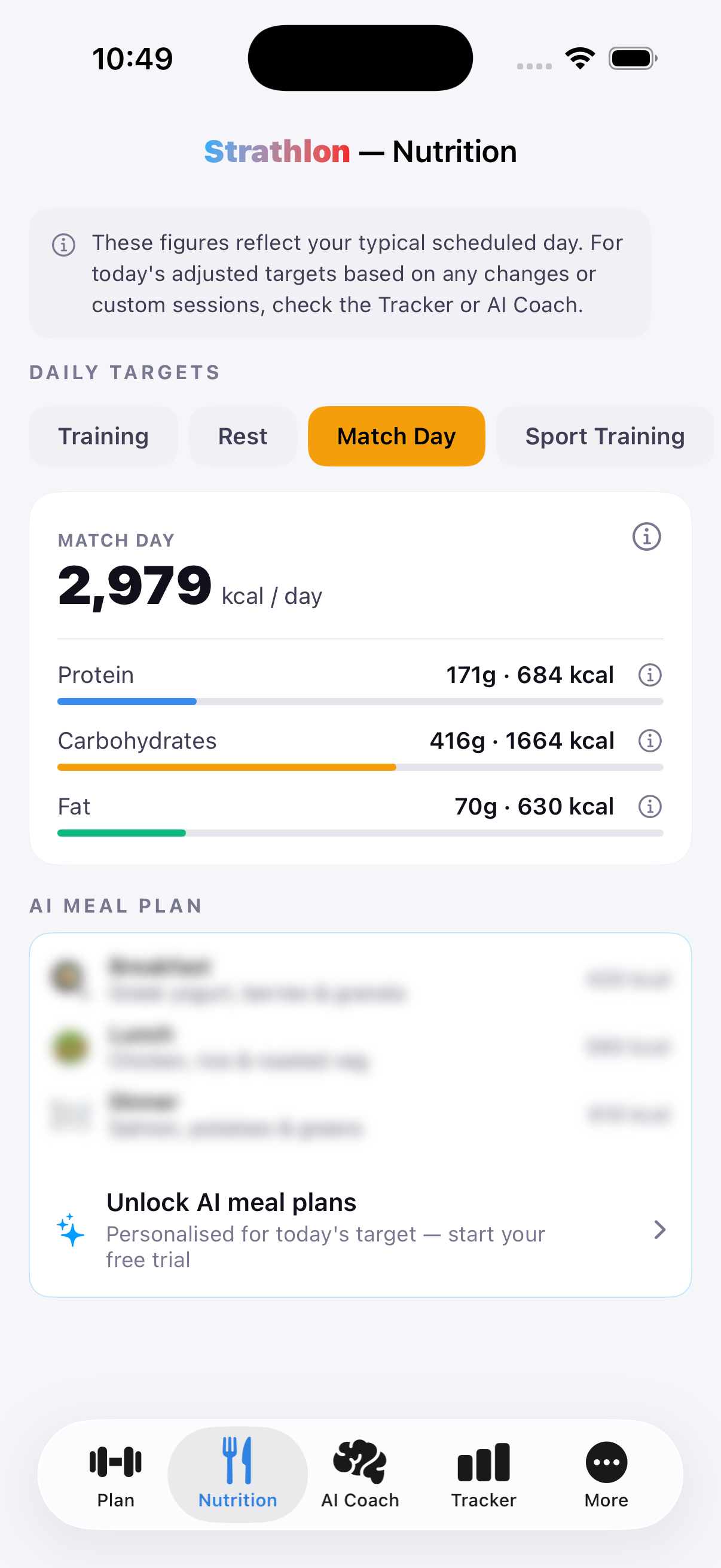
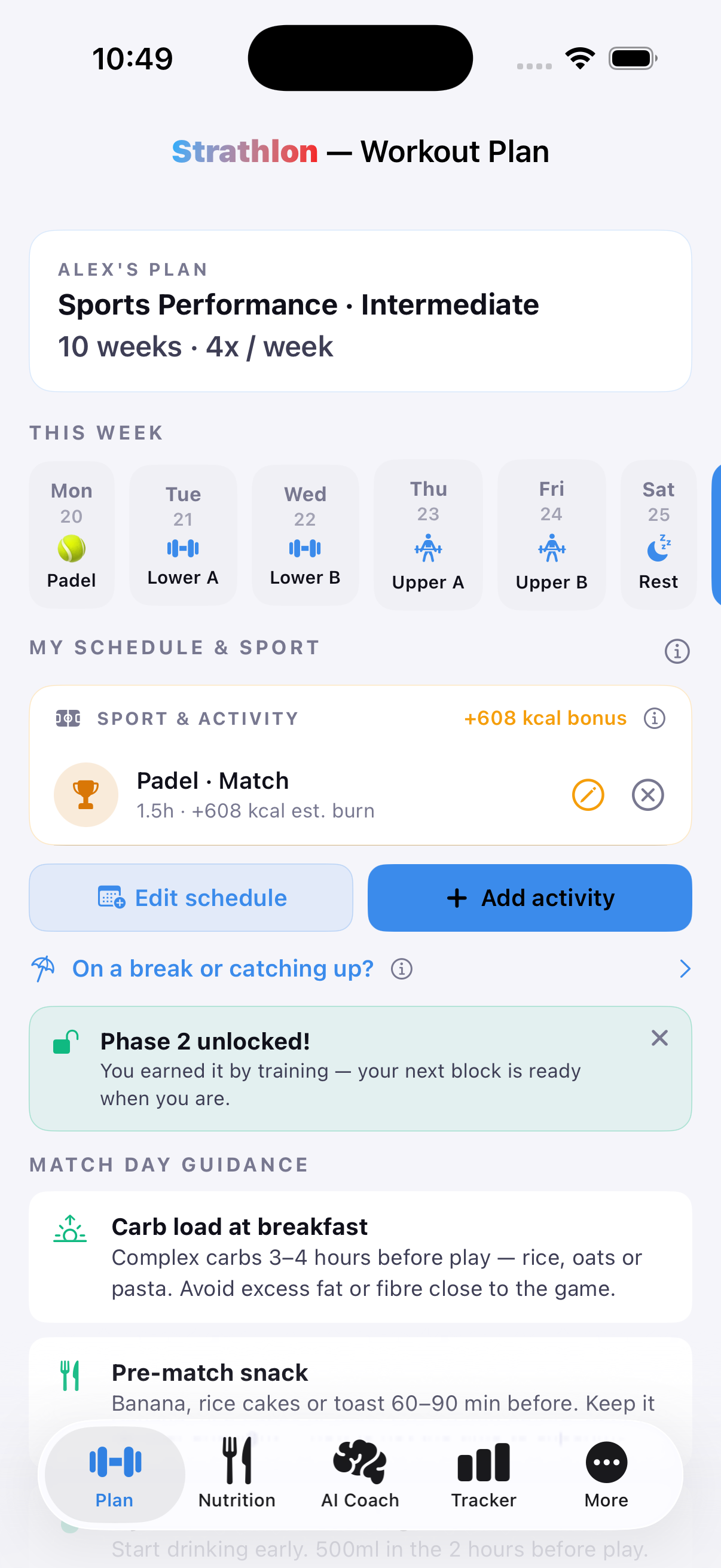
Where Strathlon fits
Common questions
What strength work matters most for padel?
The highest-value work is explosive rotational power, multidirectional lower-body strength, and shoulder and forearm resilience, all built on a base of general strength. Practically that means rotational medicine-ball throws and cable chops for the hip-to-shoulder power that drives your drives and smash; a heavy squat and hinge for the force every push-off and brake draws on; lateral and single-leg work (lateral lunges, skater squats, Bulgarian split squats, Copenhagen adductor work) for the sideways strength and change-of-direction control the court demands; rotator-cuff and scapular strengthening for the overhead smash; and wrist-extensor and grip work for the elbow. These qualities matter because padel is a game of short, repeated bursts, rapid braking and cutting in a confined court, and repeated overhead and rotational striking. Power, agility and joint durability are what separate players physically. Endurance capacity isn't the deciding factor.
Will lifting weights make me slower or less mobile on court?
For most players, the opposite. Appropriately programmed strength and power training builds force largely through neural adaptations, and meta-analyses show resistance and plyometric training improve sprint, jump and change-of-direction speed rather than harming them: exactly the qualities padel needs. Training through a full range of motion does not make you tight. Done properly, it tends to maintain or improve mobility. You would have to train very differently (high volume, high calories, for a long time) to gain the kind of bulk some players fear. For a typical padel player, a couple of brief, focused sessions a week make you more explosive, more agile and more durable. They don't make you heavy and slow.
How do I protect my shoulder and elbow from padel injuries?
The elbow is one of the most commonly injured regions in padel, usually as tendinopathy of the wrist-extensor tendons (padel or tennis elbow), and the shoulder is close behind. For the elbow, systematic reviews support progressive eccentric loading of the wrist extensors as a core part of managing lateral elbow tendinopathy, alongside grip work, sensible technique and not over-playing through pain. For the shoulder, strengthening the rotator cuff (especially external rotators) and the scapular muscles targets known risk factors in overhead athletes. A large cluster-randomised trial in handball players (Andersson and colleagues, 2017) found a shoulder programme reduced the prevalence of shoulder problems, though the wider evidence in overhead sport is mixed. Build these proactively, before pain appears, and see a clinician for persistent pain rather than pushing through it.
How many strength sessions a week do I need for padel?
For most recreational players, about two focused sessions a week in a build phase captures the bulk of the benefit, on top of your court time. When you are playing and competing heavily, you can drop to one to two shorter maintenance sessions: research in trained athletes (Ronnestad and colleagues, 2011) found that one strength session per week maintained strength and sprint performance across an in-season block, whereas training only once every two weeks let it slip. Maintenance sessions must stay heavy or explosive (keeping the quality high but the volume low). Watering them down to light, high-rep work removes the very stimulus that holds the adaptation.
Can strength training reduce my risk of knee and ankle injuries in padel?
It can reduce risk, though nothing removes it. Padel's lower-limb injuries (mostly knee and ankle ligament sprains) come from repeated braking, cutting and landing in a confined court, and strength and neuromuscular training address exactly those mechanisms. A broad meta-analysis of exercise interventions (Lauersen and colleagues, 2014) found strength-training programmes reduced overall sports-injury rates to roughly a third and cut overuse injuries by almost half. More specifically, balance and proprioceptive training is associated with roughly a third fewer ankle sprains, with a larger effect in players who have sprained before (Schiftan and colleagues, 2015). Single-leg strength, controlled deceleration work and landing mechanics are the practical tools. Frame them as risk reduction rather than a guarantee.
Do I need extra conditioning if I already play padel several times a week?
Playing regularly already delivers a lot of padel-specific conditioning, because match play is intermittent by nature: short, sharp efforts with frequent short recoveries. What playing alone tends to under-train is a solid aerobic base (which speeds recovery between points and between matches on a tournament day) and dedicated repeat-sprint and reactive-agility work at higher quality than a social game provides. A modest amount of aerobic work plus a little sharp, well-rested agility and repeat-sprint training rounds out what the court gives you. If your goal is general fitness rather than competition, the padel itself may be plenty. The extra conditioning matters most for players chasing performance or long tournament days.
Takeaways
- Train for power, agility and durability. The qualities that matter most are explosive rotational power, multidirectional and single-leg strength, and a resilient shoulder and elbow. Endurance capacity isn't one of them.
- Build a heavy base, then make it fast. A heavy squat and hinge (loads around ≥80% of 1RM, low reps) build force through neural adaptations. Rotational throws and plyometrics turn that force into racquet-head speed and a quicker first step.
- Strengthen sideways and on one leg. Padel almost never happens facing forward: lateral, adductor/abductor and single-leg work builds the frontal-plane strength and deceleration control cutting demands.
- Protect the elbow and shoulder proactively. Eccentric wrist-extensor loading and grip work guard the elbow, and rotator-cuff (external rotators) and scapular strength guard the shoulder for the smash. Both are well-founded prehab, alongside managing striking volume.
- Guard the knee and ankle. Strength training cuts overall injury rates substantially (Lauersen 2014). Balance/proprioceptive work is linked to roughly a third fewer ankle sprains (Schiftan 2015), more so if you've sprained before.
- Condition for repeat efforts. Padel is aerobic-with-bursts: an aerobic base plus sharp, well-rested repeat-sprint and reactive-agility work beats endurance grinding.
- Two sessions to build, one to two to maintain. One quality session a week can hold strength through a busy competitive block (Ronnestad 2011): keep it brief and heavy rather than light and long, and taper before big tournaments.
- Prehab is performance work. The single-leg, lateral, cuff and scapular work that protects your joints also makes you quicker and your smash more repeatable.
If you take one thing away, make it this: a padel player's gym work isn't about getting big, it's about building a more explosive, more agile and more durable version of the player you already are: a couple of brief, focused, springy sessions a week that make your first step quicker, your smash sharper and your joints better able to take the repeated braking and striking padel demands. Strathlon's role is to give you a padel-aware plan to start from, remember what you lifted, and show the trend, so the strength half of your training is one less thing to guess at.
Pair this with the padel fuelling guide: how to fuel the training this guide builds, from steady daily carbohydrate and protein to quick between-game energy and lasting a full tournament day.
References
Numbered sources for the specific figures, effect sizes and named studies above. Where a claim reflects agreed guidance rather than a single trial, the citation is to the position stand or consensus statement of the body concerned, with the country or international remit named. Padel is a young sport with a correspondingly small literature: two padel-specific sources below and the rest read across from tennis and badminton, whose court movement is the closest match. That read-across is stated rather than hidden.
- Pradas F, Muñoz D, Garcia-Gimenez A, Moreno-Azze A, Sánchez-Alcaraz BJ, Sánchez-Pay A. Physical fitness in professional padel: performance differences according to players' gender and playing side position. Biology of Sport. 2025;42(4):231–239. Study of physical fitness in professional padel by gender and playing position: the source for the sport's fitness profile. PubMed 41048248 · PMC12490300 full text
- Escudero-Tena A, Sánchez-Alcaraz BJ, García-Rubio J, Ibáñez SJ. Analysis of Game Performance Indicators during 2015-2019 World Padel Tour Seasons and Their Influence on Match Outcome. International Journal of Environmental Research and Public Health. 2021;18(9). Analysis of game performance indicators across World Padel Tour seasons, the source for the rally-length and point-structure description. PubMed 34064529 · PMC8125176 full text
- Meyer HL, Birkner L, Polan C, Mester B, Herten M, Dudda M, et al. Injuries and overuse injuries in padel tennis: a retrospective epidemiological cross-sectional study of a level 1 trauma center in Germany. The Journal of Sports Medicine and Physical Fitness. 2025;65(10):1363–1370. Retrospective epidemiological study of injuries and overuse injuries in padel, the source for the sport's injury pattern. PubMed 40677135
- Reid M, Schneiker K. Strength and conditioning in tennis: current research and practice. Journal of Science and Medicine in Sport. 2008;11(3):248–56. Kovacs and colleagues on strength and conditioning in tennis, read across to padel's very similar court demands. PubMed 17597004
- Phomsoupha M, Laffaye G. The science of badminton: game characteristics, anthropometry, physiology, visual fitness and biomechanics. Sports Medicine. 2015;45(4):473–95. The science of badminton review, used for the lunging and change-of-direction demands padel shares with it. PubMed 25549780
- Jiang J, Li H, Xiu C. Characterization of Muscle Activation and Muscle Synergism in the 'Forward Lunge' Gait Movement of Badminton Players Using Surface Electromyography Sensors. Sensors. 2025;25(6). Study characterising muscle activation and synergy in the forward lunge in racquet sport, the mechanism behind the single-leg emphasis. PubMed 40292700 · PMC11944875 full text
- Schiftan GS, Ross LA, Hahne AJ. The effectiveness of proprioceptive training in preventing ankle sprains in sporting populations: a systematic review and meta-analysis. Journal of Science and Medicine in Sport. 2015;18(3):238–44. Schiftan and colleagues' meta-analysis of proprioceptive training and ankle sprains, the source for the ankle-prehab figure. PubMed 24831756
- Cools AM, Johansson FR, Borms D, Maenhout A. Prevention of shoulder injuries in overhead athletes: a science-based approach. Brazilian Journal of Physical Therapy. 2015;19(5):331–9. Cools and colleagues on preventing shoulder injuries in overhead athletes, the basis for the cuff and scapular work. PubMed 26537804 · PMC4647145 full text
- Suchomel TJ, Nimphius S, Stone MH. The Importance of Muscular Strength in Athletic Performance. Sports Medicine. 2016;46(10):1419–49. Suchomel and colleagues on the importance of muscular strength in athletic performance: the source for greater maximal strength being associated with faster sprinting, jumping and change of direction, and with lower injury risk. PubMed 26838985
- Seitz LB, Reyes A, Tran TT, Saez de Villarreal E, Haff GG. Increases in lower-body strength transfer positively to sprint performance: a systematic review with meta-analysis. Sports Medicine. 2014;44(12):1693–702. Seitz and colleagues' systematic review with meta-analysis showing increases in lower-body strength transfer positively to sprint performance, the evidence behind the 'strength is the base' argument. PubMed 25059334
- Lauersen JB, Andersen TE, Andersen LB. Strength training as superior, dose-dependent and safe prevention of acute and overuse sports injuries: a systematic review, qualitative analysis and meta-analysis. British Journal of Sports Medicine. 2018;52(24):1557–1563. Lauersen and colleagues' meta-analysis finding strength training a superior, dose-dependent and safe prevention of acute and overuse sports injuries: the direct source for treating strength work as prehab. PubMed 30131332
- Lauersen JB, Bertelsen DM, Andersen LB. The effectiveness of exercise interventions to prevent sports injuries: a systematic review and meta-analysis of randomised controlled trials. British Journal of Sports Medicine. 2014;48(11):871–7. Lauersen and colleagues' earlier meta-analysis of exercise interventions to prevent sports injuries, the broader evidence base the prevention advice sits on. PubMed 24100287
- . American College of Sports Medicine position stand. Progression models in resistance training for healthy adults. Medicine and Science in Sports and Exercise. 2009;41(3):687–708. American College of Sports Medicine (ACSM, United States) position stand on progression models in resistance training: the source for the heavy-load and explosive-load percentage ranges quoted. PubMed 19204579
- Cuthbert M, Haff GG, Arent SM, Ripley N, McMahon JJ, Evans M, et al. Effects of Variations in Resistance Training Frequency on Strength Development in Well-Trained Populations and Implications for In-Season Athlete Training: A Systematic Review and Meta-analysis. Sports Medicine. 2021;51(9):1967–1982. Cuthbert and colleagues' systematic review of resistance-training frequency in well-trained populations, the source for the sessions-per-week guidance. PubMed 33886099 · PMC8363540 full text
- Spiering BA, Mujika I, Sharp MA, Foulis SA. Maintaining Physical Performance: The Minimal Dose of Exercise Needed to Preserve Endurance and Strength Over Time. Journal of Strength and Conditioning Research. 2021;35(5):1449–1458. Spiering and colleagues on the minimal dose of exercise needed to preserve endurance and strength: the source for maintaining in-season on as little as one to two sessions a week. PubMed 33629972
- Rønnestad BR, Nymark BS, Raastad T. Effects of in-season strength maintenance training frequency in professional soccer players. Journal of Strength and Conditioning Research. 2011;25(10):2653–60. Ronnestad and colleagues' trial of in-season strength maintenance frequency in professional footballers, the specific in-season maintenance result quoted. PubMed 21873897
- Nuzzo JL, Pinto MD, Kirk BJC, Nosaka K. Resistance Exercise Minimal Dose Strategies for Increasing Muscle Strength in the General Population: an Overview. Sports Medicine. 2024;54(5):1139–1162. Nuzzo and colleagues on minimal-dose resistance exercise strategies for increasing strength, supporting the claim that a small, well-chosen dose does most of the work. PubMed 38509414 · PMC11127831 full text
- Wilson JM, Marin PJ, Rhea MR, Wilson SM, Loenneke JP, Anderson JC. Concurrent training: a meta-analysis examining interference of aerobic and resistance exercises. Journal of Strength and Conditioning Research. 2012;26(8):2293–307. Wilson and colleagues' meta-analysis of concurrent training and the interference effect: the source for separating heavy lifting from hard conditioning. PubMed 22002517
- Schumann M, Feuerbacher JF, Sünkeler M, Freitag N, Rønnestad BR, Doma K, et al. Compatibility of Concurrent Aerobic and Strength Training for Skeletal Muscle Size and Function: An Updated Systematic Review and Meta-Analysis. Sports Medicine. 2022;52(3):601–612. An updated systematic review of the compatibility of concurrent aerobic and strength training, the more recent evidence that interference is smaller than once believed. PubMed 34757594 · PMC8891239 full text
- Ramirez-Campillo R, Sortwell A, Moran J, Afonso J, Clemente FM, Lloyd RS, et al. Plyometric-Jump Training Effects on Physical Fitness and Sport-Specific Performance According to Maturity: A Systematic Review with Meta-analysis. Sports Medicine - Open. 2023;9(1):23. Ramirez-Campillo and colleagues on plyometric-jump training effects on physical fitness and sport-specific performance, the source for the plyometric guidance. PubMed 37036542 · PMC10086091 full text
- Impellizzeri FM, Woodcock S, Coutts AJ, Fanchini M, McCall A, Vigotsky AD. What Role Do Chronic Workloads Play in the Acute to Chronic Workload Ratio? Time to Dismiss ACWR and Its Underlying Theory. Sports Medicine. 2021;51(3):581–592. Impellizzeri and colleagues on the pitfalls of the acute:chronic workload ratio: cited because it is the reason this guide talks about ramping load gradually rather than quoting a workload number. PubMed 33332011
- Baz-Valle E, Balsalobre-Fernández C, Alix-Fages C, Santos-Concejero J. A Systematic Review of The Effects of Different Resistance Training Volumes on Muscle Hypertrophy. Journal of Human Kinetics. 2022;81:199–210. Systematic review of resistance-training volume and hypertrophy, the general dose-response evidence behind the set and session recommendations. PubMed 35291645 · PMC8884877 full text
This is general educational information rather than medical or individualised coaching advice. The exercise-science figures here are drawn from published research and framed as population-level guides: individual needs vary widely with training age, playing level, injury history and health, and are best personalised with a qualified strength & conditioning coach. Anyone with a current injury, tendon or joint pain, a health condition, or who is pregnant or postpartum, should consult a qualified clinician before starting or changing a strength or conditioning programme, and should not train through pain. See our Terms for more.
← All guides · Fuelling for padel · How muscle actually grows · Recovery & rest · Eating for results · Home