
Polo strength & conditioning
An evidence-based guide to training the polo player's body: the athlete on the horse, as opposed to the horse. Polo asks for rotational power to swing the mallet, a braced core to transmit and control that power, single-leg and adductor strength to hold the riding position, durable grip and shoulders, and the repeat-effort conditioning to do it chukka after chukka. This covers the strength work that transfers, how to condition around it, the sport's real injury pattern and the prehab that helps, and how to fit it all around a season of riding. Practical, honest, and grounded in sports-science evidence.
Here's the short version of what to train: rotational power and an anti-rotation core to drive and control the mallet swing, single-leg and adductor strength to own the riding position, and durable grip, shoulders and repeat-effort conditioning to keep it going all game: all built on a base of general strength. Everything below is the detail behind that sentence: which movements develop each quality, why they transfer, and where the evidence is solid versus where it is honestly still thin.
On this page
A framing note before the detail. Strength and conditioning science is well studied, but people differ enormously: training age, riding experience, position on the field, injury history and how many horses you play all change what's right for you. So this is written as can, tends to and is associated with, never as a guarantee, and every specific figure is a population-level guide drawn from published research rather than a personal prescription. It is general education rather than medical or individualised coaching advice, and it is not a substitute for a qualified strength coach or clinician.
The demands of polo
Polo is often described as the fastest team sport, and from the rider's side it is a demanding blend of skill, balance and repeated bursts of effort. A match is split into chukkas (periods of roughly seven to seven-and-a-half minutes) with rest and horse changes between them, so the athletic demand is intermittent: short spells of high-intensity riding, stopping, turning and striking, punctuated by lower-intensity recovery. It is easy to assume the horse does all the work, but riding is far from passive. Studies of riders report heart rates reaching roughly 80–90% of maximum during riding, rising with the intensity of the work and the rider's level (Sung et al., 2015), a genuine cardiovascular load laid on top of near-constant postural work from the trunk and legs.
Mechanically, three things define the polo athlete. The mallet swing is a rotational, sequenced action: power initiated at the hips, transmitted through a braced trunk, and delivered through the shoulder and arm, much like a golf or tennis stroke performed from a moving platform. The riding position is essentially a loaded single-leg task: you carry weight through the stirrups, grip the horse with your adductors (inner thighs), and absorb the animal's movement through your hips and core, often in a forward-flexed or extended posture. And the hands are busy throughout: one gripping the reins, the other controlling the mallet, which loads the grip, forearm and shoulder over a long match.
The injury pattern follows directly from all this. Polo's most serious injuries are traumatic and caused by falls. In a retrospective study of 103 polo riders, fractures were the most common injury (about 31%), the upper limb was the most affected region (around 42%, with the shoulder near 20% and the distal forearm/wrist near 9%), and roughly 59% of injuries were linked to falls from or with the horse combined (Neumayr et al., 2019). An earlier prospective study reported an injury rate of about 7.8 per 1000 player-game hours, again dominated by arm injuries, fractures and head injuries from falls (Costa-Paz et al., 1999). Alongside this acute, fall-driven trauma sit the overuse complaints you'd expect from the biomechanics: the low back (from the rotated, often extended riding posture), the swinging shoulder, and the wrist and forearm. Strength and conditioning speaks mainly to the second category and to general resilience: it makes you a more durable, more capable athlete, but it cannot remove the risk that comes with riding a galloping horse in traffic.
Key strength work, and why it matters
The foundation for everything below is general maximal strength. A large body of work links greater maximal strength to better jumping, sprinting and change-of-direction ability, and to the force-time qualities that underpin explosive movement (Suchomel et al., 2016). In plain terms: the stronger you are in the big patterns, the more raw material you have to turn into the rotational power, single-leg control and postural endurance polo needs. So the base of a polo plan looks like most good strength plans: a squat or split-squat pattern, a hinge (deadlift or Romanian deadlift), an upper-body push and pull, and loaded carries. For how to set loads, reps and progression on those lifts, the build-muscle-basics guide covers progressive overload and volume properly. There is no polo-specific magic to the numbers, so it is better to use established strength guidance than to invent a scheme here. On top of that base, four areas earn special attention.
Rotational power and an anti-rotation core. The swing is a rotation, so train both halves of rotation. Build the power to rotate with medicine-ball rotational throws and cable or band rotations driven from the hips. Build the ability to resist rotation with anti-rotation and anti-extension core work: the Pallof press, dead bugs, plank variations and heavy carries. That bracing matters because a swing is only as powerful as the trunk that transmits it: if the core gives, hip power leaks out instead of reaching the mallet, and the low back takes load it shouldn't. Because power sits on top of strength, keep the heavy lifts in the plan rather than chasing rotation in isolation.
Single-leg and adductor strength for the riding position. Riding is a loaded single-leg brace, so train it as one: split squats, Bulgarian split squats, step-ups and single-leg Romanian deadlifts build the strength and balance to carry weight through the stirrups and stay stable as the horse moves. The inner-thigh adductors grip the horse and stabilise the pelvis, and they respond well to targeted work: the Copenhagen adduction exercise performed a few times a week over roughly eight weeks meaningfully increases eccentric hip-adduction strength (systematic review with meta-analysis, 2025). That strength is directly useful for the riding seat: just note the honest caveat in the injury section about what adductor work does and doesn't prove for groin-injury prevention.
Grip, forearm and wrist. Over a long match the hands never stop working, and the wrist and forearm are a common injury site in polo. Loaded carries, dead hangs and direct wrist and forearm work build the grip endurance to hold reins and mallet and the forearm robustness to handle the repeated loading. Strong, well-conditioned forearms won't stop a fall-related fracture, but they help with control, fatigue resistance and everyday durability.
Shoulder and scapular strength. The mallet arm swings thousands of times across a season, so treat the shoulder a little like an overhead athlete's: build rotator-cuff and scapular-stability work (external rotations, face pulls, controlled overhead and rowing patterns) alongside the main pushes and pulls. A strong, stable shoulder generates and tolerates the swing better and is more resilient to the overuse niggles that accumulate in a throwing-type action.
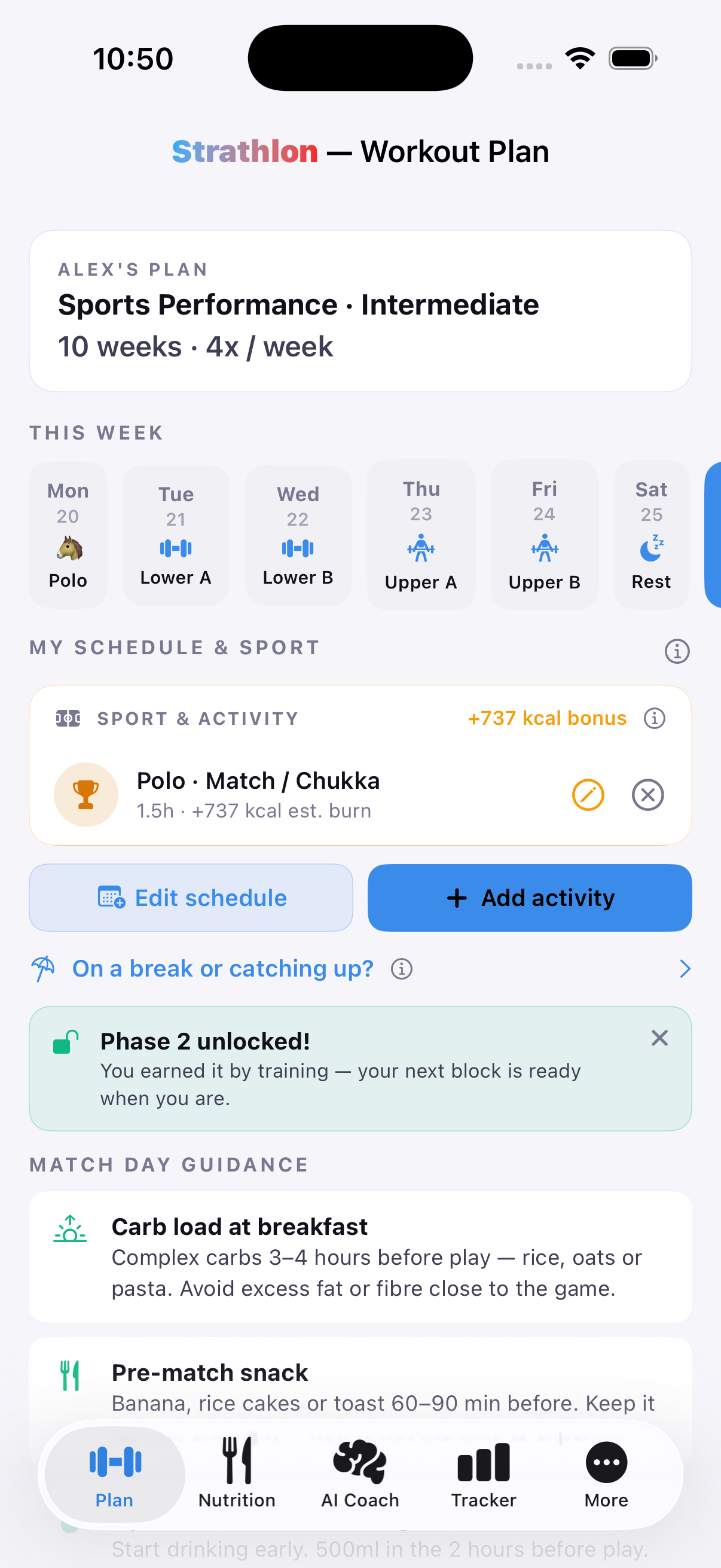
The point of that layout is worth spelling out, because it is the whole logic of training for a sport. The base lifts make you generally strong and durable: that general strength is what most reliably transfers to jumping, sprinting and change-of-direction (Suchomel et al., 2016) and gives the sport-specific work something to build on. The accessory block then biases that strength toward polo's actual demands: the rotational swing, single-leg strength and trunk control for the seat, the grip and shoulder. Neither half works alone: sport-specific drills on a weak base have little to amplify, and a big base that is never pointed at rotation, single-leg control and repeat efforts leaves transferable qualities on the table. You want both, which is exactly what the plan above is arranged to do.
Conditioning for polo
Because polo is intermittent (high-intensity spells inside a chukka, then recovery) the rider benefits from conditioning built on two layers. The first is an aerobic base: general fitness that helps you recover between efforts, between chukkas and across a match, and that raises your ceiling for repeated work. The second is repeat-effort / interval conditioning that looks a bit like the game (short, hard bouts with incomplete recovery) to train the ability to go hard, recover partially, and go again without your quality falling off. Given that riding itself pushes heart rates to roughly 80–90% of maximum (Sung et al., 2015), the rider's own cardiovascular fitness is a real, trainable contributor to how you hold up late in a game. It is not an afterthought.
Fitting conditioning alongside strength raises the question of the interference effect: the idea that heavy endurance work can blunt strength and power gains if the two are piled on top of each other. In practice it is manageable rather than a reason to avoid conditioning. The usual advice is to keep hard strength and hard conditioning sessions separated where you can (different days, or several hours apart), to avoid draining, high-volume endurance right before a strength session, and to keep most conditioning in forms that complement rather than fight your strength work. For a sport where the horse covers the ground and the efforts are short and sharp, you generally don't need marathon-style volume: targeted intervals and a solid aerobic base do more for polo than long, slow distance.
Staying injury-resilient
Honesty first: polo's headline injuries are traumatic: fractures, shoulder and wrist/forearm injuries, and head injuries, overwhelmingly from falls (Neumayr et al., 2019; Costa-Paz et al., 1999). Strength and conditioning cannot make a fall stop hurting, and the biggest levers for that category are things like helmet and protective-gear standards, horse fitness and schooling, and skill. In a survey of polo players, longer pre-season horse training was associated with fewer falls, and the use of wrist supports was associated with lower injury risk (Inness & Morgan, 2015). Both are levers of equipment and preparation rather than lifting. Keep that in view so you don't over-credit the gym.
Even so, strength and conditioning does two useful things. It reduces the overuse injuries that build up from the swing and the riding posture, and it is associated with lower overall injury risk. A well-known meta-analysis found strength-training programmes were associated with a large reduction in sports injuries (in the pooled data, injury rates fell to roughly a third of those without such training) and the effect was dose-dependent, with more strength training linked to fewer injuries (Lauersen et al., 2018). Notably, in the polo-specific survey above, gym exercise was associated with lower odds of injury (Inness & Morgan, 2015).
A few evidence-based, honestly-framed prehab priorities for polo's sore spots:
- Hamstrings and posterior chain (for the hinge, the seat and general resilience). Programmes that include the Nordic hamstring exercise are associated with roughly halving hamstring-injury rates in the pooled evidence (risk ratio about 0.49) (van Dyk et al., 2019). That figure comes mostly from running-and-cutting sports rather than polo specifically, so treat it as strong general evidence for a cheap, high-value exercise rather than a polo-measured number.
- Adductors and groin. The Copenhagen adduction exercise reliably builds eccentric adductor strength over about eight weeks (2025 systematic review), which is directly useful for the riding seat. The honest caveat: whether the exercise on its own reduces groin injuries is not yet statistically settled in the pooled data. Do it for the strength and the seat, as part of a broader programme. It is not a guaranteed groin shield.
- Low back. The rotated, extended riding posture loads the back, so the best insurance is anti-rotation and anti-extension core strength (Pallof presses, dead bugs, planks, carries) plus a strong hinge, so the trunk braces and the hips do the work rather than the lumbar spine.
- Shoulder and wrist. Rotator-cuff and scapular work supports the swinging shoulder, and grip/forearm conditioning supports the wrist through a long match. For the fall-related wrist risk specifically, remember the survey signal that wrist supports were associated with lower injury risk (Inness & Morgan, 2015), an equipment lever alongside the strength one.
- References
Two general principles tie this together. First, being generally strong and well-conditioned drives most of the injury-prevention benefit, far more than any single exercise: the dose-response in the strength-training evidence is the headline (Lauersen et al., 2018). Second, prehab only works if you actually recover. The recovery-and-rest guide covers sleep, load management and the signs of doing too much.
Programming it around your season
The calendar changes what your training is for. In the off-season, riding volume is lower and you have room to build: this is the time for two or three strength sessions a week, real progressive overload on the base lifts, a proper block of rotational-power and single-leg work, and the bulk of your conditioning. In the in-season, the job flips to maintaining what you built while fresh enough to ride and play well.
The encouraging evidence here is that maintenance is cheap. Reviews of minimal-dose training show that strength can be preserved for weeks with reduced volume and frequency (as little as one session per week) provided the loads stay heavy (around 80% of your one-rep max or more) (Spiering et al., 2021). And because training frequency makes little clear difference to strength when weekly volume is matched in trained athletes (Cuthbert et al., 2021), you can spread a small maintenance dose across one or two short, heavy sessions slotted around riding, practice and horse care. The practical rule of thumb is intensity over volume in-season: keep the weights heavy so the strength stays, but cut the number of sets and sessions so you're not adding fatigue to a body that's already riding and, sometimes, absorbing falls. A lighter deload week when accumulated fatigue mounts keeps the whole thing sustainable.
Common questions
What strength work matters most for polo?
Three qualities stand out. First, rotational power and an anti-rotation core, because the mallet swing is a sequenced hip-to-shoulder rotation that the trunk has to both create and brace against. Second, single-leg and adductor strength, because the riding position is essentially a loaded single-leg brace with the inner thighs gripping the horse. Third, durable grip and shoulder strength for holding reins and swinging the mallet. All of this sits on a base of general strength: greater maximal strength is broadly associated with better jumping, sprinting and change-of-direction ability (Suchomel et al., 2016), the athletic qualities riding draws on. Numbers such as sets, reps and loads are best taken from general strength guidance rather than invented for polo.
Can strength training reduce my injury risk in polo?
Partly, and it is worth being honest about what it can and cannot do. Most serious polo injuries are traumatic: fractures, shoulder and wrist injuries and concussions from falls (Neumayr et al., 2019; Costa-Paz et al., 1999), and no amount of lifting stops the impact of hitting the ground. But strength training is associated with substantially lower injury rates across sports, with a dose-response (Lauersen et al., 2018), programmes that include the Nordic hamstring exercise roughly halve hamstring-injury rates (van Dyk et al., 2019), and in a survey of polo players, gym exercise was associated with lower odds of injury (Inness & Morgan, 2015). Treat strength work as risk reduction and better durability. It isn't injury-proofing.
How many strength sessions a week do I need during the season?
Less than you might fear. Reviews of maintenance training find that strength can be preserved for weeks with reduced volume and frequency (as little as one session per week) provided the loads stay heavy (around 80% of your one-rep max or more) (Spiering et al., 2021). And when the weekly volume is matched, training frequency makes little clear difference to strength in trained athletes (Cuthbert et al., 2021), so you can spread a small maintenance dose across one or two short, heavy sessions that fit around riding. The off-season is when you build. The season is mostly about holding on to what you built.
Will lifting weights make me stiff, bulky or unbalance my riding?
This is the most common worry and it is largely unfounded. Greater strength is associated with better (not worse) power, sprinting and change-of-direction (Suchomel et al., 2016), and strength training done through a full range of motion does not inherently reduce flexibility. Building noticeable muscle is slow and deliberate, so you will not accidentally become bulky or "muscle-bound". For a rotational, balance-heavy sport like polo, more usable strength and power tends to help you swing, absorb the horse's movement and stay controlled, the opposite of the fear.
How should I train the mallet swing and rotational power?
Train rotation in two complementary ways. Build the power to rotate with explosive movements such as medicine-ball rotational throws and cable or band rotations, driven from the hips through the trunk. Then build the ability to resist rotation with anti-rotation work such as the Pallof press and heavy carries, which teaches the core to brace so that hip power transfers to the mallet rather than leaking through a soft trunk. Because power rides on top of maximal strength (Suchomel et al., 2016), keep general strength work in the plan too, and train both sides of your body even though you swing to one side, to avoid building a lopsided athlete.
Do adductor exercises like the Copenhagen plank protect my groin?
They reliably build the strength, which is the honest way to put it. The Copenhagen adduction exercise performed a few times a week over roughly eight weeks meaningfully increases eccentric hip-adduction strength (systematic review, 2025), and strong adductors are directly useful in the riding position, where the inner thighs grip the horse. What is not yet settled is whether the exercise on its own reduces groin injuries: the pooled injury data are not statistically conclusive. So do it for the strength and the riding benefit, and as part of a broader strength programme, rather than as a guaranteed groin-injury shield.
Takeaways
- Polo is an intermittent, skill-and-balance sport for the rider. High-intensity spells inside each chukka, high heart rates, and constant postural work: the horse covers the ground, but the rider is far from passive.
- Build general strength first. Squat/split-squat, hinge, push, pull and carries: greater maximal strength underpins the power, speed and control the game draws on (Suchomel et al., 2016).
- Bias it toward polo. Rotational power plus anti-rotation core for the swing; single-leg and adductor strength for the seat; grip, forearm and shoulder work for the hands and mallet arm.
- Condition in two layers. An aerobic base to recover between efforts and chukkas, plus repeat-effort intervals that mimic the game: kept separate enough from strength work to limit interference.
- Respect the real injury pattern. Most serious injuries are fall-related trauma (Neumayr et al., 2019; Costa-Paz et al., 1999). S&C reduces overuse and overall risk (Lauersen et al., 2018) but can't injury-proof a fall sport.
- Prehab the sore spots. Nordic curls for the hamstrings (associated with roughly halved hamstring injuries, van Dyk et al., 2019), Copenhagen work for adductor strength, anti-rotation core for the low back, cuff/scapular work for the shoulder.
- In-season, maintain don't build. As little as one heavy session a week (~80%+ 1RM) can hold strength (Spiering et al., 2021). Frequency is flexible when volume is matched (Cuthbert et al., 2021).
- Ignore the "lifting makes me slow" myth. Strength is associated with better power and speed and fewer injuries: for a rotational sport it helps the swing and the seat, it doesn't blunt them.
If you take one thing away, make it the shape of the plan: get generally strong, then point that strength at polo's real demands (the rotational swing, the single-leg-and-adductor seat, and the repeat efforts) while keeping conditioning and recovery honest. Strathlon's role is to tune a goal-driven plan toward your sport (with Sports Performance as one of your goals) and track your lifts trending up, so the base and the nudge toward polo are handled while the fine periodisation stays with you and your coach.
Pair this with the polo fuelling guide for the nutrition side: fuelling match days, hydration and recovery around a season of riding.
References
Numbered sources for the specific figures, effect sizes and named studies above. Where a claim reflects agreed guidance rather than a single trial, the citation is to the position stand or consensus statement of the body concerned, with the country or international remit named. Polo has very little published human sport-science research: most of the literature concerns the horse rather than the rider. The demands below are cited where polo-specific evidence exists, and the training prescriptions are general strength and conditioning evidence applied to a rotational, one-sided, high-grip sport. That is said plainly rather than dressed up.
- Schumacher A, Merle R, Stöckle S, Gehlen H. Player-Reported Perceptions of Lameness Risks and Contributing Factors for Polo Horses: Results from a Survey. Animals : an Open Access Journal From MDPI. 2025;15(21). Study of player-reported lameness risks and contributing factors for polo horses, cited for the structure of the game: chukkas, pony changes and the workload that shapes. PubMed 41227466 · PMC12606728 full text
- Marlin DJ, Allen JC. Cardiovascular demands of competition on low-goal (non-elite) polo ponies. Equine Veterinary Journal. 1999;31(5):378–82. Study of the cardiovascular demands of competition on low-goal polo ponies, the closest published measure of the intermittent demand a chukka imposes. PubMed 10505952
- Vincent HK, Vincent KR. Core and Back Rehabilitation for High-speed Rotation Sports: Highlight on Lacrosse. Current Sports Medicine Reports. 2018;17(6):208–214. Review of core and back rehabilitation for high-speed rotation sports: the source for the trunk and anti-rotation work a one-sided swinging sport needs. PubMed 29889150
- Nicholas SJ, Tyler TF. Adductor muscle strains in sport. Sports Medicine. 2002;32(5):339–44. Tyler and colleagues' review of adductor muscle strains in sport, the basis for the adductor and hip work the riding position demands. PubMed 11929360
- Tyler TF, Nicholas SJ, Campbell RJ, Donellan S, McHugh MP. The effectiveness of a preseason exercise program to prevent adductor muscle strains in professional ice hockey players. The American Journal of Sports Medicine. 2002;30(5):680–3. Tyler and colleagues' preseason programme preventing adductor strains, the intervention evidence for that recommendation. PubMed 12239001
- Cools AM, Johansson FR, Borms D, Maenhout A. Prevention of shoulder injuries in overhead athletes: a science-based approach. Brazilian Journal of Physical Therapy. 2015;19(5):331–9. Cools and colleagues on preventing shoulder injuries in overhead athletes, applied to the mallet-side shoulder. PubMed 26537804 · PMC4647145 full text
- Suchomel TJ, Nimphius S, Stone MH. The Importance of Muscular Strength in Athletic Performance. Sports Medicine. 2016;46(10):1419–49. Suchomel and colleagues on the importance of muscular strength in athletic performance: the source for greater maximal strength being associated with faster sprinting, jumping and change of direction, and with lower injury risk. PubMed 26838985
- Seitz LB, Reyes A, Tran TT, Saez de Villarreal E, Haff GG. Increases in lower-body strength transfer positively to sprint performance: a systematic review with meta-analysis. Sports Medicine. 2014;44(12):1693–702. Seitz and colleagues' systematic review with meta-analysis showing increases in lower-body strength transfer positively to sprint performance, the evidence behind the 'strength is the base' argument. PubMed 25059334
- Lauersen JB, Andersen TE, Andersen LB. Strength training as superior, dose-dependent and safe prevention of acute and overuse sports injuries: a systematic review, qualitative analysis and meta-analysis. British Journal of Sports Medicine. 2018;52(24):1557–1563. Lauersen and colleagues' meta-analysis finding strength training a superior, dose-dependent and safe prevention of acute and overuse sports injuries: the direct source for treating strength work as prehab. PubMed 30131332
- Lauersen JB, Bertelsen DM, Andersen LB. The effectiveness of exercise interventions to prevent sports injuries: a systematic review and meta-analysis of randomised controlled trials. British Journal of Sports Medicine. 2014;48(11):871–7. Lauersen and colleagues' earlier meta-analysis of exercise interventions to prevent sports injuries, the broader evidence base the prevention advice sits on. PubMed 24100287
- . American College of Sports Medicine position stand. Progression models in resistance training for healthy adults. Medicine and Science in Sports and Exercise. 2009;41(3):687–708. American College of Sports Medicine (ACSM, United States) position stand on progression models in resistance training: the source for the heavy-load and explosive-load percentage ranges quoted. PubMed 19204579
- Cuthbert M, Haff GG, Arent SM, Ripley N, McMahon JJ, Evans M, et al. Effects of Variations in Resistance Training Frequency on Strength Development in Well-Trained Populations and Implications for In-Season Athlete Training: A Systematic Review and Meta-analysis. Sports Medicine. 2021;51(9):1967–1982. Cuthbert and colleagues' systematic review of resistance-training frequency in well-trained populations, the source for the sessions-per-week guidance. PubMed 33886099 · PMC8363540 full text
- Spiering BA, Mujika I, Sharp MA, Foulis SA. Maintaining Physical Performance: The Minimal Dose of Exercise Needed to Preserve Endurance and Strength Over Time. Journal of Strength and Conditioning Research. 2021;35(5):1449–1458. Spiering and colleagues on the minimal dose of exercise needed to preserve endurance and strength: the source for maintaining in-season on as little as one to two sessions a week. PubMed 33629972
- Rønnestad BR, Nymark BS, Raastad T. Effects of in-season strength maintenance training frequency in professional soccer players. Journal of Strength and Conditioning Research. 2011;25(10):2653–60. Ronnestad and colleagues' trial of in-season strength maintenance frequency in professional footballers, the specific in-season maintenance result quoted. PubMed 21873897
- Nuzzo JL, Pinto MD, Kirk BJC, Nosaka K. Resistance Exercise Minimal Dose Strategies for Increasing Muscle Strength in the General Population: an Overview. Sports Medicine. 2024;54(5):1139–1162. Nuzzo and colleagues on minimal-dose resistance exercise strategies for increasing strength, supporting the claim that a small, well-chosen dose does most of the work. PubMed 38509414 · PMC11127831 full text
- Wilson JM, Marin PJ, Rhea MR, Wilson SM, Loenneke JP, Anderson JC. Concurrent training: a meta-analysis examining interference of aerobic and resistance exercises. Journal of Strength and Conditioning Research. 2012;26(8):2293–307. Wilson and colleagues' meta-analysis of concurrent training and the interference effect: the source for separating heavy lifting from hard conditioning. PubMed 22002517
- Schumann M, Feuerbacher JF, Sünkeler M, Freitag N, Rønnestad BR, Doma K, et al. Compatibility of Concurrent Aerobic and Strength Training for Skeletal Muscle Size and Function: An Updated Systematic Review and Meta-Analysis. Sports Medicine. 2022;52(3):601–612. An updated systematic review of the compatibility of concurrent aerobic and strength training, the more recent evidence that interference is smaller than once believed. PubMed 34757594 · PMC8891239 full text
- Ramirez-Campillo R, Sortwell A, Moran J, Afonso J, Clemente FM, Lloyd RS, et al. Plyometric-Jump Training Effects on Physical Fitness and Sport-Specific Performance According to Maturity: A Systematic Review with Meta-analysis. Sports Medicine - Open. 2023;9(1):23. Ramirez-Campillo and colleagues on plyometric-jump training effects on physical fitness and sport-specific performance, the source for the plyometric guidance. PubMed 37036542 · PMC10086091 full text
- Impellizzeri FM, Woodcock S, Coutts AJ, Fanchini M, McCall A, Vigotsky AD. What Role Do Chronic Workloads Play in the Acute to Chronic Workload Ratio? Time to Dismiss ACWR and Its Underlying Theory. Sports Medicine. 2021;51(3):581–592. Impellizzeri and colleagues on the pitfalls of the acute:chronic workload ratio: cited because it is the reason this guide talks about ramping load gradually rather than quoting a workload number. PubMed 33332011
- Baz-Valle E, Balsalobre-Fernández C, Alix-Fages C, Santos-Concejero J. A Systematic Review of The Effects of Different Resistance Training Volumes on Muscle Hypertrophy. Journal of Human Kinetics. 2022;81:199–210. Systematic review of resistance-training volume and hypertrophy, the general dose-response evidence behind the set and session recommendations. PubMed 35291645 · PMC8884877 full text
This is general educational information rather than medical or individualised coaching advice. The strength-and-conditioning figures here are drawn from published research and are framed as population-level guides and associations rather than promises: individual needs vary widely with training age, riding experience, position and injury history, and are best personalised with a qualified strength coach. Much of polo's injury risk is traumatic and fall-related and is not removed by training. Anyone with pain, an injury, a health condition, or who is pregnant or postpartum, should consult a qualified strength coach or clinician before starting or changing an exercise programme. See our Terms for more.
← All guides · Polo fuelling guide · How muscle actually grows · Recovery & rest · Eating for results · Understanding your stats · Home