
Skiing strength & conditioning
An evidence-based guide to training your body for skiing: mostly downhill (alpine) skiing, where the legs spend the day absorbing force rather than producing it. This covers what the sport actually asks of you, the strength and power work that transfers to the slope, the conditioning that keeps you skiing strong on the last run of the day, the prehab that lowers your risk of the knee injuries skiing is known for, and how to build all of it in the off-season and hold it through a short, intense winter. Practical, honest, and grounded in established strength-and-conditioning and sports-medicine research.
Here's the whole thing in one sentence: skiing rewards eccentric leg strength (the ability to absorb and control force), single-leg strength and balance, and the anaerobic conditioning to repeat strong, controlled runs without fading, so the training that matters most is heavy-ish leg strength, controlled landings, balance work, and enough repeat-effort fitness, built before the snow and maintained through it. Everything below is the detail behind that sentence: what skiing demands, why each kind of training transfers, and how to fit it around your season.
On this page
A framing note before the detail. Strength-and-conditioning science is well studied, but people differ enormously: training age, skiing level, sex, injury history, recovery and genetics all shift what's right for any individual. So this is written as can, tends to and is associated with, never as a guarantee, and every specific number is a population-level guide drawn from published research rather than a personal prescription. It's general education rather than medical or individual coaching advice, and it isn't a bespoke programme. It also leans toward alpine/downhill skiing. Ski touring and cross-country lean far more on aerobic endurance and are a different conversation.
The demands of skiing
Downhill skiing is, at heart, a force-absorption sport for the legs. Gravity does the accelerating. Your job is to control it. Through every turn the outside leg loads heavily as the ski bends and bites, and the muscles around the knee and hip work eccentrically (lengthening under tension) to soak up the load rather than to lift it. Analyses of skiing describe the knee extensors behaving more like shock absorbers than springs, because the contractions are long and controlled rather than fast and bouncy. That single fact shapes everything: skiing is more about controlling force than generating it.
It's also a tiring activity in a specific way. A racing run lasts roughly 45 seconds for slalom up to about two-and-a-half minutes for downhill, which puts it in the bracket of high-intensity, short-term endurance work, and a recreational skier's day is really a long string of these efforts with chairlift rests between. Both energy systems are involved: the glycolytic (anaerobic) system supplies roughly 40% of the energy cost of a slalom or giant-slalom run, while the aerobic demand can climb toward 90–95% of an athlete's maximum aerobic power, and post-run blood-lactate readings of around 9–13 mmol/L in elite racers show just how hard the legs are working. Add the near-constant isometric hold of a low, crouched position, and you have a sport that demands strong legs, a resilient trunk, good balance and the conditioning to do it all again on the next run.
Where does it go wrong? Overwhelmingly at the knee. The knee is the most frequently injured region in recreational alpine skiing, accounting for about a third of all injuries, and the anterior cruciate ligament (ACL) is the single most common serious diagnosis: roughly one in five of all ski injuries, often bundled with damage to the medial collateral ligament or a meniscus. (Overall injury rates have fallen a long way as bindings and boots have improved, to somewhere around 2–3 injuries per 1,000 skier-days, but the knee's share of what remains is stubbornly high.) The other common complaints (a fatigued, aching lower back and beaten-up quads) trace straight back to those long isometric holds and hours of eccentric loading. Training can't make skiing risk-free, but it can address every one of these demands directly.
Key strength work, and why it matters
If skiing is about absorbing and controlling force on one leg at a time, the strength work almost writes itself. The goal isn't a big one-rep max for its own sake. It's legs that stay strong and controlled deep into a run and deep into the day. Here are the patterns that transfer, and why.
| Movement / quality | Examples | Why it transfers to skiing |
|---|---|---|
| Bilateral leg strength | Back / front / goblet squat, leg press | Builds the raw force reserve behind every turn. A bigger max makes any given turn a smaller share of your capacity, so you fatigue later. |
| Eccentric & isometric control | Tempo squats (slow lowering), wall sits, Spanish squats | Trains the quads to absorb load while lengthening and to hold a low position: the exact demand of a ski run. |
| Single-leg strength | Split squats, rear-foot-elevated split squats, step-ups, step-downs, single-leg press | Skiing loads one leg at a time over uneven terrain. Unilateral work builds strength and balance where it's actually used and evens out left/right gaps. |
| Posterior chain / hinge | Deadlift, Romanian deadlift, hip thrust, hamstring curls | Strong glutes and hamstrings stabilise the hip and knee and help protect the ACL by resisting the shin sliding forward. |
| Reactive strength / landing | Box jumps with soft landings, drop landings, hops, lateral bounds | Teaches the legs to accept impact and change direction under control: the skill that fails in many knee injuries. |
| Trunk / anti-movement core | Planks, side planks, Pallof press, carries | A stiff, controlled trunk transmits force between skis and body and protects a back that's flexed and loaded all day. |
A few of these deserve unpacking. Maximal strength is the foundation because it raises the ceiling everything else sits under. To build it, the well-established loading guidance (from the American College of Sports Medicine's position stand on resistance-training progression) is to work at higher intensities (around 80–85%+ of your one-rep max) for low reps once you're past the beginner stage. Lighter loads still build strength early on, but experienced lifters need the heavier end to keep progressing. Eccentric emphasis matters more in skiing than in most sports: because the day loads your quads and hamstrings eccentrically for hours (enough that studies have found eccentric quadriceps and hamstring fatigue lingering for more than 24 hours after recreational skiing, which itself may be an injury-risk factor) it pays to train that quality deliberately with slow lowering phases and long holds.
Single-leg strength is non-negotiable for a sport skied one ski at a time on changing, off-camber terrain: split squats, step-ups and step-downs build strength and balance in the position it's used and expose the side-to-side imbalances a barbell squat can hide. And power and reactive strength round it off. Heavy lifting builds the force half of power. Adding explosive, lighter work and plyometrics builds the speed half: the ACSM guidance pairs heavy loads (roughly 85–100% of 1RM) for force with lighter, fast, explosive efforts (around 30–60% of 1RM) for rate of force development. Reviews of resistance and power training show this kind of work transferring to jumping, sprinting and change-of-direction: the athletic qualities skiing draws on when the terrain surprises you. The rule with plyometrics is to earn them: master the double-leg, soft-landing versions before single-leg or high-impact variations, because the point is landing control. Height doesn't matter here.
That pairing is worth dwelling on, because it captures the whole philosophy of training for a sport. The base lifts (the squats, hinges and presses) are what actually make you strong. They are not optional "general" filler you can skip in favour of ski-specific tricks. On top of that base sit the sport-specific pieces: an accessory block of single-leg, balance and posterior-chain work that targets skiing's particular demands, with jumps and landing drills that train landing control. Neither half works alone. Sport-specific accessories without a strong base are decoration on a weak foundation. A strong base without the skiing-specific work leaves balance, single-leg control and landing mechanics untrained. The combination (a broad strength base plus targeted skiing work plus the conditioning below) is what rounds a skier out.
Conditioning for skiing
Strength gets you a powerful turn. Conditioning lets you make that turn on the last run of the day as cleanly as on the first. Skiing's energy profile (repeated hard efforts of tens of seconds to a couple of minutes, leaning on the glycolytic system for a big slice of the work, with a strong aerobic contribution underneath) tells you exactly what to train.
- Build an aerobic base. A solid aerobic engine does two jobs: it supports the substantial aerobic demand of a run, and (more usefully for a recreational skier) it speeds recovery between efforts, so you're fresher on each chairlift ride and each subsequent run. Easy-to-moderate cardio (cycling is kind to ski legs, as are running, rowing and hiking) two or three times a week builds this without much fatigue cost.
- Train the anaerobic, repeat-effort quality. Because a run is a 45-second-to-two-minute near-maximal effort, intervals that mimic that (hard efforts of roughly 30 seconds to two minutes with controlled recovery, repeated) build the specific fitness to hold form when the legs are burning. Bike or ski-erg intervals, and circuits that keep the legs under tension (think wall-sit and squat-based circuits), map onto skiing well.
- Include muscular endurance for the legs. The long isometric hold of a ski position is its own quality. Higher-rep or timed leg work (wall sits, step-ups for reps) trains the legs to keep contributing when they're deep into fatigue.
- References
The natural worry is interference: the idea that doing endurance work blunts your strength gains. It's real but usually overstated for a recreational athlete doing moderate amounts. A few sensible habits keep strength and conditioning cooperating rather than competing: separate the hardest sessions (don't do your heaviest lifts and hardest intervals in the same session when you can help it), put strength first if they must share a day and strength is the priority, keep the truly interfering high-volume grinding endurance modest, and lean on lower-impact cardio like cycling to spare the legs. For most skiers, two to three strength sessions and a couple of conditioning sessions a week coexist comfortably.
Staying injury-resilient
Skiing's signature injury is the ACL tear, and the encouraging news is that this is one of the injuries the evidence says training can genuinely help prevent. The mechanism to target is neuromuscular control: how well you sense and manage the position of your knee under load, especially when you land, decelerate or get caught off-balance.
The strongest evidence sits with multi-component neuromuscular prevention programmes: structured routines that combine balance/proprioception work, landing and deceleration mechanics, lower-body strength, and plyometrics. A meta-analysis of these programmes found them associated with roughly a 50% reduction in ACL injuries (incidence-rate ratio about 0.49, 95% confidence interval 0.29–0.85) and about a 27% reduction in knee injuries overall across sports. Two honest caveats come with that number. First, it comes largely from cutting-and-landing team sports rather than skiing specifically, so it's a reasonable extrapolation rather than direct proof for skiers, but the mechanism (better knee control under load) is exactly what skiing needs. Second, the same analysis found that no single component (neither balance alone nor plyometrics alone) drove the effect. It was the whole package, done consistently, that mattered, with the best results when programmes ran two to three times a week and started before the season rather than mid-winter.
Alongside that, eccentric hamstring work earns its place. The hamstrings help protect the ACL by resisting the forward slide of the shin, and they take a beating in skiing. The best-studied tool is the Nordic hamstring exercise: including it in injury-prevention programmes is associated with roughly halving hamstring-injury rates in a large meta-analysis of over 8,000 athletes (risk ratio around 0.49). State that honestly, though, it's an association from mostly team-sport data, and a later methodological reappraisal argued the true effect is less certain than the neat "50%" implies. It remains a cheap, low-risk addition that complements skiing's quad-dominant loading. Round the picture out with balance and single-leg control (wobble-board and unstable-surface work has been shown to improve neuromuscular patterning), trunk strength for the back, and the plain protector no programme can replace: skiing within your ability and quitting while you're still in control, since fatigue and the last run of the day are when many injuries happen.
Programming it around your season
Skiing has an unusual shape for a training year: a short, intense season bolted onto a long off-season. That structure is a gift, because it maps cleanly onto how strength and power are best built: hard in the off-season, then held.
- Off-season (the build). This is where the heavy lifting happens, literally. Spend the months away from snow building maximal strength and some muscle with the base lifts (squats, hinges, single-leg work) at the higher intensities that drive strength, plus general conditioning. This is the only stretch of the year with the time and freshness to genuinely get stronger, so don't waste it on maintenance-level effort.
- Pre-season (the sharpen). In the weeks closest to the snow, shift the emphasis from pure strength toward power, plyometrics, balance and the neuromuscular prevention work, and layer in the anaerobic, repeat-effort conditioning that mimics a run. You're converting the strength you built into fast, controlled, ski-ready movement, and, crucially, doing the ACL-prevention work before the season, where the evidence says it helps most.
- In-season (the maintenance). Once you're skiing regularly, the goal flips from building to holding on. Here the research is genuinely freeing: once strength is built, roughly one to two short, focused sessions a week can maintain it for months, provided you keep the intensity up with a few hard sets of your main lifts, even though total volume drops sharply. That's because strength is preserved on far less work than it took to build. The catch is that you can't simply stop: strength and power start to fade within about two to four weeks of stopping completely (faster than aerobic fitness), so a brief weekly session slotted around ski days is what protects a whole off-season of work.
Two practical notes for the in-season juggle. First, respect the fatigue skiing itself creates: those long-lasting eccentric loads mean a hard leg session the day before a big ski day is poor timing. Put maintenance lifting on non-ski days or well clear of them. Second, quality over quantity: an in-season session is a short, sharp top-up (a couple of main lifts kept heavy, a little single-leg and balance work). Cramming a full off-season workout into a busy winter week is the error.
Where Strathlon fits
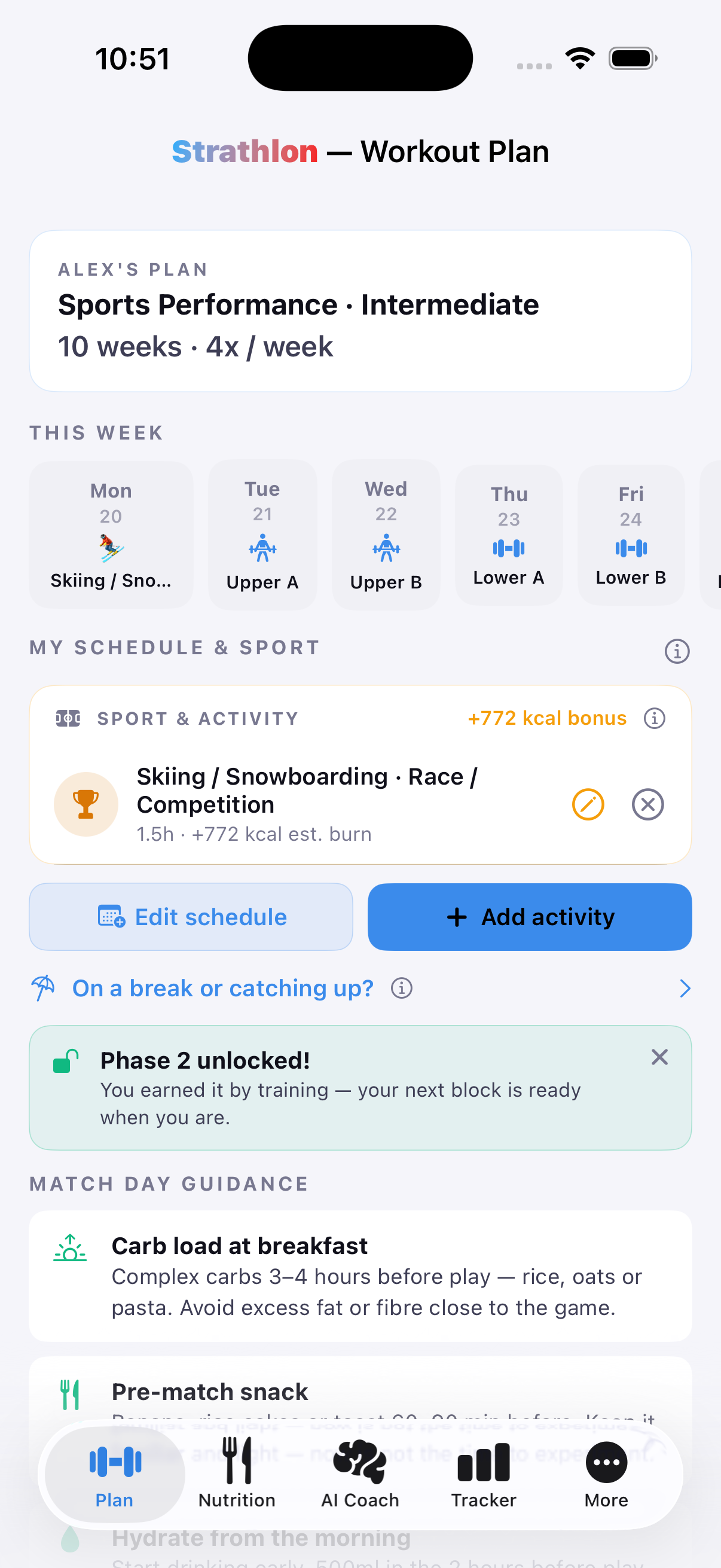
Here's the honest boundary, though: Strathlon tunes a goal-driven plan toward skiing: it does not hand-author a fully bespoke, periodised ski-specific S&C block, and it doesn't replace a specialist strength-and-conditioning coach or a physio for a real injury. Think of it as a sport-aware foundation that keeps you consistently doing the right kind of work, with the periodisation judgement and prevention-programme structure in this guide layered on top by you (or your coach).

Common questions
What's the most important kind of strength for skiing?
For downhill skiing, the standout quality is eccentric leg strength: the ability of your quads (and glutes and hamstrings) to control and absorb force while lengthening under load, which is exactly what they do turn after turn as gravity pulls you downhill. Studies of skiers describe the knee extensors acting largely as shock absorbers, and eccentric quadriceps and hamstring fatigue can persist for more than 24 hours after a day on snow. Building eccentric strength (through controlled squats and lunges, wall sits and step-downs, and later controlled landings) tends to matter more than how much you can lift just once. Single-leg strength and balance run a close second, because skiing loads one leg at a time over changing terrain.
Will lifting heavy make me slow or bulky for skiing?
Almost certainly not. Building noticeable muscle is slow and deliberate and takes months of consistent effort and eating. You won't add it by accident from a couple of weekly sessions. More to the point, heavy strength and power training tends to make athletes faster and more explosive rather than slower: reviews of resistance and power training show transfer to jumping, sprinting and change-of-direction, the same qualities skiing draws on. For skiing you're chasing stronger, more controllable legs and a resilient trunk rather than size, so train strength and power and let the myth go.
Can strength and balance training actually lower my ACL injury risk?
It can meaningfully reduce risk, though nothing removes it. The knee is the most-injured area in skiing and the ACL is the single most common serious diagnosis. Multi-component neuromuscular prevention programmes (combining balance, landing mechanics, strength and plyometrics) have been shown in a meta-analysis to cut ACL injuries by around half (roughly a 50% reduction) and knee injuries by about a quarter across sports, with the largest effect when the programme is done consistently, two to three times a week, and started before the season. No single drill is magic. It's the whole package, done regularly, that shifts the odds.
Do hamstring exercises like Nordic curls help skiers?
They're worth including. The hamstrings help protect the ACL by resisting the forward slide of the shin on the thigh, and strong, fatigue-resistant hamstrings support the knee through the loads of skiing. Including the Nordic hamstring exercise in injury-prevention programmes is associated with roughly halving hamstring injury rates in a large meta-analysis of over 8,000 athletes: an association rather than a guarantee, and one later researchers have argued is less precise than the headline number suggests. Even so, eccentric hamstring work is cheap, low-risk and complements the quad-dominant nature of skiing.
How do I keep my strength through a short ski season?
You don't need to keep training the way you did in the off-season: you need to hold the ground you gained. The evidence on reduced training is reassuring: once you've built strength, roughly one to two short, focused sessions a week can maintain it for months, provided you keep the intensity up (a few hard sets of your main lifts) even as the total volume drops. Strength and power start to fade within about two to four weeks of stopping completely, so don't stop completely. A brief weekly session slotted around ski days protects a whole off-season of work.
How far ahead of the season should I start training?
The earlier the better, because meaningful strength, power and tissue resilience take months to build. Weeks aren't enough. A common approach is to use the off-season for the heavy lifting (building maximal strength and some muscle) then shift toward power, plyometrics and balance in the pre-season weeks closest to snow, and finally drop into maintenance once you're skiing. Prevention programmes also appear to work best when started before the season rather than mid-winter, so front-loading the work both builds performance and lowers injury risk before your first day on the mountain.
Takeaways
- Skiing is a force-absorption sport. The legs work eccentrically to control gravity, so eccentric and isometric leg strength lead the priority list.
- Train one leg at a time. Split squats, step-ups and step-downs build strength and balance where skiing actually uses them and expose left/right gaps.
- Build a strong base, then add the ski-specific work. Squats and hinges make you strong. Single-leg, balance and landing work make that strength ski-ready. You need both.
- Add power and controlled landings. Pair heavy lifting with explosive and plyometric work: mastering soft, double-leg landings before anything harder.
- Condition for repeat efforts. An aerobic base speeds recovery between runs. Short, hard intervals build the fitness to hold form on the last run of the day.
- Do the prevention work. Multi-component neuromuscular programmes (balance, landing, strength, plyometrics) are associated with roughly halving ACL injuries: as a consistent package, started before the season.
- Build off-season, hold in-season. Get strong before the snow. Then ~1–2 short, intense sessions a week can maintain that strength through winter, just don't stop.
- Lifting won't make you slow. It makes you more explosive and more resilient. The myth is what holds skiers back, far more than any barbell ever could.
If you remember one thing, make it the shape of the year: build genuine leg strength and control in the off-season, sharpen it into power and balance before the snow, then hold it with a short weekly session all winter. That single arc (build, sharpen, hold) is most of what separates a skier who fades and tweaks a knee by February from one still skiing strong in spring. Strathlon's role is to give you a sport-aware starting plan and to show your lifts trending up, so the strength half of that arc is one less thing to guess at.
References
Numbered sources for the specific figures, effect sizes and named studies above. Where a claim reflects agreed guidance rather than a single trial, the citation is to the position stand or consensus statement of the body concerned, with the country or international remit named. Alpine skiing has a strong ACL-injury literature and a smaller performance one; the prevention figures below come from ski-specific and general neuromuscular-programme evidence, and which is which is said in each entry.
- Turnbull JR, Kilding AE, Keogh JW. Physiology of alpine skiing. Scandinavian Journal of Medicine & Science in Sports. 2009;19(2):146–55. The physiology of alpine skiing review: the source for the eccentric, force-absorption description of the sport's leg demand. PubMed 19335589
- Tesch PA. Aspects on muscle properties and use in competitive Alpine skiing. Medicine and Science in Sports and Exercise. 1995;27(3):310–4. Study of muscle properties and their use in competitive alpine skiing, the mechanism behind the eccentric and isometric emphasis. PubMed 7752855
- Bacharach DW, von Duvillard SP. Intermediate and long-term anaerobic performance of elite Alpine skiers. Medicine and Science in Sports and Exercise. 1995;27(3):305–9. Study of intermediate and long-term anaerobic performance in elite alpine skiers, the basis for the repeat-run conditioning prescription. PubMed 7752854
- Davey A, Endres NK, Johnson RJ, Shealy JE. Alpine Skiing Injuries. Sports Health. 2019;11(1):18–26. Review of alpine skiing injuries, the source for the sport's injury distribution. PubMed 30782106 · PMC6299353 full text
- Tarka MC, Davey A, Lonza GC, O'Brien CM, Delaney JP, Endres NK. Alpine Ski Racing Injuries. Sports Health. 2019;11(3):265–271. Review of alpine ski racing injuries, the competitive end of the same picture. PubMed 30689522 · PMC6537318 full text
- Johnson SC. Anterior cruciate ligament injury in elite Alpine competitors. Medicine and Science in Sports and Exercise. 1995;27(3):323–7. Study of anterior cruciate ligament injury in elite alpine competitors, the ski-specific ACL evidence. PubMed 7752857
- Westin M, Harringe ML, Engström B, Alricsson M, Werner S. Prevention of Anterior Cruciate Ligament Injuries in Competitive Adolescent Alpine Skiers. Frontiers in Sports and Active Living. 2020;2:11. Study of ACL injury prevention in competitive adolescent alpine skiers, the ski-specific prevention evidence. PubMed 33345006 · PMC7739649 full text
- Ko J, Seo SW, Cho JH. Managing Alpine Skiing Injuries: Focus on Anterior Cruciate Ligament (ACL) Tear Prevention in Adolescent Athletes. Iranian Journal of Public Health. 2024;53(5):1209–1210. Study of managing alpine skiing injuries with a focus on ACL tear prevention in adolescent athletes, the second source for the same. PubMed 38912138 · PMC11188639 full text
- Webster KE, Hewett TE. Meta-analysis of meta-analyses of anterior cruciate ligament injury reduction training programs. Journal of Orthopaedic Research : Official Publication of the Orthopaedic Research Society. 2018;36(10):2696–2708. Meta-analysis of meta-analyses of ACL injury reduction training programmes: the source for multi-component neuromuscular programmes roughly halving ACL injuries. This is general evidence rather than ski-specific. PubMed 29737024
- Al Attar WSA, Bakhsh JM, Khaledi EH, Ghulam H, Sanders RH. Injury prevention programs that include plyometric exercises reduce the incidence of anterior cruciate ligament injury: a systematic review of cluster randomised trials. Journal of Physiotherapy. 2022;68(4):255–261. Meta-analysis finding prevention programmes including plyometric exercises reduce ACL injury incidence, the basis for including landing and plyometric work in the package. PubMed 36244964
- Petushek EJ, Sugimoto D, Stoolmiller M, Smith G, Myer GD. Evidence-Based Best-Practice Guidelines for Preventing Anterior Cruciate Ligament Injuries in Young Female Athletes: A Systematic Review and Meta-analysis. The American Journal of Sports Medicine. 2019;47(7):1744–1753. Petushek and colleagues' evidence-based best-practice guidelines for preventing ACL injuries, the practical form of that programme. PubMed 30001501 · PMC6592422 full text
- Mujika I, Padilla S. Muscular characteristics of detraining in humans. Medicine and Science in Sports and Exercise. 2001;33(8):1297–303. Review of the muscular characteristics of detraining, the source for the 'build off-season, hold in-season' arc. PubMed 11474330
- Beattie K, Kenny IC, Lyons M, Carson BP. The effect of strength training on performance in endurance athletes. Sports Medicine. 2014;44(6):845–65. Meta-analysis of strength training in endurance athletes, cited for the 'lifting won't make you slow' point. PubMed 24532151
- Suchomel TJ, Nimphius S, Stone MH. The Importance of Muscular Strength in Athletic Performance. Sports Medicine. 2016;46(10):1419–49. Suchomel and colleagues on the importance of muscular strength in athletic performance: the source for greater maximal strength being associated with faster sprinting, jumping and change of direction, and with lower injury risk. PubMed 26838985
- Seitz LB, Reyes A, Tran TT, Saez de Villarreal E, Haff GG. Increases in lower-body strength transfer positively to sprint performance: a systematic review with meta-analysis. Sports Medicine. 2014;44(12):1693–702. Seitz and colleagues' systematic review with meta-analysis showing increases in lower-body strength transfer positively to sprint performance, the evidence behind the 'strength is the base' argument. PubMed 25059334
- Lauersen JB, Andersen TE, Andersen LB. Strength training as superior, dose-dependent and safe prevention of acute and overuse sports injuries: a systematic review, qualitative analysis and meta-analysis. British Journal of Sports Medicine. 2018;52(24):1557–1563. Lauersen and colleagues' meta-analysis finding strength training a superior, dose-dependent and safe prevention of acute and overuse sports injuries: the direct source for treating strength work as prehab. PubMed 30131332
- Lauersen JB, Bertelsen DM, Andersen LB. The effectiveness of exercise interventions to prevent sports injuries: a systematic review and meta-analysis of randomised controlled trials. British Journal of Sports Medicine. 2014;48(11):871–7. Lauersen and colleagues' earlier meta-analysis of exercise interventions to prevent sports injuries, the broader evidence base the prevention advice sits on. PubMed 24100287
- . American College of Sports Medicine position stand. Progression models in resistance training for healthy adults. Medicine and Science in Sports and Exercise. 2009;41(3):687–708. American College of Sports Medicine (ACSM, United States) position stand on progression models in resistance training: the source for the heavy-load and explosive-load percentage ranges quoted. PubMed 19204579
- Cuthbert M, Haff GG, Arent SM, Ripley N, McMahon JJ, Evans M, et al. Effects of Variations in Resistance Training Frequency on Strength Development in Well-Trained Populations and Implications for In-Season Athlete Training: A Systematic Review and Meta-analysis. Sports Medicine. 2021;51(9):1967–1982. Cuthbert and colleagues' systematic review of resistance-training frequency in well-trained populations, the source for the sessions-per-week guidance. PubMed 33886099 · PMC8363540 full text
- Spiering BA, Mujika I, Sharp MA, Foulis SA. Maintaining Physical Performance: The Minimal Dose of Exercise Needed to Preserve Endurance and Strength Over Time. Journal of Strength and Conditioning Research. 2021;35(5):1449–1458. Spiering and colleagues on the minimal dose of exercise needed to preserve endurance and strength: the source for maintaining in-season on as little as one to two sessions a week. PubMed 33629972
- Rønnestad BR, Nymark BS, Raastad T. Effects of in-season strength maintenance training frequency in professional soccer players. Journal of Strength and Conditioning Research. 2011;25(10):2653–60. Ronnestad and colleagues' trial of in-season strength maintenance frequency in professional footballers, the specific in-season maintenance result quoted. PubMed 21873897
- Nuzzo JL, Pinto MD, Kirk BJC, Nosaka K. Resistance Exercise Minimal Dose Strategies for Increasing Muscle Strength in the General Population: an Overview. Sports Medicine. 2024;54(5):1139–1162. Nuzzo and colleagues on minimal-dose resistance exercise strategies for increasing strength, supporting the claim that a small, well-chosen dose does most of the work. PubMed 38509414 · PMC11127831 full text
- Wilson JM, Marin PJ, Rhea MR, Wilson SM, Loenneke JP, Anderson JC. Concurrent training: a meta-analysis examining interference of aerobic and resistance exercises. Journal of Strength and Conditioning Research. 2012;26(8):2293–307. Wilson and colleagues' meta-analysis of concurrent training and the interference effect: the source for separating heavy lifting from hard conditioning. PubMed 22002517
- Schumann M, Feuerbacher JF, Sünkeler M, Freitag N, Rønnestad BR, Doma K, et al. Compatibility of Concurrent Aerobic and Strength Training for Skeletal Muscle Size and Function: An Updated Systematic Review and Meta-Analysis. Sports Medicine. 2022;52(3):601–612. An updated systematic review of the compatibility of concurrent aerobic and strength training, the more recent evidence that interference is smaller than once believed. PubMed 34757594 · PMC8891239 full text
- Ramirez-Campillo R, Sortwell A, Moran J, Afonso J, Clemente FM, Lloyd RS, et al. Plyometric-Jump Training Effects on Physical Fitness and Sport-Specific Performance According to Maturity: A Systematic Review with Meta-analysis. Sports Medicine - Open. 2023;9(1):23. Ramirez-Campillo and colleagues on plyometric-jump training effects on physical fitness and sport-specific performance, the source for the plyometric guidance. PubMed 37036542 · PMC10086091 full text
- Impellizzeri FM, Woodcock S, Coutts AJ, Fanchini M, McCall A, Vigotsky AD. What Role Do Chronic Workloads Play in the Acute to Chronic Workload Ratio? Time to Dismiss ACWR and Its Underlying Theory. Sports Medicine. 2021;51(3):581–592. Impellizzeri and colleagues on the pitfalls of the acute:chronic workload ratio: cited because it is the reason this guide talks about ramping load gradually rather than quoting a workload number. PubMed 33332011
- Baz-Valle E, Balsalobre-Fernández C, Alix-Fages C, Santos-Concejero J. A Systematic Review of The Effects of Different Resistance Training Volumes on Muscle Hypertrophy. Journal of Human Kinetics. 2022;81:199–210. Systematic review of resistance-training volume and hypertrophy, the general dose-response evidence behind the set and session recommendations. PubMed 35291645 · PMC8884877 full text
Pair this with the skiing fuelling guide: training builds the engine; fuelling and hydration (in the cold, at altitude, across a long day) are what keep it running. Read them together.
This is general educational information rather than medical or individual coaching advice. The strength, conditioning and injury-prevention figures here are drawn from published research and are framed as population-level guides and associations: individual needs vary widely with training age, skiing level, sex, injury history and health, and much of the injury-prevention evidence comes from sports other than skiing and is a reasonable extrapolation rather than direct proof. Anyone with pain, a current or past injury (especially a knee injury), a health condition, or who is pregnant or postpartum, should consult a qualified strength-and-conditioning coach, physiotherapist or physician before starting or changing an exercise programme. See our Terms for more.
← All guides · Skiing fuelling guide · How muscle actually grows · Recovery & rest · Eating for results · Understanding your stats · Home