
Squash strength & conditioning
An evidence-based guide to training the body squash actually asks for. Squash is a fast, one-legged, change-of-direction sport played in a small box: a story of repeated lunges, hard stops, explosive pushes and long, breathless rallies. This covers the strength and power that transfer to court, how to condition the sport's stop-start energy system without wrecking your strength, the injuries squash players pick up most, the prehab that tilts the odds, and how to fit it all around a playing season. Practical, honest, and grounded in sports-science research.
Here's the short answer to "what should a squash player train?": single-leg and lunge strength for the position you actually play in, deceleration and change-of-direction ability for the constant stopping and cutting, and resilient calves and Achilles for the explosive push-off, all backed by a heavy strength base and high-intensity intermittent conditioning that mirrors the rallies. Everything below is the detail behind that sentence: the qualities, why they transfer, and where the numbers come from.
On this page
A framing note before the detail. Sport science is well studied, but people differ enormously: your standard of play, training age, body type, injury history, age and recovery all shift what's right for you. So this is written as can, tends to and is associated with, never as a guarantee, and every specific figure is a research finding or a population-level guide rather than a personal prescription. It is general education rather than medical or individualised coaching advice.
The demands of squash
Squash is a high-intensity intermittent sport. Rallies come in short, explosive bursts with brief recoveries, repeated for the better part of an hour. In studies of elite match play, rallies tend to last roughly 15 to 30 seconds with rest intervals of only around ten seconds or less, and players are actively moving for a large share of total court time (Girard and colleagues, 2007). Whole matches run anywhere from about 37 to 89 minutes. That structure (short hard effort, short rest, over and over) is the single most important thing to understand about training for the sport.
Physiologically, that makes squash lean on both energy systems at once. Match heart rates sit high (averaging around 92% of maximum in elite play), with roughly a quarter of playing time spent above 90% of VO2max and blood lactate climbing above 8 mmol/L, all signs of heavy anaerobic contribution on top of a strong aerobic base (Girard and colleagues, 2007). Elite players also carry high aerobic capacities, commonly above 60 mL/kg/min in men and 50 in women (Girard and colleagues, 2005), because a big aerobic engine is what lets them recover between rallies and keep the quality up deep into a match.
Mechanically, squash is defined by the lunge. Much of the game is played on one leg, with most shots struck from a lunge position, linked by repeated accelerations, hard decelerations and changes of direction across a court only a few metres wide. Every rally is a series of explosive pushes out to the ball and violent stops to recover to the T. That is why the qualities that transfer to squash are so specific: single-leg strength, the ability to decelerate and change direction, resilient calves and Achilles tendons, a strong rotational core, and enough hip mobility to get low into the lunge.
The injury picture follows directly from those demands. In a long analysis of English professional squash, the lower limb accounted for roughly three-quarters of injuries, with the ankle and heel the single most-injured area (around 21%), followed by the thigh (about 13%) and the knee (about 11%), and most injuries being soft-tissue in nature (Horsley and colleagues, 2020). A recent systematic review put squash injury incidence in a broad band of roughly 7 to 15 per 1000 hours of play. In plain terms: squash injuries are overwhelmingly lower-body, they cluster around the ankle, calf and Achilles, and the knee and lower back are the next places to look after, which is exactly where the strength and prehab work below is aimed.
Key strength work, and why it matters
Strength training for squash isn't about looking like a lifter: it's about having more force available for faster push-offs and, just as importantly, harder, safer stops. A broad review of the topic found that greater maximal strength is associated with better sprinting, jumping and change-of-direction performance, and with a lower risk of injury (Suchomel and colleagues, 2016). For a sport where change-of-direction speed is one of the strongest physical correlates of on-court performance (James and colleagues, 2022), that transfer is the whole point. Here is what to prioritise, and why each piece earns its place.
- Single-leg and lunge strength: the foundation. Because squash is played on one leg and struck from a lunge, unilateral strength is the most sport-specific thing you can build. Bulgarian split squats, walking and reverse lunges, step-ups and single-leg deadlifts load exactly the positions the game uses, and they train the hip and trunk stabilisers that keep the knee and ankle tracking safely as force passes from one leg to the other. Single-leg strength is widely regarded as both a performance and an injury-prevention cornerstone for court sports.
- A heavy bilateral base: the force reservoir. A big squat and a hinge or deadlift build the raw strength that everything else draws on. General strength-training guidance puts maximal-strength work in the heavy, low-rep range (broadly at or above about 80% of your one-rep max for a handful of reps), and stronger athletes reliably out-jump, out-sprint and out-cut weaker ones (Suchomel and colleagues, 2016). You don't live in this range year-round, but a base of real strength is what makes the fast, springy qualities trainable.
- Plyometrics and reactive strength: the spring. Squash is full of fast stretch-shorten actions: pushing out of a lunge, checking and re-accelerating, absorbing a landing. Jumps, bounds, pogo hops and controlled landing drills build the reactive strength and tendon stiffness that make those actions fast and cushioned. Meta-analyses of plyometric training report moderate improvements in jumping and change-of-direction, and the tendon conditioning it provides is directly protective for the calf and Achilles.
- Rotational power: the racquet. Racquet-head speed comes from a kinetic chain that runs legs → hips → trunk → arm, and the trunk's job is to transfer that force without leaking it. Rotational medicine-ball throws and chops train the core to produce and channel power quickly. Trunk rotational strength correlates strongly with rotational throwing power, and in racquet sports med-ball throwing relates to racquet-head speed. It's the difference between arming the ball and driving it.
- Dedicated calf work: the insurance. The calves and Achilles take the brunt of every explosive lunge, and they sit at the top of the squash injury list. Heavy calf raises done both with a straight knee (gastrocnemius) and a bent knee (soleus) build a stronger, more resilient complex: this is base-strength work that doubles as prehab, which is why it appears again in the next section.
- References
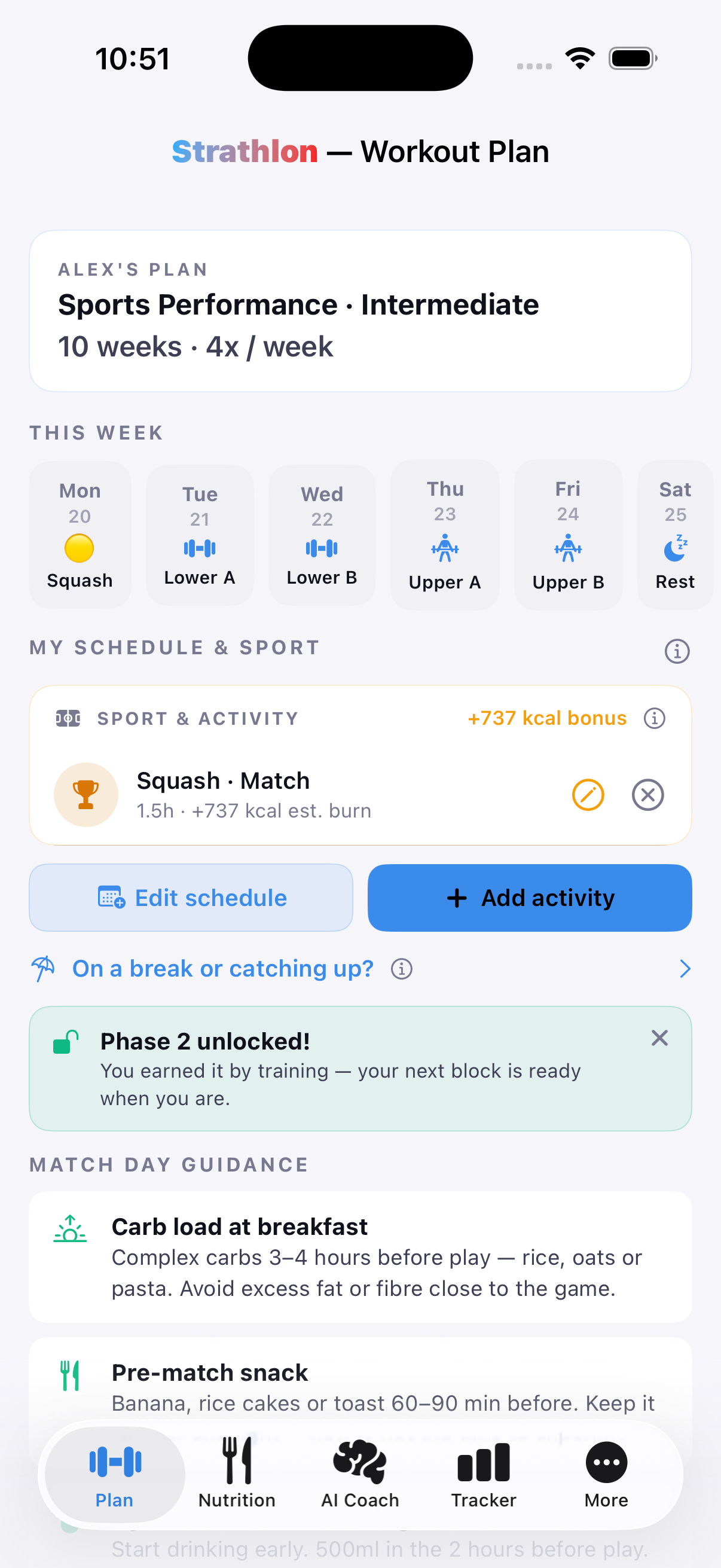
That pairing is worth dwelling on, because it captures the whole philosophy of training for a sport. The heavy bilateral base is the force reservoir. It is not general filler to be skipped in favour of more court time. On top of it sit the sport-specific pieces: an accessory block of single-leg and lunge strength for the stance the game is actually played in, rotational power for the racquet, and shoulder and forearm care for the hitting arm. Neither half works alone. Lunge and rotational work on a weak base is movement without force behind it. A strong squat that never trains the lunge or the spring leaves you strong standing still and slow to the front wall.
That's the argument of this whole section made concrete. The sport-specific work, the single-leg and rotational accessory block, is what makes the plan squash-shaped, training the lunge position and the rotational power the game rewards. But it only works because it sits on top of complementary base strength and conditioning: the heavy squat and hinge that give you force to spend, and the intervals that let you spend it rally after rally. Neither half is enough alone. A player who only ever drills lunges without building underlying strength plateaus quickly. A player who only ever lifts heavy without the single-leg and rotational work moves like a powerlifter on court. The point is the mix.
Conditioning for squash
Conditioning for squash should look like squash. Because rallies are short and hard with brief rests, the most specific fitness work is repeat-sprint and short high-intensity interval training: court sprints, ghosting drills (shadow movements to the corners), and shuttle runs, done in bursts of a similar length to a rally with similarly short recoveries. This trains the exact stop-start system a long rally taxes, and repeat-sprint ability is a strong correlate of squash performance (James and colleagues, 2022). On-court pressure sessions and conditioning games do much of this naturally.
Underneath the sharp end, an aerobic base matters more than it looks. Your ability to recover in those eight-to-ten-second gaps, and to still hit clean lengths in the fifth game, rests on aerobic fitness, which is why elite players carry such high VO2max values (Girard and colleagues, 2005). A weekly easy-to-moderate aerobic session (a run, bike or row) supports recovery between the hard days without adding much fatigue.
The trick is fitting strength and conditioning together without one blunting the other: the interference effect. When heavy endurance work and heavy strength work are piled into the same session or the same tired legs, the endurance stimulus can dampen strength and power adaptations. You can't eliminate this if you play and train a lot, but you can manage it: separate your hardest running from your heaviest lifting where you can (different days, or at least several hours apart), do the quality you care most about while fresh, and remember that a lot of your conditioning is already happening on court. Piling conditioning on top of a full playing week is one of the fastest routes to flat legs and stalled strength.
Staying injury-resilient
Squash injuries are overwhelmingly lower-body and cluster in a few predictable places (Horsley and colleagues, 2020). The good news is that the prehab for them overlaps heavily with the strength work you're already doing: resilience is mostly a by-product of getting strong in the right positions, plus a little targeted insurance.
- Ankle and foot (the most common site). The explosive lunging and cutting load the ankle constantly. Single-leg strength, balance and landing work build the control that protects it, and structured neuromuscular training programmes (combinations of balance, landing and strength drills) are associated with meaningful reductions in lower-limb and knee injuries in cutting sports. A history of ankle sprains is a strong predictor of the next one, so ongoing balance and strength work matters most for anyone who's rolled an ankle before.
- Calf and Achilles. These take the brunt of the push-off and sit near the top of the squash injury list. Regular heavy calf raises (straight- and bent-knee) plus reactive plyometric work build a tendon that tolerates the load. Where an Achilles is already painful, the best-evidenced rehabilitation is an eccentric heel-drop programme, the classic Alfredson protocol used three sets of 15 twice a day (Alfredson and colleagues, 1998), but that's a treatment to run with a clinician, and it's far better to build tolerance before a tendon complains than to rehab it after.
- Knee. The cutting, pivoting and deep lunging that squash demands are exactly the movements linked to knee and ACL injury in court and field sports. Neuromuscular and landing-focused prevention programmes are associated with substantial reductions here (on the order of roughly halving ACL injuries in meta-analyses, with knee injuries overall down meaningfully too), and the effect is strongest when people actually complete the programme consistently. Learning to decelerate and land with a soft, aligned knee is both a performance skill and a knee-saver.
- Hamstring and thigh. Thigh injuries are the second most common region in professional squash (Horsley and colleagues, 2020), driven by the explosive lunging and sprinting. Adding the Nordic hamstring exercise is associated with roughly halving hamstring-injury rates across sport (van Dyk and colleagues, 2019, reported a risk ratio near 0.49), though it's honest to say the precise magnitude has been debated in later re-analyses. Treat it as a cheap, well-supported bit of insurance rather than a guaranteed shield.
- Lower back. The repeated flexion, rotation and low lunging load the spine, and the low back is a common nagging complaint in racquet players. Anti-rotation and anti-extension core work (Pallof presses, dead bugs, loaded carries), good hinge mechanics, and enough hip mobility to get into the lunge without the back compensating all help share the load away from the spine.
A realistic note on all of the above: prevention programmes reduce risk, but they don't remove it, and the reductions quoted are associations from grouped data. They don't promise anything for any one player. Their biggest weakness is compliance: the benefit shows up mostly in people who keep doing the work.
Programming it around your season
The same exercises get organised very differently depending on the time of year, because you can't build maximal strength and play a heavy competitive schedule at full tilt at the same time.
- Off-season / pre-season: build. This is when the heavy lifting happens. With fewer matches to recover from, you have room for two to three strength sessions a week, higher volume, and dedicated blocks of maximal strength and power (including the heavy, ≥80%-1RM work and the plyometrics). It's the time to raise your ceiling.
- In-season: maintain. Once you're competing, the goal shifts from gaining to keeping. Reassuringly, maximal strength can be maintained on as little as one to two sessions a week once it's established, according to systematic-review evidence on training frequency, so in-season lifting is kept brief, heavy and low-volume: a few hard sets of the main lifts and the key single-leg and calf work, enough to hold your strength without leaving your legs flat for court. You don't need to chase personal bests in-season. You need to arrive fresh to play.
- Fit it around fatigue. Don't schedule your heaviest legs day right before an important match or a hard court session: put strength on lighter court days or after play instead of right before it, and use a lighter deload week when accumulated fatigue starts showing up as stalled progress or nagging niggles.
Common questions
What strength exercises matter most for squash?
Squash is played largely on one leg, with most shots hit from a lunge, so single-leg and lunge strength sit at the centre: split squats, walking lunges, step-ups and single-leg deadlifts. Around those, a heavy bilateral base (a squat and a hinge or deadlift) builds the force you draw on for every push-off and stop, and greater maximal strength is associated with better sprinting, jumping and change-of-direction and a lower injury risk (Suchomel and colleagues, 2016). Add rotational power work such as medicine-ball throws for racquet speed, plyometrics for reactive push-off and deceleration, and dedicated calf work for Achilles resilience. Change-of-direction speed is one of the strongest physical correlates of squash performance (James and colleagues, 2022).
Will lifting heavy weights make me slow or bulky for squash?
It is largely the opposite of what many players fear. Across the research, stronger athletes tend to sprint, jump and change direction better, because more available force means faster push-offs and harder stops (Suchomel and colleagues, 2016). Building a lot of muscle mass is slow and deliberate: it takes months of dedicated eating and training and will not happen by accident from a couple of sessions a week. Heavy, low-rep strength work develops force with relatively little added size, which is exactly what a fast court sport wants.
How do I protect my Achilles and calves in squash?
The ankle, heel and calf are among the most-injured areas in squash (Horsley and colleagues, 2020), and repeated explosive lunging loads the Achilles hard. Regular heavy calf raises (both straight-knee and bent-knee, to load the whole complex) build a more resilient tendon, and reactive plyometric work develops the tendon stiffness that absorbs landings. Where a tendon is already painful, the best-evidenced rehab is an eccentric heel-drop programme (the Alfredson protocol, 1998: three sets of 15 twice daily). That's a treatment to run with a clinician, and it doesn't replace gradually building load in the first place. Warm the calves and ankles thoroughly before you step on court.
How many strength sessions a week do I need in-season?
Fewer than you might think to hold what you have built. Systematic-review evidence indicates that maximal strength can be maintained on as little as one to two sessions a week once it is established, which is why in-season lifting is usually kept brief, heavy and low-volume so it does not drain your legs for court sessions. The bigger blocks of strength and power building belong in the off-season or pre-season, when you have room to add volume. In-season, the job is to maintain rather than chase new personal bests.
What's the best way to train squash fitness off the court?
Match the intervals to the game. Squash rallies tend to run around 15 to 30 seconds with short recoveries of roughly ten seconds or less (Girard and colleagues, 2007), so repeat-sprint and short high-intensity interval work (court sprints, ghosting and shuttle runs) trains the exact system a long rally uses, and repeat-sprint ability is a strong correlate of squash performance (James and colleagues, 2022). Underneath that, an aerobic base helps you recover between rallies and back up hard efforts, and elite players carry high aerobic capacities (Girard and colleagues, 2005). Keep the hardest conditioning and the heaviest strength on separate days where you can, so one does not blunt the other.
Does strength and prehab training actually reduce squash injuries?
It is associated with lower risk, though nothing removes risk entirely. Greater strength itself is linked to reduced injury rates (Suchomel and colleagues, 2016), and structured neuromuscular training (balance, landing and strength drills) is associated with meaningful reductions in knee and ACL injuries in cutting sports, on the order of roughly halving ACL injuries in meta-analyses, with the benefit strongest when people actually stick to the programme. For the hamstrings, adding the Nordic hamstring exercise is associated with roughly halving hamstring-injury rates (van Dyk and colleagues, 2019), although the precise magnitude is debated. Treat prehab as tilting the odds. It isn't a guarantee.
Takeaways
- Squash is a one-legged, stop-start sport. Short explosive rallies, constant lunging and cutting, over the better part of an hour: that structure decides everything you train.
- Build single-leg and lunge strength first. The game is played on one leg from a lunge, so unilateral strength is your most sport-specific (and injury-protective) work.
- Get strong underneath it. A heavy squat and hinge base (roughly ≥80% 1RM, low reps) makes everything faster. Stronger athletes change direction, sprint and jump better (Suchomel and colleagues, 2016).
- Add spring and rotation. Plyometrics build reactive, deceleration and tendon qualities. Medicine-ball throws build the rotational power that drives racquet-head speed.
- Condition like the game. Repeat-sprint and short intervals mirror 15–30s rallies with short rests (Girard and colleagues, 2007). An aerobic base underpins recovery between them.
- Protect the calf, ankle, knee and back. Heavy calf work, balance and landing drills, Nordic hamstrings and anti-rotation core are prehab that overlaps with performance, and tilts injury odds in your favour.
- Build off-season, maintain in-season. Two to three sessions to gain; one to two brief, heavy sessions to hold strength while you compete, kept off your heavy court days.
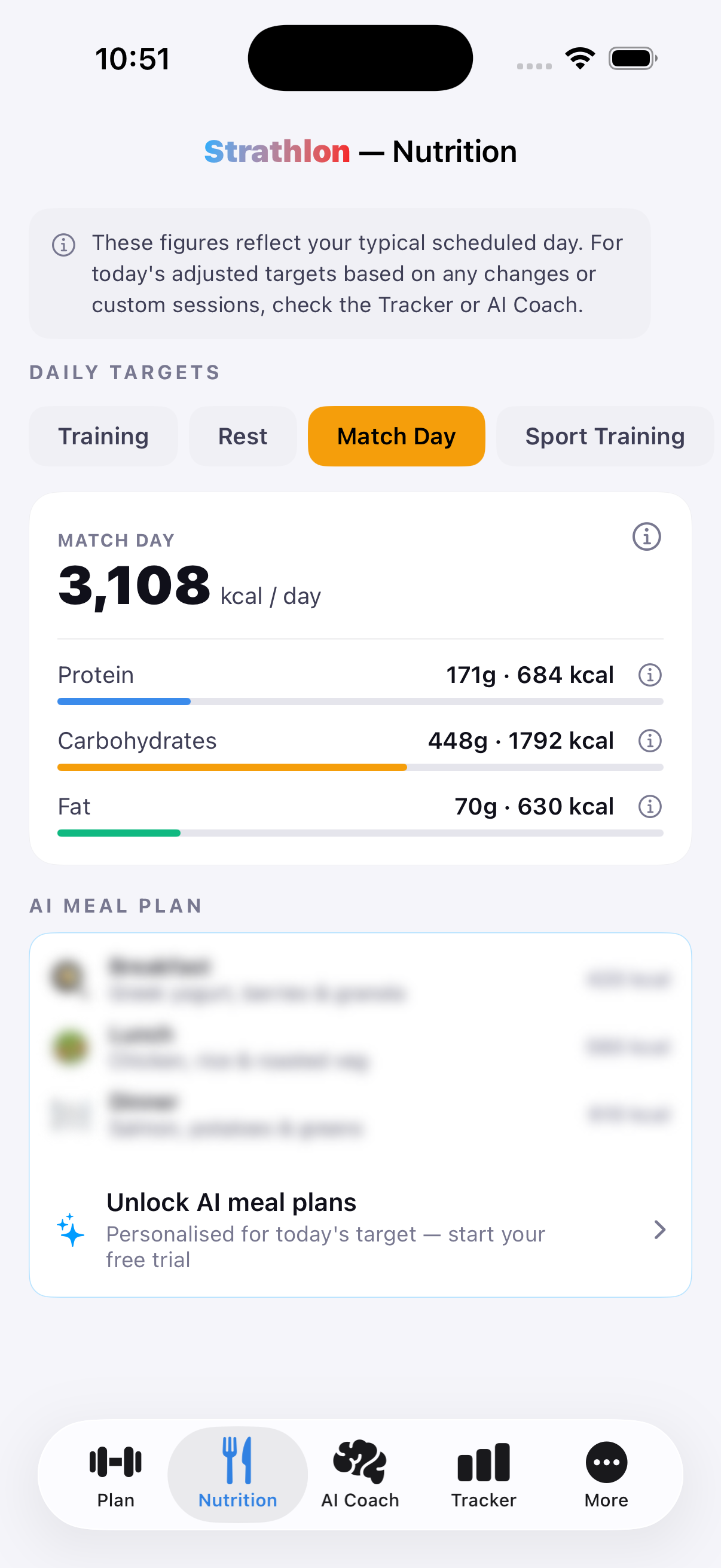
If you remember one thing, make it the shape of the sport: squash rewards a strong, springy, single-leg athlete who can stop as well as go and keep it up rally after rally. Build that athlete in the gym, then let the court sharpen it. Strathlon's job is to give you a starting plan, tuned for squash once Sports Performance is one of your goals, and keep your strength trend honest, so the work you do off court actually shows up on it.
Pair this with the squash fuelling guide: how to eat and hydrate around training and match play so the body you're building has the energy to perform.
References
Numbered sources for the specific figures, effect sizes and named studies above. Where a claim reflects agreed guidance rather than a single trial, the citation is to the position stand or consensus statement of the body concerned, with the country or international remit named. Squash has a very small published literature: one squash-specific protocol below, with the rest read across from badminton and tennis, whose intermittent court demands are the closest available match. That read-across is stated rather than hidden.
- Kingsley M, James N, Kilduff LP, Dietzig RE, Dietzig B. An exercise protocol that simulates the activity patterns of elite junior squash. Journal of Sports Sciences. 2006;24(12):1291–6. An exercise protocol simulating the activity patterns of elite junior squash: the closest published description of the sport's intermittent demand. PubMed 17101531
- Phomsoupha M, Laffaye G. The science of badminton: game characteristics, anthropometry, physiology, visual fitness and biomechanics. Sports Medicine. 2015;45(4):473–95. The science of badminton review, used for the lunging, direction-change and rally-structure demands squash shares with it. PubMed 25549780
- Reid M, Schneiker K. Strength and conditioning in tennis: current research and practice. Journal of Science and Medicine in Sport. 2008;11(3):248–56. Kovacs and colleagues on strength and conditioning in tennis, read across for the racquet-sport strength prescriptions. PubMed 17597004
- Reid M, Duffield R. The development of fatigue during match-play tennis. British Journal of Sports Medicine. 2014;48 Suppl 1(Suppl 1):i7–11. Study of the development of fatigue during match-play tennis, applied to squash's longer rallies and said to be a read-across. PubMed 24668384 · PMC3995216 full text
- Jiang J, Li H, Xiu C. Characterization of Muscle Activation and Muscle Synergism in the 'Forward Lunge' Gait Movement of Badminton Players Using Surface Electromyography Sensors. Sensors. 2025;25(6). Study characterising muscle activation and synergy in the racquet-sport forward lunge, the mechanism behind the single-leg emphasis. PubMed 40292700 · PMC11944875 full text
- Schiftan GS, Ross LA, Hahne AJ. The effectiveness of proprioceptive training in preventing ankle sprains in sporting populations: a systematic review and meta-analysis. Journal of Science and Medicine in Sport. 2015;18(3):238–44. Schiftan and colleagues' meta-analysis of proprioceptive training and ankle sprains, the source for the ankle-prehab figure. PubMed 24831756
- Cools AM, Johansson FR, Borms D, Maenhout A. Prevention of shoulder injuries in overhead athletes: a science-based approach. Brazilian Journal of Physical Therapy. 2015;19(5):331–9. Cools and colleagues on preventing shoulder injuries in overhead athletes, the basis for the cuff and scapular work. PubMed 26537804 · PMC4647145 full text
- Kongsgaard M, Kovanen V, Aagaard P, Doessing S, Hansen P, Laursen AH, et al. Corticosteroid injections, eccentric decline squat training and heavy slow resistance training in patellar tendinopathy. Scandinavian Journal of Medicine & Science in Sports. 2009;19(6):790–802. Kongsgaard and colleagues' heavy slow resistance protocol for patellar tendinopathy, the basis for the tendon-loading advice. PubMed 19793213
- Suchomel TJ, Nimphius S, Stone MH. The Importance of Muscular Strength in Athletic Performance. Sports Medicine. 2016;46(10):1419–49. Suchomel and colleagues on the importance of muscular strength in athletic performance: the source for greater maximal strength being associated with faster sprinting, jumping and change of direction, and with lower injury risk. PubMed 26838985
- Seitz LB, Reyes A, Tran TT, Saez de Villarreal E, Haff GG. Increases in lower-body strength transfer positively to sprint performance: a systematic review with meta-analysis. Sports Medicine. 2014;44(12):1693–702. Seitz and colleagues' systematic review with meta-analysis showing increases in lower-body strength transfer positively to sprint performance, the evidence behind the 'strength is the base' argument. PubMed 25059334
- Lauersen JB, Andersen TE, Andersen LB. Strength training as superior, dose-dependent and safe prevention of acute and overuse sports injuries: a systematic review, qualitative analysis and meta-analysis. British Journal of Sports Medicine. 2018;52(24):1557–1563. Lauersen and colleagues' meta-analysis finding strength training a superior, dose-dependent and safe prevention of acute and overuse sports injuries: the direct source for treating strength work as prehab. PubMed 30131332
- Lauersen JB, Bertelsen DM, Andersen LB. The effectiveness of exercise interventions to prevent sports injuries: a systematic review and meta-analysis of randomised controlled trials. British Journal of Sports Medicine. 2014;48(11):871–7. Lauersen and colleagues' earlier meta-analysis of exercise interventions to prevent sports injuries, the broader evidence base the prevention advice sits on. PubMed 24100287
- . American College of Sports Medicine position stand. Progression models in resistance training for healthy adults. Medicine and Science in Sports and Exercise. 2009;41(3):687–708. American College of Sports Medicine (ACSM, United States) position stand on progression models in resistance training: the source for the heavy-load and explosive-load percentage ranges quoted. PubMed 19204579
- Cuthbert M, Haff GG, Arent SM, Ripley N, McMahon JJ, Evans M, et al. Effects of Variations in Resistance Training Frequency on Strength Development in Well-Trained Populations and Implications for In-Season Athlete Training: A Systematic Review and Meta-analysis. Sports Medicine. 2021;51(9):1967–1982. Cuthbert and colleagues' systematic review of resistance-training frequency in well-trained populations, the source for the sessions-per-week guidance. PubMed 33886099 · PMC8363540 full text
- Spiering BA, Mujika I, Sharp MA, Foulis SA. Maintaining Physical Performance: The Minimal Dose of Exercise Needed to Preserve Endurance and Strength Over Time. Journal of Strength and Conditioning Research. 2021;35(5):1449–1458. Spiering and colleagues on the minimal dose of exercise needed to preserve endurance and strength: the source for maintaining in-season on as little as one to two sessions a week. PubMed 33629972
- Rønnestad BR, Nymark BS, Raastad T. Effects of in-season strength maintenance training frequency in professional soccer players. Journal of Strength and Conditioning Research. 2011;25(10):2653–60. Ronnestad and colleagues' trial of in-season strength maintenance frequency in professional footballers, the specific in-season maintenance result quoted. PubMed 21873897
- Nuzzo JL, Pinto MD, Kirk BJC, Nosaka K. Resistance Exercise Minimal Dose Strategies for Increasing Muscle Strength in the General Population: an Overview. Sports Medicine. 2024;54(5):1139–1162. Nuzzo and colleagues on minimal-dose resistance exercise strategies for increasing strength, supporting the claim that a small, well-chosen dose does most of the work. PubMed 38509414 · PMC11127831 full text
- Wilson JM, Marin PJ, Rhea MR, Wilson SM, Loenneke JP, Anderson JC. Concurrent training: a meta-analysis examining interference of aerobic and resistance exercises. Journal of Strength and Conditioning Research. 2012;26(8):2293–307. Wilson and colleagues' meta-analysis of concurrent training and the interference effect: the source for separating heavy lifting from hard conditioning. PubMed 22002517
- Schumann M, Feuerbacher JF, Sünkeler M, Freitag N, Rønnestad BR, Doma K, et al. Compatibility of Concurrent Aerobic and Strength Training for Skeletal Muscle Size and Function: An Updated Systematic Review and Meta-Analysis. Sports Medicine. 2022;52(3):601–612. An updated systematic review of the compatibility of concurrent aerobic and strength training, the more recent evidence that interference is smaller than once believed. PubMed 34757594 · PMC8891239 full text
- Ramirez-Campillo R, Sortwell A, Moran J, Afonso J, Clemente FM, Lloyd RS, et al. Plyometric-Jump Training Effects on Physical Fitness and Sport-Specific Performance According to Maturity: A Systematic Review with Meta-analysis. Sports Medicine - Open. 2023;9(1):23. Ramirez-Campillo and colleagues on plyometric-jump training effects on physical fitness and sport-specific performance, the source for the plyometric guidance. PubMed 37036542 · PMC10086091 full text
- Impellizzeri FM, Woodcock S, Coutts AJ, Fanchini M, McCall A, Vigotsky AD. What Role Do Chronic Workloads Play in the Acute to Chronic Workload Ratio? Time to Dismiss ACWR and Its Underlying Theory. Sports Medicine. 2021;51(3):581–592. Impellizzeri and colleagues on the pitfalls of the acute:chronic workload ratio: cited because it is the reason this guide talks about ramping load gradually rather than quoting a workload number. PubMed 33332011
- Baz-Valle E, Balsalobre-Fernández C, Alix-Fages C, Santos-Concejero J. A Systematic Review of The Effects of Different Resistance Training Volumes on Muscle Hypertrophy. Journal of Human Kinetics. 2022;81:199–210. Systematic review of resistance-training volume and hypertrophy, the general dose-response evidence behind the set and session recommendations. PubMed 35291645 · PMC8884877 full text
This is general educational information rather than medical or individualised coaching advice. The sport-science figures here are drawn from published research and are framed as associations and population-level guides: individual needs vary widely with playing standard, training age, body type and injury history, and are best personalised with a qualified strength-and-conditioning coach. Anyone with pain, a current or past injury, a health condition, or who is pregnant or postpartum, should consult a qualified clinician or S&C professional before starting or changing a training programme, and should treat any rehabilitation protocol as something to run under professional guidance. See our Terms for more.
← All guides · Squash fuelling guide · How muscle actually grows · Recovery & rest · Eating for results · Understanding your stats · Home