
Swimming strength & conditioning
An evidence-based guide to the dryland work that makes a swimmer faster and more durable. Swimming is a pulling-and-power sport played out over a shoulder that takes an extraordinary beating, so smart strength training has two jobs: build the force and power that transfer to swim velocity, starts and turns, and protect the rotator cuff and scapula that so often break down. This covers the demands, the lifts that actually carry over, how conditioning fits alongside them, the prehab that keeps shoulders healthy, and how to programme it across a season. Practical, honest, and grounded in sports-science evidence.
Here's the short version: the qualities that matter most for a swimmer are upper-body pulling power (your lats and back drive propulsion), rotator-cuff and scapular stability (to keep the shoulder healthy across thousands of strokes), and lower-body explosive power (which largely decides your start and turn): all tied together by a strong, streamlined core. Everything below is the detail behind that sentence, and every specific number traces to a source you can check.
On this page
A framing note before the detail. Sports science is well studied, but swimmers differ enormously: stroke, event distance, age, training age, sex and injury history all change what's right for a given person. So this is written as can, tends to and is associated with, never as a guarantee. Every figure is a population-level guide drawn from published research rather than a personal prescription. It's general education rather than medical or coaching advice, and it isn't an individualised programme.
The demands of swimming
Swimming is unusual among sports in that you generate propulsion with no fixed contact point: no ground to push off, just water to pull against. The bulk of forward drive in the front-crawl and butterfly strokes comes from the upper body pulling: the latissimus dorsi, pectorals, and the muscles of the back and shoulder sweeping the arm through the water, with the legs and hips contributing kick and, crucially, holding the body in a long, low-drag line. Because there's no ground reaction to lean on, the core becomes the link that lets the arms and legs apply force without the torso wobbling: the NSCA describes trunk stability as promoting distal-limb mobility and enabling the body roll that freestyle and backstroke depend on (NSCA, Swimming).
The energy-system demands span a wide range. A 50 m sprint is over in around twenty to thirty seconds and leans heavily on the anaerobic and phosphocreatine systems and on raw power; a 200 m is a brutal mix of anaerobic and aerobic work; and distance events (800 m, 1500 m, open water) are predominantly aerobic. The start and turns sit on top of all of it: they're brief, explosive, power-driven efforts that can decide a close race, and they behave much more like a jump than like swimming. In sprint events especially, the fraction of the race spent starting, pushing off walls and streamlining underwater is large enough that improving those alone can drop your time.
And then there's the injury profile, which is dominated by one joint. Shoulder pain is the most common complaint in swimmers. Point-prevalence studies find roughly one in five competitive swimmers reporting shoulder pain and disability at any given time (around 18.6% to 22.6% across age groups) and the figures climb higher when measured across a whole career (Tate et al., 2012). The reason is sheer repetition: a competitive swimmer covering on the order of 10,000 m a day performs an estimated 4,000 shoulder revolutions per day, and subacromial space narrowing is greatest exactly in the overhead, internally-rotated positions the stroke passes through thousands of times (Tate et al., 2012). That single fact shapes the whole strength plan below: build power, yes, but never at the expense of the shoulder.
Key strength work, and why it matters
The goal of dryland strength is not to be strong in the gym for its own sake: it's to build force and power you can then express in the water, and to armour the tissues that take the most load. Four movement families do most of the work.
- Pulling: the propulsion engine. Pull-ups, lat pulldowns and rows train the lats and upper back that drive the pull phase of every stroke. Maximal upper- and lower-body strength correlate strongly with sprint swim performance under 100 m (around r = 0.67 to 0.79), and bench-press power (a proxy for the push side of propulsion) shows significant relationships with 50 m freestyle time (Keiner et al.; Amara et al., 2021). Pulling strength is the least "optional" quality for a swimmer.
- Pressing and shoulder balance. A controlled overhead or bench press builds pushing strength, but for swimmers its bigger role is balance: countering the pull-dominant, internally-rotated loading of the stroke. This is where rotator-cuff and scapular work (covered under injury-resilience) sits alongside the bigger lifts rather than as an afterthought.
- Lower-body power: starts and turns. This is the clearest transfer in all of swimming S&C. The swim start is essentially a horizontal jump off the block, and lower-body strength and jump ability predict it powerfully: 1RM back squat, countermovement jump and squat jump correlate with times to 5 and 15 m at roughly r = −0.75 to −0.86, and together strength and jump measures explain around 66% to 84% of the variance in start performance (Thng et al. (2020)). Squats, hip hinges (deadlift and its variations) and, above all, jumps and plyometrics develop the rapid force production that a fast start and wall push-off demand.
- Power and med-ball work: the rate of force. Swimming rewards force applied quickly, so training that emphasises velocity and explosiveness transfers better than slow grinding alone. Plyometric and power-focused programmes have improved upper-limb maximal strength and 25/50/100/200 m performance in competitive swimmers, and medicine-ball throws are a practical way to train explosive pulling, pressing and rotational power out of the water (Fone & van den Tillaar (2022)).
- References
Two honest caveats keep this in proportion. First, transfer is not automatic. Reviews are clear that dryland work which simply raises gym strength doesn't reliably make you faster. The training that carries over is low-volume, high-velocity/force and swim-specific in its movement patterns (Amaro et al., 2019). Second, the effect sizes are real but modest: a recent front-crawl meta-analysis found resistance training improved 50 m time by around 0.6 seconds on average (mean difference −0.62 s), largely by raising stroke rate, and noted that concurrent and power-based methods (roughly 60–80% 1RM, 3–6 sets of 6–10 reps, or explosive/plyometric work) outperformed generic dryland lifting (Jin et al., 2024). In a sport decided by hundredths, though, half a second is enormous.
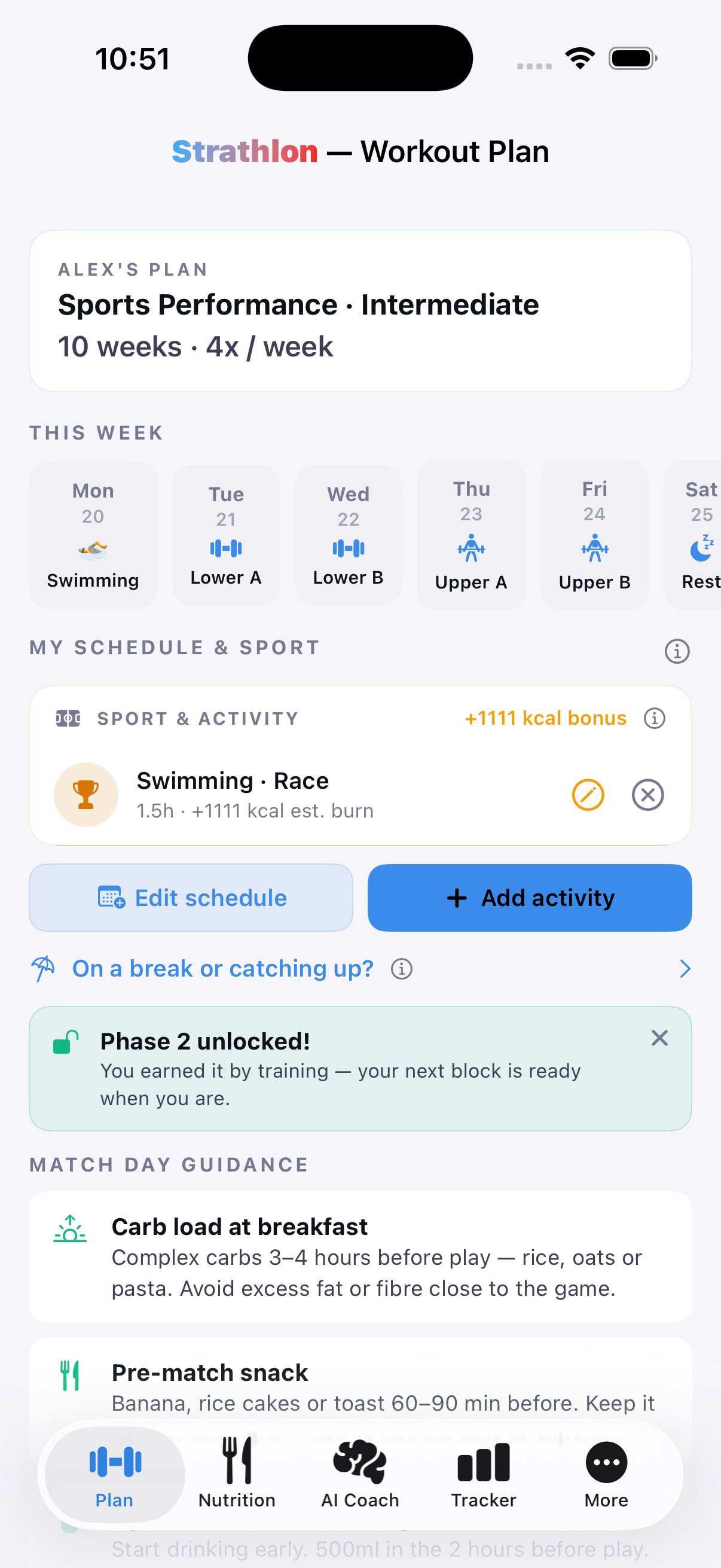
That's the whole philosophy in one view, and it's worth spelling out why both halves matter. The sport-specific work (the accessory block) is what nudges a general plan toward swimming: extra pulling volume for propulsion, dedicated cuff-and-scapular work for the shoulder, and hollow holds and anti-rotation work for a rigid streamline. But that block only works because it sits on a foundation of complementary base strength and conditioning: the squats and hinges that build the leg power behind the start and turn, the pressing that balances all that pulling, and the aerobic and interval swimming below that lets you actually apply the strength across a race. Neither half is sufficient alone: the accessory work without base strength has little to build on, and base strength without swim-specific and in-water work doesn't reach the pool.
Conditioning for swimming
Strength lives alongside the conditioning that trains swimming's energy systems, and most of that conditioning happens in the water, where it's most specific. The mix depends on your event. A sprinter spends more time on short, maximal repeats with long rest to train the anaerobic and phosphocreatine systems and preserve top-end speed; a distance swimmer builds a large aerobic base with longer, controlled sets and threshold work; a 100–200 m swimmer needs both. Interval work (repeated hard efforts with structured recovery) is the backbone of pool conditioning across all of them.
The key to combining strength and conditioning is managing the interference effect: piling heavy, fatiguing lifting on top of high-volume aerobic swimming can blunt the adaptations to both if the timing is careless. In practice that means a few simple rules. Put your highest-quality work first when it matters most: if a fast, powerful swim set is the day's priority, don't precede it with heavy squats that leave your legs flat. Separate the hardest strength and hardest swim sessions where you can, rather than stacking them. And accept that strength and conditioning pull in slightly different directions, so the emphasis should shift with the season rather than trying to maximise everything at once. Done well, they're complementary: strength raises the force you can put into each stroke and wall, and conditioning lets you sustain it.
Staying injury-resilient
Because the shoulder carries almost the entire injury burden, prehab isn't a nice-to-have for swimmers: it's part of the training. The mechanism is a slowly accumulating imbalance: the stroke heavily trains the internal rotators and adductors of the shoulder and tightens the chest, while the external rotators, posterior cuff and scapular stabilisers (the middle and lower trapezius, serratus anterior) are comparatively under-trained. Add reduced pectoralis-minor length, poor core endurance and thousands of overhead strokes, and you get impingement, scapular dyskinesis and cuff tendinopathy: the cluster labelled "swimmer's shoulder" (Tate et al., 2012).
The good news is that targeted prehab measurably counters that drift. A 12-week randomised controlled trial of a twice-weekly preventive programme (internal and external rotation at 90°, scapular punches, and prone T's and Y's, performed for two sets of ten) found it minimised the progressive shoulder rotational imbalance that develops over a competitive season: the trained groups largely held their rotator-cuff strength balance while the control group lost it, showing multiple significant drops in peak torque (Tavares et al., 2025). The realistic claim here is honest: this kind of work is associated with reduced imbalance and is a sensible, well-evidenced defence rather than a guarantee against injury.
A practical prehab stack, then, looks like: external-rotation and posterior-cuff strengthening (bands or light dumbbells), scapular control work (T's, Y's, rows, serratus punches), posterior-shoulder and chest mobility to offset the tightness the stroke creates, and genuine core endurance: reduced side-bridge endurance is among the risk factors identified for swimmer's shoulder (Tate et al., 2012). Layered on top of all of it is the least glamorous but most important variable: load management. Sudden spikes in swim mileage, or a jump in yardage after time off, are a classic trigger, so the volume itself has to be progressed sensibly.
Programming it around your season
Strength work should breathe with the competitive calendar rather than run flat all year. In the off-season and pre-season build, when swim intensity is lower, there's room for the most strength and power development: commonly two to three focused dryland sessions a week, progressing load and then shifting toward more explosive, velocity-oriented work as competition nears. This is the window to actually get stronger, because you can tolerate the fatigue.
In-season, the goal changes from building to maintaining, and the reassuring finding is how little it takes to hold on to what you built. The research on maintenance is consistent: once strength is developed, it can be maintained on as little as one quality session per week at near-maximal loads for a couple of hard sets, whereas dropping below roughly one session a week tends to let strength (and sprint ability) slip (Cuthbert et al., 2021). Frequency matters less than most people assume when total hard work is accounted for, which is exactly why a trimmed, one-to-two-session week can preserve strength while you pour energy into the pool. So you rarely abandon lifting as racing approaches: you cut the volume, keep the intensity, drop the soreness-inducing work, and let the swim training take priority.
The scheduling craft is fitting all of this around swim practice and fatigue. Keep the heaviest leg work away from your most important speed sessions, put quality before volume, and don't be surprised when a genuine taper before a meet means pulling strength volume right back so you arrive fresh. Strength that leaves you too tired to swim fast has missed its own point.
Where Strathlon fits, and a myth to retire
Common questions
Does dryland strength training actually make you swim faster?
On balance, yes, but how you train matters more than whether you train. Systematic reviews conclude that adding dryland strength work tends to improve swimming performance, and that swim-plus-strength programmes tend to beat swim-only or strength-only ones. The catch is transfer: dryland work that simply builds gym strength does not automatically make you faster, whereas low-volume, high-velocity and power-oriented training that respects swimming's movement patterns shows the clearest carry-over. A recent meta-analysis found resistance training improved front-crawl times mainly by raising stroke rate, with 50 m front crawl roughly 0.6 seconds faster on average. Treat the gym as a way to build force and power you then have to express in the water.
Will lifting weights make me slow, bulky or less flexible?
This is the most persistent myth in the sport, and the evidence runs the other way. Maximal upper- and lower-body strength correlate strongly with sprint swim performance over distances under 100 m (around r = 0.67 to 0.79), and lower-body strength and jump ability explain a large share (roughly 66 to 84%) of the variance in start performance to 5 and 15 m. Meaningful muscle gain is slow and needs a deliberate surplus of food and volume you are unlikely to hit by accident alongside heavy swim training. And strength trained through a full range of motion does not reduce flexibility. The realistic outcome of sensible lifting is a stronger start, a faster turn and more durable shoulders, without the bulky, stiff build people fear.
How do I prevent swimmer's shoulder?
Shoulder pain is the most common complaint in swimmers, and much of the risk traces to imbalance: strong internal rotators and a tight chest, relatively weak external rotators and scapular stabilisers, all loaded across thousands of overhead strokes. The evidence-based answer is targeted prehab plus managing swim volume. A 12-week randomised trial of a twice-weekly rotator-cuff and scapular programme (internal and external rotation at 90 degrees, scapular punches, and prone T's and Y's, two sets of ten) found it minimised the progressive shoulder rotational imbalance that builds over a season, where the untrained control group lost strength balance. Pair that cuff and scapular work with posterior-shoulder and chest mobility, honest core endurance, and not spiking your swim mileage suddenly.
Which dryland exercises matter most for swimmers?
Prioritise horizontal and vertical pulling for propulsion (pull-ups, lat pulldowns, rows), because pulling strength and power are what drive you through the water; a controlled overhead press and rotator-cuff and scapular work for balance and shoulder health; lower-body power for starts and turns (squats and hip hinges plus jumps and plyometrics); and anti-rotation and anti-extension core work to hold a rigid, streamlined line. Maximal strength in the bench press and squat has been reported to explain roughly 45 to 65% of the variance in sprint swim and start performance, and jump measures such as the countermovement and squat jump correlate strongly with start times. There is no single magic lift: the mix of pull, press, leg power and core is the point.
How many strength sessions a week should a swimmer do, and how does it change in-season?
In a building phase, two to three focused dryland sessions a week is a common, workable range, scheduled so heavy legs do not sabotage your hard swim sets. In-season the priority shifts from building to maintaining, and here the research is reassuring: strength can be maintained on as little as one quality session per week at near-maximal loads for a couple of hard sets, whereas dropping below about one session a week tends to let strength and sprint ability slip. So you rarely need to abandon lifting when racing approaches: you trim the volume, keep the intensity, and protect the swim work that comes first.
Takeaways
- Swimming is a pulling-and-power sport. The lats and back drive propulsion, the legs and hips power the start and turn, and the core holds a low-drag line (with no ground to push against, so the gym fills a real gap).
- Prioritise pulling, leg power, and shoulder balance. Pull-ups and rows for propulsion; squats, hinges and jumps for starts and turns; pressing plus cuff/scapular work for balance. Maximal strength and jump ability explain a large slice of start and sprint performance.
- Train for velocity ahead of size. Transfer is best from low-volume, explosive, power-oriented work. Generic bodybuilding-style dryland raises gym strength but carries over less reliably.
- Protect the shoulder deliberately. It carries nearly the whole injury burden. A twice-weekly rotator-cuff and scapular programme is associated with less of the strength imbalance that builds over a season.
- Fit conditioning without interference. Most conditioning is in-water intervals matched to your event. Keep the hardest strength and hardest swim work from colliding, and put quality first.
- Build off-season, maintain in-season. Build with two to three sessions a week. As little as one quality session a week can maintain strength once racing starts: trim volume, keep intensity.
- Manage load. Sudden jumps in swim mileage are a classic injury trigger. Progress volume sensibly and don't push through escalating shoulder pain.
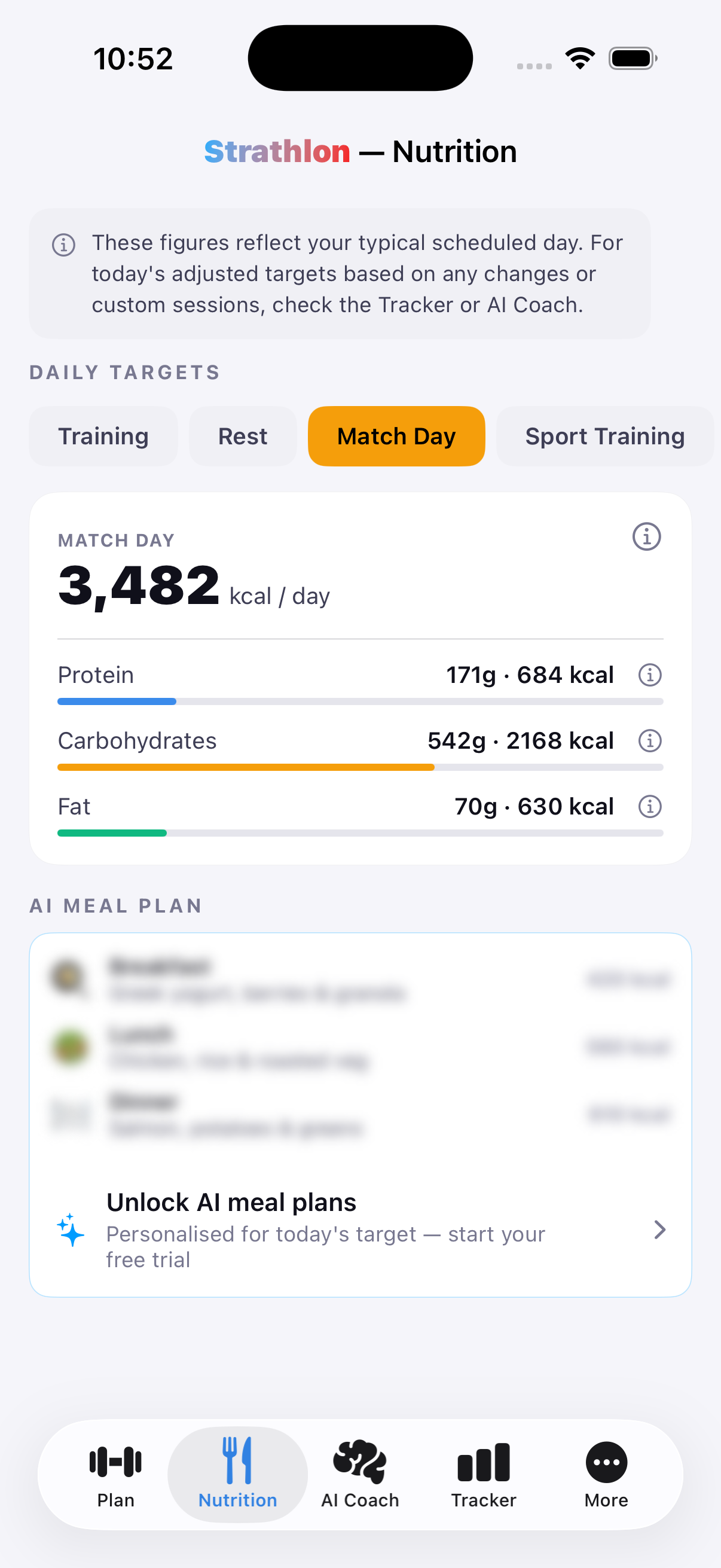
If you remember one thing, make it this: swimming rewards power you can point at the water and shoulders durable enough to keep pointing it there. Build pulling and leg power explosively, guard the cuff and scapula relentlessly, and let the emphasis shift with your season. Strathlon's role is to give you a sport-aware starting point (a plan tuned toward swimming with the right accessory work once Sports Performance is one of your goals, and a chart that shows your key lifts trending up) while a specialist coach and clinician handle the bespoke and the injured.
Pair this with the swimming fuelling guide: the training in this guide only pays off if it's fuelled and recovered.
References
Numbered sources for the specific figures, effect sizes and named studies above. Where a claim reflects agreed guidance rather than a single trial, the citation is to the position stand or consensus statement of the body concerned, with the country or international remit named. Swimming's dry-land question has been tested directly and repeatedly, so the transfer claims below are cited to swimming trials and reviews rather than generalised.
- Fone L, van den Tillaar R. Effect of Different Types of Strength Training on Swimming Performance in Competitive Swimmers: A Systematic Review. Sports Medicine - Open. 2022;8(1):19. Systematic review of the effects of different types of strength training on swimming performance in competitive swimmers: the source for the transfer claim. PubMed 35099631 · PMC8804114 full text
- Crowley E, Harrison AJ, Lyons M. The Impact of Resistance Training on Swimming Performance: A Systematic Review. Sports Medicine. 2017;47(11):2285–2307. Systematic review of the impact of resistance training on swimming performance, the second source for the same. PubMed 28497283
- Muniz-Pardos B, Gomez-Bruton A, Matute-Llorente A, Gonzalez-Aguero A, Gomez-Cabello A, Gonzalo-Skok O, et al. Nonspecific Resistance Training and Swimming Performance: Strength or Power? A Systematic Review. Journal of Strength and Conditioning Research. 2022;36(4):1162–1170. Systematic review asking whether non-specific resistance training improves swimming through strength or power, the basis for the emphasis prescribed. PubMed 32149877
- Wirth K, Keiner M, Fuhrmann S, Nimmerichter A, Haff GG. Strength Training in Swimming. International Journal of Environmental Research and Public Health. 2022;19(9). Review of strength training in swimming, the practical programming source. PubMed 35564764 · PMC9100337 full text
- Hermosilla F, Sanders R, González-Mohíno F, Yustres I, González-Rave JM. Effects of Dry-Land Training Programs on Swimming Turn Performance: A Systematic Review. International Journal of Environmental Research and Public Health. 2021;18(17). Systematic review of dry-land training programmes and swimming turn performance, cited for where the transfer is clearest. PubMed 34501929 · PMC8431432 full text
- McKenzie A, Larequi SA, Hams A, Headrick J, Whiteley R, Duhig S. Shoulder pain and injury risk factors in competitive swimmers: A systematic review. Scandinavian Journal of Medicine & Science in Sports. 2023;33(12):2396–2412. Systematic review of shoulder pain and injury risk factors in competitive swimmers : the source for the shoulder being the sport's defining injury problem. PubMed 37515375
- Tooth C, Gofflot A, Schwartz C, Croisier JL, Beaudart C, Bruyère O, et al. Risk Factors of Overuse Shoulder Injuries in Overhead Athletes: A Systematic Review. Sports Health. 2020;12(5):478–487. Systematic review of risk factors for overuse shoulder injuries in overhead athletes, the mechanism the prehab targets. PubMed 32758080 · PMC7485028 full text
- Boltz AJ, Robison HJ, Morris SN, D'Alonzo BA, Collins CL, Chandran A. Epidemiology of Injuries in National Collegiate Athletic Association Men's Swimming and Diving: 2014-2015 Through 2018-2019. Journal of Athletic Training. 2021;56(7):719–726. Study of injury epidemiology in NCAA men's swimming and diving, the incidence data behind it. PubMed 34280272 · PMC8293881 full text
- Chandran A, Morris SN, D'Alonzo BA, Boltz AJ, Robison HJ, Collins CL. Epidemiology of Injuries in National Collegiate Athletic Association Women's Swimming and Diving: 2014-2015 Through 2018-2019. Journal of Athletic Training. 2021;56(7):711–718. Study of injury epidemiology in NCAA women's swimming and diving, the companion source so the picture is not male-only. PubMed 34280282 · PMC8293891 full text
- Cools AM, Johansson FR, Borms D, Maenhout A. Prevention of shoulder injuries in overhead athletes: a science-based approach. Brazilian Journal of Physical Therapy. 2015;19(5):331–9. Cools and colleagues on preventing shoulder injuries in overhead athletes, the basis for the cuff and scapular programme. PubMed 26537804 · PMC4647145 full text
- Arsoniadis G, Botonis P, Bogdanis GC, Terzis G, Toubekis A. Acute and Long-Term Effects of Concurrent Resistance and Swimming Training on Swimming Performance. Sports. 2022;10(3). Study of the acute and long-term effects of concurrent resistance and swimming training, cited for scheduling gym work around the pool. PubMed 35324638 · PMC8953612 full text
- Suchomel TJ, Nimphius S, Stone MH. The Importance of Muscular Strength in Athletic Performance. Sports Medicine. 2016;46(10):1419–49. Suchomel and colleagues on the importance of muscular strength in athletic performance: the source for greater maximal strength being associated with faster sprinting, jumping and change of direction, and with lower injury risk. PubMed 26838985
- Seitz LB, Reyes A, Tran TT, Saez de Villarreal E, Haff GG. Increases in lower-body strength transfer positively to sprint performance: a systematic review with meta-analysis. Sports Medicine. 2014;44(12):1693–702. Seitz and colleagues' systematic review with meta-analysis showing increases in lower-body strength transfer positively to sprint performance, the evidence behind the 'strength is the base' argument. PubMed 25059334
- Lauersen JB, Andersen TE, Andersen LB. Strength training as superior, dose-dependent and safe prevention of acute and overuse sports injuries: a systematic review, qualitative analysis and meta-analysis. British Journal of Sports Medicine. 2018;52(24):1557–1563. Lauersen and colleagues' meta-analysis finding strength training a superior, dose-dependent and safe prevention of acute and overuse sports injuries: the direct source for treating strength work as prehab. PubMed 30131332
- Lauersen JB, Bertelsen DM, Andersen LB. The effectiveness of exercise interventions to prevent sports injuries: a systematic review and meta-analysis of randomised controlled trials. British Journal of Sports Medicine. 2014;48(11):871–7. Lauersen and colleagues' earlier meta-analysis of exercise interventions to prevent sports injuries, the broader evidence base the prevention advice sits on. PubMed 24100287
- . American College of Sports Medicine position stand. Progression models in resistance training for healthy adults. Medicine and Science in Sports and Exercise. 2009;41(3):687–708. American College of Sports Medicine (ACSM, United States) position stand on progression models in resistance training: the source for the heavy-load and explosive-load percentage ranges quoted. PubMed 19204579
- Cuthbert M, Haff GG, Arent SM, Ripley N, McMahon JJ, Evans M, et al. Effects of Variations in Resistance Training Frequency on Strength Development in Well-Trained Populations and Implications for In-Season Athlete Training: A Systematic Review and Meta-analysis. Sports Medicine. 2021;51(9):1967–1982. Cuthbert and colleagues' systematic review of resistance-training frequency in well-trained populations, the source for the sessions-per-week guidance. PubMed 33886099 · PMC8363540 full text
- Spiering BA, Mujika I, Sharp MA, Foulis SA. Maintaining Physical Performance: The Minimal Dose of Exercise Needed to Preserve Endurance and Strength Over Time. Journal of Strength and Conditioning Research. 2021;35(5):1449–1458. Spiering and colleagues on the minimal dose of exercise needed to preserve endurance and strength: the source for maintaining in-season on as little as one to two sessions a week. PubMed 33629972
- Rønnestad BR, Nymark BS, Raastad T. Effects of in-season strength maintenance training frequency in professional soccer players. Journal of Strength and Conditioning Research. 2011;25(10):2653–60. Ronnestad and colleagues' trial of in-season strength maintenance frequency in professional footballers, the specific in-season maintenance result quoted. PubMed 21873897
- Nuzzo JL, Pinto MD, Kirk BJC, Nosaka K. Resistance Exercise Minimal Dose Strategies for Increasing Muscle Strength in the General Population: an Overview. Sports Medicine. 2024;54(5):1139–1162. Nuzzo and colleagues on minimal-dose resistance exercise strategies for increasing strength, supporting the claim that a small, well-chosen dose does most of the work. PubMed 38509414 · PMC11127831 full text
- Wilson JM, Marin PJ, Rhea MR, Wilson SM, Loenneke JP, Anderson JC. Concurrent training: a meta-analysis examining interference of aerobic and resistance exercises. Journal of Strength and Conditioning Research. 2012;26(8):2293–307. Wilson and colleagues' meta-analysis of concurrent training and the interference effect: the source for separating heavy lifting from hard conditioning. PubMed 22002517
- Schumann M, Feuerbacher JF, Sünkeler M, Freitag N, Rønnestad BR, Doma K, et al. Compatibility of Concurrent Aerobic and Strength Training for Skeletal Muscle Size and Function: An Updated Systematic Review and Meta-Analysis. Sports Medicine. 2022;52(3):601–612. An updated systematic review of the compatibility of concurrent aerobic and strength training, the more recent evidence that interference is smaller than once believed. PubMed 34757594 · PMC8891239 full text
- Ramirez-Campillo R, Sortwell A, Moran J, Afonso J, Clemente FM, Lloyd RS, et al. Plyometric-Jump Training Effects on Physical Fitness and Sport-Specific Performance According to Maturity: A Systematic Review with Meta-analysis. Sports Medicine - Open. 2023;9(1):23. Ramirez-Campillo and colleagues on plyometric-jump training effects on physical fitness and sport-specific performance, the source for the plyometric guidance. PubMed 37036542 · PMC10086091 full text
- Impellizzeri FM, Woodcock S, Coutts AJ, Fanchini M, McCall A, Vigotsky AD. What Role Do Chronic Workloads Play in the Acute to Chronic Workload Ratio? Time to Dismiss ACWR and Its Underlying Theory. Sports Medicine. 2021;51(3):581–592. Impellizzeri and colleagues on the pitfalls of the acute:chronic workload ratio: cited because it is the reason this guide talks about ramping load gradually rather than quoting a workload number. PubMed 33332011
- Baz-Valle E, Balsalobre-Fernández C, Alix-Fages C, Santos-Concejero J. A Systematic Review of The Effects of Different Resistance Training Volumes on Muscle Hypertrophy. Journal of Human Kinetics. 2022;81:199–210. Systematic review of resistance-training volume and hypertrophy, the general dose-response evidence behind the set and session recommendations. PubMed 35291645 · PMC8884877 full text
This is general educational information rather than medical or individual coaching advice. The sports-science figures here are drawn from published research and framed as population-level tendencies and associations: individual response varies widely with stroke, event, age, training history and health, and mechanisms are described as tendencies rather than certainties. Anyone with shoulder or other pain, an injury, or a health condition, or who is pregnant or postpartum, should consult a qualified strength-and-conditioning coach or clinician before starting or changing a training programme. See our Terms for more.
← All guides · Swimming fuelling guide · How muscle actually grows · Recovery & rest · Eating for results · Understanding your stats · Home