
Water polo strength & conditioning
An evidence-based guide to training the water-polo body out of the water. Water polo is a contact throwing sport played from an unstable, treading base, so it asks for overhead throwing power, a relentless eggbeater driven by the hips and legs, a durable shoulder, and the anaerobic engine to repeat sprints and battles for four quarters. This covers the strength that transfers, the conditioning that carries you, the prehab that keeps your shoulder, knee and back in one piece, and how to fit it all around pool time. Practical, honest, and grounded in sports-science research.
Here's the short version of what a water-polo player should train: overhead throwing power built on trunk and pressing strength, eggbeater-driven hip and leg power for elevation, and repeat-sprint conditioning on a solid aerobic base, all sitting on top of a strong, well-balanced, well-managed shoulder. Everything below is the detail behind that sentence: which lifts develop each quality, why they transfer, how to condition without sabotaging your strength, and how to protect the joints water polo punishes most.
On this page
A framing note before the detail. Sports science is well studied, but water polo is a smaller research field than, say, running or soccer, and players differ enormously: position, age, sex, training history and health all shift what's right for a given person. So this is written as can, tends to and is associated with, never as a guarantee, and every specific figure is a population-level finding from published research. None of it is a personal prescription. It's general education rather than medical or individual coaching advice, and it isn't a substitute for a specialist strength-and-conditioning coach.
The demands of water polo
Water polo is unusual because everything happens from an unstable base. There's no floor to push off. The eggbeater kick treads you upright, and every pass, shot, block and wrestle is launched from a platform your own legs are creating in real time. That single fact shapes the whole physical profile of the sport.
Energy systems. A match is a mix of steady swimming and repeated, brutal high-intensity efforts: sprints for the ball, explosive rises to shoot or block, and physical duels. Match-analysis research reports mean in-play heart rates in the region of 155–160 beats per minute (around the anaerobic threshold) with repeated bursts driving blood lactate above 8 mmol/L. In plain terms, water polo is a high-intensity intermittent sport: a broad aerobic base to recover between efforts and keep treading, sitting under a powerful anaerobic capacity for the sprints and scrimmages that decide possessions.
The throw. The shot and the long pass are overhead throws, released from the water at arm-and-ball speeds commonly quoted around 30–50 mph. Like a baseball pitch or a handball throw, that velocity is a kinetic chain: it starts with the legs and hips driving the trunk, the trunk rotating, and the shoulder and arm finishing the whip. It is emphatically not "an arm thing," which is why trunk and hip strength matter as much as the shoulder.
The most punished joints. Three sites take the brunt. The shoulder is first by a distance: the repeated overhead throwing and the upright, abducted swimming posture load the rotator cuff and scapular stabilisers relentlessly. The medial knee takes chronic stress from the eggbeater's repetitive flexion–extension under an abducted, externally rotated hip, which loads the inside of the knee. And the low back absorbs the rotational forces of throwing and passing. Every part of the training plan below is, in one way or another, about building the qualities the sport rewards while armouring those three areas.
Key strength work, and why it matters
Strength training earns its place in water polo for two reasons: it makes you more powerful in the water, and it makes you harder to injure. The general case is well established: a widely cited review by Suchomel and colleagues (2016) concluded that greater muscular strength is associated with better jumping, sprinting and change-of-direction, better transfer to sport-specific skills, and lower injury risk. For water polo, that translates into a handful of movement patterns.
- Trunk rotation and anti-rotation: the shot's real engine. Because the throw is a kinetic chain, the trunk is where a lot of shooting power is transmitted. In a study of elite German water polo players, Zinner and colleagues (2015) found throwing velocity correlated with trunk/abdominal strength (about r = 0.67) as strongly as with anything else measured. Rotational medicine-ball throws, cable/band chops and lifts, and heavy anti-rotation work (Pallof presses, loaded carries) build a trunk that can both create rotation and resist unwanted twist.
- Horizontal and overhead pressing: for the throw and the fend. In the same study, throwing velocity correlated with dry-land pressing (pectoralis) strength up to r = 0.70. Bench and dumbbell pressing, plus overhead pressing done with good shoulder mechanics, build the pushing strength behind the shot and the constant shoving of a physical game. A meta-analysis of overhead-throwing athletes by Martínez-García and colleagues (2021) (16 studies, 424 athletes) found strength training produced a large improvement in throwing velocity (effect size ≈ 1.10, 95% CI 0.64–1.57), typically from two to three sessions a week over at least four weeks. Strength genuinely transfers to a faster ball.
- Lower-body strength and power: for the eggbeater and the rise. Squats, hip hinges and other bilateral leg strength build the base your legs draw on to rise out of the water to shoot and block. Add explosive intent (jump squats, and plyometric work on land where appropriate) because leg power is what turns strength into a fast in-water rise. Zinner's group also found in-water jump height related to upper-body strength and limb length, underlining that "getting high in the water" is a whole-body quality and the legs are only part of it.
- Hip external rotation and adduction: the eggbeater specifically. The kick is sustained, alternating hip external rotation and adduction, so targeted hip-rotator and adductor strength (plus the controlled mobility to reach those positions) supports the pattern directly and helps protect the medial knee it loads.
- Pulling and rotator-cuff work: to balance all that pressing. Rowing and pulling volume, and dedicated external-rotation and scapular work, keep the shoulder balanced under the heavy throwing and pressing load. This is where strength and prehab overlap (see below).
- References
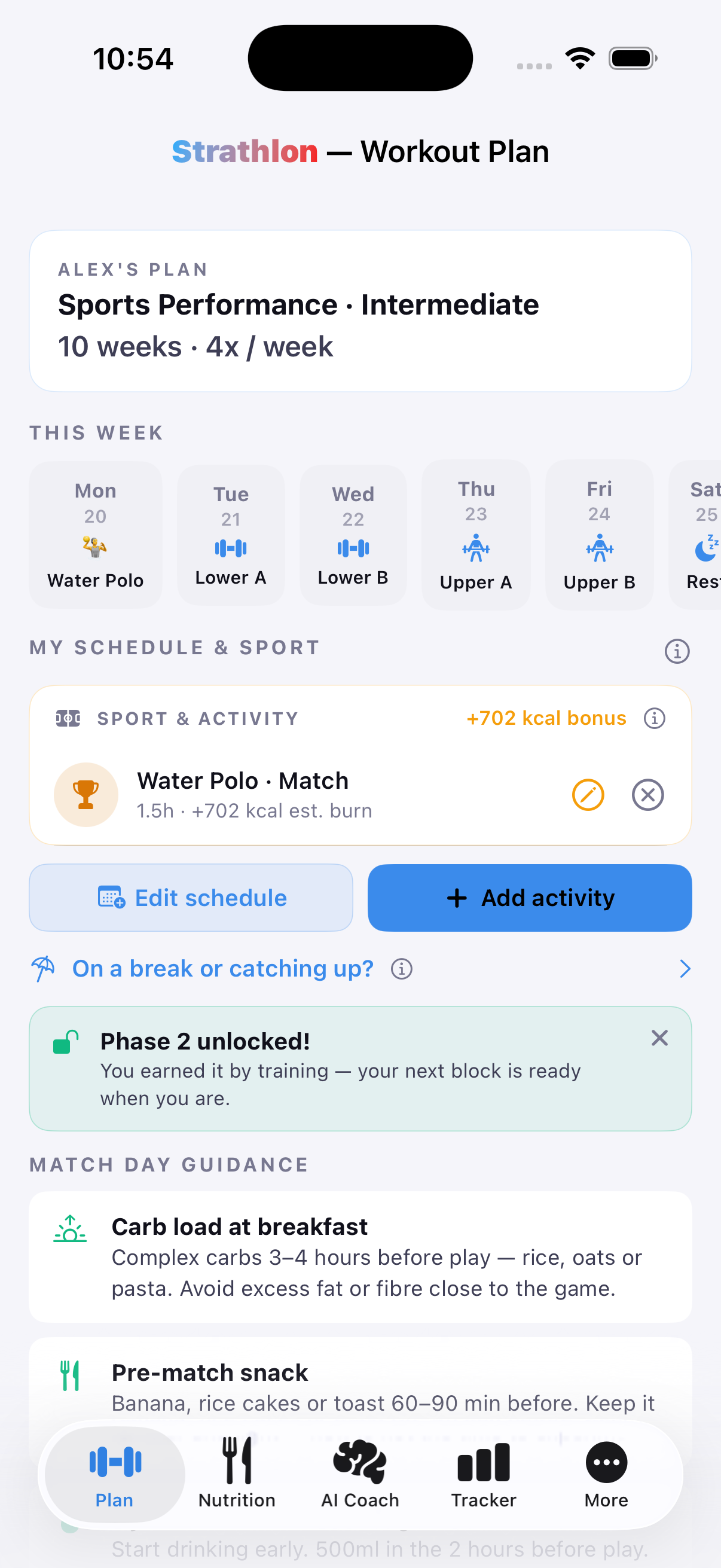
The two halves of that screen matter equally. The base lifts (a squat or hinge, a press, a row) build the general strength that Suchomel's review shows underpins jumping, sprinting and injury resistance. Without them the sport-specific work has no foundation to stand on. The accessory block (the anti-rotation core, the extra pulling, the external-rotation and scapular work) is what biases that general strength toward water polo: the shot and the shoulder. Neither half is optional. A plan that's all sport-specific drills with no base strength tends to plateau. A plan that's all barbell with no rotational or cuff work leaves throwing power and shoulder health on the table.
Conditioning for water polo
Because water polo is high-intensity and intermittent, its conditioning has to develop two things at once: the anaerobic power for repeated sprints, rises and duels, and the aerobic base that lets you recover between them and keep treading water for a whole match. Most of this is trained in the pool, and rightly so: the eggbeater, sprint swimming and small-sided games are the most specific conditioning there is.
The two useful buckets are:
- Repeat-sprint and interval work: short, hard swims and game-like bouts with incomplete recovery, which train the ability to produce a high effort, recover partially, and produce it again. This is the quality that separates players in the fourth quarter.
- Aerobic base work: steadier continuous or long-interval swimming that raises the engine underneath the sprints. A bigger aerobic base means faster recovery between high-intensity efforts, which is exactly what an intermittent sport needs.
Fitting strength and conditioning together. There is a real, well-documented phenomenon called the interference effect: piling heavy endurance work and heavy strength work on top of each other, especially in the same session, can blunt strength and power gains compared with training strength alone. You don't need to fear it, but you should manage it. In practice that means putting your most important quality first when you're fresh (do power/strength before a hard conditioning swim rather than after), separating hard lifting and hard conditioning by several hours or onto different days where you can, and not trying to max out every quality in the same week. For a field sport the season already provides most of the conditioning through practice and matches: the gym's job is then to protect strength and power. It isn't there to add yet more fatigue.
Staying injury-resilient
Water polo's injury profile is dominated by three regions, and the prehab for each is different.
The shoulder: the sport's signature injury. A systematic review by Miller and colleagues (2018) reported shoulder-injury rates of roughly 24 to 51 percent, and found shoulder injuries were more likely than any other to become chronic. In NCAA injury surveillance, Schroeder and colleagues (2022) found the shoulder was the single most commonly injured region (about 21% of injuries). The proposed risk factors are informative: high and spiking shooting volume, lost internal-rotation range, scapular dyskinesis and rotator-cuff strength imbalance. That points to clear, if imperfect, prehab: build and balance the rotator cuff and scapular stabilisers (external-rotation work, scapular control, plenty of pulling to offset all the pressing and throwing), and, just as importantly, manage throwing load so shooting volume doesn't spike. Be honest about the evidence, though: unlike some injuries, shoulder-prevention programmes in overhead sport have a thinner, more mixed research base, so treat cuff and scapular work as sensible risk-reduction. It isn't a guarantee, so get persistent shoulder pain assessed early.
The medial knee: chronic eggbeater overuse. The most common site of knee pain in water polo is the inside (medial) knee, from the eggbeater's repeated flexion–extension under an abducted, externally rotated hip. The protective work is hip and adductor strength and controlled hip mobility, so the knee isn't left to absorb what the hip should be controlling, plus (as always with overuse) sensible management of kicking volume rather than pushing through building pain.
The low back: rotational load. The trunk absorbs the rotational forces of throwing. A strong, well-conditioned core that can both produce and resist rotation (the anti-rotation and rotational work from the strength section) is the front line here, alongside general trunk strength and avoiding sudden jumps in throwing volume.
One honest cross-sport lesson worth borrowing: the single best-evidenced example that targeted strength work reduces injury comes from the hamstring. A meta-analysis of over 8,000 athletes by van Dyk and colleagues (2019) found that including the Nordic hamstring exercise in a prevention programme was associated with roughly a halving (around 51% reduction) of hamstring injuries, although later methodological reappraisals urge some caution about the exact magnitude. Hamstring strains aren't a major water-polo problem (there's little land sprinting), so this isn't a headline exercise for you. The transferable point is the principle: specific, progressive strengthening of the tissues a sport loads most tends to make them more resilient. For water polo, that means the shoulder, hip and trunk.
Programming it around your season
The biggest programming mistake water-polo players make is treating the gym the same way all year. It should change with the calendar.
Off-season / pre-season: build. This is when you develop strength and power with the most room: heavier lifting, more sets, real progression on the base lifts, and the throwing-power and leg-power work that raises your ceiling. Following the overhead-throwing research, a two-to-three-sessions-a-week strength block sustained over at least a month is a reasonable structure for building throwing velocity and general strength before the season starts.
In-season: maintain. Once matches and heavy pool practice arrive, the gym's job flips from building to protecting what you built, on much less time. The reassuring news is that maintenance is cheap. In professional footballers, Rønnestad and colleagues (2011) found that a single weekly strength session maintained the strength, sprint and jump gains from pre-season across the first twelve in-season weeks, while dropping to one session every second week let strength and sprint speed slide. A broader minimal-dose review by Spiering and colleagues (2021) reached the same conclusion: strength can be preserved on as little as one session a week and one set per exercise, provided the load stays heavy. The practical rule for in-season water polo is therefore one to two short, heavy, low-volume sessions a week: keep the intensity up, cut the volume right down, and fit them where they least interfere with key pool sessions and matches.
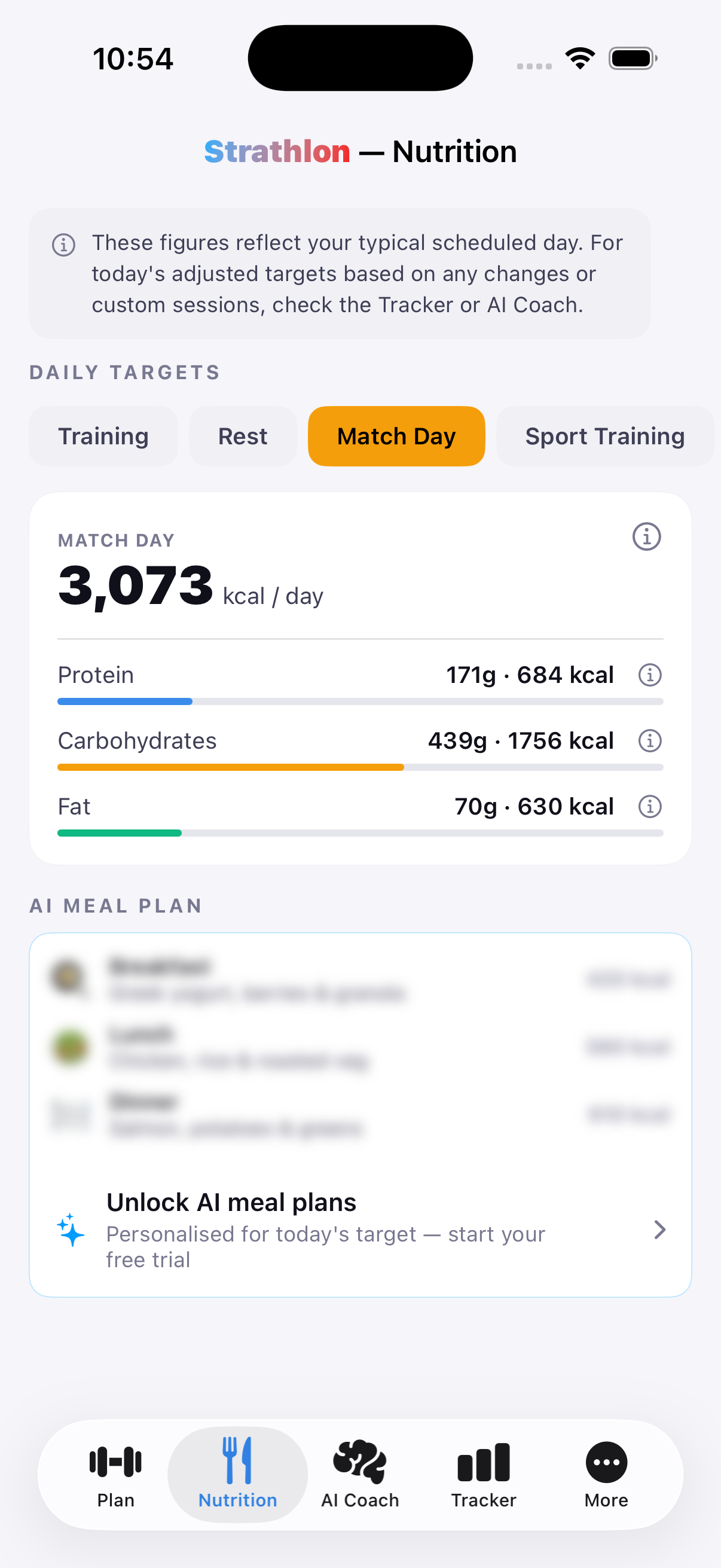
Fitting it around fatigue. Sport practice comes first: the gym exists to serve your water polo. Put strength and power work when you're relatively fresh, keep the hardest lifting away from the day before a match, and be willing to trim a session when pool fatigue is high. If you log your work, the strength trend tells you whether you're genuinely maintaining or quietly detraining, so you can adjust before it costs you.
Common questions
What strength training helps my water polo shot the most?
The shot is a whole-body throw, so the strength that transfers comes from trunk rotation and pressing power feeding a fast, well-controlled arm rather than the arm working alone. In elite German water polo players, throwing velocity was correlated with dry-land pressing strength (pectoralis, up to r = 0.70) and trunk/abdominal strength (about r = 0.67), which is why rotational core work, medicine-ball throws and horizontal pressing sit at the heart of a shooting-power block. More broadly, a meta-analysis of overhead-throwing athletes found strength training produced a large improvement in throwing velocity (effect size around 1.10), typically from two to three sessions a week over at least four weeks. But strength only helps if it feeds sound technique: build the engine in the gym, then convert it in the pool.
How do I protect my shoulder from water polo injuries?
The shoulder is the signature water-polo injury: a systematic review reported shoulder-injury rates of roughly 24 to 51 percent, and shoulder problems were more likely than others to become chronic. The best-supported levers are managing throwing volume (spikes in shooting load are a risk factor), keeping the rotator cuff and scapular stabilisers strong and balanced, and screening for scapular dyskinesis and lost internal-rotation range. Practically that means regular external-rotation and scapular work, and treating a sudden jump in shooting or a nagging ache as a signal to back off instead of pushing through. Prehab reduces risk. It does not guarantee a healthy shoulder, so see a physiotherapist for pain that persists.
Will lifting weights make me slower or too bulky for the water?
It is very unlikely to. Across the wider evidence, greater muscular strength is associated with better jumping, sprinting and change-of-direction. Stronger athletes tend to move faster rather than slower. Building substantial muscle is also slow and deliberate. You will not accidentally get bulky from a couple of strength sessions a week. The realistic outcome of sensible strength work is a higher, more explosive eggbeater, a harder shot and a more injury-resistant shoulder. If you carry a lot of extra mass it can cost buoyancy and swim economy, but that is a nutrition and training-emphasis question. It isn't a reason to avoid getting strong.
How many gym sessions a week do I need during the season?
Fewer than most people fear. Reviews of in-season training show that roughly one to two quality strength sessions a week can maintain the strength, sprint and jump gains built earlier. One study in professional footballers kept those qualities across twelve in-season weeks on a single weekly session, and a minimal-dose review found strength can be preserved on as little as one session a week and one set per exercise, provided the load stays heavy. Two sessions give more headroom. What matters most is keeping intensity up even as volume drops. Dropping to a session every other week is where strength and speed start to slide.
What builds a stronger eggbeater kick?
The eggbeater is powered by the hips (sustained, alternating hip external rotation and adduction) so the gym work that supports it targets the hips and legs: squats and other bilateral leg strength for a base, hip external-rotation and adductor strength for the specific pattern, and controlled mobility so the hips can reach the positions the kick needs. Leg strength feeds the in-water vertical rise you use to shoot and block, and stronger legs also help protect the medial knee, which is the most common site of overuse knee pain in water polo. The kick itself still has to be trained in the water. The gym raises the ceiling the pool then develops.
Takeaways
- Water polo is a throwing sport from an unstable base. It rewards overhead power, eggbeater-driven hip and leg strength, and repeat-sprint conditioning on an aerobic base, over a durable shoulder.
- Train the shot as a chain. Trunk rotation and pressing strength drive throwing velocity (Zinner 2015: pectoralis up to r = 0.70, trunk ≈ r = 0.67). Strength training reliably raises throwing speed (Martínez-García 2021, effect size ≈ 1.10).
- Build the base and the sport-specific work. Squat, press, row and hinge for the foundation; rotational, medicine-ball, hip and rotator-cuff work to bias it toward water polo. Neither half alone is enough.
- Condition in the pool, and mind the interference effect. Repeat-sprint and aerobic base work belong in the water. Put strength and power first when fresh, and separate hard lifting from hard conditioning.
- Protect the three punished joints. Cuff and scapular balance plus throwing-load management for the shoulder, hip and adductor strength for the medial knee, and a rotation-strong core for the low back.
- Maintenance is cheap in-season. One to two short, heavy, low-volume sessions a week can preserve strength and power (Rønnestad 2011, Spiering 2021). Keep the load high and cut the volume.
- Getting strong doesn't make you slow or bulky. Greater strength is associated with better jumping, sprinting and change-of-direction (Suchomel 2016), and muscle is built slowly and deliberately.
If you remember one thing, make it this: the gym isn't a separate hobby from your water polo. It's the engine room for your shot, your rise and your shoulder's durability. Build strength and throwing power in the off-season, hold it with a couple of brief heavy sessions in-season, condition mostly in the pool, and protect the shoulder, knee and back that the sport works hardest. Strathlon's role is to tune a plan toward those priorities (with Sports Performance as one of your goals) and let you watch the strength trend, so getting stronger for water polo is one less thing to guess at.
Pair this with the water polo fuelling guide: the nutrition side of training and competing across four quarters.
References
Numbered sources for the specific figures, effect sizes and named studies above. Where a claim reflects agreed guidance rather than a single trial, the citation is to the position stand or consensus statement of the body concerned, with the country or international remit named. Water polo's shoulder-injury literature is specific and strong, and the demand and injury figures below are cited to it.
- Botonis PG, Toubekis AG, Platanou TI. Physiological and Tactical On-court Demands of Water Polo. Journal of Strength and Conditioning Research. 2019;33(11):3188–3199. Review of the physiological and tactical on-court demands of water polo: the source for the intermittent swim, wrestle and throw profile described. PubMed 29912072
- Chirico E, Tessitore A, Demarie S. Physiological swimming test for water polo players in the last twenty years: a systematic review. The Journal of Sports Medicine and Physical Fitness. 2022;62(7):921–930. Systematic review of physiological swimming tests for water polo players over twenty years, the basis for the conditioning prescription. PubMed 34275260
- Platanou T. Physiological demands of water polo goalkeeping. Journal of Science and Medicine in Sport. 2009;12(1):244–50. Study of the physiological demands of water polo goalkeeping, cited because the position's demands differ from the field players'. PubMed 18077216
- Miller AH, Evans K, Adams R, Waddington G, Witchalls J. Shoulder injury in water polo: A systematic review of incidence and intrinsic risk factors. Journal of Science and Medicine in Sport. 2018;21(4):368–377. Systematic review of shoulder injury in water polo covering incidence and intrinsic risk factors: the source for the shoulder being the sport's defining injury problem. PubMed 28919494
- Hams A, Evans K, Adams R, Waddington G, Witchalls J. Epidemiology of shoulder injury in sub-elite level water polo players. Physical Therapy in Sport : Official Journal of the Association of Chartered Physiotherapists in Sports Medicine. 2019;35:127–132. Study of shoulder injury epidemiology in sub-elite water polo players, the second source for the same. PubMed 30551122
- Minelli M, Longo UG, Ranieri R, Pascucci F, Giunti F, Conti M, et al. The Epidemiology of Shoulder Injuries in Water Polo Players: A Monocentric Descriptive Study on Clinical and Radiological Presentation. Journal of Clinical Medicine. 2024;13(7). Descriptive study of shoulder injury epidemiology in water polo with clinical and radiological findings, the clinical end of that picture. PubMed 38610716 · PMC11012509 full text
- Cools AM, Johansson FR, Borms D, Maenhout A. Prevention of shoulder injuries in overhead athletes: a science-based approach. Brazilian Journal of Physical Therapy. 2015;19(5):331–9. Cools and colleagues on preventing shoulder injuries in overhead athletes: the basis for the cuff and scapular programme prescribed. PubMed 26537804 · PMC4647145 full text
- Tooth C, Gofflot A, Schwartz C, Croisier JL, Beaudart C, Bruyère O, et al. Risk Factors of Overuse Shoulder Injuries in Overhead Athletes: A Systematic Review. Sports Health. 2020;12(5):478–487. Systematic review of risk factors for overuse shoulder injuries in overhead athletes, the mechanism that programme targets. PubMed 32758080 · PMC7485028 full text
- Fone L, van den Tillaar R. Effect of Different Types of Strength Training on Swimming Performance in Competitive Swimmers: A Systematic Review. Sports Medicine - Open. 2022;8(1):19. Systematic review of strength training and swimming performance, the transfer evidence for the dry-land work. PubMed 35099631 · PMC8804114 full text
- Suchomel TJ, Nimphius S, Stone MH. The Importance of Muscular Strength in Athletic Performance. Sports Medicine. 2016;46(10):1419–49. Suchomel and colleagues on the importance of muscular strength in athletic performance: the source for greater maximal strength being associated with faster sprinting, jumping and change of direction, and with lower injury risk. PubMed 26838985
- Seitz LB, Reyes A, Tran TT, Saez de Villarreal E, Haff GG. Increases in lower-body strength transfer positively to sprint performance: a systematic review with meta-analysis. Sports Medicine. 2014;44(12):1693–702. Seitz and colleagues' systematic review with meta-analysis showing increases in lower-body strength transfer positively to sprint performance, the evidence behind the 'strength is the base' argument. PubMed 25059334
- Lauersen JB, Andersen TE, Andersen LB. Strength training as superior, dose-dependent and safe prevention of acute and overuse sports injuries: a systematic review, qualitative analysis and meta-analysis. British Journal of Sports Medicine. 2018;52(24):1557–1563. Lauersen and colleagues' meta-analysis finding strength training a superior, dose-dependent and safe prevention of acute and overuse sports injuries: the direct source for treating strength work as prehab. PubMed 30131332
- Lauersen JB, Bertelsen DM, Andersen LB. The effectiveness of exercise interventions to prevent sports injuries: a systematic review and meta-analysis of randomised controlled trials. British Journal of Sports Medicine. 2014;48(11):871–7. Lauersen and colleagues' earlier meta-analysis of exercise interventions to prevent sports injuries, the broader evidence base the prevention advice sits on. PubMed 24100287
- . American College of Sports Medicine position stand. Progression models in resistance training for healthy adults. Medicine and Science in Sports and Exercise. 2009;41(3):687–708. American College of Sports Medicine (ACSM, United States) position stand on progression models in resistance training: the source for the heavy-load and explosive-load percentage ranges quoted. PubMed 19204579
- Cuthbert M, Haff GG, Arent SM, Ripley N, McMahon JJ, Evans M, et al. Effects of Variations in Resistance Training Frequency on Strength Development in Well-Trained Populations and Implications for In-Season Athlete Training: A Systematic Review and Meta-analysis. Sports Medicine. 2021;51(9):1967–1982. Cuthbert and colleagues' systematic review of resistance-training frequency in well-trained populations, the source for the sessions-per-week guidance. PubMed 33886099 · PMC8363540 full text
- Spiering BA, Mujika I, Sharp MA, Foulis SA. Maintaining Physical Performance: The Minimal Dose of Exercise Needed to Preserve Endurance and Strength Over Time. Journal of Strength and Conditioning Research. 2021;35(5):1449–1458. Spiering and colleagues on the minimal dose of exercise needed to preserve endurance and strength: the source for maintaining in-season on as little as one to two sessions a week. PubMed 33629972
- Rønnestad BR, Nymark BS, Raastad T. Effects of in-season strength maintenance training frequency in professional soccer players. Journal of Strength and Conditioning Research. 2011;25(10):2653–60. Ronnestad and colleagues' trial of in-season strength maintenance frequency in professional footballers, the specific in-season maintenance result quoted. PubMed 21873897
- Nuzzo JL, Pinto MD, Kirk BJC, Nosaka K. Resistance Exercise Minimal Dose Strategies for Increasing Muscle Strength in the General Population: an Overview. Sports Medicine. 2024;54(5):1139–1162. Nuzzo and colleagues on minimal-dose resistance exercise strategies for increasing strength, supporting the claim that a small, well-chosen dose does most of the work. PubMed 38509414 · PMC11127831 full text
- Wilson JM, Marin PJ, Rhea MR, Wilson SM, Loenneke JP, Anderson JC. Concurrent training: a meta-analysis examining interference of aerobic and resistance exercises. Journal of Strength and Conditioning Research. 2012;26(8):2293–307. Wilson and colleagues' meta-analysis of concurrent training and the interference effect: the source for separating heavy lifting from hard conditioning. PubMed 22002517
- Schumann M, Feuerbacher JF, Sünkeler M, Freitag N, Rønnestad BR, Doma K, et al. Compatibility of Concurrent Aerobic and Strength Training for Skeletal Muscle Size and Function: An Updated Systematic Review and Meta-Analysis. Sports Medicine. 2022;52(3):601–612. An updated systematic review of the compatibility of concurrent aerobic and strength training, the more recent evidence that interference is smaller than once believed. PubMed 34757594 · PMC8891239 full text
- Ramirez-Campillo R, Sortwell A, Moran J, Afonso J, Clemente FM, Lloyd RS, et al. Plyometric-Jump Training Effects on Physical Fitness and Sport-Specific Performance According to Maturity: A Systematic Review with Meta-analysis. Sports Medicine - Open. 2023;9(1):23. Ramirez-Campillo and colleagues on plyometric-jump training effects on physical fitness and sport-specific performance, the source for the plyometric guidance. PubMed 37036542 · PMC10086091 full text
- Impellizzeri FM, Woodcock S, Coutts AJ, Fanchini M, McCall A, Vigotsky AD. What Role Do Chronic Workloads Play in the Acute to Chronic Workload Ratio? Time to Dismiss ACWR and Its Underlying Theory. Sports Medicine. 2021;51(3):581–592. Impellizzeri and colleagues on the pitfalls of the acute:chronic workload ratio; cited because it is the reason this guide talks about ramping load gradually rather than quoting a workload number. PubMed 33332011
- Baz-Valle E, Balsalobre-Fernández C, Alix-Fages C, Santos-Concejero J. A Systematic Review of The Effects of Different Resistance Training Volumes on Muscle Hypertrophy. Journal of Human Kinetics. 2022;81:199–210. Systematic review of resistance-training volume and hypertrophy, the general dose-response evidence behind the set and session recommendations. PubMed 35291645 · PMC8884877 full text
This is general educational information rather than medical or individual coaching advice. The strength-and-conditioning research here is drawn from published studies and framed as population-level findings and associations: water polo is a smaller research field than many sports, individual needs vary widely, and none of these figures are promises. Anyone with pain, an injury (especially a shoulder, knee or back problem), a health condition, or who is pregnant or postpartum, should consult a qualified strength-and-conditioning coach or a clinician before starting or changing a training programme. See our Terms for more.
← All guides · Water polo fuelling · How muscle actually grows · Recovery & rest · Eating for results · Home