
Fuelling & performance nutrition for badminton
An evidence-based guide to fuelling the badminton player's body. Badminton looks light and quick, but under the hood it's one of the most demanding intermittent sports there is: a long series of short, explosive rallies with only brief recoveries, played in warm, still-air halls, and sometimes stacked several matches deep across a single tournament day. That combination leans hard on carbohydrate and on staying hydrated. This covers daily carbohydrate, the pre-match meal, fuelling across long matches and multi-match days, quick between-game energy, hydration by your own sweat rate, caffeine, recovery and the risk of chronic under-fuelling. Practical, honest, and grounded in established sports-nutrition consensus. Pair this with the badminton strength & conditioning guide: the gym work behind the jumping, lunging power this fuelling is meant to fuel.
Here's the short answer to "how should a badminton player fuel?": build the base with enough daily carbohydrate to match your training, top up with a familiar meal before you play, keep glycogen and fluid topped up across long matches and tournament days (roughly 30–60 g of carbohydrate per hour once you're on court beyond an hour, plus fluid with some sodium in the breaks), and refuel quickly between matches, all while eating enough overall to avoid an energy deficit. Everything below is the detail behind that sentence: the numbers, where they come from, and how to make them work for your body and your schedule.
On this page
- Why badminton is a repeated-sprint, glycogen sport
- Daily carbohydrate: the base
- Before you play: the pre-match meal
- During long matches and tournament days
- Fluid, sweat rate and warm halls
- Between-game and between-match recovery
- Caffeine and the evidence
- Eating enough: under-fuelling and RED-S
- Common questions
- Takeaways
- References
A framing note before the numbers. Sports nutrition is well studied, but people differ enormously: body size, playing level, the pace of a match, the temperature of the hall, gut tolerance, sex and health status all shift what's right on the day. So this is written as can, tends to and around, never as a guarantee, and every specific figure is a population-level guide drawn from published consensus rather than a personal prescription. It's general education rather than medical or dietary advice, and it isn't a personalised plan.
Why badminton is a repeated-sprint, glycogen sport
Watch a badminton point and you see the sport's nutritional signature. Rallies are short and ferociously intense: a review of the sport's match-analysis literature puts the typical rally at about 7 seconds with roughly 15 seconds of rest after it, so the work-to-rest ratio sits near 1:2 and the shuttle is actually in play for only around a third of the match clock, an effective playing time of about 31%.[1] Individual studies report much the same shape: mean rallies of 5.5 seconds against 11.4 seconds of rest in one analysis of elite players.[2] Each rally is a burst of lunges, jumps and direction changes. The recoveries are just long enough to catch a breath before the next one.
That pattern makes badminton a classic high-intensity intermittent sport, and it taxes both energy systems at once. Studies of elite match play report mean heart rates around 169 beats per minute, close to 90% of peak heart rate.[2] The same review of badminton physiology puts the energy supply at roughly 60–70% aerobic and about 30% anaerobic, with the anaerobic share leaning far more on the alactic (phosphagen) system than on lactate production.[1] A more recent laboratory study of elite players measured a different split again (about 57% oxidative, 43% phosphagen and well under 1% anaerobic glycolytic), so treat the exact percentages as a rough map rather than a settled number.[3] Both of the main systems draw heavily on the same fuel: muscle glycogen, the carbohydrate stored inside the muscle, topped up by glucose in the blood. Fat stores are almost limitless even in a lean player, but carbohydrate yields more energy per unit of oxygen delivered to the muscle, which is why it is the substrate that matters most at the intensities badminton is played at.[4]
The catch is that glycogen stores are small, and repeated sprinting drains them. Research on football (the best-studied stop-start sport, and the only one with fibre-level data) shows that after 90 minutes of intermittent high-intensity play, two-thirds to three-quarters of individual muscle fibres can be left low on glycogen.[5] As the tank empties, the explosive efforts get slower and the footwork gets sloppy. A long three-game match, and especially a day of several matches back to back, is exactly the scenario where running low on carbohydrate quietly costs you speed, sharpness and the ability to chase one more shuttle. The whole fuelling strategy below exists to do two things: start with the tank full, and top it up before it empties.
Daily carbohydrate: the base
Match-day fuelling only works if you arrive with the tank reasonably full, and that comes from your everyday carbohydrate intake, matched to your training. The joint position on nutrition and athletic performance from the Academy of Nutrition and Dietetics (United States), Dietitians of Canada (Canada) and the American College of Sports Medicine (ACSM, United States) sets daily carbohydrate targets scaled to training load: around 5–7 g of carbohydrate per kilogram of body weight per day for a moderate program (roughly an hour a day), about 6–10 g/kg/day for the higher volumes of a serious player training or playing one to three hours a day, and 8–12 g/kg/day only at the extreme end: more than four to five hours a day of moderate-to-high-intensity exercise.[4]
The practical point is that these dials should move with your week. A hard session or a match day warrants more carbohydrate than an easy or rest day. Chronically eating at the low end while training hard is one of the most common ways players end up flat, slow to recover and unable to sustain their level deep into matches: the base is simply too empty for the quality fuelling on top to matter. Tournament blocks deserve special attention: several competitive days in a row can drain glycogen faster than a low-carb diet can refill it.
Before you play: the pre-match meal
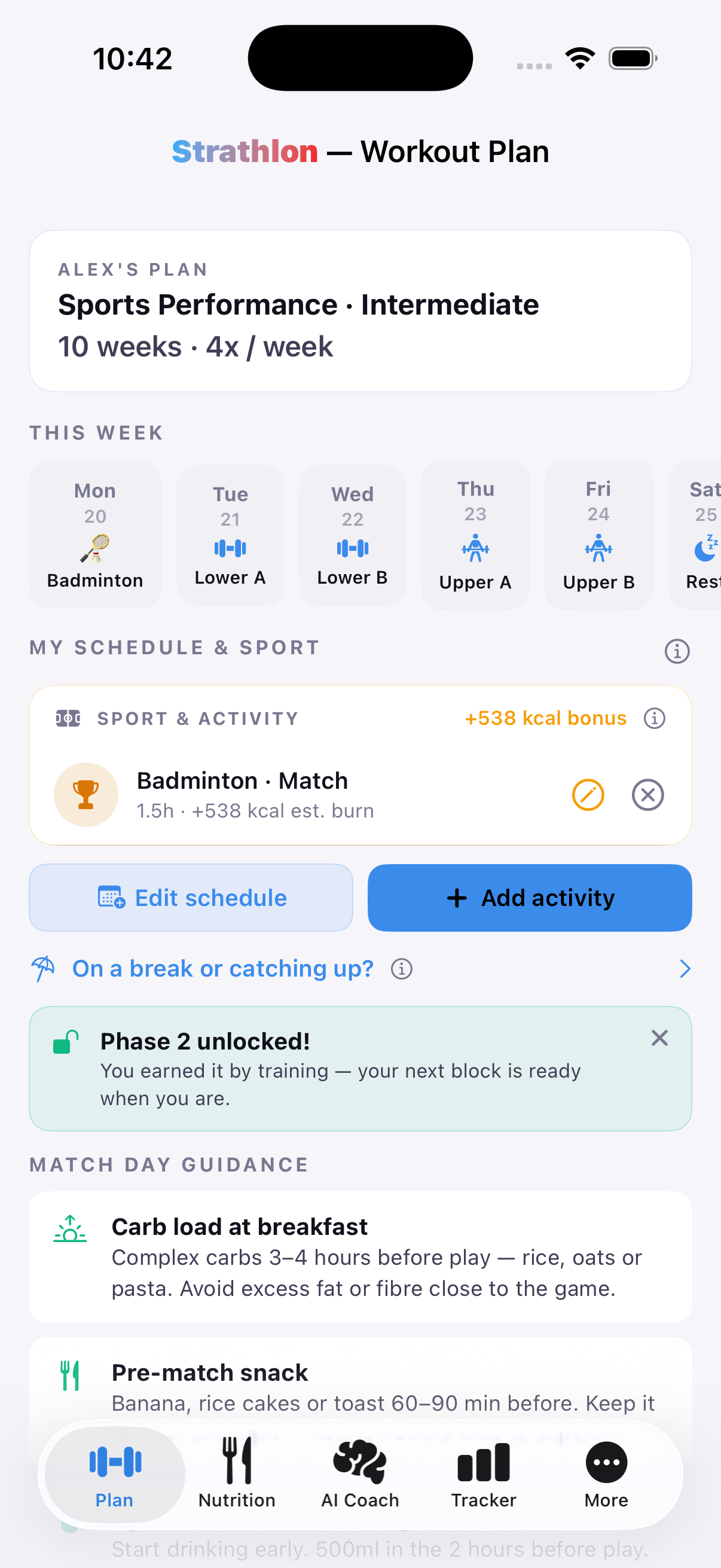
For an easy hit or a short session you often need nothing special. Before long matches, hard training or a tournament, a carbohydrate-focused top-up helps make sure liver and muscle glycogen are high at the start. The joint position stand describes a pre-event meal or snack of roughly 1–4 g of carbohydrate per kilogram of body weight, eaten one to four hours before exercise lasting more than an hour: the larger amounts earlier, when you have time to digest, and the smaller amounts closer to the first serve. It also advises avoiding choices high in fat, protein or fibre close to play, to reduce the risk of gut trouble during the event.[4]
Tolerance matters as much as the gram target. Favour familiar, lower-fibre and lower-fat carbohydrate you've rehearsed (porridge, toast, a banana, a bagel, rice, pasta) because fibre and fat slow digestion and can sit heavily when you're lunging and jumping. On a tournament day, when your first match time can slip by hours, plan for the wait: a bigger meal early, then smaller familiar carbohydrate top-ups as the call time approaches, so you're neither empty nor over-full when you walk on court. The golden rule is to try nothing new on competition day.
During long matches and tournament days
This is where badminton fuelling earns its keep. A single game or a short match is usually covered by the glycogen you started with, so fluid is the main job. But once you're on court for longer than roughly an hour (a drawn-out three-game battle, or several matches stacked across a tournament day), taking in carbohydrate during play helps maintain blood glucose, spares your limited glycogen and keeps the explosive efforts sharp. The joint position stand sets a rate of around 30–60 g of carbohydrate per hour for endurance and "stop and start" sports lasting one to two and a half hours.[4] The mechanism has been measured directly: in a controlled trial of 90 minutes of intermittent high-intensity running, trained games players who drank a carbohydrate-electrolyte solution used about 22% less muscle glycogen than on a placebo, though it was a small study of six players.[6]
| Situation | Carbohydrate | How to take it | Why |
|---|---|---|---|
| Single match under ~1 hour | Little or none | Fluid is the priority | Stored glycogen covers it. No carbohydrate needed under ~45 minutes.[4] |
| Short, very hard match | Small amounts | Sips of sports drink. A carb mouth rinse can help | For 45–75 minute efforts, small amounts including a mouth rinse.[4] |
| Long match (>~1 hour) | ~30–60 g/h | Drink, banana, gel or chews in the breaks | Supplies muscle fuel and maintains blood glucose.[4] |
| Tournament day (several matches) | ~30–60 g/h on court, plus refuel between | Feed in-match, then a proper refuel between matches | Jump height falls measurably across successive tournament matches.[7] |
Badminton's own rhythm gives you natural feeding windows. Under the laws set by the Badminton World Federation (BWF, international), there is a 60-second interval when the leading score reaches 11 points and a 2-minute break between games, and players are free to drink in both.[8] Use them to sip a sports drink or take a little easily digested carbohydrate: a few mouthfuls of banana, a gel, a couple of chews or some dried fruit. You won't hit 60 g an hour in one gulp. The point is a steady trickle across the match rather than a single large dose that sloshes. For sustained high-intensity efforts of roughly 45 to 75 minutes, where there is little metabolic need for carbohydrate, the position stand notes that even small amounts (including a carbohydrate mouth rinse, swilling a carbohydrate drink and spitting it out) can enhance performance by stimulating the brain and central nervous system.[4] That's a useful trick when your stomach won't take more fluid but the match is on the line.
Fluid, sweat rate and warm halls
Badminton has a hydration quirk built into the sport. Because the shuttlecock is so light that a draught will push it off line, airflow across the court has to be restricted: UK sports-hall design standards cap air movement at around 0.1 metres per second, and ventilation studies treat anything much above that as unfit for play.[9][10] That restriction has a thermoregulatory cost: with little air movement, metabolic heat cannot be dissipated to the environment as readily, and badminton has been reported to account for the highest number of exertional heat-related illnesses among Japanese high-school indoor-sport athletes.[10] So even though the movement looks contained, the heat load on the player can be real.
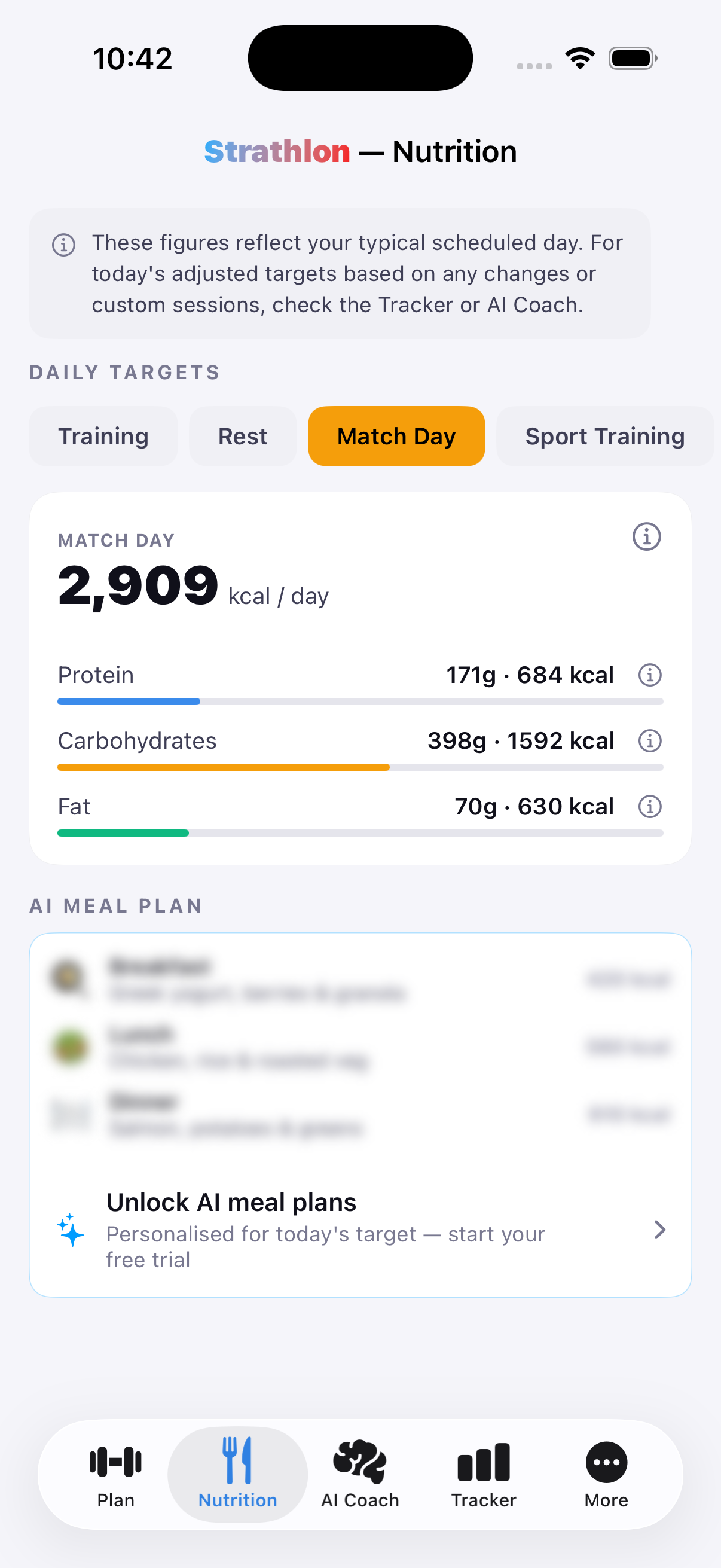
Measured sweat rates in competitive badminton reflect that: a study of elite players in match play recorded about 1.1 litres per hour in the men and 1.0 litres per hour in the women.[8] Encouragingly, the same research found that players who used the breaks to drink kept dehydration low: two-thirds finished between 0 and 1% of body mass down, and only one player in the study crossed the 2% line at which performance tends to suffer.[8] A later study of two successive matches found much the same: fluid taken on court offset sweat losses and kept dehydration under 1% of body mass, although core temperature still reached a mild 38.6–38.7°C.[11] That 2% figure is the target the joint position stand sets out: drink enough during exercise to keep the total fluid deficit under about 2% of body weight, rather than following a rigid schedule.[4]
There's no universal ml-per-hour number, because sweat rates vary between people and with the conditions: the position stand puts the range across sports at 0.3–2.4 litres per hour.[4] The most reliable way to find your number is to weigh yourself before and after a representative match or session: each kilogram lost is roughly a litre of fluid, and full rehydration afterwards takes more than that: around 1.25–1.5 litres for every kilogram lost.[4] Sodium is advised during exercise when sweat sodium losses are large (high sweat rates above about 1.2 l/h, "salty sweat", or sessions past two hours), and dietary sodium afterwards helps you retain the fluid you drink. Players who sweat heavily and salty may also be at greater risk of cramping.[4] Conveniently, the same sports drinks that carry carbohydrate usually carry sodium too, so fuelling and hydrating overlap.
Between-game and between-match recovery
Recovery in badminton happens on two timescales, and the trick is to match your fuelling to whichever one you're in.
- Within a match (seconds to a couple of minutes). The interval at 11 points and the change between games exist for quick energy and fluid, too short for a full meal. Sip a carbohydrate-electrolyte drink, take a bite of banana or a chew, and keep it light and familiar so it settles before you're back on court.
- Between matches on a tournament day (a fast turnaround of an hour or two). This is where speed matters. When another hard match is coming soon, the joint position stand describes taking in carbohydrate at around 1.0–1.2 g per kilogram of body weight per hour, starting early in recovery and continuing for four to six hours, to optimise the rate at which muscle glycogen is rebuilt. Early intake of 0.25–0.3 g/kg of high-quality protein supplies amino acids for repair, and the same document notes that 0.8 g/kg of carbohydrate plus 0.4 g/kg of protein restored glycogen and performance about as well as 1.2 g/kg of carbohydrate alone.[4] Keep drinking and replacing sodium too, so you start the next match topped up rather than already down a litre.
Over the whole day, players training and competing hard are generally advised to eat around 1.2–2.0 g of protein per kilogram of body weight (more than a sedentary person), spread across meals rather than piled into one.[4] There is a real cumulative cost to a tournament day worth respecting: in a study of elite players at a competition, jump height fell from about 37.5 cm after the second-round match to 34.8 cm after the quarter-final.[7] When the next match is a full day or more away, there's no need to rush. Simply hitting your normal daily carbohydrate and protein targets across meals refills stores in good time. The eating-for-results guide covers the broader nutrition picture in depth.
Caffeine and the evidence
Of the supplements studied in racquet sports, caffeine has the most support. A 2020 systematic review of nutritional ergogenic aids across tennis, badminton, squash and padel (21 randomised controlled trials in all), concluded that acute doses of 3–6 mg per kilogram of body weight, taken 30–60 minutes before a match, improve specific skills and accuracy, though they may not improve perceived exertion.[12] In badminton specifically, the review covered three trials, all in male players, testing about 3–4 mg/kg an hour beforehand. These showed improvements in jumps and in the number of shot impacts, alongside fewer errors in anticipation and reaction time and faster sprint times: precisely the qualities a fast net exchange rewards. Very small doses (roughly 1 mg/kg or less), by contrast, raised adrenaline in the urine without improving performance.[12]
A few honest caveats. Caffeine is a stimulant, and people respond very differently: it can disturb sleep, raise heart rate and increase jitters or anxiety, which is unhelpful the night before a tournament or in a tight match. The sensible approach is the same as for any fuelling choice: trial it low, in training, well before it matters, rather than debuting it on competition day, and accept that it isn't right for everyone. It's an optional edge rather than a requirement, and nothing here is a recommendation to use it.
Eating enough: under-fuelling and RED-S
The most serious nutrition mistake in any hard-training sport isn't a bad gel choice. It's chronically eating too little to support the training. High-volume badminton players, especially those juggling daily sessions with tournaments, can slip into low energy availability: not leaving enough energy, after exercise is paid for, to run the body's basic functions.
Sports scientists quantify this as energy availability: the difference between energy eaten and energy spent in exercise, expressed per kilogram of fat-free (lean) mass. In controlled work on regularly menstruating women, luteinising-hormone pulsatility was undisturbed at 30 kcal per kg of lean mass per day but was disrupted below that threshold.[13] A review for World Athletics summarises the position: at least about 45 kcal per kg of fat-free mass per day in women and about 40 kcal/kg FFM/day in men appears to be the threshold for optimal physiological function, with under 30 kcal/kg FFM/day typically classed as clinical low energy availability and 30–45 as subclinical.[14] Sustained low energy availability is the root cause of what the International Olympic Committee (IOC, international) calls Relative Energy Deficiency in Sport, abbreviated REDs since its 2023 consensus statement, and RED-S before that: in the IOC's words, a syndrome of deleterious health and performance outcomes experienced by both female and male athletes exposed to low energy availability.[15] Low energy availability has been linked to reduced testosterone in men, loss of periods in women, impaired bone health and a raised risk of bone stress injury, and to worse recovery, muscle mass, neuromuscular function, injury and illness risk.[14] The warning signs are worth knowing: recurrent stress injuries, frequent illness, stalled or declining performance despite hard training, and (in women) missing periods. None of these are things to push through. The answer is usually to eat more instead of training harder, and to seek help from a sports physician or registered dietitian.
Common questions
How should a badminton player fuel for a match or tournament day?
Treat it as a repeated-sprint sport that runs on carbohydrate. Build the base with enough daily carbohydrate matched to your training: roughly 5–7 g per kilogram of body weight on moderate days, rising toward 6–10 g/kg when you are training or playing one to three hours a day.[4] Top up with a familiar, carbohydrate-focused meal about one to four hours before you play. Once a match or session pushes past about an hour, or across a multi-match tournament day, take in around 30–60 g of carbohydrate per hour and sip fluid with some sodium in the breaks.[4] Then refuel quickly between matches, and eat enough overall so you are not training and competing in an energy deficit.
What should I eat and drink during a long match or a tournament day?
For a single match under about an hour your stored glycogen usually covers it, and fluid is the main priority. Once you are on court for longer than roughly an hour (a long three-game match, or several matches across a tournament day), the joint position stand of the Academy of Nutrition and Dietetics (United States), Dietitians of Canada (Canada) and the American College of Sports Medicine (United States) suggests taking in around 30–60 g of carbohydrate per hour.[4] Use the 60-second interval when the leading score reaches 11 points and the 2-minute break between games to sip a sports drink or eat a little easily digested carbohydrate such as a banana, a gel or a few chews.[8] Between matches, refuel with carbohydrate and some fluid and sodium. Rehearse whatever you plan to use in training first. Tournament day is not the time to try a new gel.
How much should I drink during badminton, and do I need electrolytes?
There is no universal number, because sweat rates vary between people and with the hall. In one study of elite badminton match play, sweat rates were about 1.1 litres per hour in the men and 1.0 litres per hour in the women.[8] Courts are deliberately kept draught-free so the shuttle flies true, and that restricted airflow makes heat harder to shed.[10] The sports-medicine principle is to drink enough to keep the fluid deficit under about 2% of body weight over a long match or day, instead of following a rigid schedule.[4] Weigh yourself before and after play to learn your own rate. Sodium is advised when sweat sodium losses are large (high sweat rates, salty sweat, or sessions past two hours), and it helps you retain the fluid you drink. The same sports drinks usually carry carbohydrate too.[4]
What is the best snack between games or between matches at a tournament?
In the short breaks within a match (the 60-second interval at 11 points and the 2-minute change between games[8]), favour quick, familiar carbohydrate that goes down easily: a few sips of a sports drink, a banana, a gel, a handful of dried fruit or a couple of chews. Between matches on a tournament day, when you may have an hour or more before the next one, add more substantial carbohydrate plus a little protein and keep drinking. If the gap is very short, prioritise fluid and small amounts of easy carbohydrate over anything heavy or high in fat and fibre, which can sit uncomfortably when you go back on court.
Does caffeine help badminton performance?
There is reasonable evidence that it can, though it is a stimulant and individual response varies. A 2020 systematic review of racquet-sport trials concluded that acute doses of caffeine of 3–6 mg per kilogram of body weight taken 30–60 minutes before a match improve specific skills and accuracy, and in badminton specifically (three trials, all in male players), doses of about 3–4 mg/kg were associated with improvements in jumps and shot impacts and fewer errors in anticipation and reaction time.[12] Caffeine affects sleep, heart rate and anxiety in some people, so it is worth trialling low and in training rather than debuting it at a tournament, and it is not right for everyone.
Takeaways
- Badminton is a repeated-sprint, glycogen sport. Rallies of about 7 seconds against 15 seconds of rest, roughly a third of the clock in play, with 60–70% of the energy coming from the aerobic system.[1]
- Build the base daily. Match everyday carbohydrate to training: roughly 5–7 g/kg on moderate days, 6–10 g/kg at one to three hours a day, and 8–12 g/kg only beyond four to five hours a day.[4]
- Top up before you play. A familiar, carb-focused meal of about 1–4 g/kg, one to four hours before, low in fat and fibre. Nothing new on competition day.[4]
- Fuel long matches and tournament days. Around 30–60 g of carbohydrate per hour once you're on court beyond an hour, sipped in the 11-point interval and between games.[4][8]
- Hydrate for warm, still-air halls. Measured sweat losses in elite match play are about 1.0–1.1 litres an hour[8]. Keep the fluid deficit under ~2% of body weight, weigh yourself to learn your rate, and add sodium on long sweaty days.[4]
- Recover on two timescales. Quick energy in the breaks. ~1.0–1.2 g/kg/h of carbohydrate plus ~0.25–0.3 g/kg of protein between matches when the turnaround is fast. Aim ~1.2–2.0 g/kg/day of protein overall.[4]
- Caffeine can help, with caveats. 3–6 mg/kg (3–4 mg/kg in the badminton trials) 30–60 minutes before play improved skills and accuracy in racquet-sport studies. Trial it low, in training, and know it isn't for everyone.[12]
- Eat enough, always. Chronic low energy availability (REDs) harms health and performance in both men and women.[15] When in doubt, eat more.
If you remember one thing, make it this: the players who last deep into a tournament aren't the ones with the fanciest gels. They're the ones who show up with a full tank, top it up sensibly across long matches and busy days, drink for the warmth of the hall, and eat enough overall to keep training. Strathlon's job is to keep that base honest by adjusting your targets around the sessions you actually log, so the everyday fuelling that underpins every match is one less thing to guess at.
References
Sources for the specific figures on this page. Where a number reflects established consensus rather than a single trial, the citation is to the relevant expert body's position stand, with the country or region that body belongs to named: guidance is written by national and regional organisations, and no one country's advice is universal. Where a source is produced or funded by a commercial interest, that is noted too.
- Phomsoupha M, Laffaye G. The science of badminton: game characteristics, anthropometry, physiology, visual fitness and biomechanics. Sports Medicine. 2015;45(4):473–495. https://pubmed.ncbi.nlm.nih.gov/25549780/
- Faude O, Meyer T, Rosenberger F, Fries M, Huber G, Kindermann W. Physiological characteristics of badminton match play. European Journal of Applied Physiology. 2007;100(4):479–485. https://pubmed.ncbi.nlm.nih.gov/17473928/
- Edel A, Vuong J-L, Kaufmann S, Hoos O, Wiewelhove T, Ferrauti A. Metabolic profile in elite badminton match play and training drills. European Journal of Sport Science. 2024;24(11):1639–1652. https://pubmed.ncbi.nlm.nih.gov/39395198/
- Thomas DT, Erdman KA, Burke LM. Position of the Academy of Nutrition and Dietetics, Dietitians of Canada, and the American College of Sports Medicine: nutrition and athletic performance. Journal of the Academy of Nutrition and Dietetics. 2016;116(3):501–528. Joint position stand of the Academy of Nutrition and Dietetics (United States), Dietitians of Canada (Canada) and the American College of Sports Medicine (ACSM, United States). https://pubmed.ncbi.nlm.nih.gov/26920240/
- Mohr M, Vigh-Larsen JF, Krustrup P. Muscle glycogen in elite soccer: a perspective on the implication for performance, fatigue, and recovery. Frontiers in Sports and Active Living. 2022;4:876534. https://pmc.ncbi.nlm.nih.gov/articles/PMC9106100/
- Nicholas CW, Tsintzas K, Boobis L, Williams C. Carbohydrate-electrolyte ingestion during intermittent high-intensity running. Medicine & Science in Sports & Exercise. 1999;31(9):1280–1286. https://pubmed.ncbi.nlm.nih.gov/10487369/
- Abián-Vicén J, Castanedo A, Abián P, González-Millán C, Salinero JJ, Del Coso J. Influence of successive badminton matches on muscle strength, power, and body-fluid balance in elite players. International Journal of Sports Physiology and Performance. 2014;9(4):689–694. https://pubmed.ncbi.nlm.nih.gov/24235773/
- Abián-Vicén J, Del Coso J, González-Millán C, Salinero JJ, Abián P. Analysis of dehydration and strength in elite badminton players. PLoS ONE. 2012;7(5):e37821. https://pmc.ncbi.nlm.nih.gov/articles/PMC3362600/
- Ismail MA, Che Jamil MS. CFD HVAC study of modular badminton hall. CFD Letters. 2020;12(7):90–99. Engineering study; the 0.1 m/s court air-velocity limit it applies is the Sport England (United Kingdom) sports-hall design standard. https://doi.org/10.37934/cfdl.12.7.9099
- Otani H, Goto T, Kobayashi Y, Goto H, Shirato M, Hosokawa Y, Tokizawa K, Kaya M. Thermal strain is greater in the late afternoon than morning during exercise in the gym without airflow and air conditioning on a clear summer day. Frontiers in Sports and Active Living. 2023;5:1147845. https://pmc.ncbi.nlm.nih.gov/articles/PMC10011131/
- Pang J, Landers G, Lin ZR, Pesch T, Anbalagan P, Girard O. Thermoregulatory responses and match characteristics across successive badminton matches. International Journal of Sports Physiology and Performance. 2025;20(12):1647–1653. https://pubmed.ncbi.nlm.nih.gov/41101724/
- Vicente-Salar N, Santos-Sánchez G, Roche E. Nutritional ergogenic aids in racquet sports: a systematic review. Nutrients. 2020;12(9):2842. https://pmc.ncbi.nlm.nih.gov/articles/PMC7551004/
- Loucks AB, Thuma JR. Luteinizing hormone pulsatility is disrupted at a threshold of energy availability in regularly menstruating women. Journal of Clinical Endocrinology & Metabolism. 2003;88(1):297–311. https://pubmed.ncbi.nlm.nih.gov/12519869/
- Melin AK, Heikura IA, Tenforde A, Mountjoy M. Energy availability in athletics: health, performance, and physique. International Journal of Sport Nutrition and Exercise Metabolism. 2019;29(2):152–164. Published in the nutrition-for-athletics consensus series of the International Association of Athletics Federations (IAAF, now World Athletics; international). https://pubmed.ncbi.nlm.nih.gov/30632422/
- Mountjoy M, Ackerman KE, Bailey DM, et al. 2023 International Olympic Committee's (IOC) consensus statement on Relative Energy Deficiency in Sport (REDs). British Journal of Sports Medicine. 2023;57(17):1073–1097. Consensus statement of the International Olympic Committee (IOC, international). https://pubmed.ncbi.nlm.nih.gov/37752011/
This is general educational information rather than medical, dietary or coaching advice. The sports-nutrition figures here are drawn from established consensus and are framed as population-level guides: individual needs vary widely with body size, playing level, the conditions, gut tolerance and health, and are best personalised with a qualified professional. Anyone with a health condition, a history of disordered eating, or who is pregnant or postpartum, or who suspects under-fuelling, stress fractures, menstrual disruption or RED-S, should consult a sports physician or registered dietitian before making changes. Stimulants such as caffeine are not suitable for everyone. See our Terms for more.
← All guides · Badminton strength & conditioning guide · Eating for results · Understanding your stats · Home