
Badminton strength & conditioning
An evidence-based guide to the gym and conditioning work that transfers to badminton. The sport looks light on its feet, but underneath it is brutally explosive: repeated jumps, deep lunges, sudden stops and overhead smashes, over and over for an hour or more. This covers the physical demands, the strength qualities that matter and why they transfer, how to condition the sport's energy systems, the prehab that keeps ankles, knees, shoulders and Achilles healthy, and how to fit it all around practice and a season. Practical, honest, and grounded in sports-science evidence.
Here's badminton S&C in one sentence: the qualities that matter most are explosive lower-body power and reactive (springy) strength, single-leg control for the constant lunging and change-of-direction, and a durable overhead shoulder, all sitting on a conditioning base built for short, sharp, repeated efforts rather than steady jogging. Everything below is the detail behind that sentence: what to train, why it transfers, and how to keep yourself on court rather than in rehab.
On this page
A framing note before the detail. Sports science studies groups and reports averages, but people differ enormously: training age, playing level, body type, injury history, sleep and recovery all shift what's right for you. So this is written as can, tends to and is associated with, never as a guarantee, and every specific figure is a population-level finding from published research rather than a personal prescription. It's general education rather than medical or individual coaching advice, and it isn't a substitute for a qualified strength coach or clinician.
The demands of badminton
Badminton is an intermittent, high-intensity sport. In a detailed review of the sport's science, Phomsoupha and Laffaye (2015, Sports Medicine) describe a typical rally lasting around 7 seconds, separated by roughly 15 seconds of rest, with players actually in play only about a third of the match. Yet the intensity of those bursts is very high: average heart rates sit near 90% of maximum, and the energy supply is roughly 60–70% aerobic and 30% anaerobic, with the anaerobic side leaning heavily on the fast, phosphate-driven alactic system that powers a single explosive lunge or jump before it needs to recharge.
Mechanically, that translates into a specific movement diet. A rally is a string of lunges, split-steps, jumps, rapid decelerations and direction changes, punctuated by overhead strokes. The lunge, as Phomsoupha and Laffaye note, is fundamentally an expression of explosive strength (high force produced quickly) combined with the agility to decelerate, change direction and recover to the middle of the court. The jump smash stacks a maximal vertical jump on top of a fast overhead rotation, so force has to travel cleanly from the floor, through a stable trunk, out to the racquet arm. Nothing here is slow or grinding. Almost everything is fast, off one leg, and repeated.
Those demands map onto the sport's injury pattern. In a 2025 systematic review and meta-analysis of badminton players (Sharma and colleagues, Journal of Arthroscopic Surgery and Sports Medicine), the lower limb accounted for around 57% of injuries, with the ankle and knee the leading specific sites, followed by the upper limb (about 24%, the shoulder prominent among them) and the trunk. Both acute and overuse problems show up: sudden ankle sprains from landing and lunging, plus overuse complaints such as patellar and Achilles tendinopathy and rotator-cuff irritation from the overhead load. Good S&C is aimed squarely at those realities: build the explosive qualities the sport rewards, and armour the tissues it tends to break.
Key strength work, and why it matters
Strength alone isn't the goal in badminton. Speed and power on court are. But strength is the foundation they're built on. In an influential review, Suchomel, Nimphius and Stone (2016, Sports Medicine) concluded that greater maximal strength is associated with better jumping, sprinting and change-of-direction performance, and with a lower injury risk, because a stronger muscle can produce more force, and can produce a given force with more in reserve. You can't express power you don't have. So the base of a badminton gym plan is unglamorous, heavy-ish strength work. The sport-specific magic is layered on top.
Here are the movement patterns that transfer, and why each one earns its place:
| Pattern | Example lifts | Why it transfers to badminton |
|---|---|---|
| Bilateral squat / hinge | Back or front squat, trap-bar or Romanian deadlift | Builds the raw lower-body force that underpins jump height and push-off. Strength is the base power is expressed from (Suchomel et al., 2016). |
| Single-leg strength | Split squat, rear-foot-elevated split squat, step-up, single-leg RDL | Badminton is played off one leg: deep lunges and single-leg landings. Unilateral work builds the change-of-direction strength and knee/ankle control the court demands. |
| Plyometrics / reactive strength | Pogos, box jumps, depth jumps, bounds, lateral hops | Turns strength into fast, springy force with short ground contacts: exactly the split-step, lunge-and-recover, jump-smash quality. |
| Trunk / anti-rotation & rotational power | Pallof press, planks, med-ball throws, cable chops | A stiff, well-timed trunk transfers force from legs to racquet. Core strength is linked to better power transfer and smash quality. |
| Shoulder & upper-back | Rows, external rotations, scapular work, overhead press | Balances the overhead volume of smashing and clears, and protects the rotator cuff (see prehab, below). |
The two levers worth understanding are heavy strength and plyometrics, because they develop different halves of power. Heavy lifting (think low-rep, high-effort sets on squats and hinges) grows the force you can produce. Plyometrics train the rate at which you produce it and how well your tendons recycle energy on a fast ground contact. Badminton needs both. A 2025 systematic review of resistance training in competitive badminton players (in Frontiers in Physiology) found that lower-limb strength and plyometric programmes reliably improved vertical-jump measures, that agility and change-of-direction improved too, and that high-load strength training was associated with faster smash velocity (around a 15% increase in one study). Most of the effective programmes trained about three times a week, and interventions longer than eight weeks tended to work better.
The plyometric side has its own supporting evidence in badminton. In an 8-week randomised controlled trial, adding progressive depth-jump training three times a week improved vertical jump height by roughly 13% and smash accuracy substantially, while shortening ground-contact time, the hallmark of reactive strength. The practical read: build a base of lower-body and single-leg strength first, then layer in jumps and bounds to make that strength fast. Plyometrics are potent but high-impact, so they're introduced gradually and kept low in volume relative to their intensity.
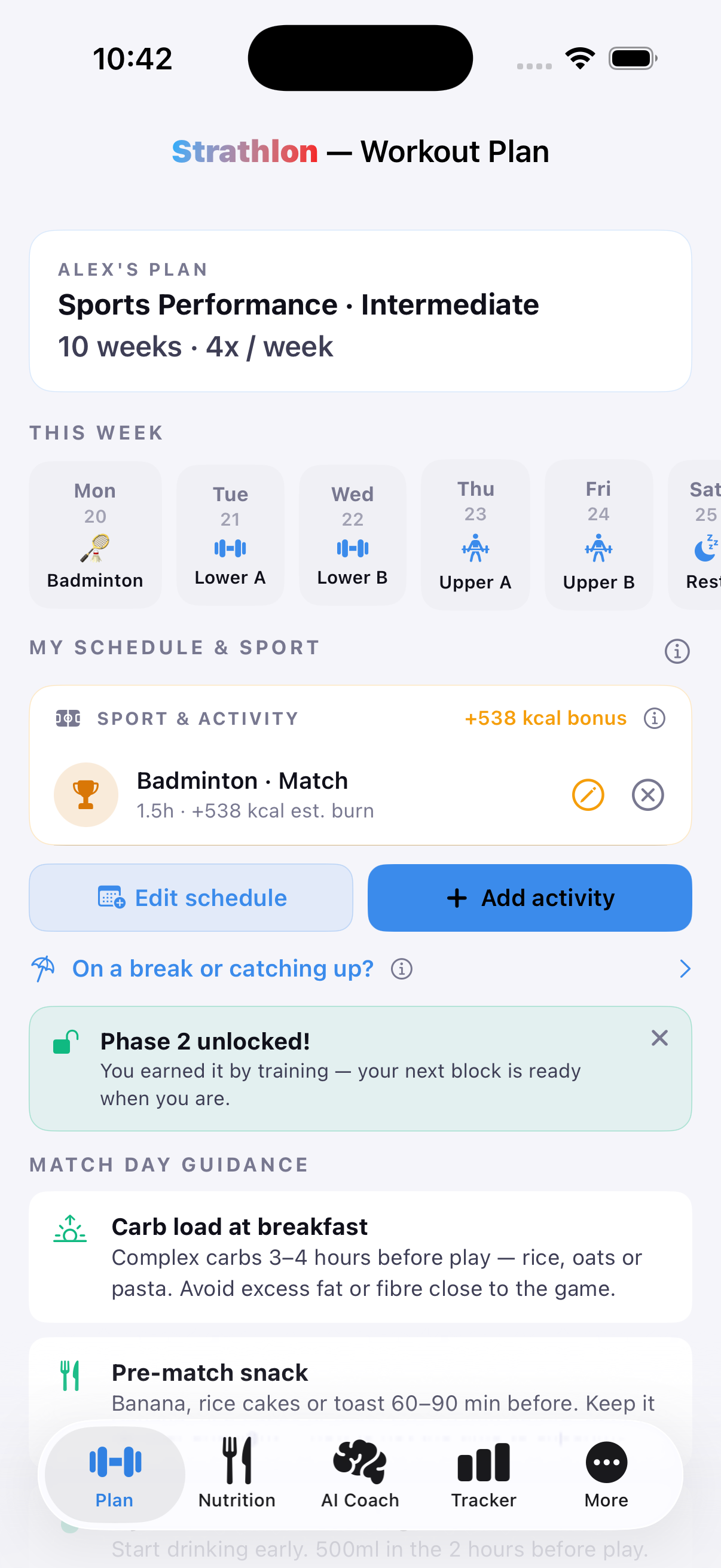
That pairing is worth dwelling on, because it captures the whole philosophy of training for a sport. The base lifts (the bilateral squat and hinge, and heavy shoulder and upper-back work) are what actually make you strong. They are not optional general filler to skip in favour of court-specific tricks. On top of that base sit the sport-specific pieces: an accessory block of single-leg work matched to a game played off one leg, rotational power for the smash, and cuff and scapular care for the overhead shoulder. Neither half works alone. Rotational and single-leg work without a strength base is a small effect on a small foundation. A strong base that is never trained to rotate fast falls short of the speed the rally demands.
Why pair a sport-specific block with ordinary base lifts in the same plan? Because the two do different jobs and you need both. The base lifts (squats, hinges, presses and rows) build the force and balanced musculature that everything else stands on. Skip them and you're trying to make a small engine rev faster. The accessory work (single-leg strength, rotational throws, cuff and scapular drills, grip work) is what tilts that general strength toward the lunging, jumping, overhead reality of badminton. A plan that's all base lifts under-trains the sport's explosive and single-leg qualities. A plan that's all jumps and drills has no strength to draw on and tends to beat you up. The point of the layout is that they complement each other.
Conditioning for badminton
Conditioning is where a lot of badminton players train the wrong way: long, steady runs, when the sport is anything but steady. Recall the match profile: rallies of about 7 seconds with roughly 15 seconds of recovery, an average heart rate near 90% of maximum, and an alactic-leaning anaerobic contribution on top of a 60–70% aerobic base (Phomsoupha and Laffaye, 2015). That is a classic repeat-sprint pattern: short maximal efforts, brief incomplete recovery, repeated for an hour or more.
So conditioning has two jobs that fit together:
- Repeat-sprint and high-intensity intervals to train the sport's actual demand: short, sharp bursts you can repeat without fading. On-court movement drills (shadow badminton, ghosting court corners, multi-shuttle feeding) are ideal because they train the exact lunge-and-recover pattern. Off-court, short shuttle runs and bike or assault-bike intervals do a similar job. Studies in badminton players show that both sprint-interval and Wingate-style high-intensity interval work can improve aerobic and anaerobic capacity, so hard intervals pull double duty.
- An aerobic base to speed recovery between those bursts: the better your aerobic fitness, the faster you clear fatigue in the 15 seconds between rallies and across a long three-game match. This is where some steadier work still earns a place, just not as the main dish.
- References
The trickier question is how strength and conditioning fit together without interference. Doing lots of hard endurance work in the same window as heavy lifting can blunt strength and power gains somewhat: the so-called interference effect. In practice you manage it rather than fear it: keep your hardest strength and your hardest conditioning on different days where you can, or at least separated by several hours; if they must share a day, do the quality you care about most first while you're fresh; and remember that badminton practice is conditioning, so you rarely need to bolt on much extra running. The goal is stress that complements rather than competes.
Staying injury-resilient
Because the lower limb absorbs most of badminton's load, prehab pays off most there, but the overhead shoulder needs attention too. The evidence-based moves, injury by injury:
- Ankle (sprains). The ankle is one of the sport's most common acute injuries, and balance (proprioceptive) training is the best-evidenced prevention. A meta-analysis by Schiftan, Ross and Hahne (2015, Journal of Science and Medicine in Sport) found proprioceptive training reduced ankle-sprain incidence overall (relative risk around 0.65), with the largest benefit (roughly a 36% reduction in risk) in athletes who had already sprained that ankle. Single-leg balance, wobble-board and cushion drills, and deliberate landing/deceleration practice are the staples. If your ankle is chronically unstable, a physiotherapist can add bracing and a targeted plan.
- Knee (patellar tendinopathy, "jumper's knee", and ACL risk in landing/cutting). The knee is a leading injury site. Progressive strength lowers general injury risk (Suchomel et al., 2016), and for a grumbly patellar tendon the mainstay is progressive tendon loading (heavy-slow resistance or eccentric work), building the tendon's tolerance rather than resting it into weakness. Well-controlled landing and change-of-direction mechanics (soft, aligned, absorbing through the hip) also matter for the sudden decelerations that stress the knee.
- Shoulder (rotator cuff, overhead overuse). Science-based reviews of overhead athletes highlight modifiable risk factors: weakness of the external rotators, poor scapular control, and loss of internal-rotation range. The prehab that follows is rotator-cuff strengthening (especially external rotation) plus scapular-stabiliser work, done a couple of times a week and progressed gradually, alongside enough pulling/upper-back volume to balance all that smashing.
- Achilles (tendinopathy). The repeated fast push-offs load the Achilles, and the evidence-based response to an irritable tendon is progressive loading: classic eccentric heel-drops or heavy-slow resistance calf work both improve pain and function (e.g. Beyer et al., 2015, American Journal of Sports Medicine), though not everyone responds fully and a broader loading approach is sometimes needed. Strong, resilient calves also help the ankle cope with landing.
One honest note on the popular Nordic hamstring curl. In sports with a lot of sprinting, programmes including the Nordic exercise are associated with a large drop in hamstring-strain rate: a meta-analysis by van Dyk, Behan and Whiteley (2019, British Journal of Sports Medicine, 8459 athletes) reported the injury rate roughly halved (injury risk ratio 0.49), though later reappraisals argue the true effect is less certain. Hamstring strains aren't badminton's top problem, so Nordics are a useful bit of general lower-limb insurance rather than a headline: the ankle, knee, shoulder and Achilles work above is where the sport-specific payoff lives. And underpinning all of it is load management: a large share of badminton complaints are overuse, so sensible progression, adequate recovery and not spiking your training suddenly do as much as any single exercise.
Programming it around your season
The calendar changes the job. Off-season (or pre-season) is when you build: this is the window for higher strength-training frequency, commonly two to three sessions a week, the dose most effective badminton studies used, pushing strength and power up while court demands are lighter. You can tolerate heavier lifting and more plyometric volume here because you're not also trying to be fresh for competition.
In-season, the goal flips from building to maintaining while staying fresh for matches, and the encouraging finding is that maintenance is cheap. A systematic review and meta-analysis of resistance-training frequency (Cuthbert et al., 2021, Sports Medicine) concluded that, over a competitive block of several weeks, differences in strength between higher and lower training frequencies are small. In plain terms: even one or two well-chosen, genuinely hard sessions a week can hold most of the strength your off-season built, as long as the sessions stay challenging. What loses strength is dropping to almost nothing, or letting the sessions go soft.
Fitting it around practice and fatigue is the real skill. A few honest rules of thumb: put your heaviest lifting on lighter court days rather than the day before a big match or tournament; keep in-season gym sessions short and focused (a couple of main lifts plus your cuff/ankle prehab beats a long bodybuilding session); and treat badminton practice as part of your weekly load rather than something to train on top of. When in doubt in a busy week, protect the sport and the prehab, and let the volume of the gym work flex down. Consistency at a sustainable dose beats heroic weeks you can't repeat.
Common questions
Will lifting weights make me slower or less agile on court?
The evidence points the other way. A widely cited review of muscular strength in athletes concluded that greater maximal strength is associated with better jumping, sprinting and change-of-direction rather than worse: strength is the base that fast, explosive movements are built on. In badminton specifically, a 2025 systematic review found that high-load strength training was associated with meaningfully faster smash velocity (around a 15% increase in one study). Building strength does not automatically build bulk: visible muscle gain is slow and deliberate, and the far more likely result of sensible lifting is a springier, more durable athlete. The caveat is quality: train movement and power alongside heavy singles, and keep court practice as the priority.
What actually builds a harder jump smash?
There is no single magic exercise: the smash is a whole-body action that drives force from the ground, through the trunk, out to the racquet. The best-supported recipe is lower-body strength as the base plus plyometric (jump) training to turn that strength into fast, reactive power, with core work to transfer it up the chain. In one 8-week randomised controlled trial, progressive depth-jump plyometrics three times a week raised vertical jump height by about 13% and improved smash outcomes, alongside a shorter ground-contact time. Strength and plyometrics together tend to beat either alone.
How do I stop rolling my ankle?
Ankle sprains are one of badminton's most common acute injuries, and the best-evidenced defence is balance (proprioceptive) training. A systematic review and meta-analysis found proprioceptive training reduced ankle-sprain incidence overall (relative risk around 0.65), with the biggest benefit (roughly a 36% reduction in risk) in athletes who had already sprained that ankle before. Practically that means regular single-leg balance work, wobble-board or cushion drills, and controlled landing and deceleration practice. If you have recurrent sprains or lasting instability, see a physiotherapist, as bracing and a targeted rehab plan may also help.
How many strength sessions a week do I need in season?
Fewer than most people assume, once the base is built. Reviews of in-season training find that, over a competitive block of a few weeks to a few months, differences in strength between higher and lower training frequencies are small, so a reduced dose, even a single well-chosen hard session a week, can hold most of the strength an off-season built, provided the sessions stay genuinely challenging. The off-season is when you build with more (commonly two to three sessions a week). The in-season job is to maintain while fresh for matches. Dropping to almost nothing, or making the sessions easy, is where strength tends to slip.
My shoulder aches after overhead sessions: what helps?
Badminton is an overhead sport, and the shoulder is a common overuse site. Science-based reviews of overhead athletes point to a few modifiable risk factors: weakness of the rotator-cuff external rotators, poor scapular (shoulder-blade) control, and loss of internal-rotation range. The prehab that follows is rotator-cuff strengthening (especially external rotation) plus scapular-stabiliser work, folded in a couple of times a week and progressed gradually. Persistent or sharp shoulder pain, weakness, or night pain is a reason to see a clinician rather than train through it; this is general education rather than a diagnosis.
Is running enough conditioning for badminton?
Steady running builds a useful aerobic base, but it does not match how badminton is actually played. Match analysis describes rallies of roughly 7 seconds separated by around 15 seconds of rest, with an average heart rate near 90% of maximum and an energy mix of about 60–70% aerobic and 30% anaerobic, leaning on the fast alactic system. That is a repeat-sprint pattern: short, sharp efforts with brief recovery, repeated for an hour or more. Training that mirrors it (short high-intensity intervals and on-court movement drills) sits on top of an aerobic base that speeds recovery between rallies. So keep some easy aerobic work, but make repeat-sprint and multidirectional intervals the sport-specific core.

Takeaways
- Badminton is explosive and intermittent. Short ~7-second rallies at ~90% of max heart rate, played off one leg with constant lunges, jumps and direction changes: train for that rather than a steady jog.
- Strength is the base, power is the goal. Greater maximal strength is linked to better jumping, sprinting and change-of-direction. Heavy lifting builds force, plyometrics make it fast.
- Train off one leg. Split squats, single-leg work and lateral plyometrics build the change-of-direction strength and joint control the court actually demands.
- Plyometrics pay off. In badminton players, adding depth-jump training (≈3×/week, 8 weeks) raised jump height ~13% and improved smash outcomes, introduced gradually.
- Condition like the sport. Repeat-sprint and on-court intervals for the demand, plus an aerobic base for recovery between rallies. Separate hard lifting and hard conditioning where you can.
- Prehab the hot spots. Balance work for the ankle (≈36% fewer recurrent sprains), tendon loading for patellar/Achilles, and cuff + scapular work for the overhead shoulder.
- Maintain, don't grind, in-season. Even one or two hard sessions a week can hold off-season strength. Build with more in the off-season, protect freshness in-season.
- Ignore the "lifting makes you slow" myth. Sensible strength work tends to make you faster and more durable rather than bulkier and slower.
If you take one thing away: build a base of strength, make it fast with jumps and single-leg power, condition in short sharp bursts, and spend a little insurance on your ankles, knees, shoulders and Achilles. That combination is most of what keeps a badminton player explosive and on court. Pair this with the badminton fuelling guide for the nutrition side: the two together cover training and fuelling for the sport.
References
Numbered sources for the specific figures, effect sizes and named studies above. Where a claim reflects agreed guidance rather than a single trial, the citation is to the position stand or consensus statement of the body concerned, with the country or international remit named. Badminton is comparatively well studied for a racquet sport, and the rally-length, heart-rate and jump figures below come from badminton-specific research rather than being read across from tennis.
- Phomsoupha M, Laffaye G. The science of badminton: game characteristics, anthropometry, physiology, visual fitness and biomechanics. Sports Medicine. 2015;45(4):473–95. The science of badminton review: the source for the game characteristics, physiology and biomechanics behind the explosive, intermittent description. PubMed 25549780
- Faude O, Meyer T, Rosenberger F, Fries M, Huber G, Kindermann W. Physiological characteristics of badminton match play. European Journal of Applied Physiology. 2007;100(4):479–85. Study of the physiological characteristics of badminton match play, the source for the rally-length and near-maximal heart-rate figures quoted. PubMed 17473928
- Edel A, Vuong JL, Kaufmann S, Hoos O, Wiewelhove T, Ferrauti A. Metabolic profile in elite badminton match play and training drills. European Journal of Sport Science. 2024;24(11):1639–1652. Metabolic profile of elite badminton match play and training drills, the more recent confirmation of the same intermittent demand. PubMed 39395198 · PMC11534631 full text
- Chia JS, Chow JY, Barrett LA, Burns SF. Reliability of a Novel Badminton Intermittent Exercise Protocol. Research Quarterly for Exercise and Sport. 2019;90(4):487–496. A badminton intermittent exercise protocol, cited for the repeat-effort conditioning that mirrors match demand. PubMed 31184986
- Abian-Vicen J, Castanedo A, Abian P, Gonzalez-Millan C, Salinero JJ, Del Coso J. Influence of successive badminton matches on muscle strength, power, and body-fluid balance in elite players. International Journal of Sports Physiology and Performance. 2014;9(4):689–94. Study of successive badminton matches on muscle strength, power and fluid balance, the evidence behind protecting freshness across a tournament. PubMed 24235773
- Jørgensen U, Winge S. Injuries in badminton. Sports Medicine. 1990;10(1):59–64. The review of injuries in badminton, the source for the sport's characteristic injury pattern. PubMed 2197700
- Schiftan GS, Ross LA, Hahne AJ. The effectiveness of proprioceptive training in preventing ankle sprains in sporting populations: a systematic review and meta-analysis. Journal of Science and Medicine in Sport. 2015;18(3):238–44. Schiftan and colleagues' meta-analysis of proprioceptive training in preventing ankle sprains: the source for the roughly 36% reduction in recurrent sprains quoted. PubMed 24831756
- Kongsgaard M, Kovanen V, Aagaard P, Doessing S, Hansen P, Laursen AH, et al. Corticosteroid injections, eccentric decline squat training and heavy slow resistance training in patellar tendinopathy. Scandinavian Journal of Medicine & Science in Sports. 2009;19(6):790–802. Kongsgaard and colleagues' trial of heavy slow resistance training in patellar tendinopathy, the basis for the tendon-loading advice. PubMed 19793213
- Cools AM, Johansson FR, Borms D, Maenhout A. Prevention of shoulder injuries in overhead athletes: a science-based approach. Brazilian Journal of Physical Therapy. 2015;19(5):331–9. Cools and colleagues on preventing shoulder injuries in overhead athletes, the source for the cuff and scapular work in the prehab section. PubMed 26537804 · PMC4647145 full text
- Suchomel TJ, Nimphius S, Stone MH. The Importance of Muscular Strength in Athletic Performance. Sports Medicine. 2016;46(10):1419–49. Suchomel and colleagues on the importance of muscular strength in athletic performance: the source for greater maximal strength being associated with faster sprinting, jumping and change of direction, and with lower injury risk. PubMed 26838985
- Seitz LB, Reyes A, Tran TT, Saez de Villarreal E, Haff GG. Increases in lower-body strength transfer positively to sprint performance: a systematic review with meta-analysis. Sports Medicine. 2014;44(12):1693–702. Seitz and colleagues' systematic review with meta-analysis showing increases in lower-body strength transfer positively to sprint performance, the evidence behind the 'strength is the base' argument. PubMed 25059334
- Lauersen JB, Andersen TE, Andersen LB. Strength training as superior, dose-dependent and safe prevention of acute and overuse sports injuries: a systematic review, qualitative analysis and meta-analysis. British Journal of Sports Medicine. 2018;52(24):1557–1563. Lauersen and colleagues' meta-analysis finding strength training a superior, dose-dependent and safe prevention of acute and overuse sports injuries: the direct source for treating strength work as prehab. PubMed 30131332
- Lauersen JB, Bertelsen DM, Andersen LB. The effectiveness of exercise interventions to prevent sports injuries: a systematic review and meta-analysis of randomised controlled trials. British Journal of Sports Medicine. 2014;48(11):871–7. Lauersen and colleagues' earlier meta-analysis of exercise interventions to prevent sports injuries, the broader evidence base the prevention advice sits on. PubMed 24100287
- . American College of Sports Medicine position stand. Progression models in resistance training for healthy adults. Medicine and Science in Sports and Exercise. 2009;41(3):687–708. American College of Sports Medicine (ACSM, United States) position stand on progression models in resistance training: the source for the heavy-load and explosive-load percentage ranges quoted. PubMed 19204579
- Cuthbert M, Haff GG, Arent SM, Ripley N, McMahon JJ, Evans M, et al. Effects of Variations in Resistance Training Frequency on Strength Development in Well-Trained Populations and Implications for In-Season Athlete Training: A Systematic Review and Meta-analysis. Sports Medicine. 2021;51(9):1967–1982. Cuthbert and colleagues' systematic review of resistance-training frequency in well-trained populations, the source for the sessions-per-week guidance. PubMed 33886099 · PMC8363540 full text
- Spiering BA, Mujika I, Sharp MA, Foulis SA. Maintaining Physical Performance: The Minimal Dose of Exercise Needed to Preserve Endurance and Strength Over Time. Journal of Strength and Conditioning Research. 2021;35(5):1449–1458. Spiering and colleagues on the minimal dose of exercise needed to preserve endurance and strength: the source for maintaining in-season on as little as one to two sessions a week. PubMed 33629972
- Rønnestad BR, Nymark BS, Raastad T. Effects of in-season strength maintenance training frequency in professional soccer players. Journal of Strength and Conditioning Research. 2011;25(10):2653–60. Ronnestad and colleagues' trial of in-season strength maintenance frequency in professional footballers, the specific in-season maintenance result quoted. PubMed 21873897
- Nuzzo JL, Pinto MD, Kirk BJC, Nosaka K. Resistance Exercise Minimal Dose Strategies for Increasing Muscle Strength in the General Population: an Overview. Sports Medicine. 2024;54(5):1139–1162. Nuzzo and colleagues on minimal-dose resistance exercise strategies for increasing strength, supporting the claim that a small, well-chosen dose does most of the work. PubMed 38509414 · PMC11127831 full text
- Wilson JM, Marin PJ, Rhea MR, Wilson SM, Loenneke JP, Anderson JC. Concurrent training: a meta-analysis examining interference of aerobic and resistance exercises. Journal of Strength and Conditioning Research. 2012;26(8):2293–307. Wilson and colleagues' meta-analysis of concurrent training and the interference effect: the source for separating heavy lifting from hard conditioning. PubMed 22002517
- Schumann M, Feuerbacher JF, Sünkeler M, Freitag N, Rønnestad BR, Doma K, et al. Compatibility of Concurrent Aerobic and Strength Training for Skeletal Muscle Size and Function: An Updated Systematic Review and Meta-Analysis. Sports Medicine. 2022;52(3):601–612. An updated systematic review of the compatibility of concurrent aerobic and strength training, the more recent evidence that interference is smaller than once believed. PubMed 34757594 · PMC8891239 full text
- Ramirez-Campillo R, Sortwell A, Moran J, Afonso J, Clemente FM, Lloyd RS, et al. Plyometric-Jump Training Effects on Physical Fitness and Sport-Specific Performance According to Maturity: A Systematic Review with Meta-analysis. Sports Medicine - Open. 2023;9(1):23. Ramirez-Campillo and colleagues on plyometric-jump training effects on physical fitness and sport-specific performance, the source for the plyometric guidance. PubMed 37036542 · PMC10086091 full text
- Impellizzeri FM, Woodcock S, Coutts AJ, Fanchini M, McCall A, Vigotsky AD. What Role Do Chronic Workloads Play in the Acute to Chronic Workload Ratio? Time to Dismiss ACWR and Its Underlying Theory. Sports Medicine. 2021;51(3):581–592. Impellizzeri and colleagues on the pitfalls of the acute:chronic workload ratio: cited because it is the reason this guide talks about ramping load gradually rather than quoting a workload number. PubMed 33332011
- Baz-Valle E, Balsalobre-Fernández C, Alix-Fages C, Santos-Concejero J. A Systematic Review of The Effects of Different Resistance Training Volumes on Muscle Hypertrophy. Journal of Human Kinetics. 2022;81:199–210. Systematic review of resistance-training volume and hypertrophy, the general dose-response evidence behind the set and session recommendations. PubMed 35291645 · PMC8884877 full text
This is general educational information rather than medical or individual coaching advice. The sports-science findings here are drawn from published research and framed as population-level tendencies and associations; individual responses vary widely with training age, level, body type and injury history, and are best personalised with a qualified strength & conditioning coach. Anyone with pain, an injury, a health condition, or who is pregnant or postpartum, should consult a qualified clinician before starting or changing an exercise programme, and see a physiotherapist or sports physician for a persistent or worsening injury. See our Terms for more.
← All guides · Badminton fuelling guide · How muscle actually grows · Recovery & rest · Eating for results · Home