
Fuelling & performance nutrition for basketball
An evidence-based guide to fuelling for basketball, an intermittent, indoor team sport built from repeated sprints, jumps, changes of direction and sudden stops, played in warm arenas over four quarters. This covers why basketball taxes your carbohydrate stores, the daily carbohydrate base, the pre-game fuelling timeline, carbs and fluid on the bench, hydration by your own sweat rate, and recovery across the sport's brutal congested schedules: back-to-backs and tournaments. Practical, honest, and grounded in established sports-nutrition consensus. Pair this with the basketball strength & conditioning guide, the gym work behind the repeat-sprint power and jumping this fuelling is meant to power.
Here's the short answer to "how should a basketball player fuel?": keep muscle glycogen well stocked with enough daily carbohydrate, top up with a familiar carb-focused meal one to four hours before tip-off, sip a carbohydrate-electrolyte drink at every break to stay fuelled and under about 2% fluid loss, and (the part basketball players most often get wrong) refuel fast between games in a congested schedule. Everything below is the detail behind that sentence: the numbers, where they come from, and how to make them work for your body and your schedule.
On this page
A framing note before the numbers. Sports nutrition is well studied, but people differ enormously: body size, playing position and minutes, fitness, the arena's heat, gut tolerance, sex and health status all shift what's right on the day. It's also worth being honest that basketball has less sport-specific research than, say, running or cycling: a 2023 systematic review that pooled 72 studies of basketball players concluded there is not yet a sufficient number of investigations to frame discipline-specific, evidence-based sports-nutrition recommendations for the sport.[1] So much of what follows is drawn from the wider team-sport and general sports-nutrition consensus and applied sensibly to the game. So this is written as can, tends to and around, never as a guarantee: general education rather than medical or dietary advice, and not a personalised plan.
Why basketball taxes your fuel stores
Basketball looks like a sprint sport wrapped in a lot of standing around, and that's roughly true. A review of basketball match-play reports that about 60% of live playing time is spent in low-intensity activity and only about 15% at high intensity.[2] That low-and-moderate backdrop is broken up by frequent bursts of genuinely hard work: sprints, jumps, accelerations, decelerations, cuts and dead stops. This repeated high-intensity work drives the fuel demand far more than the jogging does.
Those bursts are powered mostly by carbohydrate, stored as glycogen in your muscles, plus glucose in the blood. The phosphagen system can only supply energy for about ten seconds. Beyond that, the anaerobic glycolytic pathway, which runs on blood glucose and muscle glycogen, is the primary system supporting high-intensity efforts lasting roughly 10 to 180 seconds.[3] And because those efforts recruit the same muscle fibres over and over, a game steadily draws the tank down. We could find no equivalent muscle-biopsy study in basketball. In the closest available one, a Danish study of association football, muscle glycogen fell from 449 to 255 mmol/kg dry weight across a match (about 40%), and roughly 47% of individual muscle fibres finished completely or almost empty of glycogen.[4]
You can see the consequence on the court. In elite under-18 official games, distance covered, player load and the number of high-intensity accelerations and decelerations all fell between the first quarter and the last, in every playing position.[5] Fatigue is multi-causal, but running low on carbohydrate is part of the story: in that football study, sprint performance was reduced at the end of the game, and the researchers attributed the drop to glycogen depletion in individual muscle fibres rather than to lactate or pH.[4] Basketball isn't a "hit the wall" sport the way a marathon is (the game is too short and stop-start for that), but the principle is the same in miniature: start with more fuel, and top it up, so you're as sharp in the fourth quarter as the first.
Daily carbohydrate: the base
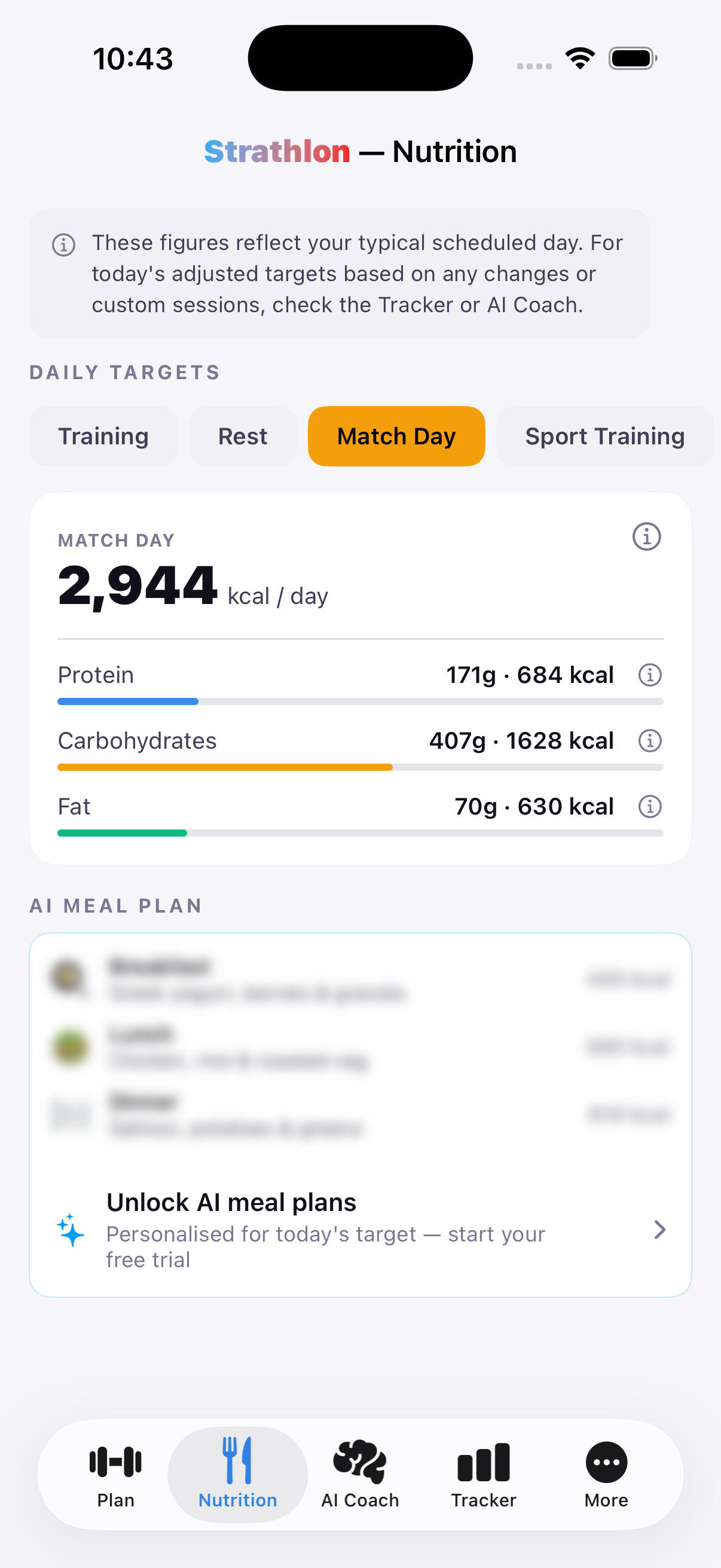
Game-day fuelling only works if you show up with the tank reasonably full, and that comes from your everyday carbohydrate intake, matched to your training and game load. The joint position on nutrition and athletic performance from the Academy of Nutrition and Dietetics, Dietitians of Canada and the American College of Sports Medicine sets daily carbohydrate targets scaled to how hard you're working: around 5–7 g of carbohydrate per kilogram of body weight per day for a moderate exercise programme (about an hour a day), roughly 6–10 g/kg/day for a high load (one to three hours a day of moderate-to-high-intensity exercise), and 8–12 g/kg/day for a very high load (more than about four to five hours a day), which is the territory of a double session or a tournament day.[3]
There's a specific, honest warning for basketball here. When researchers actually measure what players eat, the numbers come in low. The systematic review above doesn't report a single basketball figure. It reports a separate range for each group it looked at: average carbohydrate intakes of 1.9–6.0 g/kg/day in adult male players and 2.9–4.1 g/kg/day in adult women, roughly 4.5–6.3 g/kg/day in under-18 boys and 3.4–5.4 g/kg/day in under-18 girls, and about 3.1–4.2 g/kg/day and 3.2–3.7 g/kg/day in male and female wheelchair players. Its own summary is the part worth remembering: the great majority of the studies it included reported average intakes below 5 g/kg/day, regardless of age group, gender or disability.[1] That is at or below the bottom of the recommended range, and short of what a heavy training-and-games week calls for. Chronically fuelling the base too low while playing and practising hard is one of the most common ways players end up flat, slow to recover and fading late in games: the tank is simply too empty for good game-day fuelling on top to rescue. The practical fix is to move the dial with your week: more carbohydrate around games, double-days and tournaments. A little less on rest days.
What basketball does not need is full marathon-style carbohydrate loading. That protocol is aimed at events lasting more than about 90 minutes of sustained or intermittent exercise and runs at 10–12 g/kg per 24 hours for 36–48 hours beforehand.[3] The more proportionate move for a game is simply a well-fuelled day or two in front of it. Soccer guidance describes 6–8 g/kg/day the day before competition[6], which is most worth doing ahead of tournaments and back-to-backs.
The pre-game fuelling timeline
The job before tip-off is to arrive with liver and muscle glycogen high and your stomach settled. Position stands describe a pre-exercise meal of roughly 1–4 g of carbohydrate per kilogram of body weight, eaten around one to four hours beforehand: a larger meal three to four hours out when you have time to digest, or a smaller snack closer to the start.[3] In one laboratory study, a breakfast providing 2.5 g/kg roughly three hours before exercise raised muscle glycogen by 15%, but only when it was high-glycaemic-index. An equivalent low-GI meal left glycogen unchanged. The same high-GI meal also increased how fast glycogen was burned during the exercise that followed, so it is a head start rather than a free lunch.[7]
A rough game-day timeline that works for many players:
- 3–4 hours before: a familiar carbohydrate-based meal (pasta, rice, potatoes, chicken, a little veg), moderate in protein, low in heavy fat and fibre.
- 1–2 hours before: a smaller top-up if needed (toast and honey, a banana, a bagel, oats, or a sports drink), kept light and easy to digest.
- Warm-up onward: start sipping fluid (water or a carbohydrate-electrolyte drink) so you tip off already hydrated.
Grams are the arithmetic; tolerance is the art. Favour familiar, lower-fibre and lower-fat carbohydrate you've rehearsed: the position stand notes that low-fat, low-fibre, low-to-moderate-protein foods are the preferred pre-event choice because they are less prone to cause gut problems and empty from the stomach faster.[3] The golden rule is to try nothing new on game day: the pre-game meal, the drink and the timing should all already be rehearsed in practice.
During games: carbs and fluid on the bench
Because a game's actual playing time is short and broken into quarters, a single game rarely needs the aggressive in-race feeding a marathon does. But taking in some carbohydrate during play still helps. In a review of soccer, three-quarters of the eligible carbohydrate studies found that 6–8% solutions of glucose, sucrose or maltodextrin taken at 30–60 g per hour enhanced at least one aspect of skilled performance over the course of soccer-specific exercise.[8] A 2024 systematic review reached the same broad conclusion: carbohydrate before and during a match improves running speed and the number of sprints, attenuates the decline in shooting accuracy and speed, increases time to fatigue and enhances cognitive function, while finding no consensus on passing, dribbling, jumping or agility.[6] The position stand's guideline for endurance exercise "including 'stop and start' sports" lasting one to two and a half hours is likewise 30–60 g of carbohydrate per hour.[3]
Basketball makes this easy: you have time-outs, quarter and half-time breaks, free throws and bench time as ready-made drinking windows. Use them. For a routine single game, a sports drink through these breaks covers both fuel and fluid comfortably. The times to be more deliberate about carbohydrate are long games with overtime, and multi-game days (tournaments and back-to-backs), where the hours of play add up and glycogen has less chance to recover in between.
One option for efforts where you don't want a full stomach: a carbohydrate mouth rinse, swilling a carbohydrate drink for about ten seconds and spitting it out. A meta-analysis of maltodextrin-based rinsing found a small average performance benefit over placebo (standardised mean difference 0.15) in exercise lasting 30–75 minutes, with the most effective protocol a ten-second rinse at a 6–6.5% concentration, though on the more conservative statistical model the effect just missed significance, and the trials were in cycling, running and resistance exercise rather than basketball.[9] Treat it as a marginal gain worth trying if you're queasy or on a tight turnaround. It isn't something to rely on.
Fluid, sweat and warm arenas
Indoor arenas are often warm, and basketball's repeated high-intensity work generates a lot of heat, so players sweat more than the stop-start look of the game suggests. A review of fluid balance in team sports pooled nine basketball studies covering 230 players and reported sweating rates spanning roughly 0.7–2.7 litres per hour, with body-mass changes of about −0.6% to −1.6%.[11] (That review was written by researchers employed by the Gatorade Sports Science Institute, a PepsiCo-owned research body in the United States, so we've paired it with an independent measurement below.) At the hot end, 96 male players at a European under-20 championship played in 30°C heat and averaged a sweat rate of 2.7 L/h, finishing about 1% down on body mass, and more than three-quarters of them started the game already dehydrated.[12]
The long-standing sports-medicine goal is to drink enough to keep body-mass loss under about 2%: the joint position stand states that fluid deficits greater than 2% of body weight can compromise cognitive function and aerobic exercise performance, particularly in hot weather, while decrements in anaerobic work and sport-specific technical skills are more commonly seen once 3–5% is lost.[3] Basketball itself sits at the sharper end of that: in the controlled study above, timed and shooting drills declined progressively from 1% to 4% dehydration, reaching significance at 2%.[10] And in a small simulated-game study, ten players who were kept from drinking finished 1.9% down on body mass and shot 8.1% worse in the second half than the first, though with that sample the difference did not reach statistical significance, so treat it as suggestive rather than settled.[13]
The good news is that basketball is one of the easier team sports to stay on top of: because of frequent substitutions, time-outs and quarter breaks, the fluid deficits reported across those basketball studies mostly land between 0.6% and 1.6%, under the 2% threshold.[11] There's no universal ml-per-hour number, though: sweat rates vary enormously between people, so the reliable approach is to weigh yourself before and after a game or hard practice: in the position stand's words, a loss of 1 kg of body weight represents approximately 1 litre of sweat loss, which tells you how much more to drink next time.[3] For hard or long sessions, include some sodium (electrolytes): the same position stand advises sodium during exercise for athletes with high sweat rates (above about 1.2 L/h), salty sweat, or sessions beyond two hours, sweat sodium averaging roughly 1 g per litre.[3] Conveniently, the same sports drinks that deliver carbohydrate carry sodium too, so fuelling and hydrating overlap.
Recovery, back-to-backs and tournaments
For a lot of basketball players this is the section that matters most, because the real challenge isn't one game. It's the next one. A single hard game can lower muscle glycogen substantially, and a review of muscle glycogen in elite soccer concludes that roughly 72 hours is needed to fully replenish those stores after a match, particularly in the type 2 fibres that power sprinting and jumping.[14] Play again before you've refilled and you start the next game already down on fuel, which is exactly why performance tends to sag through tournaments and back-to-backs. Recovery nutrition is how you defend against that.
Two jobs matter after a game: refill glycogen and repair muscle. How urgently you chase the first depends entirely on when you next play.
- Fast turnaround (another game within a day, a tournament, or a double-header). Speed matters. The position stand's "speedy refuelling" guidance, for less than eight hours between two fuel-demanding sessions, is carbohydrate at 1–1.2 g per kilogram of body weight per hour for the first four hours, then a return to normal daily targets.[3] Soccer-specific guidance is slightly more aggressive, at roughly 1–1.5 g/kg/h for four hours beginning within about the first 20 minutes.[6] Add some protein: the position stand puts the early-recovery dose at 0.25–0.3 g/kg, or about 15–25 g across the usual range of athlete body sizes[3]. Rehydrate to replace what you sweated, and protect your sleep.
- Normal turnaround (a full day or more until the next game). No need to rush. Simply hitting your usual daily carbohydrate and protein targets across normal meals refills stores comfortably before you need them. The "eat within 30 minutes or lose your gains" urgency is real only when the next game is genuinely close.
Across the whole day, the International Society of Sports Nutrition (ISSN, United States) states that 1.4–2.0 g of protein per kilogram of body weight per day is sufficient for most exercising people to build and maintain muscle[15], and the joint position stand gives a similar 1.2–2.0 g/kg/day for athletes[3], more than a sedentary person, because the jumping, contact and sprinting damage muscle and protein supports repair and adaptation, spread across meals rather than piled into one. The eating-for-results guide covers the broader nutrition picture in depth.
Eating enough overall
The most serious nutrition mistake in basketball isn't a poor drink choice. It's chronically eating too little to support the training and games. The sport combines heavy energy demands with, in some settings, a culture around leanness, and the measured intakes noted earlier suggest a fair number of players run their carbohydrate and total energy too low.[1] Sustained under-fuelling produces low energy availability: not leaving enough energy, once the exercise is paid for, to run the body's basic functions.
Left unaddressed, this is the root of what the International Olympic Committee (IOC, international) calls Relative Energy Deficiency in Sport (RED-S in its earlier statements, REDs since 2023). The IOC defines it as a syndrome of impaired physiological and/or psychological functioning experienced by female and male athletes, whose detrimental outcomes include decreases in energy metabolism, reproductive function, musculoskeletal health, immunity, glycogen synthesis and cardiovascular and haematological health, which can individually and together lead to impaired well-being, increased injury risk and decreased sports performance.[16] The warning signs are worth knowing: bone stress injuries, frequent illness, stalled or declining play despite hard training, low mood, and (in women) disrupted or missing periods.[16] None of these are things to push through: the answer is usually to eat more rather than train harder, and to seek help from a sports physician or registered dietitian. For a jump-heavy, high-impact sport, keeping bones and tendons well fuelled isn't optional. It's injury prevention.
Common questions
How should a basketball player fuel on game day?
Arrive with muscle glycogen topped up and stay hydrated. Position stands describe a carbohydrate-focused meal of roughly 1–4 g per kilogram of body weight eaten about one to four hours before tip-off: larger and earlier, or smaller and closer to the start, depending on what your stomach tolerates. Keep sipping fluid through warm-up, use time-outs, quarter breaks and bench time to drink, and for a normal single game your existing stores plus a sports drink are usually enough. Favour familiar, lower-fibre, lower-fat carbohydrate you've rehearsed, and try nothing new on game day.
Do I need carbohydrate during a basketball game?
For a single game you usually don't need much beyond a carbohydrate-electrolyte sports drink, because a game's actual playing time is short and stop-start. But taking in carbohydrate still helps: research on intermittent team sports links carbohydrate intake during play to better maintained sprinting, shooting accuracy and cognitive function late in games, though there is no consensus on passing, dribbling, jumping or agility. The team-sport guideline is around 30–60 g of carbohydrate per hour of play, most easily taken as a 6–8% sports drink sipped at every break. This matters most for long games, overtime, and back-to-back or tournament days.
How much should a basketball player drink during a game?
There is no single number, because sweat rates vary widely. Across studies of basketball players, sweating rates span roughly 0.7 to 2.7 litres per hour, with the top of that range coming from a championship played in 30 degrees of heat. The goal is to keep body-mass loss under about 2%, since fluid deficits past that point can compromise aerobic performance and cognition, and basketball shooting drills have been shown to decline significantly at 2% dehydration. Basketball's frequent substitutions, time-outs and quarter breaks make it easier than many sports to keep up: use every one of them to drink. The best way to find your own number is to weigh yourself before and after a game: 1 kg lost is about 1 litre of sweat.
How do I recover between back-to-back games or in a tournament?
Prioritise carbohydrate, and start soon. A single hard game can lower muscle glycogen substantially, and in team-sport research it can take around 72 hours to fully replenish those stores, so a congested schedule is really a refuelling problem. When the next game is within a day, position-stand guidance is to take in 1–1.2 g of carbohydrate per kilogram of body weight per hour for the first four hours (soccer-specific guidance says 1–1.5 g/kg/h, starting within about 20 minutes), plus some protein (roughly 0.25–0.3 g per kilogram) to support repair. Rehydrate to replace what you sweated, and sleep. With a full day or more between games, normal high-carbohydrate meals refill stores comfortably.
What should I eat before a game and how long before?
Aim for a carbohydrate-focused meal of about 1–4 g per kilogram of body weight, roughly one to four hours before tip-off: a bigger meal three to four hours out, or a smaller snack closer in. One laboratory study found a high-glycaemic-index breakfast providing about 2.5 g per kilogram three hours before exercise raised muscle glycogen by 15%, while a low-GI meal of the same size did not change it. Keep it familiar, lower in fibre and fat, and easy on the stomach (porridge, rice, pasta, toast, a banana), and rehearse it in practice rather than debuting it on game day.
Do basketball players need to carb-load like marathoners?
Not in the full marathon sense. Classic carbohydrate loading is aimed at events longer than about 90 minutes of sustained or intermittent exercise and involves 36 to 48 hours at 10–12 g per kilogram of body weight per day, whereas a basketball game's actual playing time is short and broken up. What matters more is arriving with well-stocked glycogen from a high-carbohydrate day or two beforehand. Soccer guidance describes around 6–8 g per kilogram of body weight per day the day before competition, which is especially worth doing before tournaments and back-to-backs, where you'll play repeatedly with little time to refuel.
Takeaways
- Basketball runs on glycogen in bursts. About 60% of live time is low-intensity and only ~15% high-intensity[2], but it's the sprints and jumps that decide games, and physical output measurably falls from the first quarter to the last.[5]
- Build the base daily. Match everyday carbohydrate to load: roughly 5–7 g/kg for about an hour a day, 6–10 g/kg for one to three hours, 8–12 g/kg for the very heaviest[3], and note that most measured basketball intakes come in below 5 g/kg/day, regardless of age group, gender or disability.[1]
- Time the pre-game meal. About 1–4 g/kg of familiar, low-fat, low-fibre carbohydrate, one to four hours before tip-off[3]. Nothing new on game day.
- Fuel and hydrate at the breaks. A 6–8% carbohydrate-electrolyte drink at ~30–60 g of carbs per hour is the dose that improved skilled performance in most soccer trials[8] and matches the position stand's guidance for stop-start sports[3]. Be more deliberate for overtime and multi-game days.
- Hydrate to your own sweat rate. Basketball sweating rates span ~0.7–2.7 L/h across studies[11][12]. Keep body-mass loss under ~2%, because past that aerobic work and cognition suffer[3] and basketball shooting drills decline significantly.[10] Don't over-drink.
- Win the congested schedule with recovery. Full glycogen replenishment can take ~72 hours[14], so between back-to-backs and in tournaments, refuel fast: 1–1.2 g/kg/h of carbs for the first four hours plus ~0.25–0.3 g/kg protein[3]. Rehydrate and sleep.
- Eat enough, always. Aim ~1.4–2.0 g/kg/day of protein overall[15], and treat chronic low energy availability (REDs) as an injury and performance risk rather than a shortcut.[16] When in doubt, eat more.
If you remember one thing, make it this: the players who fuel basketball well aren't the ones with the fanciest supplements. They're the ones who show up with a full tank, drink and sip at every break, and refuel fast enough to be as sharp in the fourth quarter of the second game as the first quarter of the first. Strathlon's job is to keep that base honest by adjusting your targets around the games and practices you actually log, so the everyday fuelling that underpins every game is one less thing to guess at.
References
Sources for the specific figures on this page. Where a number reflects established consensus rather than a single trial, the citation is to the relevant expert body’s position stand, with the country or region that body belongs to named: guidance is written by national and regional organisations, and no one country’s advice is universal. Basketball has comparatively little sport-specific nutrition research, so several numbers below come from association football, the closest well-studied stop-start team sport; where that is the case it is stated. Where a source is produced or funded by a commercial interest, that is noted too.
- Nowaczyk PM, Adamczewski J, Durkalec-Michalski K. Practical application and methodological considerations on the basics of sports nutrition in basketball: a comprehensive systematic review of observational and interventional studies. Nutrients. 2023;15(20):4484. Systematic review of 72 records (2581 participants) from Poznań University of Physical Education (Poland). https://pmc.ncbi.nlm.nih.gov/articles/PMC10610293/
- Gottlieb R, Shalom A, Calleja-Gonzalez J. Physiology of basketball — field tests. Review article. Journal of Human Kinetics. 2021;77:159–167. Review by authors in Israel and Spain. https://pmc.ncbi.nlm.nih.gov/articles/PMC8008295/
- Thomas DT, Erdman KA, Burke LM. Position of the Academy of Nutrition and Dietetics, Dietitians of Canada, and the American College of Sports Medicine: nutrition and athletic performance. Journal of the Academy of Nutrition and Dietetics. 2016;116(3):501–528. Joint position stand of the Academy of Nutrition and Dietetics (United States), Dietitians of Canada (Canada) and the American College of Sports Medicine (ACSM, United States). https://pubmed.ncbi.nlm.nih.gov/26920240/
- Krustrup P, Mohr M, Steensberg A, Bencke J, Kjaer M, Bangsbo J. Muscle and blood metabolites during a soccer game: implications for sprint performance. Medicine & Science in Sports & Exercise. 2006;38(6):1165–1174. Danish biopsy study in association football, used here as the closest available evidence in a stop-start team sport; no equivalent biopsy study exists in basketball. https://pubmed.ncbi.nlm.nih.gov/16775559/
- Vázquez-Guerrero J, Fernández-Valdés B, Jones B, Moras G, Reche X, Sampaio J. Changes in physical demands between game quarters of U18 elite official basketball games. PLoS ONE. 2019;14(9):e0221818. https://pmc.ncbi.nlm.nih.gov/articles/PMC6720027/
- Pueyo M, Llodio I, Cámara J, Castillo D, Granados C. Influence of carbohydrate intake on different parameters of soccer players’ performance: systematic review. Nutrients. 2024;16(21):3731. Systematic review of 61 articles, University of the Basque Country (Spain). Soccer-specific. https://pmc.ncbi.nlm.nih.gov/articles/PMC11547566/
- Wee SL, Williams C, Tsintzas K, Boobis L. Ingestion of a high-glycemic index meal increases muscle glycogen storage at rest but augments its utilization during subsequent exercise. Journal of Applied Physiology. 2005;99(2):707–714. Laboratory crossover study, Loughborough University (United Kingdom). https://pubmed.ncbi.nlm.nih.gov/15831796/
- Hills SP, Russell M. Carbohydrates for soccer: a focus on skilled actions and half-time practices. Nutrients. 2018;10(1):22. Review from Leeds Trinity University (United Kingdom); the authors declare no funding and no conflicts of interest. Evidence is soccer-specific and applied here by analogy. https://pmc.ncbi.nlm.nih.gov/articles/PMC5793250/
- Hartley C, Carr A, Bowe SJ, Bredie WLP, Keast RSJ. Maltodextrin-based carbohydrate oral rinsing and exercise performance: systematic review and meta-analysis. Sports Medicine. 2022;52(8):1833–1862. Deakin University (Australia) and the University of Copenhagen (Denmark). https://pmc.ncbi.nlm.nih.gov/articles/PMC9325805/
- Baker LB, Dougherty KA, Chow M, Kenney WL. Progressive dehydration causes a progressive decline in basketball skill performance. Medicine & Science in Sports & Exercise. 2007;39(7):1114–1123. Pennsylvania State University (United States); dehydration was induced by interval treadmill walking in the heat rather than by playing. https://pubmed.ncbi.nlm.nih.gov/17596779/
- Nuccio RP, Barnes KA, Carter JM, Baker LB. Fluid balance in team sport athletes and the effect of hypohydration on cognitive, technical, and physical performance. Sports Medicine. 2017;47(10):1951–1982. Peer-reviewed review; all four authors are employed by the Gatorade Sports Science Institute (United States), which is owned by PepsiCo. Its basketball sweat-rate range is corroborated independently by reference 12. https://pmc.ncbi.nlm.nih.gov/articles/PMC5603646/
- Vukašinović-Vesić M, Andjelković M, Stojmenović T, Dikić N, Kostić M, Ćurčić Đ. Sweat rate and fluid intake in young elite basketball players on the FIBA Europe U20 Championship. Vojnosanitetski Pregled. 2015;72(12):1063–1068. Independent field study of 96 players, Sports Medicine Association of Serbia (Serbia). https://pubmed.ncbi.nlm.nih.gov/26898028/
- Hoffman JR, Stavsky H, Falk B. The effect of water restriction on anaerobic power and vertical jumping height in basketball players. International Journal of Sports Medicine. 1995;16(4):214–218. Ten players (Israel); the 8.1% fall in field-goal percentage did not reach statistical significance. https://pubmed.ncbi.nlm.nih.gov/7657413/
- Mohr M, Vigh-Larsen JF, Krustrup P. Muscle glycogen in elite soccer — a perspective on the implication for performance, fatigue, and recovery. Frontiers in Sports and Active Living. 2022;4:876534. Review from the University of Southern Denmark (Denmark); soccer-specific. https://pmc.ncbi.nlm.nih.gov/articles/PMC9106100/
- Jäger R, Kerksick CM, Campbell BI, et al. International Society of Sports Nutrition position stand: protein and exercise. Journal of the International Society of Sports Nutrition. 2017;14:20. Position stand of the International Society of Sports Nutrition (ISSN, United States). https://pubmed.ncbi.nlm.nih.gov/28642676/
- Mountjoy M, Ackerman KE, Bailey DM, et al. 2023 International Olympic Committee’s (IOC) consensus statement on Relative Energy Deficiency in Sport (REDs). British Journal of Sports Medicine. 2023;57(17):1073–1097. Consensus statement of the International Olympic Committee (IOC, international). https://doi.org/10.1136/bjsports-2023-106994
This is general educational information rather than medical, dietary or coaching advice. The sports-nutrition figures here are drawn from established consensus (much of it from wider team-sport and general position stands applied to basketball, since sport-specific evidence is still limited) and are framed as population-level guides. Individual needs vary widely with body size, position and minutes, arena conditions, gut tolerance and health, and are best personalised with a qualified professional. Anyone with a health condition, a history of disordered eating, or who is pregnant or postpartum, or who suspects under-fuelling, stress fractures, menstrual disruption or RED-S, should consult a sports physician or registered dietitian before making changes. See our Terms for more.
← All guides · Basketball strength & conditioning guide · Eating for results · Understanding your stats · Home