
Basketball strength & conditioning
An evidence-based guide to training the basketball body off the court. Basketball is a jumping, cutting, stop-start sport played on hard floors, and the gym work that helps most is specific: lower-body power and plyometrics for the jump, single-leg and deceleration work for change of direction, repeat-sprint conditioning so you're still sharp in the fourth quarter, and targeted prehab for the joints the sport punishes: ankles and knees above all. This guide is practical and honest, grounded in published sports-science and injury-prevention research.
If you only remember one line: the physical qualities that matter most for basketball are lower-body power and reactive strength (the jump), the ability to decelerate, land and change direction under control, and repeat-sprint conditioning, all built on a base of maximal strength and joint resilience, especially at the ankle and knee. Everything below is the detail behind that sentence: what to train, why it transfers, and how to fit it around a season without wearing yourself out.
On this page
A framing note before the detail. Strength and conditioning is well studied, but people differ enormously: training age, playing position, sex, injury history, sleep and recovery all shift what's right for a given player. So this is written as can, tends to and is associated with, never as a guarantee, and every specific figure is a population-level finding from published research rather than a personal prescription. It's general education rather than medical advice or individual coaching, and it isn't a substitute for a qualified strength coach or clinician who can see you move.
The demands of basketball
Basketball is an intermittent, multidirectional sport: short, maximal bursts (accelerations, decelerations, cuts, jumps and landings) stitched together by jogging, shuffling and standing, over four quarters. Match-play analyses describe players covering roughly 4,500–5,000 m in a game while performing on the order of a hundred or more high-intensity actions, each only a couple of seconds long but recurring roughly every 20–30 seconds of live play. The heart rate spends much of the game high, but the defining efforts are brief and explosive.
That activity pattern tells you what to train. Because the key actions are short and powerful, basketball leans heavily on the anaerobic (fast) energy systems for each burst. But it relies on a well-developed aerobic base to recover between bursts and to keep the quality of those bursts up late in a game. In other words, it's a repeat-sprint sport: the winner of a one-on-one in the fourth quarter is often whoever's explosive actions have decayed the least.
The demands also explain the injuries. All that jumping, landing and cutting on a hard court concentrates load on the lower body: injury-surveillance data from professional basketball consistently put the lower extremity at the top of the list, with the ankle and knee the most-affected sites. The three injuries every basketball player should train to resist are lateral ankle sprains (the most common acute injury), knee ligament injuries including the ACL (less frequent but far more serious, typically from landing or cutting), and patellar tendinopathy: "jumper's knee" (an overuse problem from repetitive jump loading). The rest of this guide is really about two things at once: getting more powerful, and staying in one piece while you do it.
Key strength work, and why it matters
Basketball rewards power (force expressed quickly), and power is built on a floor of maximal strength. You can't drive a big jump or a hard first step through legs that can't produce much force to begin with. Reviews of athletic performance (for example Suchomel and colleagues, 2016) make the case plainly: stronger athletes tend to jump higher and sprint faster, and greater maximal strength generally amplifies the benefit you get from explosive and plyometric training on top. So the base of a basketball gym plan is unglamorous and heavy.
- Heavy bilateral strength: squats and hinges. Back or front squats and a hip-hinge pattern (trap-bar deadlift, Romanian deadlift, hip thrust) build the force your jump and acceleration draw on. The transfer is well established: heavier squat and deadlift strength is associated with better jump and sprint performance in athletes, including basketball players. This is trained with heavy loads and low-to-moderate reps (think efforts around or above 80% of your one-rep-max rather than light, high-rep burnouts) because maximal force is the quality you're after.
- Plyometrics: reactive strength. Strength is the engine. Plyometrics teach you to fire it fast. Countermovement jumps, broad jumps, bounds, pogo hops and (once you have a strength base) drop and depth jumps train the stretch-shortening cycle: the rapid stretch-then-shorten your muscles and tendons use in a real jump. Meta-analyses of plyometric training in basketball players report moderate-to-large improvements in jumping (with effect sizes for the countermovement and squat jump around 0.8), typically from programmes run about twice a week over 8–12 weeks. This is quality work, made of crisp, well-rested efforts rather than a fatiguing conditioning circuit.
- Single-leg strength: for cutting and landing. Basketball jumps, drives and cuts are very often off one leg, so unilateral work (split squats, rear-foot-elevated split squats, step-ups, single-leg Romanian deadlifts) transfers directly to change of direction and helps even out the left-right asymmetries that both hurt performance and raise injury risk. Single-leg work also loads the hip and knee in the exact positions where cuts and landings go wrong.
- Deceleration and landing strength. Everyone trains to jump. Fewer train to land and stop, which is where knees are hurt. Deliberately practising controlled landings and decelerations (jump-and-stick, snap-downs, absorbing force with the hips back and knees tracking over the toes) builds the eccentric strength and motor control to soak up landing forces rather than dump them into a ligament. This is strength work and injury prevention in the same movement, which is why it reappears in the injury section below.
- Calves, feet and trunk. Strong calves and feet contribute to a stiffer, more responsive ankle for jumping and cutting. A strong, stable trunk helps you hold position through contact and land balanced. These play a supporting role, but they round out a durable basketball body.
- References
That pairing is worth dwelling on, because it captures the whole philosophy of training for a sport. The base lifts (heavy bilateral squats and hinges at low-to-moderate reps) are what actually build the force behind a jump and a first step. They are not general filler to be skipped in favour of more court work. On top of that base sit the sport-specific pieces: an accessory block of single-leg work matched to cuts and drives, deliberate landing and deceleration work for the knee, and plyometrics (box jumps, broad jumps and pogo hops) that train the stretch-shortening cycle the game actually uses. Neither half works alone. Heavy strength builds the engine and plyometrics teach you to use it quickly: jump training on a weak base adds little and costs a lot of knee, while a strong squat that is never trained reactively arrives too slowly to matter.
That figure is the whole philosophy in one screen. The base lifts (a heavy squat and hinge) build the force floor. The accessory block of single-leg and landing work makes that strength usable in the cutting, one-legged positions basketball actually happens in. The plyometrics in the same block teach you to express it fast. None of the three alone is enough: heavy lifting without reactive work leaves you strong but slow to fire, plyometrics without a strength base have little force to work with (and a higher injury risk), and neither addresses the single-leg landings where knees and ankles get hurt. The sport-specific work and the complementary base strength are two halves of the same plan.
Conditioning for basketball
Basketball conditioning has to match the sport's stop-start rhythm. Long, steady jogging alone doesn't prepare you for repeated maximal bursts, and neither does pure sprint work with full recovery. The sport demands repeat-sprint ability: producing near-maximal efforts again and again with incomplete rest, and recovering enough between them to do it once more.
- Build an aerobic base. A solid aerobic engine is what refills the fast energy systems between bursts and keeps your explosive actions from fading late in games. This is the role of easier continuous work and tempo runs, plus the accumulated running of practice itself. You don't need a marathoner's base, but a bigger aerobic engine buys you better recovery between sprints.
- Train repeat-sprint ability directly. Short maximal efforts (roughly 5–10 seconds) with deliberately incomplete recovery, repeated in sets, teach the body to buffer fatigue and reproduce power. Shuttle runs and change-of-direction sprints match basketball better than straight-line running because they include the decelerations and re-accelerations that actually cost you.
- Use the game as conditioning. Small-sided games and full-court drills condition the energy systems and the exact movements and decisions of basketball at once, which is why so much of the sport's fitness is built by playing it. Structured intervals fill the gaps the game doesn't cover.
The practical question is how strength and conditioning coexist without one blunting the other: the so-called interference effect. The honest summary of the research is reassuring: for most athletes the interference between strength and endurance training is small, and it's largest when hard conditioning and heavy lifting are crammed into the same session with the running first. So the fixes are simple. Where you can, separate heavy lower-body lifting from your hardest conditioning by a few hours or onto different days. If they must share a session, do the quality strength or power work first, while you're fresh. Keep your heaviest leg day away from a hard court day, and the two sides of your training will add up rather than cancel out.
Staying injury-resilient
Prehab isn't separate from performance training in basketball: much of the same lower-body strength, single-leg and landing work that makes you powerful is also what protects your joints. Three injuries are worth targeting specifically.
Lateral ankle sprains are the most common acute basketball injury. In an NBA injury-surveillance study, Herzog and colleagues (2019) found the overwhelming majority of sprains were lateral (about 80%), most happened in games, and the single-season risk of spraining an ankle was roughly one in four, and a sprain in the previous year raised the risk of the next one by around 40%. That recurrence pattern is the key: one sprain makes another more likely, so resilience matters most for anyone who's already rolled an ankle. The best-supported prevention is balance and proprioceptive training: single-leg balance, wobble-board and unstable-surface work, and hop-and-stick landings. A meta-analysis by Schiftan and colleagues (2015) associated proprioceptive training with roughly a 35% reduction in ankle-sprain rate overall, and a similar reduction in re-injury for those with a prior sprain. For unstable ankles, external bracing or taping during play also has good supporting evidence and pairs well with balance work.
Knee ligament injuries, including the ACL, are much less common than ankle sprains but far more costly, and they typically happen on landing or cutting rather than from contact. The good news is that structured neuromuscular training programmes meaningfully lower the risk. In a best-practice meta-analysis, Petushek and colleagues (2019) found such programmes roughly halved ACL injury risk (odds ratio about 0.51, from around 1 in 54 athletes to 1 in 111), with the largest benefit in younger athletes. The effective ingredients are consistent: lower-body strength (including hamstring, lunge and calf work), plyometrics, and above all a deliberate focus on landing and deceleration technique: landing softly with hips back and knees tracking over the toes, and holding balanced "stick" landings. That's the same deceleration-strength work from the section above, done with intent.
A brief word on the posterior chain: Nordic hamstring exercises feature in many lower-limb prevention programmes, and a meta-analysis by van Dyk and colleagues (2019) associated including them with roughly a halving of hamstring-injury rates across sports, though a later reappraisal cautioned that the certainty of that precise figure is lower than it first appeared, so treat it as a strong association rather than a guarantee. Eccentric hamstring strength is worth having regardless.
Patellar tendinopathy (jumper's knee) is an overuse injury of the tendon just below the kneecap, driven by high, repetitive jump-and-land loading: exactly what basketball involves. The instinct to rest it completely is usually wrong. Tendons adapt to managed load far better than to inactivity. The evidence favours progressive strengthening: heavy slow resistance and eccentric loading both reduce pain and improve function, and in a well-known trial Kongsgaard and colleagues (2009) found heavy slow resistance delivered notably higher patient satisfaction than eccentric work alone. Isometric holds can help settle pain during the season. The realistic plan is to manage jump volume when the tendon is grumpy, load it deliberately and progressively, and build back up, with a physiotherapist's guidance if pain is sharp, worsening or lingering.
Programming it around your season
Strength and power don't need a huge time commitment to build and hold: they need the right emphasis at the right time of year, fitted around court practice and games rather than piled on top of them.
- Off-season: build. This is when you make the biggest gains. Aim for roughly two to three quality lower-body strength and power sessions a week, driving genuine progressive overload on the base lifts, layering plyometrics on a rested nervous system, and building your conditioning base. With less court load competing for recovery, this is the window to get meaningfully stronger and more explosive.
- In-season: maintain. Once games start, the goal shifts from building to keeping what you built while staying fresh to play. Encouragingly, that takes less than people fear: research on in-season training (for example Cuthbert and colleagues, 2021) indicates that when the load is kept heavy, frequency is flexible, and around one to two quality sessions per week can maintain strength. An earlier study found once-weekly lifting held strength across a 12-week competitive block. The trick is intensity over volume: short, heavy, crisp sessions that preserve strength without leaving your legs flat for games, placed away from game day.
- Fit it around fatigue. Games and hard practices already tax the same legs the gym does, so in-season strength work should auto-regulate: cut volume (not intensity) in congested weeks, keep the powerful, low-rep work, and protect sleep and recovery. A missed session in a brutal week costs you far less than showing up to a game with dead legs.
Where Strathlon fits
Common questions
What is the best strength work to jump higher in basketball?
There isn't one magic exercise: a higher jump comes from two qualities trained together. First, maximal lower-body strength from heavy squats and hinges: reviews of athletic performance (for example Suchomel and colleagues, 2016) argue that stronger athletes tend to jump and sprint better, because a bigger force base is what power is built on. Second, reactive strength from plyometrics (countermovement jumps, bounds, pogos and, once you are strong enough, drop jumps) which trains the fast stretch-shortening cycle a jump actually uses. Meta-analyses of plyometric training in basketball players report moderate-to-large improvements in jump height, with programmes typically running about twice a week for 8 to 12 weeks. Heavy strength builds the engine. Plyometrics teach you to use it quickly. Do both, progress them gradually, and let the jump follow.
Will lifting weights make me slower or too bulky for basketball?
Almost certainly the opposite. Maximal strength underpins jumping and sprinting, and getting stronger tends to make athletes faster rather than slower, when the strength work sits alongside your court training. Building a lot of muscle is a slow, deliberate process that takes months to years of dedicated eating and lifting: you will not accidentally get bulky from twice-weekly strength work aimed at power. If size is a genuine concern, it is controlled mostly by how much you eat, with how heavy you lift playing a much smaller part. For basketball, heavy-but-explosive strength training tends to make you more powerful and more durable.
How do I stop rolling my ankle?
Ankle sprains are the single most common acute basketball injury, and most are lateral (rolling the outside of the ankle). The best-supported prevention is balance and proprioceptive training. A meta-analysis by Schiftan and colleagues (2015) found that proprioceptive training was associated with roughly a 35% lower rate of ankle sprains overall, and a similar reduction in re-injury for people who had sprained before. In practice that means single-leg balance work, wobble-board or unstable-surface drills, and hop-and-stick landings, done a few times a week. If you have sprained badly before or have a loose, unstable ankle, an external brace or taping during play has good evidence too, and is worth discussing with a clinician. Balance work and a brace are not mutually exclusive.
How many days a week should I lift during the season?
Less than you might fear. Research on in-season training (for example Cuthbert and colleagues, 2021) suggests that when the load is kept heavy, training frequency is fairly flexible, and around one to two quality strength sessions per week can maintain the strength you built in the off-season. An earlier study found once-weekly lifting held strength across a 12-week competitive block. Keep the weights heavy and the sets crisp rather than long and draining, prioritising intensity over volume, so lifting supports your court performance instead of leaving your legs flat for games. Place heavy lower-body work away from game day, and cut volume before dropping it entirely when the schedule is congested.
I have jumper's knee: should I stop training?
Usually not completely. Patellar tendinopathy (jumper's knee) is an overuse problem of the tendon below the kneecap, common in jumping sports, and tendons generally respond better to managed loading than to complete rest. The evidence favours progressive strengthening: heavy slow resistance and eccentric loading both reduce pain and improve function, and in a well-known trial by Kongsgaard and colleagues (2009) heavy slow resistance produced notably higher patient satisfaction than eccentric-only work. Isometric holds can help calm pain during the season. The practical plan is to reduce jumping volume for a while, load the tendon deliberately and progressively, and build back up, ideally guided by a physiotherapist, because sharp or worsening pain needs proper assessment rather than pushing through.
Do I need plyometrics, or is lifting heavy enough?
You want both, because they train different things. Heavy lifting builds maximal force: the size of the engine. Plyometrics train reactive strength and the stretch-shortening cycle: how quickly you can express that force in a jump or cut, which is what basketball actually demands. Meta-analyses show plyometric training improves jump and, in some groups, sprint and change-of-direction performance. Strength gives plyometrics something to work with (jumping onto a weak base has little to express and a higher injury risk), so most programmes build a strength base first and layer reactive work on top, rather than choosing one or the other.
Takeaways
- Train power on a base of strength. Heavy squats and hinges build the force floor. Explosive intent turns it into a bigger jump and a harder first step.
- Add plyometrics for reactive strength. Jumps, bounds and (when strong enough) drop jumps train the stretch-shortening cycle basketball actually uses: about twice a week works in the research.
- Go single-leg. Cuts, drives and many jumps are off one leg, so split squats, step-ups and single-leg hinges transfer directly to change of direction and even out asymmetries.
- Train to land and to stop, as much as to jump. Controlled decelerations and stick landings build the eccentric strength that protects knees, and it's the same work that prevents ACL injuries.
- Condition for repeat sprints. Short, hard efforts with incomplete recovery, plus an aerobic base to recover between them, match the sport better than steady jogging.
- Protect the ankle. Ankle sprains are the most common injury and recur. Balance and proprioceptive work is associated with roughly a third fewer sprains (Schiftan and colleagues, 2015).
- Protect the knee. Neuromuscular programmes (strength, plyometrics and landing technique) roughly halve ACL risk (Petushek and colleagues, 2019). Heavy slow resistance manages jumper's knee.
- Build off-season, maintain in-season. Two to three sessions a week to build. Around one to two heavy, crisp sessions a week can maintain strength through a season (Cuthbert and colleagues, 2021), placed away from game day.
- Keep strength and conditioning from clashing. Interference is small. Separate heavy lifting from hard conditioning where you can, and do quality work first when they share a day.
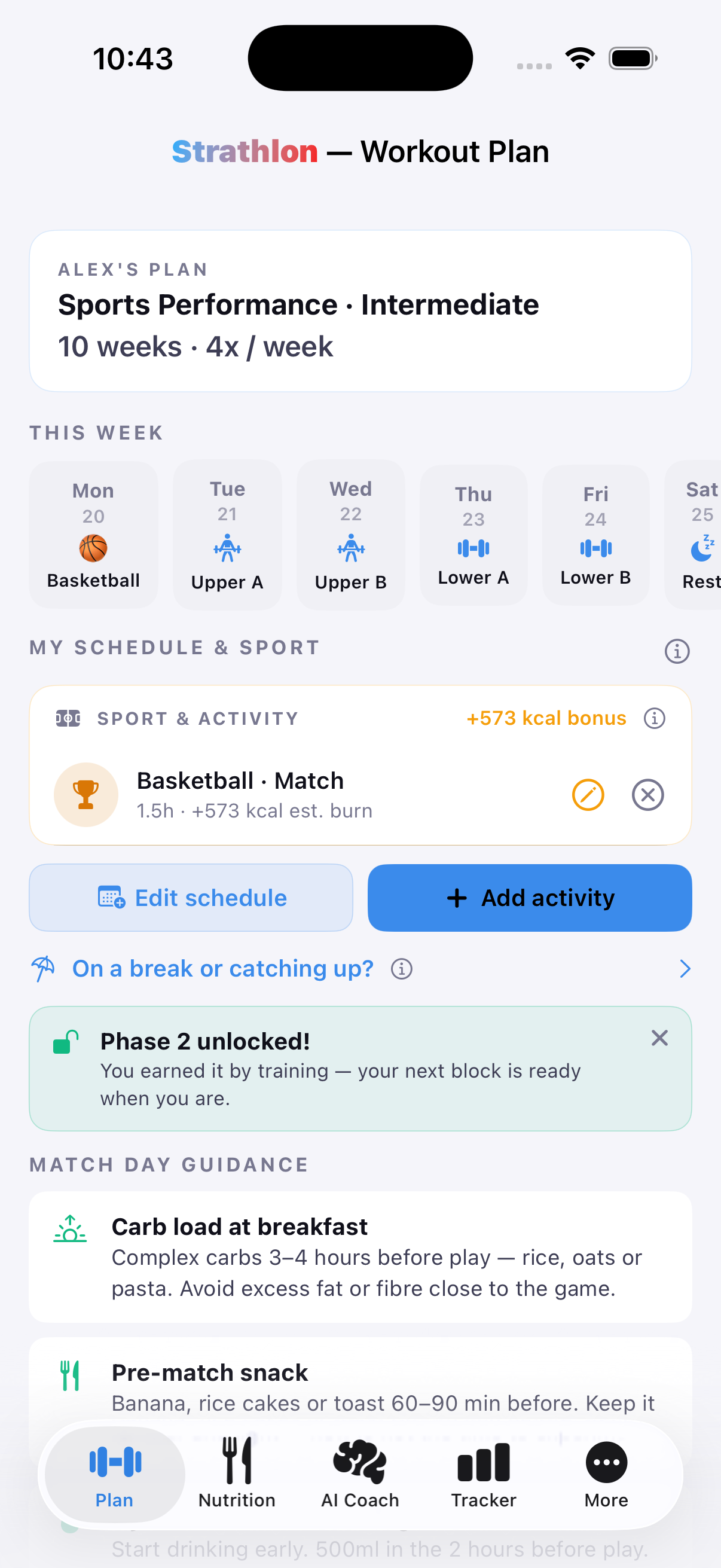
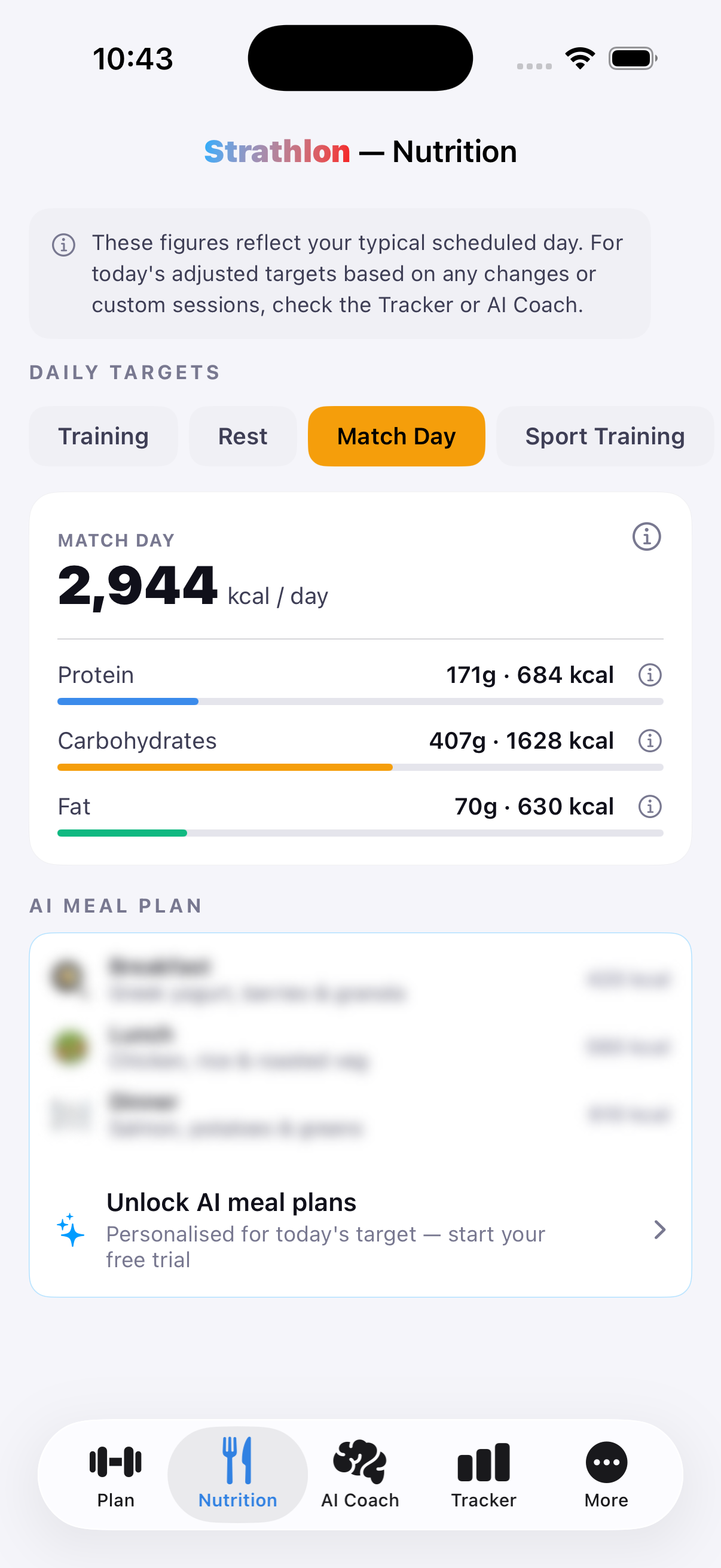
If you take one thing away: the same lower-body strength, single-leg and landing work that makes you a more explosive basketball player is also what keeps your ankles and knees intact, so training for performance and training for durability are mostly the same plan. Strathlon's job is to keep that plan in front of you: a complementary strength base with, once Sports Performance is one of your goals, basketball-tuned accessory work on top, with your lifts tracked so you can see them trend up.
Pair this with the basketball fuelling guide: how to eat and hydrate to power the repeat-sprint, high-jump demands above and recover between sessions and games.
References
Numbered sources for the specific figures, effect sizes and named studies above. Where a claim reflects agreed guidance rather than a single trial, the citation is to the position stand or consensus statement of the body concerned, with the country or international remit named. Basketball has good injury-prevention trial evidence, including cluster-randomised warm-up programmes, so the ankle and knee figures below are cited to the trials that produced them.
- Stojanović E, Faude O, Nikić M, Scanlan AT, Radovanović D, Jakovljević V. The incidence rate of ACL injuries and ankle sprains in basketball players: A systematic review and meta-analysis. Scandinavian Journal of Medicine & Science in Sports. 2023;33(6):790–813. Systematic review and meta-analysis of ACL injury and ankle sprain incidence in basketball players, the source for ankle sprains being the most common injury. PubMed 36752659
- Emery CA, Owoeye OBA, Räisänen AM, Befus K, Hubkarao T, Palacios-Derflingher L, et al. The "SHRed Injuries Basketball" Neuromuscular Training Warm-up Program Reduces Ankle and Knee Injury Rates by 36% in Youth Basketball. The Journal of Orthopaedic and Sports Physical Therapy. 2022;52(1):40–48. The SHRed Injuries Basketball neuromuscular training warm-up trial, the source for the 36% reduction in ankle and knee injury rates quoted. PubMed 34972488
- Stojanović E, Terrence Scanlan A, Radovanović D, Jakovljević V, Faude O. A multicomponent neuromuscular warm-up program reduces lower-extremity injuries in trained basketball players: a cluster randomized controlled trial. The Physician and Sportsmedicine. 2023;51(5):463–471. Cluster-randomised trial of a multicomponent neuromuscular warm-up reducing lower-extremity injuries in trained basketball players, the second trial behind the same claim. PubMed 36208619
- Petushek EJ, Sugimoto D, Stoolmiller M, Smith G, Myer GD. Evidence-Based Best-Practice Guidelines for Preventing Anterior Cruciate Ligament Injuries in Young Female Athletes: A Systematic Review and Meta-analysis. The American Journal of Sports Medicine. 2019;47(7):1744–1753. Petushek and colleagues' meta-analysis of ACL injury prevention in young female athletes, the direct source for neuromuscular programmes roughly halving ACL risk. PubMed 30001501 · PMC6592422 full text
- Schiftan GS, Ross LA, Hahne AJ. The effectiveness of proprioceptive training in preventing ankle sprains in sporting populations: a systematic review and meta-analysis. Journal of Science and Medicine in Sport. 2015;18(3):238–44. Schiftan and colleagues' meta-analysis of proprioceptive training and ankle sprains, the source for the roughly one-third reduction quoted. PubMed 24831756
- Ramirez-Campillo R, García-Hermoso A, Moran J, Chaabene H, Negra Y, Scanlan AT. The effects of plyometric jump training on physical fitness attributes in basketball players: A meta-analysis. Journal of Sport and Health Science. 2022;11(6):656–670. Ramirez-Campillo and colleagues' meta-analysis of plyometric jump training in basketball players specifically, the sport-specific version of the plyometric claim. PubMed 33359798 · PMC9729929 full text
- Barrera-Domínguez FJ, Martínez-García D, Jerez-Mayorga D, Chirosa-Ríos LJ, Almagro BJ, Molina-López J. Vertical Versus Horizontal Training for Improving the Change of Direction Speed in Adult Basketball Players: A Systematic Review and Meta-analysis. Journal of Strength and Conditioning Research. 2024;38(4):791–803. Systematic review of vertical versus horizontal training for change-of-direction speed in basketball, supporting the single-leg and deceleration emphasis. PubMed 38091370
- Antoranz Y, Alonso-Pérez-Chao E, Tejero-González CM, Salazar H, Del Campo-Vecino J, Jiménez-Sáiz SL. Understanding External Peak Demands in Elite vs. Non-Elite Male Basketball Players. Sports. 2025;13(6). Study of external peak demands in elite and non-elite male basketball players, the source for the repeat-sprint conditioning description. PubMed 40559691 · PMC12197028 full text
- Ochoa-Lácar J, Singh M, Bird SP, Charest J, Huyghe T, Calleja-González J. How Sleep Affects Recovery and Performance in Basketball: A Systematic Review. Brain Sciences. 2022;12(11). Systematic review of how sleep affects recovery and performance in basketball, cited in the recovery discussion. PubMed 36421894 · PMC9688068 full text
- Suchomel TJ, Nimphius S, Stone MH. The Importance of Muscular Strength in Athletic Performance. Sports Medicine. 2016;46(10):1419–49. Suchomel and colleagues on the importance of muscular strength in athletic performance, the source for greater maximal strength being associated with faster sprinting, jumping and change of direction, and with lower injury risk. PubMed 26838985
- Seitz LB, Reyes A, Tran TT, Saez de Villarreal E, Haff GG. Increases in lower-body strength transfer positively to sprint performance: a systematic review with meta-analysis. Sports Medicine. 2014;44(12):1693–702. Seitz and colleagues' systematic review with meta-analysis showing increases in lower-body strength transfer positively to sprint performance, the evidence behind the 'strength is the base' argument. PubMed 25059334
- Lauersen JB, Andersen TE, Andersen LB. Strength training as superior, dose-dependent and safe prevention of acute and overuse sports injuries: a systematic review, qualitative analysis and meta-analysis. British Journal of Sports Medicine. 2018;52(24):1557–1563. Lauersen and colleagues' meta-analysis finding strength training a superior, dose-dependent and safe prevention of acute and overuse sports injuries, the direct source for treating strength work as prehab. PubMed 30131332
- Lauersen JB, Bertelsen DM, Andersen LB. The effectiveness of exercise interventions to prevent sports injuries: a systematic review and meta-analysis of randomised controlled trials. British Journal of Sports Medicine. 2014;48(11):871–7. Lauersen and colleagues' earlier meta-analysis of exercise interventions to prevent sports injuries, the broader evidence base the prevention advice sits on. PubMed 24100287
- . American College of Sports Medicine position stand. Progression models in resistance training for healthy adults. Medicine and Science in Sports and Exercise. 2009;41(3):687–708. American College of Sports Medicine (ACSM, United States) position stand on progression models in resistance training, the source for the heavy-load and explosive-load percentage ranges quoted. PubMed 19204579
- Cuthbert M, Haff GG, Arent SM, Ripley N, McMahon JJ, Evans M, et al. Effects of Variations in Resistance Training Frequency on Strength Development in Well-Trained Populations and Implications for In-Season Athlete Training: A Systematic Review and Meta-analysis. Sports Medicine. 2021;51(9):1967–1982. Cuthbert and colleagues' systematic review of resistance-training frequency in well-trained populations, the source for the sessions-per-week guidance. PubMed 33886099 · PMC8363540 full text
- Spiering BA, Mujika I, Sharp MA, Foulis SA. Maintaining Physical Performance: The Minimal Dose of Exercise Needed to Preserve Endurance and Strength Over Time. Journal of Strength and Conditioning Research. 2021;35(5):1449–1458. Spiering and colleagues on the minimal dose of exercise needed to preserve endurance and strength, the source for maintaining in-season on as little as one to two sessions a week. PubMed 33629972
- Rønnestad BR, Nymark BS, Raastad T. Effects of in-season strength maintenance training frequency in professional soccer players. Journal of Strength and Conditioning Research. 2011;25(10):2653–60. Ronnestad and colleagues' trial of in-season strength maintenance frequency in professional footballers, the specific in-season maintenance result quoted. PubMed 21873897
- Nuzzo JL, Pinto MD, Kirk BJC, Nosaka K. Resistance Exercise Minimal Dose Strategies for Increasing Muscle Strength in the General Population: an Overview. Sports Medicine. 2024;54(5):1139–1162. Nuzzo and colleagues on minimal-dose resistance exercise strategies for increasing strength, supporting the claim that a small, well-chosen dose does most of the work. PubMed 38509414 · PMC11127831 full text
- Wilson JM, Marin PJ, Rhea MR, Wilson SM, Loenneke JP, Anderson JC. Concurrent training: a meta-analysis examining interference of aerobic and resistance exercises. Journal of Strength and Conditioning Research. 2012;26(8):2293–307. Wilson and colleagues' meta-analysis of concurrent training and the interference effect, the source for separating heavy lifting from hard conditioning. PubMed 22002517
- Schumann M, Feuerbacher JF, Sünkeler M, Freitag N, Rønnestad BR, Doma K, et al. Compatibility of Concurrent Aerobic and Strength Training for Skeletal Muscle Size and Function: An Updated Systematic Review and Meta-Analysis. Sports Medicine. 2022;52(3):601–612. An updated systematic review of the compatibility of concurrent aerobic and strength training, the more recent evidence that interference is smaller than once believed. PubMed 34757594 · PMC8891239 full text
- Ramirez-Campillo R, Sortwell A, Moran J, Afonso J, Clemente FM, Lloyd RS, et al. Plyometric-Jump Training Effects on Physical Fitness and Sport-Specific Performance According to Maturity: A Systematic Review with Meta-analysis. Sports Medicine - Open. 2023;9(1):23. Ramirez-Campillo and colleagues on plyometric-jump training effects on physical fitness and sport-specific performance, the source for the plyometric guidance. PubMed 37036542 · PMC10086091 full text
- Impellizzeri FM, Woodcock S, Coutts AJ, Fanchini M, McCall A, Vigotsky AD. What Role Do Chronic Workloads Play in the Acute to Chronic Workload Ratio? Time to Dismiss ACWR and Its Underlying Theory. Sports Medicine. 2021;51(3):581–592. Impellizzeri and colleagues on the pitfalls of the acute:chronic workload ratio, cited because it is the reason this guide talks about ramping load gradually rather than quoting a workload number. PubMed 33332011
- Baz-Valle E, Balsalobre-Fernández C, Alix-Fages C, Santos-Concejero J. A Systematic Review of The Effects of Different Resistance Training Volumes on Muscle Hypertrophy. Journal of Human Kinetics. 2022;81:199–210. Systematic review of resistance-training volume and hypertrophy, the general dose-response evidence behind the set and session recommendations. PubMed 35291645 · PMC8884877 full text
This is general educational information rather than medical or coaching advice. The sports-science and injury-prevention figures here are drawn from published research and are framed as population-level associations rather than guarantees: individual needs vary widely with training age, position, sex, injury history and recovery, and are best personalised with a qualified strength coach or clinician. Anyone with pain, a current or past injury, or a health condition, or who is pregnant or postpartum, should consult a suitably qualified professional before starting or changing a strength, plyometric or conditioning programme, and should seek assessment for any injury rather than training through it. See our Terms for more.
← All guides · Basketball fuelling · How muscle actually grows · Eating for results · Understanding your stats · Home