
Fuelling & performance nutrition for football (soccer)
An evidence-based guide to fuelling association football: the repeat-sprint game that quietly empties your fuel tank over 90 minutes. How muscle glycogen drains across a match, how to top it up before kick-off, what to take on at half-time, how to drink to a plan across a game, and how to put glycogen and muscle back afterwards. Practical, honest, and grounded in published sports-nutrition consensus.
In one sentence: a footballer fuels best by going into a match with well-stocked carbohydrate (glycogen) stores, topping up before and at half-time, drinking enough to avoid getting more than about 2% lighter, and refilling carbohydrate and protein straight after the final whistle. Football looks like an endurance sport (you might cover 10–12 km) but it's really a repeat-sprint sport, and that changes what "fuelling" means. The metres are jogged. The games are won and lost in the sprints, and it's your glycogen tank that pays for those.
Pair this with the football strength and conditioning guide for the training side: sprint and acceleration work, repeat-sprint conditioning and the hamstring, groin and ACL prehab that keeps players on the pitch.
On this page
- Why football drains fuel: the repeat-sprint game
- Topping up glycogen before a match
- The match-day fuelling timeline
- During the match and the half-time top-up
- Fluid and hydration across a match
- After the whistle: glycogen and protein recovery
- Two games close together, and tournaments
- Common questions
- Takeaways
- References
A framing note before the detail. The broad principles here are well-established in sports nutrition, but players differ enormously: position, size, playing time, the weather, fitness, age and individual metabolism all shift the numbers. Every figure below is a general guide drawn from published consensus, framed as can, tends to and around, never a promise, and it's written for the recreational and semi-serious player as much as the professional. It's general education rather than medical or personalised dietary advice.
Why football drains fuel: the repeat-sprint game
A match isn't run at a steady pace. Analyses of match play describe outfield players covering roughly 10–12 km over the 90 minutes[1][2], but stitched together from short efforts: one soccer review describes a sprint roughly every 90 seconds, and notes that over 300 accelerations and decelerations may occur in each half.[7] Each of those explosive efforts is powered largely by carbohydrate stored in the muscle as glycogen. That's the tank that matters in football, and it's not a big one.
The classic evidence for how fast it drains is striking. A much-cited study measured muscle glycogen at about 96 mmol/kg before a match, ~32 mmol/kg at half-time and ~9 mmol/kg by full time, close to empty.[3] More recent fibre-level work shows the same story with more detail: after a game, roughly two-thirds to three-quarters of individual muscle fibres are depleted of glycogen, including the fast fibres you rely on to sprint.[1][4] This is why the last 15 minutes so often decide games: as glycogen runs low, high-speed running and sprint distance fall, and depleted players simply can't produce the same explosive efforts.[4][5]
The practical takeaway is that football fuelling is mostly about protecting and replacing glycogen: going in full, sparing it during the game, and putting it back afterwards. Everything that follows is a way of doing one of those three things.
Topping up glycogen before a match
Football does not need the dramatic multi-day "carb-loading" ritual (the depletion runs followed by a big taper-week overfeed) that marathoners sometimes use. A 90-minute game empties a smaller, faster-refilling tank than a three-hour endurance race. What you want is simpler: arrive with full, but not stuffed, glycogen stores.
For a hard match day, the UEFA expert group statement on nutrition in elite football points to around 6–8 g of carbohydrate per kg of body weight across the day[5], and the joint Academy of Nutrition and Dietetics / Dietitians of Canada / ACSM position places moderate-to-high training loads (about 1–3 hours a day) in a similar 6–10 g/kg/day band, with roughly 5–7 g/kg/day covering general training needs.[6] For a 70 kg player, 6–8 g/kg works out to roughly 420–560 g of carbohydrate in the day: meals built around real portions of pasta, rice, potatoes, bread, oats and fruit, rather than a token amount.
The other half of loading is doing less the day before. An easier training day, or a rest day, lets the carbohydrate you eat bank as glycogen rather than being burned in training. For a big match, an easy day plus a couple of carbohydrate-rich days beforehand is all the "loading" most players need.
The match-day fuelling timeline
The day itself is really about timing familiar carbohydrate around kick-off. Here's a realistic timeline for an afternoon match, based on published guidance, treat the exact grams as illustrative and the pattern as the point.
| When | What | Rough amount | Why |
|---|---|---|---|
| Day before | Carbohydrate-rich meals, easy training | ~6–8 g/kg | Bank glycogen with lower training so it isn't burned off.[5] |
| 3–4 h before | Main pre-match meal, lower fat & fibre | ~1–3 g/kg carbs | Tops up glycogen and blood glucose, with time to digest (UEFA).[5] |
| ~1 h before | Small, familiar carb snack (optional) | ~30–60 g | A final top-up if you tolerate it well. |
| Warm-up | Sip fluid, optional carb drink | to thirst | Start the game well-hydrated rather than overloaded. |
| Half-time | Carb-electrolyte drink / gel | part of 30–60 g/h | Refuel and rehydrate for the second half.[5] |
| After full time | Carbs + protein + fluid | see recovery | Start refilling glycogen and repairing muscle. |
The one rule that overrides the table: practise it, don't experiment on match day. The pre-match meal should be food you've eaten before big efforts and know sits well. Lower-fat, lower-fibre choices 3–4 hours out tend to digest more comfortably and reduce the odds of a heavy stomach or a dash to the toilet mid-game.
During the match and the half-time top-up
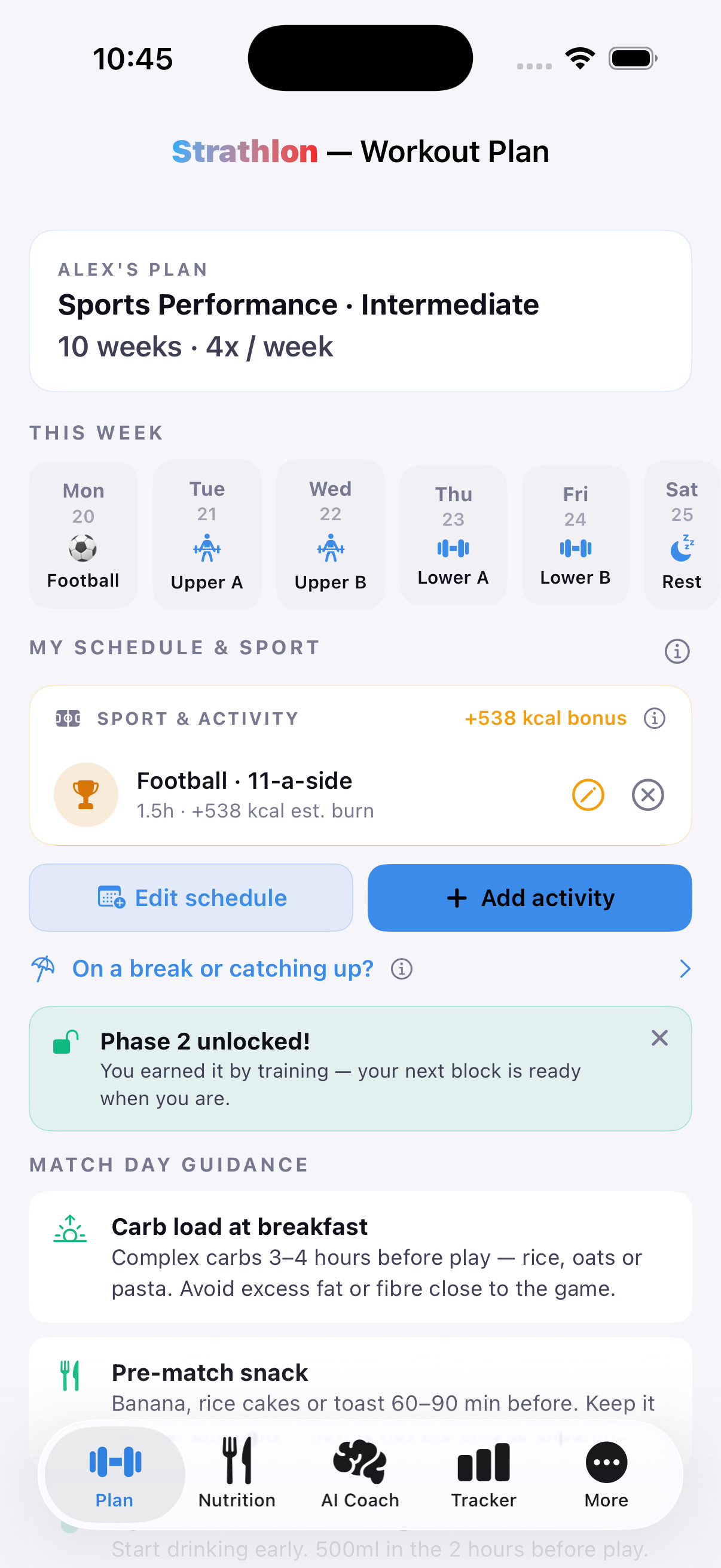
You can't refill glycogen mid-match, but you can slow its fall and keep blood glucose up by taking on carbohydrate during play. Soccer-specific reviews recommend around 30–60 g of carbohydrate per hour of match play (the same broad range the position stands give for exercise lasting one to a few hours) usually as a 6–8% carbohydrate-electrolyte drink.[5][6][7] In football the obvious window is half-time, plus the warm-up and any stoppages.[5]
The half-time top-up is one of the better-supported small wins in football nutrition. Studies reviewed for soccer link a half-time carbohydrate feed (and, separately, a brief re-warm-up rather than sitting cold for the full interval) with better dribbling, sprint and skill performance in the opening minutes of the second half, the period where a cold, fuel-dipped player is most exposed.[7][8] One study even found a more concentrated 12% carbohydrate solution taken as 250 mL boluses improved dribbling and self-paced performance.[9] For a short, casual kickabout, water is usually all you need. The 30–60 g/h figure is a recommendation for competitive match play.[7]
Fluid and hydration across a match
Football is played with few chances to drink, so hydration is largely won before and at half-time. Sweat losses vary hugely with the weather and the player: normative data across athletes put the average whole-body sweat rate in soccer at about 0.94 litres per hour[10], while a review of team-sport fluid balance reports soccer studies with mean rates spanning roughly 0.3–2.5 litres per hour.[11] Body-mass change over a game varies just as widely: that same review spans a small gain of 0.4% to a loss of 3.5% across studies, with losses beyond about 2% reported most often in high-calibre players in the heat.[11]
Why the 2% figure keeps coming up: it's the line the American College of Sports Medicine's fluid-replacement position stand draws for drinking during exercise: prevent a water deficit greater than 2% of body weight, so performance isn't compromised.[12] The team-sport evidence behind it is more mixed than the round number suggests: a review of hydration in team sports found the effects on skill and on cognition inconsistent, with performance impaired most reliably at larger deficits of around 3–4% and when the fluid loss came with heat stress, though ratings of fatigue and perceived exertion rose consistently.[11] So the practical goal isn't to drink as much as possible (over-drinking has its own risks) but to limit body-mass loss to under roughly 2%.[6][12] Drink to thirst plus a little at the warm-up, half-time and any breaks, and lean toward a carbohydrate-electrolyte drink rather than plain water when it's hot or the game is long, since the sodium helps you hold on to what you take in.
The single most useful habit is to weigh yourself before and after a match or hard training a few times. Each kilogram lost is roughly a litre of fluid, so it tells you your personal sweat rate and how aggressively you actually need to drink, which is far more reliable than any generic millilitre target.[6][12]
After the whistle: glycogen and protein recovery
A match leaves your muscles largely emptied of glycogen and with some fibre damage from all the sprinting, turning and tackling. Recovery nutrition has three jobs: refill glycogen, repair muscle, and rehydrate. How urgent it is depends on when you next play or train.
- Carbohydrate to refill glycogen. When recovery time is short (another match or hard session within a day or so) position stands suggest aggressive early refuelling of about 1–1.2 g of carbohydrate per kg of body weight per hour for the first few hours.[6] When you have longer, there's no need to force it: a carbohydrate-rich recovery day of roughly 5–7 g/kg does the job.[6][13] Either way, full glycogen restoration can take up to around 72 hours, and the fast fibres are especially slow to refill: which is why back-to-back games leave players progressively more depleted.[1][13]
- Protein to repair muscle. Pairing carbohydrate with protein supports muscle repair and remodelling. A practical target is around 0.3 g of protein per kg (roughly 20–25 g) soon after the game, then similar amounts across the following meals.[6][13] Across the day, athletes are generally guided toward about 1.2–2.0 g of protein per kg of body weight (football-specific guidance often sits around 1.3–1.8 g/kg).[6][13]
- Fluid and sodium to rehydrate. Because you also lose fluid in urine while rehydrating, replacing only what the scales say isn't quite enough. Guidance is to drink around 150% of the fluid lost over the hours after the game, with some sodium (from food or an electrolyte drink) to help you retain it.[6][13] The ~2% deficit typical after a match can usually be restored within about 6 hours.[13]
For a normal weekly rhythm with one match, you don't need to obsess over the clock: a proper meal with plenty of carbohydrate, some quality protein and fluids within a couple of hours covers it. The early-and-aggressive approach matters most when the next effort is close. For the broader picture on everyday eating around training, see eating for results.
Two games close together, and tournaments
Everything above gets more important when matches stack up: a Saturday-then-Tuesday week, a weekend tournament, or a cup replay. With full glycogen restoration taking up to around 72 hours, players heading into a second game within a day or two often start it already partly depleted, which shows up as reduced high-intensity running late on.[1][5]
The response is to front-load recovery: take carbohydrate and protein in early (leaning on the ~1–1.2 g/kg/hour early-refuel guidance), keep total daily carbohydrate high between games, and rehydrate deliberately with fluid and sodium.[5][6] In a tournament with several matches in a few days, this disciplined refuelling between games (rather than anything you do during them) is usually what separates players who stay sharp from those who fade. Extra-time periods and repeated matches raise the stakes further, making the half-time and post-match top-ups even more valuable.
Common questions
How many carbohydrates does a footballer need on match day?
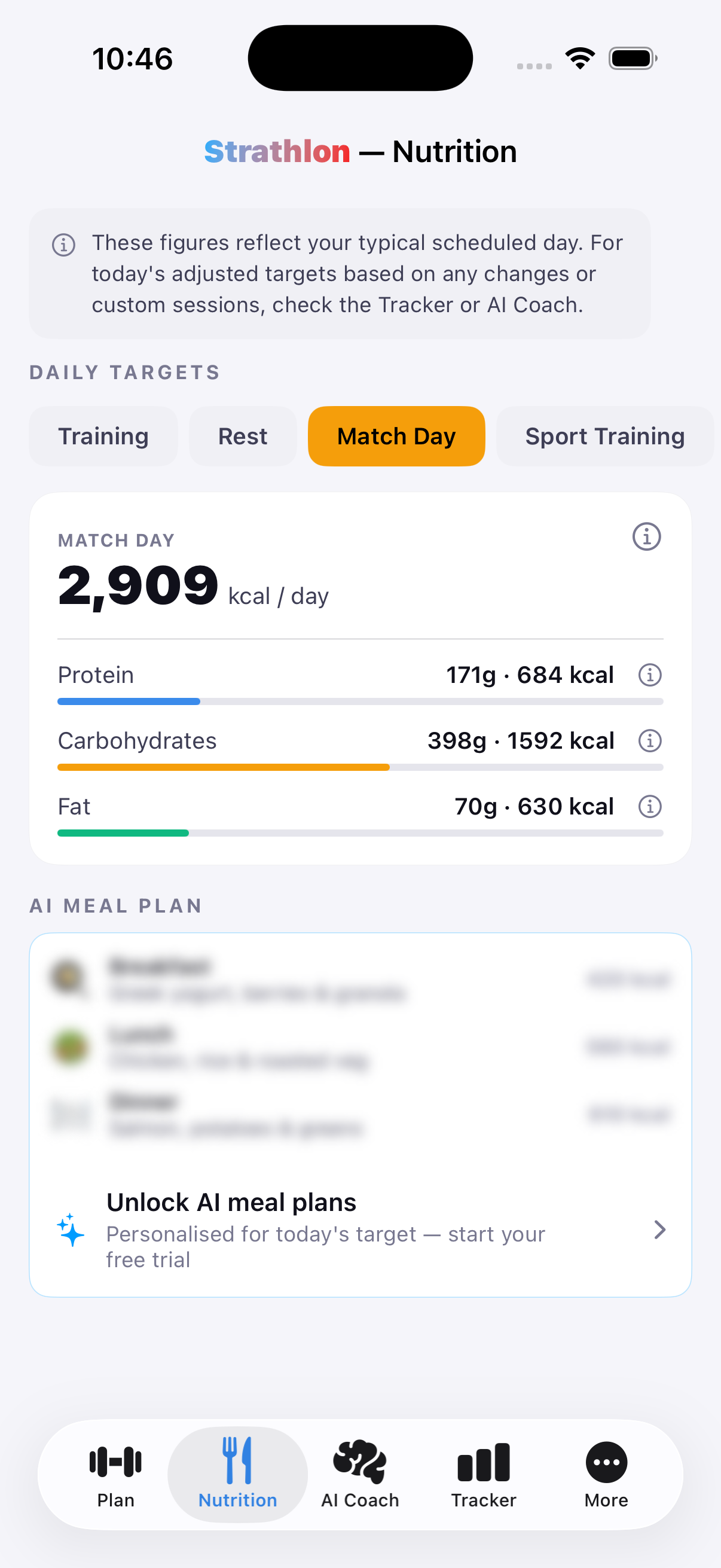
For a hard match day, expert guidance for elite football suggests around 6 to 8 g of carbohydrate per kg of body weight across the day, and general sports-nutrition position stands put moderate-to-high training loads in a similar 6 to 10 g/kg/day band.[5][6] For a 70 kg player that is roughly 420 to 560 g of carbohydrate. The aim is to start the game with well-stocked muscle glycogen, because football's repeated sprints draw heavily on it and low glycogen is linked with fatigue and slower play late on.[5]
What should I eat before a football match?
The UEFA expert group suggests a carbohydrate-rich meal providing around 1 to 3 g of carbohydrate per kg of body weight, eaten about 3 to 4 hours before kick-off, based on foods you tolerate well.[5] Think familiar, lower-fat, lower-fibre choices such as pasta, rice, potatoes, bread or oats with some lean protein. A smaller carbohydrate snack an hour or so before kick-off can top you up further. Keep it practised rather than experimental on match day.
Should I take on carbohydrate at half-time?
Yes, it tends to help. Reviews of carbohydrate for soccer recommend around 30 to 60 g of carbohydrate per hour of match play, and half-time is the main practical window to take some on, often as a 6 to 8 percent carbohydrate-electrolyte drink.[5][7] Studies have linked a half-time carbohydrate top-up, ideally paired with a brief re-warm-up, with better dribbling and sprint performance early in the second half.[7][8] For a short kickabout, water is usually enough: the 30 to 60 g/h figure is a recommendation for competitive match play.[7]
How much should I drink during a football match?
There is no single number because sweat rates vary widely, but normative data put the average whole-body sweat rate in soccer at about 0.94 litres per hour, and soccer studies have reported means anywhere from roughly 0.3 to 2.5 litres per hour.[10][11] The practical goal is to drink to limit body-mass loss to under about 2 percent, the deficit the American College of Sports Medicine position stand says to stay inside so performance isn't compromised, though the team-sport evidence behind it is mixed, with impairment showing up most reliably at larger deficits.[11][12] Use the warm-up, half-time and any breaks to drink to thirst plus a little, and weigh yourself before and after occasionally to learn your own sweat rate.
What should I eat after a game to recover?
Prioritise carbohydrate to refill glycogen and protein to support muscle repair, plus fluids. When another match or session is close, position stands suggest around 1 to 1.2 g of carbohydrate per kg per hour for the first few hours. Otherwise, a carbohydrate-rich recovery diet of about 5 to 7 g/kg across the day is a sensible aim.[6][13] Add roughly 0.3 g of protein per kg (about 20 to 25 g) soon after, and rehydrate with around 150 percent of the fluid you lost, with some sodium.[6][13] Full glycogen recovery can take up to around 72 hours.[1][13]
Does carbohydrate loading matter for a 90-minute match?
You do not need the extreme multi-day depletion-and-loading protocols used for marathons, but starting a match with topped-up glycogen does matter. A classic study found muscle glycogen fell from about 96 to 32 mmol/kg by half-time and to about 9 mmol/kg by full time, and low glycogen tracks with less sprinting late in games.[3][5] Simply eating plenty of carbohydrate in the day or two before, around 6 to 8 g/kg on the day, with an easier training day beforehand, is enough for most players.[5]
Takeaways
- Football is a repeat-sprint game. The sprints and duels that decide matches run on carbohydrate (glycogen), and that tank empties fast: from ~96 to ~9 mmol/kg across a game in the classic study.[3]
- Load sensibly rather than extremely. Aim for roughly 6–8 g of carbohydrate per kg on match day, with an easier training day beforehand, no marathon-style depletion rituals needed.[5]
- Time the pre-match meal. Around 1–3 g/kg of carbohydrate, 3–4 hours before kick-off, from familiar, lower-fat, lower-fibre foods, plus an optional small snack about an hour out.[5]
- Use half-time. Take on carbohydrate toward 30–60 g/h (a 6–8% drink), and do a brief re-warm-up, both are linked with a sharper start to the second half.[5][7][8]
- Drink to a plan. Keep body-mass loss under about 2%. Learn your sweat rate by weighing before and after, and add sodium when it's hot or the game is long.[12]
- Refuel fast when it counts. Carbohydrate (up to ~1–1.2 g/kg/h early if another game is near, or ~5–7 g/kg across the day otherwise), ~0.3 g/kg protein, and ~150% of fluid lost, full glycogen recovery can take up to ~72 hours.[6][13]
- Congested fixtures raise the stakes. Between two close games, front-load recovery aggressively. That's usually what keeps players sharp in tournaments.[5]
If you remember one thing, make it the shape of a match day: go in full, top up before and at half-time, drink to stay under about 2% down, and refill carbohydrate and protein straight after. Do that consistently and you protect the very efforts football is won with: the ones that come in the last 15 minutes when everyone else is running on empty.
References
Sources for the specific figures on this page. Where a number reflects established consensus rather than a single trial, the citation is to the relevant expert body’s position stand, with the country or region that body belongs to named: guidance is written by national and regional organisations, and no one country’s advice is universal. Where a source is produced or funded by a commercial interest, that is noted too.
- Mohr M, Vigh-Larsen JF, Krustrup P. Muscle glycogen in elite soccer – a perspective on the implication for performance, fatigue, and recovery. Frontiers in Sports and Active Living. 2022;4:876534. https://pmc.ncbi.nlm.nih.gov/articles/PMC9106100/
- Stølen T, Chamari K, Castagna C, Wisløff U. Physiology of soccer: an update. Sports Medicine. 2005;35(6):501–536. https://pubmed.ncbi.nlm.nih.gov/15974635/
- Saltin B. Metabolic fundamentals in exercise. Medicine and Science in Sports. 1973;5(3):137–146. https://pubmed.ncbi.nlm.nih.gov/4270581/
- Krustrup P, Mohr M, Steensberg A, Bencke J, Kjaer M, Bangsbo J. Muscle and blood metabolites during a soccer game: implications for sprint performance. Medicine & Science in Sports & Exercise. 2006;38(6):1165–1174. https://pubmed.ncbi.nlm.nih.gov/16775559/
- Collins J, Maughan RJ, Gleeson M, et al. UEFA expert group statement on nutrition in elite football. Current evidence to inform practical recommendations and guide future research. British Journal of Sports Medicine. 2021;55(8):416–442: Consensus statement of the Union of European Football Associations (UEFA, Europe). https://pubmed.ncbi.nlm.nih.gov/33097528/
- Thomas DT, Erdman KA, Burke LM. Position of the Academy of Nutrition and Dietetics, Dietitians of Canada, and the American College of Sports Medicine: nutrition and athletic performance. Journal of the Academy of Nutrition and Dietetics. 2016;116(3):501–528: Joint position stand of the Academy of Nutrition and Dietetics (United States), Dietitians of Canada (Canada) and the American College of Sports Medicine (ACSM, United States). https://pubmed.ncbi.nlm.nih.gov/26920240/
- Hills SP, Russell M. Carbohydrates for soccer: a focus on skilled actions and half-time practices. Nutrients. 2017;10(1):22. https://pmc.ncbi.nlm.nih.gov/articles/PMC5793250/
- Mohr M, Krustrup P, Nybo L, Nielsen JJ, Bangsbo J. Muscle temperature and sprint performance during soccer matches – beneficial effect of re-warm-up at half-time. Scandinavian Journal of Medicine & Science in Sports. 2004;14(3):156–162. https://pubmed.ncbi.nlm.nih.gov/15144355/
- Harper LD, Stevenson EJ, Rollo I, Russell M. The influence of a 12% carbohydrate-electrolyte beverage on self-paced soccer-specific exercise performance. Journal of Science and Medicine in Sport. 2017;20(12):1123–1129. https://pubmed.ncbi.nlm.nih.gov/28483560/
- Barnes KA, Anderson ML, Stofan JR, et al. Normative data for sweating rate, sweat sodium concentration, and sweat sodium loss in athletes: an update and analysis by sport. Journal of Sports Sciences. 2019;37(20):2356–2366: Peer-reviewed journal paper; the authors are employed by the Gatorade Sports Science Institute (United States), which is owned by PepsiCo. https://pubmed.ncbi.nlm.nih.gov/31230518/
- Nuccio RP, Barnes KA, Carter JM, Baker LB. Fluid balance in team sport athletes and the effect of hypohydration on cognitive, technical, and physical performance. Sports Medicine. 2017;47(10):1951–1982: Peer-reviewed review; the authors are employed by the Gatorade Sports Science Institute (United States), which is owned by PepsiCo. https://pmc.ncbi.nlm.nih.gov/articles/PMC5603646/
- American College of Sports Medicine; Sawka MN, Burke LM, Eichner ER, Maughan RJ, Montain SJ, Stachenfeld NS. American College of Sports Medicine position stand: exercise and fluid replacement. Medicine & Science in Sports & Exercise. 2007;39(2):377–390: Position stand of the American College of Sports Medicine (ACSM, United States). https://pubmed.ncbi.nlm.nih.gov/17277604/
- Res P. Recovery nutrition for football players. Sports Science Exchange. 2014;27(129):1–5: Published by the Gatorade Sports Science Institute (United States), the sports-science arm of PepsiCo, which owns Gatorade; not an independent or international body. https://www.gssiweb.org/sports-science-exchange/article/sse-129-recovery-nutrition-for-football-players
This is general educational information rather than medical, dietary or coaching advice. The principles described are well-established in broad terms, but individual variation is large, and figures are framed as tendencies and general ranges rather than certainties: any grams, percentages or timings are population-level guides rather than personalised prescriptions. Anyone with a health condition, who is pregnant or postpartum, who has a history of disordered eating, or who is unsure how to fuel for their situation, should consult a qualified professional (such as a registered dietitian) before changing their nutrition. See our Terms for more.
← All guides · Strength & conditioning for football (soccer) · Eating for results · Understanding your stats · Home