
Strength & conditioning for football (soccer)
An evidence-based guide to training the footballer's body away from the ball. Football is a repeat-sprint game: long stretches of low-intensity movement punctuated by the accelerations, sprints, jumps, tackles and sharp changes of direction that decide matches. This covers the heavy strength and explosive power that put force into those actions, the conditioning that lets you repeat them for 90 minutes, and the prehab that keeps hamstrings, groins, ankles and knees intact. Practical, honest, and grounded in sports-science and injury-prevention research.
Here's the short version: football rewards maximal lower-body strength and explosive power (the force behind sprinting, jumping and cutting), repeat-sprint conditioning on an aerobic base (so you can do it again and again late in the game), and the ability to decelerate and change direction without breaking down, all resting on a resilient posterior chain and single-leg control. Train those, protect the hamstrings and groin, and you have most of what strength & conditioning can offer a footballer.
On this page
A framing note before the detail. Sports science is well studied but people differ enormously: age, training history, position, sex, injury history and playing level all shift what's right for an individual. So this is written as can, tends to and is associated with, never as a guarantee, and every specific number is a population-level finding from published research rather than a personal prescription. It's general education rather than medical or individualised coaching advice.
The demands of football
Football looks like continuous running, but the tracking data tells a more useful story. Over a match an outfield player typically covers somewhere around 9–13 km, yet most of that is walking and jogging. What actually decides moments is the small fraction spent at high intensity: the high-speed runs, the flat-out sprints, and (often overlooked) the hundreds of accelerations and decelerations that GPS studies find occur more frequently than any other high-intensity action. Individual sprints are typically short and sharp: match-analysis work finds they rarely exceed about 20 metres or last more than roughly four seconds. Football is, in one phrase, a repeat-sprint sport: brief maximal efforts, incomplete recovery, done over and over.
That shapes the energy systems it draws on. Total energy is supplied predominantly by the aerobic system (average match intensity sits high, on the order of ~85% of maximum heart rate in the classic soccer studies) but the decisive actions are fuelled anaerobically, by the fast, powerful phosphocreatine and glycolytic pathways. A good footballer therefore needs a big aerobic engine to recover between efforts and the power to make each effort count. Neither alone is enough.
The demands also explain where football players get hurt. The lower limb dominates the injury tally, and the pattern is consistent across the literature:
- Hamstrings: the single most common injury in the men's professional game, driven by high-speed running and the eccentric load of decelerating the swinging leg.
- Groin / adductors: strained by cutting, kicking and rapid changes of direction.
- Ankle: sprains from tackles, landings and uneven contact.
- Knee (ACL): the most serious common injury, typically from non-contact cutting and landing, and markedly more frequent in female players.
- References
The UEFA Elite Club Injury Study, which has tracked elite European men's teams since 2001, reports that hamstring injuries have risen over two decades and now make up around 24% of all time-loss injuries: nearly one in four. That single statistic is why so much of a footballer's gym time is, quietly, hamstring insurance.
Key strength work, and why it matters
Everything explosive a footballer does (the first two steps of a sprint, the leap for a header, the plant and push-off of a cut) is a problem of putting force into the ground quickly. Strength training is how you raise the ceiling on that force, and power and plyometric work is how you learn to express it fast. Systematic reviews in soccer players are encouraging here: strength, plyometric and combined training all produce moderate improvements in jumping, acceleration and change-of-direction speed (typical effect sizes in the moderate range), with strength training the strongest driver of lower-body strength itself. The lifts below each earn their place by transferring to a specific on-pitch quality.
| Movement | Examples | Why it transfers to football |
|---|---|---|
| Heavy squat | Back squat, front squat | Builds maximal lower-body force: the base under sprinting and jumping. |
| Heavy hinge | Deadlift, Romanian deadlift, hip thrust | Loads the posterior chain (glutes, hamstrings) that drives horizontal acceleration. |
| Plyometrics | Bounds, hurdle hops, drop jumps | Trains reactive strength: fast ground contacts, as in sprinting and cutting. |
| Single-leg | Split squat, step-up, single-leg RDL | Football is played on one leg at a time. Builds change-of-direction control. |
| Eccentric hamstring | Nordic curl | Strengthens the hamstring in its injury-prone lengthened position. |
| Adductor | Copenhagen adduction | Builds groin strength for cutting, kicking and lateral control. |
Maximal strength (squat and hinge). The foundation is heavy, low-rep strength work on big multi-joint lifts. Standard strength-and-conditioning guidance places maximal-strength training in the heavy-load, low-rep zone (broadly loads at or above ~85% of your one-rep max for sets of around six reps or fewer), for a handful of hard sets. The point isn't to become a powerlifter. It's that a stronger athlete can produce more force in the split-second a sprint step or a jump allows. Because strength is the quality that most reliably improves in soccer training studies, and because it feeds power and speed downstream, it belongs at the centre of the plan.
Plyometrics (reactive strength). Heavy lifting builds the force. Plyometrics teach you to apply it in the roughly 0.1–0.2 seconds a fast ground contact lasts. Jump, bound and hop drills are well supported in soccer: meta-analyses show plyometric training improves jump, sprint and change-of-direction performance, with review-level programmes commonly running around two sessions a week and on the order of 140–240 foot contacts per week over blocks longer than about seven weeks. Include both vertical (drop jumps, hurdle hops) and horizontal (bounds) variations, because acceleration is a horizontal-force problem.
Single-leg strength. Football is almost never played on two legs at once. Split squats, step-ups and single-leg Romanian deadlifts build the unilateral strength and control that a bilateral barbell squat can miss: directly relevant to accelerating, decelerating and cutting off one leg, and to ironing out left–right imbalances that can raise injury risk.
Sprint mechanics and acceleration. The most specific way to get better at sprinting is to sprint: short, maximal accelerations with full recovery, on the pitch. This is also protective: regular exposure to high-speed running means match-day sprinting isn't a sudden shock to an unprepared hamstring. Treat sprint work as training in its own right, done fresh. It doesn't belong as conditioning filler tacked onto the end of a tiring session.
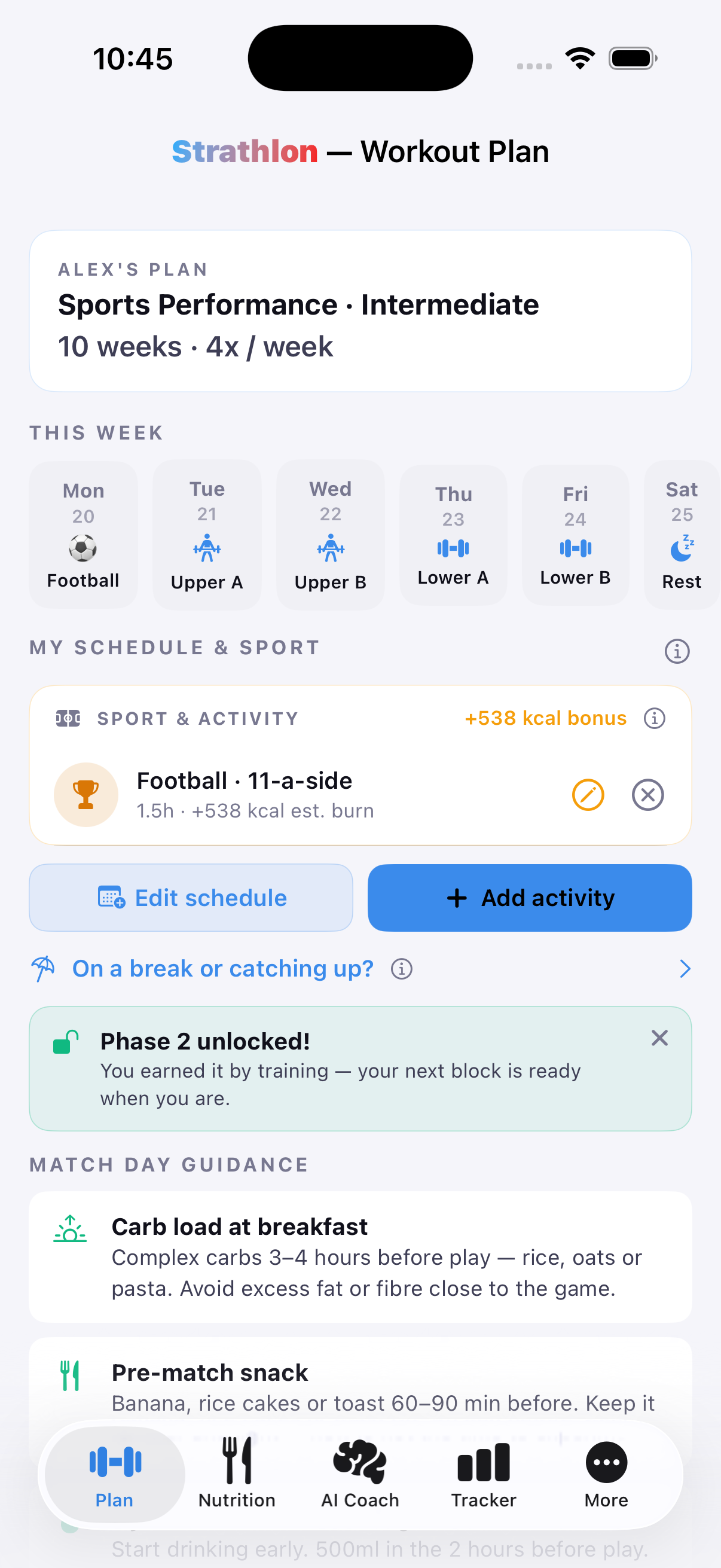
That figure is the whole idea in one screen. The sport-specific block (the football accessory work) is what makes the plan a footballer's plan rather than a generic gym routine: it prioritises the posterior chain, single-leg control and explosive qualities the sport leans on. But it only works because it sits on top of a complementary base of heavy squat and hinge strength and the conditioning below. The accessory block gives you football-specific resilience and power. The base gives you the raw force and the aerobic engine to express it. Neither half is optional: the sport-specific work without the base is a house with no foundation, and the base without the sport-specific work leaves obvious football qualities untrained.
Conditioning for football
Strength gives you a powerful sprint. Conditioning lets you produce it in minute 85 as well as minute 5. Football conditioning has two jobs: build the aerobic base that clears fatigue between efforts, and sharpen repeat-sprint ability: the capacity to do near-maximal efforts with short rest without fading.
Aerobic base and high-intensity intervals. A large aerobic engine is what lets you recover between sprints and cover ground late in a game. High-intensity interval training is the efficient tool: in a well-known soccer study, Helgerud and colleagues had players do four sets of four minutes at 90–95% of maximum heart rate, with three-minute jogs between, twice a week for eight weeks. The trained group improved VO2max by around 10%, and (the part that matters) covered 20% more distance in a match and performed roughly twice as many sprints, with no change in the control group. That's aerobic fitness translating directly into football output.
Repeat-sprint and small-sided games. Because football is a repeat-sprint sport, it helps to train that quality directly. Field-based repeated-sprint training (sets of short maximal sprints with brief recovery) is shown in meta-analysis to improve sprint speed, repeat-sprint ability, change-of-direction and high-intensity running. Small-sided games (say 4-v-4 on a compact pitch) achieve much of the same conditioning while keeping the ball involved, which is why coaches lean on them: they blend the aerobic and anaerobic stress with the technical and decision-making demands of the real game.
Fitting strength and conditioning together. Training strength and endurance at the same time can produce a modest interference effect: hard endurance work can slightly blunt strength and power gains if the two are piled on top of each other. The practical fixes are simple: separate hard running and heavy lifting onto different days where you can, or leave several hours between them; do the quality you care about most while you're freshest; and don't try to build maximum strength, maximum speed and maximum endurance all in the same crowded week. For most amateur footballers, doing too much of everything at once is the bigger risk, well ahead of interference itself.
Staying injury-resilient
Prehab is where sports science has some of its clearest wins for footballers, but it only pays out if you actually keep doing it, and the honest framing is risk reduction: it lowers the odds without guaranteeing an outcome. Here are the best-supported targets for football's four signature injuries.
Hamstring: the Nordic curl. Since hamstring strains are the most common injury in the men's professional game, this is the highest-value prehab there is. A meta-analysis of over 8,000 athletes by Van Dyk and colleagues found that including the Nordic hamstring exercise in injury-prevention programmes was associated with roughly halving the rate of hamstring injuries (a risk ratio near 0.5). That's a large effect for a single exercise. In the interest of honesty, a later methodological reappraisal argued the true protective effect is less certain than that headline suggests, so treat Nordic curls as a strongly-associated, low-cost benefit worth doing, well short of a cast-iron guarantee. Build them in gradually. They are humbling at first and can leave you very sore if you rush.
Groin: the Copenhagen adduction exercise. Adductor strains are among football's most common complaints, and adductor strengthening has good trial evidence. A cluster-randomised trial in male footballers by Harøy and colleagues found an adductor-strengthening programme built around the Copenhagen adduction exercise was associated with around a 41% lower risk of groin problems across a season. Like the Nordic curl, it's deceptively demanding, so progress it slowly from a shortened-lever version.
Ankle and knee: neuromuscular training. Structured neuromuscular warm-up programmes (the best known is FIFA 11+, a ~20-minute routine of running, strength, plyometric and balance drills), reduce injuries across the board. Meta-analyses of randomised trials associate FIFA 11+ with roughly a 30% reduction in overall injuries and meaningful reductions in knee and ankle injuries specifically. For the ACL (football's most feared injury, and notably more common in women) neuromuscular training programmes that emphasise landing mechanics, deceleration and change-of-direction control are associated with roughly a halving of ACL injuries in female athletes in pooled analyses. The recurring lesson across all of this research is that compliance is the active ingredient: the programmes work when teams actually do them consistently, and stop working when they don't.
Programming it around your season
Football's calendar makes S&C a scheduling problem as much as a training one. The season splits into phases, and the goal shifts with each.
- Off-season / pre-season: build. This is when you develop qualities, because there are no matches to protect and recovery is easier. Prioritise heavy maximal-strength work, introduce and progress plyometrics, build the aerobic base with intervals, and lay in the prehab (Nordic curls, Copenhagen adduction) while there's time to progress it. Two to three strength sessions a week is realistic here.
- In-season: maintain. Now matches and pitch training dominate, and the gym's job switches from building to preserving. The reassuring evidence is that maintaining strength is far easier than building it: research on training frequency indicates that as little as one well-designed strength session a week can maintain strength gains through the season, and a study in professional male footballers found a single autoregulated weekly session maintained physical and match-running performance. So keep the loads reasonably heavy, cut the volume hard (a couple of quality sets on the lifts that matter most), keep the prehab ticking over at roughly once weekly, and let the pitch supply most of the conditioning.
- Around matches: respect fatigue. Put your heaviest gym work on the days furthest from a match, keep the day before a game light, and don't chase a strength personal best in a congested fixture week. The aim in-season is to arrive fresh for matches.
A realistic amateur template might be: in pre-season, two to three gym sessions plus interval/running conditioning; in-season, one to two short strength-and-prehab sessions slotted around two or three football sessions and a match, leaning on the game itself for much of the aerobic and repeat-sprint load. The exact split depends on your fixtures, your recovery and your body, which is where an adaptable plan earns its keep.
Common questions
What's the single most important strength exercise for footballers?
There isn't one magic lift, but if you had to pick a foundation it's a heavy lower-body strength movement (a squat or a hinge, such as deadlift, hip thrust, or Romanian deadlift) because maximal lower-body strength underpins the force you put into the ground when you accelerate, jump and change direction. Systematic reviews in soccer players find that strength, plyometric and combined training all produce moderate improvements in jumping, acceleration and change-of-direction performance. For injury protection specifically, the Nordic hamstring curl is the standout addition. In practice you want both: a heavy squat or hinge for force, plus Nordic curls and single-leg work to make that force resilient and directable.
Will lifting weights make me slower or too bulky for football?
This is one of the most persistent myths in football and the evidence points the other way. Meta-analyses of strength and plyometric training in soccer players report gains in sprint acceleration, jump height and change-of-direction speed, the opposite of what the myth predicts. Getting stronger lets you apply more force to the ground in the short windows a sprint or cut allows, which tends to make you faster. Meaningful muscle bulk is slow and deliberate to build and is further blunted by the large running volume of football training, so accidental bulk that harms performance is not a realistic outcome of a sensible programme. The players who lift well are usually the explosive ones.
How do I reduce my risk of a hamstring injury?
Hamstring strains are the single most common injury in men's professional football, so this matters. The best-supported specific intervention is the Nordic hamstring exercise: a meta-analysis of over 8,000 athletes by Van Dyk and colleagues found that including it in injury-prevention programmes roughly halved the rate of hamstring injuries. Honesty requires noting that a later methodological reappraisal argued the true protective effect is less certain than that headline, so treat it as a strongly associated benefit rather than a guarantee. Alongside Nordic curls, regular exposure to high-speed running (so sprinting isn't a shock), sensible load management and eccentric and single-leg strength all help build a hamstring that tolerates the sport.
How many strength sessions a week do I need to keep my gains in-season?
Less than most people fear. The evidence on training frequency suggests that once you've built strength in pre-season, as little as one well-designed strength session per week can maintain it through the competitive season, and one to two quality sessions is a realistic target around matches and practice. A study in professional male footballers found that a single autoregulated weekly strength session maintained physical and match-running performance across the season. Maintaining strength is far easier than building it, so in-season you keep the loads reasonably heavy but cut the volume: a couple of hard sets on the lifts that matter most, fitted on a day that doesn't clash with a match or the heaviest pitch work.
How should I train my conditioning without wrecking my strength?
Football's engine is repeat-sprint ability sitting on top of a solid aerobic base, so both matter. High-intensity interval work is efficient: a classic soccer study by Helgerud and colleagues used four sets of four minutes at 90–95% of maximum heart rate, twice a week, and saw a roughly 10% rise in VO2max, a 20% increase in distance covered in a match and a doubling of sprints. Small-sided games and field-based repeated-sprint drills build the same qualities in a football-specific way. To limit interference with strength, keep hard running and heavy lifting on separate days or well apart within a day, do the quality you care about most when you're freshest, and don't try to peak everything in the same week.
What can I do about recurring groin (adductor) strains?
Groin problems are among the most common complaints in football, and adductor strengthening has good evidence behind it. A cluster-randomised trial in male footballers by Harøy and colleagues found that an adductor-strengthening programme built around the Copenhagen adduction exercise was associated with around a 41% lower risk of groin problems over a season. The practical recipe is to build the exercise in gradually (it is deceptively hard) starting in pre-season a few times a week and dropping to roughly once weekly for maintenance during the season. As with all prehab, it works only if you actually keep doing it. Adherence is the real active ingredient.
Takeaways
- Football is a repeat-sprint sport. Brief maximal efforts (sprints, jumps, cuts, hundreds of accelerations and decelerations) decide matches, on top of an aerobic base that lets you repeat them.
- Build force with heavy squat and hinge. Maximal lower-body strength (heavy loads, low reps) is the base under sprinting and jumping, and the quality that most reliably improves in soccer training studies.
- Add plyometrics and single-leg work. Reactive strength and unilateral control turn raw force into fast, directable, football-specific power.
- Sprint to get faster. Short maximal accelerations done fresh both build speed and prepare the hamstring for match-day sprinting.
- Condition with intervals and small-sided games. HIIT (e.g. 4×4 min at 90–95% HRmax) and repeated-sprint work build the engine that carries your power to minute 90.
- Protect the hamstrings and groin. Nordic curls are associated with roughly halving hamstring injuries. Copenhagen adduction is linked to around 41% fewer groin problems, if you keep doing them.
- Warm up to protect knees and ankles. Neuromuscular programmes like FIFA 11+ are associated with ~30% fewer injuries overall and about half the ACL risk in female players. Compliance is the active ingredient.
- Build off-season, maintain in-season. As little as one quality strength session a week can maintain strength during the season: keep it heavy, cut the volume, respect match fatigue.
If you take one thing away, make it the balance: the football-specific block (the accessory work that targets your hamstrings, groin, single-leg control and explosive power) is what makes a plan a footballer's plan, but it only works sitting on a base of heavy strength and real conditioning. Train both, protect the tissues football punishes most, and keep showing up. Strathlon's role is to tune that balance toward your sport (with Sports Performance as one of your goals) and keep your lifts and targets honest, so the plan adapts to you rather than the other way around.
References
Numbered sources for the specific figures, effect sizes and named studies above. Where a claim reflects agreed guidance rather than a single trial, the citation is to the position stand or consensus statement of the body concerned, with the country or international remit named. Football has the largest sports-science literature of any team sport, so almost every figure below is cited to football-specific research or to a trial run in footballers.
- Filter A, Olivares-Jabalera J, Dos'Santos T, Madruga M, Lozano J, Molina A, et al. High-intensity Actions in Elite Soccer: Current Status and Future Perspectives. International Journal of Sports Medicine. 2023;44(8):535–544. Review of high-intensity actions in elite football: the source for the sprint, acceleration and repeat-effort demands described. PubMed 37130547
- van Dyk N, Behan FP, Whiteley R. Including the Nordic hamstring exercise in injury prevention programmes halves the rate of hamstring injuries: a systematic review and meta-analysis of 8459 athletes. British Journal of Sports Medicine. 2019;53(21):1362–1370. Meta-analysis finding injury-prevention programmes including the Nordic hamstring exercise halve hamstring injury rates, the direct source for the roughly-halving figure. PubMed 30808663
- Al Attar WSA, Soomro N, Sinclair PJ, Pappas E, Sanders RH. Effect of Injury Prevention Programs that Include the Nordic Hamstring Exercise on Hamstring Injury Rates in Soccer Players: A Systematic Review and Meta-Analysis. Sports Medicine. 2017;47(5):907–916. Earlier meta-analysis of Nordic-hamstring prevention programmes in footballers specifically, the sport-specific version of the same result. PubMed 27752982
- Cuthbert M, Ripley N, McMahon JJ, Evans M, Haff GG, Comfort P. The Effect of Nordic Hamstring Exercise Intervention Volume on Eccentric Strength and Muscle Architecture Adaptations: A Systematic Review and Meta-analyses. Sports Medicine. 2020;50(1):83–99. Study of Nordic hamstring intervention volume on eccentric strength and muscle architecture, the source for the dose behind the effect. PubMed 31502142 · PMC6942028 full text
- Olsen OE, Myklebust G, Engebretsen L, Holme I, Bahr R. Exercises to prevent lower limb injuries in youth sports: cluster randomised controlled trial. BMJ. 2005;330(7489):449. Olsen and colleagues' cluster-randomised trial of exercises to prevent lower-limb injuries in youth sport, the origin of the structured neuromuscular warm-up. PubMed 15699058 · PMC549653 full text
- Mayo M, Seijas R, Alvarez P. Structured neuromuscular warm-up for injury prevention in young elite football players. Revista Espanola de Cirugia Ortopedica Y Traumatologia. 2014;58(6):336–42. Study of a structured neuromuscular warm-up for injury prevention in young elite football players, the football-specific application. PubMed 25048272
- Jiang Z, Hao Y, Jin N, Li Y. A Systematic Review of the Relationship between Workload and Injury Risk of Professional Male Soccer Players. International Journal of Environmental Research and Public Health. 2022;19(20). Systematic review of the relationship between workload and injury risk in professional male footballers, the basis for the load-management advice. PubMed 36293817 · PMC9602492 full text
- Zheng T, Kong R, Liang X, Huang Z, Luo X, Zhang X, et al. Effects of plyometric training on jump, sprint, and change of direction performance in adolescent soccer player: A systematic review with meta-analysis. PloS One. 2025;20(4):e0319548. Systematic review of plyometric training on jump, sprint and change-of-direction performance in football players, the sport-specific plyometric evidence. PubMed 40300007 · PMC12040276 full text
- He Z, Duan T, Li D, Zhang X. Effects of resisted sprint training on agility and change-of-direction performance in soccer players: a systematic review with meta-analysis. PeerJ. 2025;13:e20084. Systematic review of resisted sprint training on agility and change-of-direction performance in footballers, supporting the speed work prescribed. PubMed 41146995 · PMC12554313 full text
- Ramirez-Campillo R, Moran J, Oliver JL, Pedley JS, Lloyd RS, Granacher U. Programming Plyometric-Jump Training in Soccer: A Review. Sports. 2022;10(6). Review of programming plyometric-jump training in football, the practical dosing behind the same recommendation. PubMed 35736834 · PMC9230747 full text
- Suchomel TJ, Nimphius S, Stone MH. The Importance of Muscular Strength in Athletic Performance. Sports Medicine. 2016;46(10):1419–49. Suchomel and colleagues on the importance of muscular strength in athletic performance: the source for greater maximal strength being associated with faster sprinting, jumping and change of direction, and with lower injury risk. PubMed 26838985
- Seitz LB, Reyes A, Tran TT, Saez de Villarreal E, Haff GG. Increases in lower-body strength transfer positively to sprint performance: a systematic review with meta-analysis. Sports Medicine. 2014;44(12):1693–702. Seitz and colleagues' systematic review with meta-analysis showing increases in lower-body strength transfer positively to sprint performance, the evidence behind the 'strength is the base' argument. PubMed 25059334
- Lauersen JB, Andersen TE, Andersen LB. Strength training as superior, dose-dependent and safe prevention of acute and overuse sports injuries: a systematic review, qualitative analysis and meta-analysis. British Journal of Sports Medicine. 2018;52(24):1557–1563. Lauersen and colleagues' meta-analysis finding strength training a superior, dose-dependent and safe prevention of acute and overuse sports injuries: the direct source for treating strength work as prehab. PubMed 30131332
- Lauersen JB, Bertelsen DM, Andersen LB. The effectiveness of exercise interventions to prevent sports injuries: a systematic review and meta-analysis of randomised controlled trials. British Journal of Sports Medicine. 2014;48(11):871–7. Lauersen and colleagues' earlier meta-analysis of exercise interventions to prevent sports injuries, the broader evidence base the prevention advice sits on. PubMed 24100287
- . American College of Sports Medicine position stand. Progression models in resistance training for healthy adults. Medicine and Science in Sports and Exercise. 2009;41(3):687–708. American College of Sports Medicine (ACSM, United States) position stand on progression models in resistance training: the source for the heavy-load and explosive-load percentage ranges quoted. PubMed 19204579
- Cuthbert M, Haff GG, Arent SM, Ripley N, McMahon JJ, Evans M, et al. Effects of Variations in Resistance Training Frequency on Strength Development in Well-Trained Populations and Implications for In-Season Athlete Training: A Systematic Review and Meta-analysis. Sports Medicine. 2021;51(9):1967–1982. Cuthbert and colleagues' systematic review of resistance-training frequency in well-trained populations, the source for the sessions-per-week guidance. PubMed 33886099 · PMC8363540 full text
- Spiering BA, Mujika I, Sharp MA, Foulis SA. Maintaining Physical Performance: The Minimal Dose of Exercise Needed to Preserve Endurance and Strength Over Time. Journal of Strength and Conditioning Research. 2021;35(5):1449–1458. Spiering and colleagues on the minimal dose of exercise needed to preserve endurance and strength: the source for maintaining in-season on as little as one to two sessions a week. PubMed 33629972
- Rønnestad BR, Nymark BS, Raastad T. Effects of in-season strength maintenance training frequency in professional soccer players. Journal of Strength and Conditioning Research. 2011;25(10):2653–60. Ronnestad and colleagues' trial of in-season strength maintenance frequency in professional footballers, the specific in-season maintenance result quoted. PubMed 21873897
- Nuzzo JL, Pinto MD, Kirk BJC, Nosaka K. Resistance Exercise Minimal Dose Strategies for Increasing Muscle Strength in the General Population: an Overview. Sports Medicine. 2024;54(5):1139–1162. Nuzzo and colleagues on minimal-dose resistance exercise strategies for increasing strength, supporting the claim that a small, well-chosen dose does most of the work. PubMed 38509414 · PMC11127831 full text
- Wilson JM, Marin PJ, Rhea MR, Wilson SM, Loenneke JP, Anderson JC. Concurrent training: a meta-analysis examining interference of aerobic and resistance exercises. Journal of Strength and Conditioning Research. 2012;26(8):2293–307. Wilson and colleagues' meta-analysis of concurrent training and the interference effect: the source for separating heavy lifting from hard conditioning. PubMed 22002517
- Schumann M, Feuerbacher JF, Sünkeler M, Freitag N, Rønnestad BR, Doma K, et al. Compatibility of Concurrent Aerobic and Strength Training for Skeletal Muscle Size and Function: An Updated Systematic Review and Meta-Analysis. Sports Medicine. 2022;52(3):601–612. An updated systematic review of the compatibility of concurrent aerobic and strength training, the more recent evidence that interference is smaller than once believed. PubMed 34757594 · PMC8891239 full text
- Ramirez-Campillo R, Sortwell A, Moran J, Afonso J, Clemente FM, Lloyd RS, et al. Plyometric-Jump Training Effects on Physical Fitness and Sport-Specific Performance According to Maturity: A Systematic Review with Meta-analysis. Sports Medicine - Open. 2023;9(1):23. Ramirez-Campillo and colleagues on plyometric-jump training effects on physical fitness and sport-specific performance, the source for the plyometric guidance. PubMed 37036542 · PMC10086091 full text
- Impellizzeri FM, Woodcock S, Coutts AJ, Fanchini M, McCall A, Vigotsky AD. What Role Do Chronic Workloads Play in the Acute to Chronic Workload Ratio? Time to Dismiss ACWR and Its Underlying Theory. Sports Medicine. 2021;51(3):581–592. Impellizzeri and colleagues on the pitfalls of the acute:chronic workload ratio: cited because it is the reason this guide talks about ramping load gradually rather than quoting a workload number. PubMed 33332011
- Baz-Valle E, Balsalobre-Fernández C, Alix-Fages C, Santos-Concejero J. A Systematic Review of The Effects of Different Resistance Training Volumes on Muscle Hypertrophy. Journal of Human Kinetics. 2022;81:199–210. Systematic review of resistance-training volume and hypertrophy, the general dose-response evidence behind the set and session recommendations. PubMed 35291645 · PMC8884877 full text
Pair this with the football fuelling guide: how to eat and hydrate around training and matches, so the work in the gym and on the pitch actually sticks.
This is general educational information rather than medical, physiotherapy or individualised coaching advice. The sports-science and injury-prevention figures here are drawn from published research and are framed as population-level associations: individual responses vary widely with age, history, position, sex and health, and injury-reduction effects are risk reductions rather than guarantees. Anyone with a current injury, pain, or a health condition, or who is pregnant or postpartum, should consult a qualified strength & conditioning coach, physiotherapist or physician before starting or changing a training programme. See our Terms for more.
← All guides · Football fuelling guide · Eating for results · How muscle actually grows · Recovery & rest · Home