
Fuelling & performance nutrition for gymnastics
An evidence-based guide to fuelling the gymnast's body. Gymnastics is a strength-to-weight power and skill sport, and its most important nutrition story is the quiet, serious risk of eating too little, rather than a clever race-day trick. This guide leads with that: why fuelling enough comes first, what low energy availability and RED-S do to bone, hormones and the menstrual cycle, the extra care young athletes need, and only then the everyday carbohydrate, protein and hydration that support power and skill work. Honest, supportive, and grounded in established sports-nutrition consensus.
Here's the short answer to "how should a gymnast fuel?": the priority is eating enough rather than restricting. Take in enough total energy and carbohydrate to cover long power-and-skill sessions and, for young athletes, growth: roughly 3–7 g of carbohydrate per kilogram of body weight a day depending on the day, around 1.2–2.0 g/kg of protein for strength and repair, and steady hydration[1], while protecting bone health and, for those who menstruate, a normal cycle. In a weight-sensitive, aesthetic sport, the biggest danger is chronic under-fuelling. When in doubt, eat more. Everything below is the detail behind that sentence.
On this page
Pair this with the gymnastics strength and conditioning guide: the power-to-weight and prehab training that makes eating enough, covered here, matter so much.
A framing note before the numbers. Sports nutrition is well studied, but people differ enormously: body size, age and growth stage, training volume, discipline, sex and health status all shift what's right on the day. So this is written as can, tends to and around, never as a guarantee, and every specific figure is a population-level guide drawn from published consensus rather than a personal prescription. It's general education rather than medical or dietary advice, and it isn't a personalised plan. Because gymnastics carries a genuinely elevated risk of under-fuelling and disordered eating (often in young and female athletes under aesthetic and weight pressure), this guide deliberately puts eating enough first, and routes any warning signs to a qualified professional rather than to a diet.
The first rule: eat enough
Most sports guides start with performance fuelling. Gymnastics has to start somewhere else, because the most common and most damaging nutrition mistake in this sport isn't a poorly timed snack. It's chronic under-eating. Gymnastics prizes a lean, light, powerful body, and it sits alongside sports like figure skating and dance where aesthetic and weight expectations, real or perceived, push athletes to eat less than their training and growth demand. That pressure lands hardest on girls and women: in a study of every elite athlete in Norway, 42% of the female athletes in aesthetic sports such as gymnastics and figure skating had a clinical or subclinical eating disorder, against 4.6% of the non-athlete controls.[2]
The science here is unusually clear, and it points the opposite way to the culture. Studies of gymnasts have repeatedly found average energy availability well below the healthy mark of about 45 kcal per kilogram of fat-free mass per day.[1] In men's collegiate artistic gymnastics, average energy availability was about 22 kcal/kg fat-free mass a day, with 86% of the squad below the low-energy-availability threshold and carbohydrate intake averaging just 3.7 g/kg.[3] In a group of 67 rhythmic gymnasts training 36 hours a week before an international competition it averaged about 31 kcal/kg.[4] And in a study of adolescent female artistic gymnasts, half were in a low-energy-availability state, eating markedly less carbohydrate (3.1 vs 4.8 g/kg) and protein (0.8 vs 1.5 g/kg) than the teammates who were not.[5] These are small studies, but they point the same way: under-fuelling isn't a fringe problem in gymnastics. That's exactly why the honest priority is sufficient fuel, and why the rest of this guide is about eating to your training rather than around it.
Low energy availability and RED-S
To fuel well you need to understand the thing you're avoiding. Sports scientists measure it as energy availability: roughly, the energy you eat minus the energy you burn in training, divided by your fat-free (lean) body mass. It's what's left over to run everything that isn't exercise: your heart, hormones, immune system, bone remodelling and, in a growing athlete, growth itself. Research associates a chronic reduction below about 30 kcal per kg of fat-free mass per day with impairments across a range of body functions, while something nearer 45 kcal/kg FFM/day is associated with energy balance and optimal health.[1] The range between is a grey zone.[6] Worth saying plainly: the 30 kcal/kg figure came from short laboratory studies in a small sample of sedentary women, and the International Olympic Committee now treats it as a guide rather than a diagnostic cut-off.[6]
Sustained low energy availability is the root cause of what the International Olympic Committee calls Relative Energy Deficiency in Sport (REDs): in the IOC's own words, a syndrome of deleterious health and performance outcomes experienced by female and male athletes exposed to low energy availability.[6] Its consequences reach across the whole body: impaired bone health and bone stress injuries, disrupted menstrual and reproductive function, weakened immunity, altered metabolism, mental-health effects, impaired growth and development in young athletes, and (the point every competitor should note) reduced performance itself. The IOC's performance model lists decreased muscle strength, decreased power, decreased endurance, decreased recovery, a decreased training response, and decreased cognitive performance and skill, including reduced reaction time and athletes' own reports of impaired judgement and decreased coordination and concentration.[6] None of it is a fair trade for looking lean.
Two of those consequences deserve emphasis in gymnastics. Bone is loaded hard and repeatedly in this sport, and low energy availability turns bone chemistry against you. In a controlled study of young exercising women, every restricted energy-availability condition suppressed markers of bone formation, and the most severe restriction also raised markers of bone breakdown: the authors warned this could prevent young women reaching their peak bone mass.[7] And for those who menstruate, a missing or irregular period is one of the clearest signs the body isn't getting enough fuel, and a warning that bone and long-term health are being drawn down. Encouragingly, the fix is usually food: in one six-month trial, exercising women with menstrual dysfunction were given an extra 360 kcal a day as a carbohydrate–protein supplement, with no change to their training, and menses resumed: no medication involved.[8] It was a small study of eight women, so treat it as encouragement rather than a protocol.
The warning signs are worth committing to memory: recurrent or nagging stress fractures, frequent illness, stalled or declining performance despite hard training, poor sleep, low mood, and (in those who menstruate) missing or irregular periods.[6] Sleep belongs on that list: the adolescent gymnasts in a low-energy-availability state also showed impaired sleep.[5] None of these are things to push through. If they appear, the answer is usually to eat more rather than train harder, and to seek help early from a sports physician or registered dietitian, ideally as part of a team that can also address the psychological side. This is not a place to self-diagnose or self-treat.
Extra care for young gymnasts
Gymnastics is unusual in how early and how intensively athletes train. A great deal of serious gymnastics happens during childhood and adolescence: precisely the years when the body needs extra energy for growth and, critically, for laying down peak bone mass. The numbers are stark: 39% of total body bone mineral is acquired in the four years around the peak of bone accretion (roughly age 12.5 in girls and 14.1 in boys), and by four years after that peak, 95% of adult bone mass is already there.[9]
That makes under-fuelling in a young gymnast far more serious than the same shortfall in an adult. Impaired growth and development is one of the health outcomes the IOC lists for REDs, assessed through deviation from a child's expected growth curve and through delayed markers of puberty.[6] Low energy availability also suppresses bone formation at exactly the age peak bone mass is being built.[7] Young athletes should be encouraged to eat enough to cover both training and development, and deliberate dieting is generally inappropriate for a still-growing gymnast. Any sign of under-eating, food anxiety, weight-cutting pressure or a period that arrives late or stops should be taken seriously and handled by a sports physician or registered dietitian who works with youth athletes, with coaches and parents kept firmly on the side of eating enough.
What gymnastics asks of your body
With the priority set, here's the physiology fuelling actually supports. Gymnastics is a strength-to-weight power and skill sport: short, explosive efforts (a tumbling pass, a vault run, a series of skills on bars or beam) repeated across a long, stop-start training session that can run two, three or more hours. Worth correcting a common assumption here: gymnastics is often called a purely anaerobic sport, but when researchers measured the energetics of sub-elite floor routines lasting 72 seconds for the men and 86 for the women, the aerobic system supplied about 59% of the energy, with the anaerobic alactic (24%) and lactic (17%) systems making up the rest.[10] Either way, the fuel is largely carbohydrate (stored as muscle glycogen), and a long session steadily empties the tank.
Two things follow. First, running low on glycogen doesn't just make you tired: it makes you imprecise. Depleting these stores is associated with fatigue in the form of reduced work rates, impaired skill and concentration, and an increased perception of effort, and inadequate carbohydrate for the central nervous system impairs motor skill and concentration: a deterioration in power, strength, agility, skill and concentration that shows up towards the end of a session.[1] In a sport performed metres in the air that is a safety matter as much as a performance one, and low energy availability is itself associated with increased injury risk.[6] Second, gymnastics builds and rebuilds a lot of muscle and connective tissue, so protein and overall energy underpin the strength and repair the sport is made of. Good gymnastics fuelling is therefore less about race-day feeding and more about steady, sufficient daily energy, carbohydrate and protein, so every session starts fuelled and every session is repaired.
Daily energy and carbohydrate
Because a gymnastics session is intermittent (short efforts separated by long waits) rather than hours of continuous work, its carbohydrate needs sit at the lower-to-moderate end of the athlete range, but "lower than a marathoner" is not the same as "low", and pushing carbohydrate too far down is one of the fastest routes into low energy availability: it was the main driver of the deficit in those collegiate gymnasts, whose protein intake was fine at 1.6 g/kg while carbohydrate sat at 3.7.[3] The joint position stand from the Academy of Nutrition and Dietetics (United States), Dietitians of Canada (Canada) and the American College of Sports Medicine (United States) scales daily carbohydrate to training load:[1]
| Training that day | Carbohydrate | Roughly what that is |
|---|---|---|
| Light / skill-focused / rest-ish | ~3–5 g/kg/day | Low-intensity or technique days |
| Moderate (~1 h a day) | ~5–7 g/kg/day | A typical solid training day |
| High (1–3 h a day, moderate-to-high intensity) | ~6–10 g/kg/day | Big conditioning or double sessions |
The practical point is that these dials should move with your week: a heavy conditioning day warrants more carbohydrate than a light skill or rest day. Most gymnasts, most of the time, will land in the 3–7 g/kg band. Just as important as the grams is the total energy around them: enough overall calories, with carbohydrate and protein hitting their targets and fat kept at a reasonable share of intake. The position stand discourages athletes from chronically eating below roughly 20% of energy from fat, because the loss of dietary variety that usually comes with it cuts into fat-soluble vitamins and essential fatty acids.[1] A tell-tale pattern in under-fuelled gymnasts is carbohydrate drifting down toward 3 g/kg and protein dropping with it.[5] The fix is to bring both back up rather than cut further.
Protein for strength and repair
Gymnastics is a strength sport in disguise, and strength is built and maintained with protein plus enough energy to use it. The independent joint position stand puts daily protein for athletes at 1.2–2.0 g per kilogram of body weight per day (more than a sedentary person, because training damages muscle and protein supplies the building blocks for repair and adaptation), and notes that intakes at the top of that range or higher may be warranted during intensified training or when energy intake is being reduced.[1] A gymnast doing heavy strength work is a good candidate for the upper half. You will often see a narrower 1.4–2.0 g/kg quoted for building and maintaining muscle. That range comes from the International Society of Sports Nutrition (ISSN, United States), whose position-stand authors declare extensive research funding and consultancy from companies selling protein supplements: worth knowing when weighing a number that happens to sit above the independent one.[11]
How you spread it matters as much as the total. The position stand recommends about 0.25–0.3 g/kg of high-quality protein (roughly 15–25 g for most athletes) after key sessions and every three to five hours across the day, rather than piling it into one big meal.[1] A practical shape is protein at each main meal plus a protein-containing snack after training. One caveat matters specifically for this sport: protein only builds strength when overall energy is adequate. The position stand is explicit that eating enough energy, particularly from carbohydrate, is what spares amino acids for building rather than burning them,[1] which is another reason under-fuelling quietly saps the very strength gymnastics depends on.
Fuelling around a session
Day-to-day sufficiency is the main event. Timing around a session is the fine-tuning on top. Three simple pieces cover it.
- Before. Don't train a long, hard session on empty. A carbohydrate-focused meal or snack beforehand tops up energy: the joint position stand describes roughly 1–4 g of carbohydrate per kilogram of body weight, eaten one to four hours before exercise lasting over an hour, larger and earlier when you have time to digest, smaller and closer to the start when you don't. It also suggests avoiding choices high in fat, protein or fibre to reduce the risk of gut trouble during the session.[1] Favour familiar foods your stomach tolerates: porridge, toast, a banana, rice, so nothing sits heavily during tumbling or inversions.
- During long sessions. For sessions of two hours or more, a small carbohydrate snack or drink in the breaks (a piece of fruit, a cereal bar, a sports drink) helps maintain blood glucose, energy and concentration in the back half, when skill quality and safety are most at risk. For context, the position stand's guidance for endurance and stop-start sports lasting one to two and a half hours is 30–60 g of carbohydrate an hour, rising to up to 90 g/h only in ultra-endurance events over about three hours. Below 45 minutes it says none is needed.[1] A gymnastics session sits toward the modest end of that, so think top-up rather than race feeding, and shorter sessions generally need nothing beyond water.
- After. Recovery means refilling glycogen and repairing muscle. A meal or snack combining carbohydrate with around 0.25–0.3 g/kg of protein covers both. Rushing it (the position stand's 1–1.2 g/kg of carbohydrate per hour for the first four hours) is aimed at athletes with under eight hours between two fuel-demanding sessions. If you have a full day before the next tough session, normal meals hitting your daily carbohydrate and protein targets refill stores comfortably.[1]
Hydration and concentration
Gymnastics is usually indoors and its sweat losses are more modest than continuous outdoor endurance, but a long, warm session in a chalky gym still costs fluid. Be precise about what that costs you: fluid deficits of more than about 2% of body mass can compromise cognitive function and aerobic performance, while sport-specific technical skills and high-intensity efforts more commonly suffer once 3–5% is lost.[1] So the concentration cost arrives before the skill cost, which for a gymnast is still a performance and safety matter more than a thermoregulation one. There's no single ml-per-hour number, because sweat rates vary from roughly 0.3 to 2.4 litres an hour with the individual, the intensity and the room. The position stand's advice is to drink enough during a session to keep the total fluid deficit under 2% of body mass.[1]
The most reliable way to learn your own need is to weigh yourself before and after a typical long session occasionally: each kilogram lost represents roughly a litre of sweat, which tells you how much you're under-replacing.[1] Keep a water bottle at the edge of the floor and sip in the breaks rather than gulping at the end. For most gymnastics, water is enough. Only very long or very sweaty sessions need added electrolytes. And, as in every sport, drinking far more than you lose isn't safer: the position stand's own framing is neither to drink in excess of your sweat rate nor to let dehydration reach problematic levels.[1]
Common questions
How should a gymnast fuel?
The priority for a gymnast is eating enough rather than restricting. Gymnastics is a strength-to-weight power and skill sport with long, intermittent sessions, so it runs on carbohydrate, needs protein to build and repair strength, and depends on steady hydration and concentration. The most important thing is to take in enough total energy and carbohydrate to cover training and, for young athletes, growth. Sports-nutrition guidance points to roughly 3–7 grams of carbohydrate per kilogram of body weight a day depending on how hard you train, and around 1.2–2.0 grams of protein per kilogram (toward the upper half of that range for the strength work gymnastics involves) spread across the day.[1] Chronic under-eating is the real danger in this sport, so when in doubt, eat more rather than less.
How much carbohydrate and protein does a gymnast need each day?
As a general guide from the joint position stand of the Academy of Nutrition and Dietetics (United States), Dietitians of Canada and the American College of Sports Medicine (United States), carbohydrate scales with training load: around 3–5 grams per kilogram of body weight a day for light or skill-focused days, and roughly 5–7 g/kg on days with about an hour of moderate training. The same position stand puts daily protein at 1.2–2.0 grams per kilogram, spread across the day in roughly 0.3 g/kg servings every three to five hours rather than piled into one meal, with the upper half of the range suiting the strength work gymnastics involves.[1] These are population-level guides rather than personal prescriptions, and a bigger or younger athlete on a heavy training day will sit at the higher end.
What are the warning signs of under-fuelling (RED-S) in gymnastics?
The signs worth knowing include recurrent stress fractures or bone injuries, frequent illness, stalled or declining performance despite hard training, poor sleep, low mood, and (in those who menstruate) irregular or missing periods. These stem from low energy availability, the root cause of what the International Olympic Committee calls Relative Energy Deficiency in Sport (REDs), which affects both female and male athletes and can harm bone, reproductive function, immunity, mental health, growth in young athletes, and performance itself.[6] None of these are things to push through. If they appear, the answer is usually to eat more rather than train harder, and to seek help from a sports physician or registered dietitian, with extra urgency for a young, still-growing athlete.
What should I eat before and after gymnastics training?
Before a session, a carbohydrate-focused meal or snack helps top up energy: the joint position stand describes roughly 1–4 grams of carbohydrate per kilogram of body weight eaten one to four hours beforehand, favouring familiar foods that are not high in fat, protein or fibre so your stomach stays comfortable. During long sessions of two hours or more, a small carbohydrate snack or drink in the breaks can help maintain energy and concentration, though gymnastics doesn't demand the 30–60 grams an hour that endurance and stop-start sports are guided toward. Afterwards, a meal combining carbohydrate to refill stores and around 0.25–0.3 grams of protein per kilogram to support repair covers recovery. Rapid refuelling is aimed at athletes with under eight hours before the next fuel-demanding session, so if the next hard session isn't for a day, normal meals do the job without rushing.[1]
Do young gymnasts have different nutrition needs?
Yes, and it matters a great deal. Many gymnasts train intensively during childhood and adolescence, when the body needs extra energy for growth and for building peak bone mass: 95% of adult bone mass is in place within about four years of the peak of bone accretion, so it is a window that largely doesn't come back.[9] Under-fuelling during these years is especially harmful: impaired growth and development, including delayed markers of puberty, is one of the health outcomes the IOC lists for REDs.[6] Young athletes should eat enough to cover both training and development, and any signs of under-fuelling, disordered eating, weight pressure or missed periods deserve prompt attention from a sports physician or registered dietitian who works with youth athletes.
Is it safe to diet or lean up for gymnastics?
Deliberate weight loss carries real risk in an aesthetic, weight-sensitive sport like gymnastics, and it should never be improvised, especially for young athletes, who generally should not be dieting at all. If a change in body composition is genuinely warranted for an adult, it is safest done slowly, in the off-season, under the guidance of a sports physician and registered dietitian, keeping energy availability out of the danger zone and protecting bone and hormonal health. Lighter does not reliably mean better past a point: the IOC's REDs model lists decreased muscle strength, decreased power and decreased skill among the performance costs of low energy availability: the very qualities a lean-up is meant to sharpen.[6]
Takeaways
- Eat enough, first and always. In gymnastics the biggest nutrition risk is under-eating rather than over-eating. When in doubt, eat more.
- Know the danger zone. Chronic energy availability below ~30 kcal/kg fat-free mass/day is linked to impairments. ~45 is associated with optimal health.[1] Studies of gymnasts repeatedly find averages well under the healthy mark.[3][5]
- REDs is real and affects everyone. Low energy availability can harm bone, reproductive function, immunity, mental health, growth and performance in female and male athletes alike.[6]
- Guard young athletes. 95% of adult bone mass is laid down within about four years of the peak of bone accretion.[9] Under-fuelling then can do lasting harm, and dieting a growing gymnast is generally inappropriate.
- Carbohydrate to the day. Roughly 3–5 g/kg on light days, 5–7 g/kg on moderate ones, 6–10 g/kg on high-volume ones.[1] Most gymnasts live in the 3–7 g/kg band. Don't push it lower to "lean up".
- Protein for strength. Around 1.2–2.0 g/kg/day, toward the upper half for heavy strength work, spread in ~0.3 g/kg servings every three to five hours, and it only builds strength when overall energy is adequate.[1]
- Fuel around long sessions. A carb-focused meal of 1–4 g/kg one to four hours before, a small carb top-up during 2 h-plus sessions, and carbohydrate plus ~0.25–0.3 g/kg protein after.[1]
- Hydrate for focus. Keep fluid loss under ~2% of body mass. Past that, cognitive function suffers, with technical skills more commonly affected once 3–5% is lost.[1]
- Route warning signs to a professional. Stress fractures, missing periods, illness or a stalled season mean seeing a sports physician or registered dietitian, and eating more rather than training harder.
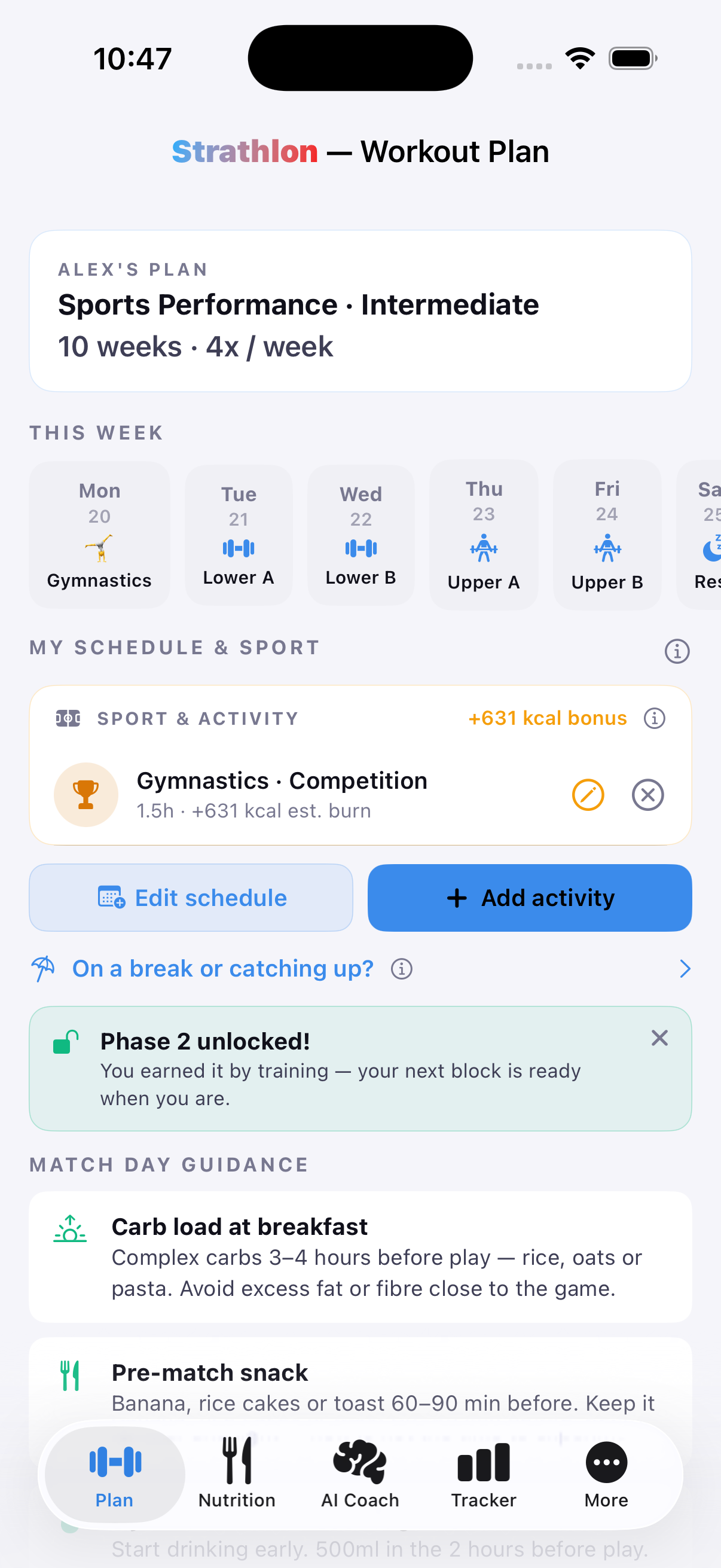
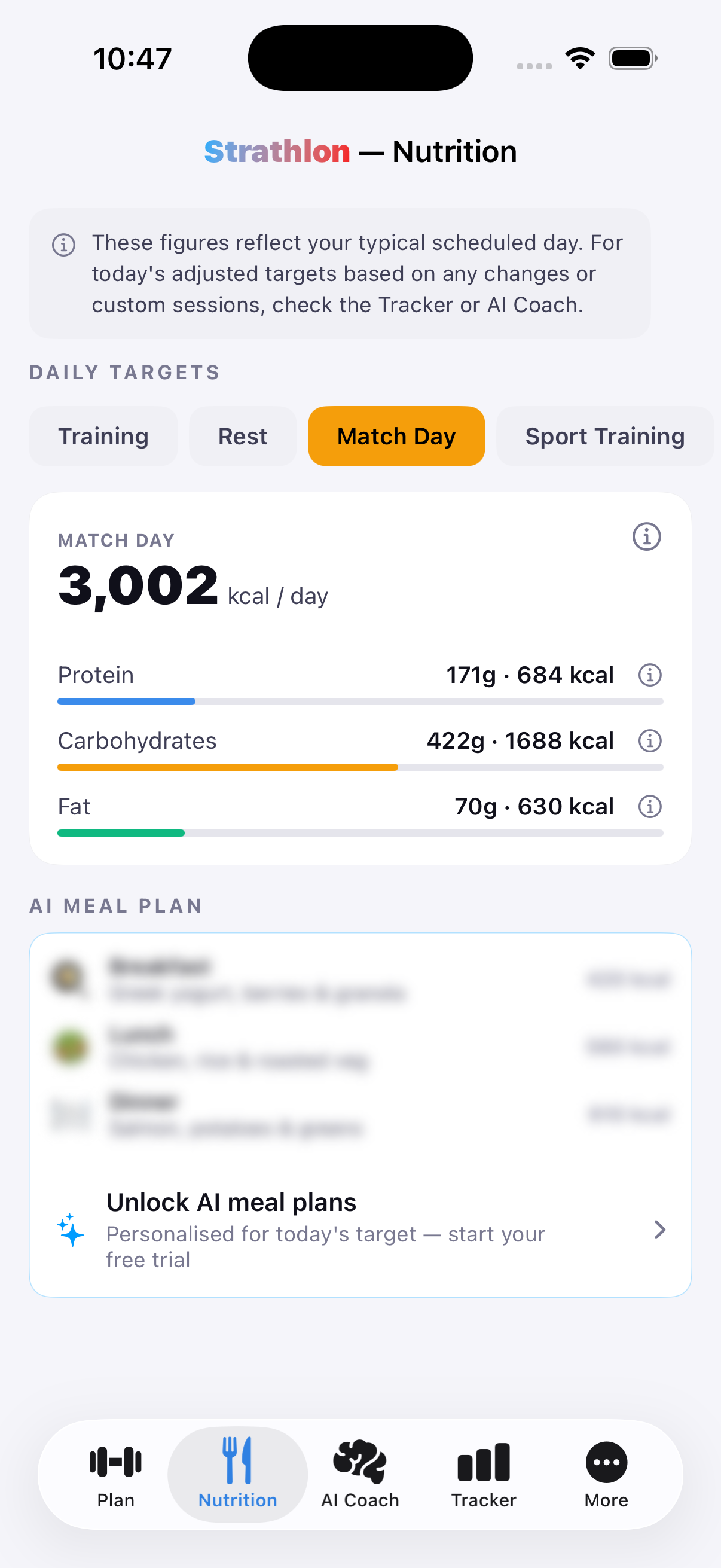
If you remember one thing, make it this: in gymnastics, fuelling well means fuelling enough. The athletes who last are the ones who cover their training and their growth, protect their bones and their cycle, and build power and skill on a full tank. Strathlon's job is to keep that base honest by adjusting your targets around the sessions you actually log, so the everyday fuelling that underpins every skill is one less thing to get wrong.
References
Every figure quoted above traces to one of the sources below. Where a number reflects established guidance rather than a single study, the citation is to a named expert body's position stand or consensus statement, with the country or international scope it speaks for: sports-nutrition guidance is written by national and international organisations, and no one country's advice is universal. Where a body's own authors declare commercial ties to the products under discussion, we say so.
- Thomas DT, Erdman KA, Burke LM. Position of the Academy of Nutrition and Dietetics, Dietitians of Canada, and the American College of Sports Medicine: nutrition and athletic performance. Journal of the Academy of Nutrition and Dietetics. 2016;116(3):501–528. Joint position of the Academy of Nutrition and Dietetics (United States), Dietitians of Canada (Canada) and the American College of Sports Medicine (ACSM, United States). PMID: 26920240
- Sundgot-Borgen J, Torstveit MK. Prevalence of eating disorders in elite athletes is higher than in the general population. Clinical Journal of Sport Medicine. 2004;14(1):25–32. Study of the entire elite-athlete population of Norway (n=1620) against 1696 controls. PMID: 14712163
- Kuhlman NM, Jones MT, Jagim AR, Magee MK, Wilcox L, Fields JB. Dietary intake, energy availability, and power in men collegiate gymnasts. Frontiers in Sports and Active Living. 2024;6:1448197. Fourteen NCAA Division III male artistic gymnasts, United States. PMC11445031
- Silva MR, Paiva T. Low energy availability and low body fat of female gymnasts before an international competition. European Journal of Sport Science. 2015;15(7):591–599. Sixty-seven rhythmic gymnasts, Portugal. PMID: 25318582
- Eberhardt HK, Ormsbee MJ, Saracino PG. A comparison of dietary habits and sleep in adolescent female gymnasts with and without low energy availability. Journal of the International Society of Sports Nutrition. 2025;22(sup2):2550155. Twelve female artistic gymnasts aged 15 ± 1, United States (a small sample, so read the direction of travel rather than the exact numbers). PMC12445184
- Mountjoy M, Ackerman KE, Bailey DM, Burke LM, Constantini N, Hackney AC, Heikura IA, Melin A, Pensgaard AM, Stellingwerff T, Sundgot-Borgen JK, Torstveit MK, Jacobsen AU, Verhagen E, Budgett R, Engebretsen L, Erdener U. 2023 International Olympic Committee's (IOC) consensus statement on Relative Energy Deficiency in Sport (REDs). British Journal of Sports Medicine. 2023;57(17):1073–1097. Consensus statement of the International Olympic Committee (IOC, international). PMID: 37752011
- Ihle R, Loucks AB. Dose-response relationships between energy availability and bone turnover in young exercising women. Journal of Bone and Mineral Research. 2004;19(8):1231–1240. PMID: 15231009
- Cialdella-Kam L, Guebels CP, Maddalozzo GF, Manore MM. Dietary intervention restored menses in female athletes with exercise-associated menstrual dysfunction with limited impact on bone and muscle health. Nutrients. 2014;6(8):3018–3039. Eight women completed the six-month intervention, United States. PMC4145292
- Weaver CM, Gordon CM, Janz KF, Kalkwarf HJ, Lappe JM, Lewis R, O'Karma M, Wallace TC, Zemel BS. The National Osteoporosis Foundation's position statement on peak bone mass development and lifestyle factors: a systematic review and implementation recommendations. Osteoporosis International. 2016;27(4):1281–1386. Position statement of the National Osteoporosis Foundation (United States). PMC4791473
- Kaufmann S, Ziegler M, Werner J, Noe C, Latzel R, Witzany S, Beneke R, Hoos O. Energetics of floor gymnastics: aerobic and anaerobic share in male and female sub-elite gymnasts. Sports Medicine – Open. 2022;8(1):3. Sub-elite gymnasts, Germany. PMC8748591
- Jäger R, Kerksick CM, Campbell BI, Cribb PJ, Wells SD, Skwiat TM, Purpura M, Ziegenfuss TN, Ferrando AA, Arent SM, Smith-Ryan AE, Stout JR, Arciero PJ, Ormsbee MJ, Taylor LW, Wilborn CD, Kalman DS, Kreider RB, Willoughby DS, Hoffman JR, Krzykowski JL, Antonio J. International Society of Sports Nutrition position stand: protein and exercise. Journal of the International Society of Sports Nutrition. 2017;14:20. Position stand of the International Society of Sports Nutrition (ISSN, United States). Industry ties disclosed: the paper's own competing-interests statement records that many of its authors have received grants, external funding or consultancy fees from companies that sell protein supplements. PMC5477153
This is general educational information rather than medical, dietary or coaching advice. The sports-nutrition figures here are drawn from established consensus and are framed as population-level guides: individual needs vary widely with body size, age, growth stage, training and health, and are best personalised with a qualified professional. Gymnastics carries a genuinely elevated risk of low energy availability, disordered eating and RED-S, particularly in young and female athletes; anyone with a health condition, a history of disordered eating, or who is pregnant or postpartum, or who suspects under-fuelling, stress fractures, menstrual disruption or RED-S (and any parent or coach with those concerns about a young athlete) should consult a sports physician or registered dietitian promptly. See our Terms for more.
← All guides · Gymnastics strength & conditioning guide · Eating for results · Understanding your stats · Home