
Gymnastics strength & conditioning
An evidence-based guide to training the body a gymnast actually needs. Gymnastics is, more than almost any sport, a contest of relative strength, of how much force you can produce, hold and absorb for every kilogram you carry. This covers the physical demands and dominant energy systems, the strength qualities and lifts that transfer to the apparatus, how to condition around skill work without the two fighting each other, the wrist, shoulder, elbow, low-back and ankle injuries that define the sport, and how to program it all across a season. Practical, honest, and grounded in published sport-science literature.
Here's the short version: gymnastics rewards very high relative (bodyweight) strength, especially straight-arm and static holding strength and a braced, powerful core, layered on top of reactive strength for jumping and landing, and broad wrist, shoulder and ankle conditioning and mobility to survive the loads. Everything below is the detail behind that sentence: what the sport asks of the body, the gym work that builds it, and how to train hard without breaking the joints that take the most punishment.
On this page
A framing note before the detail. The science of gymnastics is well studied but far from settled, and gymnasts differ enormously: event specialism, age and maturity, training history, sex, body size and injury history all shift what's right for a given athlete. So this is written as can, tends to and is associated with, never as a guarantee, and every specific figure is a population-level finding from published research rather than a personal prescription. It's general education rather than medical or individual coaching advice, and it is not a substitute for a qualified strength & conditioning coach or clinician.
The demands of gymnastics
Gymnastics is a power and skill sport built on a foundation of relative strength. Almost every element (a support hold, a press to handstand, a giant, a tumbling pass, a vault) is a task of moving, holding or launching your own body with precision. Because the load is your body, strength that doesn't come with extra mass is worth far more than a big absolute number: two gymnasts who can both press a given weight are not equal if one of them weighs less. That's why the sport selects so strongly for a high strength-to-weight ratio.
The strength itself comes in two flavours the gym-goer rarely trains. First, straight-arm and static (isometric) strength: many of the hardest skills (planches, levers, rings support positions, the swallow and support scale) are held with the arms locked long, which loads the shoulder and elbow very differently from a bent-arm push-up or pull-up. In a study of male elite ring elements, Schärer and colleagues (2021) measured the conditioning strength these static positions demand as a share of body weight: for example, a swallow required force on the order of 63% of body weight concentrically and around 94% eccentrically, and an inverted-cross position roughly 57%, a vivid illustration of how much force a gymnast must produce through a single shoulder in a fixed position. Second, reactive strength: the ability to absorb a landing and instantly return force, which is what tumbling and vaulting live on.
Energetically, gymnastics is dominated by short, intense efforts. Competitive routines last only about 5 to 90 seconds, so individual skills lean on the anaerobic (phosphagen and glycolytic) systems, while the aerobic system underpins recovery between efforts and the sheer volume of a training day. Work summarised by Jemni and echoed in the youth-gymnastics review by Moeskops and colleagues (2019) found that even a full men's floor routine draws roughly 59% of its energy aerobically, about 24% from the anaerobic-alactic system and about 17% anaerobic-lactic, a reminder that "explosive" doesn't mean "no aerobic base."
Then there is the punishment. Gymnastics loads the body in ways few sports match: peak vertical ground reaction forces during landings have been measured across landing-biomechanics research at roughly 7 to 16 times body weight, varying with the height, the difficulty of the skill and the quality of the landing. Those forces, repeated thousands of times, concentrate at a handful of sites: the wrist, shoulder, elbow, low back and ankle, which is exactly where the sport's injuries cluster. Any serious gymnastics S&C plan is really two jobs at once: build the qualities the skills need, and armour the joints that take the load.
Key strength work, and why it matters
The most useful mental model is a strong general base with a gymnastics-specific layer on top. The base is ordinary, heavy, well-tracked gym work. The layer is the straight-arm, static and reactive work that's specific to the apparatus. Both matter, and they reinforce each other: the base raises your ceiling, and the specific work turns raw strength into usable skill.
- Heavy lower-body strength: squat and hinge. A strong squat and deadlift/hinge build the force you launch tumbling passes and vaults with, and the eccentric strength you land them with. This is where the broad evidence on strength transfer applies directly: Suchomel, Nimphius and Stone (2016), in a widely cited Sports Medicine review, concluded that greater maximal strength is associated with better jumping, sprinting and change-of-direction performance and lower injury risk. Heavier loads and lower repetitions develop this maximal, relative strength with comparatively little added body mass, the ideal trade for a gymnast.
- Upper-body pressing and pulling: bent and straight arm. Weighted pulls, presses, dips and rows build the raw strength behind support and swing. Straight-arm progressions (tuck planches, levers, ring support work) then teach the shoulder to express that strength with the elbow locked, which is the position most gymnastics holds actually use. Training both is what lets pressing strength "carry over" onto the apparatus.
- Core, but not crunches. The trunk's job in gymnastics is to transmit force between the upper and lower body and to hold rigid shapes (hollow, arch, straight-body) under load. So the highest-value core work is anti-extension and anti-rotation bracing (hollow holds, planks and their loaded variants, leg raises with a controlled pelvis) rather than endless spinal flexion. A core that can stay stiff is both a performance tool and, as the injury section explains, a low-back protector.
- Plyometrics and landing work. Reactive strength, the fast stretch-shorten cycle that turns a landing into a jump, is trainable in the gym with jumps, hops, bounds and depth landings. Reviews of plyometric-jump training (Ramirez-Campillo and colleagues, 2023) report gains in reactive strength index, jump height and sprint speed, with the effect larger when programmes run beyond about seven weeks and use three sessions a week. Crucially, the same drills let you rehearse absorbing force in good position at a controlled dose, which is landing insurance as much as performance work.
- Direct wrist, forearm and shoulder conditioning. Unlike most sports, gymnastics puts the wrist and shoulder in the primary load-bearing role. Progressive wrist extension/flexion work, forearm and grip loading, and rotator-cuff and scapular control aren't glamorous, but they build tolerance in the exact tissues that fail most often.
- References
Notice the theme: the base lifts make you strong, and the gymnastics-specific accessories (hollow holds, scapular and cuff work, overhead stability) convert that strength into the straight-arm, static and shoulder-stable qualities the sport can use. Neither half is optional. A gymnast who only does skill work leaves strength (and injury tolerance) on the table. One who only lifts never teaches the body to express it in a handstand.
Conditioning for gymnastics
Conditioning in gymnastics is easy to get wrong in both directions: too little, and you fade through a long training day or a multi-event competition; too much steady-state running, and you spend recovery you needed for skills and strength. The sport's energy profile points to the answer: because efforts are short and repeated with incomplete rest, the priority is anaerobic capacity and repeat-effort quality, built on enough of an aerobic base to recover between routines and sustain a full session.
In practice that means most gymnastics "conditioning" looks like the sport: short, hard bouts (circuits of skills, strength holds, or apparatus-specific work) with managed rest, plus some general aerobic work to raise the floor of your recovery. A modest, low-impact aerobic base (bike, easy runs, swimming) two or so times a week is usually plenty. It supports work capacity and recovery without eating into the power-to-weight ratio the sport prizes. There's little case for high-volume distance running in a gymnast's week: it adds fatigue and impact for a quality the sport barely uses.
The other half of the question is interference: the worry that endurance work blunts strength and power. The honest read of the evidence is that interference is real but manageable: it grows with the volume and frequency of hard aerobic training and shrinks when you keep aerobic conditioning moderate, separate the hardest strength and hardest aerobic sessions in time where you can, and do strength before or apart from long conditioning rather than after it. For a gymnast, whose conditioning need is modest and mostly anaerobic anyway, interference is rarely the limiting factor: total fatigue and joint load usually bite first. Program conditioning to support skills and recovery rather than to chase endurance numbers for their own sake.
Staying injury-resilient
Gymnastics has one of the higher injury burdens in youth sport, and its injuries are unusually predictable by site, which is good news, because predictable means preventable-ish. The pattern also splits by sex: broadly, males (with more upper-body apparatus) see more shoulder problems, while females see a higher share of wrist and elbow complaints. Here are the five that dominate, and the evidence-based ways to reduce them.
- Wrist. The signature gymnastics complaint. A 2026 systematic review and meta-analysis by DiLeo and colleagues pooled a wrist-pain prevalence of about 53% in adolescent artistic gymnasts, with chronic wrist injury pooled around 36%. In growing gymnasts the specific worry is distal radial physeal stress ("gymnast's wrist"): repetitive weight-bearing irritating the growth plate of the forearm bone. Classic work by DiFiori and colleagues found wrist pain in a majority of gymnasts and linked it to skill level, age (peaking around 10–14 years) and years of training. The primary defence is load management: progress tumbling and vaulting volume gradually, monitor total weight-bearing, condition the wrist and forearm progressively, and treat persistent pain as a stop sign to be assessed rather than trained through.
- Shoulder. Support holds, swings and straight-arm skills load the shoulder heavily and in end-range positions. Building rotator-cuff and scapular control alongside straight-arm support strength, and progressing overhead and support volume gradually, help the joint tolerate the positions the sport demands.
- Elbow. Straight-arm loading and hyperextension forces (rings, bars, weight-bearing) make the elbow a common overuse site. Progressive elbow-friendly loading (controlled straight-arm progressions rather than sudden jumps into maximal holds) and, again, respecting pain, are the main levers.
- Low back. Repetitive hyperextension and compression (arching, dismounts, landings) make the lumbar spine a hotspot. Reported low-back pain in gymnasts ranges widely, from roughly a quarter to the majority of athletes across studies, and spondylolysis (a stress injury of the pars interarticularis) is a leading cause of persistent adolescent-athlete back pain in extension-heavy sports. The protective strategy is a strong anti-extension core that lets the trunk stay braced instead of collapsing into the arch, sensible management of high-hyperextension volume, and early assessment of back pain that's reproduced by arching, never a "push through it" injury.
- Ankle. Landings and dismounts make ankle sprains and impact injuries common. Beyond landing technique, balance and proprioceptive training plus eccentric calf and lower-leg strength build the reactive control that helps the ankle survive awkward landings, and balance-focused work is well supported for reducing recurrent ankle sprains across sports.
Two threads run through all five. First, strength itself is protective: the same Suchomel, Nimphius and Stone (2016) review that ties strength to performance also ties it to lower injury risk, because a stronger, better-conditioned tissue tolerates more load. Second, and more important than any single exercise, is managing load and respecting pain: the wrist and back data make clear that overuse, rapid growth and simply doing too much too soon drive most of these injuries. No prehab drill substitutes for sensible volume progression and taking early pain seriously.
Programming it around your season
Gymnastics S&C has to fit into a schedule already dominated by skill practice, so the guiding rule is do the least strength work that keeps you progressing, and protect the skill work. The shape of the year helps.
- Off-season / base phase. This is when you build. With less competition pressure, you can afford two to three focused strength and power sessions a week, pushing maximal strength (heavier loads, lower reps), developing straight-arm and static qualities, and building reactive strength through a proper plyometric block. As the plyometric evidence (Ramirez-Campillo and colleagues, 2023) suggests, give jump training real time, more than about seven weeks and a couple of sessions a week, to see the reactive-strength payoff.
- In-season / competition phase. Now the job flips from building to maintaining without adding fatigue. The encouraging evidence is that this takes surprisingly little: the meta-analysis by Cuthbert and colleagues (2021) found that, when total volume is matched, maximal strength develops similarly across a wide range of weekly frequencies, which means you can consolidate into as little as one to two short, high-intensity sessions a week and hold most of your strength. The watch-word is intensity: keep the loads meaningful and the volume low, rather than drifting into lots of easy sets that add fatigue without maintaining much.
- Around fatigue and growth. Fit the hardest strength and plyometric work on lighter skill days or with enough separation from the most demanding practices, and dial it back during heavy competition weeks, illness, or rapid growth spurts (a known window of elevated injury risk). Recovery isn't lost training. It's what lets the next block land.
For the underlying mechanics of how strength is actually built and progressed (progressive overload, effort measured in reps in reserve, full range of motion and deloads), the how-muscle-grows guide goes deep, and the recovery-and-rest guide covers the recovery half that in-season gymnasts most often shortchange.
Where Strathlon fits, and a myth to drop
Common questions
What kind of strength matters most for gymnastics?
Relative strength, force you can produce for each kilogram of body weight, matters more in gymnastics than raw absolute strength, because almost every skill involves moving, holding or launching your own body. Alongside it, gymnastics leans heavily on straight-arm and static (isometric) strength for support positions and holds, on a braced core to transmit force between limbs, and on reactive strength for jumping and landing. The good news is that heavier gym-based strength work transfers: Suchomel, Nimphius and Stone (2016) concluded that greater maximal strength is associated with better jumping, sprinting and change-of-direction, and with lower injury risk, so building a strong squat, hinge and pressing/pulling base tends to raise the ceiling on the bodyweight skills too.
Will lifting weights make me bulky or slow for gymnastics?
It is very unlikely to. Building substantial muscle mass is slow and requires a sustained calorie surplus and high training volume: it does not happen by accident from a couple of strength sessions a week. Training that emphasises heavier loads for lower repetitions builds strength and neuromuscular efficiency with relatively little size, which is exactly what improves your power-to-weight ratio. In practice, being stronger for the same body weight makes static holds, presses and tumbling easier rather than harder. The bulky-and-slow fear is one of the most persistent myths in the sport.
How do I protect my wrists in gymnastics?
Wrist pain is the single most common overuse complaint in the sport: a 2026 systematic review and meta-analysis by DiLeo and colleagues pooled a wrist-pain prevalence of about 53% in adolescent artistic gymnasts. The main lever is load management: monitor how much high-impact weight-bearing your wrists take, build up tumbling and vaulting volume gradually, and treat persistent wrist pain as a signal to reduce load and get it assessed rather than train through it, especially in still-growing gymnasts aged roughly 10 to 14, where DiFiori and colleagues linked wrist pain to skill level, age and years of training. Progressive wrist and forearm conditioning and good hand positioning help, but they do not replace sensible volume.
How many days a week should I do strength and conditioning alongside gymnastics practice?
There is no single number, and it should flex with your calendar. In an off-season or base-building block, two to three focused S&C sessions a week is a common, workable dose. In-season, when practice and competition already load you heavily, you can do far less and still hold your gains: a meta-analysis by Cuthbert and colleagues (2021) found that when total training volume is matched, strength is developed similarly across a range of weekly frequencies, which supports consolidating into as little as one to two quality sessions a week to maintain strength when time is short. The priority in-season is keeping intensity honest rather than chasing volume.
Do I still need plyometrics if I already tumble and vault?
Structured plyometric and landing work still tends to add value, because it lets you train reactive strength and landing mechanics with dose and quality you can actually control, rather than only in the middle of complex, fatiguing skills. Reviews of plyometric-jump training (Ramirez-Campillo and colleagues, 2023) report improvements in reactive strength index, jump performance and sprint speed, with better results when programmes run longer than about seven weeks, use more than roughly 14 sessions, and are done around three times a week. Well-dosed low-level landing and hopping drills also let you rehearse absorbing force with good position, which is central to a sport where landings can load the body many times body weight.
Is strength training safe for young gymnasts?
Yes: appropriately designed, well-supervised resistance training is considered safe and beneficial for children and adolescents, and the long-standing fear that it stunts growth is not supported by the evidence. The important qualifiers are supervision, technique before load, and gradual progression. Gymnasts already handle very high forces through bodyweight skills and landings, so structured, progressive strength work is arguably a way to prepare the body for those forces rather than an extra risk. As always, this is general education: a qualified coach should individualise it, especially around growth spurts and any history of pain or injury.

Takeaways
- Gymnastics is a relative-strength sport. Strength per kilogram matters more than raw absolute strength, so favour work that builds force with little added mass.
- Train the specific qualities. Straight-arm and static (isometric) strength, a braced anti-extension/anti-rotation core, and reactive strength for landings: the layer ordinary lifting misses.
- Keep a strong general base. Heavy squat, hinge, press and pull raise your ceiling and, per Suchomel, Nimphius and Stone (2016), transfer to jumping, sprinting and landing while lowering injury risk.
- Condition like the sport. Short, hard, repeated efforts plus a modest aerobic base for recovery. Skip high-volume distance running: total fatigue and joint load bite before interference does.
- Armour the five hotspots. Wrist, shoulder, elbow, low back and ankle. Wrist pain affects roughly half of adolescent gymnasts (DiLeo and colleagues, 2026): manage load, condition progressively, and respect pain.
- Do plyometrics properly. Reactive-strength gains need time: beyond about seven weeks, around three sessions a week (Ramirez-Campillo and colleagues, 2023).
- Build off-season, maintain in-season. Two to three sessions to build. As little as one to two intense sessions a week can maintain strength when volume is matched (Cuthbert and colleagues, 2021).
- Lifting won't make you bulky or slow. Heavier, lower-rep training builds strength with little size: it raises power-to-weight and protects joints.
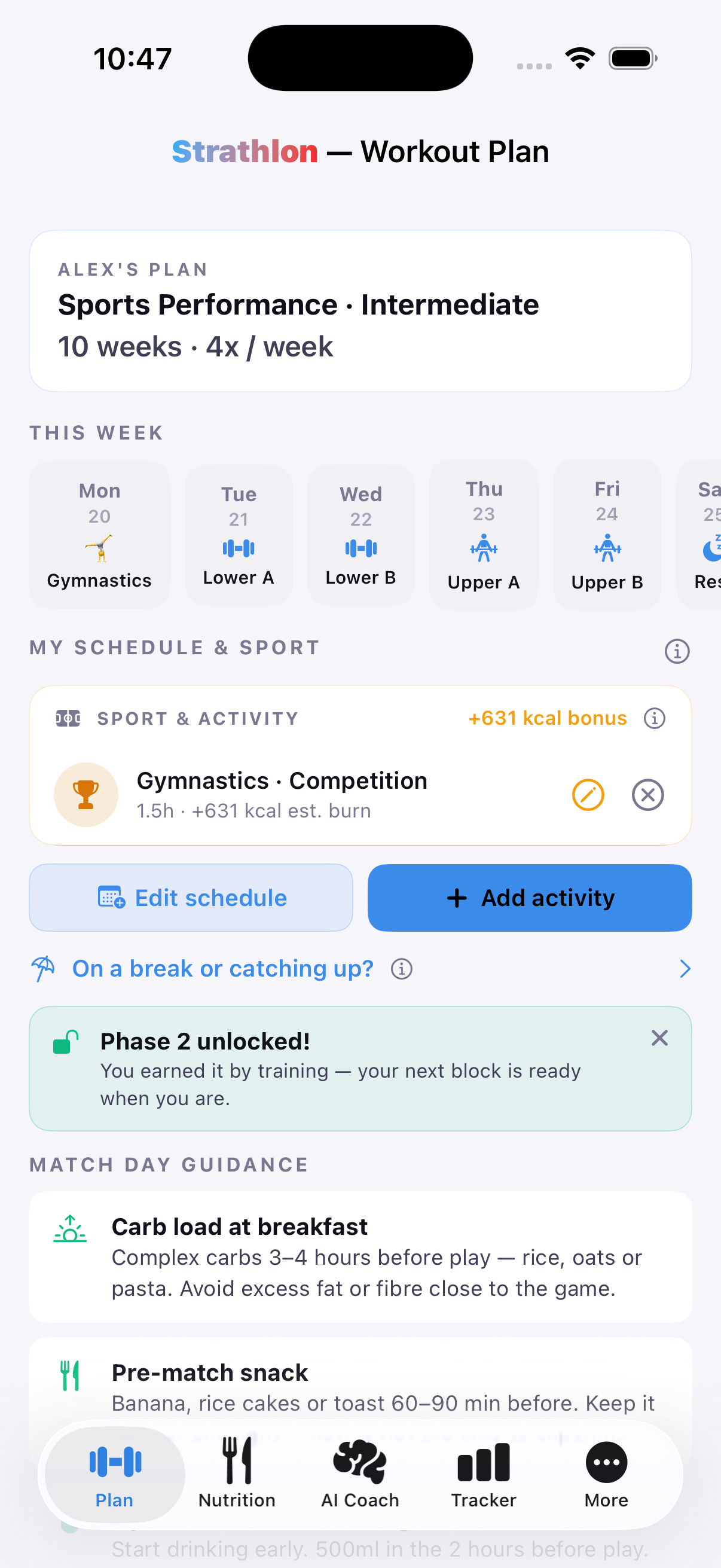
If you remember one thing, make it this: the best gymnastics S&C is a strong, well-tracked general base with a straight-arm, core and reactive layer bolted on: trained hard in the off-season, maintained lightly in-season, and always kept honest about wrist and back load. Strathlon's job is to tune that base toward gymnastics (with Sports Performance as one of your goals) and show your strength trending up, so the gym work quietly supports the skills instead of competing with them.
Pair this with the gymnastics fuelling guide: how to eat to support power-to-weight, recovery and growing bodies without under-fuelling.
References
Numbered sources for the specific figures, effect sizes and named studies above. Where a claim reflects agreed guidance rather than a single trial, the citation is to the position stand or consensus statement of the body concerned, with the country or international remit named. Gymnastics research concentrates on injury and on energy availability; the strength prescriptions below are general evidence applied to a sport whose loading is unusually high relative to body mass.
- Kaufmann S, Ziegler M, Werner J, Noe C, Latzel R, Witzany S, et al. Energetics of Floor Gymnastics: Aerobic and Anaerobic Share in Male and Female Sub-elite Gymnasts. Sports Medicine - Open. 2022;8(1):3. Study of the energetics of floor gymnastics and the aerobic and anaerobic share in sub-elite gymnasts: the source for the conditioning description. PubMed 35006417 · PMC8748591 full text
- Desai N, Vance DD, Rosenwasser MP, Ahmad CS. Artistic Gymnastics Injuries; Epidemiology, Evaluation, and Treatment. The Journal of the American Academy of Orthopaedic Surgeons. 2019;27(13):459–467. Review of artistic gymnastics injury epidemiology, evaluation and treatment, the source for the sport's characteristic injury sites. PubMed 31232791
- Höög S, Harringe ML. Incidence of acute injuries in Swedish gymnastics with a special focus on cruciate ligament injuries. The Journal of Sports Medicine and Physical Fitness. 2023;63(5):667–673. Study of acute injury incidence in Swedish gymnastics with a focus on cruciate ligament injuries, the knee-specific evidence. PubMed 36519624
- d'Hemecourt PA, Luke A. Sport-specific biomechanics of spinal injuries in aesthetic athletes (dancers, gymnasts, and figure skaters). Clinics in Sports Medicine. 2012;31(3):397–408. Review of sport-specific biomechanics of spinal injuries in aesthetic athletes, the basis for the trunk and back guidance. PubMed 22657991
- Sweeney EA, Howell DR, James DA, Potter MN, Provance AJ. Returning to Sport After Gymnastics Injuries. Current Sports Medicine Reports. 2018;17(11):376–390. Review of returning to sport after gymnastics injuries, cited in the load-management section. PubMed 30407946
- Silva MR, Paiva T. Low energy availability and low body fat of female gymnasts before an international competition. European Journal of Sport Science. 2015;15(7):591–9. Study of low energy availability and low body fat in female gymnasts before international competition: the source for the fuelling caution attached to this sport. PubMed 25318582
- Kuhlman NM, Jones MT, Jagim AR, Magee MK, Wilcox L, Fields JB. Dietary intake, energy availability, and power in men collegiate gymnasts. Frontiers in Sports and Active Living. 2024;6:1448197. Study of dietary intake, energy availability and power in male collegiate gymnasts, included because the risk is not limited to female gymnasts. PubMed 39359485 · PMC11445031 full text
- Overlin AJ, Chima B, Erickson S. Update on artistic gymnastics. Current Sports Medicine Reports. 2011;10(5):304–9. Update on artistic gymnastics, cited for the sport's training-load conventions. PubMed 23531979
- Suchomel TJ, Nimphius S, Stone MH. The Importance of Muscular Strength in Athletic Performance. Sports Medicine. 2016;46(10):1419–49. Suchomel and colleagues on the importance of muscular strength in athletic performance: the source for greater maximal strength being associated with faster sprinting, jumping and change of direction, and with lower injury risk. PubMed 26838985
- Seitz LB, Reyes A, Tran TT, Saez de Villarreal E, Haff GG. Increases in lower-body strength transfer positively to sprint performance: a systematic review with meta-analysis. Sports Medicine. 2014;44(12):1693–702. Seitz and colleagues' systematic review with meta-analysis showing increases in lower-body strength transfer positively to sprint performance, the evidence behind the 'strength is the base' argument. PubMed 25059334
- Lauersen JB, Andersen TE, Andersen LB. Strength training as superior, dose-dependent and safe prevention of acute and overuse sports injuries: a systematic review, qualitative analysis and meta-analysis. British Journal of Sports Medicine. 2018;52(24):1557–1563. Lauersen and colleagues' meta-analysis finding strength training a superior, dose-dependent and safe prevention of acute and overuse sports injuries: the direct source for treating strength work as prehab. PubMed 30131332
- Lauersen JB, Bertelsen DM, Andersen LB. The effectiveness of exercise interventions to prevent sports injuries: a systematic review and meta-analysis of randomised controlled trials. British Journal of Sports Medicine. 2014;48(11):871–7. Lauersen and colleagues' earlier meta-analysis of exercise interventions to prevent sports injuries, the broader evidence base the prevention advice sits on. PubMed 24100287
- . American College of Sports Medicine position stand. Progression models in resistance training for healthy adults. Medicine and Science in Sports and Exercise. 2009;41(3):687–708. American College of Sports Medicine (ACSM, United States) position stand on progression models in resistance training: the source for the heavy-load and explosive-load percentage ranges quoted. PubMed 19204579
- Cuthbert M, Haff GG, Arent SM, Ripley N, McMahon JJ, Evans M, et al. Effects of Variations in Resistance Training Frequency on Strength Development in Well-Trained Populations and Implications for In-Season Athlete Training: A Systematic Review and Meta-analysis. Sports Medicine. 2021;51(9):1967–1982. Cuthbert and colleagues' systematic review of resistance-training frequency in well-trained populations, the source for the sessions-per-week guidance. PubMed 33886099 · PMC8363540 full text
- Spiering BA, Mujika I, Sharp MA, Foulis SA. Maintaining Physical Performance: The Minimal Dose of Exercise Needed to Preserve Endurance and Strength Over Time. Journal of Strength and Conditioning Research. 2021;35(5):1449–1458. Spiering and colleagues on the minimal dose of exercise needed to preserve endurance and strength: the source for maintaining in-season on as little as one to two sessions a week. PubMed 33629972
- Rønnestad BR, Nymark BS, Raastad T. Effects of in-season strength maintenance training frequency in professional soccer players. Journal of Strength and Conditioning Research. 2011;25(10):2653–60. Ronnestad and colleagues' trial of in-season strength maintenance frequency in professional footballers, the specific in-season maintenance result quoted. PubMed 21873897
- Nuzzo JL, Pinto MD, Kirk BJC, Nosaka K. Resistance Exercise Minimal Dose Strategies for Increasing Muscle Strength in the General Population: an Overview. Sports Medicine. 2024;54(5):1139–1162. Nuzzo and colleagues on minimal-dose resistance exercise strategies for increasing strength, supporting the claim that a small, well-chosen dose does most of the work. PubMed 38509414 · PMC11127831 full text
- Wilson JM, Marin PJ, Rhea MR, Wilson SM, Loenneke JP, Anderson JC. Concurrent training: a meta-analysis examining interference of aerobic and resistance exercises. Journal of Strength and Conditioning Research. 2012;26(8):2293–307. Wilson and colleagues' meta-analysis of concurrent training and the interference effect: the source for separating heavy lifting from hard conditioning. PubMed 22002517
- Schumann M, Feuerbacher JF, Sünkeler M, Freitag N, Rønnestad BR, Doma K, et al. Compatibility of Concurrent Aerobic and Strength Training for Skeletal Muscle Size and Function: An Updated Systematic Review and Meta-Analysis. Sports Medicine. 2022;52(3):601–612. An updated systematic review of the compatibility of concurrent aerobic and strength training, the more recent evidence that interference is smaller than once believed. PubMed 34757594 · PMC8891239 full text
- Ramirez-Campillo R, Sortwell A, Moran J, Afonso J, Clemente FM, Lloyd RS, et al. Plyometric-Jump Training Effects on Physical Fitness and Sport-Specific Performance According to Maturity: A Systematic Review with Meta-analysis. Sports Medicine - Open. 2023;9(1):23. Ramirez-Campillo and colleagues on plyometric-jump training effects on physical fitness and sport-specific performance, the source for the plyometric guidance. PubMed 37036542 · PMC10086091 full text
- Impellizzeri FM, Woodcock S, Coutts AJ, Fanchini M, McCall A, Vigotsky AD. What Role Do Chronic Workloads Play in the Acute to Chronic Workload Ratio? Time to Dismiss ACWR and Its Underlying Theory. Sports Medicine. 2021;51(3):581–592. Impellizzeri and colleagues on the pitfalls of the acute:chronic workload ratio: cited because it is the reason this guide talks about ramping load gradually rather than quoting a workload number. PubMed 33332011
- Baz-Valle E, Balsalobre-Fernández C, Alix-Fages C, Santos-Concejero J. A Systematic Review of The Effects of Different Resistance Training Volumes on Muscle Hypertrophy. Journal of Human Kinetics. 2022;81:199–210. Systematic review of resistance-training volume and hypertrophy, the general dose-response evidence behind the set and session recommendations. PubMed 35291645 · PMC8884877 full text
This is general educational information rather than medical, coaching or individualised training advice. The sport-science figures here are drawn from published research and are framed as population-level findings: individual needs vary widely with age, maturity, event, training history and injury history, and are best personalised with a qualified strength & conditioning coach. Gymnastics involves high forces and a real injury risk; anyone with pain, an injury, a health condition, or who is a still-growing young athlete, pregnant or postpartum, should consult a qualified coach or clinician before starting or changing a training programme, and should treat persistent wrist, shoulder, elbow, back or ankle pain as a reason to seek assessment rather than train through. See our Terms for more.
← All guides · Gymnastics fuelling · How muscle grows · Recovery & rest · Eating for results · Home