
Fuelling & performance nutrition for running
An evidence-based guide to fuelling the runner's body. Running is, more than almost any everyday sport, a story about a single fuel (muscle glycogen) and about not running out of it. This covers daily carbohydrate, the pre-run meal, how much to take in during longer runs and races, carbohydrate loading, hydration by your own sweat rate, training your gut, recovery, and the quietly serious risk of chronic under-fuelling, written in plain language and grounded in established sports-nutrition consensus.
Here's the short answer to "how should a runner fuel?": build the base with enough daily carbohydrate, top up before you go, take in carbohydrate and fluid during runs longer than about an hour (roughly 30–60 g of carbs per hour, rising toward 90 g for very long races), and refuel and rehydrate afterwards, all while eating enough overall to avoid running an energy deficit.[1] Everything below is the detail behind that sentence: the numbers, where they come from, and how to make them work for your body rather than someone else's.
Pair this with the running strength & conditioning guide: the heavy lifts, plyometrics and tendon-friendly prehab that build the durable, efficient runner all this fuelling is meant to power.
On this page
- Why running is a glycogen sport
- Daily carbohydrate: the base
- Before the run: the pre-run meal
- During longer runs and races: carbs per hour
- Carbohydrate loading before long races
- Fluid, sweat rate and hydration
- Training your gut
- Recovery: carbohydrate and protein
- Under-fuelling and RED-S
- Common questions
- Takeaways
- References
A framing note before the numbers. Sports nutrition is well studied, but people differ enormously: body size, running pace, fitness, the weather, gut tolerance, sex and health status all shift what's right on the day. So this is written as can, tends to and around, never as a guarantee, and every specific figure is a population-level guide drawn from published consensus rather than a personal prescription. It's general education rather than medical or dietary advice, and it isn't a personalised plan.
Why running is a glycogen sport
Your body runs on a blend of two main fuels: fat and carbohydrate. Fat is almost limitless even in a lean runner, but it burns slowly. Carbohydrate (stored as glycogen in muscle and liver, plus glucose in the blood) burns fast and cleanly, and it's the fuel that lets you run at any real pace. The catch is that carbohydrate stores are small. A typical trained runner holds only a couple of thousand kilocalories of glycogen, enough for very roughly 90–120 minutes of hard running before it runs low.[2][3]
The faster you run, the more you lean on carbohydrate rather than fat. That's the whole reason fuelling matters more for running than for a gentle walk: at marathon pace you're spending glycogen quickly, and when the tank empties (the classic "hitting the wall" or "bonking" around 30 km of a marathon) pace collapses because they've run out of their fast fuel. Muscle damage has nothing to do with it.[2][4] The entire fuelling strategy below exists to do one of two things: start with more glycogen, and top it up as you go so you reach the finish before the tank does.
Daily carbohydrate: the base
Race-day fuelling only works if you show up with the tank reasonably full, and that comes from your everyday carbohydrate intake, matched to your training. The joint position on nutrition and athletic performance from the Academy of Nutrition and Dietetics, Dietitians of Canada and the American College of Sports Medicine sets out daily carbohydrate targets scaled to training load: around 5–7 g of carbohydrate per kilogram of body weight per day for a general or moderate program (about an hour a day), roughly 6–10 g/kg/day for the moderate-to-high volumes of a serious runner training one to three hours a day, and up to 8–12 g/kg/day for the very high volumes of heavy or multi-session days.[1] The International Society of Sports Nutrition frames the same idea as a broad 5–12 g/kg/day band, with the top reserved for those training many hours a week at intensity.[6]
The practical point is that these dials should move with your week. A big long-run or interval day warrants more carbohydrate than an easy or rest day. Chronically eating at the low end while training hard is one of the most common ways runners end up flat, under-recovered and stuck: the base is too empty for the quality fuelling on top to matter.
Before the run: the pre-run meal
For an easy or short run you often need nothing special. Before longer or harder sessions, and before races, a carbohydrate-focused top-up helps ensure liver and muscle glycogen are high at the start. Position stands describe a pre-exercise meal or snack of roughly 1–4 g of carbohydrate per kilogram of body weight, eaten around one to four hours beforehand: the larger amounts earlier when you have time to digest, the smaller amounts closer to the start.[1]
Hitting the grams is straightforward; tolerating them takes practice. Favour familiar, lower-fibre and lower-fat carbohydrate you've rehearsed in training (porridge, toast, a banana, a bagel, rice) because fibre and fat slow digestion and can sit heavily.[1] The golden rule of race morning is to try nothing new: the meal, the coffee, the timing should all be things your gut has already met on a long training run.
During longer runs and races: carbs per hour
This is where running nutrition earns its keep. Once a run pushes past roughly an hour, taking in carbohydrate during the effort helps maintain blood glucose and spares your limited glycogen, delaying fatigue. How much depends mostly on how long you'll be out there. The joint position stand and wider consensus give a duration-scaled ladder[1][3]:
| Run / race duration | Carbohydrate per hour | Type of carbohydrate | Why |
|---|---|---|---|
| Under ~45–60 min | Little or none | None needed | Your existing glycogen covers it. Fuelling is optional. |
| ~45–75 min, hard | Small amounts / mouth rinse | Single source fine | Even a carbohydrate mouth rinse can help. Little needs swallowing. |
| ~1–2.5 hours | ~30–60 g | Single source fine | Maintains blood glucose. Well within what one carb can be absorbed. |
| >~2.5–3 hours | Up to ~90 g | Multiple transportable | To absorb this much you need glucose + fructose together. |
The jump from 60 to 90 g per hour hides an important piece of physiology. The gut can only move a single type of carbohydrate (like glucose or maltodextrin) across the intestinal wall at a rate that tops out near 60 g per hour: pour in more and it sits in your stomach, which is how you get the sloshing and the gut distress runners dread.[8] But glucose and fructose use different transporters, so combining them (typically in roughly a 2:1 glucose-to-fructose ratio) lets the body absorb and burn carbohydrate faster, up to around 90 g per hour and, in some studies, higher still.[8][9] That's why modern high-carb gels, drinks and chews advertise a "2:1" or similar blend: it's not marketing, it's the transporter maths that lets a marathoner or ultra-runner fuel aggressively without their gut shutting down.
Two practical notes. First, drinks, gels and chews are interchangeable ways to hit the target: pick what your stomach and the race's aid stations support, and count the grams rather than the format. Second, these are ceilings you build up to rather than day-one targets. Beginners and shorter-race runners should sit at the lower end. Only long-course athletes need the top of the ladder, and only after training their gut to handle it (below).
Carbohydrate loading before long races
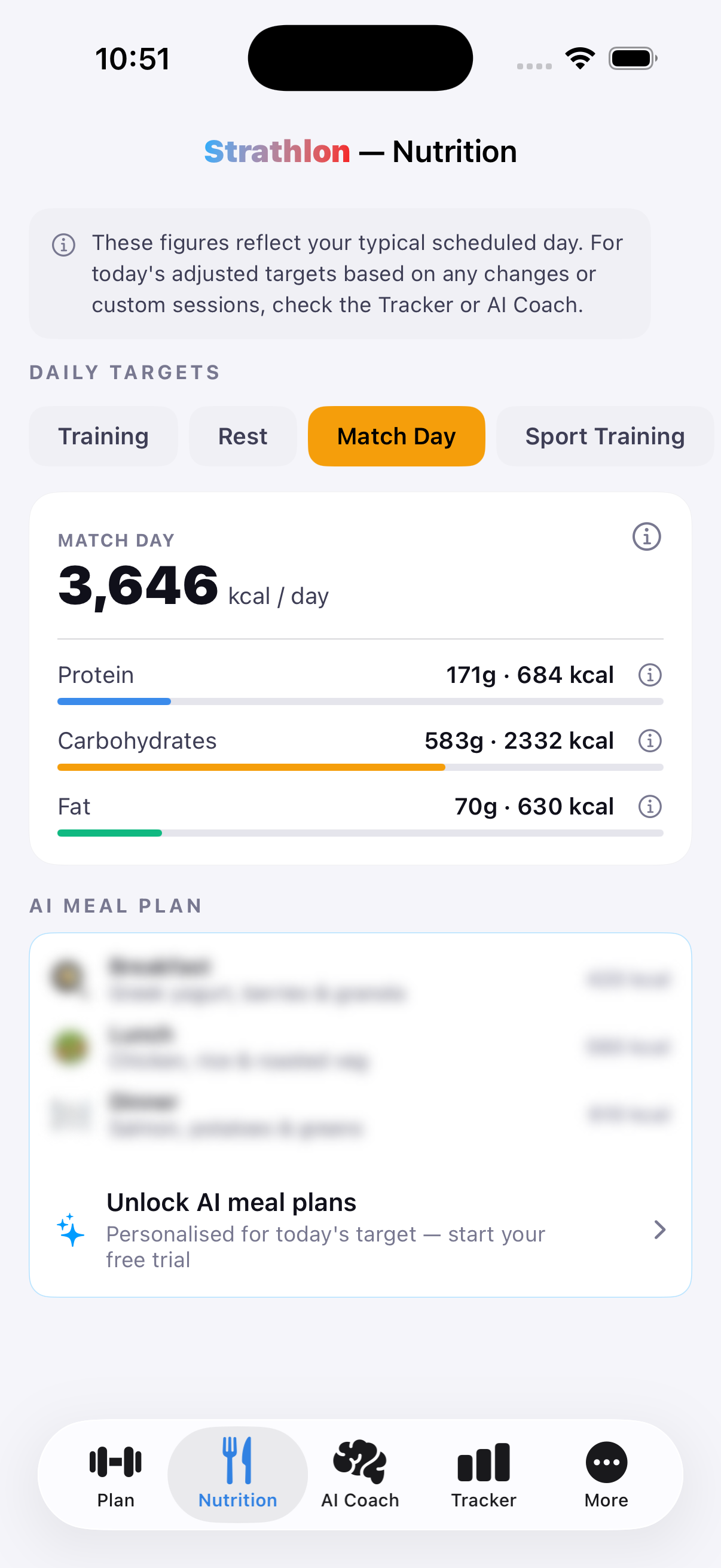
For races that last longer than about 90 minutes (a half or full marathon, an ultra), starting with maximally full glycogen stores can meaningfully delay fatigue. This is carbohydrate loading, and the science behind it goes back to the 1960s, when researchers showed that a glycogen-depleting effort followed by a high-carbohydrate diet could roughly double muscle glycogen: a phenomenon called supercompensation.[11]
The old, brutal "depletion" protocols have been replaced by something far gentler. Contemporary guidance describes eating around 10–12 g of carbohydrate per kilogram of body weight per day for the 36–48 hours before the event, while simultaneously tapering training so you're not burning off what you're storing.[1][12] There's no need to starve yourself of carbs first. Simply loading up while resting the legs brings stores close to their ceiling. Expect the scale to rise a kilo or two: each gram of glycogen is stored with roughly three grams of water,[13] so that gain is fuel and hydration rather than fat, and it will help you on the day.
Fluid, sweat rate and hydration
Running generates a lot of heat, and sweating is how you shed it, which means you're always losing fluid, sometimes a lot. Significant dehydration (losing more than roughly 2% of body mass as sweat) is associated with rising effort, higher heart rate and, in the heat, falling performance.[14][15] The long-standing guidance from the American College of Sports Medicine's position on exercise and fluid replacement is to drink enough to keep body-mass loss under about 2% over a long effort, rather than to a rigid schedule.[14]
There's no universal ml-per-hour number, because sweat rates vary enormously between people and with heat, humidity and pace: anywhere from well under half a litre to more than two litres an hour.[14] As an illustration, the ACSM position notes example intakes for runners in a broad band of roughly 400–800 ml per hour, but stresses that programs should be individualised.[14] The most reliable way to find your own number is to weigh yourself before and after a long run in representative conditions: each kilogram lost is roughly a litre of sweat, which tells you how much you're under-replacing and how much to aim for next time.[14]
For runs beyond about an hour, and especially in heat, replacing some sodium (electrolytes) alongside fluid helps you hold onto what you drink and can reduce cramping in salty sweaters.[15][16] Conveniently, the same sports drinks that deliver carbohydrate usually carry sodium too, so fuelling and hydrating overlap.
Training your gut
Here's the piece most runners skip. Taking in 60–90 g of carbohydrate an hour while running hard is a skill the gut has to learn over time, rather than a switch you can flip on race day. The intestine can be trained: regularly practising carbohydrate feeding during long runs appears to up-regulate the transporters that ferry glucose and fructose across the gut wall, speed up gastric emptying and dampen the sensation of fullness, so the same gels that make you queasy today are tolerated comfortably a few weeks from now.[18]
The method mirrors training itself: start small and build gradually. Rehearse your exact race fuelling (the same gels or drink, the same grams per hour, the same timing) on your long runs, working up toward the intake you'll want on the day. Sports scientists who study this describe deliberately practising relatively high carbohydrate feeds (in the 60–90 g/h range) during training to raise tolerance.[18] The payoff is twofold: your gut copes, and you arrive at the start line already certain your fuelling plan works. Nothing about race-day fuelling should be a first attempt.
Recovery: carbohydrate and protein
After a hard or long run, two jobs matter: refill glycogen and repair muscle. How urgently you need to chase the first depends entirely on when you next run hard.
- Fast turnaround (another hard session within a day, or twice-a-day training). Here speed matters. Research on rapid recovery describes taking in carbohydrate at around 1.0–1.2 g per kilogram of body weight per hour during the first few hours after exercise to refill glycogen as quickly as possible: the muscle is most receptive to restocking soon after you stop.[1] Adding some protein (roughly 0.25–0.3 g/kg per feed) supports repair, and appears to help glycogen refilling most when carbohydrate intake is on the low side.[1][19][20]
- Normal turnaround (a full day or more until the next hard run). There's no need to rush. Simply hitting your usual daily carbohydrate and protein targets across normal meals refills stores comfortably before you need them. The "eat within 30 minutes or lose your gains" urgency is real only when the recovery window is genuinely short.
Over the whole day, endurance runners are generally advised to eat around 1.2–2.0 g of protein per kilogram of body weight (more than a sedentary person, because running does damage muscle and protein supports repair and adaptation) spread across meals rather than piled into one.[1] The eating-for-results guide covers the broader nutrition picture in depth.
Under-fuelling and RED-S
The most serious nutrition mistake in running isn't a bad gel choice: it's chronically eating too little to support the training. Running burns a lot of energy and, combined with the sport's culture around leanness, it's one of the sports where athletes most often slip into low energy availability: not leaving enough energy, after exercise is paid for, to run the body's basic functions.
Sports scientists quantify this as energy availability: roughly, energy eaten minus energy burned in exercise, expressed per kilogram of fat-free (lean) mass. Research associates falling below about 30 kcal per kg of fat-free mass per day with a cascade of problems, while something nearer 45 kcal/kg FFM/day is considered healthy for an exercising body.[1][21] Sustained low energy availability is the root cause of what the International Olympic Committee calls Relative Energy Deficiency in Sport (RED-S): a syndrome, affecting both men and women, that can impair bone health, hormones and menstrual function, immunity, metabolism, mood and (the irony every runner should note) performance itself.[22] In women it commonly shows up as disrupted or absent periods. In men, it commonly shows up as low hormone levels, low drive and stress fractures.[22]
The warning signs are worth knowing: nagging or recurrent stress fractures, frequent illness, stalled or declining performance despite hard training, poor sleep, low mood, and (in women) missing periods.[22] None of these are things to push through. If they appear, the answer is usually to eat more rather than train harder, and to seek help from a sports physician or dietitian. Fuelling isn't only about race day: under-fuelling day after day is the fast route to injury and burnout.
Common questions
How much carbohydrate should I take during a long run or race?
It depends mostly on how long you'll be out there. Sports-nutrition position stands suggest little or no carbohydrate is needed for runs under about 45–60 minutes. For efforts of roughly one to two-and-a-half hours, aim for around 30–60 g of carbohydrate per hour, and for very long races beyond two-and-a-half to three hours, up to about 90 g per hour.[1][3] To absorb more than about 60 g per hour, you generally need a mix of multiple transportable carbohydrates (typically glucose plus fructose in roughly a 2:1 ratio) because glucose alone tends to max out near 60 g per hour.[8][9] Start at the lower end and practise these amounts in training rather than on race day.[18]
Do I need to carb-load before a marathon?
For races lasting longer than about 90 minutes, topping up muscle glycogen beforehand can help delay fatigue. Contemporary guidelines describe eating around 10–12 g of carbohydrate per kilogram of body weight per day for the 36–48 hours before the event, while easing off training.[1][12] For shorter races, a normal high-carbohydrate day or two is usually enough and a full load is unnecessary. Expect a little scale weight gain, because glycogen is stored with water: that is normal and not fat.[13]
How much should I drink while running?
There is no single number, because sweat rates vary widely between people and conditions. The long-standing sports-medicine guidance is to drink to limit body-mass loss to under about 2% over a long effort, rather than to a fixed schedule. Example intakes during running fall in a broad band of roughly 400–800 ml per hour.[14] The most reliable approach is to learn your own sweat rate by weighing yourself before and after a run, and to drink to thirst plus that knowledge. Drinking far more than you lose is not safer and can be dangerous.[15][17]
What should I eat before a run?
For an easy or short run, you often don't need anything special. Before longer or harder sessions, position stands describe a carbohydrate-focused meal or snack of roughly 1–4 g per kilogram of body weight, eaten around one to four hours beforehand: larger and earlier, or smaller and closer to the start, depending on what your stomach tolerates.[1] Favour familiar, lower-fibre, lower-fat carbohydrate you've tested in training, and don't try anything new on race morning.[1]
Can I run fasted or on a low-carbohydrate diet?
Easy, shorter runs can be done fasted without much downside, and some runners use occasional low-availability sessions deliberately. But carbohydrate is the body's preferred fuel for higher-intensity and prolonged running, and the weight of evidence is that high carbohydrate availability supports better performance in hard and long efforts.[3][5] Chronically under-eating carbohydrate (and energy overall) also raises the risk of low energy availability and its knock-on effects on bone, hormones and health, so fasted running is best used as an occasional tool rather than a default.[22]
How should I refuel after a long run?
If your next hard session is soon, prioritise carbohydrate: research on rapid recovery describes intakes of around 1.0–1.2 g per kilogram of body weight per hour in the first few hours to refill glycogen quickly, plus some protein (roughly 0.25–0.3 g per kilogram) to support muscle repair.[1][20] Adding protein seems to matter most when you can't get enough carbohydrate in.[19] If you have a full day or more before the next tough run, you don't need to rush: just hit your normal daily carbohydrate and protein targets across meals.
Takeaways
- Running is a glycogen sport. Its small carbohydrate stores are what limit hard and long efforts, so fuelling is mostly about starting full and topping up.[2][3]
- Build the base daily. Match everyday carbohydrate to training: roughly 5–7 g/kg on lighter days, up to 8–12 g/kg/day on the heaviest, and move the dial with your week.[1]
- Top up before longer runs. A familiar, carb-focused meal of about 1–4 g/kg, one to four hours before. Nothing new on race day.[1]
- Fuel by duration in races. Under an hour, little or none needed. ~30–60 g of carbs per hour for one to two-and-a-half hours. Up to ~90 g/h beyond that, using a glucose–fructose (about 2:1) blend to absorb it.[1][8][9]
- Carb-load for events over ~90 minutes. Around 10–12 g/kg/day for 36–48 hours while tapering. The extra water weight is fuel rather than fat.[1][12][13]
- Hydrate to your own sweat rate. Aim to keep body-mass loss under ~2%. Example intakes are ~400–800 ml/h, but weigh yourself to learn your number, and don't over-drink.[14][17]
- Train your gut. Rehearse race fuelling on long runs so your gut tolerates 60–90 g/h. Never debut a fuelling plan on race day.[18]
- Recover with carbs (and some protein). Rush refuelling (~1.0–1.2 g/kg/h) only when the next hard run is soon. Otherwise normal meals suffice. Aim ~1.2–2.0 g/kg/day of protein overall.[1][19]
- Eat enough, always. Chronic under-fuelling (low energy availability, RED-S) harms bone, hormones, health and performance. When in doubt, eat more rather than less.[21][22]
If you remember one thing, make it this: the runners who fuel well aren't the ones with the fanciest gels: they're the ones who show up with a full tank, top it up sensibly for the distance, and eat enough overall to keep training. Strathlon's job is to keep that base honest by adjusting your targets around the runs you actually log, so the everyday fuelling that underpins every race is one less thing to guess at.
References
Every specific figure above is traceable to one of the sources below: a primary study, or, where the number reflects settled consensus rather than a single trial, the position stand of the governing body that issued it. Bodies are named with the country or region they speak for, because sports-nutrition guidance is not identical worldwide.
- Thomas DT, Erdman KA, Burke LM. Position of the Academy of Nutrition and Dietetics, Dietitians of Canada, and the American College of Sports Medicine: Nutrition and Athletic Performance. Journal of the Academy of Nutrition and Dietetics. 2016;116(3):501–528. Joint position stand: Academy of Nutrition and Dietetics (United States), Dietitians of Canada (Canada) and the American College of Sports Medicine (United States). PubMed 26920240
- Rapoport BI. Metabolic factors limiting performance in marathon runners. PLoS Computational Biology. 2010;6(10):e1000960. PubMed 20975938
- Burke LM, Hawley JA, Wong SHS, Jeukendrup AE. Carbohydrates for training and competition. Journal of Sports Sciences. 2011;29(Suppl 1):S17–S27. Consensus review prepared for the International Olympic Committee Consensus Conference on Nutrition in Sport (international). PubMed 21660838
- Smyth B. How recreational marathon runners hit the wall: a large-scale data analysis of late-race pacing collapse in the marathon. PLOS ONE. 2021;16(5):e0251513. doi:10.1371/journal.pone.0251513
- Burke LM, Ross ML, Garvican-Lewis LA, et al. Low carbohydrate, high fat diet impairs exercise economy and negates the performance benefit from intensified training in elite race walkers. The Journal of Physiology. 2017;595(9):2785–2807. PubMed 28012184
- Kerksick CM, Arent S, Schoenfeld BJ, et al. International Society of Sports Nutrition position stand: nutrient timing. Journal of the International Society of Sports Nutrition. 2017;14:33. Position stand: International Society of Sports Nutrition (ISSN, international). PubMed 28919842
- Jeukendrup AE, Killer SC. The myths surrounding pre-exercise carbohydrate feeding. Annals of Nutrition and Metabolism. 2010;57(Suppl 2):18–25. PubMed 21346333
- Jeukendrup A. A step towards personalized sports nutrition: carbohydrate intake during exercise. Sports Medicine. 2014;44(Suppl 1):S25–S33. PMC4008807
- Jentjens RLPG, Moseley L, Waring RH, Harding LK, Jeukendrup AE. Oxidation of combined ingestion of glucose and fructose during exercise. Journal of Applied Physiology. 2004;96(4):1277–1284. PubMed 14657042
- de Oliveira EP, Burini RC, Jeukendrup A. Gastrointestinal complaints during exercise: prevalence, etiology, and nutritional recommendations. Sports Medicine. 2014;44(Suppl 1):S79–S85. PubMed 24791919
- Bergström J, Hermansen L, Hultman E, Saltin B. Diet, muscle glycogen and physical performance. Acta Physiologica Scandinavica. 1967;71(2):140–150. PubMed 5584523
- König D, Braun H, Carlsohn A, et al. Carbohydrates in sports nutrition — position of the Working Group Sports Nutrition of the German Nutrition Society (DGE). Deutsche Zeitschrift für Sportmedizin. 2020;71(7–9):185–191. doi:10.5960/dzsm.2020.456. Position of the German Nutrition Society (DGE, Germany). full text (German Journal of Sports Medicine)
- Olsson K-E, Saltin B. Variation in total body water with muscle glycogen changes in man. Acta Physiologica Scandinavica. 1970;80(1):11–18. PubMed 5475323
- Sawka MN, Burke LM, Eichner ER, Maughan RJ, Montain SJ, Stachenfeld NS. American College of Sports Medicine position stand: exercise and fluid replacement. Medicine & Science in Sports & Exercise. 2007;39(2):377–390. Position stand: American College of Sports Medicine (ACSM, United States). PubMed 17277604
- McDermott BP, Anderson SA, Armstrong LE, et al. National Athletic Trainers' Association position statement: fluid replacement for the physically active. Journal of Athletic Training. 2017;52(9):877–895. Position statement: National Athletic Trainers' Association (NATA, United States). PubMed 28985128
- Bergeron MF. Heat cramps: fluid and electrolyte challenges during tennis in the heat. Journal of Science and Medicine in Sport. 2003;6(1):19–27. PubMed 12801207
- Almond CSD, Shin AY, Fortescue EB, et al. Hyponatremia among runners in the Boston Marathon. New England Journal of Medicine. 2005;352(15):1550–1556. PubMed 15829535
- Jeukendrup AE. Training the gut for athletes. Sports Medicine. 2017;47(Suppl 1):101–110. PMC5371619
- Burke LM, van Loon LJC, Hawley JA. Postexercise muscle glycogen resynthesis in humans. Journal of Applied Physiology. 2017;122(5):1055–1067. PubMed 27789774
- Jäger R, Kerksick CM, Campbell BI, et al. International Society of Sports Nutrition position stand: protein and exercise. Journal of the International Society of Sports Nutrition. 2017;14:20. Position stand: International Society of Sports Nutrition (ISSN, international). PubMed 28642676
- Loucks AB, Thuma JR. Luteinizing hormone pulsatility is disrupted at a threshold of energy availability in regularly menstruating women. Journal of Clinical Endocrinology & Metabolism. 2003;88(1):297–311. PubMed 12519869
- Mountjoy M, Ackerman KE, Bailey DM, et al. 2023 International Olympic Committee's (IOC) consensus statement on Relative Energy Deficiency in Sport (REDs). British Journal of Sports Medicine. 2023;57(17):1073–1097. Consensus statement: International Olympic Committee (IOC, international). PubMed 37752011
This is general educational information rather than medical, dietary or coaching advice. The sports-nutrition figures here are drawn from established consensus and are framed as population-level guides: individual needs vary widely with body size, pace, conditions, gut tolerance and health, and are best personalised with a qualified professional. Anyone with a health condition, a history of disordered eating, or who is pregnant or postpartum, or who suspects under-fuelling, stress fractures, menstrual disruption or RED-S, should consult a sports physician or registered dietitian before making changes. See our Terms for more.
← All guides · Training for running · Eating for results · Understanding your stats · Home