
Strength & conditioning for running
An evidence-based guide to the gym half of running. Distance runners are often told to "just run more," but the research is remarkably consistent that a little heavy strength work and some plyometrics make you a more economical, more durable runner, without turning you into a bodybuilder. This covers the physical demands of running, the lifts that actually transfer, how to condition alongside them, the prehab that keeps the common running injuries at bay, and how to fit it all around your mileage across a season. Practical, honest, and grounded in sports-science consensus.
Here's the whole thing in one sentence: the qualities that most separate an efficient, injury-resilient runner are maximal lower-body strength, reactive (elastic) strength through the calf–Achilles and tendons, and a durable posterior chain, and you build all three with roughly two brief, heavy strength-and-plyometric sessions a week. Everything below is the detail behind that sentence: what running actually asks of your body, which exercises transfer and why, and how to fit them around your running without the two cancelling each other out.
On this page
A framing note before the detail. Exercise science is well studied, but runners differ enormously: training age, body type, mileage, injury history, sex, age and health status all shift what's right for any one person. So this is written as can, tends to and is associated with, never as a guarantee, and every specific figure is drawn from published research and framed as a population-level guide rather than a personal prescription. It's general education rather than medical or individualised coaching advice, and it isn't a substitute for a qualified strength coach or clinician.
The demands of running
Running looks simple, but mechanically it's a long series of one-legged landings. Every stride, you land on a single leg with a ground-reaction force of several times body weight, absorb it, and return much of that energy as you push off.[1] A huge share of that spring comes from elastic tissue (chiefly the Achilles tendon and calf) stretching under load and recoiling, like a pogo stick, with muscles contracting playing a comparatively small part.[2] The better your tendons store and return energy, and the better your muscles stabilise each landing, the less metabolic energy each stride costs. That energy cost at a given pace is called running economy, and it's one of the strongest predictors of distance-running performance alongside VO2max and lactate threshold.[3]
Energy-system-wise, distance running is overwhelmingly aerobic: the engine is your ability to take in and use oxygen over long periods. But the sport still spans a spectrum: a 5 km or a hard hill rep leans on high-end aerobic power and some anaerobic contribution, while a marathon is almost entirely about aerobic endurance and fuel economy. Strength and plyometrics don't grow your aerobic engine much (they don't reliably raise VO2max), but they make the chassis around that engine more efficient and more durable, which is why they earn their place.[4]
That robustness matters because running is hard on the body. Reviews of running injury data put the injured proportion of runners at roughly 40–45% over a given period (an injury incidence around 40% and prevalence around 45% in one large systematic review).[5] The most common problem sites cluster at the knee, lower leg and foot: patellofemoral pain (runner's knee) is consistently the single most prevalent complaint, alongside Achilles tendinopathy, medial tibial stress syndrome (shin splints), plantar fasciitis, iliotibial band syndrome, hamstring strains and (the most serious of the common ones) bone stress injuries.[5] Almost all of these are, at root, load-management problems: tissue asked to absorb more than it's currently prepared for. That's precisely the gap strength and conditioning is built to close.
Key strength work, and why it matters
The single most important idea for a runner in the gym is that you are training for economy and resilience rather than size. The goal is to produce more force and return more elastic energy per stride while keeping body weight essentially unchanged, because in running, every extra kilogram is a kilogram you have to carry for the whole distance. Fortunately that's exactly what heavy, low-rep training delivers: it builds strength mostly through neural adaptations (recruiting more muscle, faster and more coordinated) with little added muscle mass, which is why the research shows economy improving without a meaningful weight penalty.[4]
A widely cited systematic review by Blagrove and colleagues concluded that adding two to three strength-training sessions per week, using a variety of methods, is likely to benefit the performance of middle- and long-distance runners: improving running economy and time-trial performance while leaving VO2max unharmed.[4] Here are the movement patterns that do the work, and why each transfers:
| Movement pattern | Example lifts | Typical emphasis | Why it transfers to running |
|---|---|---|---|
| Heavy squat / press | Back or front squat, leg press, split squat | Heavy, low reps | Builds maximal leg force with little mass gain: the base of running economy. |
| Hip hinge (posterior chain) | Deadlift, Romanian deadlift, hip thrust | Heavy, low reps | Strengthens glutes and hamstrings that drive propulsion and control landing. |
| Calf–Achilles loading | Straight- & bent-knee calf raises | Progressive load | Conditions the spring that absorbs and returns most of each stride's energy. |
| Eccentric hamstring | Nordic curl, single-leg RDL | Slow eccentric | Builds eccentric strength linked to fewer hamstring strains. |
| Single-leg / hip stability | Step-ups, lunges, single-leg squat | Controlled | Running is single-legged, training the balance and hip control each stride needs. |
| Plyometrics (reactive) | Pogo hops, bounding, skips, box jumps | Fast, explosive | Trains the fast stretch–shortening cycle and tendon stiffness heavy lifting can't. |
Two of those rows deserve a closer look, because they carry the strongest evidence. Heavy resistance training (think loads at or above roughly 80% of your one-rep maximum for low reps) is the most reliable way to improve running economy.[6] In a systematic review and meta-analysis comparing methods, heavy resistance training produced a small but favourable pooled effect on running economy (a standardised effect around g = −0.32) that was larger than plyometric training's (around g = −0.13), and a larger effect on time-trial performance too.[7] A classic individual study found that half-squats at 4 sets of 4 reps, three times a week for eight weeks improved running economy by about 5% in trained runners, with no rise in body mass.[8] Effects tend to be bigger when heavy training runs for ten weeks or more and uses genuinely heavy loads.[7]
Plyometrics add something heavy lifting doesn't: reactive strength. Hops, bounds and skips train the stretch–shortening cycle and stiffen the tendons that act as springs, and they appear to improve economy especially at easier and moderate paces, whereas heavy strength tends to help more at faster speeds.[6] That's why the reviews consistently favour combining methods (a bit of heavy lifting and a bit of jumping) over either alone.[6] The good news for time-pressed runners is that plyometrics are brief by nature: a handful of quality sets of low-level hops and bounds, done fresh, is a meaningful dose.
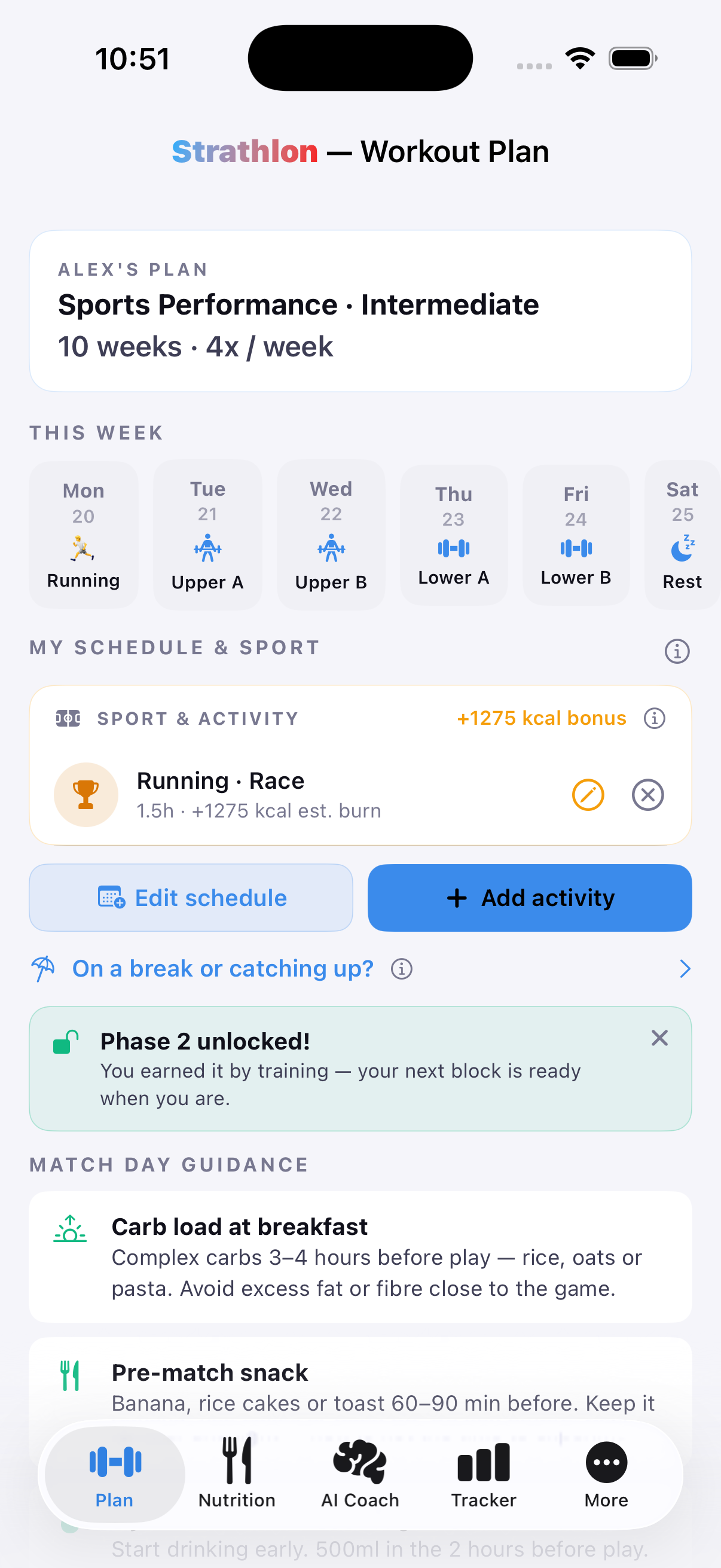
That pairing is worth dwelling on, because it captures the whole philosophy of training for a sport. The base lifts (the heavy squat, hinge and calf work at or above roughly 80% of your one-rep max) are what actually make you strong. They are not general filler to be skipped in favour of running-specific drills. On top of that base sit the sport-specific pieces: an accessory block of single-leg, hamstring and calf-Achilles work aimed at where running actually breaks. Alongside it, plyometrics (hops, skips and bounds, done with your running drills) train the fast stretch-shortening cycle heavy lifting alone does not. Neither half works alone. Heavy strength helps economy most at faster paces and plyometrics most at easier ones, so the pair covers a range neither reaches by itself.
This is worth spelling out, because it's what the plan above is doing. A good runner's strength session is really two layers. The base is a small number of heavy, compound lower-body lifts (a squat or press and a hinge) that build the raw force underpinning economy. These are the same movements that anchor almost any sensible strength plan. On top of that sits the sport-specific layer: the accessory work (calf–Achilles loading, Nordic-style hamstring work, single-leg control) that targets running's exact injury sites. Hops or bounds in your running drills train the spring. Neither layer alone is enough. The base without the running-specific accessories and plyometrics leaves the tendons and the stretch–shortening cycle under-trained. The running-specific work without a strong base has no force to build on. Rounded out with your conditioning (next section), those two layers are the whole recipe.
Conditioning for running
For a runner, "conditioning" mostly is the running, and the running is where the aerobic engine and race-specific fitness are actually built. Strength work supports that. It doesn't replace it. The backbone of almost every distance plan is a large base of easy aerobic running (comfortably conversational), which develops the cardiovascular and metabolic machinery, capillaries and mitochondria that let you use oxygen and burn fuel efficiently. Onto that base go targeted quality sessions: tempo or threshold runs to raise the pace you can sustain, intervals at around VO2max to lift your ceiling, and (closest to the strength side) hill repeats and strides, short bursts of fast running that develop power and reinforce good mechanics.
The perennial worry with mixing strength and endurance is the interference effect: the idea that doing both blunts the gains from each. It's real, but its size depends on direction. Piling heavy endurance onto a strength/power athlete can measurably blunt their power.[9] Going the other way (a runner adding a couple of heavy strength sessions), the evidence is reassuring: strength work can be added without harming endurance running performance, and while improving economy.[4] The practical key is managing fatigue well, and that doesn't mean avoiding one type of training altogether. Two rules of thumb do most of the work:
- Keep hard days hard and easy days easy. Rather than smearing moderate fatigue across every day, cluster stress: do your heavy lifting on the same day as a hard run (after it, or separated by several hours) so your easy and rest days stay genuinely restful. This "polarised" arrangement protects the quality of both your key runs and your key lifts.
- Do plyometrics and heavy strength when you're relatively fresh. Reactive work especially needs quality: a few crisp sets of hops when you're fresh beats many sloppy ones when you're wrecked. If a lift has to share a day with a run, the priority session goes first.
For the everyday recovery that lets strength and running coexist (sleep, easy days, deloads and the signs of doing too much), the recovery-and-rest guide goes deep, and it applies just as much to a runner as to a lifter.
Staying injury-resilient
Most running injuries are overuse injuries: a mismatch between the load you apply and the load your tissues are prepared for. Strength and conditioning reduces that risk in two ways: it raises tissue capacity (stronger tendons, muscles and bone tolerate more), and it improves the control and mechanics that spread load sensibly. Here's the evidence-based prehab for running's most common problems, with the magnitudes stated honestly.
- Hamstring strains: Nordic curls. The best-known example. A 2019 meta-analysis of over 8,000 athletes found injury-prevention programmes that included the Nordic hamstring exercise were associated with roughly halving hamstring-injury rates (a risk ratio near 0.49).[10] Be honest about the caveat: a later methodological reappraisal argued the true protective effect is less certain, because several of the underlying trials were at high risk of bias.[11] The fair read is that Nordic curls are a cheap, low-risk way to build eccentric hamstring strength and are associated with meaningfully fewer hamstring injuries: worth doing, without banking on an exact percentage.
- Achilles & patellar tendinopathy: progressive loading. These stubborn tendon problems respond best to progressive strengthening, far more than to rest. For midportion Achilles tendinopathy that is the clinical guideline position,[12] and structured programmes have good evidence for reducing pain and restoring function: classic Alfredson eccentric calf work (three sets of 15, done twice daily) or heavy slow resistance training (heavy loads raised and lowered over about three seconds each), with heavy slow resistance often better tolerated and needing less time.[13][14] The patellar tendon answers to the same principle: in a randomised trial, eccentric decline squats and heavy slow resistance both improved pain and function over twelve weeks and still held at six months, while a corticosteroid injection helped early then faded.[15] Building calf–Achilles and quad–patellar strength proactively, before pain appears, is sensible prehab for a load-bearing runner.
- Patellofemoral pain (runner's knee): hip and quad strength. The most prevalent running complaint. Strengthening the hips (glutes) and quadriceps, and improving single-leg control, is a core part of evidence-based management, helping the knee track and share load better under the repeated single-leg landings of running.[16]
- Bone stress injuries: load management and fuelling. Stress fractures are the most serious common running injury, and they're driven by too much load too soon and by under-fuelling. Building mileage gradually, allowing recovery, and (critically) eating enough energy protects bone. Chronic low energy availability (the core of RED-S) is strongly linked to bone stress injuries[17][18]. The running fuelling guide covers that trap in detail. A deep, localised, worsening ache in the shin, foot or hip is a red flag to stop and get assessed. It's not something to run through.
A unifying point: much of this prehab is the same work that makes you a better runner. The calf raises that protect the Achilles also build the spring that improves economy. The posterior-chain and hip work that guards against hamstring and knee problems also drives propulsion. Injury-resilience and performance are largely the same project.
Programming it around your season
Strength work should ebb and flow with your racing calendar. Running it flat all year misses the point. The broad shape most coaches use maps onto two phases:
- Off-season / base build: develop strength. When racing is far off and running volume is moderate, this is the time to build. Aim for around two (up to three) strength sessions per week, leaning on heavy compound lifts to raise maximal strength, with plyometrics layered in once a base of strength exists.[4] This is when the biggest economy and durability gains are made, because you can tolerate the extra fatigue without compromising key races.
- In-season / race phase: maintain it. As racing nears and hard running takes priority, the job flips from building strength to keeping it. The encouraging evidence here: in trained athletes, strength gains can be maintained on as little as one high-intensity session per week for a period, provided the load stays heavy.[19] Most runners settle on one to two short maintenance sessions weekly in-season. The classic mistake is thinking "maintenance" means going light and high-rep. That removes the very stimulus that holds the adaptation. Keep it brief and keep it heavy, just less of it.
Two more practical notes. First, in the final days before a goal race, taper the lifting too: pull back heavy strength and hard plyometrics so your legs arrive fresh. A little light movement to stay sharp is plenty. Second, the honest reality is that fatigue is finite: in a heavy mileage week, strength is the dial you turn down, while your key runs stay untouched. Slotting one or two quality sessions into the week (rather than chasing more) is how strength and running reinforce each other instead of competing.
Where Strathlon fits
Common questions
Will lifting heavy make me slower or bulky?
For most runners, no. Heavy, low-rep strength work builds force largely through neural adaptations (better muscle recruitment and coordination) with relatively little added muscle mass, so body weight tends to change little. Systematic reviews find that adding strength training improves running economy (the energy cost of running at a given pace) and time-trial performance in middle- and long-distance runners, without harming VO2max.[4] In other words the weight of evidence points the other way: for a typical runner, appropriate strength training tends to make you more economical and durable. Building substantial muscle takes a dedicated high-volume, high-calorie programme that looks nothing like a runner's two brief weekly sessions.
How many strength sessions a week should a runner do?
A widely cited systematic review concluded that adding roughly two to three strength sessions per week, using a mix of methods, is likely to benefit middle- and long-distance runners.[4] In practice, most runners get the bulk of the benefit from about two quality sessions per week in a build phase. In a heavy racing block you can drop to one to two shorter maintenance sessions: evidence in trained athletes suggests that as little as one high-intensity session per week can maintain strength gains for a period, provided the load stays heavy rather than being watered down to light, high-rep work.[19]
Which strength exercises matter most for runners?
The highest-value work is heavy lower-body strength and reactive (plyometric) strength, plus targeted posterior-chain and calf/Achilles work. Practically that means a heavy squat or leg press and a hip hinge or deadlift variation for force; calf raises (straight- and bent-knee) for the calf–Achilles complex that absorbs and returns most of running's load; hamstring work such as Nordic curls; single-leg exercises for the hip stability running demands; and hops, skips and bounds to train the fast stretch–shortening cycle that heavy lifting alone does not. Heavy strength (loads at or above about 80% of your one-rep max, low reps) tends to help economy most at faster paces. Plyometrics help most at easier and moderate paces.[6]
Do Nordic hamstring curls actually prevent injury?
They are one of the better-evidenced prehab exercises, though the size of the effect should be stated honestly. A 2019 meta-analysis of over 8,000 athletes found that injury-prevention programmes including the Nordic hamstring exercise were associated with roughly halving the rate of hamstring injuries (a risk ratio near 0.49).[10] A later methodological reappraisal argued the protective effect is less certain than that headline suggests, because several underlying trials carried a high risk of bias.[11] The fair summary: Nordic curls are a cheap, low-risk exercise that builds eccentric hamstring strength and are associated with meaningfully fewer hamstring injuries in the pooled data: worth including, without treating any single percentage as a guarantee.
How do I fit lifting around running without wrecking my legs?
The guiding principle is to keep hard days hard and easy days easy, so strength and quality running don't quietly erode each other. A common approach is to place a heavy lifting session on the same day as a hard run (after it, or separated by several hours) so your easy days stay genuinely easy for recovery, rather than sprinkling moderate fatigue across every day. Reassuringly, the interference between endurance and strength training is much less of a problem for a runner adding strength than for a lifter adding lots of running: reviews consistently show heavy strength work can be added without harming (and while improving) endurance running performance.[4] Leave your hardest lifting well clear of goal races.
What's the best way to handle Achilles or knee tendon pain?
For persistent Achilles or patellar (knee) tendon pain, the best-supported first-line approach is progressive loading rather than complete rest. For the Achilles, structured programmes have good evidence for reducing tendon pain and restoring function: Alfredson-style eccentric calf work (classically three sets of 15, twice daily) or heavy slow resistance training (heavy loads lifted and lowered over about three seconds each), with heavy slow resistance often better tolerated.[12][13][14] The patellar tendon looks much the same: a randomised trial found eccentric decline squats and heavy slow resistance both improved pain and function and still held at six months, unlike a corticosteroid injection.[15] This is exactly where you should see a qualified clinician for a proper diagnosis and an individualised plan, and it is not a substitute for that assessment. And treat bone-related pain differently: a deep, localised, worsening ache in the shin, foot or hip can signal a bone stress injury, which needs rest and medical assessment. Loading through it is the wrong move.
Takeaways
- Size isn't the goal. Economy and resilience are. The qualities that matter most are maximal lower-body strength, reactive (elastic) strength, and a durable posterior chain and calf–Achilles.
- Lift heavy and low-rep. Loads at or above ~80% of 1RM build force mainly through neural adaptations, so you get stronger and more economical with little added weight.[4][6]
- Add plyometrics. Hops, bounds and skips train the stretch–shortening cycle and tendon stiffness that heavy lifting misses, and combining the two beats either alone.[6]
- Two to three sessions a week to build. That's the frequency the evidence supports for improving running economy and performance. Most runners do well on two quality sessions.[4]
- Prehab is performance work. Calf–Achilles loading, Nordic-style hamstring curls, and hip/quad strength both cut injury risk and make you faster.
- Nordic curls, honestly. Associated with roughly halving hamstring injuries in pooled data (with methodological caveats): cheap, low-risk, worth doing.[10][11]
- Load tendons, don't rest them. Achilles and patellar tendinopathy respond to progressive loading (eccentric or heavy slow resistance). See a clinician, and never run through suspected bone stress.[12][15]
- Maintain in-season. One heavy session a week was enough to hold strength through a 12-week competitive season in professional footballers. The read-across to a runner's racing block is reasonable rather than directly tested: favour brief, heavy sessions over light, long ones, and taper before goal races.[19]
- Keep hard days hard. Cluster strength with your hard runs so easy days stay easy. Interference is minimal when a runner adds strength to running.[4]
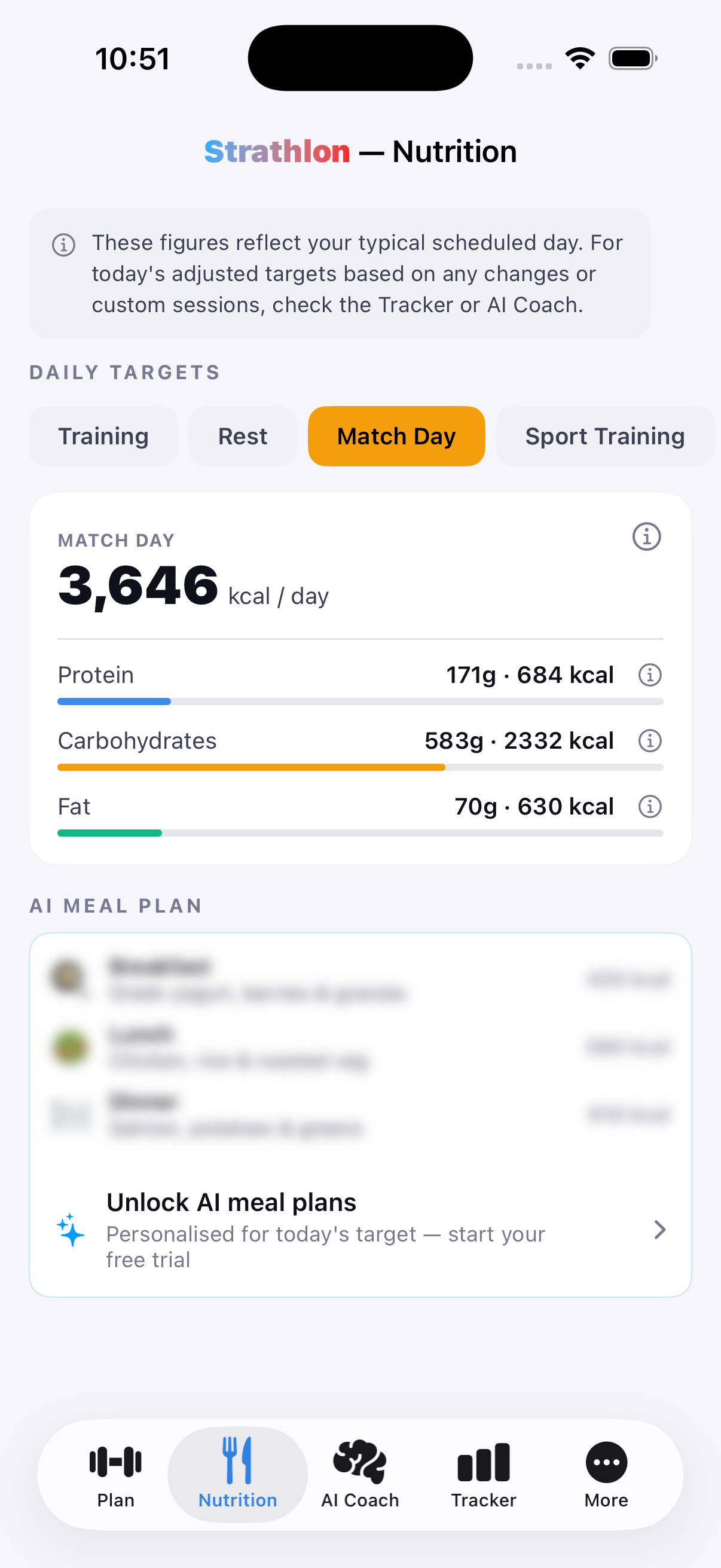
If you take one thing away, make it this: a runner's gym work isn't about getting big, it's about building a more efficient, more durable version of the runner you already are: two brief, heavy, springy sessions a week that make every stride cost a little less and every landing hurt a little less. Strathlon's role is to give you a running-aware plan to start from, remember what you lifted, and show the trend, so the strength half of your training is one less thing to guess at. Pair it with your running, and the two build on each other.
References
Numbered sources for the specific figures and effect sizes above. Where a claim reflects agreed guidance rather than a single trial, the citation is to the position stand or consensus statement of the body concerned, with the country or international remit named.
- Cavanagh PR, Lafortune MA. Ground reaction forces in distance running. Journal of Biomechanics. 1980;13(5):397–406. PubMed 7400169
- Ker RF, Bennett MB, Bibby SR, Kester RC, Alexander RM. The spring in the arch of the human foot. Nature. 1987;325:147–149. PubMed 3808070
- Saunders PU, Pyne DB, Telford RD, Hawley JA. Factors affecting running economy in trained distance runners. Sports Medicine. 2004;34(7):465–485. PubMed 15233599
- Blagrove RC, Howatson G, Hayes PR. Effects of strength training on the physiological determinants of middle- and long-distance running performance: a systematic review. Sports Medicine. 2018;48(5):1117–1149. PubMed 29249083
- Kakouris N, Yener N, Fong DTP. A systematic review of running-related musculoskeletal injuries in runners. Journal of Sport and Health Science. 2021;10(5):513–522. PMC8500811
- Llanos-Lagos C, Ramirez-Campillo R, Moran J, Sáez de Villarreal E. Effect of strength training programs in middle- and long-distance runners' economy at different running speeds: a systematic review with meta-analysis. Sports Medicine. 2024;54(4):895–932. PMC11052887
- Eihara Y, Takao K, Sugiyama T, Maeo S, Terada M, Kanehisa H, Isaka T. Heavy resistance training versus plyometric training for improving running economy and running time trial performance: a systematic review and meta-analysis. Sports Medicine – Open. 2022;8(1):138. PubMed 36370207
- Støren Ø, Helgerud J, Støa EM, Hoff J. Maximal strength training improves running economy in distance runners. Medicine & Science in Sports & Exercise. 2008;40(6):1087–1092. PubMed 18460997
- Wilson JM, Marin PJ, Rhea MR, Wilson SMC, Loenneke JP, Anderson JC. Concurrent training: a meta-analysis examining interference of aerobic and resistance exercises. Journal of Strength and Conditioning Research. 2012;26(8):2293–2307. PubMed 22002517
- van Dyk N, Behan FP, Whiteley R. Including the Nordic hamstring exercise in injury prevention programmes halves the rate of hamstring injuries: a systematic review and meta-analysis of 8459 athletes. British Journal of Sports Medicine. 2019;53(21):1362–1370. PubMed 30808663
- Impellizzeri FM, McCall A, van Smeden M. Why methods matter in a meta-analysis: a reappraisal showed inconclusive injury preventive effect of Nordic hamstring exercise. Journal of Clinical Epidemiology. 2021;140:111–124. PubMed 34520846
- Martin RL, Chimenti R, Cuddeford T, Houck J, Matheson JW, McDonough CM, Paulseth S, Wukich DK, Carcia CR. Achilles pain, stiffness, and muscle power deficits: midportion Achilles tendinopathy revision 2018, clinical practice guidelines of the Orthopaedic Section, American Physical Therapy Association (APTA, United States). Journal of Orthopaedic & Sports Physical Therapy. 2018;48(5):A1–A38. PubMed 29712543
- Alfredson H, Pietilä T, Jonsson P, Lorentzon R. Heavy-load eccentric calf muscle training for the treatment of chronic Achilles tendinosis. The American Journal of Sports Medicine. 1998;26(3):360–366. PubMed 9617396
- Beyer R, Kongsgaard M, Hougs Kjær B, Øhlenschlæger T, Kjær M, Magnusson SP. Heavy slow resistance versus eccentric training as treatment for Achilles tendinopathy: a randomized controlled trial. The American Journal of Sports Medicine. 2015;43(7):1704–1711. PubMed 26018970
- Kongsgaard M, Kovanen V, Aagaard P, Doessing S, Hansen P, Laursen AH, Kaldau NC, Kjær M, Magnusson SP. Corticosteroid injections, eccentric decline squat training and heavy slow resistance training in patellar tendinopathy. Scandinavian Journal of Medicine & Science in Sports. 2009;19(6):790–802. PubMed 19793213
- Collins NJ, Barton CJ, van Middelkoop M, et al. 2018 consensus statement on exercise therapy and physical interventions (orthoses, taping and manual therapy) to treat patellofemoral pain: recommendations from the 5th International Patellofemoral Pain Research Retreat (international consensus panel; retreat held in Gold Coast, Australia). British Journal of Sports Medicine. 2018;52(18):1170–1178. PubMed 29925502
- Mountjoy M, Ackerman KE, Bailey DM, et al. 2023 International Olympic Committee's (IOC, international) consensus statement on Relative Energy Deficiency in Sport (REDs). British Journal of Sports Medicine. 2023;57(17):1073–1097. PubMed 37752011
- Heikura IA, Uusitalo ALT, Stellingwerff T, Bergland D, Mero AA, Burke LM. Low energy availability is difficult to assess but outcomes have large impact on bone injury rates in elite distance athletes. International Journal of Sport Nutrition and Exercise Metabolism. 2018;28(4):403–411. PubMed 29252050
- Rønnestad BR, Nymark BS, Raastad T. Effects of in-season strength maintenance training frequency in professional soccer players. Journal of Strength and Conditioning Research. 2011;25(10):2653–2660. PubMed 21873897
Pair this with the running fuelling guide, how to fuel the training this guide builds, from daily carbohydrate to race-day and the under-fuelling trap that drives bone stress injuries.
This is general educational information rather than medical or individualised coaching advice. The exercise-science figures here are drawn from published research and framed as population-level guides; individual needs vary widely with training age, body type, injury history and health, and are best personalised with a qualified strength & conditioning coach. Anyone with a current injury, tendon or bone pain, a health condition, or who is pregnant or postpartum, should consult a qualified clinician before starting or changing a strength or running programme, and should not train through pain that suggests a bone stress injury. See our Terms for more.
← All guides · Fuelling for running · How muscle actually grows · Recovery & rest · Eating for results · Home