
Fuelling & performance nutrition for Ultimate Frisbee
An evidence-based guide to fuelling for Ultimate. Unlike a single continuous race, Ultimate is a repeat-sprint field sport most often played as all-day tournaments: several games in a day, sometimes across a weekend, usually in open sun. That format shifts the whole nutrition problem away from any one game and onto the day: keeping glycogen topped up across games, snacking well in the gaps, and staying hydrated and salted while the heat quietly drains you. This covers daily carbohydrate, pre-tournament loading, carbs per game, refuelling between games, hydration and sodium, recovery between games and days, and the risk of running the whole day under-fuelled. Practical, honest, and grounded in established sports-nutrition consensus.
Here's the short answer to "how should an Ultimate player fuel?": arrive with full glycogen from a high-carbohydrate day or two, take in roughly 30–60 g of carbohydrate per hour during games longer than about an hour, and (the part that actually decides your last game) refuel fast in every gap between games with carbohydrate and a little protein, all while drinking to your own sweat rate with some sodium in the sun. Everything below is the detail behind that sentence: the numbers, where they come from, and how to make an all-day tournament survivable and fast.
Pair this with the ultimate frisbee strength and conditioning guide: training and fuelling are two halves of the same job.
On this page
- What Ultimate actually demands
- The tournament is the real problem
- Daily carbohydrate: the base
- Loading before a big tournament
- The pre-game meal
- During a game: carbs per hour
- Between games: refuel fast
- Hydration, sweat and sodium in the sun
- Recovery between days
- Under-fuelling across a long day
- Common questions
- Takeaways
A framing note before the numbers. Sports nutrition is well studied, but people differ enormously: body size, position and playing time, fitness, the weather, gut tolerance, sex and health status all shift what's right on the day. So this is written as can, tends to and around, never as a guarantee, and every specific figure is a population-level guide drawn from published consensus rather than a personal prescription. It's general education rather than medical or dietary advice, and it isn't a personalised plan.
What Ultimate actually demands
Ultimate is not a jog with a disc. Match-analysis research on competitive Ultimate found players cover around 4.7 km per game, of which roughly 0.63 km is high-intensity running and 0.21 km is flat-out sprinting, across about 17 sprints a game. Mean heart rate sits near 82% of maximum and peaks around 99%: hallmarks of a genuinely high-intensity, intermittent sport (small-sided training drills push blood lactate higher still). The same study found clear fatigue late in play: about 10% less high-intensity running in the second half than the first, with the demands judged comparable to soccer and rugby.
That profile matters for fuelling. The repeated sprinting, cutting and jumping is powered mostly by muscle glycogen (your stored carbohydrate) burned in fast, anaerobic bursts, topped up by the aerobic system between points. A single competitive match in comparable intermittent sports has been shown to lower muscle glycogen by roughly 50–60%. So each game genuinely dents your fuel tank, and the late-game fade the researchers measured is exactly what an emptying tank looks like: the sprints get shorter and slower, and the disc skills that need a fresh brain start to slip.
The tournament is the real problem
Here's the twist that makes Ultimate different from most field sports: it's usually played as a tournament. You might play three, four or five games in a single day, then get up and do it again tomorrow, with only short breaks (sometimes under an hour) between games. No single game is long enough to need marathon-style fuelling, but the day absolutely is a long-duration challenge, just a broken-up one.
That reframes everything. If a game lowers muscle glycogen by 50–60% and you don't put anything back before the next one, you start the second game half-empty, the third nearly flat, and by the late rounds (exactly when placings are decided) you have nothing left for the sprint that scores or saves the point. The winning fuelling strategy for Ultimate is therefore less about any single game and more about refilling in the gaps so you arrive at your last game nearly as fuelled as your first. The sections below build that out: full stores before, sensible topping-up during, and (the decisive part) fast refuelling between games and between days.
Daily carbohydrate: the base
Tournament fuelling only works if your everyday diet keeps the tank reasonably full to begin with. The joint position on nutrition and athletic performance from the Academy of Nutrition and Dietetics, Dietitians of Canada and the American College of Sports Medicine sets daily carbohydrate targets scaled to training load: around 5–7 g of carbohydrate per kilogram of body weight per day for a general or moderate program (about an hour a day), roughly 6–10 g/kg/day for the moderate-to-high volumes of a committed player training one to three hours a day, and up to 8–12 g/kg/day on the heaviest days. The International Society of Sports Nutrition frames the same idea as a broad 5–12 g/kg/day band.
For most club players, the practical point is that these dials should move with your week. A hard track session or a tournament day warrants more carbohydrate than a rest day. Chronically eating at the low end while training and playing hard is one of the most common ways athletes end up flat, under-recovered and slow: the base is too empty for any race-day cleverness to matter.
Loading before a big tournament
Because a tournament is effectively a long day of glycogen-burning, starting with maximally full stores helps: the same logic as carbohydrate loading before an endurance race, scaled sensibly. The brutal old "depletion-then-load" protocols are gone. Contemporary guidance simply describes eating around 10–12 g of carbohydrate per kilogram of body weight per day for the 36–48 hours before a major event, while tapering training so you're storing fuel rather than burning it off.
Be proportionate about it. A full load is worth it for a two-day championship. For a single evening league game or a light session, a normal high-carbohydrate day is plenty and a deliberate load is unnecessary. Expect the scale to rise a little either way: each gram of glycogen is stored with roughly 2.7 g of water, so the gain is stored fuel and hydration rather than fat, and both help you on a hot, long day.
The pre-game meal
On the morning of a tournament, top up liver and muscle glycogen with a familiar, carbohydrate-focused meal. Position stands describe a pre-exercise meal or snack of roughly 1–4 g of carbohydrate per kilogram of body weight, eaten around one to four hours beforehand: larger and earlier when you have time to digest, smaller and closer to the first pull when you don't. Porridge, toast, a bagel, fruit, rice or a breakfast you've eaten before all work.
Favour familiar, lower-fibre, lower-fat carbohydrate you've rehearsed, because fibre and fat slow digestion and can sit heavily when you're sprinting an hour later. The golden rule of any competition morning is to try nothing new: the food, the coffee and the timing should all be things your gut has already met at a training session. And because tournament schedules slip, keep grazing on easy carbohydrate through the morning if your first game keeps getting pushed back.
During a game: carbs per hour
A single Ultimate game is an intermittent effort (bursts of sprinting separated by walking and stoppages) rather than a continuous two-hour grind, so the in-game fuelling target is modest. Sports-nutrition guidance for intermittent exercise lasting over about an hour suggests taking in around 30–60 g of carbohydrate per hour, which helps maintain blood glucose, spares your limited glycogen and supports the skills and decisions that fade when you're tired.
| Situation | Carbohydrate | Easiest form | Why |
|---|---|---|---|
| Short / early game, well-fuelled | Little needed | Water, or sip a sports drink | Your starting glycogen covers a single short game. |
| Game running over ~1 hour | ~30–60 g/h | Sports drink, banana, chews | Maintains blood glucose and spares glycogen late. |
| Back-to-back games / long day | Refuel in the gaps | See "between games" below | The day's total matters more than any one game. |
| Very long continuous endurance | up to ~90 g/h | Glucose + fructose blend | Rarely relevant to a single Ultimate game. |
In practice a standard 6–8% sports drink sipped through the game does two jobs at once (carbohydrate and fluid) and comfortably lands in the 30–60 g/h zone. You don't need the aggressive numbers endurance racers chase. To absorb much more than about 60 g per hour you'd need a glucose-plus-fructose blend (the "2:1" drinks and gels), but that ceiling is designed for very long continuous events like a marathon or ultra, and a single Ultimate game almost never needs it. Spend your effort on the gaps instead.
Between games: refuel fast
This is where a tournament is won or lost nutritionally. When only a short time separates efforts, research on athletes facing repeated matches describes prioritising, in the first ~20 minutes after a game, carbohydrate at around 1.2 g per kilogram of body weight per hour to restart glycogen refilling, plus roughly 40 g of protein to support repair. The muscle is most receptive to restocking soon after you stop, so the single most useful habit in Ultimate is to eat the moment a game ends: not after you've packed up, chatted and cooled down.
Keep it easy and familiar so it doesn't sit heavily before the next pull. Good sideline options are carbohydrate-forward with a little protein: a banana with a cereal or rice bar, a sandwich or wrap, fruit, pretzels, a recovery smoothie or flavoured milk, sipped and grazed across the break rather than eaten as one heavy plate. If the gap is long, you have room for a proper light meal. If it's under an hour, lean on drinks and soft, quick foods your stomach trusts. Pack a cooler the night before so the good choices are the easy ones.
Hydration, sweat and sodium in the sun
Ultimate is played outdoors, often on open fields with no shade and little cover, through the hottest part of a summer day, so fluid loss is a first-order problem. It isn't an afterthought. Losing more than roughly 2% of body mass as sweat is associated with rising effort, higher heart rate and, in the heat, falling performance and slipping concentration. The long-standing guidance from the American College of Sports Medicine's position on exercise and fluid replacement is to drink enough to keep body-mass loss under about 2% across the day, rather than to a rigid schedule.
There's no universal number, because sweat rates vary enormously with the person, the heat, the humidity and how much you're on the field: from well under half a litre to more than two litres an hour. As an illustration, the ACSM position notes example intakes of roughly 0.4–0.8 litres per hour during hard activity, but stresses individualising it. The reliable way to find your number is to weigh yourself before and after games in representative conditions: each kilogram lost is roughly a litre of sweat, telling you how much you're under-replacing.
For play lasting over an hour, and especially in heat, replace some sodium alongside fluid: the ACSM suggests including sodium at around 0.5–0.7 g per litre of fluid, which improves palatability, helps you hold onto what you drink, and can reduce cramping in salty sweaters. A sports drink that already carries carbohydrate usually carries sodium too, so fuelling and hydrating overlap neatly across a tournament day.
Recovery between days
A multi-day tournament gives you something a between-games gap doesn't: time. Overnight you have plenty of hours to fully refill, so the job shifts from "grab fast carbs" to "eat and drink properly, then sleep". Guidance for athletes facing repeated matches describes daily carbohydrate of around 6–10 g per kilogram of body weight when limited time separates efforts, and daily protein above roughly 1.5 g per kilogram to support repair, spread across meals rather than piled into one. Over any hard block, endurance-and-team athletes are generally advised to sit in a 1.2–2.0 g/kg/day protein range.
Rehydration between days deserves deliberate attention, because you keep losing fluid in urine after a hot day. Research on post-exercise rehydration shows that drinking around 150% of the fluid you lost, with sodium, restores fluid balance better than matching your losses exactly: the extra covers ongoing urine losses, and the sodium helps you retain it. In practice: a full carbohydrate-and-protein dinner, keep sipping fluids with some salt through the evening (a normal salted meal does a lot of this for you), and protect your sleep. The eating-for-results guide covers the broader nutrition picture in depth.
Under-fuelling across a long day
The most common tournament nutrition mistake isn't the wrong sports drink: it's simply eating far too little across a very long, distracting day. It's easy to play five games, drink a couple of bottles of water and eat one sad sandwich, then wonder why the legs vanished. A day like that leaves you running a large energy and carbohydrate deficit exactly when you need to be sharp, and it shows up as slow sprints, poor decisions and cramp.
Over the longer term, chronically eating too little to support training and play tips into low energy availability: not leaving enough energy, after exercise is paid for, to run the body's basic functions. Sports scientists quantify this as energy availability: roughly, energy eaten minus energy burned in exercise, per kilogram of fat-free mass. Falling below about 30 kcal per kg of fat-free mass per day is associated with a cascade of problems, while nearer 45 kcal/kg per day is considered healthy for an active body. Sustained low energy availability is the root of what the International Olympic Committee calls Relative Energy Deficiency in Sport (RED-S): a syndrome affecting both men and women that can impair bone health, hormones, immunity, mood and performance itself. Warning signs (recurrent stress fractures, frequent illness, a stalled season, poor sleep, missing periods) are red flags to eat more and seek help from a sports physician or dietitian. Pushing through is the wrong response.
Common questions
How should an Ultimate Frisbee player fuel for an all-day tournament?
Treat the whole day as one long, broken-up effort rather than a series of separate games. Arrive with full glycogen from a high-carbohydrate day or two beforehand and a familiar carbohydrate breakfast. During games lasting over an hour, sports-nutrition guidance suggests around 30–60 g of carbohydrate per hour, most easily taken as a sports drink or easy snacks on the sideline. The part that decides your late-day legs is refuelling in the gaps: a match can lower muscle glycogen by roughly 50–60%, so eat carbohydrate-rich snacks as soon as each game ends. And drink to your sweat rate with some sodium, because Ultimate is usually played in open sun.
What should I eat between games at a tournament?
Prioritise carbohydrate, with a little protein, and start as soon as the game ends. Research on athletes with limited time between matches describes taking in carbohydrate at around 1.2 g per kilogram of body weight per hour in the first hours, plus roughly 40 g of protein, ideally beginning within about 20 minutes of finishing. In practice that means easy, familiar foods you can eat on the sideline (a banana and a cereal or rice bar, a sandwich, fruit, a recovery drink or flavoured milk) sipped and grazed across the break rather than a single heavy meal that sits in your stomach for the next game.
Do I need to carb-load before an Ultimate tournament?
For a full day of games, topping up muscle glycogen beforehand is worthwhile, though you don't need the extreme old protocols. Contemporary guidance describes eating around 10–12 g of carbohydrate per kilogram of body weight per day for the 36–48 hours before a big event while easing off training. For a single evening game or a light session, a normal high-carbohydrate day is plenty. Expect a small rise on the scale, because glycogen is stored with water (roughly 2.7 g of water per gram of glycogen) which is stored fuel and hydration rather than fat.
How much should I drink during Ultimate in the heat, and do I need salt?
There is no single number, because sweat rates vary hugely with the person, the heat and the sun. The long-standing sports-medicine goal is to drink enough to keep body-mass loss under about 2% across the day. The American College of Sports Medicine notes example intakes of roughly 0.4–0.8 litres per hour during hard activity, individualised to you. For play lasting over an hour, and especially in heat, including sodium (the ACSM suggests around 0.5–0.7 g per litre of fluid) helps you hold onto what you drink. The most reliable method is to weigh yourself before and after games to learn your own sweat rate. Each kilogram lost is roughly a litre of sweat.
How much carbohydrate do I actually need during a single Ultimate game?
A single game is an intermittent, repeat-sprint effort rather than a two-hour continuous grind, so the in-game target is modest. For intermittent exercise lasting more than about an hour, position stands suggest around 30–60 g of carbohydrate per hour, which a standard 6–8% sports drink or a couple of easy snacks on the sideline will cover. Very high intakes near 90 g per hour, and the glucose-plus-fructose blends used to absorb them, are aimed at very long continuous endurance events and are usually more than a single Ultimate game needs. The bigger lever across a tournament is refuelling between games rather than stuffing carbohydrate into one.
How do I recover between days of a multi-day tournament?
You have far more time overnight than between games, so the job is simply to fully refill. Guidance for athletes facing repeated matches describes daily carbohydrate of around 6–10 g per kilogram of body weight when limited time separates efforts, plus daily protein above about 1.5 g per kilogram to support repair, spread across meals. Rehydrate deliberately too, because you keep sweating between drinks, replacing around 150% of the fluid you lost, with sodium, restores balance better than matching losses exactly. Eat a proper carbohydrate-and-protein dinner, keep drinking through the evening, and sleep.
Takeaways
- Ultimate is a real repeat-sprint sport. Around 4.7 km a game with ~17 sprints, near-maximal heart rates and high lactate: as demanding as a half of soccer, powered mostly by muscle glycogen.
- The tournament is the challenge, more than any single game. A match can lower muscle glycogen by ~50–60%. Several games in a day is a long, broken-up effort, so the day's fuelling matters more than any single game.
- Build the base daily. Match everyday carbohydrate to load: roughly 5–7 g/kg on lighter days, up to 8–12 g/kg/day on the heaviest.
- Load before a big one. Around 10–12 g/kg/day for 36–48 hours while tapering for a championship weekend, or a normal high-carb day for a single casual game. The water weight is fuel rather than fat.
- Pre-game: a familiar, carb-focused meal of about 1–4 g/kg, one to four hours before; nothing new on game day; keep grazing if the schedule slips.
- During a game: ~30–60 g of carbohydrate per hour once it runs past an hour: a 6–8% sports drink covers it. You don't need endurance-race numbers.
- Between games, the decider: refuel fast, ideally within ~20 minutes, at ~1.2 g/kg/h of carbohydrate plus ~40 g of protein, as easy sideline snacks and drinks.
- Hydrate to your sweat rate in the sun. Keep body-mass loss under ~2%; example intakes ~0.4–0.8 L/h; add sodium (~0.5–0.7 g/L) for play over an hour, and don't over-drink plain water.
- Between days: ~6–10 g/kg/day carbohydrate and >1.5 g/kg/day protein, and rehydrate with ~150% of losses plus sodium, then sleep.
- Eat enough, all day. The classic tournament error is under-eating across a long day. Chronic under-fuelling (low energy availability, RED-S) harms bone, hormones, health and performance.
- References
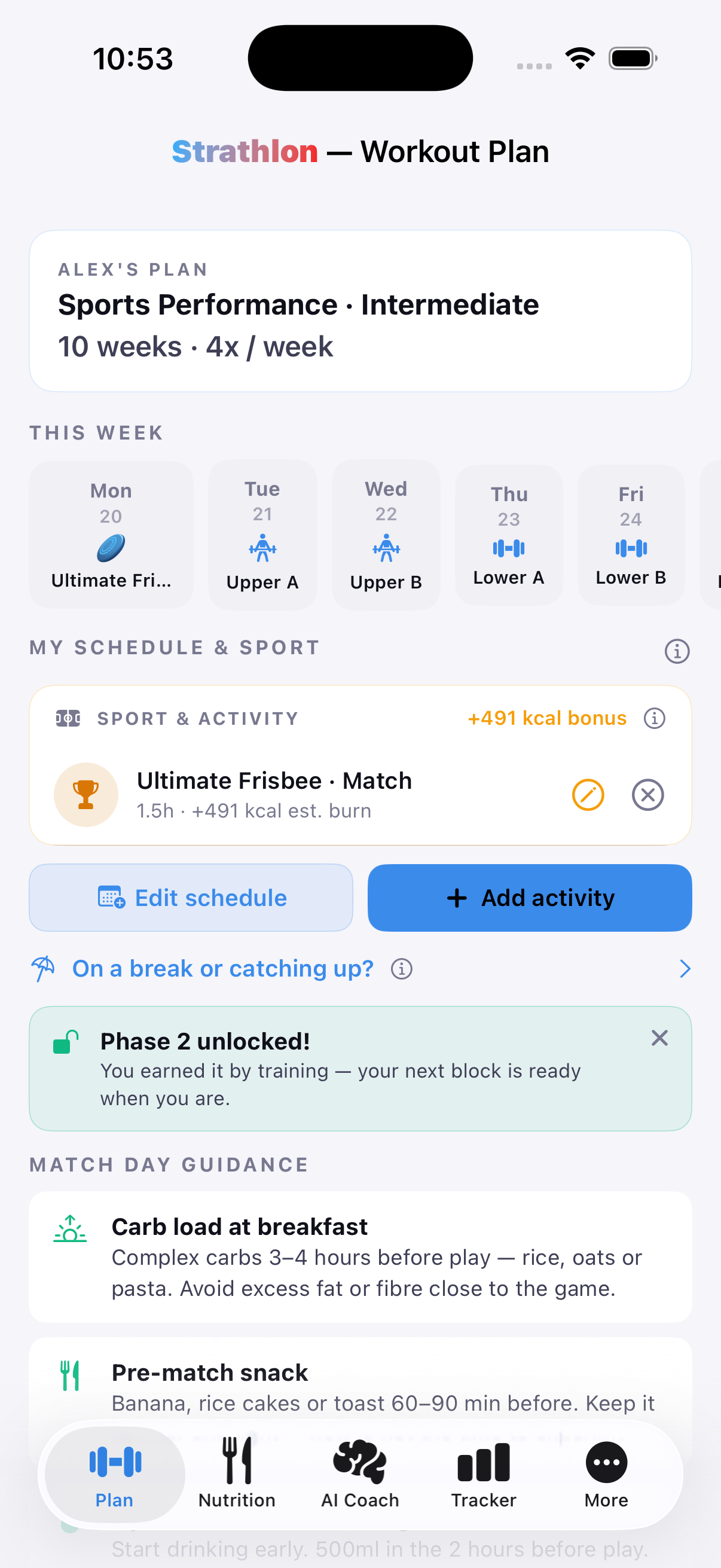
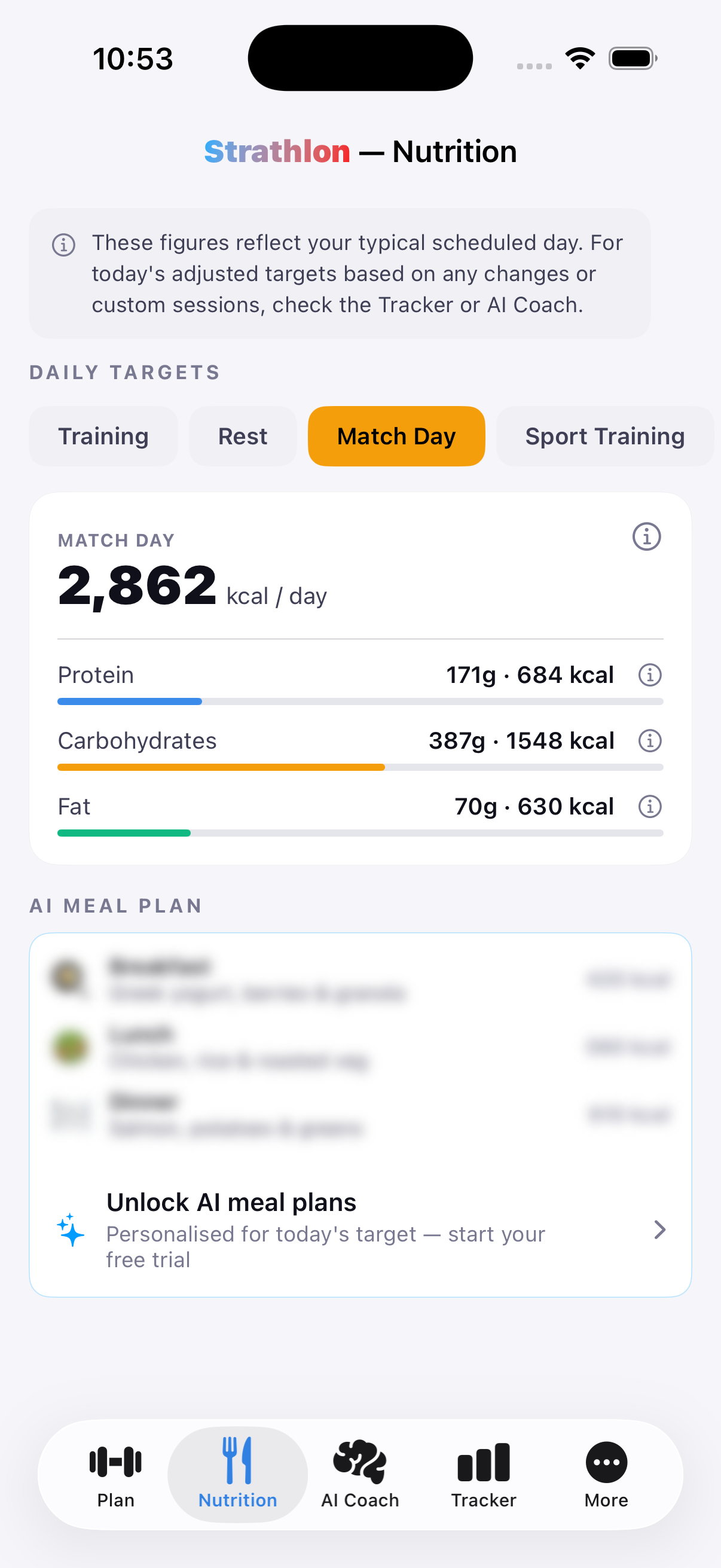
If you remember one thing, make it this: the players still sprinting in the last game aren't the ones with the fanciest gels: they're the ones who showed up loaded, ate the moment each game ended, and kept drinking with a pinch of salt all day. Strathlon's job is to keep that base honest by adjusting your targets around the games you actually log, so the everyday fuelling that underpins a whole tournament weekend is one less thing to guess at.
References
Numbered sources for the specific figures, effect sizes and named studies above. Where a claim reflects agreed guidance rather than a single trial, the citation is to the position stand or consensus statement of the body concerned, with the country or international remit named. Ultimate has no published nutrition research. The demands below are ultimate-specific and the fuelling prescriptions are read across from the intermittent team-sport literature; that is stated rather than hidden.
- Madueno MC, Kean CO, Scanlan AT. The sex-specific internal and external demands imposed on players during Ultimate Frisbee game-play. The Journal of Sports Medicine and Physical Fitness. 2017;57(11):1407–1414. Study of the sex-specific internal and external demands imposed during ultimate frisbee game play: the source for the energy cost this guide fuels for. PubMed 28094489
- Scanlan AT, Kean CO, Humphries BJ, Dalbo VJ. Physiological and Fatigue Responses Associated With Male and Mixed-Gender Ultimate Frisbee Game Play. Journal of Strength and Conditioning Research. 2015;29(9):2600–7. Study of the physiological and fatigue responses associated with male and mixed-gender ultimate game play, the basis for the tournament-day advice. PubMed 26313576
- Kajiki M, Yamashita Y, Inada R, Matsumoto T. Physical, Physiological, and Technical Demands in Ultimate Frisbee Small-Sided Games: Influence of Pitch Size. Sports. 2021;9(8). Study of the physical, physiological and technical demands of ultimate small-sided games, cited for training-day fuelling. PubMed 34437365 · PMC8402465 full text
- Williams C, Rollo I. Carbohydrate Nutrition and Team Sport Performance. Sports Medicine. 2015;45 Suppl 1(Suppl 1):S13–22. Review of carbohydrate nutrition and team-sport performance, the source for the carbohydrate case. PubMed 26553494 · PMC4672015 full text
- Baker LB, Rollo I, Stein KW, Jeukendrup AE. Acute Effects of Carbohydrate Supplementation on Intermittent Sports Performance. Nutrients. 2015;7(7):5733–63. Review of the acute effects of carbohydrate supplementation on intermittent sports performance, the in-match evidence. PubMed 26184303 · PMC4517026 full text
- Nicholas CW, Tsintzas K, Boobis L, Williams C. Carbohydrate-electrolyte ingestion during intermittent high-intensity running. Medicine and Science in Sports and Exercise. 1999;31(9):1280–6. Trial of carbohydrate-electrolyte ingestion during intermittent high-intensity running, the closest experimental match to a tournament day. PubMed 10487369
- Nuccio RP, Barnes KA, Carter JM, Baker LB. Fluid Balance in Team Sport Athletes and the Effect of Hypohydration on Cognitive, Technical, and Physical Performance. Sports Medicine. 2017;47(10):1951–1982. Review of fluid balance in team-sport athletes and the effect of hypohydration on performance: cited because ultimate is played outdoors, often all day. PubMed 28508338 · PMC5603646 full text
- Arguedas-Soley A, Townsend I, Hengist A, Betts J. Acute caffeine supplementation and live match-play performance in team-sports: A systematic review (2000-2021). Journal of Sports Sciences. 2022;40(7):717–732. Systematic review of acute caffeine supplementation and live match-play performance in team sports. PubMed 35297302
- Thomas DT, Erdman KA, Burke LM. Position of the Academy of Nutrition and Dietetics, Dietitians of Canada, and the American College of Sports Medicine: Nutrition and Athletic Performance. Journal of the Academy of Nutrition and Dietetics. 2016;116(3):501–528. Joint position of the Academy of Nutrition and Dietetics, Dietitians of Canada and the American College of Sports Medicine: the umbrella source for the daily energy, carbohydrate and protein ranges used throughout. PubMed 26920240
- Burke LM, Hawley JA, Wong SH, Jeukendrup AE. Carbohydrates for training and competition. Journal of Sports Sciences. 2011;29 Suppl 1:S17–27. Burke and colleagues on carbohydrate for training and competition, the source for the g/kg/day carbohydrate targets matched to training load. PubMed 21660838
- Jeukendrup A. A step towards personalized sports nutrition: carbohydrate intake during exercise. Sports Medicine. 2014;44 Suppl 1(Suppl 1):S25–33. Jeukendrup on personalising carbohydrate intake during exercise: the source for the g/h feeding rates and the duration at which they start to matter. PubMed 24791914 · PMC4008807 full text
- Jäger R, Kerksick CM, Campbell BI, Cribb PJ, Wells SD, Skwiat TM, et al. International Society of Sports Nutrition Position Stand: protein and exercise. Journal of the International Society of Sports Nutrition. 2017;14:20. International Society of Sports Nutrition (ISSN, United States) position stand on protein and exercise, the source for the daily protein range and per-meal distribution. PubMed 28642676 · PMC5477153 full text
- Schoenfeld BJ, Aragon AA. How much protein can the body use in a single meal for muscle-building? Implications for daily protein distribution. Journal of the International Society of Sports Nutrition. 2018;15:10. Schoenfeld and Aragon on how much protein the body can use in a single meal, the basis for the per-feed figure quoted. PubMed 29497353 · PMC5828430 full text
- Burke LM, van Loon LJC, Hawley JA. Postexercise muscle glycogen resynthesis in humans. Journal of Applied Physiology. 2017;122(5):1055–1067. Review of post-exercise muscle glycogen resynthesis, the source for the refuelling rates and for when a fast refuel is actually needed. PubMed 27789774
- Sawka MN, Burke LM, Eichner ER, Maughan RJ, Montain SJ, Stachenfeld NS. American College of Sports Medicine position stand. Exercise and fluid replacement. Medicine and Science in Sports and Exercise. 2007;39(2):377–90. ACSM position stand on exercise and fluid replacement: the source for the under-2% body-mass-loss guideline and the sweat-rate method. PubMed 17277604
- Barnes KA, Anderson ML, Stofan JR, Dalrymple KJ, Reimel AJ, Roberts TJ, et al. Normative data for sweating rate, sweat sodium concentration, and sweat sodium loss in athletes: An update and analysis by sport. Journal of Sports Sciences. 2019;37(20):2356–2366. Normative data for sweating rate and sweat sodium concentration in athletes, the source for how widely fluid and sodium losses vary between individuals. PubMed 31230518
- Hew-Butler T, Rosner MH, Fowkes-Godek S, Dugas JP, Hoffman MD, Lewis DP, et al. Statement of the Third International Exercise-Associated Hyponatremia Consensus Development Conference, Carlsbad, California, 2015. Clinical Journal of Sport Medicine : Official Journal of the Canadian Academy of Sport Medicine. 2015;25(4):303–20. Third International Exercise-Associated Hyponatremia Consensus statement, the basis for the warning against drinking well beyond sweat losses. PubMed 26102445
- Guest NS, VanDusseldorp TA, Nelson MT, Grgic J, Schoenfeld BJ, Jenkins NDM, et al. International society of sports nutrition position stand: caffeine and exercise performance. Journal of the International Society of Sports Nutrition. 2021;18(1):1. ISSN position stand on caffeine and exercise performance, the source for the caffeine dose and timing guidance. PubMed 33388079 · PMC7777221 full text
- Kreider RB, Kalman DS, Antonio J, Ziegenfuss TN, Wildman R, Collins R, et al. International Society of Sports Nutrition position stand: safety and efficacy of creatine supplementation in exercise, sport, and medicine. Journal of the International Society of Sports Nutrition. 2017;14:18. ISSN position stand on the safety and efficacy of creatine supplementation, cited where creatine is relevant to the sport's demands. PubMed 28615996 · PMC5469049 full text
- Maughan RJ, Burke LM, Dvorak J, Larson-Meyer DE, Peeling P, Phillips SM, et al. IOC consensus statement: dietary supplements and the high-performance athlete. British Journal of Sports Medicine. 2018;52(7):439–455. IOC consensus statement on dietary supplements and the high-performance athlete: the framing for treating supplements as optional extras. PubMed 29540367 · PMC5867441 full text
- Mountjoy M, Ackerman KE, Bailey DM, Burke LM, Constantini N, Hackney AC, et al. 2023 International Olympic Committee's (IOC) consensus statement on Relative Energy Deficiency in Sport (REDs). British Journal of Sports Medicine. 2023;57(17):1073–1097. The 2023 IOC consensus statement on Relative Energy Deficiency in Sport, the source for the consequences of under-fuelling a training load. PubMed 37752011
- Aragon AA, Schoenfeld BJ. Nutrient timing revisited: is there a post-exercise anabolic window?. Journal of the International Society of Sports Nutrition. 2013;10(1):5. Aragon and Schoenfeld on the post-exercise anabolic window, the source for timing mattering far less than daily totals. PubMed 23360586 · PMC3577439 full text
- British Dietetic Association (BDA, United Kingdom). Sport and exercise nutrition: Food Fact Sheet. British Dietetic Association (BDA, United Kingdom) Food Fact Sheet on sport and exercise nutrition, the practical UK dietetic framing. BDA Food Fact Sheet
This is general educational information rather than medical, dietary or coaching advice. The sports-nutrition figures here are drawn from established consensus and are framed as population-level guides: individual needs vary widely with body size, playing time, conditions, gut tolerance and health, and are best personalised with a qualified professional. Anyone with a health condition, a history of disordered eating, or who is pregnant or postpartum, or who suspects under-fuelling, stress fractures, menstrual disruption or RED-S, should consult a sports physician or registered dietitian before making changes. See our Terms for more.
← All guides · Ultimate frisbee strength and conditioning · Eating for results · Understanding your stats · Home