
Strength & conditioning for ultimate frisbee
An evidence-based guide to training the body ultimate actually asks for. Ultimate is a repeat-sprint, cut-and-land sport played on an aerobic base: you sprint flat out, plant hard, change direction, jump to catch or block, and then do it again a few seconds later. This covers the strength and power that make those actions faster and safer, the conditioning that keeps them sharp deep into a game, the prehab that protects the knees, ankles, hamstrings and shoulders ultimate loads most, and how to fit it all around your season. Practical, honest, and grounded in published sport science.
The short version: the three qualities that carry an ultimate player are repeatable sprint-and-cut speed, reactive single-leg strength to change direction and land safely, and durable hamstrings and shoulders, all sitting on an aerobic base that lets you produce the same effort on the last point as on the first. Everything below is the detail behind that sentence: what to train, why it transfers, and where the numbers come from.
On this page
A framing note before the detail. Strength and conditioning is well studied, but people differ enormously : training age, sex, position, injury history, sleep and genetics all shift how anyone responds. So this is written as can, tends to and is associated with, never as a guarantee, and every specific number is a population-level finding from published research rather than a personal prescription. It's general education rather than medical advice or individual coaching, and it's no substitute for a qualified S&C coach or clinician, especially if you're carrying an injury.
The demands of ultimate frisbee
Start with what a game actually looks like in the body. GPS and heart-rate analysis of competitive players found that a full match covered around 4.7 km, of which roughly 0.63 km was high-intensity running and 0.21 km was flat-out sprinting, spread across about 17 sprints, with the game spent at a mean heart rate near 82% of maximum and peaks around 99% (Krustrup and Mohr, 2015). In plain terms: ultimate is an intermittent, high-intensity sport, closer to repeated near-maximal efforts stitched together with brief, incomplete recoveries than to a steady jog or pure sprinting.
The mechanics on top of that running are what stress the joints. Ultimate is built on hard accelerations and decelerations, sharp cuts and pivots, and jump-landings to catch, sky an opponent or lay out for a block, very often on a single leg, and very often while reaching or off-balance. Layer on the throwing: backhands, forehand flicks and hammers repeated hundreds of times a session load the shoulder and trunk in rotation. Each of those actions is a place the body can be built up or broken down.
Unsurprisingly, then, the injury map is dominated by the lower limb. A systematic review of ultimate injuries found the lower extremity accounted for roughly 27–88% of injuries across studies, with the knee, ankle and thigh consistently the most-injured regions, and the shoulder one of the most-injured upper-limb regions (wrist and hand ranked highest among upper-limb injuries in the review). Most injuries occurred without contact (about 40–69%), and lifetime injury prevalence among surveyed players was effectively total (Fajardo Pulido and Lystad, 2020). Within the knee, the ACL is a standout: the abrupt cutting and jump-landing profile of ultimate is exactly the pattern that loads it. So the target list writes itself: build the qualities that make you fast, and protect the knee, ankle, hamstring and shoulder while you do.
Key strength work, and why it matters
The organising idea for the gym is simple: a stronger athlete is usually a faster, springier, more change-of-direction-capable and more injury-resistant athlete. A large review of the evidence concluded that greater maximal strength is associated with better jumping, sprinting and change-of-direction performance, superior force-time characteristics, and lower injury risk (Suchomel, Nimphius and Stone, 2016). Strength is the base that the explosive stuff is built on. Here's the stack that transfers to ultimate, and why each piece earns its place.
- Heavy bilateral strength: squat and hinge. Back or front squats, trap-bar or conventional deadlifts and hip thrusts build the raw force your legs can put into the ground. This is the foundation Suchomel and colleagues describe: without a base of maximal strength, there's less to turn into speed and spring. These are trained heavy and low-rep: think a handful of hard reps at loads around or above 80% of your one-rep max, the intensity zone that also preserves strength most efficiently (Spiering, Mujika, Sharp and Foulis, 2021).
- Single-leg strength: the change-of-direction lift. Cutting, decelerating and landing almost always happen on one leg, so training on one leg matters. Bulgarian split squats, single-leg Romanian deadlifts, step-ups and lunges build unilateral force and the balance to express it, and they iron out left–right differences that a barbell can hide. This is where a lot of on-field "strength that shows up" lives.
- Plyometrics and landing work: reactive strength. Sprinting, cutting and jumping are fast. The muscle has milliseconds to produce force. Jumps, bounds, pogos and, importantly, deliberate landing and deceleration drills train that reactive, elastic quality and teach the body to absorb force through a bent, aligned knee. Plyometric training has repeatedly been shown to improve jump, sprint and change-of-direction performance, and the same landing skills sit at the heart of knee-injury prevention (more below).
- Eccentric hamstring work: sprint durability. High-speed running is when hamstrings tear, and eccentric strength is the best-supported protection. The Nordic hamstring curl is the headline exercise here: it trains the hamstrings hard as they lengthen under load, which is the exact demand of the late swing phase of a sprint. It builds the resilience described in the injury section below.
- Shoulder and trunk: for throwing and landing. Repeated flicks, backhands and hammers, plus the impact of laying out, load the shoulder, a leading upper-limb injury site in ultimate (wrist and hand rank highest in the review). Work for the rotator cuff and scapular control (external rotations, band pull-aparts, presses and carries), plus a strong anti-rotation trunk, supports throwing volume and shoulder health. Honest caveat: this recommendation is largely extrapolated from overhead and throwing sports rather than proven in ultimate specifically, so treat it as sensible, transferable practice rather than a settled number.
- References
Notice how these fit together. The base lifts raise the ceiling on force; the single-leg and plyometric work turns that force into fast, one-legged, field-shaped power; and the hamstring and shoulder work keeps the whole thing durable under the sport's specific loads. You don't have to choose between "gym strength" and "ultimate-specific" work: the point is that the sport-specific pieces (Nordic curls, cutting-and-landing drills, shoulder care) sit on top of a general strength base rather than replacing it.
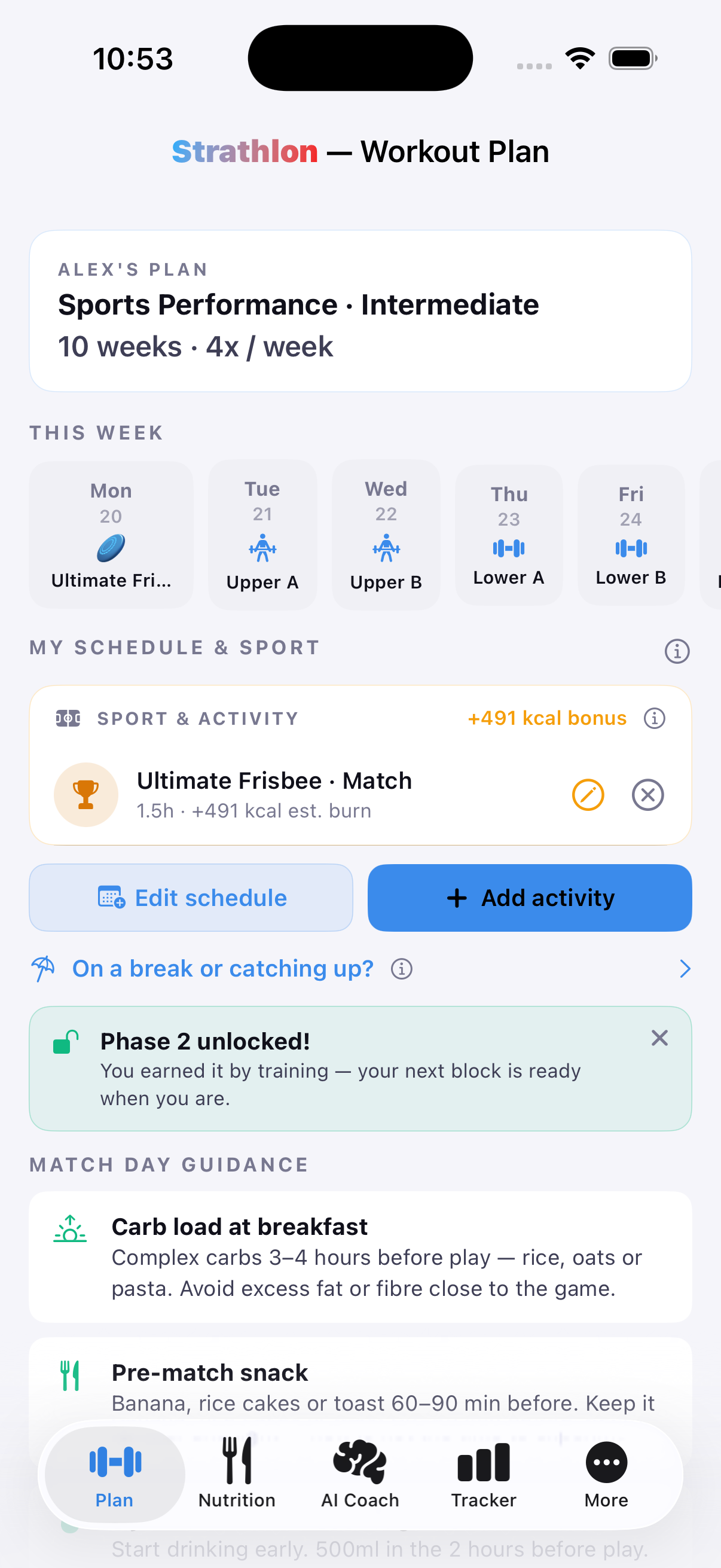
That pairing is worth dwelling on, because it captures the whole philosophy of training for a sport. The base lifts (heavy squats and hinges at or above roughly 80% of your one-rep max) are what actually make you strong. They are not general filler to be skipped in favour of more pick-up games. On top of that base sit the sport-specific pieces: an accessory block of single-leg work for the change of direction, eccentric hamstring work for sprint durability, and plyometrics with deliberate landings (box jumps, lateral bounds and pogo hops) for the cut and the layout. Neither half works alone. Landing and hamstring work on a weak base protects a player who cannot generate much. A strong squat that has never been trained to cut, land or decelerate does not reach the field.
Conditioning for ultimate frisbee
Strength makes each sprint and cut better. Conditioning is what lets you repeat them for two halves. Ultimate is a classic repeat-sprint sport, and the ability to keep reproducing high-quality sprints leans heavily on the aerobic system, which restocks energy and clears fatigue during the short recoveries between points. Reviews of repeated-sprint ability identify aerobic fitness as a key contributor to that between-effort recovery (Bishop, Girard and Mendez-Villanueva, 2011), which is exactly why match analysis shows high-intensity running tailing off late in each half as fatigue builds (Krustrup and Mohr, 2015). The player who's still fast in the final points is usually the better-conditioned one.
So conditioning for ultimate combines several modes rather than relying on a single one:
- Repeated-sprint work (short maximal efforts, roughly 3–7 seconds, with brief, incomplete recoveries) trains the exact quality the game demands: sprint, jog back, sprint again.
- Interval and high-intensity work (longer, hard efforts with fuller recovery) drives up your aerobic ceiling. Systematic reviews of high-intensity interval training in team-sport athletes report improvements in maximal oxygen uptake, intermittent-recovery-test performance and repeated-sprint ability (2024 meta-analysis in PLOS ONE).
- An aerobic base (some easier steady running) supports the recovery engine underneath it all, without which the repeated sprints degrade quickly.
Fitting conditioning alongside strength takes a little care because of the interference effect: piling heavy lifting and hard running into the same window can blunt the strength side if you're not thoughtful. The practical fixes are to separate your hardest lifting from your hardest running where you can (different days, or several hours apart), and to let the season set the priority: build both in the off-season, then protect whichever quality your competition most depends on once games begin. Much of a well-organised ultimate player's conditioning also comes from practice and games themselves, so count that load rather than stacking extra sprints on top of an already sprint-heavy week.
Staying injury-resilient
Because most ultimate injuries are lower-limb and non-contact, a lot of them are, in principle, trainable to reduce: you have some control over how your body cuts, lands and holds up. The prehab that matters maps straight onto the sport's four problem areas.
- Hamstrings: eccentric strength. The best-supported tool is the Nordic hamstring exercise. A meta-analysis of 8,459 athletes found that injury-prevention programmes including it roughly halved hamstring-injury rates (van Dyk, Behan and Whiteley, 2019). Report it honestly, though: a 2021 methodological reappraisal argued the protective effect is less certain than that clean "halved" figure implies. The fair summary is that eccentric hamstring training is associated with a meaningful reduction in hamstring injuries: a strong bet, though nothing here is guaranteed. Build the volume gradually. It's brutally hard at first.
- Knee and ACL: neuromuscular training. For a cutting, pivoting, jump-landing sport, this is the big one. Structured neuromuscular-training programmes (combining strength, balance, plyometrics and explicit coaching of soft, aligned landing and cutting mechanics) have been shown to cut all ACL injuries by about 50%, and non-contact ACL injuries by roughly two-thirds in female athletes (Webster and Hewett, 2018). The male evidence base is thinner, but the mechanics transfer. They work best performed two to three times a week in short bouts, and (the recurring finding) only if you actually keep doing them.
- Ankle: balance and proprioception. Ankle sprains are among the most common ultimate injuries, and single-leg balance and proprioceptive training is well established in sports medicine for reducing recurrent ankle sprains in particular. Simple single-leg balance drills, landing practice and wobble-surface work belong in the routine, especially if you've rolled an ankle before.
- Shoulder: cuff and scapular care. Given the throwing volume and the shoulder's status as a leading upper-limb injury site, rotator-cuff and scapular-control work is sensible insurance. As above, the ultimate-specific evidence is limited, so this is transferred good practice from overhead sports rather than a sport-specific proven dose.
The efficient move is that most of these overlap. A 10–15 minute neuromuscular warm-up done before practice (hops and landings, single-leg balance, a Nordic or hamstring bridge progression, some cutting mechanics and band shoulder work) hits hamstrings, knees, ankles and shoulders in one go, which is exactly how the well-studied prevention programmes are built. Consistency beats complexity: the programmes only deliver their numbers when people keep doing them.
Programming it around your season
The same exercises get organised differently depending on where you are in the year.
- Off-season: build. This is when strength and power get made. Two to three lifting sessions a week, progressively overloaded, with heavy base lifts, single-leg work and plyometrics, plus conditioning to rebuild your aerobic and repeat-sprint base. There's room to be sore and to push, because games aren't on the line.
- In-season: maintain. Here the goal flips from building to holding on while staying fresh for practice and games. The encouraging evidence: maximal strength can be maintained with as little as one hard session per week as long as the load stays heavy (around 80% 1RM or more) (Spiering, Mujika, Sharp and Foulis, 2021), and a review of well-trained and in-season athletes found no clear strength difference across training frequencies over 6–12 weeks, so you can micro-dose the work however your schedule allows (Cuthbert and colleagues, 2021). One or two short, heavy, low-volume sessions a week is a realistic in-season target. Keep the injury-prevention warm-up going year-round.
- Fit it around fatigue. Lift on or near practice days rather than scattering hard work across every day, so you concentrate stress and protect recovery days. Put your heaviest or most explosive gym work when you're freshest, keep hard lifting and hard sprinting from colliding in the same window, and pull back (a lighter week) when travel, tournaments or life stress stack up. In-season, quality and freshness beat volume.
Common questions
Will lifting heavy make me slower or bulky for ultimate?
Almost certainly the opposite. A large body of sport-science research links greater maximal strength with better sprinting, jumping and change-of-direction performance, and with lower injury risk (Suchomel, Nimphius and Stone, 2016). Heavy, low-rep strength work builds force without necessarily adding much size, and visible muscle gain is slow and deliberate rather than accidental. In-season you can hold onto your strength with as little as one hard session a week, so it never has to cost you your speed. The players who get slow are usually the ones who stop lifting entirely, rather than the ones who lift heavy.
What is the single best strength exercise for ultimate?
There isn't one, and chasing a single magic lift is the wrong frame. Ultimate rewards a small stack of qualities: a heavy bilateral squat or hinge for raw force, single-leg work (split squats, single-leg Romanian deadlifts, step-ups) because cutting, decelerating and landing happen on one leg, plyometrics and landing drills for reactive, springy strength, and eccentric hamstring work such as the Nordic hamstring curl for sprint durability. Greater maximal strength underpins the explosive qualities (Suchomel and colleagues, 2016), so the base lifts matter, but it's the combination that transfers to the field.
How do I stop tweaking my hamstring?
Hamstring and thigh strains are among the most common ultimate injuries, and they happen during fast running, which is most of the game. The best-supported single tool is eccentric hamstring training, above all the Nordic hamstring curl. A systematic review and meta-analysis of 8,459 athletes found that injury-prevention programmes including the Nordic hamstring exercise roughly halved hamstring injury rates (van Dyk, Behan and Whiteley, 2019). Be honest that a later methodological reappraisal argued the effect is less certain than that headline suggests, so treat it as a strong association rather than a guarantee. Build the volume up gradually (the exercise is very demanding and causes marked soreness at first), and keep some hamstring work in year-round, long before anything hurts.
How can I reduce my ACL and knee injury risk?
Ultimate is a cutting, pivoting and jump-landing sport, and the knee (including the ACL) is one of its most-injured areas, with most injuries occurring without contact. The evidence-based answer is structured neuromuscular training: a mix of strength, balance, plyometrics and, critically, coaching how to land and change direction softly on a bent, aligned knee. A meta-analysis of meta-analyses found ACL-prevention training programmes cut all ACL injuries by around 50% and non-contact ACL injuries by about two-thirds in female athletes (Webster and Hewett, 2018). Data in men is thinner, but the mechanics point the same way. These programmes work best done two to three times a week, in short bouts, and only if you actually stick with them.
How many gym sessions a week do I need in-season?
Fewer than most people fear. A narrative review of the minimal effective dose concluded that maximal strength can be maintained with as little as one session per week, provided the load stays reasonably heavy : around 80% of your one-rep max or more (Spiering, Mujika, Sharp and Foulis, 2021). A separate systematic review of well-trained and in-season athletes found no clear difference in strength development across training frequencies over six to twelve weeks, so you can spread a little work across the week or condense it (Cuthbert and colleagues, 2021). One or two focused, hard sessions a week is a realistic in-season target that holds your strength without wrecking you for practice.
Ultimate feels like all sprints: do I still need aerobic fitness?
Yes. Ultimate is a repeat-sprint sport, and your ability to keep repeating high-quality sprints depends heavily on your aerobic system, which clears fatigue and restocks energy between points. Reviews of repeated-sprint ability describe aerobic fitness as a key contributor to recovery between efforts (Bishop, Girard and Mendez-Villanueva, 2011), and match analysis shows high-intensity running drops off late in each half as fatigue accumulates (Krustrup and Mohr, 2015). A blend of repeated-sprint work, interval training and an aerobic base is what keeps your last-point sprint as sharp as your first.
Takeaways
- Ultimate is a repeat-sprint, cut-and-land sport. Around 4.7 km a game with ~17 sprints and heart rates near max: intermittent rather than steady (Krustrup and Mohr, 2015).
- Get strong first. Greater maximal strength is associated with faster sprinting, higher jumps and better change of direction, plus lower injury risk (Suchomel, Nimphius and Stone, 2016).
- Train one leg at a time, too. Single-leg strength and plyometric landing work match how cutting, decelerating and landing actually happen on the field.
- Protect the hamstrings. Nordic-hamstring-based programmes are associated with roughly halved hamstring injuries: a strong association, honestly caveated (van Dyk, Behan and Whiteley, 2019).
- Prehab the knee. Neuromuscular training cut all ACL injuries ~50% and non-contact ACL ~two-thirds in women, best done 2–3×/week with real adherence (Webster and Hewett, 2018).
- Condition the repeat-sprint engine. Aerobic fitness powers recovery between sprints, so blend repeated-sprint, interval and base work (Bishop, Girard and Mendez-Villanueva, 2011).
- Maintain, don't rebuild, in-season. One to two heavy sessions a week hold strength. Frequency matters less than intensity and consistency (Spiering et al., 2021; Cuthbert et al., 2021).
- Don't skip the boring bits. Ankle balance, shoulder care and a short neuromuscular warm-up pay off only when you keep doing them.
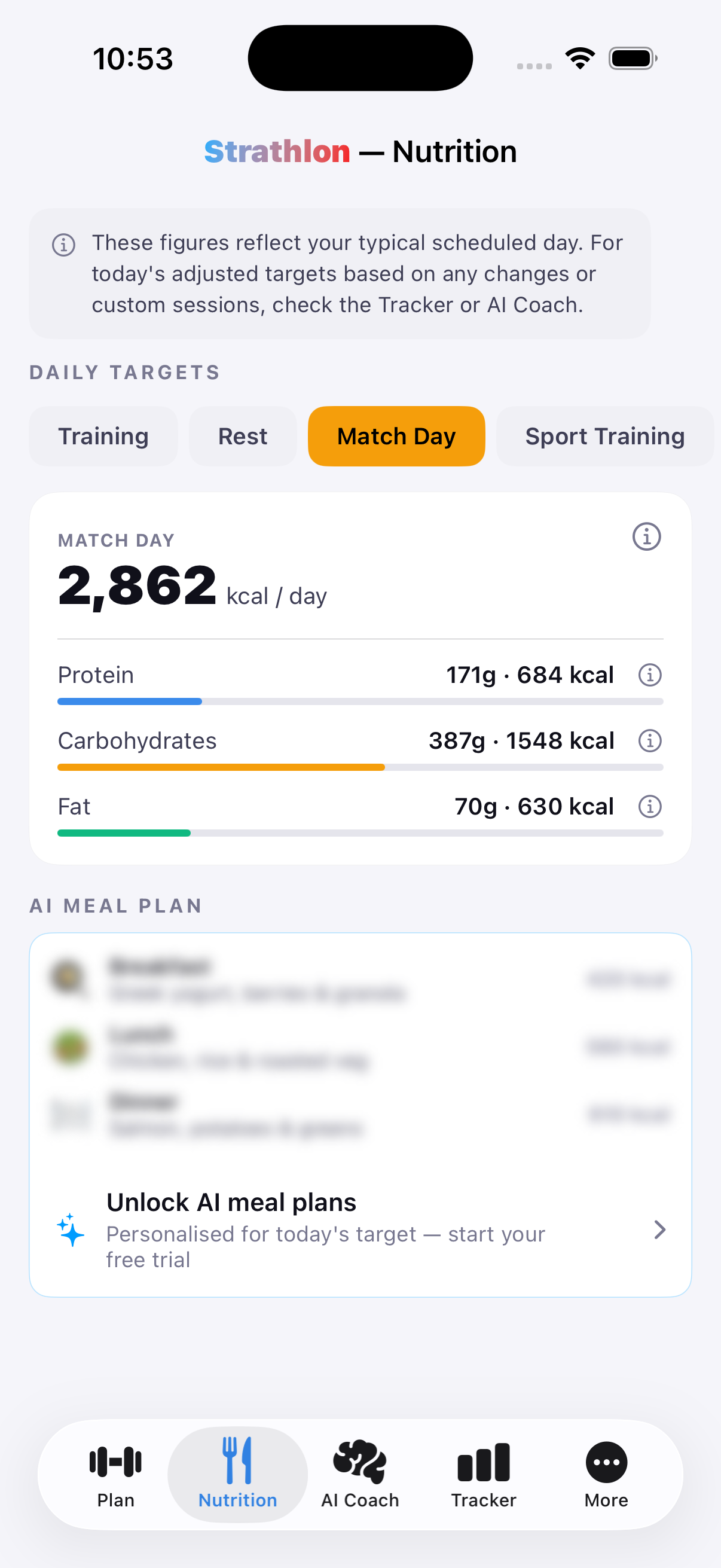
If you take one thing away: build a base of real strength, express it on one leg at speed, keep the hamstrings and knees resilient, and condition the engine that lets you do it all again on the last point. Strathlon's role is to give you a sport-aware starting plan and to keep the base lifts and accessory work trending in the right direction: a smart default you build on, well short of a replacement for a coach.
Pair this with the ultimate frisbee fuelling guide: training and fuelling are two halves of the same job.
References
Numbered sources for the specific figures, effect sizes and named studies above. Where a claim reflects agreed guidance rather than a single trial, the citation is to the position stand or consensus statement of the body concerned, with the country or international remit named. Ultimate has a small but sport-specific demand and injury literature, cited directly below; the strength prescriptions are general evidence applied to a repeated-sprint, cutting and diving sport.
- Madueno MC, Kean CO, Scanlan AT. The sex-specific internal and external demands imposed on players during Ultimate Frisbee game-play. The Journal of Sports Medicine and Physical Fitness. 2017;57(11):1407–1414. Study of the sex-specific internal and external demands imposed on players during ultimate frisbee game play: the source for the running and repeat-effort profile. PubMed 28094489
- Scanlan AT, Kean CO, Humphries BJ, Dalbo VJ. Physiological and Fatigue Responses Associated With Male and Mixed-Gender Ultimate Frisbee Game Play. Journal of Strength and Conditioning Research. 2015;29(9):2600–7. Study of physiological and fatigue responses in male and mixed-gender ultimate game play, the second source for the same. PubMed 26313576
- Kajiki M, Yamashita Y, Inada R, Matsumoto T. Physical, Physiological, and Technical Demands in Ultimate Frisbee Small-Sided Games: Influence of Pitch Size. Sports. 2021;9(8). Study of physical, physiological and technical demands in ultimate small-sided games, the basis for the sport-specific conditioning option. PubMed 34437365 · PMC8402465 full text
- Akinbola M, Logerstedt D, Hunter-Giordano A, Snyder-Mackler L. Ultimate frisbee injuries in a collegiate setting. International Journal of Sports Physical Therapy. 2015;10(1):75–84. Study of ultimate frisbee injuries in a collegiate setting: the source for the sport's injury pattern. PubMed 25709866 · PMC4325291 full text
- Pang FO, Man GC, Ling SK, Yung PS. Injury epidemiology of Ultimate Frisbee in Hong Kong. Asia-Pacific Journal of Sports Medicine, Arthroscopy, Rehabilitation and Technology. 2021;26:27–31. Study of ultimate frisbee injury epidemiology in Hong Kong, the second source for the same. PubMed 34458103 · PMC8377482 full text
- van Dyk N, Behan FP, Whiteley R. Including the Nordic hamstring exercise in injury prevention programmes halves the rate of hamstring injuries: a systematic review and meta-analysis of 8459 athletes. British Journal of Sports Medicine. 2019;53(21):1362–1370. Meta-analysis of Nordic hamstring prevention programmes halving hamstring injury rates, the source for the hamstring prehab. PubMed 30808663
- Schiftan GS, Ross LA, Hahne AJ. The effectiveness of proprioceptive training in preventing ankle sprains in sporting populations: a systematic review and meta-analysis. Journal of Science and Medicine in Sport. 2015;18(3):238–44. Schiftan and colleagues' meta-analysis of proprioceptive training and ankle sprains, the ankle half of the prehab. PubMed 24831756
- Petushek EJ, Sugimoto D, Stoolmiller M, Smith G, Myer GD. Evidence-Based Best-Practice Guidelines for Preventing Anterior Cruciate Ligament Injuries in Young Female Athletes: A Systematic Review and Meta-analysis. The American Journal of Sports Medicine. 2019;47(7):1744–1753. Petushek and colleagues' meta-analysis of ACL injury prevention, the basis for the landing and cutting work prescribed. PubMed 30001501 · PMC6592422 full text
- Suchomel TJ, Nimphius S, Stone MH. The Importance of Muscular Strength in Athletic Performance. Sports Medicine. 2016;46(10):1419–49. Suchomel and colleagues on the importance of muscular strength in athletic performance: the source for greater maximal strength being associated with faster sprinting, jumping and change of direction, and with lower injury risk. PubMed 26838985
- Seitz LB, Reyes A, Tran TT, Saez de Villarreal E, Haff GG. Increases in lower-body strength transfer positively to sprint performance: a systematic review with meta-analysis. Sports Medicine. 2014;44(12):1693–702. Seitz and colleagues' systematic review with meta-analysis showing increases in lower-body strength transfer positively to sprint performance, the evidence behind the 'strength is the base' argument. PubMed 25059334
- Lauersen JB, Andersen TE, Andersen LB. Strength training as superior, dose-dependent and safe prevention of acute and overuse sports injuries: a systematic review, qualitative analysis and meta-analysis. British Journal of Sports Medicine. 2018;52(24):1557–1563. Lauersen and colleagues' meta-analysis finding strength training a superior, dose-dependent and safe prevention of acute and overuse sports injuries: the direct source for treating strength work as prehab. PubMed 30131332
- Lauersen JB, Bertelsen DM, Andersen LB. The effectiveness of exercise interventions to prevent sports injuries: a systematic review and meta-analysis of randomised controlled trials. British Journal of Sports Medicine. 2014;48(11):871–7. Lauersen and colleagues' earlier meta-analysis of exercise interventions to prevent sports injuries, the broader evidence base the prevention advice sits on. PubMed 24100287
- . American College of Sports Medicine position stand. Progression models in resistance training for healthy adults. Medicine and Science in Sports and Exercise. 2009;41(3):687–708. American College of Sports Medicine (ACSM, United States) position stand on progression models in resistance training: the source for the heavy-load and explosive-load percentage ranges quoted. PubMed 19204579
- Cuthbert M, Haff GG, Arent SM, Ripley N, McMahon JJ, Evans M, et al. Effects of Variations in Resistance Training Frequency on Strength Development in Well-Trained Populations and Implications for In-Season Athlete Training: A Systematic Review and Meta-analysis. Sports Medicine. 2021;51(9):1967–1982. Cuthbert and colleagues' systematic review of resistance-training frequency in well-trained populations, the source for the sessions-per-week guidance. PubMed 33886099 · PMC8363540 full text
- Spiering BA, Mujika I, Sharp MA, Foulis SA. Maintaining Physical Performance: The Minimal Dose of Exercise Needed to Preserve Endurance and Strength Over Time. Journal of Strength and Conditioning Research. 2021;35(5):1449–1458. Spiering and colleagues on the minimal dose of exercise needed to preserve endurance and strength: the source for maintaining in-season on as little as one to two sessions a week. PubMed 33629972
- Rønnestad BR, Nymark BS, Raastad T. Effects of in-season strength maintenance training frequency in professional soccer players. Journal of Strength and Conditioning Research. 2011;25(10):2653–60. Ronnestad and colleagues' trial of in-season strength maintenance frequency in professional footballers, the specific in-season maintenance result quoted. PubMed 21873897
- Nuzzo JL, Pinto MD, Kirk BJC, Nosaka K. Resistance Exercise Minimal Dose Strategies for Increasing Muscle Strength in the General Population: an Overview. Sports Medicine. 2024;54(5):1139–1162. Nuzzo and colleagues on minimal-dose resistance exercise strategies for increasing strength, supporting the claim that a small, well-chosen dose does most of the work. PubMed 38509414 · PMC11127831 full text
- Wilson JM, Marin PJ, Rhea MR, Wilson SM, Loenneke JP, Anderson JC. Concurrent training: a meta-analysis examining interference of aerobic and resistance exercises. Journal of Strength and Conditioning Research. 2012;26(8):2293–307. Wilson and colleagues' meta-analysis of concurrent training and the interference effect: the source for separating heavy lifting from hard conditioning. PubMed 22002517
- Schumann M, Feuerbacher JF, Sünkeler M, Freitag N, Rønnestad BR, Doma K, et al. Compatibility of Concurrent Aerobic and Strength Training for Skeletal Muscle Size and Function: An Updated Systematic Review and Meta-Analysis. Sports Medicine. 2022;52(3):601–612. An updated systematic review of the compatibility of concurrent aerobic and strength training, the more recent evidence that interference is smaller than once believed. PubMed 34757594 · PMC8891239 full text
- Ramirez-Campillo R, Sortwell A, Moran J, Afonso J, Clemente FM, Lloyd RS, et al. Plyometric-Jump Training Effects on Physical Fitness and Sport-Specific Performance According to Maturity: A Systematic Review with Meta-analysis. Sports Medicine - Open. 2023;9(1):23. Ramirez-Campillo and colleagues on plyometric-jump training effects on physical fitness and sport-specific performance, the source for the plyometric guidance. PubMed 37036542 · PMC10086091 full text
- Impellizzeri FM, Woodcock S, Coutts AJ, Fanchini M, McCall A, Vigotsky AD. What Role Do Chronic Workloads Play in the Acute to Chronic Workload Ratio? Time to Dismiss ACWR and Its Underlying Theory. Sports Medicine. 2021;51(3):581–592. Impellizzeri and colleagues on the pitfalls of the acute:chronic workload ratio, cited because it is the reason this guide talks about ramping load gradually rather than quoting a workload number. PubMed 33332011
- Baz-Valle E, Balsalobre-Fernández C, Alix-Fages C, Santos-Concejero J. A Systematic Review of The Effects of Different Resistance Training Volumes on Muscle Hypertrophy. Journal of Human Kinetics. 2022;81:199–210. Systematic review of resistance-training volume and hypertrophy, the general dose-response evidence behind the set and session recommendations. PubMed 35291645 · PMC8884877 full text
This is general educational information rather than medical or individual coaching advice. The strength and conditioning findings here are drawn from published research and framed as population-level associations and tendencies: individual responses vary widely with training age, sex, position and injury history, and are best personalised with a qualified S&C coach or clinician. Anyone with pain, a current or past injury, a health condition, or who is pregnant or postpartum, should consult a suitable professional before starting or changing a training programme. See our Terms for more.
← All guides · Ultimate frisbee fuelling · How muscle actually grows · Recovery & rest · Eating for results · Understanding your stats · Home