
Eating at maintenance: the skill everyone skips
An evergreen guide to the most underrated eating skill there is: holding your weight steady on purpose. Almost everyone thinks in terms of losing or gaining, and treats "maintenance" as the boring gap in between. In truth it is a goal in its own right, the phase that protects the results of every cut and bulk, and the state your body spends most of its life in. This covers what maintenance eating actually is, why it is a skill rather than a failure, how to find your maintenance calories, and how to hold them without drifting. Practical, honest, and grounded in established nutrition science.
Here's the whole idea in one sentence: eating at maintenance means matching what you eat to what you burn, so your weight stays stable, and doing that on purpose is a skill worth learning rather than a sign you've given up. Everything below is the detail: what "maintenance" really is, how to find your number, and why the weeks and months you spend eating at maintenance are what make a diet or a bulk actually stick.
On this page
A framing note before the detail. Energy balance is one of the best-established ideas in nutrition, but people differ a great deal: body size, activity, age, sex, sleep, hormones, health status and how long you've been dieting all shift the numbers. So this is written as can, tends to and around, never as a guarantee, and every specific figure is a population-level guide from published research rather than a personal prescription. It's general education rather than medical or dietary advice, and it isn't a personalised plan.
What maintenance eating actually is
Maintenance is the state of energy balance: the calories you take in match the calories your body uses, so your weight holds steady over time. Your daily burn is your total daily energy expenditure (TDEE): the sum of your resting metabolism (the energy to keep you alive at rest), the energy spent digesting food, and everything you do moving around, from a hard workout to fidgeting. Your maintenance calories are simply your TDEE: eat that amount and, on average, you store no new fat and burn none off.
Two things follow from that definition, and both matter. First, maintenance is not a single fixed number etched into you: it is a moving target. It rises when you train harder, move more, or carry more body mass. It falls when you're less active, lose weight, or simply age. That is why a heavy training day has a higher maintenance than a rest day, and why the number you found last year may not be the number today. Second, "weight stable" means stable on the trend, rather than identical every morning. The scale naturally swings a kilo or two day to day from water, glycogen, salt, and the food and drink still in your gut, none of which is a real change in fat. Maintenance is what the smoothed trend line does over weeks.
Why it's a skill rather than a failure
Diet culture frames life in two modes ("cutting" or "bulking") and quietly treats maintenance as the dead zone between them, the place you land when you've stopped trying. That framing is backwards. Maintenance is the destination rather than the waiting room, and it is where you spend the vast majority of your life, and being able to hold a body weight you're happy with, deliberately and comfortably, is the single most valuable outcome of everything else you do.
The evidence for how hard that skill is should end any idea that it's the easy option. When successful weight loss is defined the way researchers define it (losing at least 10% of your body weight and keeping it off for a year or more) only around one in five people manage it. Across structured weight-loss programmes, people tend to regain roughly half of what they lost within about two years. The losing is the part most people can do. The keeping is where it falls apart. So a phase where the scale simply holds steady isn't a lack of progress. It is the exact thing most diets fail to deliver.
There's a positive flip side, too. The people who study long-term maintainers, such as the National Weight Control Registry, a large group of people who have each lost a substantial amount of weight (enrolment requires keeping off at least 13.6 kg / 30 lb for over a year) and kept it off, on average, for several years, show that maintenance is a set of learnable habits rather than a personality trait or luck. It responds to skill and attention, which means it can be practised and got good at. That reframing is the whole point of this guide: maintenance isn't what happens when you give up on a goal. It is the goal, and a demanding one.
How to find your maintenance calories
There are two steps, and the second one is the one people skip: estimate, then verify.
Step one: estimate. Use a calculator or equation to get a starting figure for your TDEE based on your size, sex, age and rough activity level. This gives you a ballpark to work from. Don't over-invest in it: as the last section said, these formulas are population averages and can be off by a few hundred calories for any individual. The estimate is a place to start. It isn't the answer.
Step two: verify by tracking. This is what turns a guess into your number. For about two to four weeks, eat close to your estimated maintenance while doing two things: track what you actually eat and drink as honestly as you can, and weigh yourself regularly (ideally most mornings, under similar conditions). Then look at the average: both your average daily intake and the trend of your weight across the whole window, disregarding any single day.
- If your average weight held steady, the intake you ate is your maintenance.
- If it drifted down, you were slightly under maintenance: nudge intake up.
- If it drifted up, you were slightly over: nudge intake down.
- References
When you adjust, move in small steps of roughly 100–200 calories a day, then hold the new number for another couple of weeks and reassess. Two or three rounds of this usually lands you on a figure that genuinely holds your weight, and because it's built from your own data, it beats any calculator. The reason to give each round a fortnight or more is that a single week is too noisy: water shifts, a salty meal, a poor night's sleep or where you are in a menstrual cycle can move the scale far more than a few days of eating ever could.
A worked "find your maintenance" log
The method is clearer on a page. Here's a realistic four-block run for someone whose calculator estimated maintenance at 2,400 kcal, using two-week blocks and judging by the average weight trend across each block. The numbers are illustrative. They aren't a prescription.
| Block | Avg daily intake | Weight trend over the block | What it tells you | Next move |
|---|---|---|---|---|
| 1 | 2,400 kcal | Trend drifting down ~0.2 kg/wk | Estimate was a touch low: you're in a small deficit. | Add ~150 kcal/day. |
| 2 | 2,550 kcal | Trend roughly flat | Close to maintenance: confirm it isn't a fluke. | Hold and watch another block. |
| 3 | 2,550 kcal | Trend drifting up ~0.15 kg/wk | Slightly over now: likely more relaxed tracking or less activity. | Trim ~100 kcal/day. |
| 4 | 2,450 kcal | Trend flat across the block | This holds your weight: this is your maintenance. | Settle here. Recheck if training or weight changes. |
Read it as a homing-in process. It isn't a clean calculation. The calculator's 2,400 was close but not right. A couple of small adjustments, each judged over two weeks, landed the real figure near 2,450–2,550. Notice the number wasn't perfectly repeatable even for the same person: that's normal, because activity and tracking accuracy wobble. Maintenance is a range you steer within rather than a single perfect integer, and steering is exactly the skill.
Why maintenance protects a cut or a bulk
Here's the argument for giving maintenance a deliberate place in your plan. When you diet, your body doesn't sit still. It pushes back. Prolonged calorie restriction triggers metabolic adaptation (also called adaptive thermogenesis): your energy expenditure falls by more than the loss of body mass alone can explain. In analyses of weight loss, a large share of the drop in energy expenditure tracks the lost tissue, but a meaningful remainder (on the order of 40% in one review) is this extra, adaptive slowdown. Alongside it, appetite hormones shift toward more hunger and less fullness. Your body is defending its weight.
That adaptation can be surprisingly stubborn. The follow-up of "The Biggest Loser" contestants is the vivid example: at the end of their 30-week competition, resting metabolic rate had fallen by around 610 kcal/day, and six years later (despite most participants regaining a large amount of the weight) resting metabolism was still roughly 700 kcal/day below where it started, with an adaptive component near -500 kcal/day. That's an extreme case (rapid, very large weight loss). Most dieters won't see numbers that large, but it illustrates the direction of travel: the deeper and longer the deficit, the harder the body leans against you.
This is precisely why a deliberate return to maintenance is protective. Spending planned time at maintenance (eating enough to hold your new weight) lets some of the fatigue and hormonal pressure of dieting ease before you either push for more loss or simply settle. It's the difference between arriving at a lower weight and being able to stay there. The controlled research on structured diet breaks points the same way: in the MATADOR study, dieters who broke a calorie deficit into two-week blocks separated by two-week returns to maintenance (eating at their full energy needs) lost more fat and blunted the fall in resting energy expenditure compared with an unbroken diet of the same total deficit. Maintenance isn't the opposite of progress: used well, it's part of the machinery that makes progress last. The diet breaks & refeeds guide unpacks that tactic in full.
The same logic protects a bulk. After a phase of eating in a surplus to build muscle, dropping straight into another goal wastes the transition. A stretch at maintenance lets you settle at your new, bigger bodyweight, confirm what's muscle versus temporary water and gut fill, and hold the composition you worked for before deciding what's next.
Maintenance for performance and health
Beyond protecting a result, eating enough to hold your weight is what lets your body work. A deficit is a compromise you accept for a while to lose fat. Maintenance removes that compromise. Fully fuelled, you tend to train harder, recover better, sleep better and think more clearly, because you're no longer asking the body to build, repair and perform on a chronic shortfall. For anyone chasing strength, endurance or skill, most of the actual adapting happens far more readily at maintenance or a slight surplus than in a deep cut.
There's a health floor here as well. Chronically eating too little (dragging energy availability too low for too long) is associated with knock-on effects on bone, hormones, menstrual function, immunity and mood, a picture sports medicine calls low energy availability and, at the sharper end, RED-S. Maintenance is the state that keeps you comfortably clear of that floor. Deliberately eating enough is not indulgence. For an active person it is a requirement.
Protein deserves a specific mention, because holding your weight isn't the same as holding your muscle unless the diet supports it. Guidance from the International Society of Sports Nutrition describes an overall intake of roughly 1.4–2.0 g of protein per kilogram of body weight per day as enough to build and maintain muscle in most exercising people. Keeping protein toward that range at maintenance (spread across the day) is how you hold onto the lean mass you built or preserved, so "weight stable" also means "physique stable." (During an aggressive deficit some people go higher, around 2.3–3.1 g/kg, to protect lean mass. At maintenance you don't need that.)
Eating at maintenance without drifting
The quiet risk of maintenance is drift: with no deficit to enforce attention, small overages accumulate and, months later, the weight has crept. This is especially likely right after a diet, when appetite is elevated and your expenditure has fallen. The fix isn't rigidity. It's a few light guardrails that the long-term maintainers reliably use. Drawn from what the National Weight Control Registry and related research see in people who keep weight off:
- Keep a weigh-in habit. Around three-quarters of registry maintainers weigh themselves at least weekly. The point isn't to obsess over a number. It's an early-warning system, so a small creep prompts a small correction long before it becomes a big one.
- Use a weight range instead of a line. Pick a band a couple of kilos wide around your maintenance weight and let the scale roam within it freely. Only when the trend pushes toward the top of the band do you gently tighten up (a slightly closer eye on intake or a bit more activity) until it settles. This turns maintenance into a thermostat rather than a tightrope.
- Keep the pattern consistent. Maintainers tend to eat fairly consistently across weekdays and weekends, rather than being strict Monday to Friday and blowing out at the weekend. It's the weekly average that sets your weight, and wild swings make it far harder to read what's happening.
- Hold your protein and your anchors. Keep protein up (see above) and keep the handful of habits that got you here: the regular meals, the training, the vegetables, the sleep. Maintenance is mostly the same behaviours as a good diet, just with a little more food and a lot less pressure.
- Re-verify occasionally. Because maintenance moves, re-run the two-week check (previous section) after a real change: a new training block, an injury layoff, a season shift, or a meaningful change in weight. Your maintenance number is a living thing. It isn't a one-time result.
None of this asks for the intensity of a diet. That's the appeal: maintenance done well is lighter work than dieting, sustained. A weekly glance at the scale and a stable set of habits is enough to hold a result that most people lose: which is exactly why it's a skill worth building.
Common questions
What are maintenance calories?
Maintenance calories are the amount you can eat each day to keep your weight stable over time, because intake matches the energy your body burns: your total daily energy expenditure. Eat at that level and, on average, you neither gain nor lose fat. It is not a single fixed number: it is an estimate you refine, and it shifts with your activity, your body weight, your age and how much lean mass you carry. Because it moves with training, a hard exercise day has a higher maintenance than a rest day.
How do I find my maintenance calories?
Start with an estimate from a calculator or equation, then verify it against reality, because equations are only a starting guess. Eat around that estimated number for two to four weeks while tracking your intake and weighing yourself regularly, and look at the average weight trend rather than any single day. If your average weight holds steady, you have found maintenance. If it drifts up or down, adjust by roughly 100–200 calories a day in the opposite direction and check again over another couple of weeks. Tracking your own numbers is far more accurate than any formula alone.
Is eating at maintenance the same as giving up on my goal?
No. Maintenance is a goal in its own right, far from a consolation prize or an in-between. Holding a hard-won result steady is itself an achievement: research suggests only around one in five people who lose a meaningful amount of weight keep it off for a year or more. Time at maintenance also lets the metabolic and hormonal adaptations of a diet ease, supports training and recovery, and protects the body composition you built during a bulk. Being able to hold your weight on purpose is arguably the most useful eating skill there is.
Will I gain weight if I eat at maintenance after a diet?
By definition, eating at maintenance holds your weight steady. A little scale rise in the first days after a diet ends is usually glycogen and the water stored with it, plus more food in the gut, rather than fat. The real cause of regain is drifting above maintenance without noticing, which is easy after a long deficit when appetite is up and your energy expenditure has fallen. That is exactly why finding your true maintenance number, tracking, and watching a weight range rather than a single reading matter so much in the weeks after a diet.
How much protein should I eat at maintenance?
Keeping protein up at maintenance helps you hold onto the muscle you built or preserved. The International Society of Sports Nutrition position stands describe an overall intake of roughly 1.4–2.0 g of protein per kilogram of body weight per day as sufficient to build and maintain muscle in most exercising people, spread across the day. That upper-ish range is a sensible maintenance target for anyone training. There is no need to keep protein as high as the 2.3–3.1 g/kg some use to protect lean mass during an aggressive deficit.
How is maintenance different from a diet break?
They use the same skill over different timeframes. A diet break is a short, planned return to maintenance eating (often a week or two) taken in the middle of a fat-loss phase to ease fatigue and adaptation before resuming the deficit. Maintenance as a goal is open-ended: you have reached the weight or shape you want and now hold it. Learning to eat at maintenance well makes diet breaks easier too, because it is the same target either way: energy in matched to energy out.
Takeaways
- Maintenance is energy balance. Intake matched to your total daily burn, so weight holds steady on the trend rather than identical every morning.
- It's a skill rather than a failure. Only about one in five people keep off a meaningful weight loss for a year. A steady scale is the thing most diets fail to deliver.
- Estimate, then verify. Take a calculator figure as a starting guess, then eat at it for two to four weeks and let your average weight trend tell you the truth. Adjust in ~100–200 kcal steps.
- Maintenance protects a cut or a bulk. Dieting drives metabolic adaptation and more hunger. Planned time at maintenance eases that and helps a result actually last.
- It fuels performance and health. Fully fuelled, you train, recover and adapt better, and stay clear of the risks of chronic under-eating.
- Hold your protein. Roughly 1.4–2.0 g/kg/day keeps the muscle you built, so "weight stable" also means "physique stable."
- Guard against drift. Weigh in weekly, steer within a weight range rather than a single line, keep a consistent weekly pattern, and re-verify when training or weight changes.
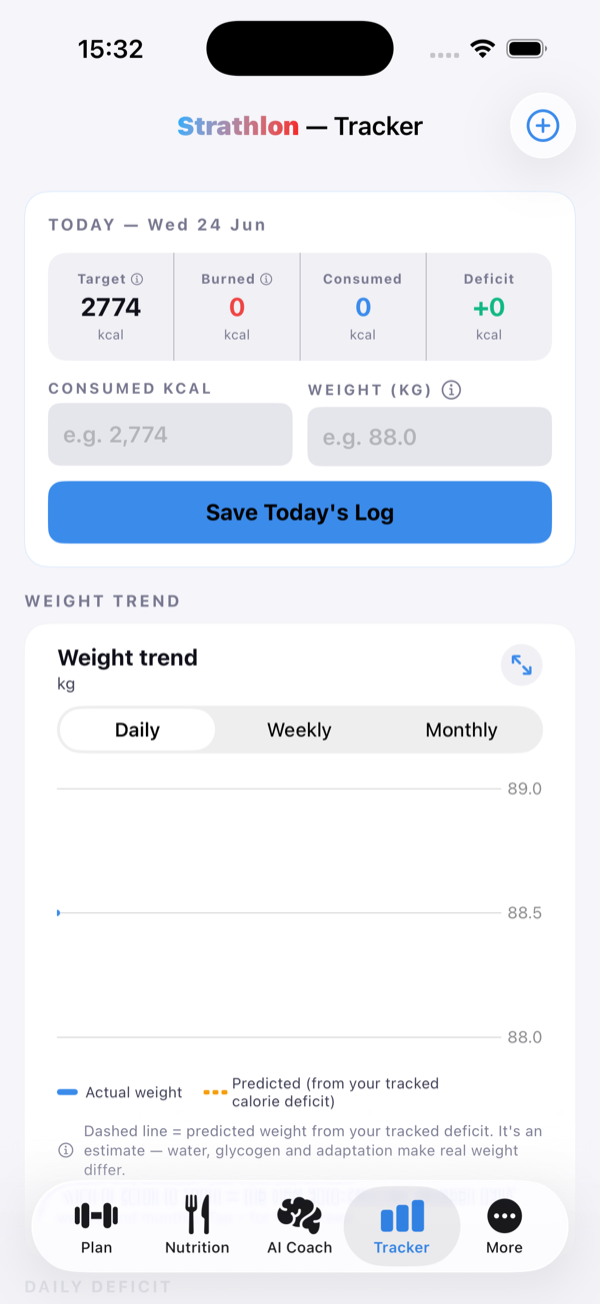
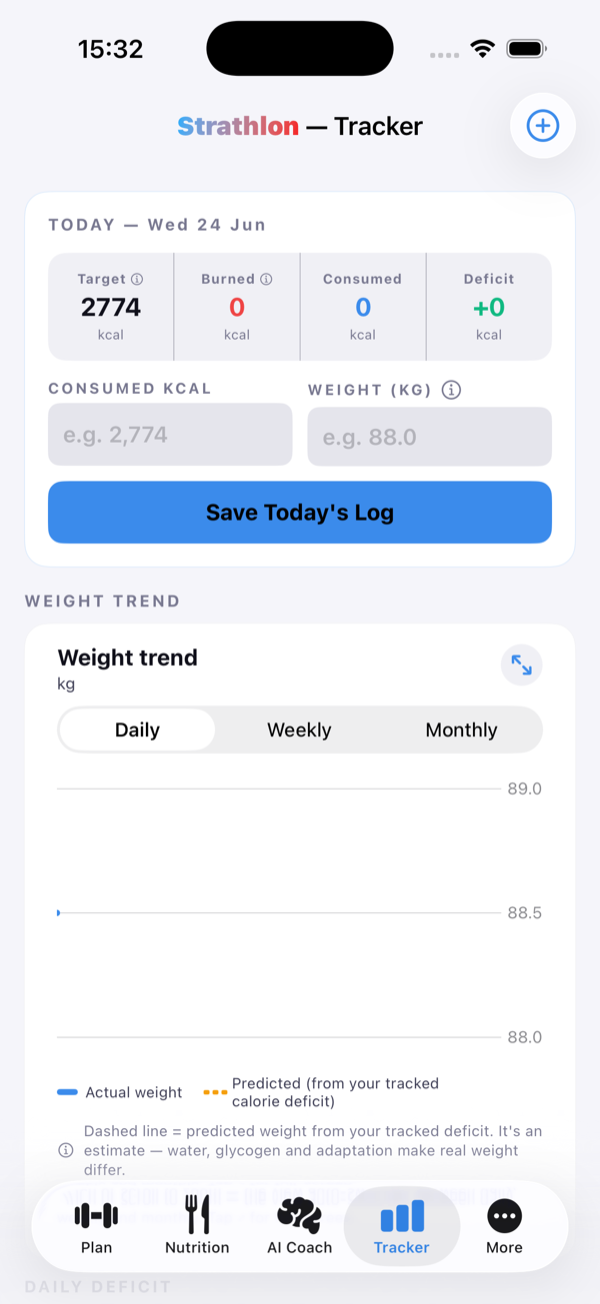
If you take one thing away, make it the reframe: maintenance isn't the boring gap between goals. It's the goal that most people never get to keep. Learn to find your number, hold it with a light touch, and you've mastered the eating skill that makes every other one stick. Strathlon's job is to keep that number honest and visible: adjusting your target around what you actually do, and smoothing the daily noise so "am I holding steady?" is answerable at a glance.
References
Numbered sources for the specific figures and ranges above. Where a point reflects agreed guidance rather than a single trial, the citation is to the position stand or consensus statement of the body concerned, with the country or international remit named. Maintenance is under-researched relative to weight loss, so several points here rest on registry and follow-up data rather than on trials.
- Wing RR, Phelan S. Long-term weight loss maintenance. The American Journal of Clinical Nutrition. 2005;82(1 Suppl):222S–225S. Wing and Phelan on long-term weight-loss maintenance: the source for the roughly one-in-five figure that opens the 'skill rather than a failure' section. PubMed 16002825
- Daeninck E, Miller M. What can the National Weight Control Registry teach us?. Current Diabetes Reports. 2006;6(5):401–4. National Weight Control Registry findings on what maintainers actually do, supporting weekly weigh-ins and a consistent weekly pattern as the practical toolkit. PubMed 17077003
- Trexler ET, Smith-Ryan AE, Norton LE. Metabolic adaptation to weight loss: implications for the athlete. Journal of the International Society of Sports Nutrition. 2014;11(1):7. Metabolic adaptation to weight loss framed for the athlete: the basis for why planned time at maintenance eases the adaptation a diet creates. PubMed 24571926 · PMC3943438 full text
- Fothergill E, Guo J, Howard L, Kerns JC, Knuth ND, Brychta R, et al. Persistent metabolic adaptation 6 years after "The Biggest Loser" competition. Obesity. 2016;24(8):1612–9. Six-year follow-up of the Biggest Loser cohort, the strongest single illustration that adaptation after aggressive loss persists. PubMed 27136388 · PMC4989512 full text
- Hall KD. Energy compensation and metabolic adaptation: "The Biggest Loser" study reinterpreted. Obesity. 2022;30(1):11–13. The reinterpretation of that same cohort accounting for energy compensation: included so the guide's claim stays proportionate rather than alarmist. PubMed 34816627
- Martins C, Gower BA, Hill JO, Hunter GR. Metabolic adaptation is not a major barrier to weight-loss maintenance. The American Journal of Clinical Nutrition. 2020;112(3):558–565. Evidence that metabolic adaptation is not a major barrier to maintenance, the counterweight that keeps the section honest. PubMed 32386226 · PMC7458773 full text
- Westerterp KR. Diet induced thermogenesis. Nutrition & Metabolism. 2004;1(1):5. Review of diet-induced thermogenesis, supporting the explanation of why total daily burn is not a fixed number to be matched exactly. PubMed 15507147 · PMC524030 full text
- Peos JJ, Helms ER, Fournier PA, Krieger J, Sainsbury A. A 1-week diet break improves muscle endurance during an intermittent dieting regime in adult athletes: A pre-specified secondary analysis of the ICECAP trial. PloS One. 2021;16(2):e0247292. Trial showing a one-week diet break improved muscle endurance during intermittent dieting in athletes, supporting maintenance as a protective phase inside a cut. PubMed 33630880 · PMC7906362 full text
- Byrne NM, Sainsbury A, King NA, Hills AP, Wood RE. Intermittent energy restriction improves weight loss efficiency in obese men: the MATADOR study. International Journal of Obesity. 2018;42(2):129–138. The MATADOR trial on intermittent energy restriction: the evidence that planned maintenance blocks improve the efficiency of a deficit. PubMed 28925405 · PMC5803575 full text
- Jäger R, Kerksick CM, Campbell BI, Cribb PJ, Wells SD, Skwiat TM, et al. International Society of Sports Nutrition Position Stand: protein and exercise. Journal of the International Society of Sports Nutrition. 2017;14:20. ISSN position stand on protein and exercise, the source for holding roughly 1.4 to 2.0 g/kg/day so 'weight stable' also means 'physique stable'. PubMed 28642676 · PMC5477153 full text
- Morton RW, Murphy KT, McKellar SR, Schoenfeld BJ, Henselmans M, Helms E, et al. A systematic review, meta-analysis and meta-regression of the effect of protein supplementation on resistance training-induced gains in muscle mass and strength in healthy adults. British Journal of Sports Medicine. 2018;52(6):376–384. Morton and colleagues' meta-analysis of protein supplementation and resistance-training outcomes, supporting the protein floor at maintenance. PubMed 28698222 · PMC5867436 full text
- Thomas DT, Erdman KA, Burke LM. Position of the Academy of Nutrition and Dietetics, Dietitians of Canada, and the American College of Sports Medicine: Nutrition and Athletic Performance. Journal of the Academy of Nutrition and Dietetics. 2016;116(3):501–528. Joint ACSM / AND / DC position on nutrition and athletic performance: the source of the 1.2 to 2.0 g/kg range quoted alongside the ISSN figure. PubMed 26920240
- Mountjoy M, Ackerman KE, Bailey DM, Burke LM, Constantini N, Hackney AC, et al. 2023 International Olympic Committee's (IOC) consensus statement on Relative Energy Deficiency in Sport (REDs). British Journal of Sports Medicine. 2023;57(17):1073–1097. The 2023 IOC consensus statement on Relative Energy Deficiency in Sport, the basis for the health argument against sitting in a deficit indefinitely. PubMed 37752011
- ROBINSON MF, WATSON PE. DAY-TO-DAY VARIATIONS IN BODY-WEIGHT OF YOUNG WOMEN. The British Journal of Nutrition. 1965;19:225–35. The classic study of day-to-day body-weight variation in young women: why maintenance is judged on a trend and a range rather than a single morning. PubMed 14290861
- Burke LE, Bizhanova Z, Conroy MB, Cheng J, Beatrice B, Kariuki JK, et al. Adherence to self-monitoring and behavioral goals is associated with improved weight loss in an mHealth randomized-controlled trial. Obesity. 2025;33(3):478–489. Randomised trial linking self-monitoring adherence to weight outcome, supporting weekly weigh-ins as the drift alarm. PubMed 39962997 · PMC11897847 full text
This is general educational information rather than medical, dietary or coaching advice. The figures here are drawn from established nutrition and physiology research and are framed as population-level guides: individual needs vary widely with body size, activity, age, sex, hormones and health, and are best personalised with a qualified professional. Anyone with a health condition, a history of disordered eating, or who is pregnant or postpartum, or who suspects under-fuelling, should consult a physician or registered dietitian before making changes. See our Terms for more.
← All guides · Fat-loss fundamentals · Diet breaks & refeeds · Eating for results · Understanding your stats · Home