
Brazilian jiu-jitsu strength & conditioning
An evidence-based guide to the gym work that actually transfers to the mat. Brazilian jiu-jitsu is a grip-heavy, position-heavy, long-duration grappling sport, and the strength and conditioning that supports it looks different from a bodybuilding split. This covers the sport's real physical demands, the lifts and movement patterns that transfer, how to condition for long intermittent rolls without wrecking your training, prehab for the joints BJJ punishes most, and how to fit it all around a training week that's already full. Practical, honest, and grounded in published sport science.
Here's the short version of what BJJ asks of your body: grip and pulling strength that lasts, isometric core and hip strength to hold and break positions, and a deep aerobic base with enough power to win the decisive scrambles. Everything below is the detail behind that sentence: the demands, the lifts that build those qualities, the conditioning that fits around rolling, and the prehab that keeps your elbows, shoulders, neck and low back in the game.
On this page
A framing note before the detail. The demands of grappling are reasonably well studied, but people differ enormously: training age, body size, belt level, weight class, sex, sleep and injury history all shift what's right for any individual. So this is written as can, tends to and is associated with, never as a guarantee, and every specific figure is a population-level guide drawn from published research rather than a personal prescription. It's general education rather than medical or coaching advice, and it isn't a personalised programme.
The demands of Brazilian jiu-jitsu
Strip a BJJ match down to its physiology and three things stand out. First, it is a long, intermittent effort. Time-motion analyses of matches describe a high effort-to-pause ratio (roughly 6:1 to 13:1, with long stretches of grappling broken by short pauses) and a low-to-high-intensity ratio around 8:1, where the brief bursts of maximal effort last only a few seconds each (Andreato and colleagues). Post-match blood lactate sits near 10 mmol/L, which points to moderate (not maximal) glycolytic strain. In plain terms: most of a roll is sustained, sub-maximal work with occasional all-out scrambles, so it leans heavily on the aerobic system to keep you going and recover between bursts, with the anaerobic systems supplying the decisive explosions.
Second, it is a grip sport. Controlling sleeves, collars, lapels and limbs is the currency of almost every position, and the hands pay for it: handgrip strength measurably declines across a match, and grip endurance is repeatedly linked to success in takedowns, throws, submissions and holding position (Andreato and colleagues, 2017). Elite grapplers show high isometric handgrip strength (reported around 48–57 kgf in one review), but for BJJ it's grip endurance, more than peak force, that tends to decide who keeps control when both athletes are tired.
Third, the decisive moments are strength and power expressed through the whole body. The same review concluded that maximal dynamic strength is associated with competitive success, and that the sport's decisive actions depend largely on muscular power in both the upper and lower limbs (Andreato and colleagues, 2017). Meanwhile aerobic power in trained athletes sits in a moderate band (VO2max roughly 42–52 mL/kg/min in men) and doesn't strongly separate levels on its own: a base you need, but not the thing that wins medals.
The injury picture completes the demands. BJJ loads the joints in extreme, often end-range positions (that's the whole point of a submission), so the tissues most at risk are the fingers and hands, the shoulder, the elbow, the knee, the neck and the low back. In one detailed survey, upper-extremity complaints made up about 74% of injuries, with fingers and hands most common, followed by the shoulder and then the elbow. The knee was the most common lower-body site, and neck injuries, while less frequent, were the most likely to force a break from training (Hunker and colleagues, 2023). We'll come back to protecting these in the prehab section.
Key strength work, and why it matters
The gym's job for a grappler is not to make you look like a lifter: it's to build the specific qualities above: durable grip and pulling strength, a trunk and hips that can brace and hold under load, and whole-body force you can express quickly. A handful of movement patterns cover most of it.
- Heavy hinges (deadlift, Romanian deadlift, hip thrust). The hinge builds the posterior chain (glutes, hamstrings, spinal erectors) that powers bridging, standing up in guard, finishing takedowns and driving through a pass. It's also the most direct way to build the raw hip and back strength that underpins nearly every grappling scramble.
- Pulling: rows, chin-ups, and heavy carries. Grappling is a pulling sport far more than a pressing one: you're constantly drawing an opponent in, retracting, and hanging on. Vertical and horizontal pulls build the lats, upper back and biceps that do that work, and loaded carries (farmer's and suitcase carries) train grip endurance and a braced trunk at the same time. Because grip endurance matters more than peak crush strength in BJJ, favour longer holds and carries over one-rep grip maxes: thick-bar or towel/gi-grip holds of roughly 30–60 seconds directly rehearse hanging onto a sleeve or collar.
- Squat and single-leg work. Bilateral squats build lower-body force. Unilateral work (split squats, step-ups, lunges) adds the balance and change-of-direction strength that scrambles and takedown entries demand. Reviews of athletic performance find that stronger athletes tend to jump, sprint and change direction better and get injured less (Suchomel, Nimphius and Stone, 2016): the transfer runs through the same lower-body strength you build here.
- Isometric and anti-movement core work. This is the quietly BJJ-specific piece. Guard retention, framing, holding side control and resisting a pass are all fundamentally isometric: you're producing force to not move, or to stop your opponent moving you. Train it the same way: planks and side planks, dead bugs and Pallof presses (anti-rotation), heavy carries, and hollow holds, prioritising the ability to brace and resist rotation and extension under load rather than doing endless dynamic sit-ups.
- Explosive / power work. Because decisive actions ride on power, a little fast, heavy-intent work pays off: trap-bar jumps, medicine-ball throws, kettlebell swings, or simply moving a moderately heavy bar with speed. You don't need much: the point is to teach the strength you've built to come out quickly.
- References
On the prescriptive numbers: the exact sets, reps and loads are a matter of your progressive-overload programming rather than a BJJ-specific formula, so the honest guidance is to train the main strength lifts in lower rep ranges with real load, keep most working sets a couple of reps shy of failure, and progress them gradually. The evidence base gives us the qualities and their transfer with confidence. It does not give a universal, sport-specific sets-and-reps prescription, and anyone who claims one is overselling.
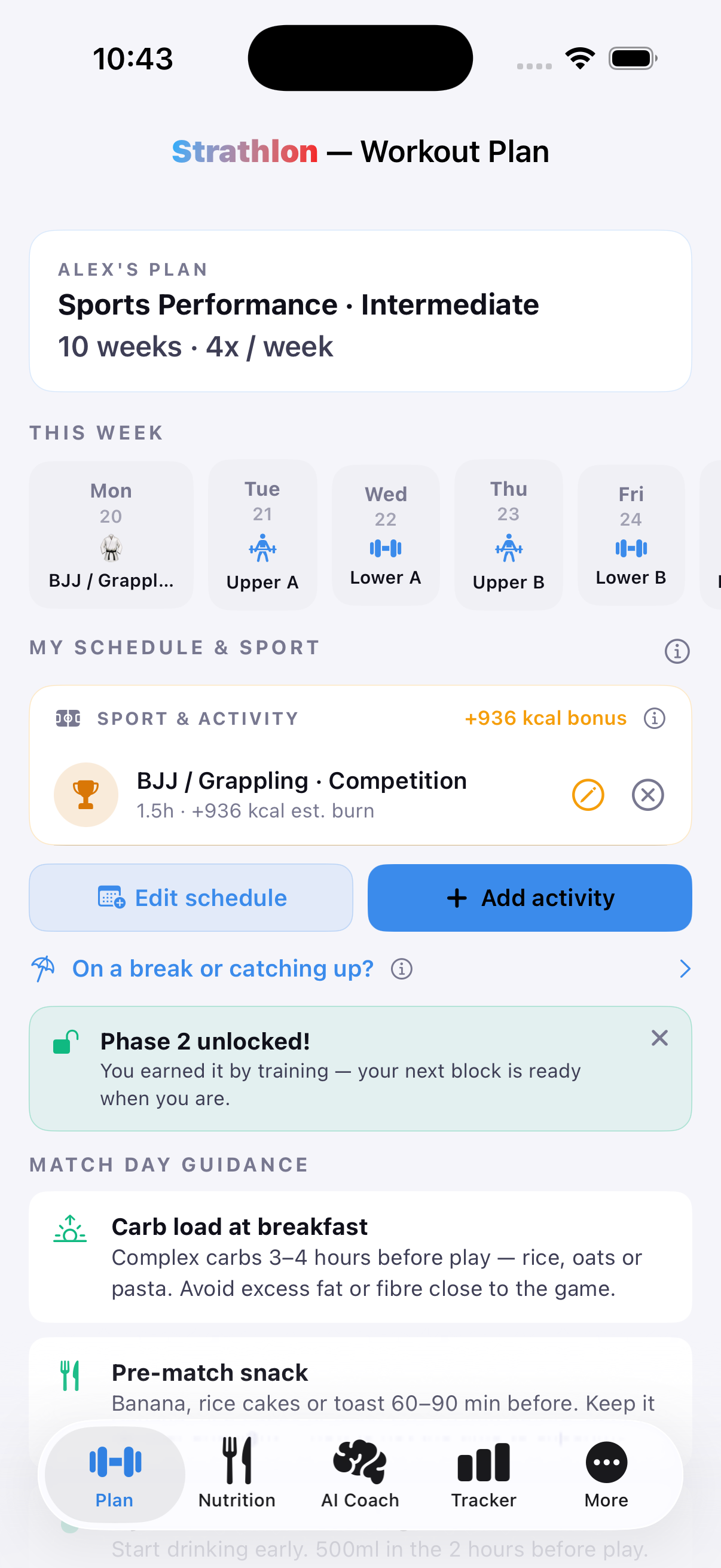
That pairing is worth dwelling on, because it captures the whole philosophy of training for a sport. The base lifts (heavy hinges, squats and pulls) are what actually make you strong. They aren't optional general filler you can skip in favour of mat-specific drills. On top of that base sit the sport-specific pieces: an accessory block of grip work, pulling and loaded carries that matches how a grappler is actually loaded, and explosive swings, slams and sled drags for the scramble, with a core finisher closing your gym sessions. Neither half works alone. Grip and core work on a weak base is decoration on a poor foundation. A strong deadlift with no grip endurance loses the sleeve in the third minute.
That's the practical shape of this whole section, and it's worth spelling out why both parts matter. The base lifts (a hinge, a squat, a press and a pull) are what build the general strength and power that every grappler needs. Skip them and no amount of sport-specific accessory work has a foundation to stand on. The sport-specific block (the grip work, the extra pulling, the carries and the explosive swings and slams) is what biases that foundation toward BJJ's real demands. Neither replaces the other. The mistake at both extremes is common: lifters who only barbell-train and wonder why their grip dies in round three, and grapplers who only do "functional" band work and never get strong enough for it to matter. The rounded plan is base strength plus the sport-tuned accessories and conditioning that round it out.
Conditioning for Brazilian jiu-jitsu
Because a roll is a long, intermittent effort recovered between bursts by the aerobic system, your conditioning has two jobs: build a big aerobic base so you recover fast and don't gas, and sharpen the repeat-effort capacity to keep producing hard scrambles late in a match. Both sit on top of the sport itself (hard rolling is already brutal conditioning), so extra cardio should complement mat time, without competing with it.
- Aerobic base (year-round). Low-to-moderate steady work (easy runs, bike, row, or long flow rolls) builds the engine that clears fatigue between bursts. This is the foundation the sport's physiology points to, and it's best kept ticking over all year.
- High-intensity intervals (nearer competition). Short, hard intervals (think repeated 20–60 second efforts with incomplete rest, or sport-specific rounds) train the anaerobic and repeat-effort qualities that decide scrambles, mirroring the brief maximal bursts a match demands. Add these in the weeks approaching a competition rather than grinding them year-round.
- Sport-specific conditioning. Positional sparring, shark-tank rounds and drilling at pace are the most transferable conditioning of all, because they load the exact patterns and grips you'll use. Use structured cardio to top up what the mat can't safely give you (volume without the collision and submission risk). It supplements mat time; it never substitutes for it.
The one thing to manage is interference: the well-known tension where lots of hard endurance work can blunt strength and power gains if the two are piled on top of each other. The practical fixes are simple: keep genuinely hard cardio and hard lifting on different days or separated by several hours where you can. Put your most important quality first when you must combine them. And remember that for a grappler the mat work is itself a huge conditioning load, so you rarely need much additional high-intensity cardio to be well-conditioned. Strength maintenance and a solid aerobic base coexist happily. What backfires is stacking maximal intervals onto maximal lifting, day after day.
Staying injury-resilient
BJJ's injuries cluster where the sport loads joints hardest and furthest. Surveys consistently put the fingers and hands, the shoulder, the elbow, the knee, the neck and the low back at the top of the list, with upper-extremity complaints dominating (about 74% of injuries in one detailed survey) and neck injuries, though less common, most likely to force time off the mat (Hunker and colleagues, 2023). The signature mechanism is the armbar: elbow hyperextension when a submission is held past the tap (Scoggin and colleagues, 2014). A broad systematic review found the great majority of injuries happen in training, far more than in competition (Santos and colleagues, 2024), which is good news: training is exactly where prehab and smart habits can act.
The single most protective habit isn't in the gym at all: it's tapping early. No amount of tendon strength beats releasing a locked-in armbar or heel hook in time, and the culture of training with control and tapping without ego prevents more injuries than any exercise. On top of that, the general strength work above is itself strongly protective: a landmark meta-analysis found that strength-training programmes reduced sports injuries to less than a third of the rate seen without them, and almost halved overuse injuries specifically (Lauersen and colleagues, 2014). That's an association across many sports rather than a BJJ-specific guarantee, but the direction is consistent and large. Beyond that headline, some targeted prehab addresses BJJ's specific hot-spots:
- Elbow (armbar resilience). Build tolerance in the tissues that take the hyperextension load (controlled eccentric biceps and elbow-flexor work, plus general pulling strength) so the joint is strong through range. Strength buys margin. It does not make an elbow immune to a submission held too long, so it pairs with, never replaces, tapping early.
- Shoulder. The shoulder is wrenched into extreme positions in kimuras, Americanas and posts. Rotator-cuff and scapular strengthening (external-rotation work, face pulls, controlled overhead and pulling patterns through full range) builds the stability that helps the joint tolerate those loads.
- Neck. Because neck injuries are among the most likely to sideline you, gentle, progressive neck strengthening (isometric holds progressing to controlled movement) is worth prioritising: the neck responds to loading like any other muscle group.
- Low back. Guard, inversions and bridging load the lumbar spine repeatedly. The antidote is the hinge and anti-movement core work above: a back that's strong and can brace isometrically tolerates flexion and rotation far better than a weak, deconditioned one.
- Knee and posterior chain. The knee is the top lower-body injury site, and building strong hamstrings and glutes supports it. As a general note, in field sports, programmes built around the Nordic hamstring curl are associated with roughly a halving of hamstring-strain rates in meta-analyses: hamstring strains aren't BJJ's dominant injury, but eccentric posterior-chain strength is a sensible, low-cost addition for anyone whose knees and hamstrings take a beating in scrambles.
None of this replaces good coaching or a clinician's assessment of an existing injury. Prehab reduces risk. It doesn't abolish it, and the honest magnitude of the strength-training effect is "roughly a two-thirds reduction on average across studies". An average is all it is, and no promise for any one athlete.
Programming it around your season
The hardest part of S&C for a grappler isn't the exercises: it's fitting them around a mat schedule that's already demanding. The season framing solves most of it.
In the off-season (or any block where you're not competing soon), you can push strength and build the aerobic base: two to three focused gym sessions a week, driving the main lifts up with real progressive overload, and steady aerobic work alongside. This is when you get genuinely stronger.
In-season, the priority flips to maintaining what you've built while mat volume and competition take centre stage, and here the evidence is reassuring. In athletes, a single quality strength session a week was enough to maintain strength, jump and sprint gains across a 12-week competitive period, whereas dropping to one session every two weeks preserved less (Rønnestad and colleagues, 2011). So one to two short, hard sessions a week (a few heavy sets of the big patterns, placed on lighter mat days) hold your strength without adding fatigue you can't afford. This is the "~1–2 quality sessions a week can maintain strength in-season" idea made concrete: you do not have to choose between lifting and rolling.
Two practical rules tie it together. First, autoregulate around fatigue: after a hard rolling week or a competition, pull the gym back rather than forcing a planned session onto a wrecked body. Second, protect the priority: the mat is the sport, so the gym exists to serve it: when something has to give in a heavy week, it's usually the accessory volume. Sleep and the technical work come first.
Where Strathlon fits

Common questions
What strength qualities matter most for Brazilian jiu-jitsu?
Three stand out. Grip and pulling strength, because controlling grips, sleeves and collars underpins almost every position, and handgrip force measurably declines across a match (Andreato and colleagues, 2017). Isometric trunk and hip strength, meaning the ability to brace and hold a position under load, which is what framing, guard retention and passing actually demand. And whole-body strength expressed as power, since reviews of BJJ conclude that the decisive actions of a match depend largely on muscular power (Andreato and colleagues, 2017). Heavy hinges, rows and pulls, squats, loaded carries and anti-movement core work build all three.
Will lifting weights make me slow, stiff or too bulky to roll?
It's close to the opposite of what the evidence suggests. A major review found that greater maximal strength is associated with better jumping, sprinting and change-of-direction, and with lower injury risk. Movement doesn't suffer (Suchomel, Nimphius and Stone, 2016). Building substantial muscle is slow and deliberate, taking months of consistent training and eating in a surplus, so you won't wake up accidentally too big. Train for strength and power rather than chasing size, keep the reps crisp, and pair lifting with mobility work, and it tends to make you harder to move. It won't make you slower.
How many gym sessions a week do I need if I already train BJJ most days?
Fewer than most people fear. In athletes, one quality strength session a week has been shown to maintain strength, jump and sprint gains across a 12-week in-season, while training only every second week held onto less (Rønnestad and colleagues, 2011). Two focused sessions tend to build rather than just maintain. So roughly one to two short, hard gym sessions a week, placed on your lighter mat days, is a realistic and evidence-based dose that fits around rolling without wrecking recovery.
How do I protect my elbows and shoulders from armbars and submissions?
The first rule is training culture: tap early and often, because the classic armbar injures the elbow through hyperextension (Scoggin and colleagues, 2014), and no amount of strength beats releasing a locked-in submission in time. On top of that, strength training itself is protective. A meta-analysis found it cuts sports-injury risk to under a third (Lauersen and colleagues, 2014). Build tolerance in the tissues that get loaded, with controlled eccentric elbow and biceps work plus rotator-cuff and scapular strengthening for the shoulder, and keep the joints strong through range rather than only in a stretched position.
Is conditioning or strength more important for jiu-jitsu?
You need both, and they train different things. BJJ matches are long, intermittent efforts with a high effort-to-pause ratio and only moderate blood-lactate levels, so an aerobic base plus repeat-effort conditioning is what keeps you from gassing (Andreato and colleagues). Strength and power let you generate and resist force in the decisive moments. The practical answer is to build an aerobic base year-round, add short high-intensity intervals nearer competition, and keep one to two strength sessions running throughout, separating hard cardio from hard lifting by a few hours where you can to limit interference.
Takeaways
- Know the demands. BJJ is a long, intermittent, grip-heavy grappling sport recovered by the aerobic system, decided by strength and power, and it punishes the fingers, shoulder, elbow, knee, neck and low back.
- Build grip and pulling strength that lasts. Rows, chin-ups and loaded carries, favouring longer holds and carries because grip endurance matters more than a one-rep grip max.
- Hinge and squat for the posterior chain and power. Deadlifts, RDLs, hip thrusts and single-leg work build the hips and back that drive bridges, passes and scrambles.
- Train the core isometrically. Planks, Pallof presses, dead bugs and carries (bracing and anti-rotation), because guard retention and framing are fundamentally isometric.
- Condition both systems. Aerobic base year-round, short hard intervals near competition, and let hard rolling do much of the work: keeping hard cardio and hard lifting apart to limit interference.
- Prehab the hot-spots. Tap early above all. Add eccentric elbow work, rotator-cuff and scapular strengthening, neck strengthening and a strong braceable low back. Strength training is associated with roughly a two-thirds cut in injury rate on average.
- Programme by season. Push strength off-season. In-season, one to two quality sessions a week can maintain it while the mat takes priority.
- Ignore the bulky myth. Greater strength is associated with better movement and fewer injuries. It doesn't make you a slower grappler.
If you take one thing away, make it this: for BJJ the gym is a supporting act. The mat is the show. Get generally strong through the big patterns, bias a little of it toward grip, pulling and isometric core, keep an aerobic base ticking over, protect your joints and tap early, then let the mat be where it all comes together. Strathlon's role is to tune that base toward jiu-jitsu (with Sports Performance as one of your goals) and keep your lifts trending up, so the strength work stays honest while you focus on rolling.
Pair this with the Brazilian jiu-jitsu fuelling guide for the nutrition side: fuelling long training sessions, weight-class management and recovery around hard rolls.
References
Numbered sources for the specific figures, effect sizes and named studies above. Where a claim reflects agreed guidance rather than a single trial, the citation is to the position stand or consensus statement of the body concerned, with the country or international remit named. Brazilian jiu-jitsu has a modest but growing literature; the physiological profile and competition injury data below are sport-specific, while the prehab prescriptions are general strength evidence applied to the sport's known hot-spots.
- Andreato LV, Lara FJD, Andrade A, Branco BHM. Physical and Physiological Profiles of Brazilian Jiu-Jitsu Athletes: a Systematic Review. Sports Medicine - Open. 2017;3(1):9. Systematic review of the physical and physiological profiles of Brazilian jiu-jitsu athletes, the source for the sport being decided by strength and power and recovered by the aerobic system. PubMed 28194734 · PMC5306420 full text
- Andreato LV, Franchini E, de Moraes SM, Pastório JJ, da Silva DF, Esteves JV, et al. Physiological and Technical-tactical Analysis in Brazilian Jiu-jitsu Competition. Asian Journal of Sports Medicine. 2013;4(2):137–43. Physiological and technical-tactical analysis of jiu-jitsu competition, the source for the long, intermittent, grip-heavy description of a match. PubMed 23802056 · PMC3690734 full text
- Moreira A, Franchini E, de Freitas CG, Schultz de Arruda AF, de Moura NR, Costa EC, et al. Salivary cortisol and immunoglobulin A responses to simulated and official Jiu-Jitsu matches. Journal of Strength and Conditioning Research. 2012;26(8):2185–91. Study of salivary cortisol and immunoglobulin A responses to simulated and official jiu-jitsu matches, supporting the point that competition carries a stress load training does not. PubMed 22027851
- Hunker JJ, Tarpada SP, Khoury J, Goch A, Kahn M. Injuries Common to the Brazilian Jiu-Jitsu Practitioner. Cureus. 2023;15(4):e37502. Hunker and colleagues on injuries common to the Brazilian jiu-jitsu practitioner, the source for the hot-spots the prehab section targets. PubMed 37187642 · PMC10181877 full text
- Scoggin JF 3rd, Brusovanik G, Izuka BH, Zandee van Rilland E, Geling O, Tokumura S. Assessment of Injuries During Brazilian Jiu-Jitsu Competition. Orthopaedic Journal of Sports Medicine. 2014;2(2):2325967114522184. Scoggin and colleagues' assessment of injuries during jiu-jitsu competition, the epidemiology behind 'tap early above all'. PubMed 26535299 · PMC4555620 full text
- Souza GTS, Lopes JSS, Fernandes GT, Magalhães Neto AM, Lemos JFS, Andrade CMB. Analysis of lipid profile before and after a simulated Brazilian jiu-jitsu para-sport fight: Multiple case analysis. Heliyon. 2024;11(1):e41107. Analysis of the metabolic response to a simulated jiu-jitsu fight, cited for the conditioning demand of a full-length match. PubMed 39811372 · PMC11729650 full text
- Alfredson H, Pietilä T, Jonsson P, Lorentzon R. Heavy-load eccentric calf muscle training for the treatment of chronic Achilles tendinosis. The American Journal of Sports Medicine. 1998;26(3):360–6. Alfredson and colleagues' heavy-load eccentric training protocol, the origin of the eccentric loading principle applied to the elbow here. PubMed 9617396
- Daly E, Pearce AJ, Ryan L. A Systematic Review of Strength and Conditioning Protocols for Improving Neck Strength and Reducing Concussion Incidence and Impact Injury Risk in Collision Sports; Is There Evidence?. Journal of Functional Morphology and Kinesiology. 2021;6(1). Systematic review of strength and conditioning protocols for improving neck strength, the basis for the neck-strengthening recommendation. PubMed 33462169 · PMC7838928 full text
- Suchomel TJ, Nimphius S, Stone MH. The Importance of Muscular Strength in Athletic Performance. Sports Medicine. 2016;46(10):1419–49. Suchomel and colleagues on the importance of muscular strength in athletic performance, the source for greater maximal strength being associated with faster sprinting, jumping and change of direction, and with lower injury risk. PubMed 26838985
- Seitz LB, Reyes A, Tran TT, Saez de Villarreal E, Haff GG. Increases in lower-body strength transfer positively to sprint performance: a systematic review with meta-analysis. Sports Medicine. 2014;44(12):1693–702. Seitz and colleagues' systematic review with meta-analysis showing increases in lower-body strength transfer positively to sprint performance, the evidence behind the 'strength is the base' argument. PubMed 25059334
- Lauersen JB, Andersen TE, Andersen LB. Strength training as superior, dose-dependent and safe prevention of acute and overuse sports injuries: a systematic review, qualitative analysis and meta-analysis. British Journal of Sports Medicine. 2018;52(24):1557–1563. Lauersen and colleagues' meta-analysis finding strength training a superior, dose-dependent and safe prevention of acute and overuse sports injuries, the direct source for treating strength work as prehab. PubMed 30131332
- Lauersen JB, Bertelsen DM, Andersen LB. The effectiveness of exercise interventions to prevent sports injuries: a systematic review and meta-analysis of randomised controlled trials. British Journal of Sports Medicine. 2014;48(11):871–7. Lauersen and colleagues' earlier meta-analysis of exercise interventions to prevent sports injuries, the broader evidence base the prevention advice sits on. PubMed 24100287
- . American College of Sports Medicine position stand. Progression models in resistance training for healthy adults. Medicine and Science in Sports and Exercise. 2009;41(3):687–708. American College of Sports Medicine (ACSM, United States) position stand on progression models in resistance training, the source for the heavy-load and explosive-load percentage ranges quoted. PubMed 19204579
- Cuthbert M, Haff GG, Arent SM, Ripley N, McMahon JJ, Evans M, et al. Effects of Variations in Resistance Training Frequency on Strength Development in Well-Trained Populations and Implications for In-Season Athlete Training: A Systematic Review and Meta-analysis. Sports Medicine. 2021;51(9):1967–1982. Cuthbert and colleagues' systematic review of resistance-training frequency in well-trained populations, the source for the sessions-per-week guidance. PubMed 33886099 · PMC8363540 full text
- Spiering BA, Mujika I, Sharp MA, Foulis SA. Maintaining Physical Performance: The Minimal Dose of Exercise Needed to Preserve Endurance and Strength Over Time. Journal of Strength and Conditioning Research. 2021;35(5):1449–1458. Spiering and colleagues on the minimal dose of exercise needed to preserve endurance and strength, the source for maintaining in-season on as little as one to two sessions a week. PubMed 33629972
- Rønnestad BR, Nymark BS, Raastad T. Effects of in-season strength maintenance training frequency in professional soccer players. Journal of Strength and Conditioning Research. 2011;25(10):2653–60. Ronnestad and colleagues' trial of in-season strength maintenance frequency in professional footballers, the specific in-season maintenance result quoted. PubMed 21873897
- Nuzzo JL, Pinto MD, Kirk BJC, Nosaka K. Resistance Exercise Minimal Dose Strategies for Increasing Muscle Strength in the General Population: an Overview. Sports Medicine. 2024;54(5):1139–1162. Nuzzo and colleagues on minimal-dose resistance exercise strategies for increasing strength, supporting the claim that a small, well-chosen dose does most of the work. PubMed 38509414 · PMC11127831 full text
- Wilson JM, Marin PJ, Rhea MR, Wilson SM, Loenneke JP, Anderson JC. Concurrent training: a meta-analysis examining interference of aerobic and resistance exercises. Journal of Strength and Conditioning Research. 2012;26(8):2293–307. Wilson and colleagues' meta-analysis of concurrent training and the interference effect, the source for separating heavy lifting from hard conditioning. PubMed 22002517
- Schumann M, Feuerbacher JF, Sünkeler M, Freitag N, Rønnestad BR, Doma K, et al. Compatibility of Concurrent Aerobic and Strength Training for Skeletal Muscle Size and Function: An Updated Systematic Review and Meta-Analysis. Sports Medicine. 2022;52(3):601–612. An updated systematic review of the compatibility of concurrent aerobic and strength training, the more recent evidence that interference is smaller than once believed. PubMed 34757594 · PMC8891239 full text
- Ramirez-Campillo R, Sortwell A, Moran J, Afonso J, Clemente FM, Lloyd RS, et al. Plyometric-Jump Training Effects on Physical Fitness and Sport-Specific Performance According to Maturity: A Systematic Review with Meta-analysis. Sports Medicine - Open. 2023;9(1):23. Ramirez-Campillo and colleagues on plyometric-jump training effects on physical fitness and sport-specific performance, the source for the plyometric guidance. PubMed 37036542 · PMC10086091 full text
- Impellizzeri FM, Woodcock S, Coutts AJ, Fanchini M, McCall A, Vigotsky AD. What Role Do Chronic Workloads Play in the Acute to Chronic Workload Ratio? Time to Dismiss ACWR and Its Underlying Theory. Sports Medicine. 2021;51(3):581–592. Impellizzeri and colleagues on the pitfalls of the acute:chronic workload ratio, cited because it is the reason this guide talks about ramping load gradually rather than quoting a workload number. PubMed 33332011
- Baz-Valle E, Balsalobre-Fernández C, Alix-Fages C, Santos-Concejero J. A Systematic Review of The Effects of Different Resistance Training Volumes on Muscle Hypertrophy. Journal of Human Kinetics. 2022;81:199–210. Systematic review of resistance-training volume and hypertrophy, the general dose-response evidence behind the set and session recommendations. PubMed 35291645 · PMC8884877 full text
This is general educational information rather than medical, coaching or individualised training advice. The sport-science figures here are drawn from published research and are framed as population-level guides and associations: individual needs vary widely with training age, body size, belt level, weight class, sex and injury history, and are best personalised with a qualified strength & conditioning coach. Anyone with a current injury, pain, or a health condition, or who is pregnant or postpartum, should consult a qualified S&C coach or clinician before starting or changing a training programme. See our Terms for more.
← All guides · BJJ fuelling guide · How muscle actually grows · Recovery & rest · Eating for results · Understanding your stats · Home