
Fuelling & performance nutrition for BJJ / Grappling
Brazilian jiu-jitsu and grappling ask two things of your nutrition at once: fuel the hard, repeated efforts of a real roll, and (if you compete in a division) hit a number on the scale. This is a plain-English, evidence-based guide to doing both safely: carbohydrate for high-intensity rolling, protein for repair and to protect muscle, sensible hydration, and (the part that makes grappling different) how to manage competition weight when many jiu-jitsu events weigh you in on the day, in your gi, with almost no time to rehydrate. It leans on sports-nutrition position stands rather than mat-side folklore. Pair this with the Brazilian jiu-jitsu strength & conditioning guide: the gym work behind the strength and durability this fuelling is meant to support.
Here's the short answer to "how should a BJJ athlete fuel?": match your daily carbohydrate to how hard you train, keep protein high to repair and protect muscle, hydrate well, and manage competition weight gradually over weeks rather than with a last-minute water cut, because BJJ's same-day weigh-ins usually leave no window to rehydrate before you compete. Everything below is the detail behind that sentence, and the word that matters most for the weight part is gradual.
On this page
- What rolling actually demands
- Daily carbohydrate: matched to the mats
- Protein: repair and muscle protection
- Around a hard session and a comp day
- Hydration for jiu-jitsu
- Making weight: the same-day weigh-in problem
- If a small final adjustment is needed
- Under-fuelling and RED-S
- Common questions
- Takeaways
A framing note before the numbers. The principles of fuelling and safe weight management are well established, but grapplers differ enormously: belt rank and training age, weight class, sex, how much you have to lose, health status and how your body handles heat and dehydration all change the picture. So this is written as can, tends to and is associated with, never as a guarantee, and the figures are general ranges from published guidance rather than a personal prescription. It is general education rather than medical advice. Weight-cutting in particular is an area where a bad plan can genuinely harm you, so the honest recommendation running through this guide is to build yours with a doctor or a registered sports dietitian rather than a training partner or a video.
What rolling actually demands
A hard roll doesn't feel like a jog, and it isn't fuelled like one. Grappling is intermittent, high-intensity work: bursts of maximal effort (a scramble, a guard pass, a submission attempt) stitched together with lower-intensity grip fighting and positional control. Studies of jiu-jitsu matches describe short, near-maximal actions of only a few seconds separated by longer, lower-intensity periods, roughly an effort-to-pause pattern in the region of 6:1. That structure leans on the anaerobic (glycolytic) system for the explosive moments while the aerobic system keeps you going across a match and, crucially, helps you recover between bursts and between rounds.
You can see it in the physiology. Simulated-match research in jiu-jitsu athletes reports heart rates rising to around 165–175 beats per minute and blood-lactate concentrations climbing to roughly 10–12 mmol/L after a match: clear evidence that the glycolytic pathway, which runs on carbohydrate, is heavily taxed. The same work notes that grappling draws on carbohydrate, fat and protein pathways, and that longer or repeated matches drain athletes progressively across a competition day. The practical upshot: the fuel that powers your best scrambles and keeps late-round decision-making sharp is largely carbohydrate, stored as muscle and liver glycogen, and that store is finite.
Daily carbohydrate: matched to the mats
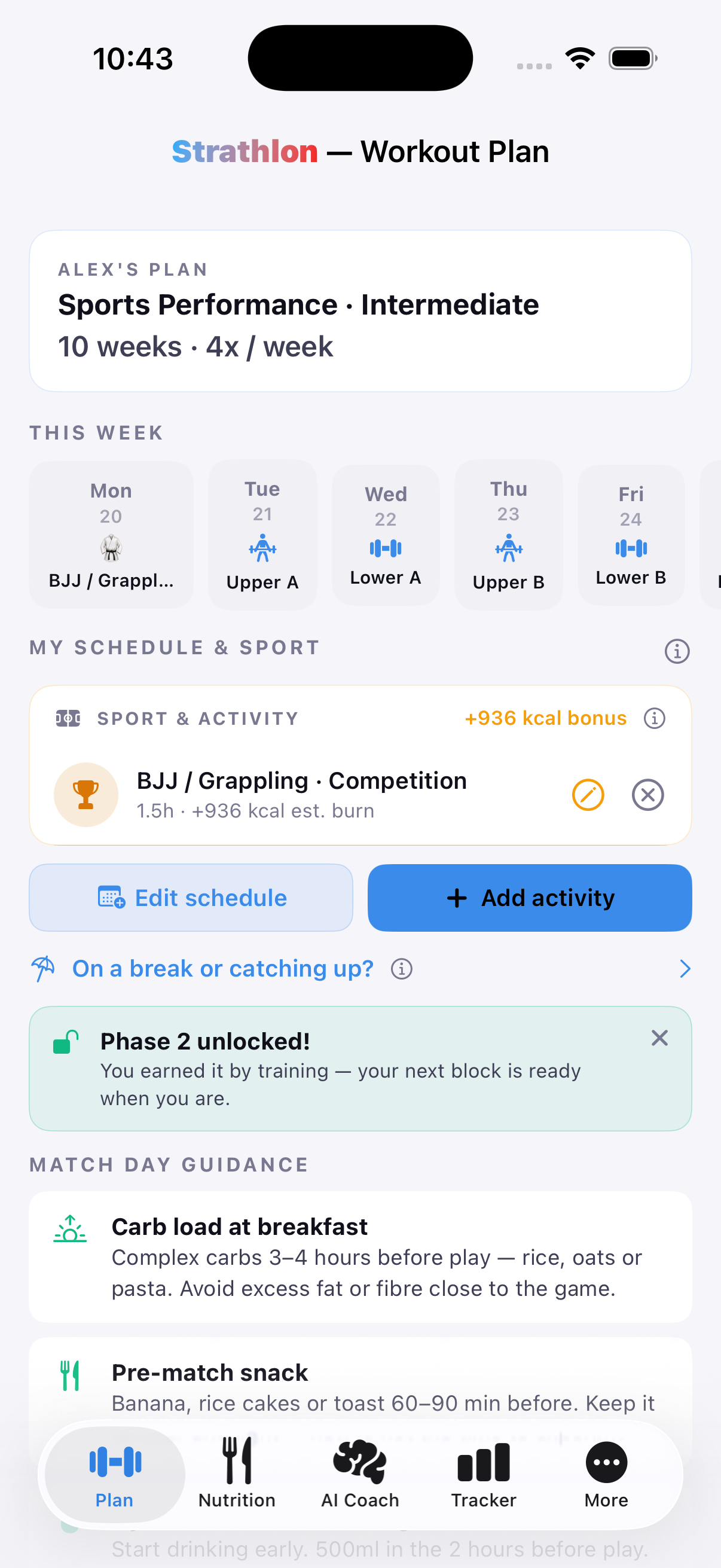
Good competition and training performance starts with showing up with the tank reasonably full, and that comes from your everyday carbohydrate intake, scaled to your training load. The joint position on nutrition and athletic performance from the American College of Sports Medicine, the Academy of Nutrition and Dietetics and Dietitians of Canada sets daily carbohydrate to training volume: roughly 3–5 g of carbohydrate per kg of body mass per day for light activity, around 5–7 g/kg for a moderate program, and 6–10 g/kg for the one-to-three hours a day of moderate-to-hard training a committed grappler racks up in a heavy week. Combat-sports guidance frames the same idea as roughly 3–5 g/kg on lighter days rising toward 6–10 g/kg on the hardest training days.
The point isn't to eat the maximum every day: it's to move the dial with your week. A double session with hard sparring earns more carbohydrate than a technical drilling day or a rest day. Chronically eating at the bottom of the range while training hard is one of the most common ways grapplers end up flat, gassing early and struggling to recover between sessions: the base is simply too empty.
Protein: repair and muscle protection
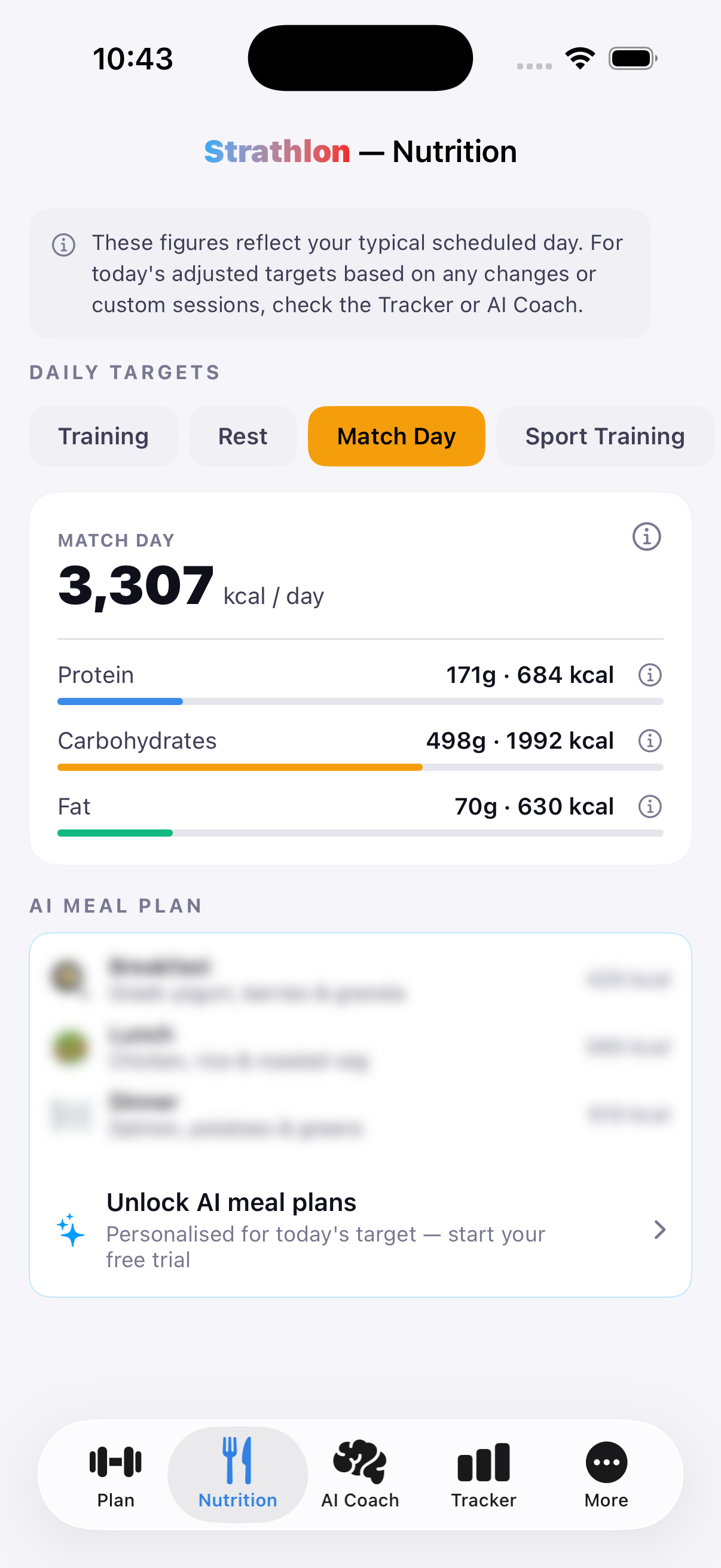
Grappling is punishing on muscle and connective tissue: the grip work, the isometric holds, the impacts and the constant tension all create damage that protein helps repair. General combat-sports guidance puts daily protein at around 1.2–2.4 g per kg of body mass (broadly 15–30% of calories). If you're also losing weight for a division, that need goes up: during an active weight descent the recommendation rises toward 1.6–2.2 g per kg per day, specifically to preserve lean mass while you're in an energy deficit. Spreading protein across the day's meals, rather than piling it into one, tends to support muscle retention and repair better.
Why guard protein so carefully? Because when you cut calories, the danger isn't only the number on the scale: it's what you lose. Lose fat and you keep your engine. Lose muscle and you weaken the grip, the base and the explosiveness that grappling runs on. Protein is your main defence against that, which is why it's the last macronutrient to trim. The eating-for-results guide covers the wider "how to build a diet" picture this sits inside.
Around a hard session and a comp day
For an ordinary hour on the mats, your existing glycogen and a normal day's meals cover it: you don't need to fuel mid-session. Two situations change that: a long open mat and, above all, a competition day, where you may face several matches spread across many hours.
- Before you train or compete. Position stands describe a carbohydrate-focused meal or snack of roughly 1–4 g per kg of body mass, eaten around one to four hours beforehand: larger and earlier when you have time to digest, smaller and closer to the start otherwise. Favour familiar, lower-fibre, lower-fat foods you've rehearsed in training, and never try anything new on competition morning.
- During long or repeated work. For a long session, or between matches across a comp day, taking in around 30–60 g of carbohydrate per hour (the established endurance-nutrition range for prolonged moderate-to-hard exercise) helps keep blood glucose up and your output from fading in later matches. Easy-to-digest options (a banana, a sports drink, a gel, rice cakes) sit best between bouts. On a competition day the gaps between matches are also your refuelling and rehydration windows. Use them.
- After training. If you'll train again soon, recovery is faster taking carbohydrate and protein together: combat-sports guidance suggests around 1.2 g of carbohydrate per kg per hour alongside 0.2–0.5 g of protein per kg per hour in the first hours after a hard session. If your next hard session is a day or more away, there's no rush: normal meals hitting your daily targets refill stores comfortably.
- References
Hydration for jiu-jitsu
Rolling is hot, close work in a thick gi, and fluid losses stack up fast, especially across a multi-match day under competition stress. Significant dehydration (losing more than roughly 2% of body mass as sweat) is associated with rising perceived effort, higher heart rate, and reduced strength, endurance and coordination, every one of which costs you on the mat. The long-standing sports-medicine guidance is to drink enough to keep body-mass loss under about 2% over a session, rather than to a rigid schedule.
There's no universal millilitres-per-hour figure, because sweat rates vary hugely with the person, the room and the intensity. The reliable way to find your own is to weigh yourself before and after a hard session in representative kit: each kilogram lost is roughly a litre of sweat, telling you how much you're under-replacing. On long or especially sweaty days, replacing some sodium alongside fluid helps you hold onto what you drink. And because BJJ so often weighs in same-day with no rehydration window (more on that next), arriving well-hydrated matters even more than in sports where you weigh in the day before.
Making weight: the same-day weigh-in problem
Here's what makes grappling genuinely different from boxing and MMA, and why the weight-making advice has to change with it. Many jiu-jitsu competitions weigh you in on the day of competition, often in your full gi, and sometimes only 15 to 30 minutes before your first match: with, at events like the IBJJF, a strict zero-tolerance limit where being fractionally over means disqualification. (Your gi itself typically adds around 1 to 2 kg to the reading, so it counts.)
Contrast that with boxing and MMA, where the weigh-in is usually the day before and combat-sports position stands describe a recovery window of roughly 24 to 36 hours to rehydrate and refuel. Our boxing and MMA guides cover how fighters use that window: sodium-rich oral rehydration at around 1 to 1.5 litres per hour, carbohydrate refuelling, aiming to regain at least 10% of body mass, to partly reverse a cut before they compete. In same-day BJJ, that window barely exists. Whatever water you sweat off, you carry into your first match dehydrated, because there's no time to put it back.
That single fact flips the risk maths. An aggressive water cut (the kind some fighters attempt precisely because they'll rehydrate overnight) is far more dangerous in a same-day-weigh-in sport, because you get the downsides (impaired strength, endurance, grip and cognition; strain on the kidneys) with none of the recovery time. So for most grapplers the sensible default favours managing weight gradually so you make the limit, in your gi, without a big last-minute cut at all over the "cut hard and rehydrate" approach.
Practically, that means two things. First, carry your everyday weight close to your division (combat-sports guidance suggests staying within roughly 12 to 15% above your limit off-camp) so the gap to close is small. Second, close whatever gap remains with slow, mostly-fat loss: the evidence points to losing around 0.5 to 1 kg of body mass per week, with research cited in combat-sports position stands finding that losing at roughly 0.7% of body mass per week had little measurable effect on performance, while faster loss tends to cost strength and power. Even in a deficit, the guidance is to not let macronutrients collapse: keep carbohydrate around 3–4 g/kg, protein around 1.6–2.2 g/kg and fat around 0.5–1.0 g/kg per day, prioritising protein to defend lean mass.
If a small final adjustment is needed
Sometimes, despite good management, you arrive at comp week a kilo or so over. The safest tools for a small final trim are the gentlest ones, and they're about reducing gut and residual bulk rather than wringing out water: a day or two of lower-fibre eating to reduce the food residue sitting in your gut, sensible portion control, and simply not over-drinking on the morning. These are modest measures for a modest gap.
What the same-day format argues strongly against is the heavy-sweating toolkit (saunas, hot baths, plastic suits, diuretics) used to shed several percent of body mass. Position stands describe any acute water manipulation as something to keep small (on the order of 2 to 4% of body mass within 24 hours of a weigh-in) and supervised, and that guidance assumes a rehydration window afterward that same-day BJJ doesn't give you. Without that window, the honest advice is to avoid meaningful water cutting altogether and fix the problem upstream, over the training block, with a professional's help. When in doubt, compete a division up rather than cut hard on the day.
Under-fuelling and RED-S
The flip side of weight-class pressure is chronic under-fuelling, and it's a real, named condition. It is not a character flaw or a sign of discipline. Relative Energy Deficiency in Sport (RED-S), the term used by the International Olympic Committee, describes the cluster of health and performance problems that arise when an athlete's energy availability (the energy left to run the body once training is paid for) stays too low for too long.
Energy availability is usually expressed per kilogram of fat-free (lean) mass. Falling below about 30 kcal per kg of fat-free mass per day is the commonly cited threshold at which problems start to appear, while something nearer 45 kcal per kg of fat-free mass per day is often described as healthy for a training athlete. Weight-class sports such as jiu-jitsu are explicitly recognised as higher-risk, because the incentive to stay in a division can push athletes into that low zone for weeks at a time. (Male thresholds appear somewhat lower and less settled than the female-derived 30 figure, but the direction is the same for everyone: chronically under-eating for your training catches up with you.)
Sustained low energy availability is associated with hormonal disruption, weaker bones and more stress fractures, poor and slow recovery, disrupted sleep, low mood, more frequent illness and (the part that tends to finally get attention) worse performance. In women it commonly shows up as disrupted or absent periods. In men, it shows up as low hormone levels, low drive and stress fractures. None of these are things to push through: if they appear, the answer is usually to eat more rather than train harder, and to seek help from a sports physician or dietitian.
Common questions
How should I fuel for jiu-jitsu training?
Match carbohydrate to how hard you're training. Combat-sports guidance suggests around 3 to 5 g of carbohydrate per kg of body mass on lighter days and up to 6 to 10 g per kg on the hardest rolling days, alongside protein of roughly 1.2 to 2.4 g per kg per day for repair. For a long open mat or a full day of competition, taking in around 30 to 60 g of carbohydrate per hour during the work helps keep your output up, and pairing carbohydrate with some protein afterwards speeds recovery. The simplest rule is to eat more on hard days and less on easy ones, rather than the same amount every day.
Should I cut weight for a same-day-weigh-in BJJ competition?
Be very cautious. Many jiu-jitsu competitions, including IBJJF events, weigh you in on the day of competition (in your gi, sometimes only 15 to 30 minutes before your first match) which leaves little or no time to rehydrate. That is the opposite of boxing or MMA, where a day-before weigh-in gives roughly 24 to 36 hours to recover. An aggressive water cut you cannot reverse in time means competing dehydrated, which tends to reduce strength, endurance, grip and clear thinking. The safer approach for most grapplers is gradual weight management so you make weight without a big last-minute cut. Any real weight cut should be planned with a doctor or sports dietitian rather than copied from a teammate.
How much protein does a grappler need?
Enough to repair hard training and protect muscle if you're losing weight. General combat-sports guidance puts protein at around 1.2 to 2.4 g per kg of body mass per day, and during a weight descent the recommendation rises to roughly 1.6 to 2.2 g per kg per day, spread across meals, specifically to preserve lean mass. Grappling is demanding on muscle and connective tissue, so protein is the macronutrient to guard most carefully when you're trimming calories.
How should I handle hydration for jiu-jitsu?
Rolling is hot, gripping work in a thick gi, so fluid losses add up quickly, especially across a multi-match competition day. Sports-medicine guidance is to drink enough to keep body-mass loss under about 2% over a session, rather than to a fixed schedule, and to learn your own sweat rate by weighing yourself before and after training. Because BJJ often weighs in same-day with no rehydration window, arriving already well hydrated matters more than in sports with a day-before weigh-in. Include some sodium on long, sweaty days, and don't over-drink plain water, which is not safer.
What is RED-S and are grapplers at risk?
RED-S, relative energy deficiency in sport, is a cluster of health and performance problems driven by low energy availability: too little energy left to run the body once training is paid for. It is commonly defined as below about 30 kcal per kg of fat-free mass per day, with around 45 kcal per kg often described as healthy for a training athlete. Weight-class sports like jiu-jitsu are recognised as higher-risk, because chronic under-eating to stay in a division can tip athletes into that zone, which is associated with hormonal disruption, weaker bones, poor recovery, low mood and worse performance. Persistent fatigue, frequent illness, stress fractures or, in women, missing periods are reasons to see a professional.
How is making weight for BJJ different from boxing or MMA?
The main difference is the weigh-in timing. Boxing and MMA usually weigh in the day before, giving roughly 24 to 36 hours to rehydrate and refuel, which is why fighters in those sports sometimes attempt larger water cuts. Many jiu-jitsu competitions weigh in on the day, in your gi, minutes before you compete, so there is essentially no recovery window, and a hard cut leaves you competing dehydrated. That makes gradual weight management, rather than an acute water cut, the sensible default for grapplers. Our boxing and MMA guides cover the day-before-weigh-in rehydration playbook in more detail.
Takeaways
- Rolling runs on carbohydrate. High-intensity bursts tax the glycolytic system (heart rate ~165–175 bpm, lactate ~10–12 mmol/L in match studies), so glycogen is what powers your best scrambles and late-match sharpness.
- Match carbs to the work. Roughly 3 to 5 g/kg on light days, up to 6 to 10 g/kg on the hardest days. Move the dial with your week rather than eating the same every day.
- Guard protein. Around 1.2 to 2.4 g/kg/day for repair, rising to about 1.6 to 2.2 g/kg/day when cutting, to protect the muscle that makes your grip and base.
- Fuel long sessions and comp days. A familiar carb-focused meal (~1 to 4 g/kg) beforehand, ~30 to 60 g of carbs per hour during long or repeated work, and carbohydrate plus protein afterwards.
- Hydrate to your own sweat rate. Keep body-mass loss under ~2%. Weigh yourself before and after to learn your number, add sodium on sweaty days, and don't over-drink.
- Respect the same-day weigh-in. BJJ often weighs in on the day, in the gi, minutes before you compete, with no window to rehydrate. That makes aggressive water cuts far riskier than in boxing or MMA.
- Manage weight gradually. Live within ~12 to 15% of your division, lose at ~0.5 to 1 kg/week (about 0.7%/week), and avoid the heavy-sweat toolkit. Drop a class over a block rather than dehydrate on the morning.
- Eat enough, always. Chronic low energy availability (below ~30 kcal/kg fat-free mass) drives RED-S. Jiu-jitsu is a higher-risk sport for it, and it eventually costs performance as well as health.
- Get a professional in your corner. Any real weight cut or diet should be planned with a doctor or registered sports dietitian rather than improvised from tradition.
If you take one thing away, make it this: because jiu-jitsu usually weighs you in on the day with no time to recover, the weight is won in the weeks before the competition. The morning of it is too late to matter. Manage weight gradually, protect your muscle, fuel and hydrate fully, and let the scale be an outcome of good habits rather than a crisis to survive. Strathlon's job is to keep your day-to-day fuelling matched to your training so you arrive lean, strong and fully fuelled, and to make "am I eating enough for what I'm doing?" answerable at a glance.
References
Numbered sources for the specific figures, effect sizes and named studies above. Where a claim reflects agreed guidance rather than a single trial, the citation is to the position stand or consensus statement of the body concerned, with the country or international remit named. Jiu-jitsu has little sport-specific nutrition research, so the demands below are cited to BJJ physiology and the fuelling prescriptions to the combat-sport and general sports-nutrition literature.
- Andreato LV, Lara FJD, Andrade A, Branco BHM. Physical and Physiological Profiles of Brazilian Jiu-Jitsu Athletes: a Systematic Review. Sports Medicine - Open. 2017;3(1):9. Systematic review of the physical and physiological profiles of Brazilian jiu-jitsu athletes: the source for the energy-system mix a session actually draws on. PubMed 28194734 · PMC5306420 full text
- Andreato LV, Franchini E, de Moraes SM, Pastório JJ, da Silva DF, Esteves JV, et al. Physiological and Technical-tactical Analysis in Brazilian Jiu-jitsu Competition. Asian Journal of Sports Medicine. 2013;4(2):137–43. Physiological and technical-tactical analysis of jiu-jitsu competition, the basis for the long, intermittent demand this guide fuels for. PubMed 23802056 · PMC3690734 full text
- Souza GTS, Lopes JSS, Fernandes GT, Magalhães Neto AM, Lemos JFS, Andrade CMB. Analysis of lipid profile before and after a simulated Brazilian jiu-jitsu para-sport fight: Multiple case analysis. Heliyon. 2024;11(1):e41107. Analysis of the metabolic response to a simulated jiu-jitsu fight, cited for the fuelling demand of a full-length roll. PubMed 39811372 · PMC11729650 full text
- Reale R, Slater G, Burke LM. Acute-Weight-Loss Strategies for Combat Sports and Applications to Olympic Success. International Journal of Sports Physiology and Performance. 2017;12(2):142–151. Review of acute weight-loss strategies in combat sports: the source for the weight-making cautions where a competitor has to hit a division. PubMed 27347784
- Matthews JJ, Stanhope EN, Godwin MS, Holmes MEJ, Artioli GG. The Magnitude of Rapid Weight Loss and Rapid Weight Gain in Combat Sport Athletes Preparing for Competition: A Systematic Review. International Journal of Sport Nutrition and Exercise Metabolism. 2019;29(4):441–452. Systematic review of the magnitude of rapid weight loss and regain in combat-sport athletes, the second source for the same. PubMed 30299200
- Burke LM, Slater GJ, Matthews JJ, Langan-Evans C, Horswill CA. ACSM Expert Consensus Statement on Weight Loss in Weight-Category Sports. Current Sports Medicine Reports. 2021;20(4):199–217. ACSM expert consensus statement on weight loss in weight-category sports, the governing guidance for cutting safely. PubMed 33790193
- Lakicevic N, Paoli A, Roklicer R, Trivic T, Korovljev D, Ostojic SM, et al. Effects of Rapid Weight Loss on Kidney Function in Combat Sport Athletes. Medicina. 2021;57(6). Study of the effects of rapid weight loss on kidney function in combat-sport athletes, the health end of that argument. PubMed 34072641 · PMC8229569 full text
- Williams C, Rollo I. Carbohydrate Nutrition and Team Sport Performance. Sports Medicine. 2015;45 Suppl 1(Suppl 1):S13–22. Review of carbohydrate nutrition and team-sport performance, applied to the repeated-effort demand of a training night. PubMed 26553494 · PMC4672015 full text
- Thomas DT, Erdman KA, Burke LM. Position of the Academy of Nutrition and Dietetics, Dietitians of Canada, and the American College of Sports Medicine: Nutrition and Athletic Performance. Journal of the Academy of Nutrition and Dietetics. 2016;116(3):501–528. Joint position of the Academy of Nutrition and Dietetics, Dietitians of Canada and the American College of Sports Medicine: the umbrella source for the daily energy, carbohydrate and protein ranges used throughout. PubMed 26920240
- Burke LM, Hawley JA, Wong SH, Jeukendrup AE. Carbohydrates for training and competition. Journal of Sports Sciences. 2011;29 Suppl 1:S17–27. Burke and colleagues on carbohydrate for training and competition, the source for the g/kg/day carbohydrate targets matched to training load. PubMed 21660838
- Jeukendrup A. A step towards personalized sports nutrition: carbohydrate intake during exercise. Sports Medicine. 2014;44 Suppl 1(Suppl 1):S25–33. Jeukendrup on personalising carbohydrate intake during exercise: the source for the g/h feeding rates and the duration at which they start to matter. PubMed 24791914 · PMC4008807 full text
- Jäger R, Kerksick CM, Campbell BI, Cribb PJ, Wells SD, Skwiat TM, et al. International Society of Sports Nutrition Position Stand: protein and exercise. Journal of the International Society of Sports Nutrition. 2017;14:20. International Society of Sports Nutrition (ISSN, United States) position stand on protein and exercise, the source for the daily protein range and per-meal distribution. PubMed 28642676 · PMC5477153 full text
- Schoenfeld BJ, Aragon AA. How much protein can the body use in a single meal for muscle-building? Implications for daily protein distribution. Journal of the International Society of Sports Nutrition. 2018;15:10. Schoenfeld and Aragon on how much protein the body can use in a single meal, the basis for the per-feed figure quoted. PubMed 29497353 · PMC5828430 full text
- Burke LM, van Loon LJC, Hawley JA. Postexercise muscle glycogen resynthesis in humans. Journal of Applied Physiology. 2017;122(5):1055–1067. Review of post-exercise muscle glycogen resynthesis, the source for the refuelling rates and for when a fast refuel is actually needed. PubMed 27789774
- Sawka MN, Burke LM, Eichner ER, Maughan RJ, Montain SJ, Stachenfeld NS. American College of Sports Medicine position stand. Exercise and fluid replacement. Medicine and Science in Sports and Exercise. 2007;39(2):377–90. ACSM position stand on exercise and fluid replacement: the source for the under-2% body-mass-loss guideline and the sweat-rate method. PubMed 17277604
- Barnes KA, Anderson ML, Stofan JR, Dalrymple KJ, Reimel AJ, Roberts TJ, et al. Normative data for sweating rate, sweat sodium concentration, and sweat sodium loss in athletes: An update and analysis by sport. Journal of Sports Sciences. 2019;37(20):2356–2366. Normative data for sweating rate and sweat sodium concentration in athletes, the source for how widely fluid and sodium losses vary between individuals. PubMed 31230518
- Hew-Butler T, Rosner MH, Fowkes-Godek S, Dugas JP, Hoffman MD, Lewis DP, et al. Statement of the Third International Exercise-Associated Hyponatremia Consensus Development Conference, Carlsbad, California, 2015. Clinical Journal of Sport Medicine : Official Journal of the Canadian Academy of Sport Medicine. 2015;25(4):303–20. Third International Exercise-Associated Hyponatremia Consensus statement, the basis for the warning against drinking well beyond sweat losses. PubMed 26102445
- Guest NS, VanDusseldorp TA, Nelson MT, Grgic J, Schoenfeld BJ, Jenkins NDM, et al. International society of sports nutrition position stand: caffeine and exercise performance. Journal of the International Society of Sports Nutrition. 2021;18(1):1. ISSN position stand on caffeine and exercise performance, the source for the caffeine dose and timing guidance. PubMed 33388079 · PMC7777221 full text
- Kreider RB, Kalman DS, Antonio J, Ziegenfuss TN, Wildman R, Collins R, et al. International Society of Sports Nutrition position stand: safety and efficacy of creatine supplementation in exercise, sport, and medicine. Journal of the International Society of Sports Nutrition. 2017;14:18. ISSN position stand on the safety and efficacy of creatine supplementation, cited where creatine is relevant to the sport's demands. PubMed 28615996 · PMC5469049 full text
- Maughan RJ, Burke LM, Dvorak J, Larson-Meyer DE, Peeling P, Phillips SM, et al. IOC consensus statement: dietary supplements and the high-performance athlete. British Journal of Sports Medicine. 2018;52(7):439–455. IOC consensus statement on dietary supplements and the high-performance athlete: the framing for treating supplements as optional extras. PubMed 29540367 · PMC5867441 full text
- Mountjoy M, Ackerman KE, Bailey DM, Burke LM, Constantini N, Hackney AC, et al. 2023 International Olympic Committee's (IOC) consensus statement on Relative Energy Deficiency in Sport (REDs). British Journal of Sports Medicine. 2023;57(17):1073–1097. The 2023 IOC consensus statement on Relative Energy Deficiency in Sport, the source for the consequences of under-fuelling a training load. PubMed 37752011
- Aragon AA, Schoenfeld BJ. Nutrient timing revisited: is there a post-exercise anabolic window?. Journal of the International Society of Sports Nutrition. 2013;10(1):5. Aragon and Schoenfeld on the post-exercise anabolic window, the source for timing mattering far less than daily totals. PubMed 23360586 · PMC3577439 full text
- British Dietetic Association (BDA, United Kingdom). Sport and exercise nutrition: Food Fact Sheet. British Dietetic Association (BDA, United Kingdom) Food Fact Sheet on sport and exercise nutrition, the practical UK dietetic framing. BDA Food Fact Sheet
This is general educational information rather than medical, nutritional or coaching advice. Weight-making and rapid weight loss in combat sports carry genuine health risks, and same-day weigh-ins, common in jiu-jitsu, remove the rehydration window that makes any cut riskier still. Individual needs vary widely; the figures and ranges here are drawn from published sports-nutrition guidance and are general guides rather than promises or a personalised plan. Anyone planning a weight cut, or who has a health condition, an eating concern, an injury, or who is pregnant or postpartum, should consult a qualified physician or registered sports dietitian before changing their diet, hydration or training. If you feel unwell during a cut (dizziness, confusion, a racing heart, severe cramps or an inability to sweat) stop and seek medical help. See our Terms for more.
← All guides · BJJ strength & conditioning guide · Fuelling for boxing · Fuelling for MMA · Eating for results · Understanding your stats · Home