
Climbing strength & conditioning
An evidence-based guide to training the body that climbs. Climbing is, more than almost any other sport, a story about the hands: about generating force through small contact points while the rest of the body hangs, twists and holds position. This covers finger and grip strength progressed carefully around a fragile front line, pulling and upper-back power, core anti-extension, the antagonist pushing work that keeps shoulders healthy, hip mobility, how climbing's energy systems fit alongside strength, and how to programme it around your season. Practical, honest, and grounded in sport-science and sports-medicine research.
Here's the short version: climbing rewards maximal finger and grip strength, strong pulling and upper-back muscles, and resilient shoulders (built on a base of core control and hip mobility), and the single most important rule is to progress the fingers slowly, because the tissue that limits climbers is also the tissue that injures them most.
On this page
A framing note before the detail. Climbing science is a smaller field than, say, running physiology, and climbers vary enormously: discipline (boulder, sport, trad), grade, age, training age and injury history all change what's right for a given person. So this is written as can, tends to and is associated with, never as a guarantee, and every specific number is a population-level guide drawn from published research rather than a personal prescription. It's general education rather than medical or coaching advice, and it isn't a personalised programme.
The demands of climbing
At its mechanical core, climbing is repeated, near-maximal gripping combined with pulling, done while the body controls its position against gravity. The hands are the interface: force travels from small holds, through the finger flexor tendons, up the pulling chain of the forearms, back and shoulders, and into a torso and hips that keep you close to the wall and load your feet. That makes climbing unusual: it's a whole-body sport whose performance ceiling usually sits in the fingers.
Physiologically, the finger flexors work as intermittent isometric contractions: you grip hard, hold, release to move, and grip again. Because a hard grip compresses the forearm's own blood vessels, sustained contraction is partly blood-flow-restricting, so the forearm leans on anaerobic metabolism and then relies on the brief relaxation between holds to restore oxygen and clear metabolites. Whole-body, hard climbing is genuinely taxing: research on climbing-specific tests reports oxygen uptake around 75% of maximum and heart rates near 83% of maximum during sustained routes, with blood lactate rising well above resting levels, evidence that both the aerobic and the anaerobic-glycolytic systems contribute (climbing exercise-test research, 2021). Tellingly, more able climbers de-oxygenate their finger-flexor muscles more, and recover forearm oxygenation faster between efforts, than less able ones (Fryer and colleagues, 2015): local forearm endurance, on top of raw grip, separates levels.
The injury map follows the demand. Many climbers report an injury each year, and the upper limb dominates: surveys put the fingers and hands as the most affected region, with the shoulder also commonly affected, and chronic overuse injuries outnumbering acute ones (systematic review of climbing injuries, 2025). The headline sites are the finger pulleys (especially the A2), the shoulder, and the elbow, which is exactly where the strength and prehab work below is aimed.
Key strength work, and why it matters
Climbing develops your fingers and pulling muscles simply by doing it, so supplementary strength work earns its place two ways: by pushing the qualities that transfer, and by building the qualities climbing neglects. Here's the movement map and why each piece transfers.
| Quality | How to train it | Why it transfers to climbing |
|---|---|---|
| Finger / grip strength | Hangboard (max hangs or low-intensity holds) and heavy carries | The direct performance limiter. Relative grip strength tracks climbing level. |
| Maximal pulling strength | Weighted pull-ups, rows, lat work, front-lever progressions | Pulling strength is among the strongest correlates of grade, leaving more force in reserve per move. |
| Upper-back / scapular | Rows, face pulls, scapular pulls, band work | Positions and stabilises the shoulder under load, protecting the joint. |
| Antagonist push | Push-ups, overhead / bench press, external rotation | Balances a pull-dominant sport and is associated with lower shoulder-impingement risk. |
| Core (anti-extension / anti-rotation) | Front planks, hollow holds, dead bugs, ab-wheel, Pallof press | Keeps hips into the wall, transmits force from hands to feet, and resists over-arching. |
| Lower body & hips | Squats, single-leg work, hip mobility drills | Drives high steps and weight transfer, with unilateral control for precise footwork. |
Fingers first, carefully. Finger strength is trainable: in a 10-week study, structured hangboard training raised peak finger force by roughly 17%, and rate of force development also rose (though the between-group difference versus controls did not reach significance) training twice a week (Hermans et al., 2022). Two evidence-backed styles exist. The classic is max hangs: short, near-maximal dead-hangs of about 10 seconds at roughly 85–95% of your one-rep maximum. A gentler alternative uses low-intensity, longer-duration holds performed frequently. A 2024 review found both approaches produced modest gains and that combining them was additive (Gilmore et al., 2024). One caveat: fingers adapt more slowly than muscles, so hangboarding suits climbers with a base of consistent climbing rather than beginners, and load should creep up over weeks, never days.
Pull like it matters, because it does. Pulling strength and relative grip strength are among the strongest correlates of climbing level in the performance-determinants literature (sport-climbing determinants review, 2024), and the broader principle that greater maximal strength underpins force and power expression is well established (Suchomel et al., 2016). Weighted pull-ups and rows in lower rep ranges build the strength reserve that makes any single climbing move feel submaximal, and rows in particular double as scapular and upper-back work that keeps the shoulder healthy.
Then build what climbing skips. This is where a gym plan pays off most. Climbing rarely trains the pushing muscles or shoulder external rotators, so dedicated pressing, face pulls and rotator-cuff work restore the balance a pull-only sport erodes. Core anti-extension and anti-rotation work (planks, hollow holds, dead bugs, ab-wheel, Pallof presses) trains the trunk to keep your hips into the wall and transmit force cleanly from hands to feet, rather than letting the lower back over-arch. And lower-body and hip work matters more than climbers assume: while general flexibility explains only a small slice of climbing performance, climbing-specific hip mobility (the hip flexion, abduction and external rotation behind a high step or a wide flag) and single-leg control feed directly into footwork and weight transfer. Legs and hips shouldn't be dropped from a climber's preparation just because the sport looks like an upper-body one.
Conditioning for climbing
Climbing's "engine" is unusual: the limiting endurance is local, in the forearms, more than whole-body cardiovascular fitness. Because gripping restricts its own blood flow, the ability to keep contracting hard depends on how quickly the forearm restores oxygen and clears metabolites in the split seconds between holds, the exact quality that separates ability groups (Fryer and colleagues, 2015). So climbing conditioning centres on training the forearm's capacity and recovery far more than on running miles.
Practically, that means training the energy systems the way you'll use them. Power and maximal strength (short, hard bouldering; limit hangs) develop the top-end force behind single moves. Strength-endurance and "power-endurance" (repeated hard efforts with incomplete rest, such as intervals on a system board, repeaters on a hangboard, or laps on a route) train the forearm to resist and recover from pump. And a modest aerobic base, whether from easier high-volume climbing (ARC-style traversing) or general cardio, supports the between-effort recovery that lets you climb more before fading. Match the emphasis to your discipline: a boulderer leans toward power and maximal strength, a sport or trad climber toward strength-endurance and aerobic capacity.
On fitting strength and conditioning together without them fighting: keep the hardest, most finger-intensive work when you're fresh (climbing and finger training before heavy gym pulling or long endurance work, never afterward). Separate genuinely hard strength sessions from hard climbing by enough recovery that neither is sabotaged, and treat long, fatiguing conditioning as a lower priority than skill and finger quality when time is tight. For climbers, the interference to watch isn't so much cardio blunting strength as accumulated forearm and connective-tissue fatigue blunting everything, which is why how you programme the week matters as much as what's in it.
Staying injury-resilient
Climbing's injuries are predictable, which makes them partly preventable. Three sites dominate.
Finger pulleys (especially the A2). The finger pulleys are the most commonly injured structure in climbing: pulley ruptures account for up to about a third of climbing injuries in some series, with a reported 19–26% incidence in competitive climbers, most often in the middle and ring fingers (Artiaco et al., 2022; Miro et al., 2021). The mechanism is largely the full crimp: biomechanical modelling shows the load on the A2 pulley can be many times higher in a full crimp than in an open-hand grip (Vigouroux et al., 2006). Prehab, then, is mostly load management: warm the fingers up progressively, favour open-hand and half-crimp for most loading, avoid maximal full-crimping when cold or pumped, build finger load gradually over weeks, and (the one that saves seasons) respect sharp, localised finger pain instead of climbing through it.
Shoulder. As a common injury site, the shoulder pays the price of a pull-dominant sport. Climbers tend to develop relatively weak external rotators and scapular stabilisers, an imbalance associated with impingement and pain (rock-climbing injury overview). The evidence-aligned prehab is the antagonist work from the strength section: pressing, external rotation and scapular control, plus training yourself to hang actively (shoulders set down and back rather than dangling passively) so the joint is stabilised under load.
Elbow. "Climber's elbow" is usually medial epicondylalgia, an overuse tendinopathy of the flexor-pronator muscles on the inner elbow (its outer-elbow cousin, lateral epicondylalgia, also occurs), driven by heavy, repetitive gripping. Elbow complaints make up a smaller share of climbing injuries. The mainstay of managing tendinopathy is load management plus progressive resistance loading of the affected tendon (often eccentric or heavy-slow work), though the evidence suggests eccentrics are best combined with broader progressive loading rather than relied on alone. Building forearm and wrist strength through a full range, and managing sudden spikes in climbing volume, is the sensible prevention.
A general point ties these together: most climbing injuries come from overuse, rarely from a single accident. They come from too much, too soon: a jump in volume, intensity or crimping that outpaces what the connective tissue has adapted to. Tendons and pulleys strengthen far more slowly than muscles, so the strongest prehab of all is patient, gradual progression.
Programming it around your season
Climbers rarely have a clean "off-season," but the same logic applies: build strength when climbing demands are lower, and shift to maintenance when climbing itself becomes the priority (a trip, a project, an outdoor season or a competition block).
In a build phase, strength and finger training can take a larger share: two or three focused strength sessions a week alongside climbing, with progressive overload on the key lifts and, for appropriately experienced climbers, a structured finger-strength block. In an in-season or performance phase, the goal flips to holding onto that strength without adding fatigue that competes with climbing. The reassuring evidence here is that maintenance is cheap: research in athletes has found that as little as one strength session per week can maintain strength gains across roughly a 12-week competitive season (Rønnestad et al., 2011), and broader reviews find little difference in strength maintenance across training frequencies once volume is accounted for (training-frequency review, 2021). The practical move is to cut strength volume, keep the load heavy on a couple of key lifts, and let climbing carry the week.
Two habits keep S&C from colliding with climbing. First, put the highest-skill, most finger-intensive work first, when you're fresh, and heavier gym work after or on separate days. Second, build in recovery: climbing's connective tissues (fingers, tendons, pulleys) recover more slowly than muscle, so planned lighter weeks and honest rest days aren't lost time. They're what let the next block progress. Realistically, most recreational climbers do well with two or three climbing sessions and one or two short strength sessions a week, adjusted around fatigue.
How Strathlon fits
Strathlon isn't a bespoke climbing coach, and it's honest about that. What it does is take a goal-driven gym plan and tune it toward your sport once Sports Performance is one of your goals. When your sport is climbing, its sport tuning blends the training emphasis toward climbing's movement patterns and adds climbing-relevant accessory work on top of a solid base of pulling, pressing, core and lower-body lifts, so the plan you see reflects the balance this guide describes: sport-specific work plus the complementary base strength and conditioning that rounds it out.
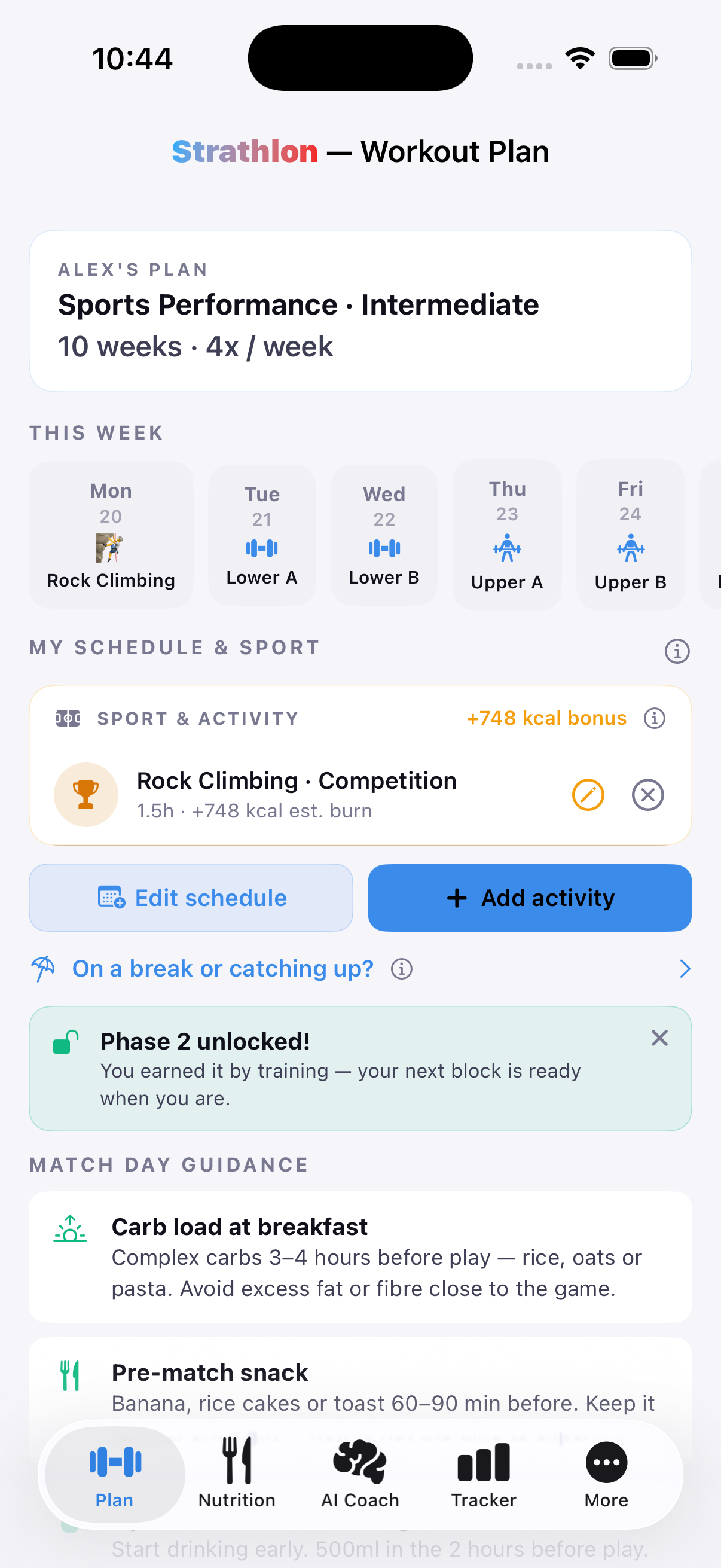
That pairing is worth dwelling on, because it captures the whole philosophy of training for a sport. The base work (the weighted pulls, and the pressing, hip and lower-body work climbing otherwise skips) is what makes the finger training survivable. It is not filler to be dropped for more hangboarding. On top of it sits the sport-specific work: the max hangs and repeaters on your board that raise the finger ceiling, and the accessory block's antagonist, scapular and cuff work that keeps a pull-only sport from eroding the shoulder. Neither half works alone. Finger strength without the surrounding base is the fastest route to a pulley injury. A balanced gym body that never loads the fingers does not climb harder.
Common questions
Should I do hangboard training, and how hard should I pull?
Hangboarding can build finger strength, but it is intense loading and is best reserved for climbers with a base of a year or so of consistent climbing rather than beginners, whose fingers adapt more slowly than their muscles. Two evidence-backed approaches exist. The long-standing method is Max Hangs: short near-maximal holds of roughly 10 seconds at around 85–95% of your one-repetition maximum. A gentler alternative uses low-intensity, longer-duration holds performed frequently. A 2024 review found both methods produced modest gains and that combining them was additive. In a 10-week study, structured hangboard training raised peak finger force by around 17% training twice a week. Always warm up thoroughly, progress load slowly, and stop if you feel sharp finger pain.
How do I train my fingers without hurting my pulleys?
The finger pulleys (the A2 in particular) are the most commonly injured structure in climbing, accounting for up to about a third of climbing injuries in some series, and the full-crimp grip is the main culprit. Biomechanical modelling shows the load on the A2 pulley can be many times higher in a full crimp than in an open-hand grip. The practical protection is to warm up the fingers progressively, favour open-hand and half-crimp positions for most loading, avoid maximal full-crimping when cold or fatigued, add finger load gradually over weeks rather than days, and back off at the first sign of sharp, localised pain rather than climbing through it.
Do I still need to lift weights if I already climb a lot?
Climbing itself develops your fingers and pulling muscles well, so the gym is most useful for the qualities climbing under-trains. Pulling strength and relative grip strength are among the strongest correlates of climbing level, and greater maximal strength broadly underpins force and power expression, so heavy, low-rep pulling can help. But the highest-value gym work for most climbers is what climbing neglects: antagonist pushing and external-rotation work for shoulder health, core anti-extension, and lower-body and hip work. Supplementary strength training complements climbing rather than replacing it.
Why should a climber train pushing muscles when climbing is all pulling?
Precisely because climbing is so pull-dominant. Repetitive pulling with little opposing work tends to leave climbers with relatively weak shoulder external rotators and scapular stabilisers, an imbalance associated with shoulder impingement and pain: the shoulder is a common injury site in climbers after the fingers. Regular pressing (push-ups, overhead press) plus dedicated external-rotation and scapular work helps restore balance around the shoulder, improve posture, and keep the joint healthy. This antagonist work is prehab. It isn't bodybuilding. The job is keeping the shoulder resilient over years of pulling.
How do I keep my strength during a climbing trip or a busy season?
You do not need to keep training strength at full volume to hold onto it. Research in athletes has found that as little as one strength session per week can maintain strength gains across a competitive season of around 12 weeks. The practical move in a heavy climbing block is to reduce strength volume (fewer sets, fewer sessions) while keeping the load reasonably heavy on a small number of key lifts. That preserves the strength you built without adding fatigue that competes with your climbing.
What is the best way to deal with climber's elbow?
Climber's elbow usually refers to medial epicondylalgia: an overuse tendinopathy of the flexor-pronator muscles on the inner elbow, driven by the heavy gripping climbing demands. Elbow complaints make up a smaller share of climbing injuries. The mainstay of management is load management plus progressive, often eccentric or heavy-slow, resistance loading of the affected tendon, though the evidence suggests eccentric work is best combined with broader progressive loading rather than used alone. Reduce aggravating volume, load the tendon gradually and consistently, and see a qualified clinician if pain persists, because elbow tendinopathy can be stubborn and slow to settle.
Takeaways
- The fingers are the ceiling, and the fragile part. Maximal finger and grip strength drives climbing, but the pulleys are the most-injured tissue, so progress finger load slowly.
- Hangboard only with a base. Max hangs (~10s at ~85–95% 1RM) or frequent low-intensity holds both work and combine additively, but hold off if you're a true beginner.
- Pull hard, then train what climbing skips. Weighted pulls build the strength that correlates with grade. Pressing, external rotation, core and hips are the highest-value additions.
- Balance the shoulder. A pull-only sport erodes external rotators and scapular control. Antagonist push and cuff work is prehab. It isn't vanity work.
- Condition the forearm before the lungs. Local strength-endurance and recovery between holds matter most. Add an aerobic base to support it.
- Respect pain. Sharp, localised finger, elbow or shoulder pain means stop and deload: most climbing injuries are overuse from too much, too soon.
- Maintain in-season on the cheap. As little as one strength session a week can hold your gains across ~12 weeks. Cut volume, keep the load.
- References
If you remember one thing, make it this: climbing improves fastest when the fingers are strong and the chain behind them (pulling muscles, balanced shoulders, a braced core and mobile hips) is strong enough to use that strength without breaking. Strathlon's role is to give you a sport-aware plan that puts those pieces in front of you, and to keep the base honest, so the specialist stuff you add on top has somewhere solid to sit.
Pair this with the climbing fuelling guide for the nutrition side: how to fuel hard sessions and recover between them.
References
Numbered sources for the specific figures, effect sizes and named studies above. Where a claim reflects agreed guidance rather than a single trial, the citation is to the position stand or consensus statement of the body concerned, with the country or international remit named. Climbing research is a small field and much of it is on finger strength; where a recommendation goes beyond that (pressing, shoulder balance, programming) it rests on the general strength evidence, which is said where it applies.
- Giles LV, Rhodes EC, Taunton JE. The physiology of rock climbing. Sports Medicine. 2006;36(6):529–45. The physiology of rock climbing review, the source for maximal finger and grip strength driving performance and for the forearm being the limiting system. PubMed 16737345
- Hermans E, Saeterbakken AH, Vereide V, Nord ISO, Stien N, Andersen V. The Effects of 10 Weeks Hangboard Training on Climbing Specific Maximal Strength, Explosive Strength, and Finger Endurance. Frontiers in Sports and Active Living. 2022;4:888158. Ten-week hangboard training trial on climbing-specific maximal strength, explosive strength and finger endurance, the direct source for the hangboard protocols described. PubMed 35571743 · PMC9092147 full text
- Callender NA, Hayes TN, Tiller NB. Cardiorespiratory demands of competitive rock climbing. Applied Physiology, Nutrition, and Metabolism = Physiologie Appliquee, Nutrition et Metabolisme. 2021;46(2):161–168. Study of the cardiorespiratory demands of competitive rock climbing, the basis for the conditioning advice and the aerobic base underneath it. PubMed 32813982
- Gabl M, Lener M, Pechlaner S, Judmaier W. Isolated injuries of the pulley of the finger flexor tendon sheath--injuries in extreme climbing sports. Sportverletzung Sportschaden : Organ Der Gesellschaft Fur Orthopadisch-Traumatologische Sportmedizin. 1992;6(3):119–22. The original description of isolated finger flexor pulley injuries in extreme climbing, the source for the pulleys being the most-injured tissue. PubMed 1411917
- Mora-Fernandez A, Argüello-Arbe A, Tojeiro-Iglesias A, Latorre JA, Conde-Pipó J, Mariscal-Arcas M. Nutritional Assessment, Body Composition, and Low Energy Availability in Sport Climbing Athletes of Different Genders and Categories: A Cross-Sectional Study. Nutrients. 2024;16(17). Nutritional assessment, body composition and low energy availability in sport climbing athletes, cited for the fuelling caution alongside the training advice. PubMed 39275289 · PMC11397518 full text
- Cools AM, Johansson FR, Borms D, Maenhout A. Prevention of shoulder injuries in overhead athletes: a science-based approach. Brazilian Journal of Physical Therapy. 2015;19(5):331–9. Cools and colleagues on preventing shoulder injuries in overhead athletes, the basis for the antagonist push and external-rotation work prescribed against a pull-only sport. PubMed 26537804 · PMC4647145 full text
- Cools AM, Struyf F, De Mey K, Maenhout A, Castelein B, Cagnie B. Rehabilitation of scapular dyskinesis: from the office worker to the elite overhead athlete. British Journal of Sports Medicine. 2014;48(8):692–7. Cools and colleagues on rehabilitation of scapular dyskinesis, the scapular-control half of the same recommendation. PubMed 23687006
- Suchomel TJ, Nimphius S, Stone MH. The Importance of Muscular Strength in Athletic Performance. Sports Medicine. 2016;46(10):1419–49. Suchomel and colleagues on the importance of muscular strength in athletic performance, the source for greater maximal strength being associated with faster sprinting, jumping and change of direction, and with lower injury risk. PubMed 26838985
- Seitz LB, Reyes A, Tran TT, Saez de Villarreal E, Haff GG. Increases in lower-body strength transfer positively to sprint performance: a systematic review with meta-analysis. Sports Medicine. 2014;44(12):1693–702. Seitz and colleagues' systematic review with meta-analysis showing increases in lower-body strength transfer positively to sprint performance, the evidence behind the 'strength is the base' argument. PubMed 25059334
- Lauersen JB, Andersen TE, Andersen LB. Strength training as superior, dose-dependent and safe prevention of acute and overuse sports injuries: a systematic review, qualitative analysis and meta-analysis. British Journal of Sports Medicine. 2018;52(24):1557–1563. Lauersen and colleagues' meta-analysis finding strength training a superior, dose-dependent and safe prevention of acute and overuse sports injuries, the direct source for treating strength work as prehab. PubMed 30131332
- Lauersen JB, Bertelsen DM, Andersen LB. The effectiveness of exercise interventions to prevent sports injuries: a systematic review and meta-analysis of randomised controlled trials. British Journal of Sports Medicine. 2014;48(11):871–7. Lauersen and colleagues' earlier meta-analysis of exercise interventions to prevent sports injuries, the broader evidence base the prevention advice sits on. PubMed 24100287
- . American College of Sports Medicine position stand. Progression models in resistance training for healthy adults. Medicine and Science in Sports and Exercise. 2009;41(3):687–708. American College of Sports Medicine (ACSM, United States) position stand on progression models in resistance training, the source for the heavy-load and explosive-load percentage ranges quoted. PubMed 19204579
- Cuthbert M, Haff GG, Arent SM, Ripley N, McMahon JJ, Evans M, et al. Effects of Variations in Resistance Training Frequency on Strength Development in Well-Trained Populations and Implications for In-Season Athlete Training: A Systematic Review and Meta-analysis. Sports Medicine. 2021;51(9):1967–1982. Cuthbert and colleagues' systematic review of resistance-training frequency in well-trained populations, the source for the sessions-per-week guidance. PubMed 33886099 · PMC8363540 full text
- Spiering BA, Mujika I, Sharp MA, Foulis SA. Maintaining Physical Performance: The Minimal Dose of Exercise Needed to Preserve Endurance and Strength Over Time. Journal of Strength and Conditioning Research. 2021;35(5):1449–1458. Spiering and colleagues on the minimal dose of exercise needed to preserve endurance and strength, the source for maintaining in-season on as little as one to two sessions a week. PubMed 33629972
- Rønnestad BR, Nymark BS, Raastad T. Effects of in-season strength maintenance training frequency in professional soccer players. Journal of Strength and Conditioning Research. 2011;25(10):2653–60. Ronnestad and colleagues' trial of in-season strength maintenance frequency in professional footballers, the specific in-season maintenance result quoted. PubMed 21873897
- Nuzzo JL, Pinto MD, Kirk BJC, Nosaka K. Resistance Exercise Minimal Dose Strategies for Increasing Muscle Strength in the General Population: an Overview. Sports Medicine. 2024;54(5):1139–1162. Nuzzo and colleagues on minimal-dose resistance exercise strategies for increasing strength, supporting the claim that a small, well-chosen dose does most of the work. PubMed 38509414 · PMC11127831 full text
- Wilson JM, Marin PJ, Rhea MR, Wilson SM, Loenneke JP, Anderson JC. Concurrent training: a meta-analysis examining interference of aerobic and resistance exercises. Journal of Strength and Conditioning Research. 2012;26(8):2293–307. Wilson and colleagues' meta-analysis of concurrent training and the interference effect, the source for separating heavy lifting from hard conditioning. PubMed 22002517
- Schumann M, Feuerbacher JF, Sünkeler M, Freitag N, Rønnestad BR, Doma K, et al. Compatibility of Concurrent Aerobic and Strength Training for Skeletal Muscle Size and Function: An Updated Systematic Review and Meta-Analysis. Sports Medicine. 2022;52(3):601–612. An updated systematic review of the compatibility of concurrent aerobic and strength training, the more recent evidence that interference is smaller than once believed. PubMed 34757594 · PMC8891239 full text
- Ramirez-Campillo R, Sortwell A, Moran J, Afonso J, Clemente FM, Lloyd RS, et al. Plyometric-Jump Training Effects on Physical Fitness and Sport-Specific Performance According to Maturity: A Systematic Review with Meta-analysis. Sports Medicine - Open. 2023;9(1):23. Ramirez-Campillo and colleagues on plyometric-jump training effects on physical fitness and sport-specific performance, the source for the plyometric guidance. PubMed 37036542 · PMC10086091 full text
- Impellizzeri FM, Woodcock S, Coutts AJ, Fanchini M, McCall A, Vigotsky AD. What Role Do Chronic Workloads Play in the Acute to Chronic Workload Ratio? Time to Dismiss ACWR and Its Underlying Theory. Sports Medicine. 2021;51(3):581–592. Impellizzeri and colleagues on the pitfalls of the acute:chronic workload ratio, cited because it is the reason this guide talks about ramping load gradually rather than quoting a workload number. PubMed 33332011
- Baz-Valle E, Balsalobre-Fernández C, Alix-Fages C, Santos-Concejero J. A Systematic Review of The Effects of Different Resistance Training Volumes on Muscle Hypertrophy. Journal of Human Kinetics. 2022;81:199–210. Systematic review of resistance-training volume and hypertrophy, the general dose-response evidence behind the set and session recommendations. PubMed 35291645 · PMC8884877 full text
This is general educational information rather than medical, physiotherapy or coaching advice. The figures here are drawn from published research and are framed as population-level guides: individual needs vary widely with discipline, grade, age, training history and injury status, and are best personalised with a qualified strength & conditioning coach or clinician. Anyone with a current injury, finger, elbow or shoulder pain, a health condition, or who is pregnant or postpartum, should consult a qualified professional before starting or changing a training programme. Finger and tendon injuries in particular should be assessed by a sports physician or physiotherapist. See our Terms for more.
← All guides · Climbing fuelling guide · How muscle actually grows · Recovery & rest · Eating for results · Home