
Lacrosse strength & conditioning
An evidence-based guide to training the body lacrosse actually asks for. Lacrosse is a fast, collision-and-cut sport: repeated sprints, hard changes of direction, explosive dodges and a shot driven from the ground up, played over a game that runs on an intermittent, high-heart-rate engine. This covers the strength qualities that transfer to the field, how to condition the sport's repeat-sprint demands, the prehab that keeps the hamstring, knee, ankle, shoulder and head resilient, and how to fit it all around practice and a competitive season. Practical, honest, and grounded in published sport science.
Here's the short version: lacrosse rewards players who can sprint, cut and brake repeatedly, jump and land under control, and drive a shot through a fast rotation: so the S&C that matters most is lower-body and single-leg strength for acceleration and change of direction, lower-body power and landing control, and rotational power for the shot, all sitting on top of a repeat-sprint engine and wrapped in prehab for the hamstring, knee, ankle and head. Everything below is the detail behind that sentence: the lifts, why they transfer, the conditioning, the prehab, and how to programme it without the pieces fighting each other.
On this page
A framing note before the detail. Strength and conditioning is well studied, but people differ enormously: training age, playing level, sex, position, injury history and schedule all shift what's right for a given player. So this is written as can, tends to and is associated with, never as a guarantee, and every specific figure is a population-level guide drawn from published research. It's general education rather than medical or individual coaching advice, and it isn't a substitute for a qualified S&C coach or clinician.
The demands of lacrosse
Lacrosse is an intermittent, high-acceleration field sport: repeated short sprints and hard changes of pace, threaded through long periods of jogging and positioning, over a game that keeps the heart rate high for most of its length. GPS tracking of elite men bears this out: the movement profile is built from repeated bursts rather than steady running, and the load is not shared evenly across the field: midfielders cover the most high-speed running and sprint distance, while attackers and defenders do proportionally more low-intensity work (Akiyama, Sasaki and Mashiko, 2019). Match heart rates commonly average around 80% of maximum, which tells you the aerobic system is working hard underneath the sprints the whole time.
The energy systems follow that shape. The dodges, sprints and shots within a possession are fuelled mainly by the immediate (ATP-PC) and anaerobic systems. The aerobic system works quietly underneath, restoring energy between efforts and holding fatigue off across four quarters. The practical consequence is that a lacrosse player needs to be explosive on every repeat and still be explosive in the fourth quarter, which is a different quality from being able to run a long way slowly.
Biomechanically, two demands dominate. First, multidirectional movement: explosive first steps, sharp cuts, dodges, and hard deceleration to plant and change direction, much of it off a single leg. Braking is often overlooked but it's constant, and it's where a lot of the injury risk lives. Second, the shot and pass are ground-up, rotational actions. In skilled players, peak rotational velocity starts at the pelvis, travels up through the trunk, and is delivered out through the shoulder, arms and stick: a kinetic chain in which the legs and trunk generate the speed and the arms merely finish it. Getting the lower-body force and the trunk rotation to sequence well is what separates a hard shot from an arm-only one.
The injury map follows the demands. Broadly, the lower extremity dominates: knee injuries are the most common lower-limb problem, ankle sprains are frequent (and proportionally more so in the women's game), and hamstring and thigh strains cluster around the sprinting and cutting. Lacrosse also carries a notably high concussion burden for a field sport, and women's lacrosse has one of the highest ACL-injury rates of any women's sport, according to NCAA injury-surveillance reviews. The overhead throwing and cradling load the shoulder, and the big rotational torque of the shot can nag at the lower back. In short: train the lower body to sprint, cut and brake; train the trunk to rotate and transfer force; and deliberately protect the hamstring, knee, ankle, shoulder and head.
Key strength work, and why it matters
Underneath every quality lacrosse needs sits one general one: maximal strength. Across the literature, being stronger is associated with better jumping, sprinting and change-of-direction performance, and with lower injury risk, because greater strength improves the force you can put into the ground in the fraction of a second a dodge or a first step allows (Suchomel, Nimphius and Stone, 2016). Strength is the base you then make fast. Four patterns do most of the work.
1. Lower-body and single-leg strength. Squats and hip hinges (deadlift and Romanian deadlift variations, hip thrusts) build the force and hip-extension power behind sprinting, dodging and the drive phase of the shot, and the posterior chain (glutes and hamstrings) is what you accelerate and decelerate with. Because lacrosse is so often played off one leg (cutting, planting, shooting on the run) single-leg work such as split squats, step-ups and lunges is not optional garnish: it builds strength in the exact stance you cut from, evens out left–right differences, and directly supports the knee and ankle that pay the price of hard changes of direction. Train these heavier and lower-rep when the goal is maximal strength. Save lighter, higher-rep work for where muscular endurance is the aim.
2. Lower-body power, jumping and landing. Strength is potential. Power is strength expressed fast, and lacrosse is a fast sport. Plyometrics (jumps, bounds and hops) plus explosive lifts or throws train the rate at which you produce force, which is what a first step and a dodge actually demand. Just as important, jump landing work is where power training and injury prevention overlap: learning to absorb force under control, on one leg, is the same skill that protects the ACL in cutting and landing. Power work should be low-rep, high-quality efforts done fresh. Save conditioning for when fatigue has already set in.
3. Rotational power for the shot. Because the shot and long passes are ground-up rotational actions, explosive rotation is one of the most sport-specific qualities you can train in the gym. Rotational and overhead medicine-ball throws and cable rotations and chops, driven at maximum velocity, build the trunk rate of force development that sequences into stick and ball speed: the pelvis-to-trunk-to-arm chain made trainable. A strong, controllable trunk also helps you tolerate the large rotational torque a hard shot puts through the lower back. Treat these as power work: a few reps per set, thrown as hard as possible, with full recovery.
4. Shoulder and neck resilience. The throwing shoulder is loaded repeatedly by shooting, passing and cradling, so balancing that overhead work with dedicated external-rotation and scapular strengthening (lower trapezius and serratus anterior, via band work, prone Y/T raises and rows) helps the joint tolerate the load. And because lacrosse is a collision and stick-contact sport, neck and upper-back strengthening earns its place too (more in the injuries section below). This is where strength training and injury prevention become the same thing.
That pairing is worth dwelling on, because it captures the whole philosophy of training for a sport. The base lifts (the lower-body compound work) are what actually build the force behind a sprint, a dodge and a shot. They are not general filler to be skipped in favour of more wall ball. On top of that base sit the sport-specific pieces: an accessory block of single-leg, hamstring and adductor strength, with jumping and landing work aimed at the sport's two signature lower-limb injuries. Neither half works alone. Landing and single-leg work on a weak base protects a player who cannot generate much force. A strong squat that has never been trained to land or decelerate does not reach the game.
That pairing is worth dwelling on, because it captures the whole philosophy of this guide. The sport-specific work (the jump and landing work, the single-leg, hamstring and adductor accessory movements) is what makes a plan a lacrosse plan, and it's the part generic gym programmes leave out. But it only works because of what sits beside it: the complementary base lifts (squat, hinge, press, pull) that build the maximal strength everything else is expressed through, and the conditioning that gives you the engine to repeat it. Skip the base and the jumps have little strength to convert into power. Skip the sport-specific work and you're just a stronger gym-goer who hasn't trained the qualities the field demands. The two halves are complementary rather than interchangeable.
Conditioning for lacrosse
Because lacrosse is intermittent, the conditioning that transfers best looks intermittent. The most specific work is repeat-sprint training: short maximal sprints of roughly 5–10 seconds with brief recovery, and multidirectional shuttles that mirror the cuts and changes of pace of a possession. This trains you to be explosive, recover quickly, and then be explosive again, which is the physical story of a lacrosse game, in which midfielders in particular repeat high-speed efforts throughout (Akiyama, Sasaki and Mashiko, 2019).
You still need a genuine aerobic base. Aerobic fitness is what restores energy between sprints and holds fatigue off late in a game, and a match spent averaging around 80% of maximum heart rate makes real demands on it. The practical implication is a mix: mostly repeat-sprint intervals and on-field movement, with some moderate steady aerobic work to build the base. A diet of long, slow distance running does little for the sport's explosive side and eats into recovery.
The harder problem is fitting strength and conditioning together without interference. Doing a lot of hard endurance work in close proximity to hard strength work can blunt strength and power gains: the classic concurrent-training interference effect. You reduce it by keeping the two from colliding: separate hard lifting and hard conditioning by several hours or onto different days where you can, put the priority quality first when you're fresh (power and speed before you're tired), and remember that a lot of your conditioning is already delivered by field practice and games: so extra running should top up that base without burying it.
Staying injury-resilient
Prehab in lacrosse isn't separate from performance training: it's mostly the same strength, power and landing work aimed at the tissues that take the most load. Four areas deserve deliberate attention.
The hamstrings. Sprinting and rapid acceleration make hamstring strains one of the sport's recurring lower-limb injuries. The best-known evidence-based tool is the Nordic hamstring exercise: injury-prevention programmes that include it are associated with roughly halving hamstring-injury rates in meta-analysis (van Dyk, Behan and Whiteley, 2019, reported an injury risk ratio near 0.49). In fairness, a later methodological reappraisal argued the true protective effect is less certain than that headline suggests (Impellizzeri et al., 2021), so treat it as an associated reduction worth having. It isn't a guarantee. Eccentric hamstring strength built through Nordics and Romanian deadlifts is a sensible, low-cost inclusion regardless.
The knee (ACL). Cutting, planting and landing are exactly the movements that load the ACL, and women's lacrosse carries one of the highest ACL-injury rates of any women's sport. The good news is that this is one of the most preventable injuries in sport: neuromuscular training programmes that combine strength, plyometrics, balance and landing technique are associated with about a 50% reduction in all ACL injuries and around a 67% reduction in non-contact ACL injuries in women (Webster and Hewett, 2018). The catch is compliance: these programmes only work if you actually do them, consistently and year round.
The ankle. Ankle sprains are frequent, and proportionally even more common in the women's game. Single-leg strength, balance and proprioception work, and controlled landing and deceleration drills are the front-line defence. A history of ankle sprain is one of the strongest predictors of the next one, so players who have rolled an ankle before especially benefit from ongoing balance work.
The head and neck (concussion). Lacrosse carries a high concussion burden for a field sport, and the mechanism differs by game: in the men's game most concussions come from athlete-to-athlete contact, whereas in the women's game stick or ball contact with the head dominates. One evidence-based lever is neck strength: in a study of nearly 7,000 high-school athletes that included lacrosse players, each one-pound increase in neck strength was associated with about a 5% reduction in the odds of concussion (Collins et al., 2014). The wider evidence for neck training as concussion prevention is still developing and not settled, so see it as a plausible, low-risk addition rather than a proven shield: one that sits alongside good technique, rules enforcement and proper equipment.
Cutting across all of it is workload management. Sharp spikes in training and playing load are among the most consistent injury risk factors across field sports, so ramp volume and intensity up gradually rather than in jumps: the most reliable injury-prevention tool is often simply not doing too much, too soon, especially early in pre-season when injury rates tend to climb.
Programming it around your season
The goal changes with the calendar, and so should the plan.
Off-season and pre-season: build. With few or no games, this is when you develop maximal strength and power: heavier compound lifts, dedicated plyometric, jump-landing and rotational-power work, and a higher training frequency (commonly two to three S&C sessions a week). This is the block that raises your ceiling. The sport-specific speed and power sit on top of the strength you build here. It's also the ideal time to drill the ACL and hamstring prehab into a habit before the schedule gets busy.
In-season: maintain, don't build. Once games are frequent, the aim shifts to keeping what you built while staying fresh to play. The reassuring evidence: strength can be maintained for a long stretch on surprisingly little: up to around 32 weeks on as little as one session per week and even a single set per exercise, provided you keep the load (intensity) high (Spiering et al., 2021). A review of training frequency likewise found no clear strength difference between frequencies when total volume and load are matched, which frees you to spread a little lifting across the week around games (Cuthbert et al., 2021). In practice, one to two short, heavy sessions a week (keep the load, cut the volume) is usually enough to hold your strength and power through a season. Keep the prehab going. It matters most when you're playing most.
Fitting it around practice and fatigue. Schedule your hard lifting away from key games, put the power and speed work when you're freshest, and back off (a deload, or simply fewer sets) when a congested block or accumulated fatigue tells you to. Field practice is the main event, and the gym exists to support it. How much extra you add should follow the week's playing load, more than any rigid template.

Common questions
What strength work should I prioritise for lacrosse?
Prioritise three things: lower-body and single-leg strength, lower-body power, and rotational power for the shot. Lacrosse is a sprint-and-cut sport, so heavier squats, hinges and split-squats build the maximal strength that is associated with faster sprinting, jumping and change of direction (Suchomel, Nimphius and Stone, 2016). On top of that, jumps and throws develop the explosive power you cut, dodge and shoot with, and medicine-ball and cable rotations train the ground-up kinetic chain (pelvis to trunk to arm) that drives shot speed. Add external-rotation and scapular work for the throwing shoulder and neck strengthening for collision and stick-contact resilience. You don't need to pick one. A good lacrosse plan rotates through all of them on a strong base.
Will lifting heavy make me slow or bulky for lacrosse?
That's the most common fear and the evidence points the other way. Greater maximal strength is associated with better sprint, jump and change-of-direction performance (Suchomel, Nimphius and Stone, 2016), because being stronger lets you put more force into the ground in the split second a dodge or a first step allows. Lacrosse strength work is also low in volume compared with bodybuilding, and training heavy and explosive with low reps builds force and power rather than size. Large amounts of muscle are slow and deliberate to gain. It doesn't happen by accident. Keep field practice and some mobility in the week, and heavy lifting tends to help your movement.
How do I reduce my risk of hamstring and ACL injuries?
These are two of lacrosse's signature lower-limb injuries, and both have evidence-based prehab. For the hamstrings, including the Nordic hamstring exercise in a prevention programme is associated with roughly halving hamstring-injury rates in meta-analysis (van Dyk, Behan and Whiteley, 2019, reported a risk ratio near 0.49), though a later reappraisal argued the true effect is less certain than that headline (Impellizzeri et al., 2021), so treat it as an association worth having. It isn't a guarantee. For the ACL, neuromuscular training programmes that combine strength, plyometrics, balance and landing technique are associated with about a 50% reduction in all ACL injuries and around a 67% reduction in non-contact ACL injuries in women (Webster and Hewett, 2018). Women's lacrosse in particular carries one of the highest ACL-injury rates of any women's sport, so this work matters. Compliance is what makes it pay off: do it consistently, year round.
Does neck strength really help with concussion in lacrosse?
Lacrosse carries a high concussion burden (from athlete-to-athlete contact in the men's game and stick or ball contact in the women's game) so it's a fair question. In a study of nearly 7,000 high-school athletes that included lacrosse players, each one-pound increase in neck strength was associated with about a 5% reduction in the odds of concussion (Collins et al., 2014). The wider evidence for neck training as concussion prevention is still developing and not settled, so it is best seen as a low-risk, plausibly helpful addition rather than a proven shield. Strengthening the neck and upper back is sensible for a collision sport regardless, and it sits alongside (not instead of) good technique, rules enforcement and proper equipment.
How many strength sessions a week do I need in-season?
Fewer than you might think to hold on to what you built. Research on maintaining performance found that strength can be preserved for up to around 32 weeks on as little as one session per week and even a single set per exercise, provided you keep the load (intensity) high (Spiering et al., 2021). A broader review likewise found no clear strength difference between training frequencies when total volume and load are matched, which lets you spread a small amount of lifting across the week around games and practice (Cuthbert et al., 2021). So in-season, one to two short, heavy sessions a week is usually enough to maintain: the off-season is when you build.
Do I need long-distance running to get fit for lacrosse?
Not really. Lacrosse is an intermittent, high-acceleration sport: GPS studies of elite men show it is built from repeated short sprints and constant changes of pace, with midfielders covering the most high-speed running, on a match heart rate that often averages around 80% of maximum (Akiyama, Sasaki and Mashiko, 2019). That profile is best trained with repeat-sprint intervals and multidirectional shuttles rather than long steady runs. You still want an aerobic base, because it underpins recovery between efforts and resists fatigue late in a game, but you can build that with a mix of intervals and moderate aerobic work, and a lot of your conditioning already comes from field practice itself.
Takeaways
- Three qualities matter most: lower-body and single-leg strength (for acceleration, cutting and deceleration), lower-body power and landing control, and rotational power for the shot, on top of a repeat-sprint engine.
- Build strength as the base. Greater maximal strength is associated with faster sprinting, jumping and change of direction, and lower injury risk (Suchomel, Nimphius and Stone, 2016). Squats, hinges and single-leg lifts underpin everything.
- Train power explosively. Jumps, landings, medicine-ball throws and cable rotations build the speed and shot power that strength is expressed through: done fresh, low-rep, high-quality.
- Protect the hamstring and ACL. Nordic hamstring work is associated with roughly halving hamstring injuries (van Dyk, Behan and Whiteley, 2019; less certain per Impellizzeri et al., 2021), and neuromuscular ACL programmes with ~50% fewer ACL injuries and ~67% fewer non-contact ACL injuries in women (Webster and Hewett, 2018).
- Mind the ankle, shoulder, head and low back. Balance work for ankles, cuff and scapular work for the throwing shoulder, and neck strengthening: each 1 lb of extra neck strength was linked to ~5% lower concussion odds (Collins et al., 2014), though that evidence is still developing.
- Condition like the sport plays. Repeat-sprint intervals and multidirectional movement, on a match averaging ~80% of max heart rate (Akiyama, Sasaki and Mashiko, 2019), beat long slow running. Keep a modest aerobic base.
- Maintain in-season on little. One to two short, heavy sessions a week hold strength when the load stays high (Spiering et al., 2021; Cuthbert et al., 2021). Build in the off-season.
- Ramp load gradually. Sharp spikes in training and playing load are a consistent injury risk. Do too much, too soon and you invite the very injuries the prehab is meant to prevent.
- References
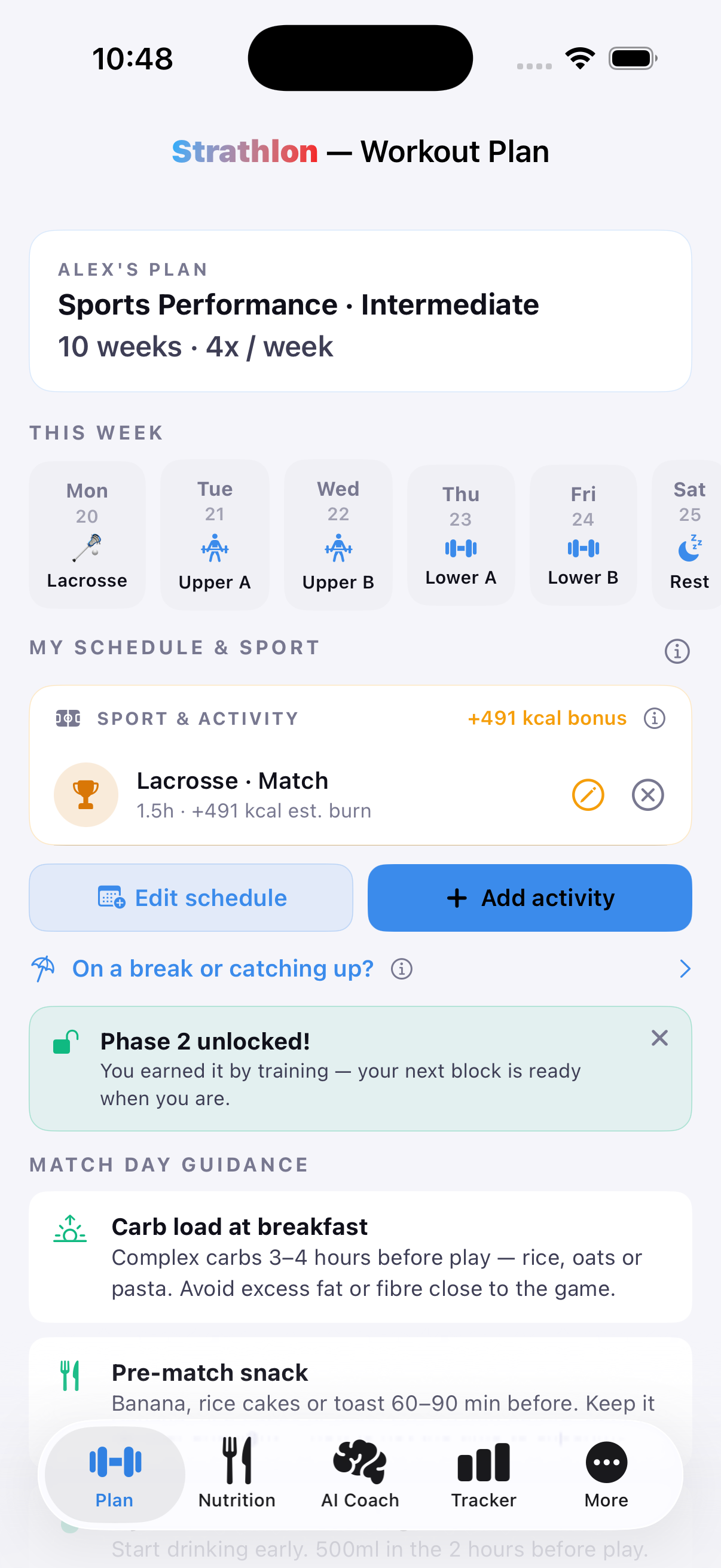
If you remember one thing, make it the shape of the plan: build a strong, powerful lower body, add the lacrosse-specific rotational, jump-landing and shoulder/neck work on top, condition with short sharp efforts, protect the hamstring, knee, ankle and head, and do just enough in-season to keep it all. Strathlon's job is to tune that base toward your sport (with Sports Performance as one of your goals) and keep the trend honest: a sport-aware starting point you can build on, ideally alongside a coach for the competitive details.
References
Numbered sources for the specific figures, effect sizes and named studies above. Where a claim reflects agreed guidance rather than a single trial, the citation is to the position stand or consensus statement of the body concerned, with the country or international remit named. Lacrosse has a solid injury-epidemiology literature and very little training-intervention research, so the prescriptions below are general strength evidence targeted at the sport's documented injury sites.
- Akiyama K, Sasaki T, Mashiko M. Elite Male Lacrosse Players' Match Activity Profile. Journal of Sports Science & Medicine. 2019;18(2):290–294. Study of the elite male lacrosse match activity profile: the source for the running and repeat-effort demands described. PubMed 31191099 · PMC6543992 full text
- Garcia A, Redler LH. Descriptive Epidemiology of Injuries Sustained in National Collegiate Athletic Association Men's and Women's Lacrosse, 2004-2005 Through 2013-2014 Seasons. HSS Journal : the Musculoskeletal Journal of Hospital for Special Surgery. 2024;20(2):288–297. Descriptive epidemiology of injuries in NCAA men's and women's lacrosse, the source for the sport's injury distribution. PubMed 39281991 · PMC11393631 full text
- Barber Foss KD, Le Cara E, McCambridge T, Hinton RY, Kushner A, Myer GD. Epidemiology of Injuries in Women's Lacrosse: Implications for Sport-, Level-, and Sex-Specific Injury Prevention Strategies. Clinical Journal of Sport Medicine : Official Journal of the Canadian Academy of Sport Medicine. 2018;28(4):406–413. Study of injury epidemiology in women's lacrosse and its implications for sex-specific prevention, cited so the guidance is not drawn from the men's game alone. PubMed 28742608
- Vincent HK, Zdziarski LA, Vincent KR. Review of Lacrosse-Related Musculoskeletal Injuries in High School and Collegiate Players. Sports Health. 2015;7(5):448–51. Systematic review of lacrosse-related musculoskeletal injuries in high-school and collegiate players, the second source for the same pattern. PubMed 26502422 · PMC4547109 full text
- Mihata LC, Beutler AI, Boden BP. Comparing the incidence of anterior cruciate ligament injury in collegiate lacrosse, soccer, and basketball players: implications for anterior cruciate ligament mechanism and prevention. The American Journal of Sports Medicine. 2006;34(6):899–904. Study comparing ACL injury incidence in collegiate lacrosse, football and basketball, the basis for the knee-prevention emphasis. PubMed 16567461
- Vincent HK, Vincent KR. Core and Back Rehabilitation for High-speed Rotation Sports: Highlight on Lacrosse. Current Sports Medicine Reports. 2018;17(6):208–214. Review of core and back rehabilitation for high-speed rotation sports with a focus on lacrosse: the source for the trunk and rotational work prescribed. PubMed 29889150
- Petushek EJ, Sugimoto D, Stoolmiller M, Smith G, Myer GD. Evidence-Based Best-Practice Guidelines for Preventing Anterior Cruciate Ligament Injuries in Young Female Athletes: A Systematic Review and Meta-analysis. The American Journal of Sports Medicine. 2019;47(7):1744–1753. Petushek and colleagues' meta-analysis of ACL injury prevention, the source for the neuromuscular programme effect quoted. PubMed 30001501 · PMC6592422 full text
- van Dyk N, Behan FP, Whiteley R. Including the Nordic hamstring exercise in injury prevention programmes halves the rate of hamstring injuries: a systematic review and meta-analysis of 8459 athletes. British Journal of Sports Medicine. 2019;53(21):1362–1370. Meta-analysis of Nordic hamstring prevention programmes, the source for the hamstring prehab figure. PubMed 30808663
- Schiftan GS, Ross LA, Hahne AJ. The effectiveness of proprioceptive training in preventing ankle sprains in sporting populations: a systematic review and meta-analysis. Journal of Science and Medicine in Sport. 2015;18(3):238–44. Schiftan and colleagues' meta-analysis of proprioceptive training and ankle sprains, the ankle half of the prehab. PubMed 24831756
- Suchomel TJ, Nimphius S, Stone MH. The Importance of Muscular Strength in Athletic Performance. Sports Medicine. 2016;46(10):1419–49. Suchomel and colleagues on the importance of muscular strength in athletic performance: the source for greater maximal strength being associated with faster sprinting, jumping and change of direction, and with lower injury risk. PubMed 26838985
- Seitz LB, Reyes A, Tran TT, Saez de Villarreal E, Haff GG. Increases in lower-body strength transfer positively to sprint performance: a systematic review with meta-analysis. Sports Medicine. 2014;44(12):1693–702. Seitz and colleagues' systematic review with meta-analysis showing increases in lower-body strength transfer positively to sprint performance, the evidence behind the 'strength is the base' argument. PubMed 25059334
- Lauersen JB, Andersen TE, Andersen LB. Strength training as superior, dose-dependent and safe prevention of acute and overuse sports injuries: a systematic review, qualitative analysis and meta-analysis. British Journal of Sports Medicine. 2018;52(24):1557–1563. Lauersen and colleagues' meta-analysis finding strength training a superior, dose-dependent and safe prevention of acute and overuse sports injuries: the direct source for treating strength work as prehab. PubMed 30131332
- Lauersen JB, Bertelsen DM, Andersen LB. The effectiveness of exercise interventions to prevent sports injuries: a systematic review and meta-analysis of randomised controlled trials. British Journal of Sports Medicine. 2014;48(11):871–7. Lauersen and colleagues' earlier meta-analysis of exercise interventions to prevent sports injuries, the broader evidence base the prevention advice sits on. PubMed 24100287
- . American College of Sports Medicine position stand. Progression models in resistance training for healthy adults. Medicine and Science in Sports and Exercise. 2009;41(3):687–708. American College of Sports Medicine (ACSM, United States) position stand on progression models in resistance training: the source for the heavy-load and explosive-load percentage ranges quoted. PubMed 19204579
- Cuthbert M, Haff GG, Arent SM, Ripley N, McMahon JJ, Evans M, et al. Effects of Variations in Resistance Training Frequency on Strength Development in Well-Trained Populations and Implications for In-Season Athlete Training: A Systematic Review and Meta-analysis. Sports Medicine. 2021;51(9):1967–1982. Cuthbert and colleagues' systematic review of resistance-training frequency in well-trained populations, the source for the sessions-per-week guidance. PubMed 33886099 · PMC8363540 full text
- Spiering BA, Mujika I, Sharp MA, Foulis SA. Maintaining Physical Performance: The Minimal Dose of Exercise Needed to Preserve Endurance and Strength Over Time. Journal of Strength and Conditioning Research. 2021;35(5):1449–1458. Spiering and colleagues on the minimal dose of exercise needed to preserve endurance and strength: the source for maintaining in-season on as little as one to two sessions a week. PubMed 33629972
- Rønnestad BR, Nymark BS, Raastad T. Effects of in-season strength maintenance training frequency in professional soccer players. Journal of Strength and Conditioning Research. 2011;25(10):2653–60. Ronnestad and colleagues' trial of in-season strength maintenance frequency in professional footballers, the specific in-season maintenance result quoted. PubMed 21873897
- Nuzzo JL, Pinto MD, Kirk BJC, Nosaka K. Resistance Exercise Minimal Dose Strategies for Increasing Muscle Strength in the General Population: an Overview. Sports Medicine. 2024;54(5):1139–1162. Nuzzo and colleagues on minimal-dose resistance exercise strategies for increasing strength, supporting the claim that a small, well-chosen dose does most of the work. PubMed 38509414 · PMC11127831 full text
- Wilson JM, Marin PJ, Rhea MR, Wilson SM, Loenneke JP, Anderson JC. Concurrent training: a meta-analysis examining interference of aerobic and resistance exercises. Journal of Strength and Conditioning Research. 2012;26(8):2293–307. Wilson and colleagues' meta-analysis of concurrent training and the interference effect: the source for separating heavy lifting from hard conditioning. PubMed 22002517
- Schumann M, Feuerbacher JF, Sünkeler M, Freitag N, Rønnestad BR, Doma K, et al. Compatibility of Concurrent Aerobic and Strength Training for Skeletal Muscle Size and Function: An Updated Systematic Review and Meta-Analysis. Sports Medicine. 2022;52(3):601–612. An updated systematic review of the compatibility of concurrent aerobic and strength training, the more recent evidence that interference is smaller than once believed. PubMed 34757594 · PMC8891239 full text
- Ramirez-Campillo R, Sortwell A, Moran J, Afonso J, Clemente FM, Lloyd RS, et al. Plyometric-Jump Training Effects on Physical Fitness and Sport-Specific Performance According to Maturity: A Systematic Review with Meta-analysis. Sports Medicine - Open. 2023;9(1):23. Ramirez-Campillo and colleagues on plyometric-jump training effects on physical fitness and sport-specific performance, the source for the plyometric guidance. PubMed 37036542 · PMC10086091 full text
- Impellizzeri FM, Woodcock S, Coutts AJ, Fanchini M, McCall A, Vigotsky AD. What Role Do Chronic Workloads Play in the Acute to Chronic Workload Ratio? Time to Dismiss ACWR and Its Underlying Theory. Sports Medicine. 2021;51(3):581–592. Impellizzeri and colleagues on the pitfalls of the acute:chronic workload ratio: cited because it is the reason this guide talks about ramping load gradually rather than quoting a workload number. PubMed 33332011
- Baz-Valle E, Balsalobre-Fernández C, Alix-Fages C, Santos-Concejero J. A Systematic Review of The Effects of Different Resistance Training Volumes on Muscle Hypertrophy. Journal of Human Kinetics. 2022;81:199–210. Systematic review of resistance-training volume and hypertrophy, the general dose-response evidence behind the set and session recommendations. PubMed 35291645 · PMC8884877 full text
This is general educational information rather than medical or individual coaching advice. The sport-science figures here are drawn from published research and are framed as population-level guides and associations rather than guarantees: individual needs vary widely with training age, level, sex, position, history and schedule, and are best personalised with a qualified strength & conditioning coach. Anyone with pain, an injury, a health condition, or who is pregnant or postpartum, should consult a qualified clinician before starting or changing a training programme, and any suspected concussion, or persistent hamstring, knee, ankle, shoulder or back pain, should be assessed rather than trained through. See our Terms for more.
Pair this with the lacrosse fuelling guide for the nutrition side of playing and training. More: Running strength & conditioning · Tennis strength & conditioning · How muscle actually grows · Eating for results · All guides · Home