
Strength & conditioning for walking
An evidence-based guide to the strength and conditioning that makes walking better and keeps you doing it. Walking is a superb, sustainable aerobic base, but it is a gentle sport, and the very gentleness that makes it so joint-friendly also means it barely loads muscle, bone or balance. This covers the lower-body and posterior-chain strength that drives propulsion and hills, the single-leg balance and hip stability behind every step, durable calves and feet, the prehab that reduces the most common walking niggles, and how to fit it all around your walking week. Practical, honest, and grounded in exercise-science consensus.
Here's the short version: the strength work that most helps a walker builds three things walking itself barely touches: lower-body and posterior-chain strength for propulsion, hills and carrying, single-leg balance and hip stability for every stride and for staying upright on uneven ground, and durable calves and feet that shrug off the miles, while the walking supplies the aerobic base. Everything below is the detail behind that sentence.
On this page
A framing note before the detail. Exercise science is well studied, but people differ enormously: age, training history, body weight, joint health, terrain and goals all change what's right for you. So this is written as can, tends to and is associated with, never as a guarantee, and every specific number is a population-level guide drawn from published research rather than a personal prescription. It's general education rather than medical or coaching advice, and it isn't an individualised programme.
The demands of walking
Walking looks simple, and metabolically it mostly is: it's a low-intensity, predominantly aerobic activity you can sustain for hours, fuelled largely by fat with a modest carbohydrate contribution at easy paces. There's no glycogen crisis to manage on a normal walk. What defines walking as a training stress is duration and repetition rather than intensity: thousands of steps, day after day, each one a small mechanical event repeated an enormous number of times.
Mechanically, every one of those steps is a single-leg task. For much of the gait cycle your whole body weight is balanced over one foot, so the hip abductors (chiefly gluteus medius) work to stop the pelvis dropping, the hip extensors (glutes and hamstrings) drive you forward, the quadriceps control the knee, and the calf and plantar flexors push you off the ground as the foot behaves like a spring, storing and releasing energy through the arch and plantar fascia. Impact forces in walking are relatively low (very roughly around one to one-and-a-half times body weight, against the two-and-a-half to three times seen in running), which is exactly why walking is so kind to joints, and also why, on its own, it's a weak stimulus for building muscle, bone or balance reserve.
Because the same low-level loads recur so many times, walking's typical problems are overuse niggles rather than dramatic injuries, and they cluster at predictable sites: the foot and plantar fascia (plantar fasciitis is the classic), the knee (patellofemoral pain, and the aggravation of existing knee osteoarthritis), the hip, the calf and Achilles, and the low back, which has to hold you upright for the whole outing. For older walkers there's a further consideration that isn't an injury at all but matters more than any of them: falls, where strength and balance are the protective qualities.
Key strength work, and why it matters
The goal of strength work for a walker isn't to turn walking into a strength sport: it's to build a bigger capacity reserve underneath your walking, so hills, long days, a heavy pack and simply the years ahead all feel easier, and so the tissues that take the repetitive load can tolerate it well. A handful of movement patterns does almost all of it.
| Movement pattern | Examples | Why it transfers to walking |
|---|---|---|
| Squat / sit-to-stand | Goblet squat, leg press, box sit-to-stand | Builds the quads and glutes that power hills, stairs and rising from a chair. Leg strength is linked to faster, steadier gait. |
| Hip hinge | Deadlift, Romanian deadlift, hip thrust | Loads the posterior chain (glutes, hamstrings) that drives propulsion and holds posture, and heavy hinging is a potent bone stimulus. |
| Calf / heel raise | Standing and bent-knee heel raises, single-leg progressions | Strengthens the plantar flexors and foot that push you off every step. Progressive loading builds resilience against calf, Achilles and plantar trouble. |
| Single-leg / hip abductor | Step-ups, split squats, banded side steps, balance holds | Trains the way you actually walk (one leg at a time), improving pelvic stability, balance and confidence on uneven ground. |
| Core / carry | Suitcase carries, planks, dead bugs | Supports upright posture over long distances and, with carries, rehearses the trunk demand of walking with a load. |
How hard, and how heavy? For general health, the World Health Organization's activity guidelines call for muscle-strengthening at moderate or greater intensity across all major muscle groups on two or more days a week, with older adults additionally advised to do balance-and-strength work on three or more days a week to help prevent falls. Within that, you don't need heroic volume: an overview of minimal-dose resistance training (Nuzzo, 2024) found that even single-set programmes done a few times a week (or as little as one session weekly) can produce meaningful strength gains, on the order of roughly 20% improvements when effort and load are there. Beginners and older walkers should start with bodyweight or light loads, prioritise good technique, and add load gradually.
Two of those patterns deserve a closer look because they carry benefits walking simply can't provide. Heavy hinging and squatting build bone. In the LIFTMOR randomised trial (Watson et al., 2018), postmenopausal women with low bone mass performed twice-weekly supervised heavy training (deadlift, squat and overhead press at more than 85% of their one-rep maximum, five sets of five) and improved lumbar-spine bone density by about 2.9% while a low-intensity comparison group lost around 1.2%. Walking's gentle loads don't come close to that osteogenic signal. And progressive calf loading builds foot and lower-leg durability: the same heavy heel-raise work that treats plantar fasciitis (below) is, done pre-emptively, a reasonable way to armour the tissues that walking hammers most.
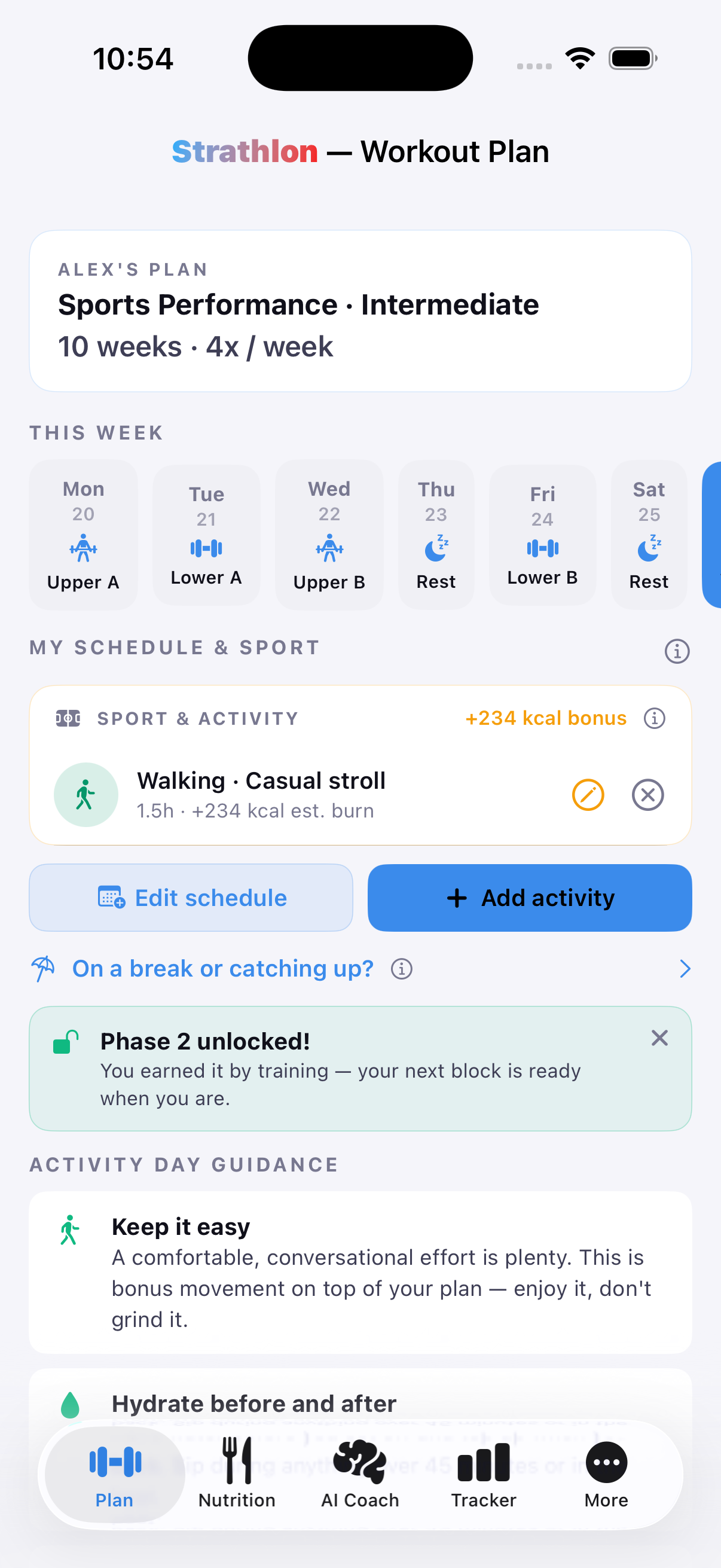
That's the whole idea in one plan. The base lifts (a squat pattern and a hinge) do the heavy lifting for whole-body strength and bone. Your gym sessions end with a core finisher for the trunk. The walking-specific layer is the accessory work you add on top: the calf raises, step-ups, hip-abductor work and balance holds that target exactly the single-leg, push-off and stability demands described above. Neither half is optional. Base strength without the walking-specific accessories leaves the calves, feet and balance under-trained. Accessories without a strength base never build much reserve. The point is to have both in the same plan.
Conditioning for walking
Here's the neat thing about conditioning for walking: the sport is the conditioning. Walking is itself steady, low-intensity aerobic work (the classic "Zone 2" base that endurance athletes chase), so you don't need to bolt a separate cardio programme onto it. The conditioning job is mostly to progress the walking itself and to add a little variety of intensity:
- Build volume gradually. More minutes and more frequent walks are the primary progression. Increase them in modest steps rather than big jumps, which is how overuse niggles are kept at bay.
- Add intensity through terrain and pace. Hills, brisk-walking intervals and faster segments raise the aerobic and muscular demand without the impact of running: a gentle way to push fitness.
- Use load carriage (rucking). Walking with a weighted pack bridges conditioning and strength: it raises the energy cost and loads the legs, back and bone more than unweighted walking. Add weight gradually and keep the pack sensible for your back and joints.
- References
How do strength and conditioning fit together without fighting each other? Unusually well, in walking's case. The "interference effect" (where large volumes of endurance work can blunt strength gains) is mainly a concern with high-intensity, high-volume endurance training such as hard running. Easy walking sits at the opposite end of that spectrum: it's low intensity and low fatigue, so it interferes very little with your lifting, and your lifting recovers easily alongside it. Practically, that means you can lift two or three times a week and walk most days without the two undermining each other: you simply avoid stacking a very heavy leg session immediately before a long or important walk.
Staying injury-resilient
Walking injuries are overuse problems, and the same evidence base that treats them tends to point at the strength work that helps prevent them. None of this replaces a clinician for a painful or persistent injury, but it explains why the walking-specific accessory work above earns its place.
- Foot / plantar fasciitis. A randomised controlled trial (Rathleff et al., 2015) found that adding high-load strength training (progressive, heavy single-leg heel raises with a rolled towel under the toes, performed every second day with a slow tempo) improved Foot Function Index scores markedly more than stretching alone at three months (the groups converged by twelve months). Stretching alone isn't enough. Loading the tissue is what drives the improvement, and strong, conditioned calves and feet are more resilient in the first place.
- Knee (patellofemoral pain and osteoarthritis). Strengthening the quadriceps and hips is among the best-supported non-drug treatments for knee osteoarthritis, with meta-analyses reporting average reductions in pain and improvements in function. Some evidence suggests adding hip strengthening to quadriceps work improves walking outcomes further. Strong quads and glutes help the knee tolerate the repetitive load of walking.
- Hip and pelvic stability. Because single-leg support is the crux of gait, hip-abductor strength (gluteus medius) helps control the pelvis step to step, which tends to reduce compensations felt at the knee, hip and low back.
- Low back. For persistent non-specific low-back pain, exercise in general (including strengthening and core/motor-control work) is more effective than minimal intervention, though no single exercise type has proven clearly superior to the others. A stronger, better-conditioned trunk supports the upright posture that long walks demand.
- Falls (older adults). This is where strength and balance training pays its biggest dividend. Structured strength-and-balance programmes such as the Otago Exercise Programme (leg strengthening plus balance retraining) are associated in meta-analyses with roughly a third fewer falls in community-dwelling older adults. Walking alone does not deliver that protection. The balance and single-leg work does.
The connecting thread is progressive loading. Tissues adapt to the loads you gradually expose them to. The way to build resilient feet, calves, knees, hips and back for walking is to load them a little more over time under control, which is exactly what the strength section prescribes.
Programming it around your season
Walking isn't seasonal the way team sports are, but most walkers still have build phases (training up for a long-distance charity walk, a multi-day trek, a hillwalking trip, or simply progressing from sedentary) and maintenance phases once the base is there. Strength work should ebb and flow with those.
- Build phase (off-season equivalent). Two to three strength sessions a week, progressively overloaded, is the sweet spot for laying down strength, muscle and bone. This is the time to push the base lifts heavier (with technique first), and to build the calf, hip and balance accessories from bodyweight toward loaded versions. Give it a proper block (eight to twelve weeks) before expecting big changes.
- Maintenance phase (in-season equivalent). When a big walking block or event dominates your time and legs, you don't have to keep hammering the gym to hold your gains. The minimal-dose evidence is reassuring here: as little as one hard session a week, kept heavy (loads around 80% of maximum), can maintain much of the strength you've built for weeks at a time, even as overall volume drops. One to two brief, intense sessions a week is plenty to stop the slide.
- Fitting it around fatigue. Because easy walking is low-fatigue, this is simple. Separate your heaviest lower-body session from your longest or hardest walk by a day where you can, keep the walking-heavy weeks lighter in the gym, and treat the strength work as insurance for the walking rather than a competitor to it.
- Beginners and older adults. Start smaller and progress slower: bodyweight sit-to-stands, supported step-ups and balance holds before loaded barbell work, at least two strengthening days a week, with balance work most days. The direction of travel matters more than the starting load.
Where Strathlon fits
Common questions
If I already walk a lot, do I really need to strength train?
Walking is excellent aerobic exercise, but it is a weak stimulus for muscle, bone and balance because the loads and impacts involved are low. Strength training complements it: major health bodies recommend muscle-strengthening work for all major muscle groups on two or more days a week on top of aerobic activity, and in older adults resistance training is associated with small but real improvements in usual walking speed and walking distance. So walking and lifting work as partners rather than substitutes: the walking builds the aerobic base, the lifting builds the strength, bone and balance that walking alone barely touches.
How many strength sessions a week does a walker need?
For general health, guidelines point to muscle-strengthening on at least two days a week covering the major muscle groups. Older adults are additionally advised to do multicomponent activity emphasising balance and strength on three or more days a week to help prevent falls. Two to three focused sessions a week is a sensible build. Encouragingly, once you have built strength, the evidence on minimal effective doses suggests that as little as one hard session a week, kept heavy, can maintain much of it: useful when a big walking block dominates your time.
What are the best strength exercises for walking?
A short list covers most of it: a squat or sit-to-stand pattern and a hip hinge (such as a deadlift or hip thrust) for the quads, glutes and hamstrings that drive propulsion and hills; heel raises for the calves and feet that push you off and that take a beating on long walks; single-leg work and hip-abductor exercises (step-ups, split squats, banded side steps) because every stride is a single-leg balancing act; and some core and loaded-carry work for upright posture over distance. Load them progressively rather than chasing exhaustion.
Will lifting weights make me too sore or too slow to walk?
It shouldn't, if you programme it sensibly. The idea that strength training makes you slow or bulky is a myth for almost everyone: building substantial muscle is slow, deliberate and hard to do by accident, and for older or less-trained walkers the far likelier outcome is a faster, steadier gait. Some muscle soreness is normal when a movement is new and it fades as you adapt. Because easy walking is low intensity, it interferes very little with strength work, so the two coexist comfortably. Just avoid a brutal heavy leg session the day before a long or important walk.
Can strength training help my plantar fasciitis or knee pain from walking?
Often, yes, though it is not a guarantee and painful or persistent injuries warrant a clinician. For plantar fasciitis, a randomised trial found that adding high-load strength training (progressive, heavy heel raises with a rolled towel under the toes, done every second day) improved symptoms more than stretching alone at three months, with the groups converging by a year. For knee pain and knee osteoarthritis, strengthening the quadriceps and hips is among the best-supported non-drug treatments for reducing pain and improving function. Progress the load gradually and stop short of provoking sharp pain.
Is heavy lifting safe if I'm older or have low bone density?
Under competent supervision it can be both safe and unusually beneficial. In the LIFTMOR trial, postmenopausal women with low bone mass did eight months of twice-weekly, supervised heavy resistance and impact training (deadlift, squat and overhead press at high intensity) and improved lumbar-spine bone density while a low-intensity comparison group lost some, with only one minor adverse event across the trial. That is not licence to load a barbell unsupervised: start with guidance on technique, progress gradually, and clear it with a clinician if you have osteoporosis, a fracture history or another medical condition.
Takeaways
- Walking is the aerobic base. Strength is the reserve. Walking is gentle by design, so it does little for muscle, bone or balance: strength work fills exactly those gaps.
- Train five patterns. Squat/sit-to-stand, hip hinge, heel raise, single-leg/hip-abductor and core/carry cover almost everything walking asks of the body.
- Lift on two or more days a week. Guidelines advise muscle-strengthening for all major groups. Older adults add balance-and-strength work on three-plus days to cut fall risk.
- Heavy loading builds what walking can't. Supervised heavy squats and hinges improved bone density in trial participants with low bone mass. Walking's low loads don't.
- Let the sport be the conditioning. Progress walking volume, add hills, brisk intervals and a weighted pack. Easy walking interferes little with lifting.
- Prehab the classic niggles. High-load heel raises for plantar fasciitis, quad-and-hip work for knees, balance work for falls: the same strength that treats them helps prevent them.
- Build, then maintain. Two to three progressive sessions a week to build. As little as one hard, heavy session a week can hold your gains through a busy walking block.
- Start where you are. Beginners and older adults progress from bodyweight and balance work upward: the direction matters more than the starting load.
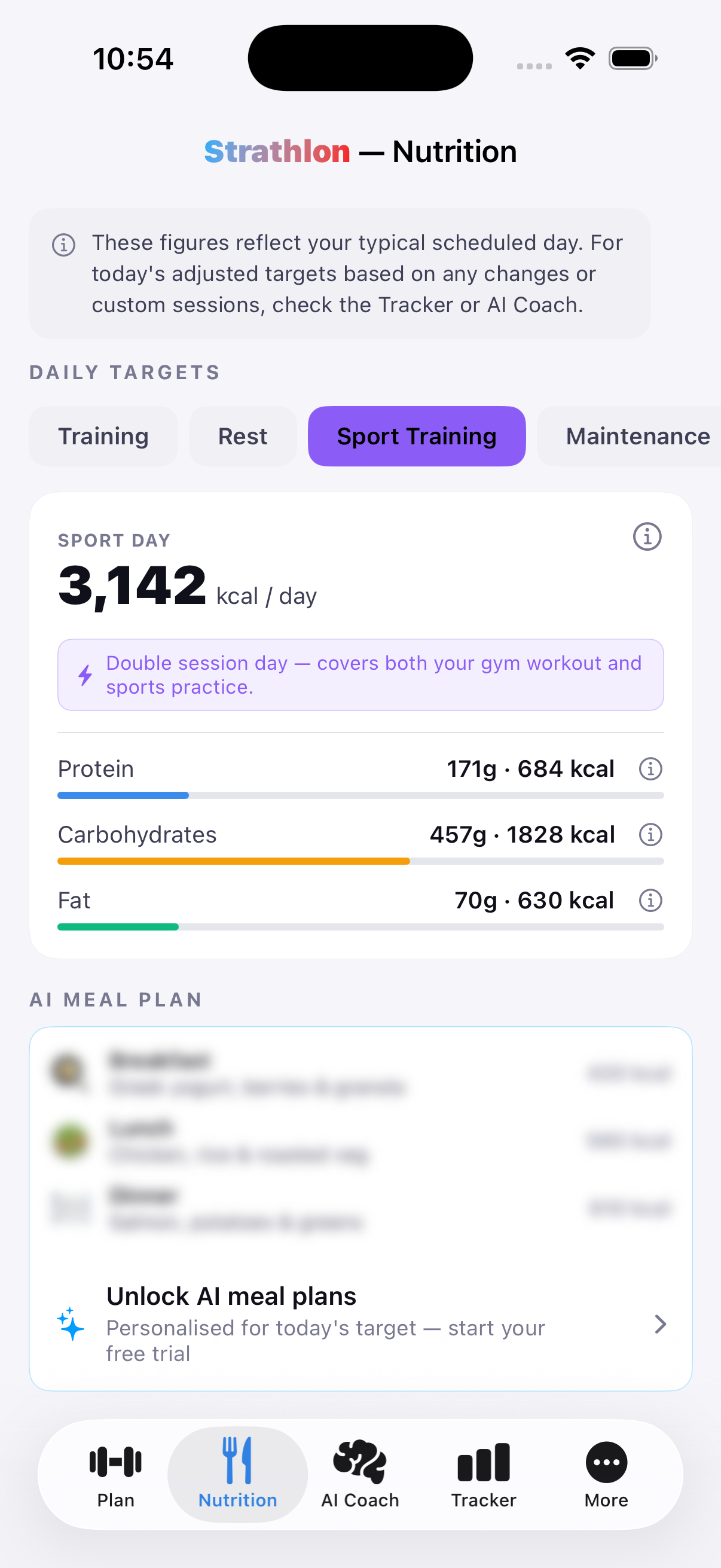
If you remember one thing, make it this: walking and strength training aren't rivals for your time, they're two halves of a whole. The walking gives you a durable aerobic engine and the habit. The strength work gives you the muscle, bone and balance to keep using that engine, uphill and for years. Strathlon's job is to keep the strength half honest: building your gym plan, tracking your lifts, and adjusting your fuelling on the days you actually get out and move.
Pair this with the walking fuelling guide for how to eat around your walking and everyday energy needs: the fuelling companion to this training guide.
References
Numbered sources for the specific figures, effect sizes and named studies above. Where a claim reflects agreed guidance rather than a single trial, the citation is to the position stand or consensus statement of the body concerned, with the country or international remit named. Walking is the one activity here with population-scale outcome evidence rather than performance trials, so the sources below are largely epidemiological: meta-analyses of steps and health rather than studies of how to walk faster.
- Rodríguez-Gutiérrez E, Torres-Costoso A, Del Pozo Cruz B, de Arenas-Arroyo SN, Pascual-Morena C, Bizzozero-Peroni B, et al. Daily steps and all-cause mortality: An umbrella review and meta-analysis. Preventive Medicine. 2024;185:108047. Umbrella review and meta-analysis of daily steps and all-cause mortality, the source for the dose-response between walking volume and health. PubMed 38901742
- Stens NA, Bakker EA, Mañas A, Buffart LM, Ortega FB, Lee DC, et al. Relationship of Daily Step Counts to All-Cause Mortality and Cardiovascular Events. Journal of the American College of Cardiology. 2023;82(15):1483–1494. Meta-analysis relating daily step counts to all-cause mortality and cardiovascular events, the second source for the same. PubMed 37676198
- Xu C, Jia J, Zhao B, Yuan M, Luo N, Zhang F, et al. Objectively measured daily steps and health outcomes: an umbrella review of the systematic review and meta-analysis of observational studies. BMJ Open. 2024;14(10):e088524. Umbrella review of objectively measured daily steps and health outcomes across systematic reviews, the broadest summary of that evidence. PubMed 39384238 · PMC11474941 full text
- Inoue K, Tsugawa Y, Mayeda ER, Ritz B. Association of Daily Step Patterns With Mortality in US Adults. JAMA Network Open. 2023;6(3):e235174. Study of the association of daily step patterns with mortality in US adults, cited for the point that how the steps are accumulated matters less than the total. PubMed 36976556 · PMC10051082 full text
- Anton SD, Duncan GE, Limacher MC, Martin AD, Perri MG. How much walking is needed to improve cardiorespiratory fitness? An examination of the 2008 Physical Activity Guidelines for Americans. Research Quarterly for Exercise and Sport. 2011;82(2):365–70. Study of how much walking is needed to improve cardiorespiratory fitness against the physical activity guidelines, the source for the intensity guidance. PubMed 21699118 · PMC4126169 full text
- Xu Z, Zheng X, Ding H, Zhang D, Cheung PM, Yang Z, et al. The Effect of Walking on Depressive and Anxiety Symptoms: Systematic Review and Meta-Analysis. JMIR Public Health and Surveillance. 2024;10:e48355. Systematic review and meta-analysis of the effect of walking on depressive and anxiety symptoms, the mental-health half of the case. PubMed 39045858 · PMC11287235 full text
- Bizzozero-Peroni B, Díaz-Goñi V, Jiménez-López E, Rodríguez-Gutiérrez E, Sequí-Domínguez I, Núñez de Arenas-Arroyo S, et al. Daily Step Count and Depression in Adults: A Systematic Review and Meta-Analysis. JAMA Network Open. 2024;7(12):e2451208. Systematic review and meta-analysis of daily step count and depression, the second source for the same. PubMed 39680407 · PMC11650418 full text
- Herrmann SD, Willis EA, Ainsworth BE, Barreira TV, Hastert M, Kracht CL, et al. 2024 Adult Compendium of Physical Activities: A third update of the energy costs of human activities. Journal of Sport and Health Science. 2024;13(1):6–12. The 2024 Adult Compendium of Physical Activities, the source for the energy cost of walking at different speeds and gradients. PubMed 38242596 · PMC10818145 full text
- National Health Service (NHS, United Kingdom). Physical activity guidelines for adults aged 19 to 64. NHS physical activity guidance for adults, the weekly target this guide's advice is built around. NHS physical activity guidelines
- Suchomel TJ, Nimphius S, Stone MH. The Importance of Muscular Strength in Athletic Performance. Sports Medicine. 2016;46(10):1419–49. Suchomel and colleagues on the importance of muscular strength in athletic performance, the source for greater maximal strength being associated with faster sprinting, jumping and change of direction, and with lower injury risk. PubMed 26838985
- Seitz LB, Reyes A, Tran TT, Saez de Villarreal E, Haff GG. Increases in lower-body strength transfer positively to sprint performance: a systematic review with meta-analysis. Sports Medicine. 2014;44(12):1693–702. Seitz and colleagues' systematic review with meta-analysis showing increases in lower-body strength transfer positively to sprint performance, the evidence behind the 'strength is the base' argument. PubMed 25059334
- Lauersen JB, Andersen TE, Andersen LB. Strength training as superior, dose-dependent and safe prevention of acute and overuse sports injuries: a systematic review, qualitative analysis and meta-analysis. British Journal of Sports Medicine. 2018;52(24):1557–1563. Lauersen and colleagues' meta-analysis finding strength training a superior, dose-dependent and safe prevention of acute and overuse sports injuries, the direct source for treating strength work as prehab. PubMed 30131332
- Lauersen JB, Bertelsen DM, Andersen LB. The effectiveness of exercise interventions to prevent sports injuries: a systematic review and meta-analysis of randomised controlled trials. British Journal of Sports Medicine. 2014;48(11):871–7. Lauersen and colleagues' earlier meta-analysis of exercise interventions to prevent sports injuries, the broader evidence base the prevention advice sits on. PubMed 24100287
- . American College of Sports Medicine position stand. Progression models in resistance training for healthy adults. Medicine and Science in Sports and Exercise. 2009;41(3):687–708. American College of Sports Medicine (ACSM, United States) position stand on progression models in resistance training, the source for the heavy-load and explosive-load percentage ranges quoted. PubMed 19204579
- Cuthbert M, Haff GG, Arent SM, Ripley N, McMahon JJ, Evans M, et al. Effects of Variations in Resistance Training Frequency on Strength Development in Well-Trained Populations and Implications for In-Season Athlete Training: A Systematic Review and Meta-analysis. Sports Medicine. 2021;51(9):1967–1982. Cuthbert and colleagues' systematic review of resistance-training frequency in well-trained populations, the source for the sessions-per-week guidance. PubMed 33886099 · PMC8363540 full text
- Spiering BA, Mujika I, Sharp MA, Foulis SA. Maintaining Physical Performance: The Minimal Dose of Exercise Needed to Preserve Endurance and Strength Over Time. Journal of Strength and Conditioning Research. 2021;35(5):1449–1458. Spiering and colleagues on the minimal dose of exercise needed to preserve endurance and strength, the source for maintaining in-season on as little as one to two sessions a week. PubMed 33629972
- Rønnestad BR, Nymark BS, Raastad T. Effects of in-season strength maintenance training frequency in professional soccer players. Journal of Strength and Conditioning Research. 2011;25(10):2653–60. Ronnestad and colleagues' trial of in-season strength maintenance frequency in professional footballers, the specific in-season maintenance result quoted. PubMed 21873897
- Nuzzo JL, Pinto MD, Kirk BJC, Nosaka K. Resistance Exercise Minimal Dose Strategies for Increasing Muscle Strength in the General Population: an Overview. Sports Medicine. 2024;54(5):1139–1162. Nuzzo and colleagues on minimal-dose resistance exercise strategies for increasing strength, supporting the claim that a small, well-chosen dose does most of the work. PubMed 38509414 · PMC11127831 full text
- Wilson JM, Marin PJ, Rhea MR, Wilson SM, Loenneke JP, Anderson JC. Concurrent training: a meta-analysis examining interference of aerobic and resistance exercises. Journal of Strength and Conditioning Research. 2012;26(8):2293–307. Wilson and colleagues' meta-analysis of concurrent training and the interference effect, the source for separating heavy lifting from hard conditioning. PubMed 22002517
- Schumann M, Feuerbacher JF, Sünkeler M, Freitag N, Rønnestad BR, Doma K, et al. Compatibility of Concurrent Aerobic and Strength Training for Skeletal Muscle Size and Function: An Updated Systematic Review and Meta-Analysis. Sports Medicine. 2022;52(3):601–612. An updated systematic review of the compatibility of concurrent aerobic and strength training, the more recent evidence that interference is smaller than once believed. PubMed 34757594 · PMC8891239 full text
- Ramirez-Campillo R, Sortwell A, Moran J, Afonso J, Clemente FM, Lloyd RS, et al. Plyometric-Jump Training Effects on Physical Fitness and Sport-Specific Performance According to Maturity: A Systematic Review with Meta-analysis. Sports Medicine - Open. 2023;9(1):23. Ramirez-Campillo and colleagues on plyometric-jump training effects on physical fitness and sport-specific performance, the source for the plyometric guidance. PubMed 37036542 · PMC10086091 full text
- Impellizzeri FM, Woodcock S, Coutts AJ, Fanchini M, McCall A, Vigotsky AD. What Role Do Chronic Workloads Play in the Acute to Chronic Workload Ratio? Time to Dismiss ACWR and Its Underlying Theory. Sports Medicine. 2021;51(3):581–592. Impellizzeri and colleagues on the pitfalls of the acute:chronic workload ratio, cited because it is the reason this guide talks about ramping load gradually rather than quoting a workload number. PubMed 33332011
- Baz-Valle E, Balsalobre-Fernández C, Alix-Fages C, Santos-Concejero J. A Systematic Review of The Effects of Different Resistance Training Volumes on Muscle Hypertrophy. Journal of Human Kinetics. 2022;81:199–210. Systematic review of resistance-training volume and hypertrophy, the general dose-response evidence behind the set and session recommendations. PubMed 35291645 · PMC8884877 full text
This is general educational information rather than medical or coaching advice. The exercise-science figures here are drawn from published research and framed as population-level guides: individual responses vary widely with age, training history, joint health and body weight, and are best personalised with a qualified professional. Anyone with pain, an injury, low bone density, a heart or other medical condition, or who is pregnant or postpartum, should consult a qualified strength-and-conditioning coach, physiotherapist or physician before starting or changing an exercise programme. See our Terms for more.
← All guides · Walking fuelling guide · Strength & conditioning for running · How muscle actually grows · Recovery & rest · Eating for results · Understanding your stats · Home