
Strength & conditioning for wrestling
An evidence-based guide to training the wrestler's body. Wrestling asks for almost everything at once: brute strength, explosive power, a crushing grip, a resilient neck, and the anaerobic engine to keep imposing all of it for six hard minutes and across a tournament day. This covers the lifts that actually transfer to the mat and why, how to condition the sport's energy systems without wrecking your strength, the prehab that lowers your odds of wrestling's most common injuries, and how to programme it around your season. Weight-cutting is a separate topic: the wrestling fuelling guide handles that.
The short version: wrestling rewards whole-body maximal strength and explosive power (especially through the legs, hips and posterior chain, and in everything you pull), backed by a strong grip and a resilient neck, and expressed through repeatable anaerobic power endurance. Build strength as the foundation, add power and grip on top, protect the neck and shoulders, condition the energy systems the sport actually uses, and keep it all sitting underneath your time on the mat rather than competing with it.
On this page
A framing note before the detail. Strength & conditioning is well studied, but wrestlers differ enormously: weight class, style (folkstyle, freestyle, Greco-Roman), training age, sex and injury history all shift what's right for a given athlete. So this is written as can, tends to and is associated with, never as a guarantee, and every specific figure is a population-level guide drawn from published research rather than a personal prescription. It's general education rather than medical or coaching advice, and it isn't a substitute for a qualified S&C coach.
The demands of wrestling
Wrestling is a weight-class combat sport contested in short, ferociously intense bouts. At senior international level a match is two three-minute periods with a 30-second break (around six minutes of near-continuous grappling) under United World Wrestling rules (folkstyle and age-group formats vary, but the pattern of short, dense rounds is the same). In that window you are generating and resisting force with your whole body: driving through the legs and hips on a shot, finishing takedowns and throws through the back and posterior chain, controlling ties with your grip and arms, and holding posture and defending with the neck and trunk. A great deal of the work is isometric (holding a position, resisting an opponent who is trying to move you), and a great deal is explosive (the penetration step, the finish, the scramble).
Energetically, wrestling is dominated by high-intensity anaerobic work sitting on top of a well-developed aerobic base. Reviews of the sport's physiology describe efforts that can push heart rate above roughly 90% of maximum and drive blood lactate well beyond 10 mmol/L, reflecting heavy reliance on anaerobic glycolysis, while the aerobic system does the quieter job of clearing fatigue between scrambles, between periods and across the many matches of a tournament day (Kraemer, Vescovi & Dixon, 2004; Chaabene et al., 2017).
The injury picture tells you where to spend your prehab time. In NCAA men's wrestling injury-surveillance data, the most commonly injured sites are the knee (around a fifth of all injuries), the shoulder, and the head and face (with concussion among the most frequently reported specific injuries), followed by the neck and elbow (Kroshus / NCAA-ISP surveillance, Journal of Athletic Training). Competition injury rates run several times higher than practice rates, and although the shoulder isn't the single most-injured joint, wrestling shoulder injuries are disproportionately likely to need surgery. Put the demands and the injuries together and the qualities that matter most fall out cleanly: maximal strength and explosive power, grip endurance, neck and shoulder resilience, and anaerobic power endurance.
Key strength work, and why it matters
Start with maximal strength, because it sits underneath everything else. The evidence that stronger athletes perform better is broad and consistent: Suchomel, Nimphius & Stone (2016) summarise that greater muscular strength is associated with jumping higher, sprinting faster and changing direction better, and with a lower risk of injury. For a sport decided by who can impose position, a bigger strength reserve means every hold, lift, sprawl and scramble costs a smaller fraction of your maximum, so you fatigue later and finish more of what you start. These are the patterns that carry over:
- Heavy hip hinge (deadlift, Romanian deadlift, and pulls or power cleans) builds the hip and posterior-chain force that drives shots, lifts, throws and mat returns. The posterior chain is the engine of finishing a takedown, and it's also, conveniently, the muscle group most implicated in the hamstring strains wrestlers pick up in explosive extension.
- Squatting (back and front squat) develops the leg drive behind the penetration step and a strong, stable stance: the ability to change levels under load without collapsing.
- Pulling strength (rows, chin-ups and pull-ups, and heavy carries) dominates the hand-fighting, ties, underhooks and control that decide grip battles. Wrestlers are famously strong pullers for a reason: the sport is a pulling contest as much as a pushing one.
- Pressing and overhead work, plus a braced, strong trunk, underpin posting, framing and pushing an opponent away, and help armour the shoulder against the positions wrestling forces it into.
- Grip work and loaded carries (farmer's carries, thick-bar or towel holds, rope climbs) build the grip endurance that lets you keep controlling a wrist or a collar tie when your forearms are screaming: often the difference in a long exchange.
- Explosive power work, weightlifting derivatives (cleans and pulls), jumps, and medicine-ball throws, trains rate of force development: how fast you can express the strength you have. That's the quality behind an explosive shot or a snap-down. Meta-analytic evidence shows strength and plyometric training improve jump, sprint and change-of-direction performance, which are the same reactive qualities you need in a scramble.
- References
On loading, standard S&C guidance (for example the NSCA's Essentials of Strength Training and Conditioning) develops maximal strength with heavier loads (around 85% of your one-rep max or more, for roughly two to six reps, with full recovery between sets) and power with lighter, fast, explosive efforts driven with maximal intent. Earlier in a training year, some higher-rep hypertrophy work (moderate loads taken close to failure) adds the muscle that both underpins strength and armours joints. And because so much of wrestling is holding a position, positional isometrics (holds in sport-relevant shapes, such as isometric pulls or split-stance holds) help you build strength you can actually express while locked up and fatigued, which the physiology reviews highlight as a wrestling-specific need (Kraemer et al., 2004).
That's worth reading closely, because it shows the two halves that a wrestler's gym plan needs and how they fit together. The base lifts (squat, hinge, pull and press) are where your raw strength and power come from. They aren't wrestling-specific, and they don't need to be, because maximal strength transfers broadly to almost everything you do on the mat. The wrestling accessory block then biases that base toward the sport: extra grip and neck work, and explosive swings, slams and sled drags with conditioning built in, which nudge the session toward the anaerobic qualities wrestling actually taxes. Neither half works alone. Accessories without a strong base are decoration on a weak foundation, and a big squat and deadlift without any grip, neck or sport-specific work leaves obvious holes an opponent will find. The point of the plan is to have both: general strength underneath, sport-specific emphasis on top.
Conditioning for wrestling
Wrestling conditioning has to serve two engines at once: the anaerobic system that powers repeated near-maximal bursts, and the aerobic system that clears the fatigue between them (Kraemer et al., 2004; Chaabene et al., 2017). In practice that means two kinds of work. Hard interval and repeated-effort conditioning (short, near-maximal efforts with deliberately incomplete recovery) trains the anaerobic capacity and buffering that let you keep scoring in the back half of a period. And an aerobic base (steady, sub-maximal work) speeds recovery within a match, between periods, and across the several matches of a tournament, so you show up to the semi-final as fresh as you can be. Crucially, a lot of the best conditioning is simply live wrestling and hard drilling: it builds the energy systems and the specific skill under fatigue at the same time.
The catch is interference. Piling heavy strength work and heavy endurance work on top of each other carelessly can blunt the strength adaptation: the well-known "concurrent training" problem. You manage it, rather than fear it, by keeping the two from colliding: separate your hardest lifting and your hardest conditioning where you can, prioritise whichever quality is that day's focus, lean on the mat for most of your conditioning, and (importantly) bias your gym work toward maximal-strength and power methods (low reps, explosive, lower total volume), which interfere with endurance far less than high-volume bodybuilding-style training does. Done that way, strength and conditioning add up instead of cancelling out.
Staying injury-resilient
Wrestling's injury hotspots (knee, shoulder, and head/neck) tell you exactly where to invest a small, consistent amount of prehab. None of this makes you injury-proof. The honest claim is that it reduces risk, sometimes substantially.
- Posterior chain and hamstrings. Eccentric hamstring work (most famously the Nordic hamstring curl) is one of the better-evidenced prehab tools in sport. A large meta-analysis of 8,459 athletes found that including the Nordic hamstring exercise in prevention programmes was associated with roughly halving the rate of hamstring injuries (a risk ratio of about 0.49) (van Dyk, Behan & Whiteley, 2019). Two honest caveats: a 2021 reappraisal argued the protective effect is less certain once methodological issues are corrected, and the benefit clearly depends on actually doing the exercise consistently. Either way, the eccentric strength it builds is the same strength that finishes takedowns, so it's a low-cost inclusion.
- Shoulder. The shoulder is the joint most likely to send a wrestler to surgery (Goodman et al., 2018), so building it to be strong and controlled through a full range pays off. Alongside your pressing and pulling, add rotator-cuff and scapular-control work and gradually build robustness in the overhead and behind-the-body positions wrestling forces the shoulder into. The evidence here is more general than for the Nordic curl, but stronger, better-controlled shoulders are a sensible defence against the sport's most surgery-prone injury.
- Neck. Wrestlers already tend to have exceptionally strong necks (Chaabene et al., 2017), and that's protective: observational research links greater neck strength to fewer concussions: one study of over 6,000 high-school athletes found roughly a 5% reduction in concussion odds for each additional pound of neck strength (Collins et al., 2014). The intervention evidence is still limited and mixed, so treat neck training as biologically plausible and low-risk rather than proven, and (this matters) build it gradually and under control (progressive extension, flexion and lateral work). Maximal bridging to failure and ballistic loading of the cervical spine have no place in it.
- General strength itself. Don't overlook the simplest point: being stronger is, on its own, associated with a lower risk of injury (Suchomel et al., 2016). The maximal-strength base you build for performance is also your best all-round insurance.
If something hurts in a way that isn't ordinary training soreness (a joint that gives way, pain that lingers, numbness or tingling), that's a stop-and-assess signal rather than something to wrestle through. Prehab lowers the odds. A qualified clinician handles the actual injuries.
Programming it around your season
The single biggest programming mistake is training the same way all year. Strength & conditioning should shift with the calendar, and it should always sit underneath your wrestling, never on top of it.
- Off-season: build. This is when you raise the ceiling: heavier maximal-strength work, explosive power, and some hypertrophy to add muscle, typically across two to four gym sessions a week, while you also build your aerobic base and refine technique with less competitive pressure. Progressive overload is the engine: gradually doing a little more over time. The progressive-overload guide covers that mechanism in depth.
- Pre-season: sharpen. Shift the emphasis toward power, speed and sport-specific conditioning, and let the heaviest, highest-volume lifting taper as live wrestling ramps up.
- In-season: maintain, don't build. Here's the liberating part: keeping the strength you built takes far less than building it did. Research on training frequency and the minimal maintenance dose indicates that roughly one to two quality strength sessions per week (kept heavy but low in volume, and stopped well short of failure) can maintain strength through a competitive season on a reduced training load, as long as the intensity stays high (Cuthbert et al., 2021). That frees your energy for the mat, where it belongs during the competitive season. Think of in-season lifting as insurance on your strength rather than a place to chase new personal records.
Woven through all of it: manage fatigue. Use lighter deload weeks when accumulated tiredness builds, autoregulate around competitions, and protect sleep and nutrition, because adaptation happens in recovery, and a fatigued wrestler is both slower and easier to injure.
Where Strathlon fits

Common questions
What strength work matters most for wrestling?
Whole-body maximal strength and explosive power come first: built with heavy compound lifts (squat, deadlift and hip hinge, presses) and pulling strength (rows, chin-ups, heavy carries), plus explosive work like weightlifting derivatives, jumps and medicine-ball throws. Greater maximal strength is associated with faster sprints, higher jumps and better change of direction, and with lower injury risk, so it underpins nearly everything you do on the mat. On top of that base, prioritise grip endurance, neck strength and the posterior chain, because those are the qualities wrestling specifically taxes. Standard S&C guidelines develop maximal strength with heavier loads (around 85% of your one-rep max or more) for low reps, and power with lighter, fast, explosive efforts.
Will lifting heavy make me slower or too bulky for my weight class?
It's the opposite of what most people fear. Training for maximal strength (heavy loads, low reps, explosive intent) builds force and power with relatively little added muscle mass, and stronger athletes tend to be faster and more explosive rather than slower. Noticeable size gain comes mainly from high-volume bodybuilding-style training combined with eating in a calorie surplus, both of which you control. For a weight-class sport the goal is strength-to-weight (being strong for your size) far more than sheer bulk, so heavy, low-rep, powerful lifting is exactly the right tool.
How should I train my neck safely for wrestling?
Train it deliberately, progressively and under control, well short of maximal bridging to failure. Observational research links stronger necks to fewer concussions (one study of high-school athletes found roughly a 5% reduction in concussion odds for each additional pound of neck strength), and although the intervention evidence is still limited and mixed, neck strengthening is biologically plausible and low-risk. Use controlled neck extension, flexion and lateral work, plus general trunk and upper-back strength, and build load gradually. Avoid ballistic or heavily loaded movements on the cervical spine, and stop and see a clinician if you get neck pain, numbness or tingling.
How many strength sessions a week do I need during the season?
In-season the aim shifts from building strength to simply maintaining what you built, and that takes surprisingly little. Research on training frequency and the minimal maintenance dose indicates that roughly one to two quality strength sessions per week (kept heavy but low in volume, and well short of failure) can maintain strength for months, even at a fraction of your previous training volume, provided the intensity stays high. That leaves your energy for the mat, which is the priority in-season. In the off-season, when you're building, two to four sessions a week is more typical.
What kind of conditioning is best for wrestling?
Wrestling is mostly high-intensity anaerobic work sitting on top of an aerobic base, so you need both. A senior international bout is two three-minute periods with a short break, and it can push heart rate above about 90% of maximum with blood lactate climbing well beyond 10 mmol/L. Train that with hard interval and repeated-effort work that mimics the density of a match (short, near-maximal bursts with incomplete recovery), while also building an aerobic base that speeds your recovery between scrambles, between periods and across a tournament day. Much of this conditioning is best done through live wrestling and drilling itself.
Do Nordic hamstring curls and other prehab actually prevent injuries?
They reduce risk rather than remove it, and the size of the effect should be stated honestly. A large meta-analysis found that including the Nordic hamstring exercise in prevention programmes was associated with roughly halving the rate of hamstring injuries, though a later reappraisal argued the effect is less certain once methods are corrected, and the benefit depends heavily on actually doing the exercise consistently. More broadly, being stronger is itself associated with lower injury risk. So a sensible prehab base (eccentric hamstring work, rotator-cuff and scapular control for the shoulder, progressive neck work, and general strength) lowers your odds of the injuries wrestling is known for, but no programme makes you injury-proof.
Takeaways
- Strength is the foundation. Whole-body maximal strength and power transfer broadly to sprinting, jumping and changing direction (and to imposing position on the mat) while lowering injury risk.
- Train the patterns wrestling uses. Heavy hinge and squat for hips and legs, hard pulling for ties and control, presses and a braced trunk for framing, plus explosive lifts and throws for a fast shot.
- Grip and neck are sport-specific priorities. Loaded carries and thick-bar holds build grip endurance. Deliberate, progressive neck work builds resilience where wrestling most needs it.
- Use positional isometrics. Holds in wrestling-relevant positions build strength you can express while locked up and fatigued.
- Condition both engines. Hard intervals for anaerobic power endurance, plus an aerobic base for recovery between bursts and across a tournament, much of it built through live wrestling.
- Manage interference. Bias the gym toward low-rep, explosive strength (which interferes less with endurance), and separate your hardest lifting and conditioning.
- Prehab the hotspots honestly. Nordic curls are associated with roughly halving hamstring-injury rates (with caveats). Rotator-cuff/scapular work guards the surgery-prone shoulder. Stronger necks are linked to fewer concussions. Risk goes down. It never disappears entirely.
- Periodise around the season. Build in the off-season (2–4 sessions/week), maintain in-season on roughly 1–2 heavy, low-volume sessions/week, and always keep the mat first.
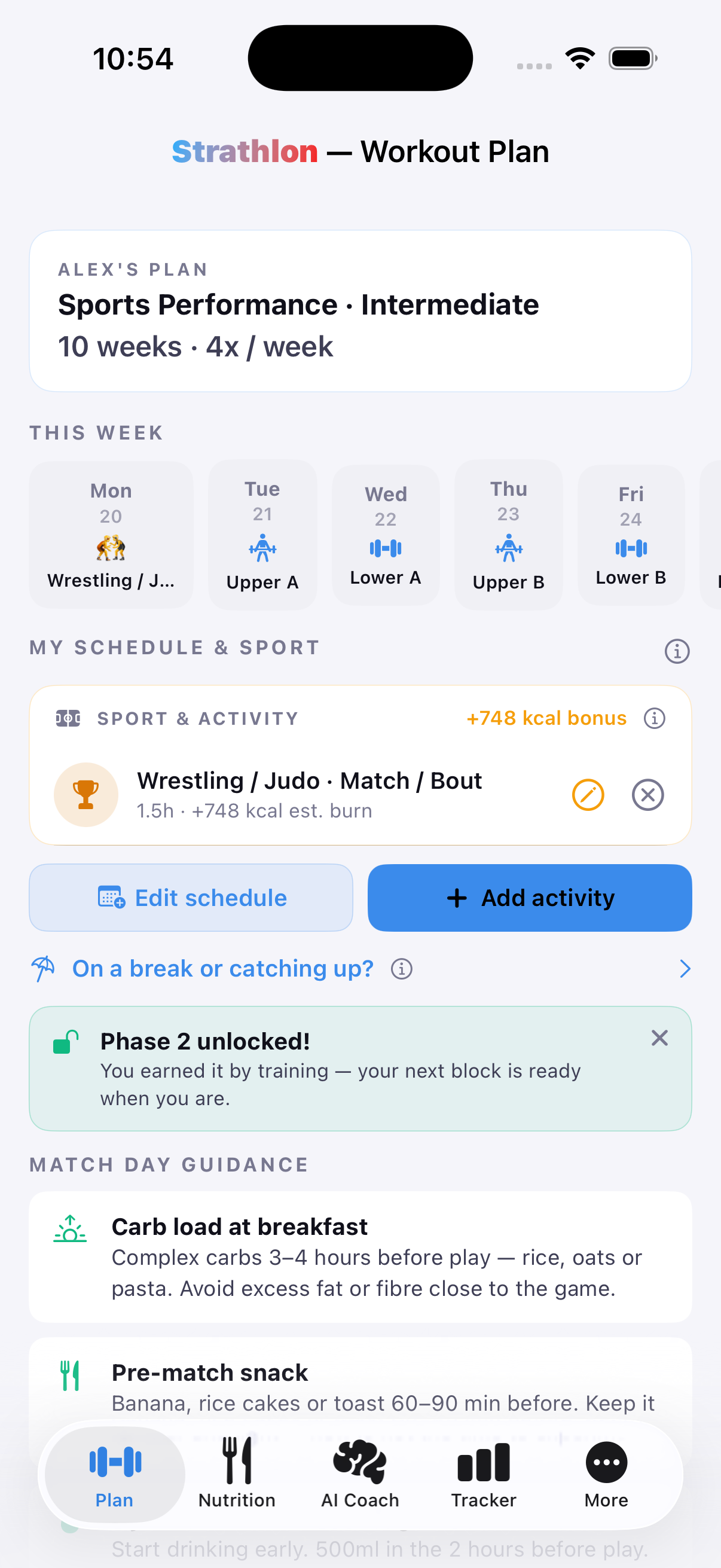
If you take one idea away, make it this: get strong for your size, express that strength explosively and repeatedly, protect the neck and shoulders, and let your conditioning come mostly from wrestling, then dial the gym work down in-season so it supports your mat time instead of stealing from it. Strathlon's job is to give you a starting plan, tuned for wrestling once Sports Performance is one of your goals, and to show your lifts trending up, so the strength base underneath your wrestling is one less thing to guess at.
Pair this with the wrestling fuelling guide: it covers making weight, weight-cutting done less harmfully, and fuelling for training and tournament days.
References
Numbered sources for the specific figures, effect sizes and named studies above. Where a claim reflects agreed guidance rather than a single trial, the citation is to the position stand or consensus statement of the body concerned, with the country or international remit named. Wrestling's literature concentrates on weight-making and on tournament physiology; the strength prescriptions below are general evidence applied to a grip-heavy, repeated-effort combat sport.
- Kafkas ME, Taşkiran C, Şahin Kafkas A, Özen G, Taşkapan Ç, Özyalin F, et al. Acute physiological changes in elite free-style wrestlers during a one-day tournament. The Journal of Sports Medicine and Physical Fitness. 2016;56(10):1113–1119. Study of acute physiological changes in elite freestyle wrestlers during a one-day tournament: the source for the repeated-effort, all-day demand described. PubMed 26558832
- Farzad B, Gharakhanlou R, Agha-Alinejad H, Curby DG, Bayati M, Bahraminejad M, et al. Physiological and performance changes from the addition of a sprint interval program to wrestling training. Journal of Strength and Conditioning Research. 2011;25(9):2392–9. Randomised trial adding a sprint interval programme to wrestling training, the direct evidence behind the conditioning prescription. PubMed 21849912
- Dehnou VV, Azadi S, Gahreman D, Doma K. The effect of a 4-week core strengthening program on determinants of wrestling performance in junior Greco-Roman wrestlers: A randomized controlled trial. Journal of Back and Musculoskeletal Rehabilitation. 2020;33(3):423–430. Randomised trial of a four-week core-strengthening programme on determinants of wrestling performance in junior Greco-Roman wrestlers, the trunk-work evidence. PubMed 31524140
- Reale R, Slater G, Burke LM. Acute-Weight-Loss Strategies for Combat Sports and Applications to Olympic Success. International Journal of Sports Physiology and Performance. 2017;12(2):142–151. Review of acute weight-loss strategies in combat sports and their application to Olympic success: the source for the weight-making caution. PubMed 27347784
- Marten AD, Mattin MD, Rumps MV, Saraf SM, Mulcahey MK. Effects of Rapid Weight Loss in Male and Female Wrestlers. Journal of Strength and Conditioning Research. 2025;39(5):e721–e729. Review of the effects of rapid weight loss in male and female wrestlers, the sport-specific version of the same. PubMed 40266645
- Hammer E, Sanfilippo JL, Johnson G, Hetzel S. Association of in-competition injury risk and the degree of rapid weight cutting prior to competition in division I collegiate wrestlers. British Journal of Sports Medicine. 2023;57(3):160–165. Study associating in-competition injury risk with the degree of rapid weight cutting in collegiate wrestlers, the injury half of that argument. PubMed 36261252
- Marttinen RH, Judelson DA, Wiersma LD, Coburn JW. Effects of self-selected mass loss on performance and mood in collegiate wrestlers. Journal of Strength and Conditioning Research. 2011;25(4):1010–5. Study of self-selected mass loss on performance and mood in collegiate wrestlers, cited for the performance cost. PubMed 21399531
- Daly E, Pearce AJ, Ryan L. A Systematic Review of Strength and Conditioning Protocols for Improving Neck Strength and Reducing Concussion Incidence and Impact Injury Risk in Collision Sports; Is There Evidence?. Journal of Functional Morphology and Kinesiology. 2021;6(1). Systematic review of strength and conditioning protocols for improving neck strength, the basis for the neck work prescribed. PubMed 33462169 · PMC7838928 full text
- Burke LM, Slater GJ, Matthews JJ, Langan-Evans C, Horswill CA. ACSM Expert Consensus Statement on Weight Loss in Weight-Category Sports. Current Sports Medicine Reports. 2021;20(4):199–217. ACSM expert consensus statement on weight loss in weight-category sports, the governing guidance for making weight safely. PubMed 33790193
- Suchomel TJ, Nimphius S, Stone MH. The Importance of Muscular Strength in Athletic Performance. Sports Medicine. 2016;46(10):1419–49. Suchomel and colleagues on the importance of muscular strength in athletic performance: the source for greater maximal strength being associated with faster sprinting, jumping and change of direction, and with lower injury risk. PubMed 26838985
- Seitz LB, Reyes A, Tran TT, Saez de Villarreal E, Haff GG. Increases in lower-body strength transfer positively to sprint performance: a systematic review with meta-analysis. Sports Medicine. 2014;44(12):1693–702. Seitz and colleagues' systematic review with meta-analysis showing increases in lower-body strength transfer positively to sprint performance, the evidence behind the 'strength is the base' argument. PubMed 25059334
- Lauersen JB, Andersen TE, Andersen LB. Strength training as superior, dose-dependent and safe prevention of acute and overuse sports injuries: a systematic review, qualitative analysis and meta-analysis. British Journal of Sports Medicine. 2018;52(24):1557–1563. Lauersen and colleagues' meta-analysis finding strength training a superior, dose-dependent and safe prevention of acute and overuse sports injuries: the direct source for treating strength work as prehab. PubMed 30131332
- Lauersen JB, Bertelsen DM, Andersen LB. The effectiveness of exercise interventions to prevent sports injuries: a systematic review and meta-analysis of randomised controlled trials. British Journal of Sports Medicine. 2014;48(11):871–7. Lauersen and colleagues' earlier meta-analysis of exercise interventions to prevent sports injuries, the broader evidence base the prevention advice sits on. PubMed 24100287
- . American College of Sports Medicine position stand. Progression models in resistance training for healthy adults. Medicine and Science in Sports and Exercise. 2009;41(3):687–708. American College of Sports Medicine (ACSM, United States) position stand on progression models in resistance training: the source for the heavy-load and explosive-load percentage ranges quoted. PubMed 19204579
- Cuthbert M, Haff GG, Arent SM, Ripley N, McMahon JJ, Evans M, et al. Effects of Variations in Resistance Training Frequency on Strength Development in Well-Trained Populations and Implications for In-Season Athlete Training: A Systematic Review and Meta-analysis. Sports Medicine. 2021;51(9):1967–1982. Cuthbert and colleagues' systematic review of resistance-training frequency in well-trained populations, the source for the sessions-per-week guidance. PubMed 33886099 · PMC8363540 full text
- Spiering BA, Mujika I, Sharp MA, Foulis SA. Maintaining Physical Performance: The Minimal Dose of Exercise Needed to Preserve Endurance and Strength Over Time. Journal of Strength and Conditioning Research. 2021;35(5):1449–1458. Spiering and colleagues on the minimal dose of exercise needed to preserve endurance and strength: the source for maintaining in-season on as little as one to two sessions a week. PubMed 33629972
- Rønnestad BR, Nymark BS, Raastad T. Effects of in-season strength maintenance training frequency in professional soccer players. Journal of Strength and Conditioning Research. 2011;25(10):2653–60. Ronnestad and colleagues' trial of in-season strength maintenance frequency in professional footballers, the specific in-season maintenance result quoted. PubMed 21873897
- Nuzzo JL, Pinto MD, Kirk BJC, Nosaka K. Resistance Exercise Minimal Dose Strategies for Increasing Muscle Strength in the General Population: an Overview. Sports Medicine. 2024;54(5):1139–1162. Nuzzo and colleagues on minimal-dose resistance exercise strategies for increasing strength, supporting the claim that a small, well-chosen dose does most of the work. PubMed 38509414 · PMC11127831 full text
- Wilson JM, Marin PJ, Rhea MR, Wilson SM, Loenneke JP, Anderson JC. Concurrent training: a meta-analysis examining interference of aerobic and resistance exercises. Journal of Strength and Conditioning Research. 2012;26(8):2293–307. Wilson and colleagues' meta-analysis of concurrent training and the interference effect: the source for separating heavy lifting from hard conditioning. PubMed 22002517
- Schumann M, Feuerbacher JF, Sünkeler M, Freitag N, Rønnestad BR, Doma K, et al. Compatibility of Concurrent Aerobic and Strength Training for Skeletal Muscle Size and Function: An Updated Systematic Review and Meta-Analysis. Sports Medicine. 2022;52(3):601–612. An updated systematic review of the compatibility of concurrent aerobic and strength training, the more recent evidence that interference is smaller than once believed. PubMed 34757594 · PMC8891239 full text
- Ramirez-Campillo R, Sortwell A, Moran J, Afonso J, Clemente FM, Lloyd RS, et al. Plyometric-Jump Training Effects on Physical Fitness and Sport-Specific Performance According to Maturity: A Systematic Review with Meta-analysis. Sports Medicine - Open. 2023;9(1):23. Ramirez-Campillo and colleagues on plyometric-jump training effects on physical fitness and sport-specific performance, the source for the plyometric guidance. PubMed 37036542 · PMC10086091 full text
- Impellizzeri FM, Woodcock S, Coutts AJ, Fanchini M, McCall A, Vigotsky AD. What Role Do Chronic Workloads Play in the Acute to Chronic Workload Ratio? Time to Dismiss ACWR and Its Underlying Theory. Sports Medicine. 2021;51(3):581–592. Impellizzeri and colleagues on the pitfalls of the acute:chronic workload ratio: cited because it is the reason this guide talks about ramping load gradually rather than quoting a workload number. PubMed 33332011
- Baz-Valle E, Balsalobre-Fernández C, Alix-Fages C, Santos-Concejero J. A Systematic Review of The Effects of Different Resistance Training Volumes on Muscle Hypertrophy. Journal of Human Kinetics. 2022;81:199–210. Systematic review of resistance-training volume and hypertrophy, the general dose-response evidence behind the set and session recommendations. PubMed 35291645 · PMC8884877 full text
This is general educational information rather than medical or individual coaching advice. The strength & conditioning figures here are drawn from published research and are framed as population-level guides: individual needs vary widely with weight class, style, training age, sex and injury history, and are best personalised with a qualified strength & conditioning coach. Anyone with a current injury, pain, numbness, a health condition, or who is pregnant or postpartum, should consult a qualified S&C coach or clinician before starting or changing a training programme: especially before loading the neck or spine. See our Terms for more.
← All guides · Wrestling fuelling guide · Progressive overload · Eating for results · Understanding your stats · Home