
Carbohydrate loading: who needs it, and how to do it
An evidence-based guide to one of endurance sport's oldest tricks: deliberately topping up muscle glycogen before a long event so you reach the finish before the tank does. This covers what carbohydrate loading actually is, who genuinely benefits and who is wasting their time, the modern one-to-two-day protocol that replaced the brutal old method, practical food examples, the kilogram or two of water weight it adds, and the myths, the pasta dinner chief among them. Practical, honest, and grounded in established sports-nutrition consensus.
Here's the short version: carbohydrate loading, eating a lot of carbohydrate for a day or two while resting, can meaningfully delay fatigue, but only for continuous endurance events lasting well over about 90 minutes. For anything shorter, a normal high-carbohydrate day or two is all you need, and a full load does nothing useful. Everything below is the detail behind that sentence: why it works, who it's for, exactly how to do it, and the misconceptions that make people either skip it when it would help or perform it when it won't.
On this page
- What carbohydrate loading actually is
- Who benefits, and who doesn't
- The modern protocol: how to do it
- What to eat: practical examples
- Race day itself: the meal, the timing, the rehearsal
- The water weight: why the scale jumps
- The old depletion method, and why it's gone
- The big myths, corrected
- Common questions
- Takeaways
- References
A framing note before the numbers. Sports nutrition is well studied, but people differ enormously: body size, training status, the event, the weather and gut tolerance all shift what's right on the day. So this is written as can, tends to and around, never as a guarantee, and every specific figure is a population-level guide drawn from published consensus rather than a personal prescription. It's general education rather than medical or dietary advice, and it isn't a personalised plan.
What carbohydrate loading actually is
To understand loading you have to understand the fuel. Your body stores carbohydrate as glycogen (in the muscles and the liver), and that store is the fast fuel that lets you hold a real pace.[1][4] It's also finite: an average adult carries roughly 500 g of glycogen in muscle and about 80 g in the liver.[4] That's enough that in races under about 90 minutes there is still plenty of glycogen left in the working muscle at the finish. It is only in efforts beyond about 90 minutes that running short of it becomes the thing holding you back.[2] When the stores do empty mid-race, pace collapses: the marathoner's "wall," the cyclist's "bonk." The muscle isn't damaged. It has simply run out of its preferred fuel.[4]
Carbohydrate loading is the practice of deliberately packing those stores higher than normal before a long event, so there's more fuel in the tank at the gun. It works because of a quirk of physiology called glycogen supercompensation: give a muscle a big, sustained supply of carbohydrate while it isn't burning much, and it will restock beyond its usual level. The classic research on this goes back to the 1960s, and a well-executed load can roughly double muscle glycogen: the original Scandinavian work described a doubling, and a later loading study took resting muscle glycogen from 95 to 180 mmol/kg wet mass in a single day.[5][6][7] More starting fuel means you reach a given distance with more glycogen still in reserve, which is why loading tends to delay the point of fatigue rather than make you faster from the start.
How much does that buy you? Reviews of the research suggest carbohydrate loading can improve performance in events lasting longer than about 90 minutes by a few percent, a figure often cited as roughly 2–3%, and the benefit shows up mostly as being able to hold your pace later into the race, rather than as a faster opening.[2] For a four-hour marathoner, a few percent late in the race is the difference between finishing strong and grinding to a walk. For a parkrunner, it's nothing at all, because they never get near the wall.
Who benefits, and who doesn't
This is the part most guides skate over, and it's the whole game. Loading is only worth doing when the event is long enough that running out of glycogen is a realistic limiter. That means a single, continuous effort lasting well over about 90 minutes.[2][3] The clearest beneficiaries:
- Marathon runners (and, for most people, the half depending on pace): the archetypal loading event.
- Long-course triathletes: half and full-distance racing runs well past the glycogen ceiling.
- Road cyclists and sportive riders doing long, sustained days in the saddle.
- Ultra-endurance athletes and long cross-country skiers: hours of continuous work.
And the people for whom loading does little or nothing:
- Anyone racing under about 90 minutes: a 5K, 10K, parkrun, a short time trial, a pool swim. Your normal stores already cover it, so eating normally (or a slightly higher-carb day or two) is all that's needed.[2][8]
- Gym-goers and strength trainees. A weights session doesn't come close to depleting whole-body glycogen. There's nothing to super-fill for.
- Most single team-sport matches. A prolonged, high-intensity intermittent game (think a full football match with lots of sprinting) can deplete glycogen enough that high-carb preparation helps (position stands note this for intermittent efforts over ~90 minutes)[3], but a short game, or one with plenty of standing around, isn't a loading occasion.
The honest rule of thumb: if your event is comfortably under 90 minutes, skip the load and just eat a normal, carb-inclusive day or two beforehand. If it's a continuous effort of two hours or more, loading is one of the few race-week interventions with genuinely good evidence behind it. In between, roughly 90 minutes to two hours, it's a judgement call that depends on your pace, your fitness and how hard you'll go. A modest bump in carbohydrate is sensible, while a full aggressive load remains optional.
The modern protocol: how to do it
The good news is that modern loading is gentle and short. The joint position stand of the Academy of Nutrition and Dietetics (United States), Dietitians of Canada and the American College of Sports Medicine (United States) sets it out as a very high carbohydrate intake of around 10–12 g per kilogram of body weight per day for the 36–48 hours before the event, while tapering your training so you're storing fuel rather than burning it.[3][10] The International Society of Sports Nutrition (United States) pitches it a little lower and over a slightly longer window: 8–10 g/kg/day for one to three days, with training volume cut back for three to four, so it's the range, rather than any single number, that's the target.[9] Either way, no starvation phase is required.[8][9]
| Event length | What to do | Carbohydrate target | Timing |
|---|---|---|---|
| Under ~90 min | No load needed | Normal daily carbs | Just eat well the day or two before |
| ~90 min – 2 h | Optional light top-up | ~7–10 g/kg/day | The day before |
| > ~2 hours (continuous) | Full load + taper | ~10–12 g/kg/day | 36–48 h before |
To make the top row concrete: a 70 kg runner loading for a marathon at 10 g/kg is aiming for around 700 g of carbohydrate a day, a genuinely large amount that surprises people. Hitting it is less about giant plates and more about making every meal, snack and drink carbohydrate-rich, and deliberately leaning on the concentrated, easy-to-eat sources below. Two things make it work:
- Taper hard. The load only supercompensates if the muscle isn't spending what you feed it. Race week is meant to be low-volume anyway. Loading and tapering go hand in hand. Training through a load defeats the point.
- Spread it across the day. Three big meals plus regular carb-rich snacks and drinks is far easier on the stomach, and more effective, than two enormous sittings. This is also why the load runs over a day or two rather than in a single evening.
What to eat: practical examples
Reaching several hundred grams of carbohydrate in a day is much easier if you pick concentrated, familiar, lower-fibre and lower-fat foods.[3] High-fibre and high-fat choices fill you up and slow digestion, so a loading day is one of the few times "white" versions earn their place. Reliable building blocks:
- Grains and starches: pasta, white rice, bread, bagels, potatoes, couscous, noodles.
- Breakfast carbs: porridge or oats, cereal, pancakes, toast with jam or honey.
- Fruit: bananas, dates, raisins, fruit juice and smoothies: carbohydrate-dense and easy.
- Liquids and easy wins: sports drinks, fruit juice, and even the odd sweet snack. Drinking some of your carbohydrate spares your stomach the sheer volume of solid food.
A worked day for that 70 kg runner might look like: a large bowl of oats with banana, honey and juice at breakfast; a bagel with jam mid-morning; a big plate of pasta with a low-fat tomato sauce at lunch; rice cakes, dried fruit and a sports drink through the afternoon; rice or potatoes with a modest protein source at dinner; and a bowl of cereal before bed. Notice it's relentless rather than heavy: a steady drip of carbohydrate all day rather than one enormous meal.
Two honest cautions. First, a big carbohydrate load with lots of fibre can cause gut discomfort, so ease off high-fibre foods in the final day and favour the refined options: this is exactly when they help.[3] Second, rehearse it. Just as you'd never debut a new gel on race day, don't attempt your first-ever full load the night before your goal race. Try it before a long training day so you know how your gut responds. The running, cycling and triathlon fuelling guides cover the race-day and in-event side of the picture.
Race day itself: the meal, the timing, the rehearsal
Loading is the two or three days beforehand. The morning of the event is a separate, smaller job, and it is the one people improvise. Three things about it are actually sourced.
The pre-event meal: roughly 1 to 4 g of carbohydrate per kg, 1 to 4 hours before. That is the range in the joint position of the Academy of Nutrition and Dietetics, Dietitians of Canada and the American College of Sports Medicine,[3] and the ISSN's nutrient-timing stand puts the same figure on the hours leading up to competition.[14] Larger amounts go earlier, so there is time to digest them, and smaller amounts closer to the start. Most people settle on a main meal three to four hours out, which sits in the middle of that window, though it is worth knowing the published range is wider than that: the ISSN's exercise and sports nutrition review update suggests pre-exercise meals be consumed about four to six hours before.[15] Three to four hours is a common landing spot rather than a rule.
Nothing new on the day, and this is a published recommendation rather than gym lore. The review of gastrointestinal complaints during exercise reports that 30% to 50% of athletes experience them, names nutritional factors among the causes, and states directly in its advice to athletes: experiment with the pre-race and race-day nutrition plan many times before race day.[16] The companion paper on training the gut says the same thing from the other direction, that it is important to practise a race nutritional strategy in training and get used to the higher volumes and higher carbohydrate intakes involved.[17] Tolerance is trainable, and race morning is not when to find out where your limit is.
Favour what you have already tested. The same practical guidance is to keep the pre-event meal low in fat, low in fibre and familiar, since fat and fibre both slow digestion and are among the things most often implicated when a stomach turns on someone mid-event.[16] That happens to be the same food list a loading day already asks for, which makes the whole thing easier to rehearse: the meals you practised on your loading days are the rehearsal.
One honest note on provenance. The "practise it first" advice is published in narrative reviews in a sports-medicine supplement rather than as a numbered clause in a position stand. It is authoritative and it is written down. It is not quite the same thing as a governing body's formal recommendation, and this guide would rather say so than let a reader assume otherwise.
The water weight: why the scale jumps
Almost everyone who loads properly notices the same thing: the scale goes up, typically by around a kilogram to a kilogram and a half, in a day or two.[11][12] This alarms people who've been carefully managing their weight. It shouldn't. The explanation is simple physiology: glycogen is stored together with water, at least 3 grams of water for every gram of glycogen, and by some estimates nearer four.[4][12][13] So when you pack several hundred extra grams of glycogen into your muscles and liver, a corresponding amount of water is bound up with it.
That means the gain is stored fuel and hydration: you cannot gain a kilo of fat in two days of eating, whatever the scale says. And it's not dead weight you have to haul around for nothing: the bound water is a small hydration bonus, and it's released again as you burn the glycogen during the event. Expect the extra kilogram or so, understand what it is, and don't let a race-week weigh-in talk you out of a load that will help you on the day. If you track your weight day to day, this is one of the clearest examples of why a single reading can be misleading: the eating-for-results guide digs into why the scale wobbles for reasons that have nothing to do with fat.
The old depletion method, and why it's gone
Older runners may remember carbohydrate loading as something genuinely miserable. The original protocol, developed from Scandinavian research in the 1960s, used a depletion phase: about three days of very low-carbohydrate eating combined with hard training to drain glycogen stores as low as possible, then three days of very high carbohydrate to rebound above baseline.[5][8] The depletion was thought to prime a bigger supercompensation. The problem is that the depletion days are wretched: low energy, foul mood, poor training, susceptibility to illness, landing precisely in the week you most want to feel good.
Later research made the depletion phase unnecessary for trained athletes.[8][9] Work from the early 1980s showed a modified protocol, simply eating high-carbohydrate while tapering training, with no severe depletion, reached the same high glycogen levels.[8] Studies since have gone further, restoring near-maximal stores in as little as one to three days of high carbohydrate. One much-cited study achieved a near-doubling of muscle glycogen with a single day of about 10 g/kg.[7][9] The upshot is the gentle modern protocol above: load and taper, skip the suffering. There's rarely any reason to do the old depletion method today, and for most people it just risks a rough final week for no extra benefit.
The big myths, corrected
Carbohydrate loading attracts more folklore than almost any other nutrition topic. The big ones, gathered in one place:
- "Carb-loading means a giant pasta dinner the night before." The single most common myth. One big meal is too little, too late to change your glycogen stores meaningfully. It mostly leaves you bloated at the start. Loading is a day or two of consistently high carbohydrate spread across meals and snacks, while resting. A normal, familiar pre-race dinner is fine, but it isn't a load.
- "Everyone should carb-load before a race." Only continuous events over roughly 90 minutes benefit.[2][3] Before a 5K, 10K or a gym session, a load does nothing useful and can leave you heavier for no reason.
- "You must deplete first: do a long, carb-starved run to empty the tank." Outdated. Trained athletes reach the same glycogen ceiling by loading while tapering, without the grim depletion phase.[8][9] It's uncomfortable for no clear gain.
- "Loading is a licence to eat anything, as long as it's a lot." Not quite. Piling on fat and fibre alongside the carbohydrate fills you up, slows digestion and can wreck your gut. A load is specifically carbohydrate-heavy: favour the concentrated, lower-fat, lower-fibre sources.[3]
- "The weight gain means it's not working / I got fat." Backwards. The kilogram or so is glycogen plus its bound water, the visible sign that the load is working.[4][11][12][13] It's fuel that gets spent during the event. None of it is stored as fat.
Common questions
Does carbohydrate loading actually work?
Yes, for the right events. Loading up on carbohydrate for a day or two while resting can push muscle glycogen well above its normal level: classic research showed it can roughly double muscle glycogen stores, a phenomenon called supercompensation.[5][6][7] Reviews suggest this can improve performance in continuous events lasting longer than about 90 minutes by a few percent, mostly by letting you hold your pace later into the effort rather than by making you faster early on.[2] For shorter events it makes little or no difference, because you don't run low on glycogen in the first place.[2][8]
Who actually needs to carb-load?
Mainly people doing a single, continuous endurance effort lasting well over about 90 minutes: a marathon, a long-course triathlon, a long road race or sportive, an ultra, or cross-country skiing.[3] Your muscles hold roughly 500 g of glycogen and your liver about 80 g,[4] which is enough that in a race under about 90 minutes there is still plenty left in the working muscle at the finish, so anything shorter is already covered by eating normally.[2] For a 5K, a 10K, a parkrun, a gym session or a short match, a full carbohydrate load is unnecessary.[8]
How do I carb-load, the modern way?
Contemporary sports-nutrition guidance describes eating around 10–12 g of carbohydrate per kilogram of body weight per day for the 36–48 hours before the event, while easing right off training (tapering) so you're not burning off what you're storing.[3][10] There's no need for the old depletion phase of starving yourself of carbs first.[8][9] Spread the carbohydrate across meals and snacks, favour familiar lower-fibre, lower-fat sources,[3] and rehearse it before a big event rather than trying it for the first time on race weekend.
Why do I gain weight when I carb-load?
Because glycogen is stored together with water, roughly 3 grams of water for every gram of glycogen.[4][13] Filling your glycogen stores therefore comes with extra bound water, and it is normal to see the scale rise by a kilogram or two over a loading period.[11] That gain is stored fuel and hydration. None of it is fat, and it tends to help rather than hinder you on the day.
Is a big pasta dinner the night before the same as carb-loading?
No. One large meal the night before is too little, too late to change your glycogen stores much, and it often just leaves you bloated at the start line. Real loading is a day or two of consistently high carbohydrate intake, spread across meals and snacks, while resting. A sensible, familiar pre-event dinner is still a good idea, but it isn't carbohydrate loading on its own.
Do I have to do the depletion phase first?
No. The original 1960s protocol involved a punishing phase of low-carbohydrate eating and hard exercise to empty glycogen stores before loading.[5][8] Later research showed that trained people can reach the same high glycogen levels by simply eating lots of carbohydrate while tapering, without the depletion phase,[8][9] and studies have restored near-maximal stores in as little as one to three days.[7] The depletion method is uncomfortable, risks a bad final week, and offers no clear advantage for most athletes.
Takeaways
- Loading super-fills glycogen. A day or two of very high carbohydrate while resting can roughly double muscle glycogen (supercompensation), which delays fatigue in long events.[5][6][7]
- It's for long, continuous efforts only. Real benefit kicks in over about 90 minutes: marathons, long-course triathlon, long rides, ultras. Under that, skip it.[2][3]
- The modern protocol is gentle. Around 10–12 g/kg/day of carbohydrate for 36–48 hours while tapering,[3][10] or 8–10 g/kg/day over one to three days depending on whose guidance you follow. No depletion phase needed.[9]
- Spread it, don't cram it. Meals plus regular carb-rich snacks and drinks all day beats one giant dinner, which is the classic "pasta the night before" mistake.
- Favour concentrated, low-fibre carbs. Good choices include pasta, rice, bread, potatoes, cereal, fruit, juice and sports drinks. Go easy on fat and fibre in the final day.[3]
- Expect around a kilogram on the scale. Glycogen binds at least 3 g of water per gram. That gain is fuel and hydration, spent during the event rather than stored as fat.[4][11][12][13]
- The old depletion method is obsolete. Trained athletes reach the same stores by loading and tapering, without the miserable carb-starved phase.[8][9]
- Rehearse before it counts. Try a load before a long training day so your gut has met it before your goal event.
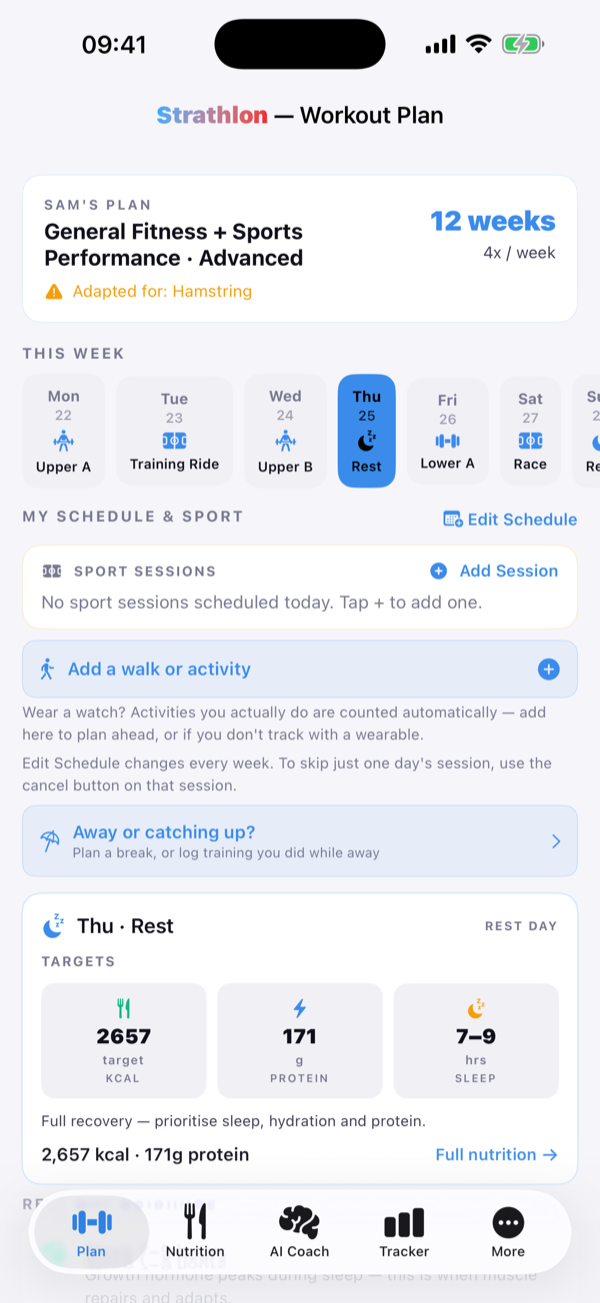
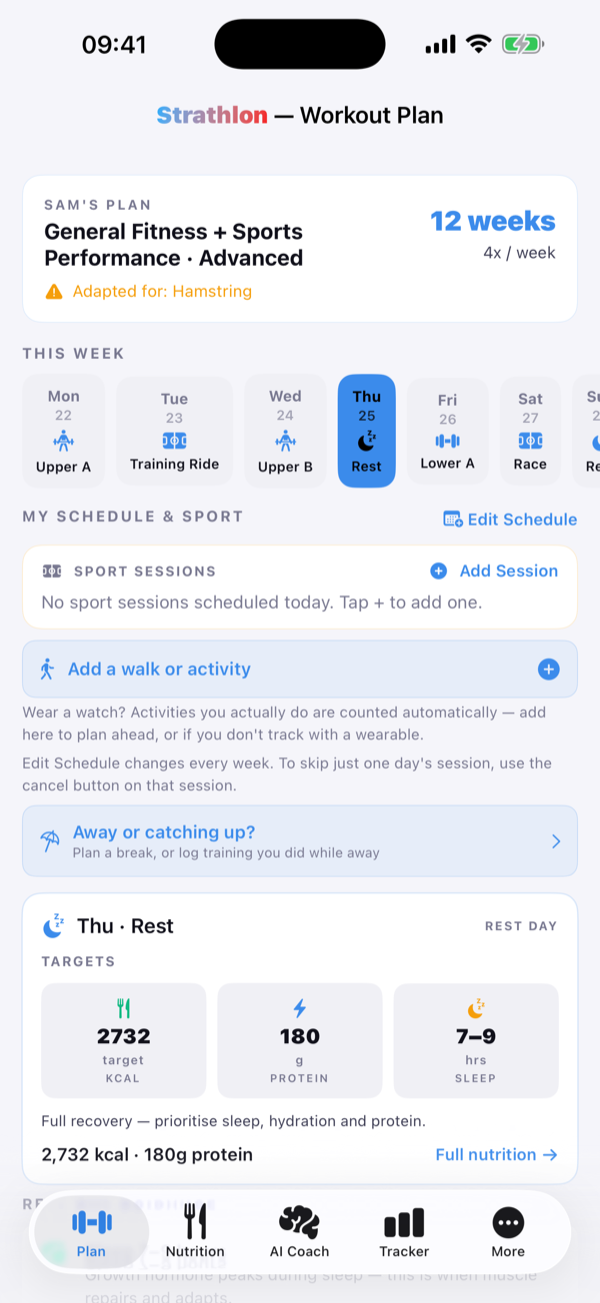
If you remember one thing, make it the boundary: carbohydrate loading is a precise tool for a specific problem: running out of fuel in a long event. It isn't a general "carbs are good" ritual to perform before everything. Match it to the distance, keep it gentle, and let the everyday fuelling underneath it stay honest. Strathlon's role is that last part: adjusting your targets around the sessions you actually log, so the base that every good race is built on is one less thing to guess at.
References
The figures in this guide come from the sources below. Where a number reflects established guidance rather than a single trial, the citation is to the position stand of the professional body that issued it, with the country it belongs to named. Guidance differs a little between nations, and no one country's advice is the last word.
- British Dietetic Association (BDA, United Kingdom). Sport and exercise nutrition: Food Fact Sheet. BDA, May 2026 (review date May 2029). bda.uk.com/resource/sport-exercise-nutrition.html
- Hawley JA, Schabort EJ, Noakes TD, Dennis SC. Carbohydrate-loading and exercise performance: an update. Sports Medicine. 1997;24(2):73–81. PubMed 9291549
- Thomas DT, Erdman KA, Burke LM. American College of Sports Medicine Joint Position Statement. Nutrition and Athletic Performance. Medicine & Science in Sports & Exercise. 2016;48(3):543–568. Issued jointly by the Academy of Nutrition and Dietetics (United States), Dietitians of Canada (Canada) and the American College of Sports Medicine (ACSM, United States), and published simultaneously in the Journal of the Academy of Nutrition and Dietetics. PubMed 26891166 · full text (Dietitians of Canada, PDF)
- Murray B, Rosenbloom C. Fundamentals of glycogen metabolism for coaches and athletes. Nutrition Reviews. 2018;76(4):243–259. PMC6019055
- Bergström J, Hermansen L, Hultman E, Saltin B. Diet, muscle glycogen and physical performance. Acta Physiologica Scandinavica. 1967;71(2):140–150. PubMed 5584523
- Solem K, Clauss M, Jensen J. Glycogen supercompensation in skeletal muscle after cycling or running followed by a high carbohydrate intake the following days: a systematic review and meta-analysis. Frontiers in Physiology. 2025;16:1620943. PMC12399638
- Bussau VA, Fairchild TJ, Rao A, Steele P, Fournier PA. Carbohydrate loading in human muscle: an improved 1 day protocol. European Journal of Applied Physiology. 2002;87(3):290–295. PubMed 12111292
- Sherman WM, Costill DL, Fink WJ, Miller JM. Effect of exercise-diet manipulation on muscle glycogen and its subsequent utilization during performance. International Journal of Sports Medicine. 1981;2(2):114–118. PubMed 7333741
- Kerksick CM, Arent S, Schoenfeld BJ, et al. International Society of Sports Nutrition (ISSN, United States) position stand: nutrient timing. Journal of the International Society of Sports Nutrition. 2017;14:33. PMC5596471
- Burke LM, Hawley JA, Wong SHS, Jeukendrup AE. Carbohydrates for training and competition. Journal of Sports Sciences. 2011;29(sup1):S17–S27, from the International Olympic Committee (IOC, international) Consensus Conference on Nutrition in Sport, Lausanne, October 2010. This is the paper whose carbohydrate-guideline table the position stand at reference 3 above reproduces. PubMed 21660838
- Olsson KE, Saltin B. Variation in total body water with muscle glycogen changes in man. Acta Physiologica Scandinavica. 1970;80(1):11–18. PubMed 5475323 · the original measurement. No abstract is published and the full text is paywalled, so its findings are quoted here as reported in the open-access review at reference 12 below.
- Shiose K, Takahashi H, Yamada Y. Muscle glycogen assessment and relationship with body hydration status: a narrative review. Nutrients. 2022;15(1):155. Reports that “during carbohydrate loading, it is generally understood that body weight increases by approximately 1.0–1.5 kg, mainly due to an increase in body water content,” and that Olsson and Saltin (reference 11 above) “initially suggested that 1 g of muscle glycogen is bound to 3–4 g of water.” PMC9823884
- Fernández-Elías VE, Ortega JF, Nelson RK, Mora-Rodriguez R. Relationship between muscle water and glycogen recovery after prolonged exercise in the heat in humans. European Journal of Applied Physiology. 2015;115(9):1919–1926. PubMed 25911631
- Kerksick CM, Arent S, Schoenfeld BJ, Stout JR, Campbell B, Wilborn CD, et al. International Society of Sports Nutrition position stand: nutrient timing. Journal of the International Society of Sports Nutrition. 2017;14:33. Issued by the International Society of Sports Nutrition. The pre-competition carbohydrate figure, stating that glycogen in the hours leading up to competition is best maintained or increased with high-carbohydrate meals or snacks at 1 to 4 g per kg. PubMed 28919842 · PMC5596471 full text
- Kerksick CM, Wilborn CD, Roberts MD, Smith-Ryan A, Kleiner SM, Jäger R, et al. ISSN exercise & sports nutrition review update: research & recommendations. Journal of the International Society of Sports Nutrition. 2018;15(1):38. Carried here for the wider end of the published timing range: pre-exercise meals suggested at about four to six hours before exercise, which is why this guide presents three to four hours as a common landing spot rather than a rule. PubMed 30068354 · PMC6090881 full text
- de Oliveira EP, Burini RC, Jeukendrup A. Gastrointestinal complaints during exercise: prevalence, etiology, and nutritional recommendations. Sports Medicine. 2014;44(Suppl 1):S79–S85. The source for 30% to 50% of athletes experiencing gastrointestinal complaints, for nutritional factors being among the causes, and for the explicit advice to experiment with the pre-race and race-day nutrition plan many times before race day. Also the basis for keeping the pre-event meal low in fat and fibre. PubMed 24791919 · PMC4008808 full text
- Jeukendrup AE. Training the Gut for Athletes. Sports Medicine. 2017;47(Suppl 1):101–110. The source for gastrointestinal tolerance being trainable, and for the recommendation to practise a race nutritional strategy in training rather than on the day. PubMed 28332114 · PMC5371619 full text
This is general educational information rather than medical, dietary or coaching advice. The sports-nutrition figures here are drawn from established consensus and are framed as population-level guides. Individual needs vary widely with body size, training status, the event, conditions and gut tolerance, and are best personalised with a qualified professional. Anyone with diabetes or another metabolic or health condition, a history of disordered eating, or who is pregnant or postpartum, should consult a sports physician or registered dietitian before making significant changes to carbohydrate intake. See our Terms for more.
← All guides · Fuelling for running · Fuelling for cycling · Fuelling for triathlon · Eating for results · Home