
Ice hockey strength & conditioning: skate faster, protect your groin, last the third period
An evidence-based guide to training the body hockey actually demands. Skating is a strength-and-power sport balanced on a thin steel edge, played in short, ferocious shifts, in a league of unavoidable collisions. This covers the lower-body strength and explosive power that drive the skating stride, the hip and adductor work that keeps groins intact, rotational core for shooting and contact, the conditioning that lets you repeat sprints all night, and honest prehab for the sport's signature injuries. Practical, deep and grounded in published sports science.
Here's the whole thing in one sentence: hockey rewards lower-body maximal strength and explosive power (that's your skating), hip and adductor strength (that's your durability, and largely your groin), and repeat-sprint conditioning (that's still being dangerous in the third period), built on a base of strength that transfers to speed. Size for its own sake isn't the goal. Everything below is the detail behind those qualities, where the numbers come from, and how to fit the work around a season of practices and games.
On this page
A framing note before the detail. Exercise science is well studied, but athletes differ enormously: position, age, sex, training age, playing level, health status and injury history all change what's right for a given player. So this is written as can, tends to and is associated with, never as a guarantee, and every specific figure is a population-level finding from published research rather than a personal prescription. It's general education rather than medical or coaching advice, and it isn't an individualised programme. A qualified S&C coach and clinician are the right people to tailor any of this to you.
The demands of ice hockey
Start with the stride, because almost everything physical about hockey traces back to it. Skating isn't running on ice: it's a series of powerful, mostly sideways pushes. Each stride extends the hip and knee while the leg drives out and back against the blade's edge, which means the hip abductors, extensors and external rotators do enormous work, and the adductors (the groin) fire hard to recover the leg and stabilise the pelvis between pushes. It is a fundamentally single-leg, force-hungry action performed in a low, hinged posture. On top of that sit the sport's other physical signatures: explosive acceleration and change of direction, collisions and battles along the boards that demand whole-body strength, and a shot that is driven by rotational power through the trunk and hips.
Now the engine. Hockey is a high-intensity intermittent sport: shifts are short and near-maximal, separated by longer rests on the bench, repeated across three periods. A 2023 systematic review of ice-hockey testing describes exactly this profile: repeated short, intense efforts that demand acceleration, speed, power, and the ability to repeat sprints, with the game's physiological demands having risen over recent decades. That makes on-ice work heavily anaerobic within a shift, riding on top of an aerobic base that clears fatigue between shifts and periods. The same review cites figures around 55 ml/kg/min of VO2max as a level associated with elite North American professional play. Skating speed and acceleration, in turn, are underpinned by lower-body muscular strength and power, which is why off-ice tests like the vertical jump, broad jump, short sprints and the Wingate cycle test tend to correlate with on-ice skating speed, and why the gym is where a lot of skating is actually built.
Finally, the injury map, because resilient training has to be pointed at real risks. Surveillance of NCAA men's ice hockey (2014–2019) found the most common specific injuries were concussion (about 9.6% of injuries), acromioclavicular (AC) joint sprains of the shoulder (about 7.3%), and medial collateral ligament (MCL) tears of the knee (about 3.7%), with the lower limb accounting for the largest share of injuries and groin/adductor strains a recurring theme. Checking and general play are the leading mechanisms. In short: the groin, the knee (MCL), the head and the shoulder are where hockey hurts people, and a smart S&C plan has an answer for each.
Key strength work, and why it matters
If skating is force applied through a single leg in a hinged position, then the strength programme that serves it is fairly predictable. Five buckets cover most of it, and each one earns its place by transferring to something the sport demands.
- Heavy bilateral strength: the force base. Squats and hinge patterns (back or front squat, trap-bar or conventional deadlift, hip thrust) build the raw force-producing capacity of the hips and legs that skating acceleration draws on. Classic NSCA loading guidance places maximal-strength work at heavy loads (roughly ≥85% of your one-rep max for about 6 reps or fewer, across a few hard sets) because that's the zone that most develops the high-threshold force you can later express quickly. This is the deep well every other quality is drawn from.
- Single-leg strength: matched to the stride. Because each skating push happens on one leg, unilateral work (rear-foot-elevated split squats, single-leg squats and Romanian deadlifts, step-ups, lateral lunges) builds strength in a pattern that looks like the sport, exposes and evens out left/right imbalances, and challenges the hip stability that a two-legged barbell lift can hide. Change-of-direction ability, in particular, responds well to strength training, with meta-analyses reporting moderate-to-large improvements.
- Explosive power: turning force into fast pushes. Strength you can't express quickly is only half-useful to a skater. Jump and plyometric training (broad jumps, bounds, box and depth jumps, lateral hops) trains the stretch-shortening cycle: the rapid, elastic stretch-then-shorten that a skating stride relies on. Systematic reviews find plyometric training produces small-to-moderate improvements in jump height, sprint speed and lower-body power, typically when run for at least eight weeks, two to three times a week. Where an athlete is well coached, weightlifting derivatives (cleans, high pulls, jump shrugs) add another high-power option.
- Hip and adductor strength: performance and durability at once. The adductors help power and control the stride, and they're also the sport's most strain-prone muscle group, so this bucket does double duty. Dedicated adductor work (Copenhagen adduction, sliding or band adduction, adductor-biased lunges) plus abductor and glute strength keeps the hips both powerful and protected. The injury section below has the evidence.
- Rotational core: shooting and contact. A shot's power runs from the ground, through the hips, and out through a stiff, rotating trunk. Upper-body and trunk power are associated with shot speed (Bežák & Přidal, 2017). Rotational and anti-rotation training (medicine-ball rotational throws, cable chops and lifts, Pallof presses, loaded carries) builds both the power you put into a shot and the trunk stiffness that resists getting knocked off the puck.
- References
The important idea tying these together is transfer. Heavy lifting builds force. Jumps and throws teach you to release that force fast. Single-leg and rotational work aim it at the exact patterns hockey uses. A plan that has only one of those buckets (all grinding heavy squats, or all bouncy plyometrics on weak legs) leaves speed on the table. A hockey-tuned plan layers a sport-specific accessory block (the adductor work, the jumps and lateral bounds, the single-leg patterns) on top of a solid base of general strength, so the base gives you the force and the sport-specific work sharpens it into skating.
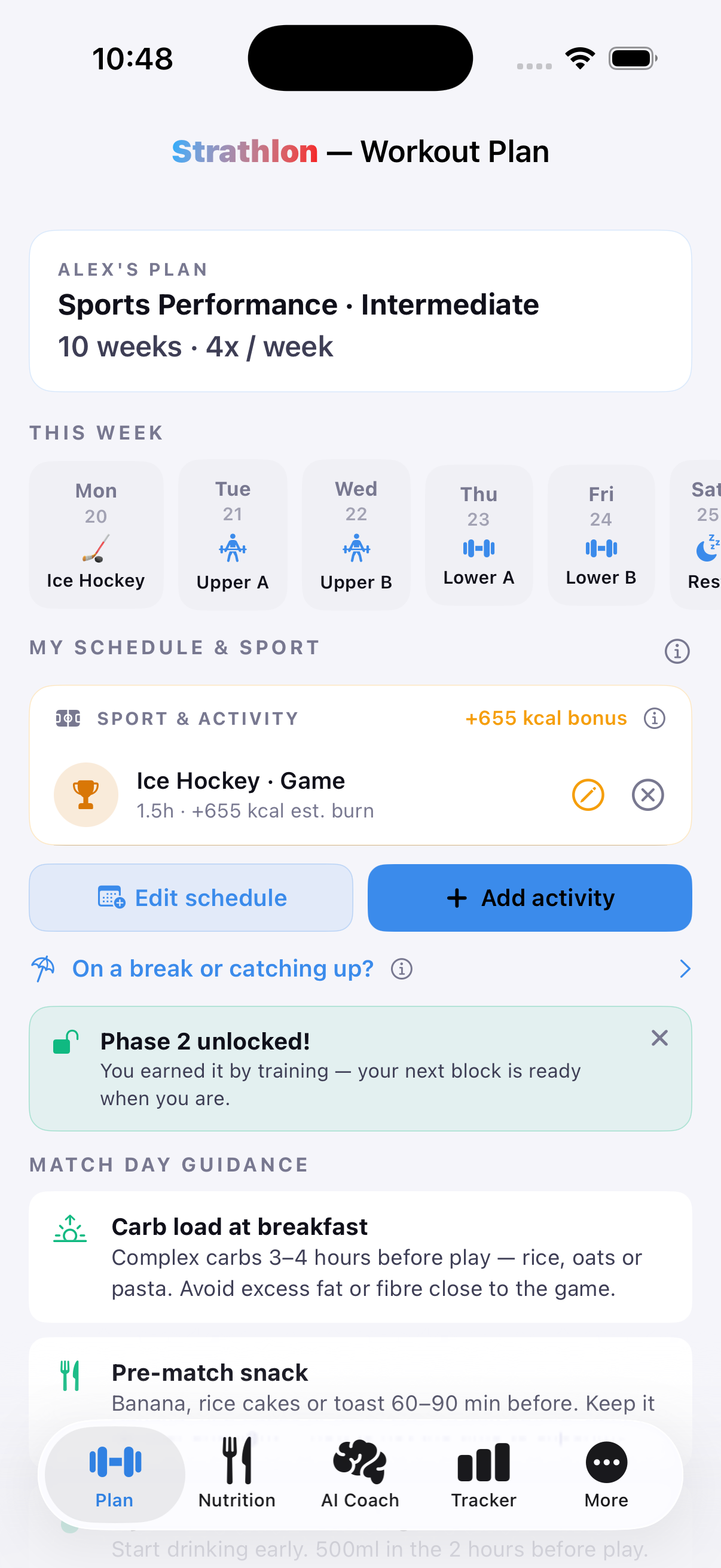
That pairing is worth dwelling on, because it captures the whole philosophy of training for a sport. The base lifts (heavy bilateral squats and hinges) are what actually build the force behind every stride. They are not general filler to be dropped in favour of skating drills. On top of that base sit the sport-specific pieces: an accessory block of single-leg work matched to the stride, hip and adductor strength for the sport's signature injury, and explosive work (jumps, lateral bounds and sled pushes) that turns force into a fast first push. Neither half works alone. Adductor and single-leg work on a weak base protects a body that cannot generate much. A strong squat that is never trained fast does not reach the first three strides.
Conditioning for ice hockey
Conditioning for hockey has to match the game's shape: short, hard efforts with incomplete recovery, repeated for sixty minutes. Two systems need feeding, and they're trained differently.
The first is your repeat-sprint ability: the capacity to produce a near-maximal effort, recover partially, and do it again without falling off a cliff. Off-ice, that's trained with short, intense intervals that echo a shift: efforts in the tens of seconds, near maximal, with work-to-rest ratios that leave you incompletely recovered (think repeated ~10–40 second hard efforts on the bike or in shuttle runs, with structured rest), and best of all on the ice itself, where the skating pattern is specific. This is the quality that keeps your last shift as sharp as your first.
The second is your aerobic base: the unglamorous engine that clears fatigue between shifts and between periods and lets you recover on the bench. It's why elite players carry a respectable VO2max despite hockey looking like a pure power sport. A modest amount of steady or moderate-intensity aerobic work (or longer intervals) underpins the ability to repeat those anaerobic shifts. The fitter your base, the faster you're ready to go again.
The catch is fitting conditioning around strength without the two undermining each other: the so-called interference effect, where lots of hard endurance work can blunt strength and power gains. You don't have to fear it, but you should respect it: keep the truly hard lower-body strength sessions and the truly hard conditioning sessions from colliding on the same day where you can, put the priority quality first when they must share a day, and remember that during the season the games and practices are a large slice of your conditioning. Off-ice conditioning tops up what skating doesn't fully cover. It shouldn't bury your legs before you get to the rink.
Staying injury-resilient
Prehab is most useful when it's aimed at a sport's actual injuries, and hockey's are well documented: the groin, the knee's MCL, the head, and the shoulder. The good news is that strength training as a category is one of the best-evidenced protective tools we have: a meta-analysis by Lauersen and colleagues (2018) found that programmes including strength training were associated with a substantial reduction in overall injury risk, with more strength-training volume linked to further protection. Here's how that maps onto the specific risks.
- Groin / adductor strains. This is the one with the clearest, most hockey-specific evidence. Tyler and colleagues (2001) found preseason hip-adduction strength was about 18% lower in professional players who went on to strain their groin, and that players whose adduction strength fell below 80% of their abduction strength were at elevated risk. Their follow-up intervention (2002) took those at-risk players, put them on an adductor-strengthening programme, and saw the adductor-strain rate drop from 3.2 to 0.71 per 1000 player-game exposures across the intervention seasons. Beyond hockey, a large football trial of an Adductor Strengthening Programme built on the Copenhagen adduction exercise (three sessions a week pre-season, one a week in-season) cut the risk of groin problems by about 41% (Harøy et al., 2019). That football evidence isn't a perfect transfer, but the groin loading is similar enough to make dedicated adductor strengthening a hockey staple, carried through the whole season as well as the build-up to it.
- MCL and knee. The MCL tear is hockey's signature knee injury, often from a collision or an awkward edge. You can't strength-train a hit away, but building strong, well-controlled hips and legs (including the single-leg strength, landing and deceleration mechanics above) gives the knee a sturdier, better-controlled platform to absorb load, which is the general logic behind why strength-based programmes reduce lower-limb injuries across cutting and contact sports.
- Concussion. Be honest here: no gym programme prevents concussions, and it would be wrong to imply otherwise. Concussion risk is driven mostly by rules, safe checking technique, on-ice respect and equipment. Neck strength is an area of interest (some observational data associate greater neck strength with lower concussion odds), but the evidence is limited and doesn't prove neck training prevents concussion. Train the neck and trunk as part of a contact-ready body, but treat head-injury prevention as chiefly a matter of how the game is played, and never play through a suspected concussion.
- Shoulder / AC joint. AC-joint sprains and shoulder injuries mostly come from checking and boards contact, so, like the MCL, they're not fully preventable in the gym. General upper-body and scapular strength (pressing, pulling, and rotator-cuff/scapular control work) helps build a shoulder that tolerates contact better, alongside sound checking technique.
Programming it around your season
The same qualities matter all year, but the emphasis and volume should shift with the calendar.
In the off-season, when no games are competing for your recovery, you build. This is the time for the heaviest maximal-strength work and the biggest power blocks, typically two to three sessions a week, progressing over blocks from general strength toward more explosive, hockey-specific power as the season approaches. It's also the window to bank adductor and single-leg strength before the schedule gets busy.
In-season, the goal flips from building to maintaining: holding onto your off-season strength and power while games and practices take priority. The encouraging evidence is that this takes surprisingly little: a systematic review of training frequency (Cuthbert et al., 2021) notes that resistance training as little as once a week maintained strength across roughly the first twelve weeks of a season, whereas cutting to once every two weeks let strength slip by around 10%. So one to two short, high-intensity sessions a week is usually enough to keep your gains, provided you keep the loads heavy even as you cut the volume, since intensity maintains strength far better than piling on more sets does. That matters because the in-season grind itself tends to erode lower-body power: a study of collegiate players found significant reductions in lower-body power across the season, exactly the drift that a weekly heavy maintenance session is there to fight.
The practical scheduling rules are simple. Keep the hard lower-body strength work away from game days and the heaviest skating days so your legs are fresh when it counts. Put quality first when strength and conditioning must share a day. Finally, treat the twelve-week caveat above as a nudge to keep at least a little strength work going right through a long season rather than abandoning it after Christmas.

Common questions
What strength work makes you skate faster?
Skating speed and acceleration are underpinned by lower-body strength and power, and off-ice tests of leg power (the vertical jump, broad jump, short sprints and Wingate peak power) tend to correlate with on-ice skating speed. In practice that means building heavy bilateral strength (squat and hinge patterns), single-leg strength that matches the one-leg push of the skating stride, and explosive work (jumps, throws and, if coached, weightlifting derivatives) to turn that strength into fast, forceful pushes. The strength has to be trained explosively to transfer: heavy lifting builds the force, and plyometric and jump training (typically run for at least eight weeks) help convert it into rapid, reactive power. There is no single magic exercise. A squat or trap-bar deadlift, a split squat, and a jump or med-ball throw together cover most of what skating asks for.
Will lifting weights make me slow or too bulky for hockey?
This is one of the most persistent myths in the sport, and the evidence points the other way. Meta-analyses find that resistance training transfers positively to sprint speed, jump height and change-of-direction ability rather than degrading them, as long as some of the work is done with intent to move fast. Getting stronger relative to your body weight tends to make you a more powerful, quicker skater. Large amounts of muscle mass are built slowly and deliberately over months of eating and training for size. You will not gain it by accident from a couple of strength sessions a week aimed at force and power. The realistic outcome of sensible S&C is a more explosive first few strides and a body that holds up to contact, well short of the bulky, sluggish caricature.
How do I prevent groin and adductor strains in hockey?
Adductor (groin) strains are among the most common muscle injuries in hockey, and the strongest evidence-based lever is adductor strength. In professional players, Tyler and colleagues (2001) found preseason hip-adduction strength was about 18% lower in players who went on to strain their groin. A follow-up (2002) put at-risk players (those whose adduction strength was under 80% of their abduction strength) on an adductor-strengthening programme and saw the adductor-strain rate fall from 3.2 to 0.71 per 1000 player-game exposures across the intervention seasons. In footballers, an Adductor Strengthening Programme built around the Copenhagen adduction exercise (three times a week pre-season, once a week in-season) reduced the risk of groin problems by about 41% (Harøy et al., 2019). That evidence is from football, but the loading demand on the groin is similar enough to make adductor strengthening a sensible hockey staple. Build hip-abductor strength and normal deceleration mechanics alongside it, and keep the work going through the season, well past pre-season.
How many days a week should I lift during the season?
Less than you might fear. A systematic review of training frequency (Cuthbert et al., 2021) notes that resistance training as little as once a week maintained strength across the first roughly twelve weeks of a season, whereas dropping to once every two weeks led to strength loss of around 10%. The practical read is that one to two focused, hard-but-brief sessions a week can hold onto the strength and power you built in the off-season, provided the intensity stays high even as the volume drops, because in-season hockey itself tends to erode lower-body power over the year if nothing maintains it. Off-season, when games aren't competing for your recovery, two to three sessions a week is a more typical build phase. Schedule the hard lower-body work away from games and heavy skating days so it doesn't blunt your legs when they matter.
Can strength training prevent concussions?
Not directly, and it would be dishonest to claim otherwise. Concussion is among the most common injuries in hockey, and the gym has little role in reducing it: what helps most is rules enforcement, safe body-checking technique, respect between players and well-fitted equipment. Neck strength is an area of active interest, with some observational evidence linking greater neck strength to lower concussion odds, but the evidence is limited and not proof that neck training prevents concussion. Where strength training clearly does help is the wider injury picture: across sports, programmes that include strength training are associated with a substantial reduction in overall injury risk (Lauersen et al., 2018). So train your neck and trunk as part of a durable, contact-ready body, but treat concussion prevention as mostly a matter of how the game is played, and take any suspected head injury seriously with proper medical assessment.
Takeaways
- Skating is a strength-and-power problem. Lower-body maximal strength and explosive power underpin acceleration and top speed. Off-ice jump, sprint and peak-power tests track with on-ice skating.
- Train the five buckets. Heavy bilateral strength for force, single-leg strength for the stride and change of direction, jumps/plyometrics for reactive power, adductor and hip work for durability, and rotational core for shooting and contact.
- Layer sport-specific on top of a base. A hockey accessory block (adductor, single-leg, power) sits on a foundation of general strength. You need both.
- Condition for repeat sprints on an aerobic base. Short, hard intervals build shift-to-shift punch. A steady aerobic base clears fatigue between shifts and periods.
- Protect the groin deliberately. Adductor strengthening is the best-evidenced hockey prehab. In pros, an intervention cut adductor strains from 3.2 to 0.71 per 1000 exposures (Tyler et al., 2002).
- Be honest about concussion. No gym work prevents it. Rules, technique and equipment do the heavy lifting. Strength training still lowers overall injury risk (Lauersen et al., 2018).
- Maintain in-season on very little. One to two hard, brief sessions a week can hold your strength. Keep the loads heavy as volume drops (Cuthbert et al., 2021).
- Ignore the bulky-and-slow myth. Strength training transfers to speed, jump and agility when trained with intent. It makes skaters faster.
If you remember one thing, make it this: hockey is built in the off-season and defended in-season. Build lower-body strength and power, protect the groin with dedicated adductor work, condition for repeated sprints, and then keep just enough of it going through the year that the season can't quietly take it back. Strathlon's role is to keep that base present and, with Sports Performance as one of your goals, your sport-specific work in the plan, so the training that makes a hockey player is one less thing to assemble from scratch.
Pair this with the ice hockey fuelling guide, the nutrition side of playing a full, fast season.
References
Numbered sources for the specific figures, effect sizes and named studies above. Where a claim reflects agreed guidance rather than a single trial, the citation is to the position stand or consensus statement of the body concerned, with the country or international remit named. Ice hockey's on-ice performance question has been tested directly, so the skating-speed transfer claims below come from hockey trials rather than from dry-land generalisation.
- Bieniec A, Grabara M. Does functional strength training program improve ice speed and agility in young elite ice hockey players? Functional strength training's impact on hockey performance. Frontiers in Physiology. 2025;16:1448495. Trial of a functional strength training programme on ice speed and agility in young elite ice hockey players, the direct evidence that gym work transfers to the ice. PubMed 40144546 · PMC11936901 full text
- Dietze-Hermosa MS, Montalvo S, Gonzalez MP, Dorgo S. The Impact of an 8-Week Resisted Sprint Training Program on Ice Skating Performance in Male Youth Ice Hockey Players. Journal of Strength and Conditioning Research. 2024;38(5):957–965. Eight-week resisted sprint training trial and its effect on skating performance in youth players, the second source for the same transfer. PubMed 38620058
- Mazurek CM, Pearsall DJ, Renaud PJ, Robbins SM. Inter-Segment Coordination of Male and Female Collegiate Ice Hockey Players During Forward Skating Starts. Research Quarterly for Exercise and Sport. 2024;95(4):834–842. Study of inter-segment coordination during forward skating starts in collegiate players, the mechanism behind that transfer. PubMed 38776467
- Tyler TF, Nicholas SJ, Campbell RJ, Donellan S, McHugh MP. The effectiveness of a preseason exercise program to prevent adductor muscle strains in professional ice hockey players. The American Journal of Sports Medicine. 2002;30(5):680–3. Tyler and colleagues' preseason programme preventing adductor muscle strains in professional ice hockey players, the direct source for the adductor prehab prescribed. PubMed 12239001
- Nicholas SJ, Tyler TF. Adductor muscle strains in sport. Sports Medicine. 2002;32(5):339–44. Tyler and colleagues' review of adductor muscle strains in sport, the background to that programme. PubMed 11929360
- Anderson GR, Melugin HP, Stuart MJ. Epidemiology of Injuries in Ice Hockey. Sports Health. 2019;11(6):514–519. Review of the epidemiology of injuries in ice hockey, the source for the sport's injury distribution. PubMed 31158326 · PMC6822215 full text
- Ornon G, Ziltener JL, Fritschy D, Menetrey J. Epidemiology of injuries in professional ice hockey: a prospective study over seven years. Journal of Experimental Orthopaedics. 2020;7(1):87. Seven-year prospective study of injuries in professional ice hockey, the longer-window evidence. PubMed 33159261 · PMC7647969 full text
- Eliason PH, Galarneau JM, Babul S, Mrazik M, Bonfield S, Schneider KJ, et al. Safe2Play in youth ice hockey: injury profile and risk factors in a 5-year Canadian longitudinal cohort study. Annals of Medicine. 2024;56(1):2385024. Five-year Canadian longitudinal cohort study of injury profile and risk factors in youth ice hockey, cited for the age-group picture. PubMed 39189073 · PMC11351362 full text
- Morrissey PJ, Zhou JJ, Shah NV, Torre BB, Dekis JC, Newman JM, et al. Epidemiology of female youth ice hockey injuries presenting to United States emergency departments from 2002 to 2019. The Physician and Sportsmedicine. 2022;50(5):388–393. Study of female youth ice hockey injuries presenting to US emergency departments, included so the injury picture is not male-only. PubMed 34030578
- Suchomel TJ, Nimphius S, Stone MH. The Importance of Muscular Strength in Athletic Performance. Sports Medicine. 2016;46(10):1419–49. Suchomel and colleagues on the importance of muscular strength in athletic performance, the source for greater maximal strength being associated with faster sprinting, jumping and change of direction, and with lower injury risk. PubMed 26838985
- Seitz LB, Reyes A, Tran TT, Saez de Villarreal E, Haff GG. Increases in lower-body strength transfer positively to sprint performance: a systematic review with meta-analysis. Sports Medicine. 2014;44(12):1693–702. Seitz and colleagues' systematic review with meta-analysis showing increases in lower-body strength transfer positively to sprint performance, the evidence behind the 'strength is the base' argument. PubMed 25059334
- Lauersen JB, Andersen TE, Andersen LB. Strength training as superior, dose-dependent and safe prevention of acute and overuse sports injuries: a systematic review, qualitative analysis and meta-analysis. British Journal of Sports Medicine. 2018;52(24):1557–1563. Lauersen and colleagues' meta-analysis finding strength training a superior, dose-dependent and safe prevention of acute and overuse sports injuries, the direct source for treating strength work as prehab. PubMed 30131332
- Lauersen JB, Bertelsen DM, Andersen LB. The effectiveness of exercise interventions to prevent sports injuries: a systematic review and meta-analysis of randomised controlled trials. British Journal of Sports Medicine. 2014;48(11):871–7. Lauersen and colleagues' earlier meta-analysis of exercise interventions to prevent sports injuries, the broader evidence base the prevention advice sits on. PubMed 24100287
- . American College of Sports Medicine position stand. Progression models in resistance training for healthy adults. Medicine and Science in Sports and Exercise. 2009;41(3):687–708. American College of Sports Medicine (ACSM, United States) position stand on progression models in resistance training, the source for the heavy-load and explosive-load percentage ranges quoted. PubMed 19204579
- Cuthbert M, Haff GG, Arent SM, Ripley N, McMahon JJ, Evans M, et al. Effects of Variations in Resistance Training Frequency on Strength Development in Well-Trained Populations and Implications for In-Season Athlete Training: A Systematic Review and Meta-analysis. Sports Medicine. 2021;51(9):1967–1982. Cuthbert and colleagues' systematic review of resistance-training frequency in well-trained populations, the source for the sessions-per-week guidance. PubMed 33886099 · PMC8363540 full text
- Spiering BA, Mujika I, Sharp MA, Foulis SA. Maintaining Physical Performance: The Minimal Dose of Exercise Needed to Preserve Endurance and Strength Over Time. Journal of Strength and Conditioning Research. 2021;35(5):1449–1458. Spiering and colleagues on the minimal dose of exercise needed to preserve endurance and strength, the source for maintaining in-season on as little as one to two sessions a week. PubMed 33629972
- Rønnestad BR, Nymark BS, Raastad T. Effects of in-season strength maintenance training frequency in professional soccer players. Journal of Strength and Conditioning Research. 2011;25(10):2653–60. Ronnestad and colleagues' trial of in-season strength maintenance frequency in professional footballers, the specific in-season maintenance result quoted. PubMed 21873897
- Nuzzo JL, Pinto MD, Kirk BJC, Nosaka K. Resistance Exercise Minimal Dose Strategies for Increasing Muscle Strength in the General Population: an Overview. Sports Medicine. 2024;54(5):1139–1162. Nuzzo and colleagues on minimal-dose resistance exercise strategies for increasing strength, supporting the claim that a small, well-chosen dose does most of the work. PubMed 38509414 · PMC11127831 full text
- Wilson JM, Marin PJ, Rhea MR, Wilson SM, Loenneke JP, Anderson JC. Concurrent training: a meta-analysis examining interference of aerobic and resistance exercises. Journal of Strength and Conditioning Research. 2012;26(8):2293–307. Wilson and colleagues' meta-analysis of concurrent training and the interference effect, the source for separating heavy lifting from hard conditioning. PubMed 22002517
- Schumann M, Feuerbacher JF, Sünkeler M, Freitag N, Rønnestad BR, Doma K, et al. Compatibility of Concurrent Aerobic and Strength Training for Skeletal Muscle Size and Function: An Updated Systematic Review and Meta-Analysis. Sports Medicine. 2022;52(3):601–612. An updated systematic review of the compatibility of concurrent aerobic and strength training, the more recent evidence that interference is smaller than once believed. PubMed 34757594 · PMC8891239 full text
- Ramirez-Campillo R, Sortwell A, Moran J, Afonso J, Clemente FM, Lloyd RS, et al. Plyometric-Jump Training Effects on Physical Fitness and Sport-Specific Performance According to Maturity: A Systematic Review with Meta-analysis. Sports Medicine - Open. 2023;9(1):23. Ramirez-Campillo and colleagues on plyometric-jump training effects on physical fitness and sport-specific performance, the source for the plyometric guidance. PubMed 37036542 · PMC10086091 full text
- Impellizzeri FM, Woodcock S, Coutts AJ, Fanchini M, McCall A, Vigotsky AD. What Role Do Chronic Workloads Play in the Acute to Chronic Workload Ratio? Time to Dismiss ACWR and Its Underlying Theory. Sports Medicine. 2021;51(3):581–592. Impellizzeri and colleagues on the pitfalls of the acute:chronic workload ratio, cited because it is the reason this guide talks about ramping load gradually rather than quoting a workload number. PubMed 33332011
- Baz-Valle E, Balsalobre-Fernández C, Alix-Fages C, Santos-Concejero J. A Systematic Review of The Effects of Different Resistance Training Volumes on Muscle Hypertrophy. Journal of Human Kinetics. 2022;81:199–210. Systematic review of resistance-training volume and hypertrophy, the general dose-response evidence behind the set and session recommendations. PubMed 35291645 · PMC8884877 full text
This is general educational information rather than medical or coaching advice. The training and injury-prevention findings here are drawn from published sports science and are framed as population-level tendencies and associations; individual response varies widely with position, age, sex, training history and health, and no programme removes the risk of injury in a contact sport. Anyone with pain, a current or past injury, a health condition, or who is pregnant or postpartum, should consult a qualified S&C coach or clinician before starting or changing a training programme, and any suspected concussion needs proper medical assessment. See our Terms for more.
← All guides · Ice hockey fuelling · Eating for results · Skiing S&C · Rowing S&C · Understanding your stats · Home