
Rowing strength & conditioning
An evidence-based guide to the gym and conditioning work behind a faster boat. Rowing is a power-endurance sport driven by the legs through the hips and back, over and over, for minutes at a time, so it asks for an unusual combination: a large aerobic engine, real maximal strength, and a trunk that can hold posture when everything is tired. This covers the lifts that transfer to stroke power, how to condition the energy systems without wrecking your strength, protecting the two areas rowers break most (the lower back and the ribs), and how to fit it all around a heavy on-water schedule, kept practical, honest and grounded in the sport-science literature.
If you train three things, train these: a big aerobic engine, leg-driven maximal strength and power through the posterior chain, and trunk endurance to protect the spine. A 2,000 m race is mostly aerobic but won’t be won without the force to send the boat off the start and finish it hard, and none of it matters if your back or ribs put you on the sidelines. Everything below is the detail behind that sentence.
On this page
A framing note before the detail. Sport science is well studied but people differ enormously: training age, sex, body size, sweep versus sculling, lightweight versus openweight, injury history and health all shift what’s right for a given rower. So this is written as can, tends to and is associated with, never as a guarantee, and every specific number is a population-level figure from published research rather than a personal prescription. It’s general education rather than medical or individual coaching advice, and it isn’t a bespoke programme.
The demands of rowing
Every stroke is a full-body triple extension: the legs drive the seat back, the hips and back swing open, and the arms finish the pull, in that order, with the legs doing most of the work. Then you recover forward and do it again, around 30–40 times a minute in a race, for the whole race. That makes rowing a power-endurance sport: it needs force, applied fast, repeated without fading.
On the energy side, a 2,000 m race lasts roughly five-and-a-half to eight minutes and is predominantly aerobic: studies of race and race-simulation efforts put the aerobic contribution at around 75–88% of total energy, with the remaining ~12–25% anaerobic. But that aerobic majority hides where races are decided: the start and the sprint finish demand mechanical power at or above your maximal aerobic output, and that spike is fuelled anaerobically. So a rower needs a huge aerobic base and the strength and anaerobic power to attack the ends of the piece.
The injury picture is dominated by two sites. Low back pain is the most commonly reported injury in the sport: annual figures cluster around a third to a half of rowers, lifetime prevalence sits near 50%, and it accounts for roughly 15–25% of all rowing injuries. Rib stress fractures are less common (reported in about 9% of elite rowers) but brutal for training time, typically costing six to eight weeks out. Wrists, forearms and knees pick up overuse complaints too, but the back and the ribs are the ones a strength-and-conditioning plan should be built to protect.
Key strength work, and why it matters
Because the stroke is a leg-driven hinge-and-pull, the lifts that transfer are the ones that load that same chain heavily. In studies of rowers, maximal strength in the leg press and the bench pull is among the strongest strength correlates of 2,000 m ergometer performance, and in elite women the back squat, deadlift and bench pull track with it too. The mechanism is simple: a stronger leg drive and hinge mean each stroke can put more force into the water, and more reserve strength means each stroke is a smaller fraction of your maximum, so it fatigues you less over 2,000 m.
- Back squat / leg press: leg drive. The squat trains the exact quadriceps-and-glute extension that opens the stroke. It is the headline lower-body lift for rowers and one of the best-correlated with boat speed.
- Deadlift and Romanian deadlift: the hip hinge and posterior chain. The hinge trains the hips and back to open under load with a braced, near-neutral spine, which is exactly the pattern that fails when a rower’s back rounds under fatigue. A strong, well-drilled hinge is both a power-builder and back insurance.
- Horizontal pulls: bench pull / prone row. The bench pull mimics the arm-and-back finish of the stroke and, in the research, its maximal strength is a repeated correlate of rowing performance.
- Power variants: high pulls, cleans, jumps. Rowing rewards force applied fast. Power and jump measures relate to the high stroke velocities at the start and finish, so explosive pulls and jumps add the rate-of-force piece that heavy grinds alone don’t.
- References
Strength work is a meaningful slice of a rower’s week (around 10–20% of total training time in elite programmes), and it is genuinely heavy: in the competitive phase, rowers commonly lift the main strength movements at loads of roughly 85–95% of one-rep max, in low-rep sets, because force and power matter here more than gym endurance. As an illustration, a strength block used with trained rowers in one study prescribed heavy compound work such as back squat 4×5 and bench pull 3×5 at ~85% 1RM, with Romanian deadlifts around 3×8 alongside explosive pulls. Treat those as an example of the shape of heavy rowing strength work: your loads and progression depend on your training age and lifting technique.
On the honest side of the ledger: a 2020 systematic review with meta-analysis of strength training in rowers found small but genuine improvements in lower-limb maximal strength and in sport-specific performance (like 2,000 m time), and, importantly, the benefit held across recreational, sub-elite and elite rowers and wasn’t much changed by which strength style was used. “Small” is the honest word: strength work is a supporting act to the aerobic engine rather than a substitute for it. But small margins win races, and the same strength buys you resilience against the back and rib problems below.
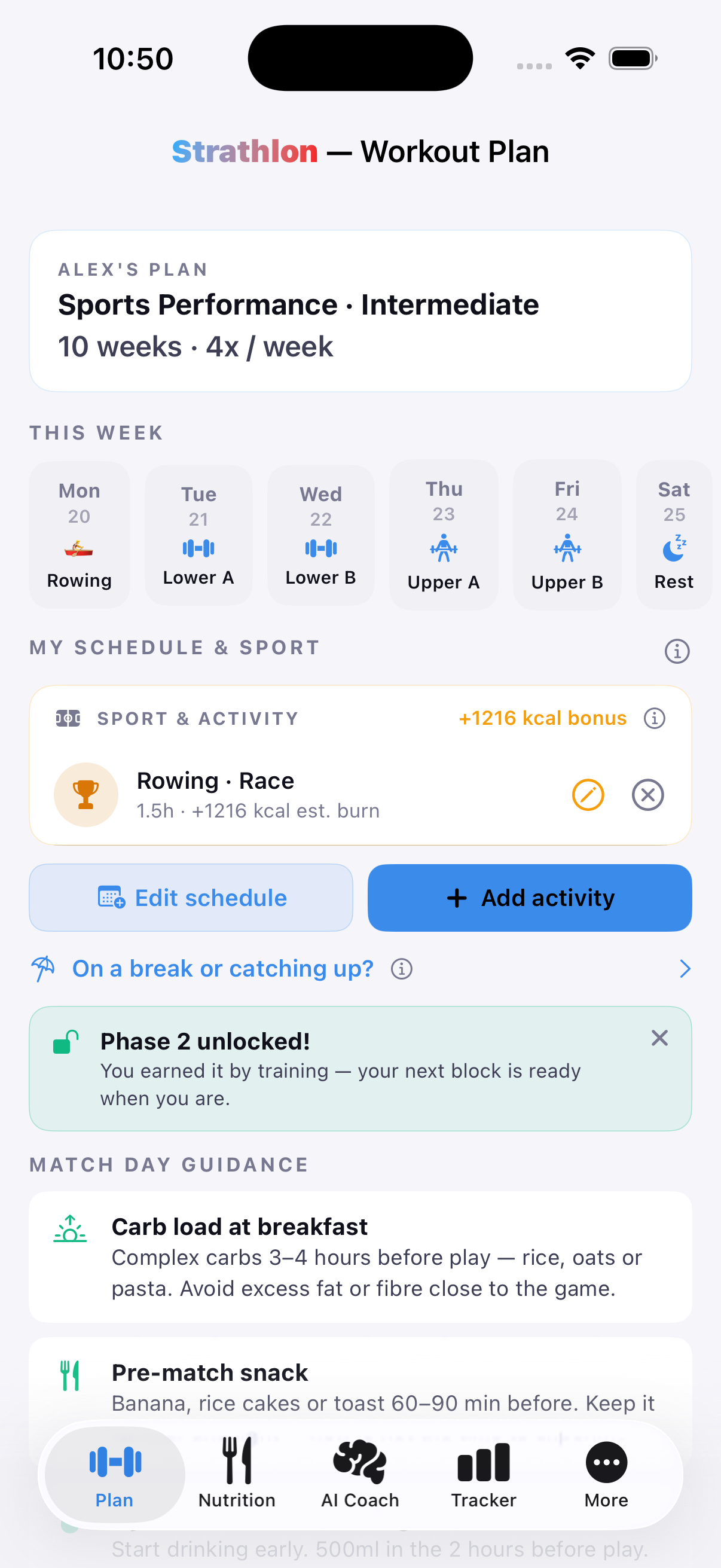
That pairing is worth dwelling on, because it captures the whole philosophy of training for a sport. The base lifts (the back squat or leg press, the deadlift and Romanian deadlift, and the bench pull) are what actually raise leg drive and the strength of the finish. They are not general filler to be dropped whenever erg volume climbs. On top of that base sit the sport-specific pieces: an accessory block of trunk and anti-extension work aimed at exactly the pattern that fails when a rower's back rounds under fatigue, and posterior-chain and single-leg work (hip thrusts, Nordic curls, split squats and step-ups) for the drive. Neither half works alone. Trunk work on a weak base holds a position you have no force to drive from. Heavy pulling with no trunk endurance rounds out in the third quarter, and both are supplements to the water and the erg, never a replacement for them.
Conditioning for rowing
Because a race is ~80% aerobic, the single biggest conditioning lever is a large aerobic base, built the way endurance athletes build it: a lot of low-intensity, high-volume steady-state rowing (on the water and the erg), with a smaller amount of harder work. The steady volume raises the ceiling you can hold for the middle kilometre-and-a-half of the race. The hard work sharpens the two ends of it.
The higher-intensity conditioning matters precisely because of the race’s anaerobic tail. Interval work at and above your maximal-aerobic-power (think repeated efforts of a few hundred metres to a couple of minutes) trains the start and the sprint finish, where mechanical power sits above VO2max. This is also where gym strength and power feed back in: the more force you can produce, the higher the power output you can hit in those anaerobic bursts.
The obvious worry with doing heavy lifting and big aerobic volume is the interference effect: the idea that endurance work blunts strength gains. The reassuring reality: at the volumes most rowers train, interference on strength is small and tends to be transient, and rowing programmes reliably build both. There is one practical timing note worth respecting: a bout of heavy strength training can leave measurable dips in power and jump performance for around 24 hours (from muscle fatigue and damage) without hurting a steady 2,000 m the next day, so avoid stacking a hard sprint or maximal-power session in the 24 hours right after heavy lifting, but don’t fear a normal aerobic row.
Staying injury-resilient
This is where a rower’s S&C plan earns its keep. The two signature injuries have different mechanisms, so they need different protection.
The lower back. Most rowing back pain is a flexion-overload story: as the hips, hamstrings and trunk fatigue, the pelvis tips back at the catch and the lumbar spine rounds and takes load it isn’t built to bear, and continuous ergometer work makes this worse, with subtle increases in spinal flexion appearing after roughly 20–30 minutes of steady erging. The most consistent risk factor in the research isn’t a mobility number or a training volume: it’s a previous episode of low back pain (associated with more than double the odds of future pain), so early management of any niggle matters. The evidence-informed levers:
- Hip and hamstring mobility. Rowers benefit from around 130 degrees of hip flexion and good hamstring length, so the hips reach the catch and the low back doesn’t have to round to get there.
- Trunk endurance, done dynamically. Good trunk-muscle endurance helps you hold technique as you tire. Guidance leans toward dynamic posterior-chain and anti-flexion work over long static planks, which do little for the rowing demand.
- Manage erg volume and ramps. Break up long ergometer pieces rather than grinding past ~30 minutes without a break, and raise training volume gradually: sudden jumps (for example moving into a new season) are when backs tend to flare.
- Own the hinge in the gym. A well-drilled deadlift and Romanian deadlift teach the hips and back to load together with a braced, near-neutral spine: the same skill that protects you at the catch.
The ribs. Rib stress fractures come from repetitive muscular loads across the rib cage (opposing pulls from the scapular and shoulder muscles during the drive and the trunk muscles at the finish), concentrated in ribs four to eight. Because they’re a bone problem as much as a mechanics one, prevention is part load-management, part bone-health:
- Protect bone and energy availability. Under-fuelling (low energy availability) is a recognised risk factor, especially for lightweight and some female rowers. Adequate energy, calcium and vitamin D underpin bone health. Our energy availability & RED-S guide goes deep on this.
- Build serratus anterior and scapular strength so the shoulder blade controls the forces that reach the ribs, and avoid excessive scapular protraction.
- Avoid load spikes in high-strain erg and pull volume, and consider dynamic or floating-head ergometers, which are hypothesised to reduce rib strain.
An honest caveat runs through this section: the quality of evidence for specific rowing-injury prevention is generally rated low, and much of the guidance is mechanism-led rather than proven by trials. The two things with the best support are unglamorous: managing training load and treating a first injury properly so it doesn’t become a recurring one. Chest-wall or back pain that worsens with rowing is a reason to see a clinician early rather than push through it.
Programming it around your season
The core idea is build strength when you have room, then defend it. Rowing volume is high and relentless, so the gym has to bend around it.
- Off-season / base: build. This is when you develop maximal strength and power, on a common structure of two to three focused strength sessions a week, progressing the heavy compound lifts and adding power work. Rowing volume is often building too, but the intensity of racing isn’t there yet, so there’s recovery to spend on getting strong.
- In-season: maintain. Here’s the liberating part: you don’t need to keep lifting three times a week to keep your strength. The maintenance evidence is clear that as little as one quality session per week can preserve maximal strength, provided you keep the load heavy (around 80% of one-rep max or above). It’s intensity that matters most to protect, more than volume: one review found one session a week held strength while one session every two weeks lost roughly 10% of half-squat strength, and cutting the load (not just the frequency) is what drives rapid detraining. So in a race block, drop to one (maybe two) short, heavy sessions and spend the rest of your energy on the water.
- Fit lifting around the priority sessions. Keep hard lifting away from your most important on-water or sprint sessions, and remember the 24-hour note above: don’t put a maximal-power piece straight after heavy strength. When fatigue is high, a maintenance lift is worth far more than a junk-fatigue “extra” one.

Common questions
Which strength exercises transfer best to rowing?
The rowing stroke is a full-body push from the legs through the hips and back, so the lifts that transfer best load that same chain heavily: the back squat and leg press for leg drive, the deadlift and Romanian deadlift for the hip hinge and posterior chain, and horizontal pulls such as the bench pull (prone row) for the finish. In studies of rowers, maximal strength in leg press and bench pull, and in the squat and deadlift in elite women, is among the strongest strength correlates of 2,000 m ergometer performance. Elite rowers typically lift these movements heavy (often around 85–95% of one-rep max in the competitive phase) because rowing rewards force applied fast, with muscular endurance in the gym contributing little.
Will lifting heavy make me slow or too bulky for rowing?
It is very unlikely on a rower’s training volume. A 2020 systematic review with meta-analysis found that adding strength training produced small but genuine improvements in rowers’ lower-limb maximal strength and in sport-specific performance such as 2,000 m ergometer time, across recreational, sub-elite and elite levels, the opposite of slowing you down. Heavy strength work on a couple of sessions a week builds force and power without adding much size, and the aerobic volume of rowing itself limits hypertrophy. The real risk is not lifting at all and leaving stroke power on the table.
How often should I lift during the rowing season?
Build the strength off-season, then maintain it in-season. In the off-season, two to three focused strength sessions a week is a common structure for developing maximal strength and power. In-season, the evidence on maintenance is encouraging: as little as one quality session per week at high intensity (loads around 80% of one-rep max or heavier) can preserve the strength you built, whereas dropping the load is what causes rapid detraining. One review found one session a week maintained strength while one session every two weeks lost roughly 10% of half-squat strength. So keep the intensity, cut the frequency and volume when the water work ramps up.
Why does rowing hurt my lower back, and how do I protect it?
Low back pain is the most commonly reported injury in rowing: annual figures cluster around a third to a half of rowers, and it accounts for roughly 15–25% of rowing injuries. Most of it is a flexion-overload problem: as the trunk and hips fatigue, the pelvis tips back and the lumbar spine rounds and takes load it is not built to take, especially on long continuous ergometer pieces. The strongest single risk factor in the research is simply a previous episode of low back pain. Practical, evidence-informed protection: build hip mobility (rowing bodies benefit from around 130 degrees of hip flexion) and hamstring flexibility so the hips reach the catch, sparing the low back; train trunk endurance with dynamic posterior-chain work rather than long static planks; break up ergometer sessions rather than grinding pieces beyond about 30 minutes without a break; and raise training volume gradually rather than in jumps.
What are rib stress fractures, and how do I lower the risk?
Rib stress fractures are overuse fractures of the rib cage from repetitive muscular loads across the thorax, and they are fairly specific to rowing: reported in roughly 9% of elite rowers (with about 86% of cases in ribs four to eight), and they cost more missed training than almost any other rowing injury, typically around six to eight weeks out. The mechanism involves opposing pulls on the ribs from the scapular and shoulder muscles during the drive and the trunk muscles at the finish. Risk reduction focuses on bone health and load: address low energy availability (a real risk for lightweight and some female rowers), get adequate calcium and vitamin D, build serratus anterior and scapular strength, avoid sudden spikes in training or high-strain erg volume, and consider dynamic or floating-head ergometers. Chest-wall pain that worsens with rowing should be assessed early. Don't push through it.
Is rowing mostly aerobic, or should I still do intervals and lifting?
A 2,000 m race lasts roughly five and a half to eight minutes and is predominantly aerobic: studies put the aerobic contribution at around 75–88% of the total, with the rest anaerobic. That means a large aerobic base built from high-volume, mostly low-intensity rowing is the foundation. But the anaerobic share is decisive: the start and the sprint finish demand power at or above your maximum aerobic output, which is where higher-intensity intervals and gym-built strength and power pay off. Strength and endurance combine well here: the interference effect on strength is small at the volumes most rowers train, and tends to be transient, so you can and should do all three: aerobic base, some high-intensity work, and heavy strength.
Takeaways
- Rowing is power-endurance. A 2,000 m race is ~75–88% aerobic over ~5.5–8 minutes, but decided at the start and finish by anaerobic power, so you need the engine and the force.
- Lift the stroke, heavy. Squat and leg press for leg drive, deadlift and RDL for the hinge, bench pull for the finish. These correlate with 2,000 m performance, and elite rowers train them at ~85–95% 1RM.
- Expect a small, real boost. Meta-analysis shows strength training gives small but genuine gains in rowers’ strength and 2,000 m time: a supporting act to the aerobic engine rather than a replacement for it.
- Build the aerobic base first. Mostly low-intensity, high-volume rowing, with targeted intervals for the anaerobic ends of the race.
- Concurrent training works. Interference on strength is small and transient at rowing volumes: just avoid a maximal-power session in the 24 hours right after heavy lifting.
- Protect the back. Flexion overload under fatigue is the enemy: hip mobility (~130° flexion), dynamic trunk endurance, gradual volume, and breaking up erg pieces beyond ~30 minutes. Previous back pain is the biggest risk factor: treat niggles early.
- Protect the ribs. ~9% of elite rowers get rib stress fractures (ribs 4–8, ~6–8 weeks out). Guard bone with energy availability, calcium and vitamin D; build serratus/scapular strength; avoid load spikes.
- Build then maintain. 2–3 strength sessions a week off-season. In-season, one heavy session a week can maintain strength: keep the load high, cut the volume.
If you take one thing away: rowing already gives you endurance in abundance, so let the gym do what rowing can’t: build maximal force and the resilience to keep applying it. Get strong through the legs and hips, keep the trunk honest under fatigue, guard the ribs, and defend that strength with a single heavy session a week once racing starts. Strathlon’s job is to tune your plan toward rowing (with Sports Performance as one of your goals) and keep your strength trend visible, so the gym stays a help to your rowing rather than a guess.
Pair this with the rowing fuelling guide, the two halves of training the sport well.
References
Numbered sources for the specific figures, effect sizes and named studies above. Where a claim reflects agreed guidance rather than a single trial, the citation is to the position stand or consensus statement of the body concerned, with the country or international remit named. Rowing's back-injury literature is unusually specific and is cited directly below; the strength prescriptions are general evidence applied to the sport's very high repetition count.
- Benson A, Abendroth J, King D, Swensen T. Comparison of rowing on a concept 2 stationary and dynamic ergometer. Journal of Sports Science & Medicine. 2011;10(2):267–73. Comparison of rowing on stationary and dynamic ergometers, the source for the stroke demand described and for why erg volume is the variable to watch. PubMed 24149871 · PMC3761858 full text
- Wilson F, Gissane C, McGregor A. Ergometer training volume and previous injury predict back pain in rowing; strategies for injury prevention and rehabilitation. British Journal of Sports Medicine. 2014;48(21):1534–7. Study finding ergometer training volume and previous injury predict back pain in rowing, with prevention strategies, the direct source for the erg-volume caution. PubMed 25257230
- Trease L, Wilkie K, Lovell G, Drew M, Hooper I. Epidemiology of injury and illness in 153 Australian international-level rowers over eight international seasons. British Journal of Sports Medicine. 2020;54(21):1288–1293. Study of injury and illness in 153 Australian international-level rowers over eight international seasons, the source for the sport's injury distribution. PubMed 32586943
- Treloar J, Bolia IK, Anvari A, Collon K, Lan R, Bell JA, et al. Update on injury epidemiology in rowing: our experience with female NCAA Division I athletes and a systematic review of the literature. The Physician and Sportsmedicine. 2022;50(3):189–196. Update on rowing injury epidemiology in female NCAA Division I athletes, cited so the picture is not drawn from male crews alone. PubMed 34000208
- Trompeter K, Fett D, Platen P. Back Pain in Rowers: A Cross-sectional Study on Prevalence, Pain Characteristics and Risk Factors. Sportverletzung Sportschaden : Organ Der Gesellschaft Fur Orthopadisch-Traumatologische Sportmedizin. 2019;33(1):51–59. Cross-sectional study of back pain prevalence, characteristics and risk factors in rowers, the specific low-back evidence. PubMed 30419587
- Finlay C, Dobbin N, Jones G. The epidemiology of injuries in adult amateur rowers: A cross-sectional study. Physical Therapy in Sport : Official Journal of the Association of Chartered Physiotherapists in Sports Medicine. 2020;41:29–33. Cross-sectional study of injuries in adult amateur rowers, included because most readers are not internationals. PubMed 31715556
- Verrall G, Darcey A. Lower back injuries in rowing national level compared to international level rowers. Asian Journal of Sports Medicine. 2014;5(4):e24293. Study comparing lower-back injuries in national- and international-level rowers, cited in the load-management section. PubMed 25741422 · PMC4335483 full text
- Baumann E, van der Vorst EMC, Hofmijster MJ. A speed-oriented phenotype is beneficial for 1500 m rowing at the Los Angeles 2028 Olympic Games. European Journal of Applied Physiology. 2026. Study of the speed-oriented phenotype for the shorter Olympic rowing distance, cited in the programming section for how the event shapes the training. PubMed 42142183
- Beattie K, Kenny IC, Lyons M, Carson BP. The effect of strength training on performance in endurance athletes. Sports Medicine. 2014;44(6):845–65. Meta-analysis of strength training in endurance athletes, the source for gym work supplementing rather than replacing the ergometer. PubMed 24532151
- Suchomel TJ, Nimphius S, Stone MH. The Importance of Muscular Strength in Athletic Performance. Sports Medicine. 2016;46(10):1419–49. Suchomel and colleagues on the importance of muscular strength in athletic performance, the source for greater maximal strength being associated with faster sprinting, jumping and change of direction, and with lower injury risk. PubMed 26838985
- Seitz LB, Reyes A, Tran TT, Saez de Villarreal E, Haff GG. Increases in lower-body strength transfer positively to sprint performance: a systematic review with meta-analysis. Sports Medicine. 2014;44(12):1693–702. Seitz and colleagues' systematic review with meta-analysis showing increases in lower-body strength transfer positively to sprint performance, the evidence behind the 'strength is the base' argument. PubMed 25059334
- Lauersen JB, Andersen TE, Andersen LB. Strength training as superior, dose-dependent and safe prevention of acute and overuse sports injuries: a systematic review, qualitative analysis and meta-analysis. British Journal of Sports Medicine. 2018;52(24):1557–1563. Lauersen and colleagues' meta-analysis finding strength training a superior, dose-dependent and safe prevention of acute and overuse sports injuries, the direct source for treating strength work as prehab. PubMed 30131332
- Lauersen JB, Bertelsen DM, Andersen LB. The effectiveness of exercise interventions to prevent sports injuries: a systematic review and meta-analysis of randomised controlled trials. British Journal of Sports Medicine. 2014;48(11):871–7. Lauersen and colleagues' earlier meta-analysis of exercise interventions to prevent sports injuries, the broader evidence base the prevention advice sits on. PubMed 24100287
- . American College of Sports Medicine position stand. Progression models in resistance training for healthy adults. Medicine and Science in Sports and Exercise. 2009;41(3):687–708. American College of Sports Medicine (ACSM, United States) position stand on progression models in resistance training, the source for the heavy-load and explosive-load percentage ranges quoted. PubMed 19204579
- Cuthbert M, Haff GG, Arent SM, Ripley N, McMahon JJ, Evans M, et al. Effects of Variations in Resistance Training Frequency on Strength Development in Well-Trained Populations and Implications for In-Season Athlete Training: A Systematic Review and Meta-analysis. Sports Medicine. 2021;51(9):1967–1982. Cuthbert and colleagues' systematic review of resistance-training frequency in well-trained populations, the source for the sessions-per-week guidance. PubMed 33886099 · PMC8363540 full text
- Spiering BA, Mujika I, Sharp MA, Foulis SA. Maintaining Physical Performance: The Minimal Dose of Exercise Needed to Preserve Endurance and Strength Over Time. Journal of Strength and Conditioning Research. 2021;35(5):1449–1458. Spiering and colleagues on the minimal dose of exercise needed to preserve endurance and strength, the source for maintaining in-season on as little as one to two sessions a week. PubMed 33629972
- Rønnestad BR, Nymark BS, Raastad T. Effects of in-season strength maintenance training frequency in professional soccer players. Journal of Strength and Conditioning Research. 2011;25(10):2653–60. Ronnestad and colleagues' trial of in-season strength maintenance frequency in professional footballers, the specific in-season maintenance result quoted. PubMed 21873897
- Nuzzo JL, Pinto MD, Kirk BJC, Nosaka K. Resistance Exercise Minimal Dose Strategies for Increasing Muscle Strength in the General Population: an Overview. Sports Medicine. 2024;54(5):1139–1162. Nuzzo and colleagues on minimal-dose resistance exercise strategies for increasing strength, supporting the claim that a small, well-chosen dose does most of the work. PubMed 38509414 · PMC11127831 full text
- Wilson JM, Marin PJ, Rhea MR, Wilson SM, Loenneke JP, Anderson JC. Concurrent training: a meta-analysis examining interference of aerobic and resistance exercises. Journal of Strength and Conditioning Research. 2012;26(8):2293–307. Wilson and colleagues' meta-analysis of concurrent training and the interference effect, the source for separating heavy lifting from hard conditioning. PubMed 22002517
- Schumann M, Feuerbacher JF, Sünkeler M, Freitag N, Rønnestad BR, Doma K, et al. Compatibility of Concurrent Aerobic and Strength Training for Skeletal Muscle Size and Function: An Updated Systematic Review and Meta-Analysis. Sports Medicine. 2022;52(3):601–612. An updated systematic review of the compatibility of concurrent aerobic and strength training, the more recent evidence that interference is smaller than once believed. PubMed 34757594 · PMC8891239 full text
- Ramirez-Campillo R, Sortwell A, Moran J, Afonso J, Clemente FM, Lloyd RS, et al. Plyometric-Jump Training Effects on Physical Fitness and Sport-Specific Performance According to Maturity: A Systematic Review with Meta-analysis. Sports Medicine - Open. 2023;9(1):23. Ramirez-Campillo and colleagues on plyometric-jump training effects on physical fitness and sport-specific performance, the source for the plyometric guidance. PubMed 37036542 · PMC10086091 full text
- Impellizzeri FM, Woodcock S, Coutts AJ, Fanchini M, McCall A, Vigotsky AD. What Role Do Chronic Workloads Play in the Acute to Chronic Workload Ratio? Time to Dismiss ACWR and Its Underlying Theory. Sports Medicine. 2021;51(3):581–592. Impellizzeri and colleagues on the pitfalls of the acute:chronic workload ratio, cited because it is the reason this guide talks about ramping load gradually rather than quoting a workload number. PubMed 33332011
- Baz-Valle E, Balsalobre-Fernández C, Alix-Fages C, Santos-Concejero J. A Systematic Review of The Effects of Different Resistance Training Volumes on Muscle Hypertrophy. Journal of Human Kinetics. 2022;81:199–210. Systematic review of resistance-training volume and hypertrophy, the general dose-response evidence behind the set and session recommendations. PubMed 35291645 · PMC8884877 full text
This is general educational information rather than medical or individual coaching advice. The sport-science figures here are drawn from published research and framed as population-level guides: individual needs vary widely with training age, body size, discipline, injury history and health, and are best personalised with a qualified strength & conditioning coach. Anyone with pain, an injury, a health condition, or who is pregnant or postpartum, and anyone concerned about back or rib pain, under-fuelling or a stress injury, should consult a qualified S&C coach, sports physician or physiotherapist before starting or changing a training programme. See our Terms for more.
← All guides · Rowing fuelling · Progressive overload · Recovery & rest · Energy availability & RED-S · Eating for results · Home