
Energy availability and RED-S: why eating enough matters
An evidence-based guide to the most under-appreciated idea in sports nutrition: that eating too little for your training (not any single bad food choice) is what quietly wrecks health and performance. This covers what energy availability means, the numbers behind low energy availability, how it grew from the Female Athlete Triad into RED-S, why it affects both men and women, what it does to bone, hormones, immunity, mood and performance, who is most at risk, the warning signs, and, most importantly, the supportive message that the answer is usually to eat more and get help. Honest, careful, and grounded in established sports-medicine consensus.
Here's the whole thing in one sentence: if you don't leave your body enough energy after training is paid for (roughly below 30 kcal per kg of fat-free mass a day, versus around 45 for a healthy exercising body) bone, hormones, immunity, mood and performance all start to suffer, in men and women alike, and the fix is almost always to eat more rather than to train harder.[1][2] Everything below is the detail behind that sentence: what the numbers mean, what goes wrong, who's most at risk, and how to catch it early.
On this page
A framing note before the detail, because this topic sits close to health. The science of energy availability is well established in broad strokes, but people differ, the exact thresholds come largely from short laboratory studies, and the syndrome it feeds into is still being refined by researchers. So this is written as can, tends to and is associated with, never as a guarantee or a diagnosis. It is general education rather than medical advice, and it is not a substitute for a proper assessment. If any of it resonates with your own situation, please treat that as a reason to talk to a qualified professional. This isn't something to self-diagnose from a web page.
What energy availability actually means
Most people think about food in terms of "calories in versus calories out" for weight. Sports scientists use a sharper idea: energy availability. It asks a different question. Instead of "am I gaining or losing weight?" it asks "after I've paid for my exercise, how much energy is left over to run the rest of my body?"
The definition is simple arithmetic: take the energy you eat, subtract the energy you burn in exercise, and divide what's left by your fat-free (lean) mass. The result is expressed as kilocalories per kilogram of fat-free mass per day (kcal/kg FFM/day).[3] That leftover energy is what keeps everything other than exercise running: your heart and brain, your immune system, your bones, your hormones, temperature regulation, digestion, tissue repair: the enormous, invisible workload of simply being a living body.
You can be in "energy balance" for weight and still be badly short on energy availability. If you burn a lot in training and eat enough to hold your weight steady, your body may still be quietly starved of the energy it needs for maintenance: it simply borrows from essential functions to cover the shortfall. That's why energy availability, more than the number on the scale, is the concept that predicts the health problems below. Someone can look lean, weigh the same month to month, and still be under-fuelled in the way that matters.
The numbers: ~30 vs ~45 kcal/kg FFM
Energy availability comes with rough, well-cited reference points. They aren't magic lines, but they orient the whole conversation:
| Energy availability | Broad interpretation | What tends to happen |
|---|---|---|
| ~45 kcal/kg FFM/day | Adequate / healthy | Enough left over to support normal hormones, bone turnover and health in an exercising body.[1][3] |
| ~30–45 kcal/kg FFM/day | Grey zone / sub-optimal | This zone doesn't guarantee clinical harm. Sustained time here can still blunt hormones, recovery and adaptation.[3][4] |
| < ~30 kcal/kg FFM/day | Clearly low energy availability | Associated with measurable hormonal and metabolic disruption, and the driver of RED-S over time.[1][2] |
Where do these come from? The foundational work is a series of controlled laboratory studies, most associated with the physiologist Anne Loucks, showing that when energy availability was pushed below about 30 kcal/kg FFM/day, hormones governing reproduction, metabolism and bone began to shift within days, while an availability nearer 45 kcal/kg FFM/day kept them stable.[1][4] That roughly-45 figure is close to the resting energy needs of a lean body, which is a useful way to picture it: dip much below what your body needs just to exist, once exercise is paid for, and something has to give.
Two honest caveats. First, these thresholds are guides, more than precise switches. Much of the original research lasted only days rather than months, and was conducted mainly in women, so the exact numbers (and how long you can spend below them before harm appears) vary between people and are still debated.[1][3] Some researchers apply the female-derived ~30 threshold to men too, since male-specific cut-offs are not well established, though some research suggests men may tolerate somewhat lower energy availability before hormonal disruption appears, and individual tolerance differs.[3][5] Second, you do not need to calculate this to act on it. Precisely measuring fat-free mass and exercise energy expenditure is hard even in a lab. The practical takeaway isn't a daily sum, it's the principle: match your training with enough food, and treat chronic under-eating as a real risk rather than a badge of discipline.
From the Female Athlete Triad to RED-S
This idea has a history worth knowing, because it explains why the modern framing is broader than many people assume. For decades, the recognised problem was the Female Athlete Triad: a linked trio of low energy availability, menstrual dysfunction (irregular or absent periods) and low bone mineral density.[6] The insight of the Triad was that low energy availability sits at the root: it drives the hormonal disruption that stops periods, which in turn starves bone of the oestrogen it needs, raising the risk of stress fractures and long-term bone-density loss.[6]
In 2014 the International Olympic Committee argued this picture was too narrow, and introduced Relative Energy Deficiency in Sport (RED-S), updated in 2018 and again in 2023 (which restyled it "REDs").[2][7][8] The core argument: low energy availability doesn't just affect three things in women. It affects many body systems, and it affects both sexes. The Triad became understood as an important part of a larger syndrome rather than the whole story. RED-S kept low energy availability as the root cause but widened the lens to bone, hormones, metabolism, immunity, protein synthesis, cardiovascular health, growth, mood and performance, and it applies to men as much as to women.[2][7]
Why it affects both sexes
This deserves its own section because it's the point most commonly missed. RED-S is not a women's issue. The IOC's position is explicit that any athlete (regardless of sex, sport or level) can develop it.[2][7] The biology of low energy availability differs somewhat between men and women, but the underlying damage is shared: starve the body of energy and it dials down the systems it can't afford to run.
The reason it's under-recognised in men is partly a detection problem. In women, low energy availability often produces an unmistakable signal, disrupted or absent periods, that flags something is wrong. Men have no equivalent early warning. Instead, low energy availability in men tends to show up more quietly as low testosterone, reduced libido, stress fractures and unexplained drops in performance: signs that are easy to attribute to overtraining, stress or "just a bad patch."[3][9] A male endurance runner or cyclist can spend a long time under-fuelled without any single obvious red flag, which is exactly why it so often goes unnoticed until an injury forces the issue.
What low energy availability does to the body
When energy is chronically short, the body triages: it protects the functions needed for immediate survival and down-regulates the ones it treats as optional in a famine. Reproduction, bone-building and a fully armed immune system are among the first things trimmed. The IOC consensus describes impairments spanning many systems. Here are the ones that matter most in practice.[2][7]
- Bone. Low energy availability (often via disrupted hormones) reduces bone formation and lowers bone mineral density, raising the risk of stress fractures and, over the long term, weaker bones that may not fully recover.[4][6] Recurrent stress fractures in an athlete are a classic clue.[10]
- Hormones and menstrual / reproductive function. In women, low energy availability commonly disrupts the menstrual cycle, causing irregular or absent periods. In men it is associated with lower testosterone and reduced libido.[1][3][9] These aren't cosmetic: the same hormonal changes drive the bone problems above.
- Immunity. Under-fuelled athletes tend to get sick more often: more frequent colds, infections and illnesses, and niggles that are slow to clear.[2][11]
- Metabolism. The body defends itself by slowing resting metabolic rate[2][12]: part of why weight can stay stubbornly stable even when eating feels low, and part of why "eat less, train more" so often stops working.
- Mood and mind. Low mood, irritability, poor concentration and disturbed sleep are commonly reported, and low energy availability can go hand in hand with, or shade into, disordered eating.[2][13]
- Performance: the great irony. The thing most people are under-eating to improve is one of the things that suffers. The IOC's performance model links RED-S to reduced endurance, decreased muscle strength, increased injury risk, impaired coordination and concentration, and poorer training response.[2] You can't adapt to training you don't have the energy to recover from.
Put together, that's the honest case against chronic under-fuelling. It doesn't make you a leaner, faster athlete. Over time it tends to make you a more injured, more often ill, worse-performing one, with health costs that can outlast the season.
Who is most at risk
Low energy availability can happen to anyone who under-eats relative to their training, including recreational gym-goers and everyday runners well outside the elite ranks.[2][14] But some groups are consistently higher-risk, usually where the sport's culture, demands or physique ideals push toward eating less:
- Endurance sports (distance running, cycling, triathlon, swimming), where energy expenditure is high, it's easy to out-train your appetite, and a lean physique is prized.[3][12][14]
- Weight-class sports (lightweight rowing, combat sports, weightlifting classes), where making weight can mean repeated, aggressive under-eating.[7][13]
- Aesthetic and "lean" sports (gymnastics, figure skating, dance, diving, some climbing), where appearance or power-to-weight is judged or advantageous, and leanness is actively pursued.[3][13]
- Anyone under-eating relative to training, including people chasing rapid weight loss, those with a busy life who simply forget to eat enough around big training days, and anyone with a difficult relationship with food. High training plus a restrictive mindset is the recipe, whatever the sport.
For the sport-specific fuelling picture, our guides on fuelling for gymnastics, fuelling for climbing and fuelling for running go into the practical detail of eating enough for exactly these demands.
The warning signs
Low energy availability rarely announces itself. It tends to be spotted as a pattern: several small signals that make more sense together than apart. Worth knowing, and worth taking seriously:
- Recurrent or unexplained stress fractures, or bone injuries that keep coming back.[10]
- Irregular, absent or lost periods in women, never a normal price of training.[6]
- Low libido in men, and other signs of low hormones.[3][9]
- Getting ill often: frequent colds, infections, niggles that won't heal.[11]
- Stalled or declining performance despite training hard, or unusual day-to-day variability.[2]
- Persistent fatigue, poor sleep, low mood or irritability.[2]
- A preoccupation with food, weight or "clean" eating, skipping meals around sessions, or anxiety about eating enough.[13]
Any one of these has other possible explanations. But a cluster of them, in someone training hard and eating lightly, is a strong hint that energy availability is too low, and a reason to act early rather than wait for a fracture to force the point.
What to do: eat enough, and get help
The message here is deliberately supportive, because this is one of the few areas of sport where the fix genuinely is the pleasant one: eat more. Restoring energy availability means closing the gap between what you burn and what you eat: usually by adding food across the day, and sometimes by easing training volume so the sums balance.[2][6] That means not skipping meals around sessions, fuelling before and after hard training, and making sure big training days are met with more food than a rest day would call for.
Crucially, this isn't something to fix alone if the warning signs are stacking up. If you're dealing with stress fractures, lost periods, frequent illness or a stalled season, the right next step is to see a sports physician and a registered dietitian (ideally sports-trained), who can assess you properly, check bone and hormone health, and build a realistic plan to refuel.[2][15] There's no shame in it: under-fuelling is common, often accidental, and very treatable, especially caught early.
And a gentle, important note: for some people, under-eating isn't an oversight but part of a difficult relationship with food. Low energy availability and disordered eating often overlap.[6][13] If food, weight or eating feel controlling, distressing or hard to talk about, that is worth raising with a professional too: a GP, a sports physician, or an eating-disorder support service. Reaching out early is a sign of strength, and support genuinely helps. You deserve to fuel your body well, and to enjoy your sport without it costing your health.
Common questions
What is energy availability, and what counts as too low?
Energy availability is the energy left over for your body's basic functions after you subtract the energy burned in exercise, expressed per kilogram of fat-free (lean) mass. Sports-science research associates falling below about 30 kcal per kg of fat-free mass per day with measurable hormonal and metabolic disruption, while something nearer 45 kcal/kg fat-free mass per day is generally considered adequate for an exercising body. Between roughly 30 and 45 is a grey zone that can still cause problems over time. These thresholds come mainly from short laboratory studies in women, so they are guides rather than exact cut-offs, and the point isn't to chase a number: it's to make sure training is matched by enough food.
Does RED-S affect men, or only women?
Both. The International Olympic Committee's consensus statements make clear that Relative Energy Deficiency in Sport can affect any athlete regardless of sex, sport or level. It was first described in women as the Female Athlete Triad, but the same underlying problem (low energy availability) harms men too. In women it often shows up as disrupted or absent periods. In men it can show up as low testosterone, reduced libido, stress fractures and unexplained drops in performance. Because men have no equivalent of a missed period, low energy availability can be harder to spot in male athletes.
What are the warning signs of low energy availability or RED-S?
Common signs include recurrent or stress fractures, frequent illnesses and infections, stalled or declining performance despite hard training, persistent fatigue and poor sleep, low mood or irritability, niggling injuries that won't heal, and, in women, irregular or missing periods. In men, low libido can be a clue. Any one of these on its own has other explanations, but a cluster of them in someone training hard and eating lightly is a reason to take it seriously and seek help.
Is it normal to lose your period when you train hard?
No. Losing your period (or having very irregular cycles) is a common consequence of low energy availability, but it is not a normal or harmless sign of being fit or lean: it is a signal that the body doesn't have enough energy to run reproductive and other functions, and it is linked to falling bone density and raised stress-fracture risk. It should not be dismissed as just part of training. It's worth discussing with a sports physician or gynaecologist, who can rule out other causes and help address the underlying energy shortfall.
What should I do if I think I'm under-fuelling?
The usual answer is to eat more rather than train harder: increasing energy intake, and sometimes easing training volume, is what restores energy availability. In practice that means adding food across the day, keeping meals around sessions rather than skipping them, and making sure hard training days are met with more food than a rest day would call for. If you have warning signs such as stress fractures, missing periods, frequent illness or a stalled season, get help from a sports physician and a registered dietitian, who can assess you properly. If food and eating feel fraught or controlling, that is worth raising too: support exists and reaching out early tends to make recovery easier.
Takeaways
- Energy availability is the concept that matters. It's the energy left for your body after exercise is paid for (not the number on the scale) and it's what predicts the health problems here.
- Know the rough numbers. Around 45 kcal/kg fat-free mass/day is considered adequate. Below about 30 is clearly low and linked to hormonal and metabolic disruption. Treat them as guides rather than exact lines.[1][3]
- Stable weight isn't proof you're eating enough. The body defends weight at low availability by quietly down-regulating hormones, bone and immunity.
- RED-S affects both sexes. It grew out of the Female Athlete Triad, but the IOC is clear it affects men too: often as low testosterone, low libido and stress fractures, which are easy to miss.[2][7]
- The costs are real and wide-ranging. Bone, hormones, immunity, metabolism, mood, and, ironically, performance itself all tend to suffer.
- Some groups are higher-risk. Endurance, weight-class, and aesthetic/lean sports, plus anyone under-eating relative to training.
- Watch for the pattern. Stress fractures, lost periods, frequent illness, stalled performance, low mood, food preoccupation: a cluster is a red flag.
- The fix is to eat enough, and to get help. Add food, match hard days with more food, ease volume if needed, and see a sports physician and registered dietitian. If food feels controlling, reach out: support helps.
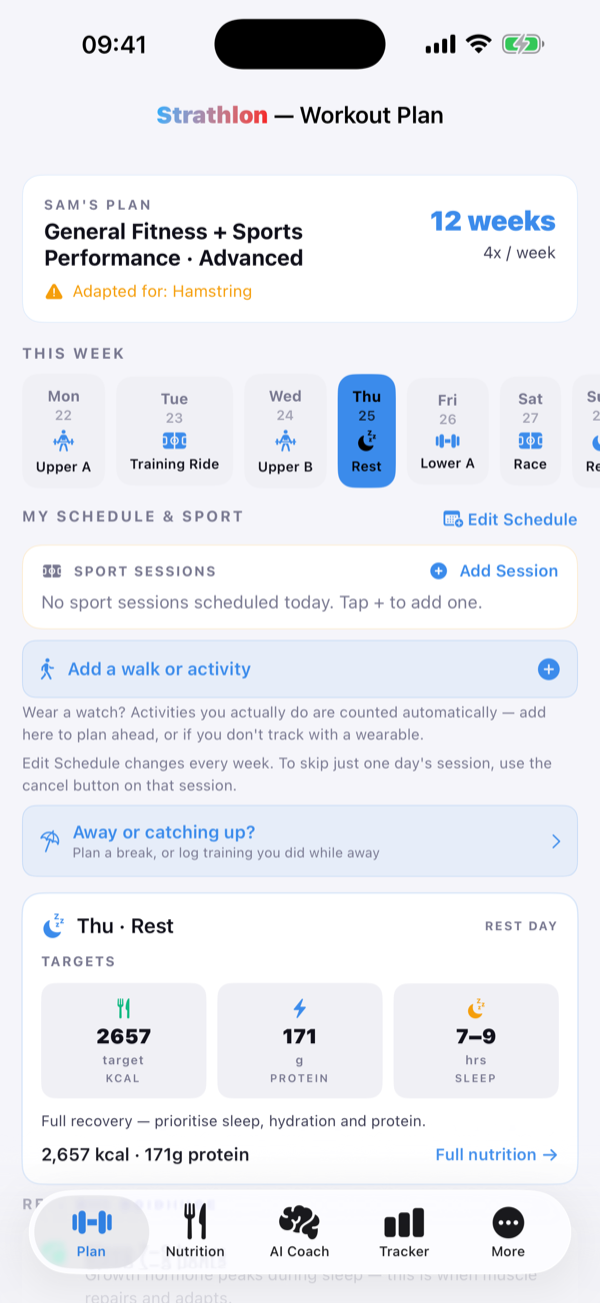
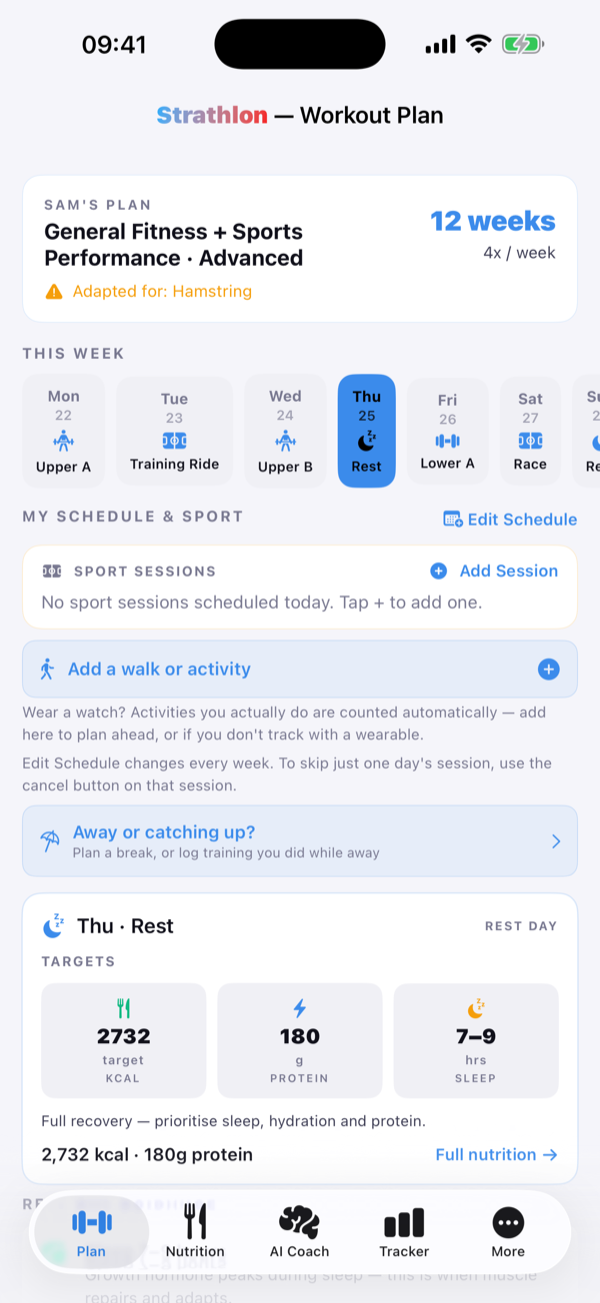
If you take one thing away, make it this: eating enough for your training isn't a lapse in discipline: it's the foundation everything else is built on. The athletes who last aren't the ones who eat the least. They're the ones who fuel the work they do. Strathlon's small part is to keep that honest, by nudging your daily target up to meet the training you actually log, so "did I eat enough for that?" is one less thing left to guess.
References
The numbered markers throughout this guide link to the sources below. Where a point reflects established guidance rather than a single study, we cite the governing body and its position stand, and name the country it belongs to: the evidence base here is genuinely international, and no one nation's guidance speaks for all of it.
- Loucks AB, Thuma JR. Luteinizing hormone pulsatility is disrupted at a threshold of energy availability in regularly menstruating women. Journal of Clinical Endocrinology & Metabolism. 2003;88(1):297–311. PubMed 12519869
- Mountjoy M, Ackerman KE, Bailey DM, Burke LM, Constantini N, Hackney AC, Heikura IA, Melin A, Pensgaard AM, Stellingwerff T, Sundgot-Borgen JK, Torstveit MK, Jacobsen AU, Verhagen E, Budgett R, Engebretsen L, Erdener U. 2023 International Olympic Committee's (IOC) consensus statement on Relative Energy Deficiency in Sport (REDs). British Journal of Sports Medicine. 2023;57(17):1073–1097. Consensus statement of the International Olympic Committee (IOC, international). PubMed 37752011
- Melin AK, Heikura IA, Tenforde A, Mountjoy M. Energy availability in athletics: health, performance, and physique. International Journal of Sport Nutrition and Exercise Metabolism. 2019;29(2):152–164. Published in the nutrition-for-athletics consensus issue of the International Association of Athletics Federations (IAAF, now World Athletics; international). PubMed 30632422
- Ihle R, Loucks AB. Dose-response relationships between energy availability and bone turnover in young exercising women. Journal of Bone and Mineral Research. 2004;19(8):1231–1240. PubMed 15231009
- Koehler K, Hoerner NR, Gibbs JC, Zinner C, Braun H, De Souza MJ, Schaenzer W. Low energy availability in exercising men is associated with reduced leptin and insulin but not with changes in other metabolic hormones. Journal of Sports Sciences. 2016;34(20):1921–1929. PubMed 26852783
- Nattiv A, Loucks AB, Manore MM, Sanborn CF, Sundgot-Borgen J, Warren MP. American College of Sports Medicine position stand: the female athlete triad. Medicine & Science in Sports & Exercise. 2007;39(10):1867–1882. Position stand of the American College of Sports Medicine (ACSM, United States). PubMed 17909417
- Mountjoy M, Sundgot-Borgen J, Burke L, Carter S, Constantini N, Lebrun C, Meyer N, Sherman R, Steffen K, Budgett R, Ljungqvist A. The IOC consensus statement: beyond the Female Athlete Triad — Relative Energy Deficiency in Sport (RED-S). British Journal of Sports Medicine. 2014;48(7):491–497. Consensus statement of the International Olympic Committee (IOC, international). PubMed 24620037
- Mountjoy M, Sundgot-Borgen JK, Burke LM, Ackerman KE, Blauwet C, Constantini N, Lebrun C, Lundy B, Melin AK, Meyer NL, Sherman RT, Tenforde AS, Torstveit MK, Budgett R. IOC consensus statement on relative energy deficiency in sport (RED-S): 2018 update. British Journal of Sports Medicine. 2018;52(11):687–697. Consensus statement of the International Olympic Committee (IOC, international). PubMed 29773536
- Keay N, Francis G, Hind K. Low energy availability assessed by a sport-specific questionnaire and clinical interview indicative of bone health, endocrine profile and cycling performance in competitive male cyclists. BMJ Open Sport & Exercise Medicine. 2018;4(1):e000424. PubMed 30364549
- Barrack MT, Gibbs JC, De Souza MJ, Williams NI, Nichols JF, Rauh MJ, Nattiv A. Higher incidence of bone stress injuries with increasing female athlete triad-related risk factors: a prospective multisite study of exercising girls and women. American Journal of Sports Medicine. 2014;42(4):949–958. PubMed 24567250
- Drew M, Vlahovich N, Hughes D, Appaneal R, Burke LM, Lundy B, Rogers M, Toomey M, Watts D, Lovell G, Praet S, Halson SL, Colbey C, Manzanero S, Welvaert M, West NP, Pyne DB, Waddington G. Prevalence of illness, poor mental health and sleep quality and low energy availability prior to the 2016 Summer Olympic Games. British Journal of Sports Medicine. 2018;52(1):47–53. PubMed 29056598
- Melin A, Tornberg ÅB, Skouby S, Møller SS, Sundgot-Borgen J, Faber J, Sidelmann JJ, Aziz M, Sjödin A. Energy availability and the female athlete triad in elite endurance athletes. Scandinavian Journal of Medicine & Science in Sports. 2015;25(5):610–622. PubMed 24888644
- Sundgot-Borgen J, Torstveit MK. Prevalence of eating disorders in elite athletes is higher than in the general population. Clinical Journal of Sport Medicine. 2004;14(1):25–32. PubMed 14712163
- Lane AR, Hackney AC, Smith-Ryan A, Kucera K, Registar-Mihalik J, Ondrak K. Prevalence of low energy availability in competitively trained male endurance athletes. Medicina (Kaunas). 2019;55(10):665. PMC6843850
- Thomas DT, Erdman KA, Burke LM. Position of the Academy of Nutrition and Dietetics, Dietitians of Canada, and the American College of Sports Medicine: nutrition and athletic performance. Journal of the Academy of Nutrition and Dietetics. 2016;116(3):501–528. Joint position of the Academy of Nutrition and Dietetics (United States), Dietitians of Canada (Canada) and the American College of Sports Medicine (ACSM, United States). PubMed 26920240
This is general educational information rather than medical, dietary or coaching advice, and it is not a diagnosis. The figures here (including the ~30 and ~45 kcal/kg fat-free mass/day thresholds) are drawn from established sports-medicine consensus and are framed as population-level guides from mostly short studies; individual needs and tolerances vary. RED-S and low energy availability are health conditions that require proper assessment. Anyone with stress fractures, menstrual disruption or lost periods, frequent illness, suspected under-fuelling or RED-S, a history of disordered eating, or who is pregnant or postpartum, should consult a sports physician and a registered dietitian before making changes. If food, weight or eating feel distressing or controlling, please reach out to a qualified professional or an eating-disorder support service. See our Terms for more.
← All guides · Fuelling for running · Fuelling for gymnastics · Fuelling for climbing · Training with your cycle · Eating for results · Home