
Women, strength and fuelling: lifting, protein and eating enough
A supportive, evidence-based guide for women who lift, or want to. It tackles the fear that keeps so many women out of the weights room (that lifting heavy makes you "bulky"), covers how much protein you actually need, and lands on the message that matters most and is most often missed: eat enough. Chronic under-fuelling harms your cycle, your bones and your performance, and it isn't only a risk for women who are dieting. Practical, honest, and grounded in established exercise and sports-nutrition science.
Here's the whole thing in one sentence: lifting heavy tends to make women leaner, stronger and more defined rather than bulky, since building large muscle takes years of dedicated effort and a real surplus, so eat enough protein (around 1.6–2.2 g per kg a day) and, above all, enough total food, because under-fuelling is the fast route to lost periods, weaker bones and stalled progress. Everything below unpacks those three ideas: you won't get bulky, get your protein, and eat enough.
On this page
A framing note before the detail. The physiology here is well established in broad terms, but people differ enormously: training history, age, genetics, sleep, health status and life stress all shift how anyone responds. So this is written as can, tends to and around, never as a guarantee, and every specific figure is a population-level guide drawn from published consensus rather than a personal prescription. It's general education rather than medical or dietary advice, and it isn't a personalised plan. If any of the health signs below sound familiar (especially missing periods, repeated injuries or a history of disordered eating), please route that to a qualified professional rather than a website.
Lifting heavy won't make you "bulky"
Let's meet the fear head-on, because it stops more women from strength training than almost anything else. The worry is that picking up heavy weights will, more or less by accident, turn you big and bulky. It won't, and the reasons are worth understanding, because they're reassuring rather than restrictive.
Building large muscle is slow, deliberate and demanding. It takes years of consistent, progressive training, a genuine calorie surplus, and a lot of hard weekly volume. It doesn't happen by turning up twice a week and lifting with intent. On top of that, hormones make dramatic bulk far harder for most women: adult men carry roughly ten times more testosterone on average (the main hormonal driver of large muscle growth), which is the single biggest reason men tend to be more muscular. The very muscular female physiques people picture when they say "bulky" are the product of many years of specialised training, precise nutrition and, often, performance-enhancing drugs. They are not what happens to someone who starts lifting.
Here's the encouraging flip side. Women absolutely do build real muscle, and the research is clear that they gain muscle at a similar relative rate to men when they train: the growth trajectory is much the same. The difference is mostly one of starting point and absolute size: women begin with less muscle and add it in smaller absolute amounts, so the typical visible result of lifting is looking leaner, firmer and more defined (the thing usually called "toned") while getting considerably stronger. In practice, most women find the real challenge is adding muscle rather than avoiding it.
What strength training actually does for women
With the bulk fear set aside, it's worth naming what you actually get, because the upside is large and reaches well beyond how you look:
- Strength and capability. The most obvious return, and it comes quickly: early strength gains are largely your nervous system getting more efficient, which is why you often get noticeably stronger before you look any different. Everyday life gets easier.
- A leaner, more defined shape. Building and holding muscle while losing fat is what produces the firm, defined look most people are actually after, and muscle is the tissue that gives your body its shape as fat comes down.
- Stronger bones. Loading the skeleton is one of the best things you can do for it. Resistance training is associated with improved bone mineral density, an effect studied especially in post-menopausal women, where progressive lifting at meaningful intensities (research often points to around 70–80% of a one-rep maximum, two to three times a week) helps protect against the bone loss that accelerates around menopause. Strong muscles pulling on bone is part of what keeps bone strong.
- Metabolic and health benefits, and mood. Resistance training supports healthy body composition, insulin sensitivity and mood, with a very low injury risk when loads are built up sensibly.
- References
None of this requires living in the gym. Two or three challenging sessions a week, progressed gradually over months, delivers the bulk of these returns. If you're new to how muscle is actually built (progressive overload, effort, range of motion, recovery), the build-muscle basics guide is the companion piece to this one.
Protein: how much, and why women often fall short
Muscle is built from protein, and getting enough is one of the few nutrition levers that genuinely matters for strength training. A widely cited target for people training to build or preserve muscle is roughly 1.6–2.2 g of protein per kilogram of body weight per day, drawn from sports-nutrition position stands. The International Society of Sports Nutrition frames 1.4–2.0 g/kg/day as sufficient for most exercising people, with the higher end associated with greater gains in lean mass in those lifting. For a 70 kg woman that's very roughly 110–150 g a day, a target that takes deliberate effort to hit and rarely happens by accident.
Distribution helps too. Rather than saving protein for one big evening meal, spreading it across the day, commonly around 20–40 g (about 0.25–0.40 g/kg) per meal, every three to four hours, appears to support muscle repair more effectively. And there's a well-documented pattern worth flagging directly: women, on average, tend to under-eat protein relative to these targets, often skewing meals toward carbohydrate and coming up short at breakfast in particular. If your training isn't translating into strength or shape the way you'd hoped, protein is one of the first places to look.
Eating enough: the message that matters most
If you take one thing from this guide, make it this: eat enough. Protein grams matter, but they sit on top of a more fundamental question: is your total energy intake keeping up with the training you're doing? For a great many active women, the honest answer is no, and it's the quiet root of more problems than any single nutrient.
Two myths feed the under-eating trap. The first is that "lighter is always better," which pushes women to eat as little as they can get away with. The second is the bulk fear above, which makes eating enough to build feel risky. Both are wrong, and together they leave a lot of women training hard on too little food, stuck feeling flat, stalled, and sometimes doing quiet harm.
On building muscle specifically: you do not need a large surplus. Beginners and returners can build some muscle while even losing a little fat, and a big surplus mostly adds fat rather than extra muscle. A slight surplus makes building easier once you're past the early stage. If you're dieting to lose fat, the priority flips to protecting the muscle you have, which is exactly when protein at the higher end helps (some evidence supports up to 2.3–3.1 g/kg/day to retain lean mass in a deficit), alongside not making the deficit brutally large. Either way, the failure mode is the same: eat too little overall for too long and the body simply can't build or hold tissue it doesn't have the energy for.
Under-fuelling, your cycle and RED-S
This is the part that turns "eat enough" from a slogan into something with real stakes. Sports scientists describe the problem as low energy availability: not leaving enough energy, once the cost of exercise is paid, to run the body's basic functions: repair, immunity, hormones, bone maintenance. It's measured as energy availability, roughly energy eaten minus energy burned in exercise, per kilogram of fat-free (lean) mass. Research links falling below about 30 kcal per kg of fat-free mass per day with disrupted hormone signalling and menstrual function, while something nearer 45 kcal/kg/day is considered healthy for an active body.
Importantly, low energy availability is often unintentional. It reaches well beyond women with an eating disorder or those deliberately cutting. It happens any time fuelling simply fails to keep pace with training, including in women training to gain strength or to perform. Estimates suggest it affects a substantial share of active women (studies of endurance and leanness-emphasis sports have reported figures spanning roughly a fifth to over half of athletes), and much of it is inadvertent, the result of a busy day, a big session and food that just didn't catch up. You do not have to be underweight, or dieting, to be under-fuelled.
Sustained low energy availability is the root cause of the female athlete triad (the linked trio of low energy availability, menstrual disruption and reduced bone density) and of the broader syndrome the International Olympic Committee calls Relative Energy Deficiency in Sport (RED-S), which can also impair immunity, metabolism, mood and, ironically, the very performance the under-eating is often meant to improve. The warning signs are worth knowing:
- Missing, irregular or lost periods: one of the clearest signals, and never a normal side effect of training hard.
- Recurrent stress fractures or bone injuries, or frequent illness.
- Stalled or declining performance despite training hard, poor sleep, low mood, or constant cold and fatigue.
None of these are things to push through. The usual answer is to eat more, and sometimes train a little less: for menstrual disruption driven by under-fuelling, restoring energy is typically the most effective fix, and to seek help from a doctor, sports physician or registered dietitian. This guide is general education; a lost period or a repeat stress fracture is a signal to involve a professional rather than to diagnose from a web page. Our energy availability and RED-S guide goes into this in depth.
A note on your menstrual cycle
A regular, healthy cycle is one of the better everyday signals that you're fuelling and recovering adequately, which is part of why the loss of one matters so much. Beyond that, many women wonder whether they should train and eat differently across the month. The honest state of the science is that the foundations (enough total energy, adequate protein, consistent progressive training and good sleep) matter far more than fine-tuning meals to a cycle phase, and the evidence for precise phase-based nutrition tweaks is still developing.
Even so, it's completely reasonable to work with your body: if appetite, energy or cravings shift across the month (often rising in the days before a period), eating a little more to match genuine hunger is sensible rather than a lapse in discipline. Treat cycle-based adjustments as personal fine-tuning on top of solid basics, never as a replacement for them. We cover this properly in the nutrition across your cycle and training with your cycle guides, which this page is designed to complement.
Putting it together
None of this is complicated in practice. The whole guide collapses into a short routine you can actually run:
- Lift with intent, two to three times a week, and progress gradually. Challenging weights are the goal: that's what builds strength, shape and bone, and it won't make you bulky.
- Anchor each day around protein, aiming toward roughly 1.6–2.2 g/kg, spread across meals, and don't skip it at breakfast. It's the nutrient most women lifting tend to under-eat.
- Eat enough overall. Match your food to your training rather than trying to eat as little as possible. On harder training days, eat more.
- Watch the warning lights. A missing period, a recurring injury, or a season that's going backwards despite hard work all point one way: usually toward eating more, sometimes training less, and checking in with a professional.
Strength training is one of the highest-return things a woman can do for her body, and the fears that keep so many away from it (getting bulky, needing to eat less to justify it) have it almost exactly backwards. Lift challenging weights, feed the work, and protect the signals your body sends you. That's the whole game.
Common questions
Will lifting heavy weights make me bulky?
Very unlikely. Building large, obviously bulky muscle takes years of dedicated training, a genuine calorie surplus and high volume, and it is made much harder for most women by hormones: adult men carry on the order of ten times more testosterone, the main driver of large muscle gains. Women who lift do build real muscle, and studies suggest they gain muscle at a similar relative rate to men, but from a smaller starting point, so the usual result is looking leaner, stronger and more defined rather than bigger. If anything, most women struggle to add muscle in the first place. You will not wake up accidentally bulky.
How much protein do I need as a woman who lifts?
For building and maintaining muscle alongside resistance training, sports-nutrition position stands put a sensible daily target at roughly 1.6–2.2 g of protein per kilogram of body weight, with about 1.4–2.0 g/kg enough for most exercising people. Spreading it across the day, commonly around 20–40 g (about 0.25–0.40 g/kg) per meal every few hours, tends to support muscle repair better than saving it all for dinner. If you are dieting to lose fat, aiming toward the higher end (some evidence supports up to 2.3–3.1 g/kg/day) helps protect muscle while you are in a deficit. These are population-level guides rather than exact thresholds.
Do I need to be in a big calorie surplus to build muscle?
No. Beginners, and people returning to training, can build some muscle while losing fat, and a large surplus is not required: it mostly adds fat rather than extra muscle. A slight surplus makes building easier and faster once you are past the early stage. Far more important than the exact surplus is eating enough overall: chronically under-eating relative to your training is one of the most common reasons progress stalls, because your body cannot build tissue it does not have the energy for.
Does low energy availability only affect women who are dieting?
No, and that is the important point. Low energy availability means not leaving enough energy, once exercise is paid for, to run the body's basic functions, and it is often unintentional: it happens whenever fuelling simply fails to keep up with training, whether or not you are trying to lose weight. It is common in active women, including those training to gain strength or perform, and well beyond those cutting. Research links falling below about 30 kcal per kg of fat-free mass per day with disrupted hormones and menstrual function, whereas around 45 kcal/kg is considered healthy. You do not have to be dieting, or underweight, to under-fuel.
I lift and my periods have become irregular or stopped: what does that mean?
A missing or irregular period in an active woman is a red flag worth taking seriously. It is never a normal side effect of training hard, and it is often a sign of low energy availability (the body down-regulating reproductive function because it is not being fed enough for the training load), which sits at the centre of the female athlete triad and RED-S, and is associated with knock-on effects on bone and hormones. The usual first step is to eat more and, if needed, train a little less, and to see a doctor or sports dietitian. It is not something to push through.
Should I eat differently around my menstrual cycle?
The foundations do not change: enough total energy, adequate protein and consistent training matter far more than fine-tuning meals to your cycle phase. Some women notice appetite, energy or cravings shift across the month, and eating a little more to match genuine hunger (especially in the days before a period) is sensible rather than something to resist. The evidence for precise phase-based nutrition tweaks is still developing, so treat it as personal fine-tuning on top of solid basics. Our cycle guides go deeper into training and nutrition across the month.
Takeaways
- You won't get bulky. Large muscle takes years, a real surplus and high volume, and is limited for most women by far lower testosterone. Lifting makes the typical woman leaner, stronger and more defined.
- You do build real muscle. Women gain muscle at a similar relative rate to men, from a smaller base, so "toned" is just muscle you've built and can see.
- Lift challenging weights, 2–3× a week. Progress gradually. It builds strength, shape and bone (studied especially in post-menopausal women) with low injury risk.
- Get your protein. Aim roughly 1.6–2.2 g/kg/day, spread ~20–40 g per meal, and don't skip breakfast, since women tend to under-eat protein.
- Eat enough overall. You don't need a big surplus, but you do need to feed your training. Under-eating stalls results and, sustained, does harm.
- Under-fuelling isn't only for dieters. Low energy availability (below ~30 kcal/kg fat-free mass/day) is often unintentional and common in active women, including those training to gain.
- Protect your cycle. A lost or irregular period is a red flag for low energy availability, the female athlete triad and RED-S, so eat more, maybe train less, and see a professional.
- Cycle tweaks are fine-tuning. Foundations come first. Adjust to genuine hunger across the month rather than overhauling your nutrition by phase.
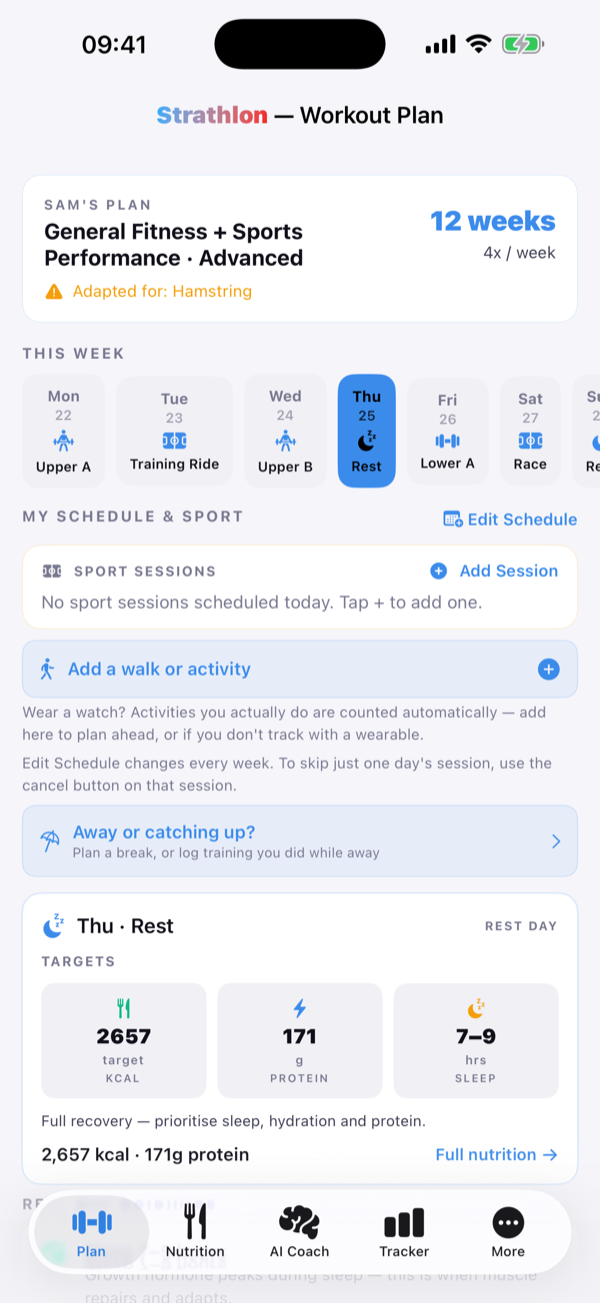
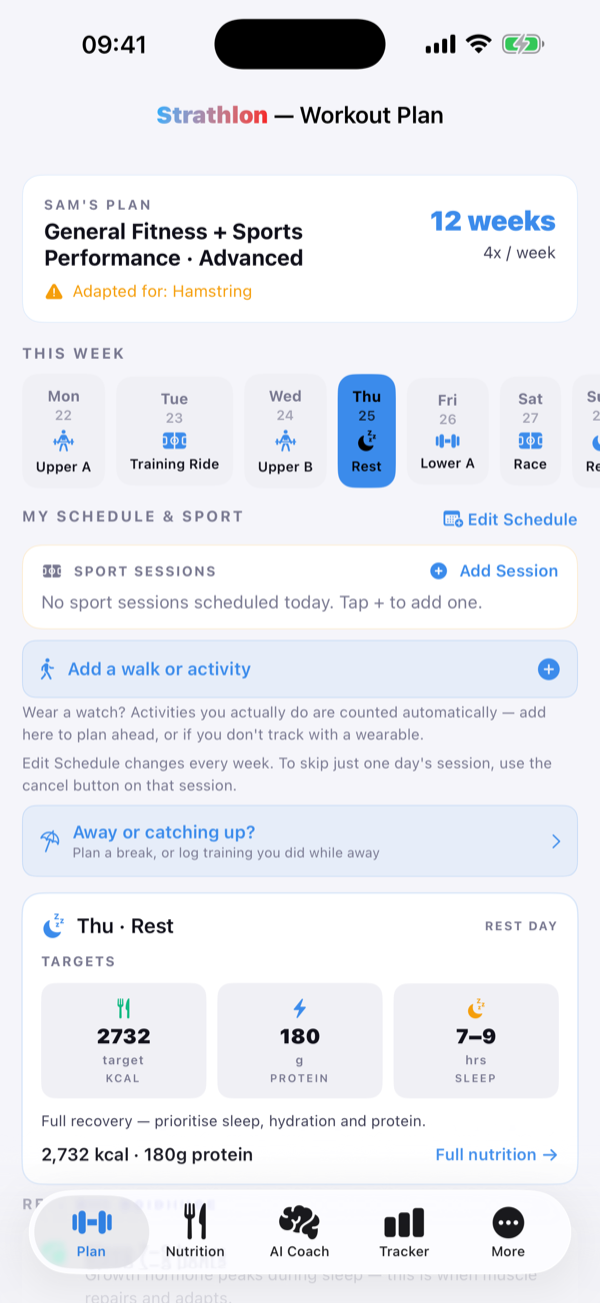
If you remember one line, make it this: strength training won't make you bulky, but eating too little to support it will hurt you. Lift with intent, get your protein, and eat enough. Strathlon's job is to keep that last part honest by lifting your daily targets around the sessions you actually log, so "did I eat enough for what I did today?" is answerable at a glance.
References
Numbered sources for the specific figures and ranges above. Where a point reflects agreed guidance rather than a single trial, the citation is to the position stand or consensus statement of the body concerned, with the country or international remit named. Where a claim is specific to women it is cited to female or sex-comparative research; where the underlying physiology is not sex-specific, the general source is used and said to be general.
- D'Souza AC, Wageh M, Williams JS, Colenso-Semple LM, McCarthy DG, McKay AKA, et al. Menstrual cycle hormones and oral contraceptives: a multimethod systems physiology-based review of their impact on key aspects of female physiology. Journal of Applied Physiology. 2023;135(6):1284–1299. A systems-physiology review of menstrual cycle hormones and hormonal contraceptives across performance variables: the anchor for treating cycle tweaks as fine-tuning rather than foundation. PubMed 37823207 · PMC10979803 full text
- D'Souza AC, Van Every DW, Bhinder A, Elango S, Lamont GAC, Lees MJ, et al. Menstrual Cycle Phase Does Not Influence Training-Induced Muscle Hypertrophy or Strength: A Randomized Controlled Trial. Medicine and Science in Sports and Exercise. 2026. Randomised controlled trial finding menstrual cycle phase did not influence training-induced hypertrophy or strength, the strongest available check on phase-based programming. PubMed 42160459
- Jäger R, Kerksick CM, Campbell BI, Cribb PJ, Wells SD, Skwiat TM, et al. International Society of Sports Nutrition Position Stand: protein and exercise. Journal of the International Society of Sports Nutrition. 2017;14:20. ISSN position stand on protein and exercise: the source for the roughly 1.6 to 2.2 g/kg/day target and the 20 to 40 g per-meal figure. PubMed 28642676 · PMC5477153 full text
- Schoenfeld BJ, Aragon AA. How much protein can the body use in a single meal for muscle-building? Implications for daily protein distribution. Journal of the International Society of Sports Nutrition. 2018;15:10. Schoenfeld and Aragon on single-meal protein dose, the basis for the per-meal range quoted. PubMed 29497353 · PMC5828430 full text
- Morton RW, Murphy KT, McKellar SR, Schoenfeld BJ, Henselmans M, Helms E, et al. A systematic review, meta-analysis and meta-regression of the effect of protein supplementation on resistance training-induced gains in muscle mass and strength in healthy adults. British Journal of Sports Medicine. 2018;52(6):376–384. Morton and colleagues' meta-analysis of protein supplementation and resistance-training outcomes, supporting the protein target for building muscle. PubMed 28698222 · PMC5867436 full text
- Baz-Valle E, Balsalobre-Fernández C, Alix-Fages C, Santos-Concejero J. A Systematic Review of The Effects of Different Resistance Training Volumes on Muscle Hypertrophy. Journal of Human Kinetics. 2022;81:199–210. Systematic review of resistance-training volume and hypertrophy, the general source behind lifting challenging weights two to three times a week. PubMed 35291645 · PMC8884877 full text
- Mountjoy M, Ackerman KE, Bailey DM, Burke LM, Constantini N, Hackney AC, et al. 2023 International Olympic Committee's (IOC) consensus statement on Relative Energy Deficiency in Sport (REDs). British Journal of Sports Medicine. 2023;57(17):1073–1097. The 2023 IOC consensus statement on Relative Energy Deficiency in Sport, the source for the health consequences of sustained under-fuelling. PubMed 37752011
- Loucks AB, Thuma JR. Luteinizing hormone pulsatility is disrupted at a threshold of energy availability in regularly menstruating women. The Journal of Clinical Endocrinology and Metabolism. 2003;88(1):297–311. Loucks and Thuma's threshold study, the origin of the roughly 30 kcal/kg fat-free mass/day energy-availability figure this guide quotes. PubMed 12519869
- Ihle R, Loucks AB. Dose-response relationships between energy availability and bone turnover in young exercising women. Journal of Bone and Mineral Research : the Official Journal of the American Society for Bone and Mineral Research. 2004;19(8):1231–40. Dose-response between energy availability and bone turnover in young exercising women, the direct evidence for the bone-health stakes. PubMed 15231009
- Melin A, Tornberg ÅB, Skouby S, Møller SS, Sundgot-Borgen J, Faber J, et al. Energy availability and the female athlete triad in elite endurance athletes. Scandinavian Journal of Medicine & Science in Sports. 2015;25(5):610–22. Study of energy availability and the female athlete triad in elite endurance athletes, supporting the claim that low energy availability is often unintentional. PubMed 24888644
- Barrack MT, Gibbs JC, De Souza MJ, Williams NI, Nichols JF, Rauh MJ, et al. Higher incidence of bone stress injuries with increasing female athlete triad-related risk factors: a prospective multisite study of exercising girls and women. The American Journal of Sports Medicine. 2014;42(4):949–58. Prospective study finding higher bone-stress-injury incidence with increasing triad-related risk factors, the injury half of the same argument. PubMed 24567250
- Cialdella-Kam L, Guebels CP, Maddalozzo GF, Manore MM. Dietary intervention restored menses in female athletes with exercise-associated menstrual dysfunction with limited impact on bone and muscle health. Nutrients. 2014;6(8):3018–39. Dietary intervention restoring menses in athletes with exercise-associated menstrual dysfunction: the evidence that eating more is the intervention. PubMed 25090245 · PMC4145292 full text
- Nattiv A, Loucks AB, Manore MM, Sanborn CF, Sundgot-Borgen J, Warren MP. American College of Sports Medicine position stand. The female athlete triad. Medicine and Science in Sports and Exercise. 2007;39(10):1867–82. ACSM position stand on the female athlete triad, the clinical framing behind 'see a professional'. PubMed 17909417
- Pengelly M, Pumpa K, Pyne DB, Etxebarria N. Iron deficiency, supplementation, and sports performance in female athletes: A systematic review. Journal of Sport and Health Science. 2025;14:101009. Systematic review of iron deficiency and performance in female athletes, supporting the fuelling-and-bloods advice. PubMed 39536912 · PMC11863318 full text
- Thomas DT, Erdman KA, Burke LM. Position of the Academy of Nutrition and Dietetics, Dietitians of Canada, and the American College of Sports Medicine: Nutrition and Athletic Performance. Journal of the Academy of Nutrition and Dietetics. 2016;116(3):501–528. Joint ACSM / AND / DC position on nutrition and athletic performance, the general fuelling guidance underneath the female-specific points. PubMed 26920240
- Kanellakis S, Skoufas E, Simitsopoulou E, Migdanis A, Migdanis I, Prelorentzou T, et al. Changes in body weight and body composition during the menstrual cycle. American Journal of Human Biology : the Official Journal of the Human Biology Council. 2023;35(11):e23951. Changes in body weight and body composition across the menstrual cycle, cited for reading the scale correctly while training. PubMed 37395124
This is general educational information rather than medical, dietary or coaching advice. The physiology and sports-nutrition figures here are drawn from established consensus and framed as population-level guides; individual needs vary widely with body size, training, health and genetics, and are best personalised with a qualified professional. Anyone with a health condition, a history of disordered eating, or who is pregnant or postpartum, or who has missing or irregular periods, recurrent stress fractures, or suspects under-fuelling or RED-S, should consult a doctor, sports physician or registered dietitian before making changes. See our Terms for more.
← All guides · How muscle actually grows · Energy availability & RED-S · Nutrition across your cycle · Training with your cycle · Eating for results · Home