
Nutrition across your menstrual cycle
A supportive, evidence-based look at how the menstrual cycle and nutrition interact: the appetite and craving shifts that show up in the luteal phase, the water-retention weight swings that make the scale lie, the small changes in energy needs, iron, and fuelling protein and carbohydrate through the month. Written honestly: some of this is well established, some is genuinely uncertain, and the single most important message is the calmest one: eat enough to keep your cycle healthy.
The short version: across your cycle your appetite, energy needs and body weight can all shift a little (mostly around the luteal phase before your period), but the swings are usually small and driven mostly by water and hormones rather than fat. The highest-value moves are the unglamorous ones: eat enough overall, get adequate protein and carbohydrate, look after iron, and treat a regular cycle as a sign you are fuelling enough. Elaborate phase-by-phase "cycle syncing" is optional and its evidence is thin. The fundamentals below are what actually matter.
On this page
- A 20-second map of the cycle
- Do your energy needs really change?
- Appetite and cravings in the luteal phase
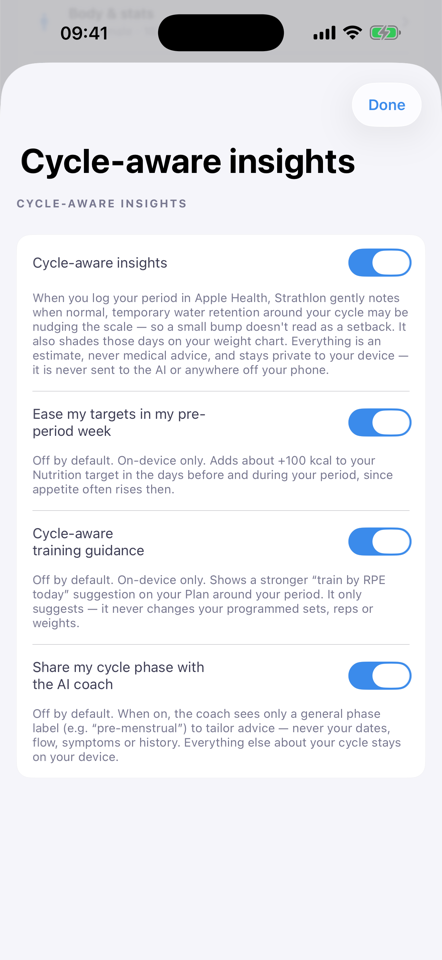
- The scale moves with your cycle: water rather than fat
- Carbohydrate and protein through the month
- Iron: the mineral women lose every month
- Eat enough to keep your cycle: the master signal
- Does "cycle syncing" your nutrition work?
- Common questions
- Takeaways
A framing note before the detail. This is a sensitive, individual topic, and the science is younger and thinner than for many areas of nutrition. Women have historically been under-represented in exercise research, so a lot of honest answers are "it can, a little, and it varies." So everything here is written as can, tends to and around, never as a guarantee, and every specific figure is a population-level guide from published sources rather than a personal prescription. It is general education rather than medical advice, and it is not a substitute for care from your own doctor or dietitian, especially if your periods are irregular, absent, very heavy, or a source of distress. This page is the nutrition companion to our training-with-your-cycle guide. The two are designed to be read together.
A 20-second map of the cycle
You only need a rough map to make sense of the nutrition. A typical cycle runs around 28 days (anywhere from about 21 to 35 is common) and splits into two halves around ovulation:
- The follicular phase: from the first day of your period up to ovulation. Estrogen rises toward the end of it. Hormone levels are relatively low early on.
- The luteal phase: from ovulation until your next period, roughly the back half of the cycle. Both progesterone and estrogen are higher here, and this is the stretch where most of the nutrition-relevant effects (appetite, cravings, a small rise in energy needs, fluid retention) tend to show up. The days just before your period (the "premenstrual" window) are the peak of it.
- References
That is the whole map you need for what follows: most of the action is in the luteal phase, and most of it is modest. The exact hormonal detail is covered in the training guide. Here we care only about how those two halves change what and how much you might want to eat.
Do your energy needs really change?
A little, probably, but less than the internet often claims. Your resting metabolic rate (the energy you burn just existing) tends to be slightly higher in the luteal phase than the follicular phase, because the rise in progesterone and estrogen nudges energy expenditure up. But the honest summary of the research is "small and inconsistent." Systematic reviews and a meta-analysis of menstrual-cycle metabolism find, on average, only a modest luteal increase: across studies the estimate spans roughly a few percent, on the order of tens of kilocalories a day (very roughly 30–120 kcal in the studies that found an effect), and several more recent, better-controlled studies find no statistically significant difference at all.
What does that mean in practice? Not much precision engineering. The change is small enough that trying to hit a different exact calorie target each week is neither necessary nor reliable. It is smaller than the day-to-day noise in most people's intake and tracking. The International Society of Sports Nutrition's position stand on the female athlete puts it gently: eumenorrheic athletes (those with regular cycles) may consider increasing their 24-hour energy intake somewhat in the luteal phase. Read that as permission to eat a bit more when you are genuinely hungrier, rather than as an instruction to force-feed.
Appetite and cravings in the luteal phase
If you feel hungrier and find yourself reaching for carbohydrate, sweet or higher-fat foods in the days before your period, that is a real, hormone-driven pattern, with neither weakness nor a failure of discipline to blame. Appetite and food intake commonly rise in the luteal phase, tracking the same hormonal shift that nudges energy expenditure up, and cravings (classically for chocolate and carb-rich comfort food) are among the most frequently reported premenstrual symptoms. The evidence isn't perfectly uniform (some studies of athletes find smaller swings), but for many people the effect is noticeable and normal.
The useful question is how to respond, and here the calm approach beats the strict one. Two things help most:
- Feed the hunger properly. Meet the extra appetite mostly with balanced, satisfying meals: enough carbohydrate to match your training, adequate protein to keep you full, regular meals rather than long gaps. People who are genuinely well-fed across the day tend to experience less overwhelming craving than those running a deficit and white-knuckling it.
- Leave room for the foods you actually want. Trying to completely suppress a craving often backfires into a bigger, guiltier episode later. A square of chocolate that you planned for is a better outcome than a fortnight of resisting followed by a binge. This is one place where flexibility is the more effective strategy. It just looks like the lazy one.
The scale moves with your cycle: water rather than fat
One of the most useful things anyone who menstruates can learn is that the number on the scale rises and falls with the cycle, and the premenstrual bump is water. Hormone changes in the luteal phase cause temporary fluid retention that typically builds through the week or two before your period and resolves soon after bleeding starts. It can move the scale by around a pound or two (roughly half to one kilogram), and more in people with strong premenstrual symptoms, and none of it is fat. It is physically impossible to gain a kilogram of body fat overnight from normal eating. That would take a surplus of several thousand kilocalories.
This matters because a premenstrual spike on the scale, misread as "fat gain," is a classic trigger for exactly the wrong response: a sudden crackdown on food right when your body is hungrier and working harder. The fix is simple and freeing: compare like with like. Weigh trends over weeks rather than days, and when you want a true read, compare the same point of successive cycles: for example, the same few days each month. That cancels out the monthly water tide and shows you the underlying direction of travel, which is the only thing worth acting on.
Carbohydrate and protein through the month
The macronutrient foundations for an active woman are the same ones that apply all month. The cycle only fine-tunes them at the edges.
Carbohydrate is your main training fuel, and the base need scales with how much and how hard you train (our fuelling guides cover the per-sport detail). There is a plausible physiological reason carbohydrate might matter a touch more in the luteal phase: the higher sex hormones there can slightly shift how the body makes and uses glucose during exercise, and the ISSN position stand suggests emphasising adequate carbohydrate intake and availability in the luteal phase in particular. The practical translation is not a special "luteal diet". It is simply to make sure you are not skimping on carbohydrate in the back half of your cycle, especially around hard sessions, when both your training and your appetite may be asking for it.
Protein supports muscle repair and adaptation and helps with fullness, useful when appetite is up. The ISSN's female-athlete position stand recommends a daily intake in the region of 1.4–2.2 g of protein per kilogram of body weight, spread across the day, with the higher end relevant for those training hard (and it flags the luteal phase, and the peri- and post-menopausal years, as times to lean toward the upper end). Around training it describes per-meal doses of roughly 0.32–0.38 g/kg. If that sounds like a lot of numbers, the takeaway is blunt: many active women under-eat protein, and getting enough (a protein source at each meal) does more for you than any cycle-timing trick. The women, strength and fuelling guide goes deeper on this, and eating for results covers the whole plate.
Iron: the mineral women lose every month
Iron is the one nutrient where menstruating is a genuine, recurring drain, and it is the deficiency active women slip into most often. Iron carries oxygen in your blood and is central to energy metabolism and endurance, so running low shows up as exactly the things you don't want: fatigue, breathlessness, poor training and flat performance. Because you lose blood, and therefore iron, with every period, requirements are higher for women than men.
- How much you need. The recommended daily intake is 18 mg for women aged 19–50, versus just 8 mg for men and for women past menopause. In pregnancy it rises to 27 mg. Each period costs a modest amount of iron: very roughly on the order of 15–25 mg over a typical bleed, which is why the monthly total adds up.
- Where to get it, and how to absorb it. Heme iron (from meat, poultry and seafood) is absorbed far better than non-heme iron (from beans, lentils, tofu, wholegrains, nuts and leafy greens). Pairing plant iron with a vitamin C source at the same meal (peppers, citrus, tomatoes) improves absorption. Because plant iron is absorbed less efficiently, vegetarians and vegans are advised to aim for roughly 1.8 times the figures above: for a premenopausal woman that works out near ~32 mg a day from food.
- Higher-risk groups. Iron deficiency is common in active women (by some estimates it affects 15–35% of female athletes), and the risk is higher with heavy periods, a plant-based diet, endurance training, or under-eating. Endurance athletes may lose a little extra iron through sweat, gut losses and the pounding of running.
Two firm safety points. First, do not self-prescribe iron supplements. Too much iron is harmful, symptoms like tiredness have many causes, and you can't tell your iron status from how you feel. If you suspect a problem, ask your doctor to check your ferritin and iron markers, and supplement only if testing and a professional recommend it. Second, food-first is a perfectly good strategy for most people: regular iron-rich meals, smartly combined, cover a lot of ground before pills enter the picture.
Eat enough to keep your cycle: the master signal
If you take one idea from this page, make it this: a regular menstrual cycle is one of the best everyday signs that you are fuelling your body enough. The reverse is the real danger. When you chronically don't eat enough to cover your training on top of running your body's basic functions, you enter what sports scientists call low energy availability, and one of the first things the body economises on is reproduction.
The numbers behind it: energy availability is roughly the energy you eat minus the energy you burn in exercise, expressed per kilogram of fat-free (lean) mass. Research associates dropping below about 30 kcal per kg of fat-free mass per day with hormonal and health disruption, while something nearer 45 kcal/kg per day is considered healthy for an exercising body. Sustained low energy availability is the root of Relative Energy Deficiency in Sport (RED-S), a syndrome that can impair bone health, hormones, immunity, mood and, ironically, performance itself. In women, one of its earliest and clearest signals is a cycle that becomes irregular or stops (functional hypothalamic amenorrhea). Our energy availability and RED-S guide goes into this properly.
So a missing, irregular, or newly very-light period during hard training is not a sign of being "lean and fit". It is a red flag that usually means you need to eat more rather than train harder. It deserves a conversation with a doctor or sports dietitian instead of a push-through. (There are other medical causes of missed periods too, which is exactly why it is worth having checked rather than guessed at.)
Does "cycle syncing" your nutrition work?
"Cycle syncing" (eating and training on a detailed, phase-by-phase protocol matched to your hormones) is everywhere online, and it's worth being straight about the evidence: right now it is limited and mostly low quality. A large 2020 systematic review and meta-analysis of menstrual cycle phase and exercise performance concluded that, on average, phase has only a trivial effect on performance (with a possible small dip in the early days of the period for some), and it rated the underlying research as largely low or very-low quality: roughly two-thirds of the included studies fell into those tiers. Reviews focused on elite athletes reach the same verdict: there isn't a strong enough, consistent enough basis to justify prescribing strict cycle-based protocols to everyone.
That is not the same as "the cycle does nothing." Individuals genuinely differ, symptoms are real, and paying attention to your own patterns is worthwhile. The honest position is one of humility and personalisation: the population-level effects are small and uncertain, so the sensible use of cycle-tracking is to notice how you respond (energy, appetite, sleep, training feel) and make small, self-directed adjustments, rather than following a rigid protocol sold as universal. Do the high-certainty things (eat enough, protein, carbohydrate, iron, a regular cycle) with confidence. Treat the detailed syncing as optional, personal experimentation.
Common questions
Do I need to eat more in the week before my period?
Possibly a little, but less than most people assume. Resting energy expenditure tends to rise slightly in the luteal phase: studies span roughly a few percent, on the order of tens of kilocalories a day, and the effect is small and inconsistent across studies. The International Society of Sports Nutrition's position stand on the female athlete notes that eumenorrheic athletes may consider increasing 24-hour energy intake a little in the luteal phase. In practice, a modest, appetite-led increase (a bit more of the balanced food you already eat) is sensible, rather than a large deliberate jump. The bigger picture is to eat enough across the whole month.
Why does the scale go up before my period?
Almost always water rather than fat. Hormone shifts in the luteal phase cause temporary fluid retention that typically builds in the week or two before a period and settles once bleeding starts, and it can move the scale by around a pound or two, sometimes more if premenstrual symptoms are strong. It is physically impossible to gain that much fat that fast from normal eating. The fix is not to react to it: compare your weight at the same point of successive cycles (for example, the same few days each month) so you are reading the real trend rather than the monthly tide.
Are premenstrual cravings real, and should I give in to them?
They are real and largely hormone-driven, with willpower having little to do with it. Appetite and cravings (often for carbohydrate or sweet and higher-fat foods) commonly rise in the luteal phase, alongside the small bump in energy needs. A workable approach is to meet the extra hunger with mostly balanced, satisfying food: enough carbohydrate, adequate protein, regular meals, so you are genuinely fed rather than fighting the signal, while still leaving room for foods you enjoy. Chronically ignoring or suppressing this hunger tends to backfire and can be a sign of under-eating overall.
Do I need an iron supplement because I have periods?
Not automatically. Iron still deserves attention. Menstruation loses iron each month, and the recommended intake for women aged 19–50 is 18 mg a day, versus 8 mg for men. Vegetarians are advised to aim roughly 1.8 times higher because plant (non-heme) iron is absorbed less well. Iron deficiency is common in active women, by some estimates affecting 15–35% of female athletes. However, you should not self-prescribe iron: too much is harmful, and low energy or fatigue has many causes. Ask a doctor to check your ferritin and iron status first, and supplement only if testing and a professional advise it.
Should I change my diet for each phase of my cycle (cycle syncing)?
You can make small, sensible adjustments, but the evidence for elaborate phase-by-phase "cycle syncing" of nutrition and training is currently limited and low quality. A large 2020 systematic review and meta-analysis concluded that menstrual cycle phase has, on average, only a trivial effect on exercise performance, and rated most of the underlying studies as low or very-low quality, too weak a basis to prescribe strict cycle-based protocols. The high-value fundamentals come first: eat enough overall, get enough protein and carbohydrate, cover iron, and adjust intuitively to appetite and symptoms. Treat detailed syncing as optional experimentation rather than a rule.
Is it normal to lose my period when I train hard and eat less?
No: a missing or irregular period is a warning sign, never a badge of fitness. It is often driven by low energy availability: not eating enough to cover training on top of basic body functions. Research links falling below about 30 kcal per kg of fat-free mass per day with hormonal and health disruption, and sustained low energy availability underlies Relative Energy Deficiency in Sport (RED-S), which can harm bone, hormones, immunity and performance. A regular cycle is a useful marker that you are fuelling enough. If your period becomes irregular or stops, treat it as a reason to eat more and see a doctor or sports dietitian, instead of something to push through.
Takeaways
- Most of the action is luteal, and most of it is small. Appetite, energy needs, fluid and mood shift most in the back half of your cycle, but usually only modestly.
- Any luteal calorie rise is minor. Resting metabolism may nudge up a few percent (tens of kcal rather than hundreds), and inconsistently. Eat a little more to appetite, don't chase a number.
- Cravings are real. Work with them. Feed the extra hunger with mostly balanced food and leave room for treats: that beats rigid restriction, which tends to backfire.
- The premenstrual scale bump is water. It's around a pound or two and leaves on its own. Compare weight at the same point of successive cycles rather than day to day.
- Nail protein and carbohydrate first. Around 1.4–2.2 g/kg/day of protein and enough carbohydrate for your training matter far more than any phase-timing trick. Give carbohydrate a little extra attention in the luteal phase.
- Mind your iron. Women 19–50 need ~18 mg/day (vs 8 mg for men), vegetarians ~1.8× more. Iron deficiency is common in active women. Eat iron-rich food, and test (don't guess) before supplementing.
- A regular cycle means you're fuelling enough. An irregular or missing period during hard training points to low energy availability / RED-S: eat more, and see a professional.
- "Cycle syncing" is optional. The evidence for detailed phase protocols is thin and low quality. Do the fundamentals with confidence. Personalise the rest by watching your own body.
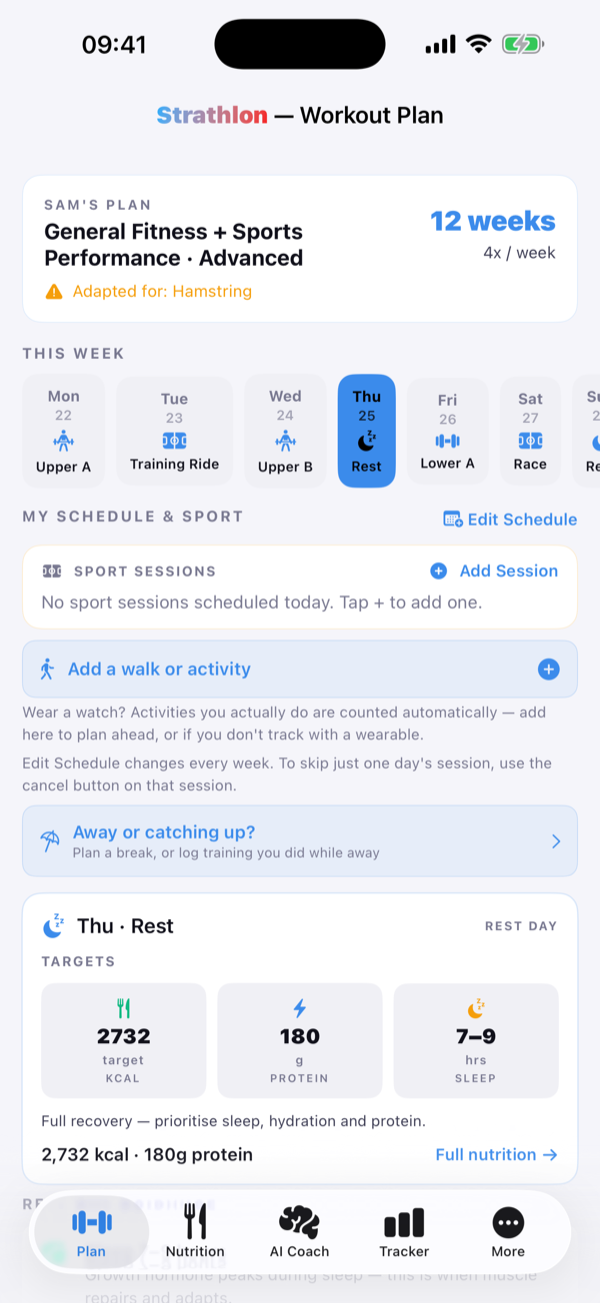
The reassuring thread through all of this is that you don't need a complicated, hormone-timed rulebook to eat well across your cycle. Eat enough, get your protein and carbohydrate and iron in, treat the monthly water bump as the tide it is, and let a regular cycle reassure you that the fuelling is working. Strathlon's role is to keep that base honest: adjusting your targets around the training you log and smoothing the weight trend, so the everyday nutrition that carries you through every phase is one less thing to overthink.
References
Numbered sources for the specific figures and ranges above. Where a point reflects agreed guidance rather than a single trial, the citation is to the position stand or consensus statement of the body concerned, with the country or international remit named. Female-specific research is thinner and more variable than the general sports-nutrition literature, and several reviews below say so explicitly, which is why this guide leans on the fundamentals and treats phase-specific protocols as optional.
- D'Souza AC, Wageh M, Williams JS, Colenso-Semple LM, McCarthy DG, McKay AKA, et al. Menstrual cycle hormones and oral contraceptives: a multimethod systems physiology-based review of their impact on key aspects of female physiology. Journal of Applied Physiology. 2023;135(6):1284–1299. A systems-physiology review of menstrual cycle hormones and oral contraceptives across key performance variables, the anchor for the guide's 'most effects are small and inconsistent' framing. PubMed 37823207 · PMC10979803 full text
- Kanellakis S, Skoufas E, Simitsopoulou E, Migdanis A, Migdanis I, Prelorentzou T, et al. Changes in body weight and body composition during the menstrual cycle. American Journal of Human Biology : the Official Journal of the Human Biology Council. 2023;35(11):e23951. Changes in body weight and body composition across the menstrual cycle, the direct source for the premenstrual scale rise being fluid rather than fat. PubMed 37395124
- ROBINSON MF, WATSON PE. DAY-TO-DAY VARIATIONS IN BODY-WEIGHT OF YOUNG WOMEN. The British Journal of Nutrition. 1965;19:225–35. Day-to-day body-weight variation in young women, supporting the advice to compare the same point of successive cycles rather than day to day. PubMed 14290861
- D'Souza AC, Van Every DW, Bhinder A, Elango S, Lamont GAC, Lees MJ, et al. Menstrual Cycle Phase Does Not Influence Training-Induced Muscle Hypertrophy or Strength: A Randomized Controlled Trial. Medicine and Science in Sports and Exercise. 2026. A randomised controlled trial finding menstrual cycle phase did not influence training-induced hypertrophy or strength, the strongest available check on phase-based programming claims. PubMed 42160459
- Dragutinovic B, Moser F, Notbohm HL, Ihalainen JK, Bloch W, Schumann M. Influence of menstrual cycle and oral contraceptive phases on strength performance, neuromuscular fatigue, and perceived exertion. Journal of Applied Physiology. 2024;137(4):919–933. Study of menstrual and oral-contraceptive phases on strength performance and neuromuscular fatigue, supporting the point that measured performance barely moves for most people. PubMed 39052822
- Jäger R, Kerksick CM, Campbell BI, Cribb PJ, Wells SD, Skwiat TM, et al. International Society of Sports Nutrition Position Stand: protein and exercise. Journal of the International Society of Sports Nutrition. 2017;14:20. ISSN position stand on protein and exercise: the source for the roughly 1.4 to 2.2 g/kg/day protein range that matters more than any phase trick. PubMed 28642676 · PMC5477153 full text
- Thomas DT, Erdman KA, Burke LM. Position of the Academy of Nutrition and Dietetics, Dietitians of Canada, and the American College of Sports Medicine: Nutrition and Athletic Performance. Journal of the Academy of Nutrition and Dietetics. 2016;116(3):501–528. Joint ACSM / AND / DC position on nutrition and athletic performance, the source for the carbohydrate guidance the luteal-phase advice adjusts within. PubMed 26920240
- Burke LM, Hawley JA, Wong SH, Jeukendrup AE. Carbohydrates for training and competition. Journal of Sports Sciences. 2011;29 Suppl 1:S17–27. Burke and colleagues on carbohydrate for training and competition, the basis for giving carbohydrate a little extra attention in the luteal phase rather than restructuring the diet. PubMed 21660838
- Pengelly M, Pumpa K, Pyne DB, Etxebarria N. Iron deficiency, supplementation, and sports performance in female athletes: A systematic review. Journal of Sport and Health Science. 2025;14:101009. Systematic review of iron deficiency, supplementation and performance in female athletes, the source for iron deficiency being common in active women and for testing before supplementing. PubMed 39536912 · PMC11863318 full text
- Mountjoy M, Ackerman KE, Bailey DM, Burke LM, Constantini N, Hackney AC, et al. 2023 International Olympic Committee's (IOC) consensus statement on Relative Energy Deficiency in Sport (REDs). British Journal of Sports Medicine. 2023;57(17):1073–1097. The 2023 IOC consensus statement on Relative Energy Deficiency in Sport, the basis for reading an irregular or missing period as a fuelling signal. PubMed 37752011
- Loucks AB, Thuma JR. Luteinizing hormone pulsatility is disrupted at a threshold of energy availability in regularly menstruating women. The Journal of Clinical Endocrinology and Metabolism. 2003;88(1):297–311. Loucks and Thuma's threshold study: the original demonstration that luteinising hormone pulsatility is disrupted below a definable energy availability, which is why a regular cycle is treated here as the master signal. PubMed 12519869
- Ihle R, Loucks AB. Dose-response relationships between energy availability and bone turnover in young exercising women. Journal of Bone and Mineral Research : the Official Journal of the American Society for Bone and Mineral Research. 2004;19(8):1231–40. Dose-response between energy availability and bone turnover in young exercising women, supporting the health stakes behind under-fuelling. PubMed 15231009
- Cialdella-Kam L, Guebels CP, Maddalozzo GF, Manore MM. Dietary intervention restored menses in female athletes with exercise-associated menstrual dysfunction with limited impact on bone and muscle health. Nutrients. 2014;6(8):3018–39. Dietary intervention restoring menses in athletes with exercise-associated menstrual dysfunction: the evidence that eating more is the intervention rather than a supplement. PubMed 25090245 · PMC4145292 full text
- Nattiv A, Loucks AB, Manore MM, Sanborn CF, Sundgot-Borgen J, Warren MP. American College of Sports Medicine position stand. The female athlete triad. Medicine and Science in Sports and Exercise. 2007;39(10):1867–82. ACSM position stand on the female athlete triad, the clinical framing this guide points readers toward. PubMed 17909417
- National Health Service (NHS, United Kingdom). Water, drinks and hydration. NHS everyday hydration guidance, referenced for the fluid-shift discussion. NHS Live Well
This is general educational information rather than medical, dietary or coaching advice. The menstrual-cycle science here is younger and less settled than many areas of nutrition; figures are drawn from published sources and framed as population-level guides and tendencies, and individual variation is large. Anyone with irregular, absent, very heavy or painful periods, a history of disordered eating, a suspected iron or other nutrient deficiency, or possible under-fuelling or RED-S, or who is pregnant, postpartum, perimenopausal, or on hormonal medication, should speak with a doctor, sports physician or registered dietitian before making changes. See our Terms for more.
← All guides · Training with your cycle · Women, strength & fuelling · Energy availability & RED-S · Eating for results · Home